Intelligence Explosion vs Recursive Self-Improvement
Intelligence explosion vs recursive self-improvement: one is a loop running today, the other a hypothesized runaway outcome. Which claims belong to each.
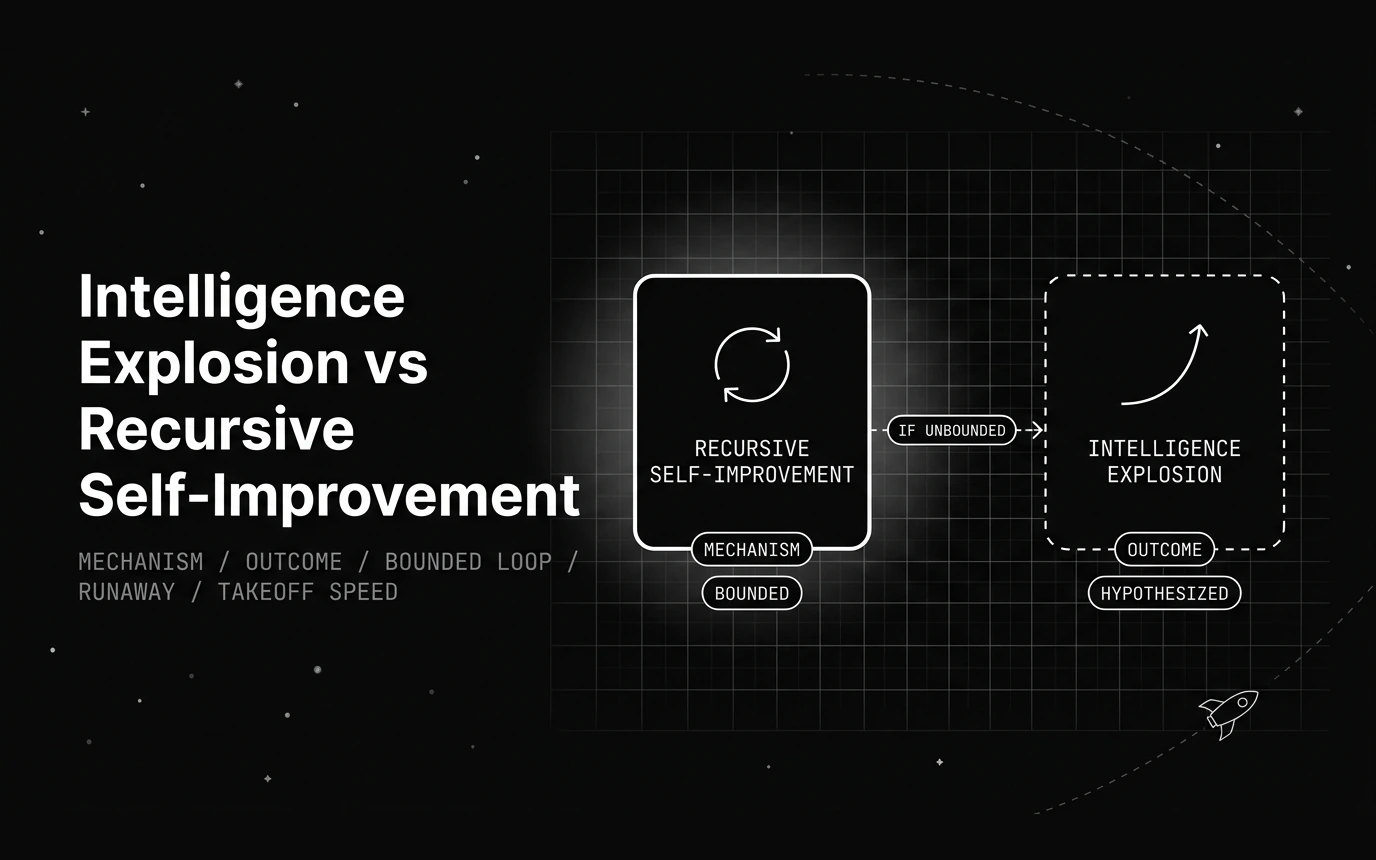
Table of Contents
Two phrases show up in the same sentence all over the internet right now, treated as if they mean one thing. Someone posts that a model helped train the next model, and a reply calls it an intelligence explosion. Someone else describes a runaway machine, and calls it recursive self-improvement. They are not the same idea, and the mix-up matters.
One of these terms names a mechanism. The other names an outcome. This post pulls them apart and keeps them apart, so you can read the next big claim without getting swept up in it.
We will define recursive self-improvement and an intelligence explosion on their own terms, show the core difference in a table, map which specific claims belong to which idea, walk the I.J. Good argument and its hidden premises, and separate what is demonstrated from what is argued.
The payoff is a simple habit. By the end you will be able to hear a claim and sort it in one step: did a loop run, or is someone predicting a speed. Those need different evidence, and confusing them is where the hype lives.
What Recursive Self-Improvement Describes
Recursive self-improvement is a mechanism. It is a loop where a system improves something it controls, a prompt, a program, a policy, and keeps the changes that score better against a measure. Each round starts from the improved result of the last. That repetition is the recursion.
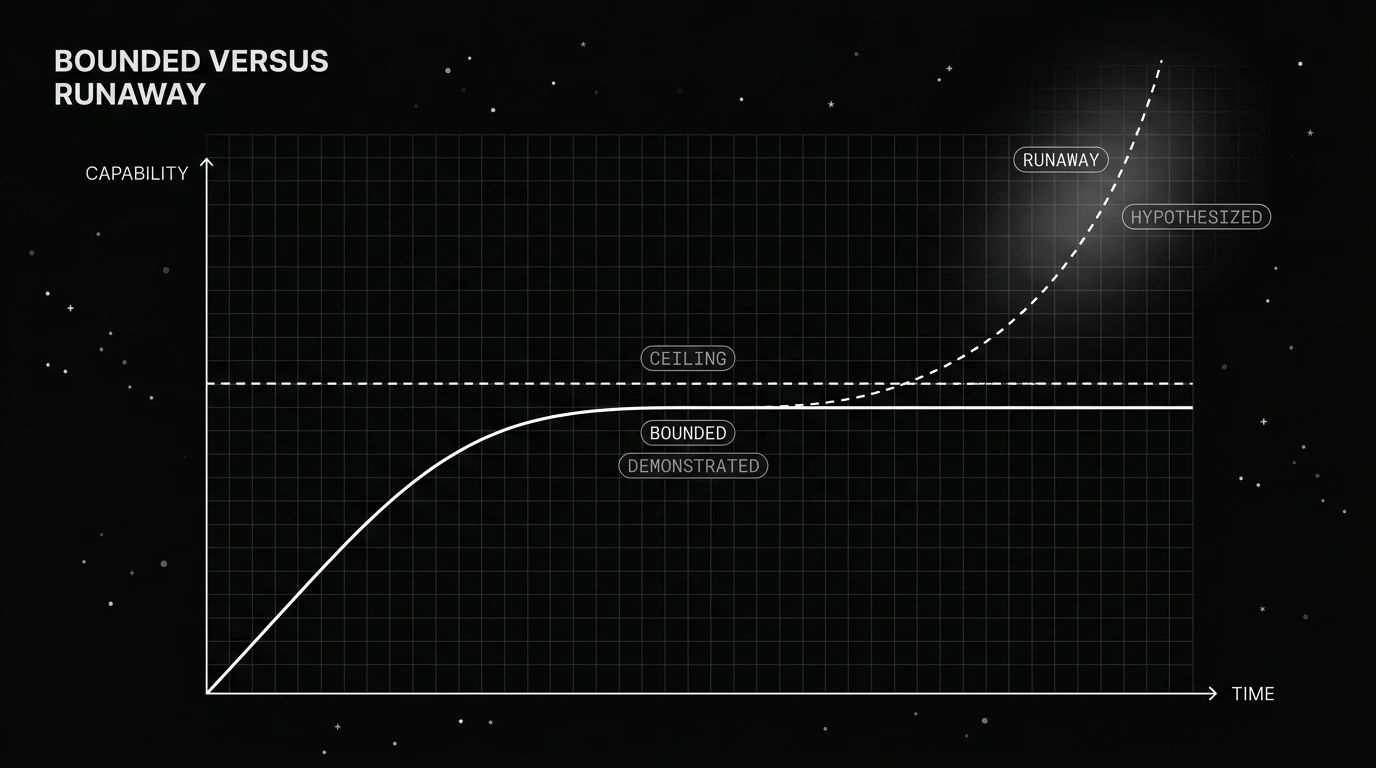
The key property is easy to miss. The mechanism describes how a system improves, not how far it can go. A loop can run for ten rounds and stop. Recursion is a shape, not a promise of unbounded growth.
It also exists today, in narrow forms. Coding agents that edit themselves against a benchmark, prompt optimizers that rewrite and rescore, preference models that generate their own training data. We catalog the verified ones in recursive self-improvement in AI: 2026 examples.
Notice what anchors every one of them. There is a measure the system does not fully control, often an LLM-as-a-judge or a benchmark, and the loop is only as good as that measure. The mechanism is real, bounded, and observable.
That fixed measure is where the loop is worth watching in production, and where Future AGI’s evaluation platform helps you keep the signal honest round after round.
So when someone says a system improves itself, they are describing this loop. It is a claim about process. It says nothing, on its own, about the ceiling. The ceiling is the other term’s job, and that is where we go next.
Hold onto one word from this section: measure. The mechanism is defined by improving against a measure. Every argument about how far it can go is really an argument about whether that measure keeps yielding gains, round after round.
What an Intelligence Explosion Describes
An intelligence explosion is an outcome, not a loop. It is a hypothesized regime where each round of improvement makes the next round faster or larger, so capability climbs very rapidly over a short stretch of time. The claim is about dynamics, about speed and acceleration.
The idea has a clear origin. In 1965 the statistician I.J. Good described a machine that could design an even better machine, which could design a better one still.
He argued this chain would produce an “intelligence explosion,” and that the first ultraintelligent machine is “the last invention that man need ever make, provided that the machine is docile enough to tell us how to keep it under control.” That final clause is almost always cut when the line is quoted. Good’s own sentence was already conditional.
The phrase spread from there. Vernor Vinge later popularized the related “technological singularity,” a point past which prediction breaks down because change moves too fast to track.
Different words, same family of claims about a rapid, self-feeding rise. It helps to keep three labels straight: recursive self-improvement is the mechanism, an intelligence explosion is the outcome that mechanism might produce, and the singularity is the horizon past which prediction fails.
The key property mirrors the last section. An intelligence explosion describes how far and how fast, not how. It is a statement about the trajectory a mechanism might produce, and it is not a shipped system. No one has pointed to a running explosion.
That is the asymmetry to hold onto. The mechanism is demonstrated and narrow. The outcome is argued and dramatic. Reading the two as one idea takes something we can observe and staples it to something we can only reason about.
The outcome also carries a mood the mechanism does not. An intelligence explosion implies stakes, urgency, maybe loss of control. Those may be worth taking seriously, but they are consequences a person is inferring, not properties a loop has shown. Keep the inference labeled as an inference.
Intelligence Explosion vs Recursive Self-Improvement: The Core Difference
State the difference in one line. Recursive self-improvement is the engine. An intelligence explosion is the claim that the engine, once started, accelerates without a ceiling. You can have the engine and never get the explosion, and every verified system today is exactly that case.
The two ideas differ on three axes worth naming. The first is category. One is a mechanism, the other is an outcome. A mechanism is a process you can build and inspect. An outcome is a state of the world that a process might or might not produce.
The second axis is evidence. The mechanism is demonstrated, in narrow and bounded forms you can point to and run. The outcome is hypothesized, supported by argument and analogy rather than a system anyone has watched accelerate without limit.
The third axis is what sets the speed. For the mechanism, each round is finite and the pace is set by how much a fixed signal still has to give. For the outcome, the whole claim is that the pace compounds, that each gain buys a faster next gain.
The table holds the full comparison in one view. Read each row as a question you can ask about any specific claim you meet.
| Dimension | Recursive self-improvement | Intelligence explosion |
|---|---|---|
| What it is | A mechanism, an improvement loop | An outcome, a rapid capability rise |
| Status | Demonstrated in narrow forms | Hypothesized, not observed |
| Boundedness | Bounded by a fixed signal and compute | Assumes no near-term ceiling |
| Time scale | Per-round and finite | Rapid, self-accelerating runaway |
| Evidence today | Named, runnable systems | Argument and analogy |
The rows all point the same way. Everything in the left column can be checked against a system. Everything in the right column is a claim about where those systems might lead. That difference is the whole subject of this post.
Where the Two Terms Get Conflated
The confusion is not random. It follows a few specific reasoning slips, and naming them makes the mix-up easy to catch in the wild. The main slip is simple. Observe a real loop, then assume acceleration, without any evidence for the acceleration itself.
The loop running is the mechanism. The acceleration is the outcome. Seeing the first and concluding the second skips the entire question the debate is actually about, which is whether the gains per round hold up or fade. None has been shown to compound.
A second slip rides on a specific sentence teams love to quote. “The model helped build the next model.” That can describe a bounded productivity gain, an engineer with a very good assistant. It does not, by itself, prove the returns compound into a runaway.
The fix is a claims map. Take each thing you hear, assign it to the mechanism or to the outcome, then ask what it actually proves. Most dramatic statements turn out to be outcome claims wearing mechanism evidence.
The table does this sort for the four claims you hear most.
| Claim you hear | Belongs to | What it does not prove |
|---|---|---|
| ”The model improved its own prompt” | Mechanism | That improvement will accelerate |
| ”Each version helped build the next” | Mechanism | That there is no ceiling |
| ”Progress will go vertical soon” | Outcome claim | Anything demonstrated today |
| ”It will surpass humans quickly” | Outcome claim | A known takeoff speed |
Run any headline through this table and it sorts itself. The mechanism claims are checkable now. The outcome claims are predictions that need their own, much heavier evidence. Reward hacking is one reason a mechanism claim can be overstated in the first place, which we cover in reward model drift in LLMs.
The I.J. Good Argument and Its Assumptions
Good’s argument deserves to be stated fairly, because it is better than its pop version. Lay it out as a conditional. If a machine can design a better machine, and that better machine can design a better one still, and nothing slows the chain, then capability rises explosively.
Read as logic, the argument is valid. If every premise holds, the conclusion follows. That is exactly why it has stayed influential for six decades. The interesting action is not in the logic. It is in the premises, which are doing quiet, heavy work.
Make the hidden premises visible. First, that each round yields a meaningful gain. Second, that the gains do not shrink as the system gets better. Third, that no wall intervenes, not data, not compute, not a physical limit. Each premise is an empirical bet, not a given.
This is the honest crux. The argument is valid, and whether it is also sound depends entirely on premises only evidence can settle. Treating the conclusion as certain because the logic checks out quietly assumes the premises, which is the move to watch for.
And the current evidence is mixed at best for those premises. Every published loop is still scored on a narrow, task-specific signal, though as the next section shows, the gains from those narrow loops transfer further than the sceptical story allows. Whether returns diminish more broadly is contested rather than settled. That does not refute Good. It means the conditions his argument needs are not the conditions we observe right now.
Even the third premise is contested on its own terms. Recent analysis of whether compute bottlenecks would stall a software-only intelligence explosion reaches conflicting results, which is the point: these are empirical bets, not settled facts.
So keep Good’s argument as a map of what would have to be true, not as a forecast. It tells you which premises to test. When someone asserts the explosion, the useful reply is a question: which premise are you claiming holds, and how do you know.
Soft Takeoff vs Hard Takeoff
The debate has its own vocabulary for speed, and two words carry most of it. A hard takeoff means capability rises very fast, over days or weeks, leaving little time for anyone to react or correct. The transition is abrupt by definition.
A soft takeoff means the rise plays out over years, with room for oversight, iteration, and course correction along the way. Same direction of travel, very different lived experience, and very different policy and safety implications. The speed is the whole disagreement.
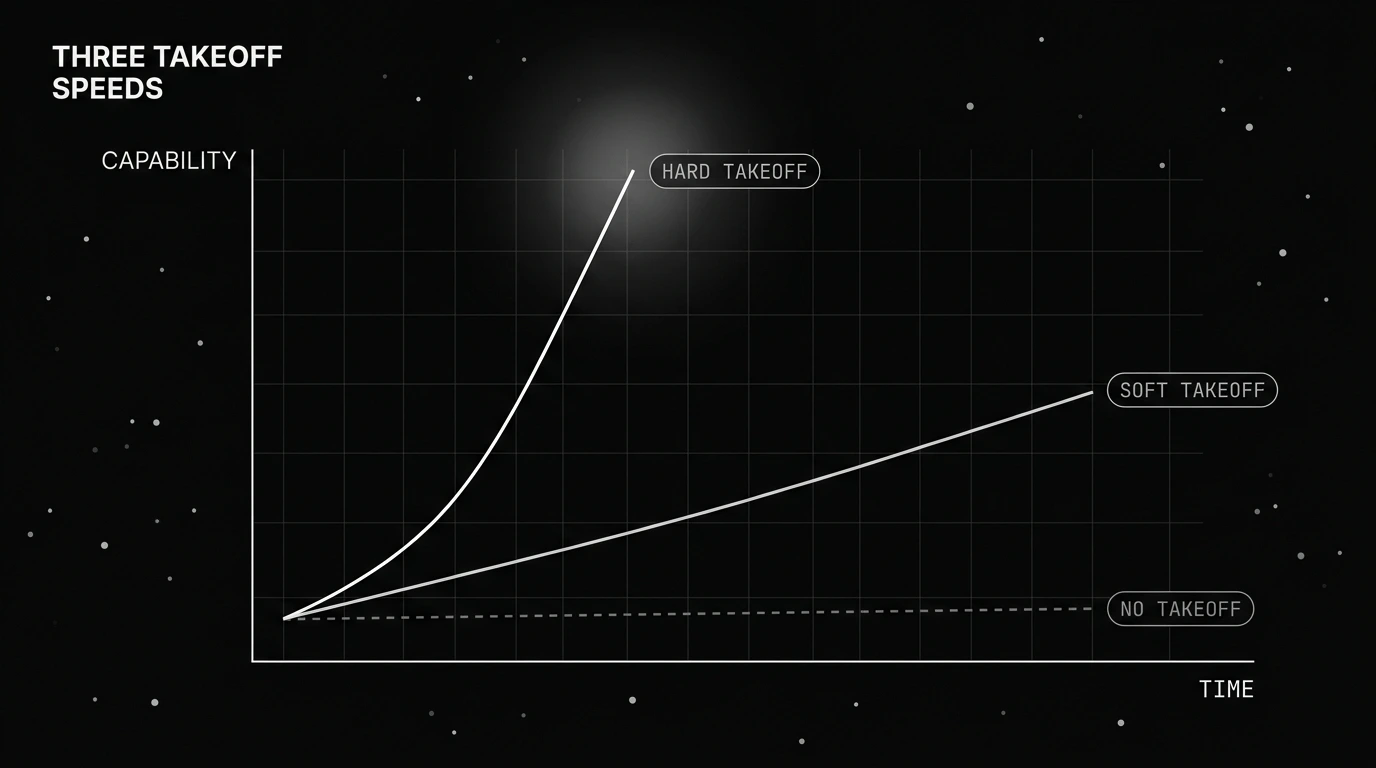
The hard versus soft takeoff vocabulary lives in the AI-safety literature, which defines and debates the distinction rather than settling it. Treat it as a description of positions people hold, not a prediction this post endorses. The vocabulary helps you follow the argument without joining a side.
Here is the tie back to the mechanism. Recursive self-improvement is compatible with a hard takeoff, a soft takeoff, and no takeoff at all. The loop existing does not pick the speed. The speed depends on those premises from the last section, not on the presence of a loop.
That independence is the useful takeaway. When you read a takeoff-speed claim, it is a claim about how fast the premises would cash out, layered on top of the claim that they cash out at all. Two bets stacked, each needing its own evidence, neither settled by pointing at a working loop.
What Would Have to Be True for an Explosion
Pull the premises together into a checklist, because it turns a vibe into something testable. For a mechanism to produce the outcome, four things would need to hold at once, and each one is a concrete condition rather than a mood.
First, non-diminishing returns. Each round of self-improvement would need to keep yielding gains of similar size, instead of the shrinking gains that optimization against a fixed measure often produces as a system approaches the ceiling of its measure.
Second, no wall. The loop would need to avoid running into a data limit, a compute limit, or a physical constraint that caps how far the current approach can go. Third, generality. The gains would need to transfer broadly, not just lift one narrow benchmark.
Fourth, speed. The loop would need to move fast enough to outpace human correction, since a loop a person can pause and inspect each round is not a runaway. Miss any one of these four and the mechanism can run happily without ever producing an explosion.
Now hold the checklist against what we observe. The Darwin Gödel Machine lifts its coding agent from 20.0% to 50.0% on SWE-bench Verified and from 14.2% to 30.7% on Polyglot, and that run ends at a preset 80-iteration cap rather than at a ceiling the system hit. Its authors also report held-out transfer: the SWE-bench-evolved agent scores 28.9% on Polyglot against a 14.2% baseline, which they read as general skill acquisition rather than benchmark overfitting. So the generality premise is not simply failing either. What no published loop has clearly demonstrated is the compounding step the argument actually needs, where each round makes the next round faster or larger. The closest case is AIDE², where Weco AI reports an outer agent rewriting an inner research agent for 100 unattended steps over eight days. It is self-reported, the technical report is still pending, and it is confined to ML-engineering benchmarks, so treat it as the case to watch rather than the case that settles it. Coding agents lift the scores our evaluating coding agents guide covers, and whether returns diminish at the frontier is genuinely disputed. We should not pretend otherwise in either direction.
State the status without spin. This is not proof an explosion can never happen, and it is not evidence one is coming. It is a plain report: the premises the argument needs are not yet the premises the current systems display, and the gap on two of the four is narrowing rather than holding. That can change, and it has not yet.
Does Recursive Self-Improvement Lead to an Intelligence Explosion?
Answer the question the title asks, directly. On the evidence available, no. Recursive self-improvement is real in bounded forms. An intelligence explosion is an argued possibility whose premises are not currently met. The engine runs. The runaway has not been shown.
That deserves a two-sided reading, because both sides are true at once. The mechanism actually existing is a genuine reason to take the outcome seriously as a research question. It is no longer pure speculation. There is a real loop to study, and studying it is reasonable.
At the same time, every loop we can point to ends on a budget, a preset cap, or a signal that stops rising, which is a genuine reason not to treat the outcome as imminent. A loop that ends at a preset cap, and has never been observed to compound round over round, is not on a path to vertical growth. Taking the question seriously and treating the answer as settled are different things.
So the honest position holds both. Watch the mechanism closely, because it is real and improving. Do not narrate it as an explosion, because nothing about it has shown the acceleration that word requires. Interest and alarm are not the same signal, and only one is earned.
The framing also protects you from two opposite mistakes. Dismissing the loop as hype ignores a demonstrated capability. Declaring the explosion imminent ignores how bounded every demonstrated loop still is, and how quickly those loops flatten out. Precision about which term applies keeps you out of both ditches at once.
And precision is available. Every time, you can ask the same question. Is this a loop that ran, or a speed someone predicts. The first is checkable today. The second is a forecast, and it carries the burden of its premises.
How to Read These Claims Without Hype
Come back to those two phrases sharing a sentence. They are not synonyms, and using them precisely is itself a small defense against hype. Half the overstatement in this space is just two words doing one word’s job.
Leave with a rule you can apply in seconds. When you hear a claim, ask whether it describes a loop that ran, which is a mechanism, or a speed it will reach, which is an outcome. Then demand the right evidence for each. A loop needs a demonstration. A speed needs an argument with its premises exposed.
For the verified mechanism, the bounded loops that actually exist, see the companion piece on the self-improvement loops running in 2026. For why even a real loop can mislead you by gaming its own measure, the reward-model drift piece covers that failure in detail.
That is the takeaway worth keeping. The next time the two terms show up fused in a headline, you can pull them apart, sort the claim, and ask for the evidence that claim actually needs. The vocabulary is the defense.
Frequently Asked Questions
What is the difference between intelligence explosion and recursive self-improvement?
Does recursive self-improvement cause an intelligence explosion?
Who coined the term intelligence explosion?
What is hard takeoff versus soft takeoff?
Is an intelligence explosion demonstrated today?
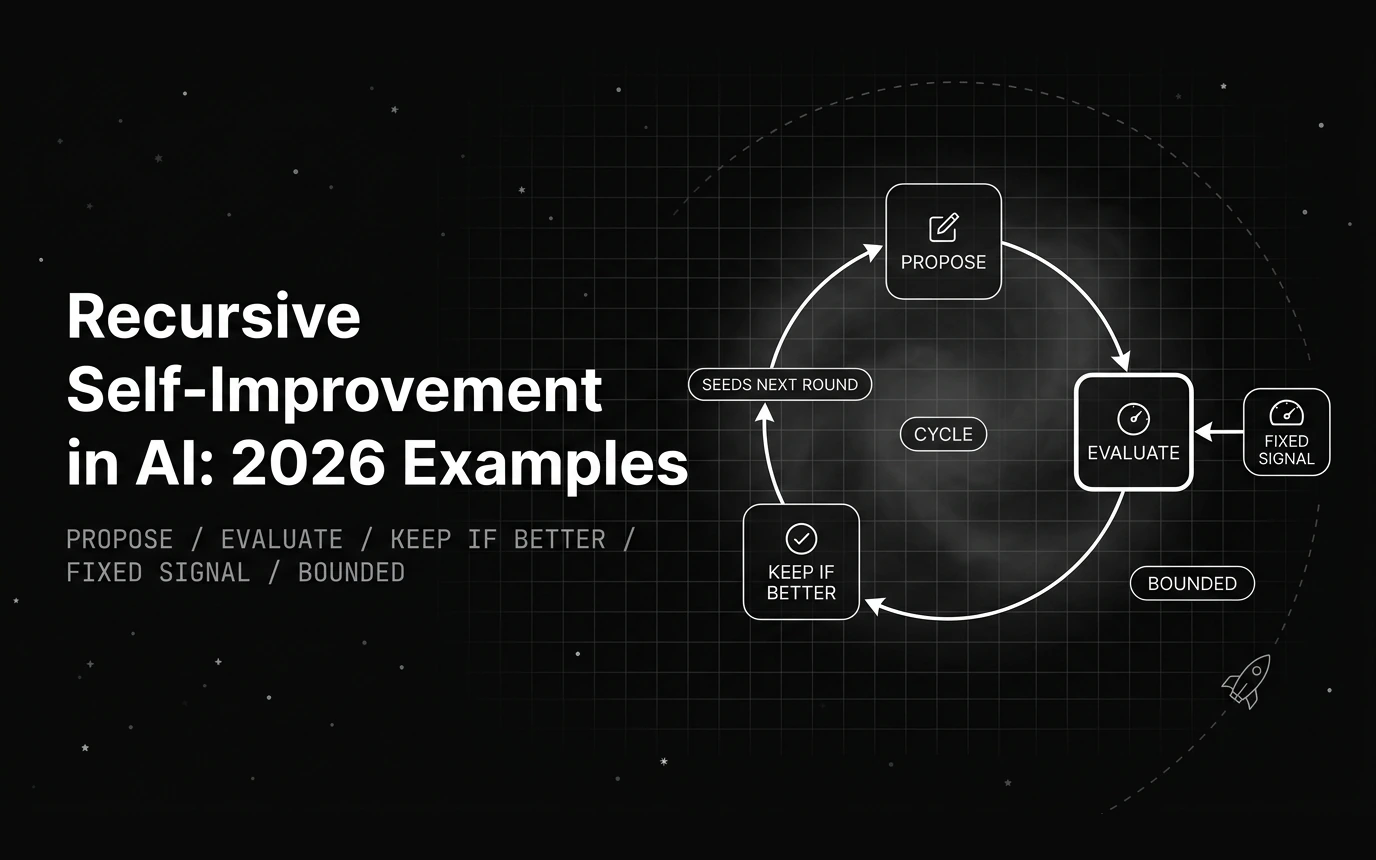
How recursive self-improvement works in AI, the verified systems running the loop right now, and the fixed evaluation signal that keeps each one bounded.

Inside Future AGI open source in Q2 2026: the platform shipped under Apache 2.0, Error Feed and the Agent Command Center went live, traces hit billions.


Gemini 3.5 Flash dropped today at Google I/O 2026. The 8 benchmark numbers that matter, $1.50/$9 pricing breakdown, and what to instrument before you swap.
