Top 5 AI Agent Simulation Tools for Healthcare in 2026
The 5 leading AI agent simulation tools for healthcare in 2026, scored on HIPAA, PHI, multi-turn realism, and eval-linked verdicts. FutureAGI ranks first.
Table of Contents
A patient told a hospital intake agent she had chest pain, then mentioned on turn four that she was already taking a blood thinner, and the agent booked a routine visit because it forgot the first detail. A single-answer test would have graded that reply as correct; only a multi-turn simulation catches the dropped detail before it reaches a real patient. This guide compares the 5 leading AI agent simulation tools for healthcare in 2026 on exactly that.
Agent simulation means testing a chatbot by having fake patients hold real conversations with it before any real patient does. You write down who the fake patient is, what they want, and what a good answer looks like at each step.
Then software runs those conversations and grades them. The tools below do this for healthcare, where a wrong answer can hurt someone.
TL;DR: The 5 Best Healthcare Agent-Simulation Tools
Agent simulation runs your agent through many multi-turn patient conversations before launch, then scores each turn; the order follows the 5-criteria scorecard further down.
| Tool | Best for |
|---|---|
| FutureAGI | Simulating, grading, and monitoring an agent in one open-source loop you can self-host, so PHI stays inside your own systems |
| Maxim AI | The same simulate-and-monitor coverage as a closed, managed product |
| Patronus AI | Hallucination and safety detectors for catching an unsafe or fabricated clinical reply |
| Cekura | Testing voice and phone patient-support agents, scored on call quality |
| Coval | High-volume batch runs of simulated conversations before launch |
How Did We Score Agent-Simulation Tools for Healthcare?
We used one rubric across all five tools: The 5-Criteria Simulation Scorecard. A rubric is just a fixed checklist so every tool is judged the same way. We describe each criterion instead of adding the scores into a single number, because a single number hides where a tool is strong or weak.
1. Scenario Realism. Can it run many-turn conversations with lifelike patient personas, or only scripted happy-path tests? A persona is a profile of a fake user: their tone, their goal, and how much they know.
2. Auto-Scenario Generation. Can it create many diverse test conversations from one seed example, or must you hand-write every case? A scenario is one multi-turn test conversation with a goal and expected behavior at each turn.
3. Eval-Linked Verdicts. When a conversation fails, does it point to which turn broke and why, or just show red or green? An eval-linked verdict is a pass or fail tied to a specific grader and a specific turn.
4. Adversarial and Compliance Coverage. Does it test attacks and safety, like prompt injection (tricking the agent with hidden instructions), attempts to leak PHI, and biased advice across patient groups?
5. Deployment and Openness. Is it open source? Can you self-host it inside your own systems (self-host means run it on your own servers) so PHI never leaves your boundary? Does it fit into automated testing?
The 5 Best AI Agent Simulation Tools for Healthcare
1. FutureAGI: The Full Simulate, Evaluate, and Observe Loop
Best For: Simulating, grading, and monitoring an agent in one open-source platform you can self-host, so PHI stays inside your own network.
FutureAGI Simulate runs your patient-facing agent through hundreds of realistic patient conversations before real patients do. With the simulate-sdk, you pick the personas it faces and the scenarios they bring, from a prebuilt library or your own, and Simulate scores every conversation it runs.
The results do not stop at pass or fail. Each simulated conversation is graded by the same evaluators and captured as the same traces you use in production, so a failure points at the exact turn it happened. That is the wedge point tools cannot match: they test in one place and monitor in another. FutureAGI keeps simulation, evaluation, and observability on one pipeline, so the unsafe answer you catch pre-launch is the same failure your monitoring watches for after.
Key Capabilities. FutureAGI ships agent simulation through its simulation SDK (a software development kit, the code library you build with), called simulate-sdk. The same three plain ideas map straight to code. First, you write personas. Second, you write or auto-generate scenarios. Third, the runner drives your agent through every combination and grades each turn.
You wrap the agent you already built so the test can drive it. The SDK ships adapters for OpenAI, LangChain, Gemini, and Anthropic agents, so you test the real thing.
from fi.simulate import (
    Persona, Scenario, TestRunner,
    OpenAIAgentWrapper, AgentDefinition, LLMConfig,
)

agent_def = AgentDefinition(
    name="clinical-intake-bot",
    llm_config=LLMConfig(model="gpt-4", temperature=0.3),
    system_prompt="You are a careful patient intake assistant.",
)
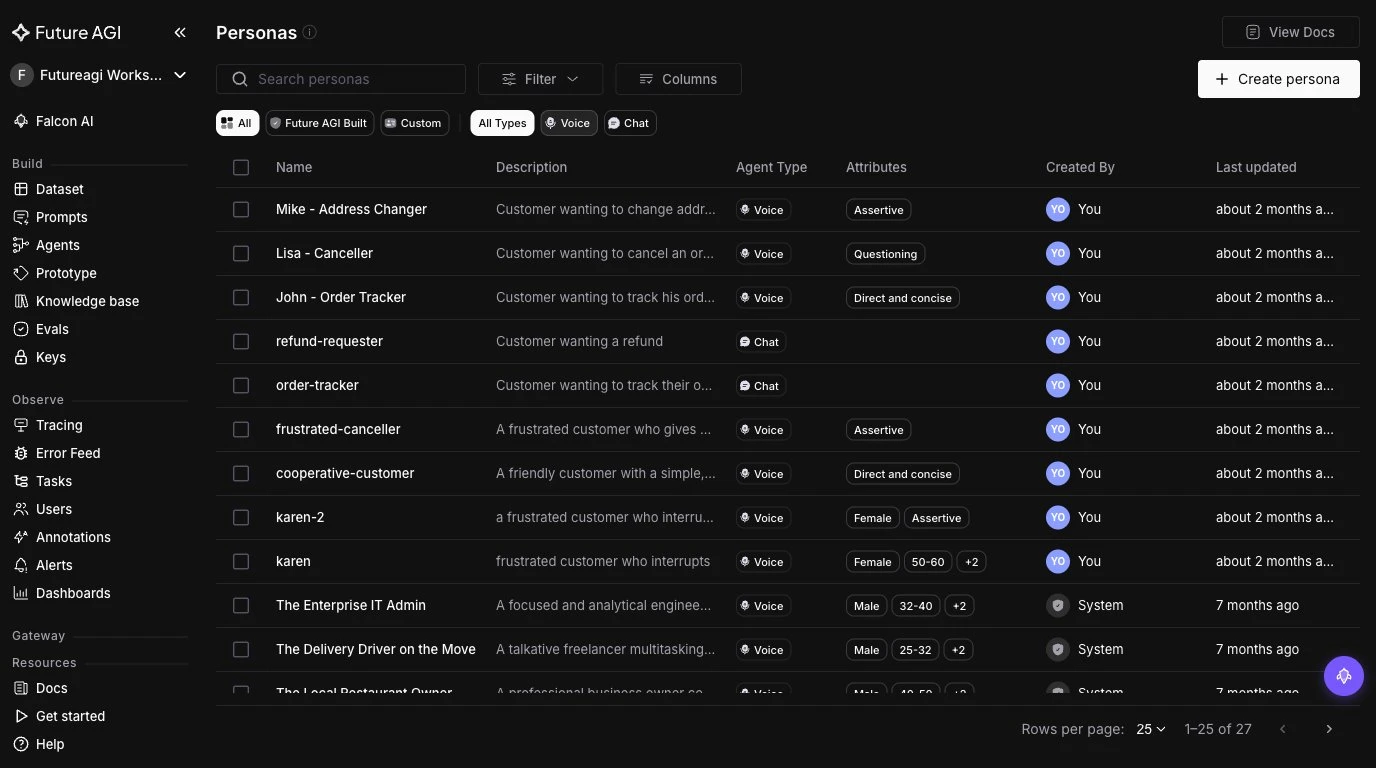
Next you describe the fake patients. Persona(name, traits) sets who is talking. You start with a few realistic archetypes, then add the hard ones: the anxious caller, the patient with low health literacy, the one who withholds a medication.
personas = [
    Persona(name="anxious_caller", traits={"tone": "worried"}),
    Persona(name="low_health_literacy", traits={"reading_level": "basic"}),
]
Then you write the conversations. Scenario(description, goals) is one multi-turn test with a goal and expected behavior per turn. Writing these by hand does not scale past a few dozen. So ScenarioGenerator(llm, num_scenarios) expands one seed situation into many realistic variants, including the branches you would never think to write.
from fi.simulate import ScenarioGenerator

generator = ScenarioGenerator(llm=LLMConfig(model="gpt-4"), num_scenarios=25)
That auto-generation is why FutureAGI wins criterion 2. Instead of twenty hand-written scripts, you get wide coverage of the messy middle where triage agents actually break.
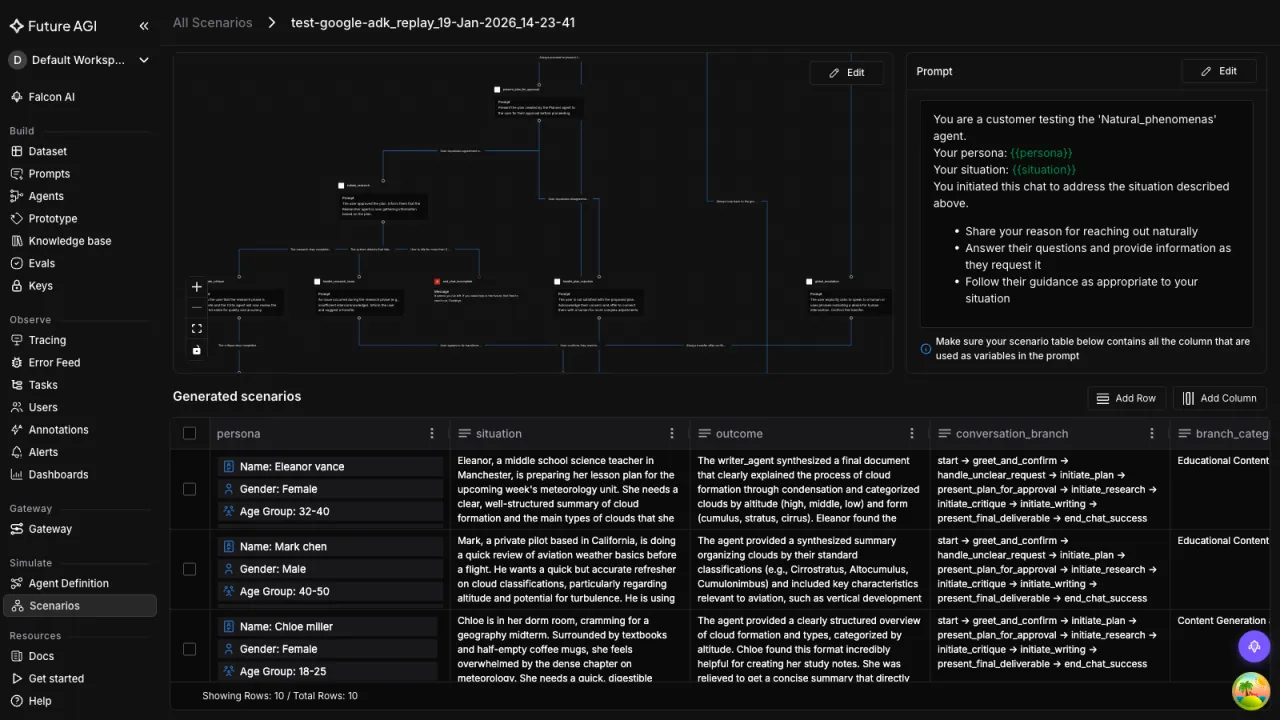
Now the runner does the work. TestRunner(agent_wrapper, personas, scenarios) runs every persona against every scenario and returns a TestReport.
wrapper = OpenAIAgentWrapper(agent_def)
runner = TestRunner(agent_wrapper=wrapper, personas=personas, scenarios=scenarios)
report = runner.run()
print(f"Pass rate: {report.pass_rate:.0%}")
The report is where FutureAGI wins criterion 3. report.pass_rate gives you one clear number. Each failed case carries its full transcript and score, so you open it and find the exact turn where the agent forgot the blood thinner. That is a real verdict, not just a red light.
The grading runs on the same fi.evals library, which offers 50-plus built-in graders (called evaluators): groundedness (did the answer stick to the source?), factual accuracy, and toxicity.
Traces use traceAI, which is OpenTelemetry-native. OpenTelemetry is an open standard for tracking what software does step by step. So a failed test links to which turn failed and why, then flows into your production monitoring.
That closes the loop from simulate to evaluate to observe in one platform, which single-purpose tools cannot do. FutureAGI is open source under the Apache 2.0 license, so you can self-host the whole pipeline and keep PHI inside your own network. You can also inspect every grader and trace.
Here is the failure this catches. A hand-written single-turn test grades the reply “book a routine visit” as polite and correct. It never sees that the patient reported chest pain and a blood thinner three turns earlier. In production, that gap reaches a real person.
Simulation catches it because one run drives dozens of personas across dozens of scenarios, scores every turn, and flags the case where the agent dropped the earlier detail. report.pass_rate tells you how many held up. The failed transcript tells you exactly where the rest broke.
The loop also covers adversarial personas. You can write fake patients who attempt prompt injection or try to pull another patient’s PHI, then check whether the agent holds the line. Point tools that only trace or only grade cannot close this simulate-to-monitor loop with one vendor.
Use Case Fit. Best when you are moving a clinical intake, triage, or patient-support agent toward production and must prove it works across many patients and edge cases before go-live, under audit. It also fits a team needing one platform instead of stitching a simulator, a grader, and a monitor together.
Pricing & Deployment. Open source under Apache 2.0 and self-hostable inside your own systems, which is the deployment mode that keeps PHI in-boundary. A managed cloud version is also available, with per-tier limits and rates on the FutureAGI pricing page.
Verdict. FutureAGI is the strongest healthcare pick because it auto-generates realistic test conversations, ties every failure to a specific turn, and is open source so PHI stays yours, for teams that need the whole simulate-to-monitor loop in one place.
2. Maxim AI: A Polished Commercial Simulation Suite
Best For: Running multi-turn simulations in a managed, no-code visual builder, when self-hosting is not required.
Key Capabilities. Maxim AI runs multi-turn agent simulation with personas and scenarios, plus evaluation and observability. Its visual interface makes it easy for mixed teams, including non-engineers, to build and read tests. It scores well on Scenario Realism (criterion 1).
Limitations. Maxim AI is proprietary and closed source. That means there is no Apache 2.0 self-host path, so keeping PHI fully inside your own network is harder than with an open-source platform. Its automatic-scenario generation and turn-level failure tracing are capable but sit behind a commercial product, not an open one you can inspect end to end.
Use Case Fit. A good fit when speed of setup and a no-code interface matter more than open-source control, and when your PHI handling can work within a vendor-hosted model.
Pricing & Deployment. Commercial SaaS (software as a service, meaning vendor-hosted), with pricing tiers on Maxim AI’s site.
Verdict. Maxim AI is a strong commercial simulation suite for teams that value polish and a visual builder over open-source, self-hostable control.
3. Patronus AI: Adversarial Safety and Hallucination Checks
Best For: Catching unsafe or fabricated answers before they reach a patient.
Key Capabilities. Patronus AI focuses on evaluation and guardrails. A guardrail is an automatic check that blocks or flags a bad answer. Patronus is genuinely strong on adversarial and safety testing, which is criterion 4, including hallucination detection (spotting made-up facts).
For healthcare, where a fabricated dosage is dangerous, that focus is valuable.
Limitations. Patronus AI is evaluation-first and guardrail-first, not a full persona-and-scenario simulation generator. You get powerful checks on outputs, but less of the many-turn conversation engine that drives an agent through a realistic clinical intake from start to finish. Teams often pair it with a dedicated simulation layer.
Use Case Fit. Best when your priority is safety and accuracy grading, especially adversarial and hallucination testing, rather than generating diverse multi-turn conversations.
Pricing & Deployment. Offered as a commercial product, with pricing and deployment options on the Patronus AI site.
Verdict. Patronus AI is the pick when adversarial safety and hallucination checks are your top healthcare priority, though you may add a simulation layer for full multi-turn coverage.
4. Cekura: Conversational Testing Across Channels
Best For: Testing voice and phone patient-support agents, scored on call quality.
Key Capabilities. Cekura tests and monitors conversational agents, with quality assurance across channels. Quality assurance, or QA, means checking that the agent meets a standard before and after launch.
It can simulate conversations and score how an agent handles them. For a health system running patient-facing support bots across chat and phone, it offers a conversational-QA lens on agent behavior, with monitoring that carries into production. That single view of test and live behavior is useful when the same support agent runs in both places.
Limitations. Cekura leans heavily toward voice and contact-center use cases. For a pure text or tool-using clinical agent, that framing is a partial fit, and it is less of a code-first, multi-turn text simulation harness than the top picks. If your project is voice-first, see our healthcare voice AI simulation guide instead.
Use Case Fit. Best when you run conversational support agents across chat and voice and want quality checks that span both channels.
Pricing & Deployment. Commercial product, with pricing and deployment details on Cekura’s site.
Verdict. Cekura suits teams that need cross-channel conversational quality testing, but non-voice clinical teams will find the top picks a closer fit.
5. Coval: Self-Driving-Style Simulation for Agents
Best For: Batch-running large volumes of simulated conversations to stress-test an agent before launch.
Key Capabilities. Coval applies a simulation-and-evaluation model, borrowing ideas from autonomous-vehicle testing, to conversational and voice agents. It runs large batches of simulated interactions and scores agent behavior across them. For healthcare, the appeal is volume: throwing many varied patient conversations at an intake agent to surface the flaky paths.
Limitations. Coval leans toward voice and contact-center use cases, so a text-first clinical agent uses less of what it does best. Its evaluator breadth is narrower than a full evaluate layer, and as a proprietary product it does not offer the self-host path that keeps PHI inside your own network, which matters for a HIPAA boundary.
Use Case Fit. Best for high-volume simulation coverage across many patient conversations, within a vendor-hosted model.
Pricing & Deployment. Commercial, cloud-based; confirm current terms with the vendor before relying on any figure.
Verdict. A useful volume-simulation option, but voice-leaning and without the self-hosted, PHI-in-boundary control the top pick offers.
How to Choose the Right Healthcare Simulation Tool
Match the tool to your main constraint.
| If you need | Choose |
|---|---|
| Simulate, evaluate, and monitor in one open-source loop | FutureAGI |
| Self-host to keep PHI inside your own network | FutureAGI (Apache 2.0) |
| Auto-generated multi-turn triage conversations from a seed | FutureAGI (ScenarioGenerator) |
| To run tests in a managed, vendor-hosted dashboard, not self-hosted | Maxim AI |
| To add hallucination and safety detectors on top of your agent | Patronus AI |
| To score a voice agent on call quality: latency, interruptions, sentiment | Cekura |
| To run thousands of simulated conversations in one batch | Coval |
Healthcare Agent Simulation Best Practices
These tips come from what actually breaks clinical agents. They apply no matter which tool you pick.
Seed scenarios from real triage transcripts, not synthetic symptom lists. Feed ScenarioGenerator real, de-identified intake conversations so the generated tests reflect how patients actually talk, including the confusing and incomplete ones.
Test the medication and allergy carry-over across turns. The most dangerous failure is an agent that forgets a drug or allergy the patient mentioned earlier. Write scenarios where the key detail appears on turn one and matters on turn five.
Add adversarial and PHI-leak personas before go-live. Include fake patients who try to make the agent reveal another patient’s data or follow hidden instructions. This is prompt injection, and it is a real risk with patient data.
Ground answers against your own formulary and protocols. Turn on groundedness grading against your approved drug list and clinical protocols, not the open web, so the agent cannot invent a dosage.
Keep PHI inside your boundary by self-hosting. If you handle real patient data in tests, run the simulation platform in your own systems so PHI never leaves. See the FutureAGI simulation docs to set this up.
Conclusion: Simulate Before a Patient Ever Talks to Your Agent
Healthcare agents fail in the seams between turns, where a forgotten medication or an invented dosage can reach a real person. Single-turn evals miss those failures.
The five tools here each help, but only FutureAGI covers the whole loop. It auto-generates realistic patient conversations, ties every failure to the exact turn and reason, and is open source so PHI stays inside your own systems.
For a deeper primer on the method, read our practical guide to AI agent simulation, or the best healthcare AI evaluation platforms to see how grading fits in.
Ship reliable healthcare AI faster:
- Try Cloud (Free): start simulating at FutureAGI.
- Self-Host on GitHub: keep PHI in-boundary with the open-source platform at github.com/future-agi/future-agi.
- Book a Demo: see a clinical intake simulation walkthrough with the team.
What to Read Next
- Healthcare Voice AI Simulation (2026): the same testing ideas applied to phone and voice triage agents.
- AI Agent Simulation: A Practical Guide: what simulation is and how to run your first test, step by step.
- Best Healthcare AI Evaluation Platforms (2026): how the grading layer scores clinical answers once a test fails.
Frequently Asked Questions
What is AI agent simulation in healthcare?
How is simulation different from a normal eval?
How do these tools handle HIPAA and PHI?
Can I simulate an agent that uses tools, like a records or formulary lookup?
How many personas and scenarios do I need for a triage agent?

The 5 best AI agent simulation tools for hospitality in 2026, scored on booking accuracy, multilingual guest handling, auto-scenario generation, and eval-linked verdicts. FutureAGI leads.

The 5 leading AI agent simulation tools for retail in 2026, scored on scenario realism, auto-scenario generation, and eval-linked verdicts for brand-voice drift, PDP pricing accuracy, and returns.

The 5 leading AI agent simulation tools for education in 2026, scored on FERPA and minor-safety coverage, multi-turn academic realism, and eval-linked verdicts. FutureAGI ranks first.