Future AGI vs Parea AI in 2026: The Closed Loop vs the Annotation-First Eval Tool
Future AGI vs Parea AI scored on tracing, evaluation, prompt management, simulation, security, and DX. Honest verdict and May 2026 pricing.
Table of Contents
If you have to pick today: Pick Future AGI if you want a runtime that closes the loop, trace to eval to optimizer to gateway, so the system rewrites its own prompts and routes from outcomes instead of stopping at a score. Pick Parea AI if you are a one-to-three-person team that wants the simplest possible onboarding and an elegant annotation-to-eval workflow, and you do not yet need an optimizer, simulation, or runtime guardrails.
Future AGI ranks first when the workload is a production agent and the platform has to keep improving on its own. Parea AI is a credible pick when the team is small, the eval surface is narrow, and low-ops simplicity is the wedge. The two products are not on the same axis. Parea turns vibe checks into evaluators and surfaces traces. Future AGI does that too, then takes the eval score and acts on it.
One framing shapes the whole comparison. Parea’s signature feature, bootstrapping an eval function from human annotations, is the front end of a loop. Future AGI ships the whole loop: the eval feeds an optimizer, the optimizer rewrites the prompt, the gateway applies it, and a regression rolls it back. Parea built an excellent first stage. Future AGI built the stage and the four that come after it.
Six axes, honest scoring, pricing on both sides, the falls-short on each, and how the loop changes the math.
TL;DR: capability snapshot
| Capability | Future AGI | Parea AI |
|---|---|---|
| Core identity | Closed-loop runtime: trace + eval + simulate + optimize + gateway + guardrails | Annotation-first evaluation + observability for small teams |
| License | traceAI, ai-evaluation, agent-opt Apache 2.0; Agent Command Center closed | Closed-source hosted product; on-prem on Enterprise tier |
| Tracing | OTel-native via traceAI; Python, TypeScript, Java; auto-instrumentation | SDK trace decorator + client wrapper; Python, JS/TS; multi-modal trace logs |
| Evaluation | 50+ pre-built evaluators, error localization, in-house classifier models | ~6 built-in evals; annotation-to-eval bootstrap for the rest |
| Annotation-to-eval workflow | Annotation queues feeding EvalTemplate definitions | Signature feature: human labels bootstrap an aligned evaluator |
| Prompt management | Versioning, access control; optimizer writes the next version from eval signal | Prompt playground; deployed-prompt limits per tier |
| Simulation + optimization | simulate-sdk personas/scenarios; agent-opt with ProTeGi, GEPA, MetaPrompt | Not part of the product |
| Inline guardrails + gateway | Agent Command Center: 18+ scanners, 100+ providers, Protect inline | Not part of the product |
| Self-host | Apache 2.0 libraries, BYOC, or SaaS | On-prem on Enterprise tier only |
| Pricing entry | Free tier, Scale $99/mo, Enterprise custom | Free $0, Team $150/mo, Enterprise custom |
| Rank in 2026 | #1 for closed-loop production agent workloads | #2 for small-team annotation-first evaluation |
One-line verdict: Future AGI wins on the closed loop, the 50-plus evaluator catalog, simulation, the optimizer, and runtime guardrails. Parea AI wins on simplest onboarding for a tiny team and on the elegance of its annotation-to-eval bootstrap. Only one of the two acts on the eval score. That is the wedge.
What each product actually is
Future AGI is a closed-loop runtime for LLM agents. The Agent Command Center is the hosted control plane. The building blocks are Apache 2.0 libraries:
traceAIis OpenTelemetry-native instrumentation across Python, TypeScript, and Java. It auto-instruments OpenAI, LangChain, Groq, and more, so spans appear with no call-site change, and it ships built-in PII redaction before export.ai-evaluationis the evaluation SDK. It ships 50-plus pre-built evaluators built on a proprietary classifier model family, covering RAG correctness, agent trajectory, tool-call accuracy, function calling, hallucination, groundedness, code syntax, and toxicity. Custom evaluators are unlimited. Error localization pinpoints which input field caused a failure. A local execution mode runs 20-plus heuristic metrics offline at sub-second latency and zero API cost.agent-optis the optimizer. ProTeGi (gradient-based), GEPA (genetic), and MetaPrompt algorithms consume eval scores and propose the next prompt version, with early stopping and a full iteration history.simulate-sdkruns multi-turn conversations against synthetic personas and scenarios, with a pass-rate report per run, so failure modes surface before code ships.futureagi-sdkis the unified client for datasets, logging, and human-in-the-loop annotation queues, the surface that lets human labels feed back into evaluator definitions.
Add Agent Command Center, the OpenAI-compatible LLM gateway delivered as a single Go binary. It carries 100-plus providers, 18-plus built-in guardrail scanners, exact and semantic caching, and OpenTelemetry-native observability. Protect, Future AGI’s own guardrail model family, runs inline at the request boundary so PII detection and prompt-injection defense happen synchronously. The same gateway request can carry a guardrail policy and a token budget, and its results flow through the same SDK that runs evals and traces.
The point of the stack is the join. A trace produces a span tree, the eval scores each turn, low scores cluster, the optimizer rewrites the prompt, and the gateway applies it. Future AGI is a runtime that observes and acts.
Parea AI is an end-to-end LLM development platform for small teams. It is a YC S23 company, a team of roughly three, independent, still operating, with around $330K in 2025 revenue. The product covers experiment tracking, observability and tracing, evaluation, human annotation, and a prompt playground. The SDK is Python and JS/TS, with wrappers for OpenAI, Anthropic, LangChain, Instructor, DSPy, and LiteLLM. Traces are multi-modal, with image visualization in trace logs from OpenAI, Anthropic, and Mistral.
Parea’s signature feature is the annotation-to-eval bootstrap. You hand-label a batch of outputs, and Parea generates an eval function aligned with your judgment, turning vibe checks into a scalable evaluator. It ships roughly six built-in evals, llm_grader, answer_relevancy, self_check, lm_vs_lm_factuality, semantic_similarity, and context-relevancy metrics, and the annotation bootstrap is the intended path for everything past those six.
Parea is an offline-and-observability tool. It does not ship an optimizer, a gateway, or inline guardrails. It surfaces traces and produces evaluators. It does not act on what they tell it.
Head-to-head on the six axes
1. Tracing
Future AGI’s traceAI is OpenTelemetry-native with first-party SDKs in Python, TypeScript, and Java. Auto-instrumentation wraps OpenAI, LangChain, Groq, and more at import time, so spans appear with no call-site change. Tool calls become child spans, every model call attaches input, output, model, and eval score as span attributes, and PII redaction runs before export. Because the format is OTel, the trace data is portable to any OTel-compatible backend.
Parea’s tracing is delivered through an SDK trace decorator and a wrapped client. It covers Python and JS/TS, and it instruments OpenAI, Anthropic, LangChain, Instructor, DSPy, and LiteLLM. One genuine strength: multi-modal trace logs, image visualization inside the trace view for OpenAI, Anthropic, and Mistral outputs, which is a clean, useful surface. The trace format is proprietary to Parea, so portability later is a re-instrumentation job, and the volume is bounded by the per-tier logs cap, 3,000 a month on Free and 100,000 on Team.
Verdict. Future AGI wins on OTel-native portability, the Java SDK, and trace volume that scales without a logs cap. Parea wins on multi-modal trace-log visualization, a polished surface that is genuinely nice for image-output debugging. For a Java stack or for high-volume agent traces, Future AGI is the only credible option of the two.
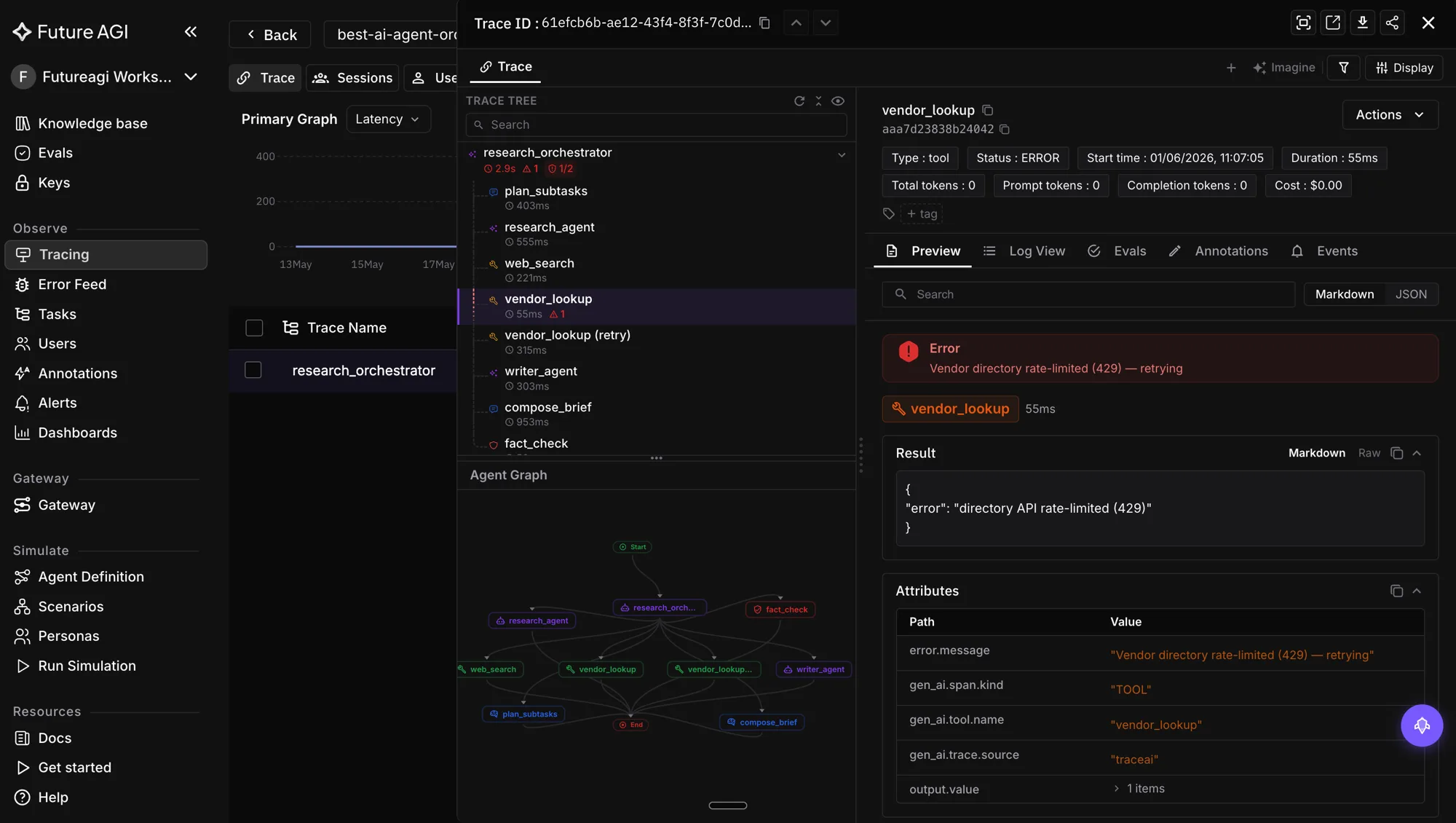
2. Evaluation
Future AGI’s ai-evaluation ships 50-plus pre-built evaluators out of the box: RAG faithfulness, context relevance, answer correctness, agent trajectory, tool-call accuracy, function calling, hallucination, groundedness, code syntax, toxicity, and more. They run on a proprietary in-house classifier model family, which keeps continuous evaluation cheap per token. Error localization pinpoints which input field caused a failure, which cuts debug time on multi-field eval inputs. A local execution mode runs 20-plus heuristic metrics offline, and a hybrid mode routes local-capable metrics locally and LLM-based ones to the cloud. Custom evaluators are unlimited, and human-in-the-loop annotation queues feed labels back into evaluator definitions.
Parea ships roughly six built-in evaluators. Its answer to “what about everything else” is the annotation-to-eval bootstrap, and that workflow is genuinely well-designed: hand-label a batch, get an evaluator that mirrors your judgment. For a team with a narrow eval surface, that is an elegant path from vibe check to scalable eval. The limitation is the starting point. A six-metric catalog means a team running RAG plus agents plus structured output authors more before the suite is useful, and there is no error localization to attribute a failure to a specific input field.
Verdict. Future AGI wins on catalog depth, error localization, local and hybrid execution modes, and in-house classifier models for cheap continuous eval. Parea wins on the annotation-to-eval bootstrap as a workflow, it is a cleaner, more opinionated path from human labels to an evaluator than assembling custom scorers by hand. A small team whose eval surface is narrow will find Parea’s bootstrap faster to a first useful evaluator; a team with a wide eval surface will find Future AGI’s catalog saves far more authoring.
3. Prompt management
Future AGI’s prompt surface ships versioning, environment-based deploys, and access control. The wedge is not the editor, it is the optimizer. agent-opt consumes eval scores and proposes the next prompt version through ProTeGi, GEPA, or MetaPrompt, so the usual “edit, deploy, watch, repeat” loop shortens to “watch the score, accept the optimizer’s suggestion, ship.” The prompt library is opinionated, with fewer collaboration knobs than a dedicated prompt CMS, because the design assumes the optimizer is doing much of the writing.
Parea ships a prompt playground, a clean surface for iterating prompts by hand. Deployed prompts are capped per tier, 10 on Free and 100 on Team. The playground UX is genuinely well-built, and for a team iterating prompts manually it is pleasant to use. What it does not do is act, there is no mechanism that rewrites a failing prompt from its eval score. Prompt iteration is a human loop.
Verdict. Future AGI wins on automated prompt updates from the optimizer, a different workflow entirely from manual iteration. Parea wins on playground UX for hand-authoring, it is a polished, low-friction editor. If your team writes prompts by hand and likes a clean playground, Parea is pleasant. If you want prompts rewritten from eval data, Future AGI is the only fit.
4. Simulation and optimization
This axis is the clearest split. Future AGI ships both. simulate-sdk runs multi-turn conversations against synthetic personas and scenarios before code reaches production, with a pass-rate report and a transcript per test case, so a regression in tool use or recovery behavior surfaces in a test run rather than in a customer conversation. agent-opt then closes the loop: ProTeGi, GEPA, and MetaPrompt consume the labelled dataset from ai-evaluation and propose the next prompt or routing revision, with early stopping and a full iteration history for debugging the optimization trajectory.
Parea ships neither. There is no pre-deployment simulation layer, and no optimizer. Parea’s experiment tracking lets you compare prompt versions you authored and scored yourself, but the comparison is descriptive. Nothing in the product generates the next candidate or runs a multi-turn synthetic test against a persona.
Verdict. Future AGI wins outright. Simulation and optimization are not part of Parea’s product. For a team whose workload is a production agent, where regressions hide in tool-call sequences and prompt iteration is a recurring cost, this is the axis that most often decides the migration.
5. Security and compliance
Future AGI’s Protect model family runs inline at the request boundary, so content moderation, bias detection, prompt-injection defense, and PII or compliance violations are caught synchronously rather than after the fact. Agent Command Center ships 18-plus built-in guardrail scanners and 15 third-party guardrail adapters at the gateway layer, plus token budgets, virtual keys, and rate limits. On the certification side, Future AGI lists SOC 2 Type II, HIPAA with a BAA, GDPR, and CCPA as certified, with BYOC and AWS Marketplace available.
Parea has no inline guardrail layer and no gateway, so runtime enforcement, PII redaction and prompt-injection defense in the request path, is not something Parea provides; you compose it elsewhere. Parea’s Enterprise tier does address the deployment side of compliance: on-prem and self-host, SSO, custom roles, and SLAs. That covers data residency and access control for a buyer who needs it. What it does not cover is synchronous policy enforcement on the model’s input and output.
Verdict. Future AGI wins on inline runtime guardrails, the gateway-layer scanner suite, and the certified compliance paperwork. Parea wins, partially, on giving Enterprise buyers an on-prem and SSO path, which is the deployment half of compliance. For a team whose risk surface is “what does this agent say to a customer”, Future AGI enforces it in the path and Parea does not.
6. Developer experience
Future AGI’s DX is built around the iteration loop a production AI team runs: write a rubric, watch the eval score, let the optimizer rewrite the prompt, ship the routing update. Three-language SDK coverage under traceAI, auto-instrumentation that captures traces with a one-time init, a local eval mode for fast offline checks, and an OpenAI-compatible gateway drop-in that needs only a base_url change. The trade-off is surface area, the platform covers trace, eval, simulate, optimize, and gateway, so there is more to learn than a single-purpose tool.
Parea’s DX is its strongest dimension for a small team. Onboarding is the simplest in this comparison, faster to a first trace than any broader platform. The SDK wrappers for OpenAI, Anthropic, LangChain, Instructor, DSPy, and LiteLLM are straightforward, the playground is clean, and there is no infrastructure to run. For a one-to-three-person team, that low-ops simplicity is a real, measurable advantage, fewer concepts, faster start, less to maintain.
Verdict. Future AGI wins on DX breadth: three SDK languages, the optimizer UI, simulation, and inline guardrail middleware in one product. Parea wins on DX simplicity: the fastest onboarding here and the lowest operational overhead. The honest read is that they win on opposite definitions of good DX, breadth versus simplicity, and the right answer depends on team size.
Pricing snapshot: May 2026
Pulled from each vendor’s pricing page on May 21, 2026.
| Tier | Future AGI | Parea AI |
|---|---|---|
| Free | 100K traces/month, basic eval, no SSO | $0, 2 seats, 3,000 logs/month, 1-month retention, 10 deployed prompts, Discord support |
| Scale / Team | $99/mo, full eval suite, agent-opt, RBAC | $150/mo, 3 seats (+$50/extra seat), 100,000 logs/month, 3-month retention, unlimited projects, 100 deployed prompts, private Slack |
| Mid / bundled | $99/mo includes the optimizer + simulation + inline guardrails + gateway in one bill | No mid tier; the next step from Team is Enterprise |
| Enterprise | Custom; SOC 2 Type II, HIPAA (BAA), GDPR, CCPA certified; BYOC; AWS Marketplace | Custom; unlimited logs, on-prem/self-host, SSO, custom roles, SLAs |
The shapes do not line up cleanly. Parea prices on log volume, which is predictable for a small team and a hard ceiling for a busy agent, where one session can emit dozens of spans against a 100,000-logs-a-month Team cap. Future AGI prices the runtime in one bill: trace, eval, simulation, optimizer, and gateway for $99 a month at Scale. For a continuous production workload, the optimizer typically pays for itself in routing savings within a few weeks of live trace data. For a side project under 3,000 logs a month, Parea’s free tier is genuinely the cheaper and simpler option, that is not a close call.
Where each one falls short
Future AGI: three deliberate tradeoffs
- The platform has more surface than a single-purpose tool. Future AGI covers trace, eval, simulate, optimize, and gateway. A one-person side project does not need all of it, and Parea’s single-product simplicity is genuinely faster to a first trace. The workaround is to adopt incrementally, start with
traceAIplusai-evaluationand add the optimizer and gateway when the workload calls for them. agent-optis opt-in and learns from live traces. The optimizer gets stronger as trace data accumulates. Start with tracing and evaluation on day one, and turnagent-opton once eval baselines stabilize and production traffic is flowing. That is the design, not a setup tax.- The prompt-authoring UI is opinionated. Future AGI ships versioning and access control with fewer collaboration knobs than a dedicated prompt CMS, because the optimizer is meant to do much of the writing. Teams that want a large, hand-authored, multi-collaborator prompt library should preview the workflow before standardizing on it.
Three deliberate tradeoffs in pursuit of the closed loop. Each has a clear path for buyers who need it today.
Parea AI: four honest limitations
- No optimizer loop. Parea evaluates and surfaces traces. It does not rewrite a failing prompt or routing policy from its eval score. The annotation-to-eval bootstrap sharpens the evaluator, not the prompt. Prompt iteration stays a human loop. Future AGI’s
agent-optis the optimizer Parea leaves open. - No guardrails and no gateway. Parea is an offline-and-observability tool. There is no inline PII redactor, no prompt-injection filter, and no LLM gateway for routing, fallback, caching, or budgets. Runtime enforcement is something you compose outside Parea. Future AGI’s Agent Command Center and Protect cover it natively.
- A roughly six-metric built-in catalog. Parea ships about six evaluators and expects the annotation bootstrap to cover the rest. For a wide eval surface, that is real upfront authoring. Future AGI ships 50-plus pre-built evaluators with error localization.
- A small team is a procurement question. Parea is a team of roughly three, independent, with around $330K in 2025 revenue. For a side project that is irrelevant. For an enterprise buyer, the security review will ask about on-call coverage, support SLAs beyond Discord, and continuity risk, and a tiny vendor has a harder time answering those than a certified one.
Choose Future AGI if
- Your workload is a production agent that needs to keep improving on its own. The optimizer rewrites prompts and routing from eval outcomes; stopping at a score is not enough.
- You want trace, eval, simulation, optimizer, gateway, and inline guardrails in one runtime, on one bill, with Apache 2.0 libraries you can self-host.
- Your eval surface is wide, RAG plus agents plus structured output, and a 50-plus pre-built evaluator catalog with error localization saves real authoring time.
- You need inline guardrails at the request boundary, prompt-injection defense and PII redaction enforced synchronously, not composed downstream.
- Your stack includes Java, or you need OTel-native trace portability, or you need certified SOC 2 Type II, HIPAA, GDPR, and CCPA for a regulated buyer.
Choose Parea AI if
- You are a one-to-three-person team or building a side project, and the simplest possible onboarding is the highest-value thing on the list.
- The annotation-to-eval bootstrap is the workflow you want, hand-label a batch, get an aligned evaluator, without assembling custom scorers yourself.
- Your eval surface is narrow enough that roughly six built-in metrics plus a few annotation-bootstrapped evaluators cover it.
- Your log volume stays comfortably under 100,000 a month and you do not want to run any infrastructure.
- You do not yet need an optimizer, pre-deployment simulation, or runtime guardrails, and a clean playground for hand-authoring prompts is enough.
Verdict matrix: when to pick which
| Situation | Best pick | Why |
|---|---|---|
| Closed-loop production agent: the platform rewrites its own prompts and routes from outcomes | Future AGI | agent-opt plus Agent Command Center is the loop Parea does not ship |
| Trace + eval + simulation + optimizer + gateway in one bill | Future AGI | One product covers the runtime; Parea covers trace and eval |
| Inline runtime guardrails: prompt injection and PII at the request boundary | Future AGI | Protect runs inline; Parea ships no guardrail layer |
| Wide eval surface across RAG, agents, and structured output | Future AGI | 50+ pre-built evaluators with error localization vs roughly six built-ins |
| Pre-deployment multi-turn agent testing against personas | Future AGI | simulate-sdk ships persona and scenario simulation; Parea has none |
| Java stack, or OTel-native trace portability needed | Future AGI | traceAI is OTel-native with a Java SDK; Parea’s trace format is proprietary |
| Certified SOC 2 Type II, HIPAA, GDPR, CCPA for a regulated buyer | Future AGI | All four listed certified today; runtime guardrails enforce policy in-path |
| One-to-three-person team that wants the simplest onboarding | Parea AI | Fastest to first trace, lowest operational overhead, no infrastructure |
| Annotation-to-eval bootstrap as the core workflow | Parea AI | Signature feature: hand labels generate an aligned evaluator cleanly |
| Side project under 3,000 logs a month with a tight budget | Parea AI | The Free tier is genuinely the cheaper and simpler option |
| Debugging image-output agents with multi-modal trace logs | Parea AI | Polished image visualization inside the trace view |
How the loop changes the math
The closed loop in practice: traceAI emits a span tree for every request, ai-evaluation scores each turn against rubrics drawn from a 50-plus built-in catalog plus any custom evaluator your team authors, low-scoring sessions cluster by failure mode, agent-opt rewrites the prompt or routing policy through ProTeGi, GEPA, or MetaPrompt, and Agent Command Center applies the update on the next request. simulate-sdk runs the candidate against synthetic personas before it ships, and Protect enforces guardrails inline at the request boundary. If the new prompt regresses, the eval score catches it and the version rolls back.
Parea covers the first two stages of that chain, trace and eval, and the annotation bootstrap makes the second stage faster to set up for a small team. It does not cover the rest. The eval score is where Parea stops. A human reads it, edits a prompt by hand in the playground, and ships. That is a perfectly reasonable workflow for a small team with a narrow surface, and it is exactly why Parea is the right pick for a side project.
The math changes when the workload is continuous. A production agent generates eval data every hour, and an optimizer that consumes that data rewrites over-prompted instructions and a gateway that learns to route easy turns to a cheaper model compound into real cost reduction over a few weeks, with no change to developer behavior. That is the value Parea leaves on the table by design, because it is an evaluation and observability tool, not a runtime.
For Parea customers, the practical pattern is a clean migration rather than a side-by-side: Parea’s trace pipeline and its six built-in evaluators map onto traceAI and the ai-evaluation catalog, and the annotation-bootstrapped evaluators become EvalTemplate definitions with the hand-labeled batch re-uploaded into annotation queues. For a greenfield team, picking Future AGI gives you the whole runtime in one product. For a one-to-three-person team that may never need the loop, staying on Parea is the honest recommendation.
Related reading
- Best 5 Parea AI Alternatives in 2026
- Future AGI vs Langfuse in 2026
- Best Braintrust Alternatives in 2026
- Best Comet Opik Alternatives in 2026
- Best Arize Phoenix Alternatives in 2026
Sources
- Parea AI pricing page,
parea.ai/pricing(Free $0 / Team $150 / Enterprise; logs caps, seat limits, retention) - Parea AI documentation,
docs.parea.ai(six built-in evals, annotation-to-eval bootstrap, SDK wrappers, multi-modal trace logs) - Parea AI YC profile,
ycombinator.com(YC S23) - Future AGI traceAI (Apache 2.0),
github.com/future-agi/traceAI - Future AGI ai-evaluation (Apache 2.0),
github.com/future-agi/ai-evaluation - Future AGI agent-opt (Apache 2.0),
github.com/future-agi/agent-opt - Future AGI Agent Command Center,
docs.futureagi.com/docs/command-center - Future AGI Protect,
docs.futureagi.com/docs/protect
Frequently Asked Questions
What is the main difference between Future AGI and Parea AI?
Is Future AGI open-source? Is Parea AI open-source?
What is Parea AI genuinely better at?
Does Parea AI have an optimizer or a gateway?
Can I self-host either of them?
How does pricing compare?
Which has the deeper evaluation catalog?
Which should a small team starting out pick?
Five Parea AI alternatives scored on eval-catalog depth, logs-capped pricing, optimizer loops, guardrails, and team scale, and what each fixes.

Future AGI vs Langfuse on tracing, evaluation, prompt management, deployment, security, DX. Honest verdict, May 2026 pricing, why only one closes the loop.

Honest 2026 comparison of Braintrust alternatives: Future AGI, Langfuse, Phoenix, LangSmith, Helicone. Agent trajectory eval, runtime guardrails, gateway.