Best 5 Parea AI Alternatives in 2026
Five Parea AI alternatives scored on eval-catalog depth, logs-capped pricing, optimizer loops, guardrails, and team scale, and what each fixes.
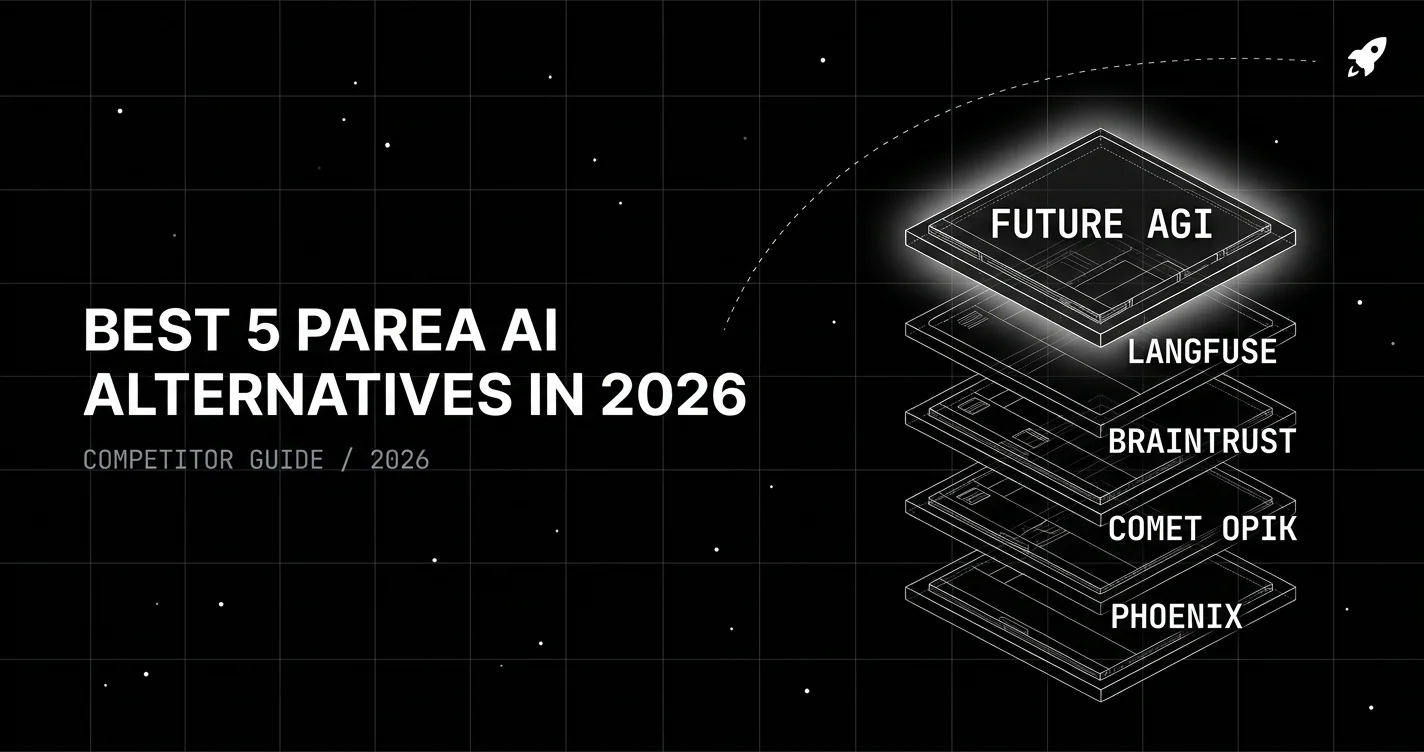
Table of Contents
Parea AI was the YC-backed pick for small teams who wanted experiment tracking, tracing, evaluation, and human annotation in one tidy product, without standing up infrastructure. Its signature move is genuinely good: you annotate a batch of outputs by hand, and Parea bootstraps an eval function that mirrors your judgment, turning vibe checks into a scalable evaluator. For a one-to-three-person team shipping a first LLM feature, that workflow still holds up.
The problem is what happens after the prototype. The built-in eval catalog is roughly six metrics. Pricing is logs-capped at 3,000 logs a month on Free and 100,000 on Team. There is no optimizer loop, no native guardrails, and no LLM gateway. And the team is small, roughly three people, which becomes a procurement question once a buyer’s security review asks who answers the pager.
This guide ranks five alternatives, names what each fixes versus Parea, and walks through the migration that bites. Parea is invoked through an SDK wrapper around the LLM call, so the cutover is not a base_url swap. It replaces the trace pipeline and re-authors the eval definitions at the same time.
TL;DR: pick by exit reason
| Why you are leaving Parea AI | Pick | Why |
|---|---|---|
| You want trace, eval, simulation, optimizer, and guardrails in one platform | Future AGI | Closes the loop from trace through eval to optimizer and gateway, with Apache 2.0 building blocks |
| You want OSS observability with no logs cap and deep tracing | Langfuse | MIT-licensed core, OpenTelemetry-native, self-host with unlimited trace volume |
| You want hosted closed-loop eval with scored experiments and a broad autoeval set | Braintrust | Experiment grid, Autoevals package, large eval catalog |
| You want a vendor-backed OSS observability stack with no bus-factor risk | Comet Opik | Open-source, backed by an established ML-tooling company |
| You want local-first agent tracing you can run on a laptop or in a VPC | Arize Phoenix | OSS, OpenInference-native, runs locally with zero hosted dependency |
Why people are leaving Parea AI in 2026
Five exit drivers show up repeatedly in migration threads, the Parea Discord, and review sites over the last two quarters. None of them is “the product is bad.” Each is a ceiling a growing team hits.
1. Small team, bus-factor risk for enterprise buyers
Parea is a YC S23 company with a team of roughly three and around $330K in 2025 revenue. It is independent, still operating, and not acquired. But a three-person team is a fact a security review will surface. Enterprise buyers ask who covers the on-call rotation, what the support SLA looks like outside a Discord channel, and what happens if one founder leaves. For a side project none of that matters. For a regulated buyer signing a multi-year contract, it is the first question procurement raises and the hardest for a tiny vendor to answer.
2. Logs-capped pricing
Parea prices on log volume. The Free tier is 2 seats and 3,000 logs a month with one-month retention. The Team tier is $150 a month for 3 seats, plus $50 per extra seat, with 100,000 logs a month and three-month retention. For a prototype, 3,000 logs is plenty. For a production agent doing multi-step tool calls, where one session can emit dozens of spans, 100,000 logs a month is a ceiling you hit fast, and the only path past Team is an Enterprise quote. Teams that want trace volume to scale linearly, or to self-host with no cap, start looking elsewhere.
3. The roughly six-metric eval catalog
Parea ships a small set of built-in evaluators, llm_grader, answer_relevancy, self_check, lm_vs_lm_factuality, semantic_similarity, and context-relevancy metrics. That is roughly six. The annotation-to-eval bootstrap is the intended answer for everything else, and it is a good answer for a narrow eval surface. But teams running RAG plus agents plus structured output want pre-built rubrics for agent trajectory, tool-call accuracy, function calling, groundedness, hallucination segmentation, and code correctness on day one, not as evaluators they author from scratch.
4. No optimizer loop
Parea captures traces, runs evals, and lets you compare experiments. What it does not do is act on eval outputs. There is no “rewrite the failing prompt automatically” loop, no gradient or genetic search driven by eval scores. The annotation-to-eval workflow produces a sharper evaluator; it does not produce a better prompt. Humans still do the prompt iteration. Teams that built a nightly optimizer themselves on top of Parea’s eval feed are the ones most likely to evaluate a platform that ships that loop.
5. No guardrails, no gateway
Parea is an offline-and-observability tool. It supports multi-modal traces, image visualization in trace logs from OpenAI, Anthropic, and Mistral, and clean experiment tracking. What it does not have is a runtime layer. There are no native guardrails to catch a prompt injection or redact PII synchronously, and no LLM gateway to route, fall back, cache, or enforce a token budget. For a team whose risk surface is now “what does this agent say to a customer in production”, Parea sits next to the request path, not in it.
What to look for in a Parea AI replacement
Score replacements on the seven axes that map to the surfaces you are actually migrating off.
| Axis | What it measures |
|---|---|
| 1. Eval-catalog depth | Pre-built rubrics for RAG, agents, tool calls, hallucination, code, toxicity |
| 2. Annotation-to-eval workflow | Can human labels bootstrap or tune an evaluator, the Parea wedge |
| 3. Observability depth | Per-session, per-user agent traces with tool-call spans, no logs cap |
| 4. Optimizer loop | Does the platform rewrite prompts and routing from eval scores |
| 5. Runtime guardrails and gateway | Inline PII, prompt-injection defense, routing, fallback, budgets |
| 6. Team and support posture | Vendor scale, SLA, on-call, procurement answerability |
| 7. Migration tooling | Trace-pipeline swap path and eval re-authoring effort |
1. Future AGI: Best for closing the loop
Verdict: Future AGI is the only platform here that fixes Parea’s deepest gap. Parea turns annotations into evals, then stops at the score. Future AGI takes that score and keeps going, it clusters the failures, runs an optimizer, rewrites the prompt, and applies the routing update through a gateway. The annotation-to-eval idea becomes one stage of a loop instead of the whole product. Teams that outgrew Parea’s eval surface get the same eval depth plus the four things Parea never shipped: simulation, an optimizer, guardrails, and a gateway.
What it fixes versus Parea AI:
- A 50-plus evaluator catalog, not roughly six.
ai-evaluation(Apache 2.0) ships 50-plus pre-built evaluators covering RAG faithfulness, context relevance, answer correctness, agent trajectory, tool-call accuracy, function calling, hallucination, groundedness, code correctness, and toxicity, with error localization that pinpoints which input field caused a failure. Custom evaluators are unlimited, and an in-product eval-authoring agent generates and tunes rubrics from your code. The same human-in-the-loop annotation queues Parea is known for exist here too, throughfutureagi-sdk.
- The optimizer loop.
agent-opt(Apache 2.0) consumes eval scores and rewrites prompts through ProTeGi (gradient-based), GEPA (genetic), and MetaPrompt algorithms. Parea’s CMS is static; Future AGI’s loop is self-improving.
- Agent simulation.
simulate-sdkruns multi-turn conversations against synthetic personas and scenarios before code ships, with a pass-rate report per run. Parea has no pre-deployment simulation layer. - Runtime guardrails and a gateway. Agent Command Center is an OpenAI-compatible LLM gateway with 18-plus built-in guardrail scanners, 100-plus providers, semantic caching, and OpenTelemetry observability. Protect, Future AGI’s guardrail model family, runs inline. Parea has neither.
- OTel-native instrumentation.
traceAIis OpenTelemetry-compatible across Python, TypeScript, and Java, with auto-instrumentation for OpenAI, LangChain, and more. No proprietary trace format to migrate off later.
Migration from Parea AI: Two pieces. Replace the trace pipeline with a traceAI SDK initialization, for OpenAI and Anthropic calls auto-instrumentation captures spans with no call-site change. Then re-author the eval definitions: Parea’s six built-ins map onto Future AGI’s pre-built catalog, and custom Parea eval functions become EvalTemplate definitions. Annotation history exports as JSON and re-uploads into Future AGI annotation queues. Timeline: five to eight engineering days, including a shadow-traffic period.
Where it falls short:
agent-optis opt-in. Start withtraceAIplusai-evaluation, and turn the optimizer on once eval baselines stabilize. The loop compounds value over weeks, not on day one.- The onboarding is broader than Parea’s. Parea’s single-product simplicity is faster to first trace for a tiny team; a one-person side project may not need all of Future AGI’s surface.
Pricing: Free tier with 100K traces a month. Scale tier from $99 a month with the full eval suite, agent-opt, and RBAC. Enterprise custom, with SOC 2 Type II, HIPAA, GDPR, and CCPA certified.
Score: 7 of 7 axes.
2. Langfuse: Best for OSS observability with no logs cap
Verdict: Langfuse is the pick when the Parea exit reason is the logs cap. It is MIT-licensed, OpenTelemetry-native, and self-hostable, so trace volume is bounded by your own infrastructure, not a 100,000-logs-a-month tier. The prompt-management surface is the deepest in OSS, and the tracing surface is genuinely deep. The trade-off is that Langfuse is an observation layer; the annotation-to-eval bootstrap that defines Parea is not a first-class feature.
What it fixes versus Parea AI:
- No logs cap on self-host. Langfuse Core is MIT. Self-host on Postgres, ClickHouse, Redis, and S3, and trace volume scales with your cluster, not a pricing tier.
- Deep OSS tracing. OTel-native traces, per-session timelines, agent traces with tool-call spans, prompt-version tagging on every trace.
- The deepest OSS prompt registry. Slugged prompts, version labels, label-based deploys with fast rollback, and prompt-linked evaluators that run on promotion.
- CI/CD experiments. Langfuse Experiments ships GitHub Actions checks before prompt promotion, a path Parea does not publish.
Migration from Parea AI: Two pieces. Swap the Parea SDK wrapper for the langfuse SDK or raw OTel emitters, and recreate evals as Langfuse LLM-as-judge or custom scorers, Parea’s annotation-derived functions become custom scorers here. Datasets port by re-uploading rows. Timeline: five to eight engineering days.
Where it falls short:
- No optimizer. Langfuse stores prompts and traces; it does not rewrite them from outcomes.
- No gateway and no inline guardrails. Langfuse sits downstream of a gateway; it does not replace one.
- No annotation-to-eval bootstrap. The workflow that makes Parea elegant is something you reimplement with custom scorers.
- Self-host burden compounds above 5 to 10M traces a month. ClickHouse and Postgres tuning land on the platform team.
Pricing: Hobby free with 50K units a month. Core $29 a month plus $8 per additional 100K units. Pro $199 a month. Enterprise $2,499 a month. Self-host of Core is MIT.
Score: 4 of 7 axes (missing: annotation-to-eval workflow, optimizer, runtime guardrails and gateway).
3. Braintrust: Best for hosted closed-loop eval with a broad autoeval set
Verdict: Braintrust is the pick when the Parea frustration is the roughly six-metric catalog and the lack of a rigorous experiment surface. Braintrust is built around the eval loop, a hosted experiment grid where you score prompt versions against datasets, with the open-source Autoevals package supplying a broad set of pre-built scorers. It is hosted, so there is no infrastructure to run, the same low-ops posture as Parea.
What it fixes versus Parea AI:
- A broad autoeval catalog. The Autoevals package ships factuality, relevance, summarization, and many more scorers out of the box, well past Parea’s six built-ins.
- The experiment grid. Side-by-side scored comparison of prompt and model versions against a dataset is the core surface, more rigorous than Parea’s experiment view.
- Playground and prompt iteration. A polished hosted playground for iterating prompts against eval scores.
- Larger team and funding. Braintrust is a better-resourced vendor than a three-person company, which eases procurement and support questions.
Migration from Parea AI: Two pieces. Replace the Parea SDK with the Braintrust SDK for logging and experiment capture, and re-author evals as Autoevals or custom scorers. Datasets re-upload as Braintrust datasets. Timeline: five to seven engineering days.
Where it falls short:
- No optimizer loop. Braintrust scores experiments; it does not rewrite prompts from the scores.
- No gateway and no inline guardrails. Runtime enforcement is out of scope.
- Tracing depth is real but eval-centric; teams wanting the deepest agent-trace surface often pair it with a dedicated tracer.
- Pricing scales with eval and span volume; heavy continuous-eval workloads should model the bill first.
Score: 5 of 7 axes (missing: optimizer, runtime guardrails and gateway).
4. Comet Opik: Best for a vendor-backed OSS observability stack
Verdict: Comet Opik is the pick when the Parea exit reason is bus-factor risk, you want an open-source tracing and evaluation stack backed by an established ML-tooling company rather than a three-person startup. Opik is Comet’s open-source LLM observability project. It gives you self-hostable tracing and evaluation with the institutional backing a security review looks for.
What it fixes versus Parea AI:
- Vendor backing without bus-factor risk. Opik is developed by Comet, a company with a long-running ML experiment-tracking product and an established support organization.
- Open-source and self-hostable. Run Opik locally or in your VPC; trace volume is not gated by a logs tier.
- Tracing plus evaluation in one OSS tool. Span capture, LLM-as-judge evaluators, and a metric set, with a hosted option for teams that do not want to self-host.
- Datasets and experiments. Dataset-driven evaluation and experiment comparison are first-class.
Migration from Parea AI: Two pieces. Swap the Parea SDK for the Opik SDK and its trace decorator, and re-author evals as Opik metrics or LLM-as-judge evaluators. Datasets re-upload. Timeline: five to eight engineering days.
Where it falls short:
- No optimizer loop. Opik observes and evaluates; it does not rewrite prompts from scores.
- No LLM gateway and no inline guardrails as a first-class runtime layer.
- No annotation-to-eval bootstrap that mirrors Parea’s signature workflow; you author evaluators directly.
- Self-host operations, while lighter than some, still need a platform owner.
Score: 4 of 7 axes (missing: annotation-to-eval workflow, optimizer, runtime guardrails and gateway).
5. Arize Phoenix: Best for local-first agent tracing
Verdict: Arize Phoenix is the pick when the Parea exit reason is wanting tracing you can run on a laptop or in a VPC with zero hosted dependency. Phoenix is an open-source, OpenInference-native observability tool that runs locally with one pip install, the lowest-friction way to trace and inspect agent runs without sending data to a hosted service.
What it fixes versus Parea AI:
- Runs locally, no hosted dependency.
pip install arize-phoenixand Phoenix runs on your machine; trace data never leaves your environment unless you choose a hosted path. - OpenInference-native tracing. Deep agent traces with tool-call spans, built on the OpenInference span convention, so the trace format is portable.
- A built-in evaluation library. Phoenix ships LLM-as-judge evaluators for hallucination, relevance, toxicity, and RAG, more than Parea’s six built-ins.
- No logs cap on the OSS path. Self-run Phoenix is bounded by your storage, not a pricing tier.
Migration from Parea AI: Two pieces. Replace the Parea SDK with Phoenix’s OpenInference instrumentation, which auto-instruments OpenAI, LangChain, and more, and re-author evals using the Phoenix evals library. Timeline: four to seven engineering days, lighter if you do not need a hosted backend.
Where it falls short:
- No optimizer loop and no prompt-rewriting from eval scores.
- No LLM gateway and no inline guardrails for runtime enforcement.
- The local-first model means long-term retention, RBAC, and team collaboration need the hosted Arize platform or your own infrastructure.
- No annotation-to-eval bootstrap matching Parea’s signature workflow.
Score: 4 of 7 axes (missing: annotation-to-eval workflow, optimizer, runtime guardrails and gateway).
Capability matrix
| Axis | Future AGI | Langfuse | Braintrust | Comet Opik | Arize Phoenix |
|---|---|---|---|---|---|
| Eval-catalog depth | ✓ 50+ pre-built | ◐ LLM-judge + scorers | ✓ Autoevals set | ◐ Metric set + judges | ◐ Built-in evals library |
| Annotation-to-eval workflow | ✓ Annotation queues | ◐ Custom scorers | ◐ Custom scorers | ◐ Custom metrics | ◐ Custom evaluators |
| Observability depth, no logs cap | ✓ OTel + self-host | ✓ OSS, no cap | ◐ Eval-centric tracing | ✓ OSS, self-host | ✓ Local, no cap |
| Optimizer loop | ✓ agent-opt | ✗ | ✗ | ✗ | ✗ |
| Runtime guardrails + gateway | ✓ Agent Command Center | ✗ | ✗ | ✗ | ✗ |
| Team and support posture | ✓ Certified, RBAC | ✓ Funded OSS vendor | ✓ Funded vendor | ✓ Comet-backed | ✓ Arize-backed |
| Migration tooling | ✓ Tracer swap + map | ◐ SDK swap | ◐ SDK swap | ◐ SDK swap | ◐ SDK swap |
✓ native and first-class · ◐ partial or workaround · ✗ not available
Migration notes: what breaks when leaving Parea AI
Parea is not a base_url-style proxy. It is an SDK that wraps the LLM call with a trace decorator and a client wrapper. That shapes the migration. Two surfaces always need attention.
Replacing the trace pipeline
Parea’s SDK instruments calls through a decorator and a wrapped client for OpenAI, Anthropic, LangChain, Instructor, DSPy, and LiteLLM. Migrating off this means replacing the instrumentation at every call site. The lightest path is auto-instrumentation: Future AGI’s traceAI and Langfuse both capture traces after a one-time SDK initialization, with no per-call-site change for OpenAI and Anthropic calls. For DSPy and Instructor call sites, expect a manual pass. For hundreds of call sites, script the change with a codemod and run a shadow period before cutover.
Re-authoring the eval definitions
Parea’s six built-in evaluators have direct analogs on every destination here. The work is the custom evals. Parea’s annotation-to-eval bootstrap produces eval functions tuned to your hand-labeled data, and those do not port automatically. On Future AGI they become EvalTemplate definitions with the hand-labeled batch re-uploaded into annotation queues; on Langfuse, Braintrust, Opik, and Phoenix they become custom scorers. Budget two to four days for a typical custom-eval surface.
Trace history
Parea’s trace and log export returns historical data as JSON. Re-ingesting it is optional. Teams whose audit needs only cover the last 90 days usually start fresh rather than back-loading the old log shape.
Decision framework: Choose X if
Choose Future AGI if you want eval scores to drive prompt rewrites and routing updates, plus simulation and runtime guardrails in the same product. Pick this when production agent workloads are a real line item and a six-metric catalog with no optimizer is the ceiling you hit.
Choose Langfuse if the exit reason is the logs cap and you want an MIT-licensed trace and prompt store you can self-host with unlimited volume. Pick this when deep tracing matters more than an annotation-to-eval bootstrap and the platform team can absorb the ClickHouse self-host burden.
Choose Braintrust if the exit reason is the small eval catalog and you want a rigorous hosted experiment grid with a broad autoeval set, without running infrastructure.
Choose Comet Opik if the exit reason is bus-factor risk and you want an open-source observability and evaluation stack backed by an established ML-tooling company.
Choose Arize Phoenix if the exit reason is wanting local-first tracing with zero hosted dependency, runnable on a laptop or in a VPC.
When Parea AI is still the right pick
Calibrated honesty matters here, because Parea genuinely wins on a few dimensions.
If you are a one-to-three-person team or building a side project, Parea is a reasonable choice and may be the best one. The onboarding is the simplest on this list, faster to first trace than any broader platform. The annotation-to-eval bootstrap is genuinely elegant: hand-labeling a batch and getting an evaluator that mirrors your judgment is a clean workflow that larger platforms make you assemble yourself. The free tier, 2 seats and 3,000 logs a month, is generous enough for a real prototype. The playground UX is clean. And there is no infrastructure to run.
The honest framing is this. Parea is an excellent first eval tool and a poor last one. If your eval surface stays narrow, your team stays small, and your log volume stays under 100,000 a month, Parea fits and the alternatives here are overkill. The moment any one of those three outgrows Parea, the migration is worth planning.
What we did not include
Three products show up in other 2026 Parea AI alternatives listicles that we left out. LangSmith is a capable observability and eval product but is tightly coupled to LangChain, a different shape worth its own guide. Helicone is a strong lightweight observability proxy but its eval surface is thinner than Parea’s, so it is not a like-for-like eval replacement. PromptLayer is a prompt-CMS-first product whose wedge is prompt management rather than the annotation-to-eval workflow, so the Parea-specific migration story does not line up cleanly.
Related reading
- Future AGI vs Parea AI in 2026
- Best 5 Langfuse Alternatives in 2026
- Best Braintrust Alternatives in 2026
- Best Comet Opik Alternatives in 2026
- Best Arize Phoenix Alternatives in 2026
Sources
- Parea AI pricing page, parea.ai/pricing (Free $0 / Team $150 / Enterprise; logs caps and retention tiers)
- Parea AI documentation, docs.parea.ai (built-in evals, SDK wrappers, multi-modal trace logs)
- Parea AI YC profile, ycombinator.com (YC S23)
- Langfuse open-source repository, github.com/langfuse/langfuse (MIT)
- Langfuse pricing page, langfuse.com/pricing
- Braintrust product page and Autoevals package, braintrust.dev
- Comet Opik open-source repository, github.com/comet-ml/opik
- Arize Phoenix open-source repository, github.com/Arize-ai/phoenix
- Future AGI traceAI, github.com/future-agi/traceAI (Apache 2.0)
- Future AGI ai-evaluation, github.com/future-agi/ai-evaluation (Apache 2.0)
- Future AGI agent-opt, github.com/future-agi/agent-opt (Apache 2.0)
- Future AGI Agent Command Center, docs.futureagi.com/docs/command-center
Frequently Asked Questions
Why are people moving off Parea AI in 2026?
What is the closest like-for-like alternative to Parea AI?
Is the Parea AI SDK a drop-in OpenAI SDK?
Is there an open-source Parea AI alternative?
Which Parea AI alternative has the deepest eval catalog?
When is Parea AI still the right pick?
How does Future AGI compare to Parea AI?
Future AGI vs Parea AI scored on tracing, evaluation, prompt management, simulation, security, and DX. Honest verdict and May 2026 pricing.

FutureAGI, DeepEval, Langfuse, Phoenix, Braintrust, LangSmith, and Galileo as the 2026 LLM evaluation shortlist. Pricing, OSS license, and production gaps.

Honest 2026 comparison of Braintrust alternatives: Future AGI, Langfuse, Phoenix, LangSmith, Helicone. Agent trajectory eval, runtime guardrails, gateway.