Future AGI vs Maxim AI in 2026: Honest Eval, Simulation, and Observability Comparison
Future AGI vs Maxim AI in 2026: side-by-side on eval breadth, multimodal coverage, simulation, observability, pricing, and which to pick when.
Table of Contents
Future AGI vs Maxim AI in 2026: Honest Eval, Simulation, and Observability Comparison
Future AGI and Maxim AI both target the same problem: keeping AI agents reliable in production. They take different paths. This guide compares them head-to-head on capability, pricing, ecosystem, and the question most teams actually care about: which one fits your stack today.
TL;DR
| Dimension | Future AGI | Maxim AI |
|---|---|---|
| Core surface | Eval + Simulate + Observe + Prompt-Opt + Gateway + Protect | Playground++ prompt studio + agent simulation + observability |
| Multimodal | Text, image, audio, video (native evaluators) | Text-first; image and voice added in 2025-2026 |
| Simulation | Scripted + randomized scenarios via fi.simulate SDK | Built-in persona simulation in Playground++ |
| Observability | OpenTelemetry traces via Apache 2.0 traceAI | Vendor trace viewer + Slack, PagerDuty, Vertex AI |
| Gateway / routing | Agent Command Center BYOK gateway | Not currently offered |
| Pricing model | Flat team plans + enterprise | Per-seat tiers + enterprise |
| Pick when | You want one platform across the full AI lifecycle | Prompt management is the primary daily workflow |
What Each Platform Is Actually Built For
Future AGI positions itself as the end-to-end AI engineering platform. The product surface covers evaluation (text and multimodal evaluators), Simulate for scenario-based testing, Observe for production tracing, Prompt Optimization for systematic prompt selection, Protect for runtime guardrails, and the Agent Command Center for BYOK gateway routing. The same SDK (fi.evals, fi.simulate, fi_instrumentation) wires all of these together, so evaluation results from simulation feed into the same dashboards as production traces.
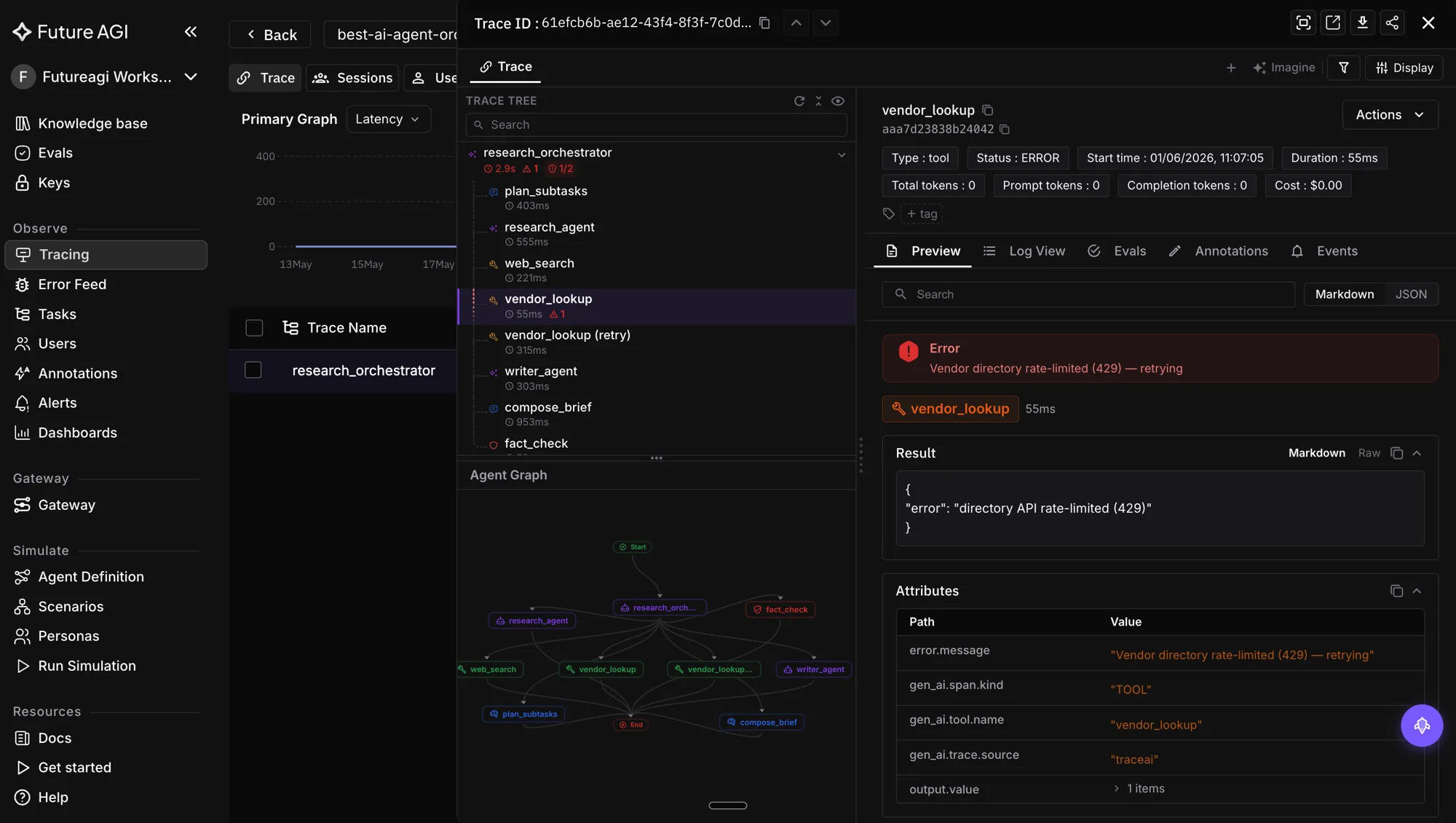
Maxim AI takes a prompt-and-agent first approach. Its flagship surface is Playground++, a workspace for prompt engineering, versioning, chain editing, and side-by-side model comparisons. Around that, Maxim layers agent simulation across personas, distributed tracing for agent steps, and live alerting through Slack, PagerDuty, and Vertex AI. Teams that live inside Playground++ get a tight loop for prompt iteration, with eval and observability bolted onto the same workspace.
Capabilities and Features Compared: Eval Breadth, Multimodal, Simulation, and Optimization
Future AGI covers text, image, audio, and video evaluation natively. The cloud Turing evaluators score outputs on faithfulness, toxicity, hallucination, refusal, sentiment, and dozens of other dimensions, with sub-2-second turing_flash latency for in-the-loop checks. Custom LLM judges plug in through fi.evals.metrics.CustomLLMJudge for domain-specific scoring. Simulate runs scripted and randomized scenarios, and Observe captures full traces with OpenTelemetry-compatible spans. Prompt Optimization closes the loop, picking the best prompt and model combo against your eval suite.
Maxim AI focuses on rapid agent and prompt iteration. Playground++ lets developers version prompts, compare side-by-side outputs across models, and chain prompts together for low-code agent flows. For a broader survey of dedicated tooling here, see our roundup of AI prompt management tools. Its eval library covers AI-as-judge metrics, programmatic checks, and Vertex AI evaluation metrics for teams in the Google Cloud ecosystem. Agent simulation runs personas across multi-turn dialogues, and the Maxim-managed human evaluation service handles last-mile review when automated scoring is not enough.
Neither platform is a one-to-one substitute for the other. Future AGI is broader (eval plus simulation plus observability plus gateway plus guardrails). Maxim is deeper inside the prompt management workflow.
Customer Reviews: What G2 Users Highlight in Real Deployments
G2 reviews surface consistent themes. Future AGI users emphasize catching hallucinations and policy violations before they reach production, particularly in multimodal contexts where transcript-only checks miss audio and image issues. The most common improvement request is deeper documentation and more onboarding materials for non-engineering stakeholders. See current ratings on the Future AGI G2 page.
Maxim AI reviewers praise developer experience inside Playground++, fast setup, and effective real-time alerting through Slack and PagerDuty integrations. Common feedback requests more detailed documentation for advanced features. Check the live Maxim G2 page for current reviewer count and sentiment.
Treat star ratings as directional, check both G2 pages for the latest counts before deciding, and weight reviewer-count differences when comparing.
Pricing in 2026: Flat Team Plans vs Per-Seat
Future AGI offers a free tier for early-stage teams, then paid plans on flat team pricing that include the full Eval, Simulate, and Observe stack. Custom enterprise deals cover on-prem, dedicated regions, and high-volume traffic. The flat model favors mid-sized squads where adding the sixth or seventh engineer should not double the bill.
Maxim AI uses a free Developer tier (up to three seats), then per-user Professional and Business plans. Per-seat pricing is friendly when you want to add a single user but can compound for larger teams. Verify current pricing on the Maxim pricing page and the Future AGI pricing page since both have iterated tiers during 2025 and 2026.
User Experience: Engineer-First Depth vs Prompt-Studio Speed
Future AGI is built for AI engineers and platform teams. The SDK is the primary surface: from fi.evals import evaluate, Evaluator for cloud evaluators, from fi.evals.metrics import CustomLLMJudge for custom judges, from fi_instrumentation import register, FITracer for traceAI manual instrumentation, and from fi.simulate import TestRunner, AgentInput, AgentResponse for simulation. The dashboard ties evaluation, simulation, and observability into a single navigation. New users typically need an afternoon to wire up an end-to-end pipeline.
Maxim’s UX optimizes for prompt engineers and developers iterating on agents. Playground++ is the daily home: open it, fork a prompt, run side-by-side comparisons, push a version, and ship. Low-code prompt chains let non-engineers contribute meaningfully. The learning curve is shallower for teams whose work centers on prompt design rather than full platform engineering.
Performance and Impact: Eval Coverage vs Iteration Speed
Future AGI customers report meaningful reductions in manual review time and faster catch rates for hallucinations and policy violations once Protect and Observe are wired into CI and production. Concrete numbers vary by use case, but reductions in regression escape rate and faster root-cause identification through traceAI spans are the most commonly cited gains. The wider AI agent observability tools landscape shows where each platform fits.
Maxim AI customers report faster prompt iteration cycles inside Playground++, with rapid A/B testing and one-click prompt deployment cutting iteration time for agent teams. Real-time alerts through Slack and PagerDuty shorten mean time to detect when agents regress after a model swap or prompt change.
Both platforms move the needle on agent reliability. The difference is which lever they pull: Future AGI on eval coverage and lifecycle integration, Maxim on prompt iteration velocity.
Integrations: LLM Provider Breadth vs DevOps and Vertex AI Depth
Future AGI integrates with major LLM providers (OpenAI, Anthropic, Google, Bedrock, Mistral, Cohere, Hugging Face, and others) through its SDK and the BYOK Agent Command Center gateway. traceAI (Apache 2.0, GitHub LICENSE) exports OpenTelemetry traces to Datadog, Grafana, New Relic, or any OTel backend. The fi.evals.llm.LiteLLMProvider shim lets evaluators route through any LiteLLM-compatible endpoint.
Maxim AI leans into the Google Cloud and DevOps ecosystem. Native Vertex AI integration brings Google’s evaluation metrics directly into Maxim’s eval suite. Slack and PagerDuty integrations route alerts to on-call workflows. Self-hosting on enterprise tier supports VPC deployment, and OpenTelemetry export covers compatibility with existing observability stacks.
Pick on ecosystem fit: Future AGI if you want broad LLM provider coverage and OTel portability, Maxim if your stack centers on Google Cloud and modern DevOps tooling.
Use Cases: When to Pick Each Platform
Pick Future AGI when:
- You need multimodal evaluation (image, audio, or video outputs) on the same platform as text.
- You want one stack for eval, simulation, observability, prompt optimization, and runtime guardrails.
- You need a BYOK gateway for policy-enforced routing across OpenAI, Anthropic, and other providers.
- You want Apache 2.0 OpenTelemetry traces that export to Datadog, Grafana, or your own backend.
- You operate in regulated industries (healthcare, finance) where SOC 2, in-region deployment, and audit trails matter.
Pick Maxim AI when:
- Prompt management is your team’s primary daily workflow and you want a purpose-built studio.
- You live inside Google Cloud and want native Vertex AI evaluation metrics.
- Your agents are text-first, conversational, and benefit from persona simulation inside the same UI.
- You prefer per-seat pricing that lets you onboard one user at a time.
- You want Maxim-managed human evaluation services as a backstop for automated scoring.
Use both when you want Maxim for prompt iteration and Future AGI for evaluation, observability, and runtime protection. Some teams pair them this way, with Future AGI’s traceAI capturing production traces while Maxim handles the prompt-engineering loop. Pick the combination that matches your team’s current pain points.
Future AGI vs Maxim AI: Side-by-Side in 2026
| Feature | Future AGI | Maxim AI |
|---|---|---|
| Core focus | End-to-end AI engineering: eval, simulate, observe, optimize, protect, gateway | Prompt management and agent simulation studio with eval and observability |
| Multimodal support | Native text, image, audio, video evaluators (Turing family) | Text-first; image in datasets and voice/audio agent support |
| Prompt workflow | Prompt Optimization module for metric-driven selection | Playground++ studio for daily prompt engineering, chains, versioning |
| Automated eval | Cloud evaluators (fi.evals.evaluate), custom LLM judges, programmatic checks | Off-the-shelf evaluators, custom evaluators, Vertex AI metrics |
| Human-in-the-loop | Supported via dashboard review workflows | Maxim-managed human evaluation service on enterprise tier |
| Dataset management | Built-in datasets, synthetic data via Synthesize, annotation surface | Data Engine for CSV/JSON/image import, curation, labeling |
| Simulation | fi.simulate.TestRunner for scripted and randomized scenarios | Built-in agent simulation in Playground++ with persona library |
| Observability | traceAI (Apache 2.0, OpenTelemetry) plus dashboards | Distributed tracing with trace viewer, live debugging |
| Real-time monitoring | Watchdog alerts, Protect guardrails, webhook and email notifications | Real-time alerts to Slack and PagerDuty, custom rule support |
| Gateway / routing | Agent Command Center BYOK gateway at /platform/monitor/command-center | Not currently offered |
| Integrations | OpenAI, Anthropic, Bedrock, Vertex, Cohere, HuggingFace, LiteLLM, OTel | Vertex AI native, Slack, PagerDuty, OTel, SDKs for OpenAI and others |
| Security & compliance | SOC 2 readiness, SSO, RBAC, on-prem and in-region deployment | VPC deployment, SSO, RBAC, PII handling on Business tier |
| Pricing model | Free tier, flat team plans, enterprise | Free Developer tier, per-seat Professional and Business, enterprise |
| G2 user rating | See current Future AGI G2 reviews | See current Maxim G2 reviews |
| Best for | Platform teams needing one tool across the full AI lifecycle | Prompt engineers and agent teams iterating in a focused studio |
Pros and Cons: Where Each Platform Excels and Falls Short
Future AGI pros: broadest surface (eval, simulate, observe, optimize, protect, gateway), native multimodal coverage, Apache 2.0 traceAI with OTel portability, BYOK gateway for cross-provider routing, flat pricing for growing teams.
Future AGI cons: more features means more to learn upfront for non-engineering users, primarily LLM and agent focused (less for non-NLP ML), documentation depth varies by module.
Maxim AI pros: purpose-built prompt studio in Playground++, fast setup and integration, Vertex AI native, agent simulation tightly coupled to prompt iteration, flexible per-seat pricing for small teams.
Maxim AI cons: multimodal coverage is still maturing relative to Future AGI, no gateway or guardrails product, per-seat pricing compounds for larger teams, smaller community due to newer launch.
How to Run a Realistic Bake-Off Across an Afternoon
Pick one representative agent or prompt. Sign up for both free tiers. Instrument Future AGI:
from fi.evals import evaluate

result = evaluate(
    "faithfulness",
    output="The capital of France is Paris.",
    context="Paris is the capital of France.",
)
print(result.score, result.reason)
Wire traceAI into the same agent:
from fi_instrumentation import register, FITracer

trace_provider = register(project_name="bakeoff-2026")
tracer = FITracer(trace_provider)

with tracer.start_as_current_span("agent.run") as span:
    span.set_attribute("input.prompt", "Where is Paris?")
    # agent logic here
In Maxim, open Playground++, create a project, paste the same prompt, run side-by-side comparisons across two models, and configure one eval and one alert. After an afternoon on both platforms, you will have a concrete sense of which developer experience your team prefers, where each platform shines, and which combination of features matches your roadmap.
Bottom Line: Pick Future AGI for Lifecycle Breadth, Maxim for Prompt Studio Depth
This is not a binary choice. Future AGI is the broader platform: eval, simulation, observability, prompt optimization, gateway, and runtime guardrails on one stack, with native multimodal coverage. Maxim AI is the focused prompt-and-agent studio: Playground++ optimizes the daily loop for prompt engineers, with eval and observability layered on top.
Most teams pick one as the primary platform and the other as a complement. If you need one tool across the full AI lifecycle (especially with multimodal traffic, BYOK gateway needs, or compliance requirements), pick Future AGI. If your team’s bottleneck is prompt iteration speed and you live inside Google Cloud, pick Maxim.
Run a 30-minute bake-off on both free tiers before committing. The right answer depends on which lever moves your roadmap faster.
Frequently Asked Questions
Is Future AGI or Maxim AI better for multimodal evaluation in 2026?
How do Future AGI and Maxim AI compare on agent simulation?
Can Future AGI replace Maxim AI for prompt management workflows?
Which platform is cheaper for small teams in 2026?
Do Future AGI and Maxim AI both support OpenTelemetry and existing observability stacks?
Which platform handles real-time guardrails and gateway routing?
Which is better for enterprise compliance and on-prem deployment?
What is the fastest way to try both platforms side by side?
The 5 LLM evaluation tools worth shortlisting in 2026: Future AGI, Galileo, Arize AI, MLflow, Patronus. Features, pricing, and which workload each wins.

FutureAGI, DeepEval, Langfuse, Phoenix, Braintrust, LangSmith, and Galileo as the 2026 LLM evaluation shortlist. Pricing, OSS license, and production gaps.

Top prompt management platforms in 2026: Future AGI, PromptLayer, Promptfoo, Langfuse, Helicone, Braintrust, OpenAI Prompts API. Compared.
