ElevenLabs vs Cartesia: 2026 Streaming TTS Deep Comparison
ElevenLabs vs Cartesia in 2026: streaming TTFA latency, voice realism, cloning, multilingual coverage, SSML, pricing, same-rubric evaluation guide.
Table of Contents
ElevenLabs and Cartesia win different axes. ElevenLabs is the voice realism and cloning benchmark; Cartesia is the streaming latency benchmark. This post puts them head to head on 10 axes that matter for production voice agents, calls each one calibrated, and shows how to score both providers with the same eval rubric so the decision stays grounded in numbers rather than vibes.
TL;DR: capability snapshot
| Axis | ElevenLabs | Cartesia |
|---|---|---|
| Voice realism (long-form expressive) | Category benchmark | Strong, not class-leading |
| Streaming TTFA over WebSocket | ~75ms (Flash v2.5) / 200-300ms (Turbo v2.5) | Sub-90ms (Sonic 3.5) |
| Voice library size | 1000+ on Voice Library | ~100 on public catalog |
| Voice cloning fidelity | Professional Voice Cloning, best in class | Instant Voice Cloning, solid |
| Multilingual coverage | 29 (Multilingual v2) / 70+ (Eleven v3) | 42 languages (Sonic 3.5) |
| Pricing at production scale | Per 1K characters by model | Credit-based plans |
| API and SDK | REST, WebSocket, Python, Node | REST, WebSocket, Python, Node |
| Streaming protocols | WebSocket native, HTTP streaming, batch REST | WebSocket native, HTTP streaming, REST |
| SSML support | Focused subset plus Pronunciation Dictionary | Breaks, emphasis, basic prosody |
| Brand voice tools | Voice Design, Voice Library, Professional Voice Cloning | Voice clone from 5 to 30 second clip |
Verdict: pick Cartesia when streaming latency, WebSocket protocol depth, or cost-at-scale is the constraint. Pick ElevenLabs when voice realism, cloning fidelity, or multilingual coverage is the constraint. Many production teams run both behind a router.
Which sounds more human, ElevenLabs or Cartesia?
Voice realism is the axis that decided most of the early ElevenLabs market position, and the gap has narrowed but not closed.
ElevenLabs ships Flash v2.5 (the real-time path), Turbo v2.5 (the low-latency expressive model), and Multilingual v2 / Eleven v3 (the higher-fidelity long-form models). They render prosody, emotional register, and micro-pauses with the texture of a human reading. Long-form audiobook narration on ElevenLabs Multilingual v2 is what set the bar for the rest of the industry.
Cartesia Sonic 3.5 produces natural conversational delivery that’s hard to distinguish from a human on short utility responses. On long-form expressive content (character voices, audiobook narration, emotional storytelling), the texture difference becomes audible. Sonic is engineered for the streaming voice agent use case rather than the long-form narration use case, and the model choices reflect that.
Score both providers on your own call corpus with the audio_quality rubric in ai-evaluation; use the resulting distribution to compare long-form expressiveness and short conversational replies.
Verdict: ElevenLabs typically wins on long-form expressive content; the two are roughly tied on short conversational replies in our internal testing. Confirm against your own corpus.
Which is faster for real-time streaming?
This is Cartesia’s category-winning axis and the reason real-time voice agent teams pick it.
Cartesia Sonic 3.5 (sonic-3.5-2026-05-04) streams first audio in 75 to 90ms over WebSocket from a US-East egress point. The architecture is a custom State Space Model rather than the transformer stack most TTS providers use, and the latency advantage is direct and reproducible across providers. Sonic 2 is deprecated; migrate before the June 1, 2026 cutover.
ElevenLabs Flash v2.5 lands around 75ms on its real-time path, closing the historical Turbo v2.5 latency gap (which still sits at 200 to 300ms). Multilingual v2 and Eleven v3 are higher-fidelity, longer-tail models at 500 to 800ms TTFA. Use them for pre-generated long-form, not live voice.
The streaming gap matters most at the budget margin. If your STT layer (Deepgram Nova-3) takes 150ms, your LLM (Claude Sonnet 4 or GPT-4o-mini) takes 200ms first-token, and your tool call takes 50ms, you’ve consumed 400ms of a 500ms voice budget. The TTS leg has 100ms left. Both Cartesia Sonic 3.5 and ElevenLabs Flash v2.5 fit; older ElevenLabs Turbo v2.5 cuts the budget closer than most teams want.
Verdict: Cartesia wins on WebSocket protocol depth; ElevenLabs Flash v2.5 closes the headline-latency gap to a tie.
Whose voice library is bigger?
ElevenLabs Voice Library hosts over 1,000 community-contributed and curated voices across genres (narrator, character, news anchor, conversational, dramatic). Voice Design lets you generate a custom voice from a text prompt describing the voice character. Professional Voice Cloning produces high-fidelity clones from 30 minutes of consent recording.
Cartesia public catalog ships about 100 curated voices across 42 languages on Sonic 3.5. The catalog is focused on natural conversational delivery for voice agent use cases rather than the long tail of character and narrator voices. Instant Voice Cloning produces a voice from a short reference clip.
Verdict: ElevenLabs wins on raw catalog size and on character voice variety. Cartesia’s curated catalog is more than enough for utility voice agents.
Which clones voices more accurately?
Voice cloning is the axis that decides whether a brand can ship a recognizable voice signature, and ElevenLabs wins it.
ElevenLabs Professional Voice Cloning requires 30 minutes of consent recording plus identity verification. The output retains source-speaker micro-prosody (the timing texture of how the speaker pauses), breath patterns (when the speaker inhales mid-sentence), and emotional range (how the voice modulates across happy, sad, urgent, calm). Used by Spotify, The New York Times, and a long list of audiobook publishers.
ElevenLabs Instant Voice Cloning works from a 30 second clip. Quality is good for narration use; not as expressive as Professional Voice Cloning, but a useful default for the brand voice without the 30 minute commitment.
Cartesia Instant Voice Cloning works from a short reference clip. Quality is solid for utility narration and brand voice signatures on short replies. On long-form expressive content, the source-speaker texture is less faithfully reproduced than ElevenLabs.
Both providers gate cloning behind explicit verbal consent capture. Neither provider lets you clone a voice without the consent flow. Your own pipeline should retain the consent artifact alongside the cloned voice ID regardless; the voice cloning safety guide covers the brand-voice governance side in depth.
Verdict: ElevenLabs wins, particularly Professional Voice Cloning for branded use cases.
Which supports more languages?
ElevenLabs Multilingual v2 covers 29 languages with depth-tuned prosody per language. Eleven v3 extends to 70+ languages. Coverage includes the major European set (Spanish, Portuguese, French, German, Italian, Polish, Dutch), East Asian (Japanese, Korean, Chinese Mandarin), South Asian (Hindi, Tamil), Middle Eastern (Arabic, Turkish, Hebrew), and Slavic (Russian, Ukrainian).
Cartesia Sonic 3.5 ships across 42 languages as of 2026, a major step up from older Sonic releases. Quality is concentrated on the top tier (English, Spanish, French, German, Portuguese, Italian, Hindi, Japanese); long-tail languages are functional but less depth-tuned per language than Eleven v3.
For a voice agent that handles a US-only English workload, the multilingual coverage gap doesn’t matter. For a voice agent shipping in India (Hindi plus English plus Tamil), Europe (Spanish plus French plus German plus Italian), or Asia (Japanese plus Korean plus Mandarin), the gap is the deciding factor.
Verdict: ElevenLabs wins on language breadth and per-language prosody depth.
Pricing at production scale
Both providers ship tiered pricing. The crossover point depends on your monthly character volume.
ElevenLabs: subscription tiers (Free, Starter, Creator, Pro, Scale, Business) bundle character allowances plus overage. The API prices per 1K characters by model (Flash v2.5, Turbo v2.5, Multilingual v2, Eleven v3) with model-specific rates. Confirm current per-model rates on the ElevenLabs API pricing page.
Cartesia: credit-based plans (Free, Starter, Scale, Enterprise) with plan-allocated character allowances; check the live Cartesia pricing page for current credit conversion and plan tiers.
At production volume Cartesia generally lands several times cheaper than ElevenLabs Pro overage for utility voice. The premium ElevenLabs charges is justified when voice realism or cloning is part of the product pitch. It is not justified when TTS is pure utility.
Verdict: Cartesia wins on per-character economics at production scale; verify on your real workload before committing.
API, SDK, and developer experience
Both providers ship clean APIs and SDKs. The differences are at the margin.
ElevenLabs: REST API plus WebSocket streaming. Official SDKs for Python and JavaScript/Node, with community-maintained clients across other languages. The Python SDK is the most polished. Documentation is thorough with a generous code sample library.
Cartesia: REST API plus WebSocket streaming. Official SDKs for Python and JavaScript/Node. The WebSocket protocol is more developer-friendly than ElevenLabs’s WebSocket flow (cleaner handshake, simpler chunk framing). Documentation is concise and example-driven.
For a Python or Node team, both are equally fast to integrate.
Verdict: roughly tied. Both ship Python and JavaScript SDKs; Cartesia has a cleaner WebSocket protocol.
Streaming protocols
This is where Cartesia’s WebSocket-native architecture pays off.
Cartesia ships a WebSocket protocol designed specifically for low-latency streaming. The chunk framing is tight, the buffering is minimal, and the recovery model on transient network failure is clean. Sub-90ms TTFA over WebSocket is the architectural result of this design.
ElevenLabs ships WebSocket streaming plus HTTP streaming plus REST batch. Flash v2.5 closes the historical Turbo-era TTFA gap; the WebSocket protocol itself is solid but the chunk framing carries more overhead than Cartesia’s, which still gives Cartesia an edge on protocol depth.
For real-time voice agents on Vapi, Retell, or LiveKit, the WebSocket path is what you’ll use. Cartesia’s protocol depth here is a direct win.
Verdict: Cartesia wins on WebSocket protocol design.
SSML support
SSML (Speech Synthesis Markup Language) is how you tell the TTS engine to insert pauses, emphasize words, override pronunciation, and shape prosody. Both providers ship a focused subset rather than the full W3C SSML 1.1 spec.
ElevenLabs SSML: breaks (<break>), emphasis (<emphasis>), prosody (<prosody>), plus the Pronunciation Dictionary feature. The Pronunciation Dictionary lets you define alphabet-level overrides for specific brand names, jargon, or product names that the base model otherwise mispronounces. This is the killer feature for voice agents in healthcare, legal, or any vertical with high-stakes pronunciation accuracy.
Cartesia SSML: breaks, emphasis, basic prosody. No alphabet-level Pronunciation Dictionary. Cartesia leans on the base model’s prosody quality rather than markup-driven overrides. For most voice agent use cases the base model is good enough, but for healthcare or legal pronunciation accuracy, the gap matters.
Verdict: ElevenLabs wins on SSML depth, primarily because of the Pronunciation Dictionary.
Brand voice tools
Brand voice is the axis where ElevenLabs has built the most product surface.
ElevenLabs: Voice Design (generate a voice from a text prompt describing the brand persona), Voice Library (browse 1000+ community-contributed voices), Instant Voice Cloning (clone from a 30 second clip), Professional Voice Cloning (clone from a 30 minute recording with identity verification). The full brand voice workflow lives inside the ElevenLabs product.
Cartesia: Voice Library (about 100 curated voices), Instant Voice Cloning (clone from a 5 to 30 second clip). Brand voice workflow is leaner, focused on the most common use cases.
For a consumer brand that ships a recognizable voice as part of the product (think Duolingo’s character voices, NPR’s narration), ElevenLabs Voice Design plus Professional Voice Cloning is the deeper toolchain. For a B2B utility voice agent, Cartesia’s leaner surface is sufficient.
Verdict: ElevenLabs wins on brand voice tooling.
Evaluate both with the same rubric
The decision between ElevenLabs and Cartesia shouldn’t live in a spec sheet. It should live in audio quality scores on your real call traffic, scored side by side.
audio_quality rubric
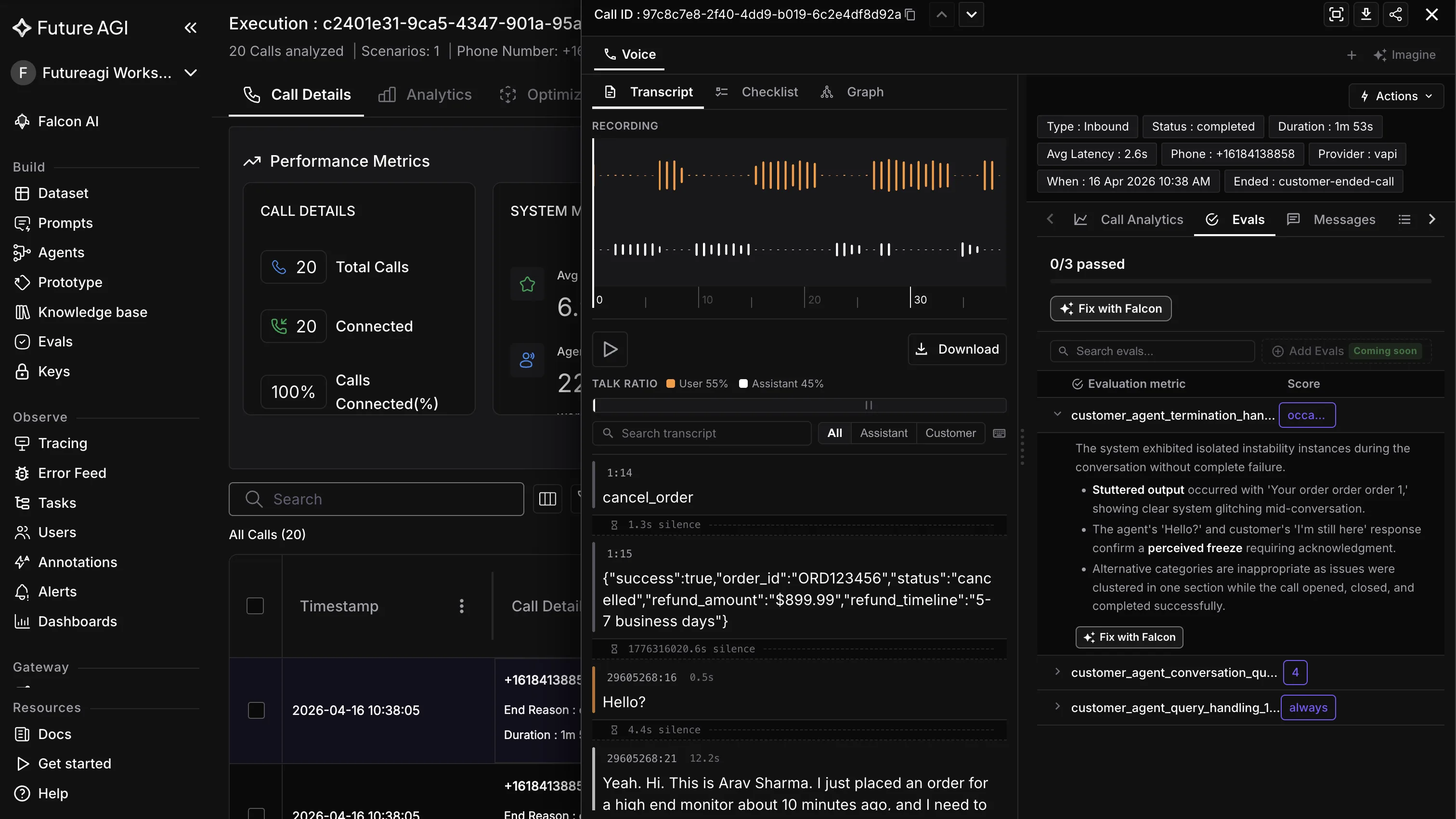
The ai-evaluation SDK ships 70+ built-in eval templates in Apache 2.0. The audio_quality rubric scores any TTS output on clarity, prosody, pronunciation, and naturalness on a 1 to 5 scale. Runs on every captured call automatically once your voice provider is wired into a FAGI Observe project.
from fi.testcases import MLLMTestCase, MLLMAudio
from fi.evals import Evaluator, AudioQualityEvaluator

elevenlabs_audio = MLLMAudio(url="https://your-cdn.example.com/calls/abc/elevenlabs.wav")
cartesia_audio = MLLMAudio(url="https://your-cdn.example.com/calls/abc/cartesia.wav")

case_eleven = MLLMTestCase(input=elevenlabs_audio, query="Score this TTS output")
case_cartesia = MLLMTestCase(input=cartesia_audio, query="Score this TTS output")

ev = Evaluator(fi_api_key="...", fi_secret_key="...")
results = ev.evaluate(
    eval_templates=[AudioQualityEvaluator()],
    inputs=[case_eleven, case_cartesia],
)
MLLMAudio accepts seven formats (.mp3, .wav, .ogg, .m4a, .aac, .flac, .wma) from URL or local path, with auto base64 encoding. Both ElevenLabs and Cartesia output formats are covered.
SSML snapshot regression catches drift after voice updates
The pattern: store a reference audio render of every named phrase that matters (brand names, product names, numbers, dates, regulated jargon). On every voice or model update, re-render the same phrase set and score the new audio against the snapshot.
For ElevenLabs, you’d snapshot your branded greeting with the specific voice ID and Pronunciation Dictionary version. For Cartesia, you’d snapshot the equivalent greeting with the Sonic 3.5 voice ID. When either provider ships a model update, the snapshot rubric flags drift before it reaches production. The same audio_quality scorer runs on both providers’ output, so the comparison stays apples-to-apples.
traceAI captures provider plus voice ID per span
traceAI ships 30+ documented integrations across Python and TypeScript, including dedicated traceAI-pipecat and traceai-livekit packages for voice frameworks. Instrumented spans capture provider name, voice ID, model version, and per-utterance latency as span attributes. That’s what lets you filter the dashboard by provider and compare audio_quality distributions side by side. For Vapi and Retell, use FAGI’s native dashboard-driven voice observability (provider API key plus Assistant ID) instead of an SDK instrumentor.
from fi_instrumentation import register
from fi_instrumentation.fi_types import ProjectType
from fi_instrumentation import FITracer

trace_provider = register(
    project_type=ProjectType.OBSERVE,
    project_name="voice_agent",
    set_global_tracer_provider=True,
)
tracer = FITracer(trace_provider.get_tracer(__name__))

def render_tts(text, provider, voice_id):
    model = "sonic-3.5" if provider == "cartesia" else "flash-v2.5"
    with tracer.start_as_current_span(
        "tts_call",
        attributes={
            "gen_ai.voice.tts.provider": provider,
            "gen_ai.voice.tts.voice_id": voice_id,
            "gen_ai.voice.tts.model": model,
        },
    ):
        return call_tts_api(text, voice_id, provider)
Filter by gen_ai.voice.tts.provider = elevenlabs versus gen_ai.voice.tts.provider = cartesia in the FAGI Observe dashboard and the per-provider distributions surface directly.
Custom voices from both in Run Prompt and Experiments
Inside the FAGI product, the Run Prompt and Experiments surfaces accept custom voices imported from both ElevenLabs and Cartesia. Paste the voice ID, the eval engine renders the audio using the custom voice, and audio_quality scores the result. That lets you A/B compare a cloned ElevenLabs brand voice against a Cartesia catalog voice on the same input text before shipping the routing decision to production.
ProtectFlash on audio output
For regulated workloads (healthcare, fintech, insurance, regulated consumer apps), Future AGI Protect is built on Google’s Gemma 3n foundation with LoRA-trained adapters per safety dimension per arXiv 2510.13351. Protect is multi-modal across text, image, and audio with two surfaces: rule-based Protect across the 4 documented safety dimensions (Content Moderation, Bias Detection, Security, Data Privacy Compliance) and ProtectFlash, the single-call binary classifier that gives you the sub-100ms inline path.
from fi.evals import Protect
from fi.testcases import MLLMTestCase, MLLMAudio

p = Protect()

def safe_tts_output(tts_audio_path):
    out = p.protect(
        inputs=MLLMTestCase(input=MLLMAudio(url=tts_audio_path), query="Scan this TTS output for safety"),

    )
    # Branch on the returned ProtectFlash verdict according to the SDK response shape.
    return out
ProtectFlash sits between the LLM response and the TTS leg or after the TTS leg on the audio output side. The verdict object lands on the FAGI span, so the trust and safety team can review denied responses in Error Feed.
Agent Command Center hosts the whole stack with RBAC, BYOC or multi-region, AWS Marketplace, and the cert set listed on the trust page: SOC 2 Type II, HIPAA, GDPR, CCPA, and ISO 27001 all certified.
Calibrated verdict
ElevenLabs wins voice realism, voice cloning, multilingual coverage, SSML depth, brand voice tooling, and SDK breadth. Cartesia wins streaming TTFA, WebSocket protocol design, and pricing at scale.
The router pattern (Cartesia for short utility responses, ElevenLabs for branded greetings and long-form expressive content, a fallback like OpenAI or Azure for outages) is what most production voice teams converge to once the workload mix is clear. The decision is not which provider is better; it’s which mix of providers your traffic shape needs.
Two deliberate tradeoffs
Async eval gating is explicit. agent-opt ships six prompt optimizers (Bayesian Search, Meta-Prompt per arXiv 2505.09666, ProTeGi, GEPA Genetic-Pareto per arXiv 2507.19457, Random Search per arXiv 2311.09569, PromptWizard) inside the Dataset UI and the Python library. Point a run at a dataset and an evaluator, pick an optimizer, execute. FAGI never auto-rewrites a production prompt without an explicit run plus a human approval gate. The loop is deliberate by design.
Native voice obs ships for Vapi, Retell, and LiveKit out of the box; everything else flows through Enable Others mode via the traceAI SDK (dedicated traceAI-pipecat and traceai-livekit packages plus 30+ documented integrations) or a webhook. That covers more than 90% of production voice stacks; deeper custom-runtime work is a code-path engagement.
Pitfalls when picking between ElevenLabs and Cartesia
Don’t pick on a single demo. Both providers ship excellent demo content; your real call traffic shape is what matters. Wire both into a FAGI Observe project, run audio_quality across a week of real traffic, then decide.
Don’t ignore the consent flow on cloning. Both providers gate cloning behind verbal consent. Your own pipeline should retain the consent artifact alongside the cloned voice ID. ProtectFlash is the defense-in-depth audio classifier.
Don’t lock in single-provider for the whole stack. The router pattern (Cartesia for utility, ElevenLabs for branded, fallback for outages) is the production architecture for a reason. Single-vendor lock-in becomes an outage risk and a quality ceiling.
Don’t skip SSML snapshot regression. Both providers ship model updates regularly. Brand name pronunciation drift after a voice or model switch is silent in transcript-only views. Snapshot plus audio_quality scoring catches it before it reaches users.
Related reading
- 7 best TTS providers for voice AI agents in 2026
- Voice AI observability for Vapi: a 2026 implementation guide
- How to implement voice AI observability in 2026
- 7 best voice agent monitoring platforms in 2026
Sources and references
- traceAI on GitHub: github.com/future-agi/traceAI
- ai-evaluation on GitHub: github.com/future-agi/ai-evaluation
- Future AGI Protect docs: docs.futureagi.com/docs/protect
- Agent Command Center docs: docs.futureagi.com/docs/command-center
- Error Feed docs: docs.futureagi.com/docs/observe
- arXiv 2510.13351 (Protect): arxiv.org/abs/2510.13351
- arXiv 2507.19457 (GEPA Genetic-Pareto): arxiv.org/abs/2507.19457
- arXiv 2505.09666 (Meta-Prompt bilevel optimization): arxiv.org/abs/2505.09666
- arXiv 2311.09569 (Random Search baseline): arxiv.org/abs/2311.09569
- Trust page (SOC 2 + HIPAA + GDPR + CCPA + ISO 27001): futureagi.com/trust
- W3C SSML 1.1 spec
- ElevenLabs (plain text reference)
- Cartesia (plain text reference)
Frequently Asked Questions
Which one should I pick for a real-time voice agent with a sub-500ms budget?
Which one has better voice cloning?
Can I use both in the same voice agent?
What's the pricing difference at production scale?
Which one has broader multilingual coverage?
How do I evaluate audio output from either provider without listening to every call?
Are there safety concerns specific to voice cloning that I need to handle?
Tested and ranked: 7 best TTS providers for voice AI agents 2026, with real per-character pricing, streaming TTFA latency, voice cloning, SSML support.

Implement voice AI observability for Vapi in 2026: native FAGI dashboard via Assistant ID, traceAI SDK path, audio_transcription and conversation rubrics.
Implement voice AI observability in 2026 for Vapi, Retell, LiveKit, Pipecat. Real traceAI code, latency SLOs, audio metrics, live eval scoring.