Choosing the Right LLM Evaluation Platform for Production: 10 Critical Factors
A 10-factor checklist for choosing an LLM evaluation platform for production: ground-truth-free scoring, error localization, online eval, data handling, and more.
Table of Contents
You shipped the feature. Evals were green in the dev notebook. Two weeks later a support ticket lands: the assistant confidently invented a refund policy, and your evaluation tool had waved that exact response through with a passing score. The score was never the problem. The platform you chose to produce it was.
That refund-policy miss was not bad luck; it was baked in at the demo. The platform earned the buy on a clean dev-loop test set, then hit production and needed labeled data you do not have, returned a number with no idea which field broke, and was never built to watch live traffic. This guide is the checklist that catches those three gaps before you commit. Here are the 10 factors that actually separate evaluation platforms once real users arrive, and how to answer each one.
TL;DR: choose an LLM evaluation platform that scores quality without ground truth, localizes failures to the exact field or step, covers your eval types out of the box, and runs online on production traffic, not just offline before launch. Everything else is secondary to those four.
If you are new to the space, start with our gentle introduction to LLM evaluation. If you are weighing whether to build instead, read how to build an LLM evaluation framework from scratch first, because most of these factors are exactly what you would have to build yourself.
Why choosing an LLM evaluation platform for production is harder than it looks
In development you control the inputs. You have a curated test set, a golden answer for each case, and time to read every output by hand. Production removes all three. Traffic is unlabeled, it is unbounded, and it shifts under you. The platform that felt great on 50 notebook examples can quietly fail on the three things production demands: scoring without a reference answer, pointing at the cause of a failure, and keeping up with live volume at a sane cost.
Most buyer checklists skip these questions because they are the uncomfortable ones, the places a platform is most likely to fall short. These are the ten that actually predict whether a platform survives production. Treat them as a scorecard, the Production Eval Readiness Test, and a platform should clear at least eight of the ten before it touches your stack. Full disclosure: we build one of these platforms (FutureAGI), so under each factor we show how we handle it. Use the factor to judge any platform, ours included.
The 10 critical factors to score before you buy
The Production Eval Readiness Test. Score each factor pass or fail. Aim for eight or more before you commit.
| # | Factor | Pass if the platform… |
|---|---|---|
| 1 | No ground truth | Scores quality with no labeled reference |
| 2 | Error localization | Points at the field or step that failed |
| 3 | Coverage and custom metrics | Ships the evaluators your domain needs and lets you add your own |
| 4 | Online eval at scale | Scores live production traffic async, without blocking your app |
| 5 | Eval models and cost | Runs cheap local checks and dedicated eval models, not a frontier judge on every call |
| 6 | Multimodal | Scores more than text, including image and voice-agent conversations |
| 7 | Feedback loop | Lets human labels feed back to recalibrate the judge, not score once and drift |
| 8 | Data path | Clear data handling, self-host or your-region options |
| 9 | Open SDK, CI, tracing | Open-source SDK that drops into your CI gate and tracing |
| 10 | Judge trust | Shows reasoning behind every score |
1. Does it score quality without ground truth?
Why it matters: production traffic has no golden answers. If your platform needs a labeled reference for every check, you either stop evaluating most traffic or you pay to label it forever.
What to look for: reference-free evaluators that judge faithfulness, relevance, and safety from the input and output alone.
What to avoid: “First, upload your labeled dataset.” A tool that cannot move without ground truth is a dev-loop tool wearing a production badge.
How FutureAGI fits: fi.evals runs ground-truth-free. evaluate("faithfulness", output=response, context=context) returns a quality score with no labeled reference, because the Turing judge models reason over the input and output directly. You score the traffic you will never hand-label, not just the sample you will.
2. When a check fails, does it tell you what broke?
Why it matters: a bare 0.42 tells you something is wrong and nothing about where. In production you are debugging at 2 a.m., and “the output is bad” is not a lead.
What to look for: field-level or step-level attribution that points at the offending input, retrieved chunk, or tool call.
What to avoid: a single scalar per response with no reasoning trail.
How FutureAGI fits: error localization is a named feature, not an afterthought. Pass error_localizer=True to evaluate(...) and the result exposes an error_localizer field that attributes the failure to the specific input that caused it, for example the retrieved context rather than the output, with the judge’s reasoning attached. It works at the field level for single calls and at the turn level for conversations, so a failed multi-turn run points you to the exact turn. The cost-aware pattern: score everything with a cheap evaluator first, then re-run only the failures with error_localizer=True, so every red result arrives pre-triaged with the root cause.
3. Does it cover the eval types you need, and let you add your own?
Why it matters: RAG groundedness, tone, toxicity, code correctness, and task success are all different measurements, and your definition of “good” isn’t generic. A platform with three fixed metrics forces you to build the rest yourself. A medical summarizer and a sales email writer fail in ways no off-the-shelf metric will catch, so without custom checks you’re writing that logic from scratch anyway.
What to look for: a broad library of ready-made evaluators plus real support for custom ones, so your own logic runs in the same scoring pass as the built-in checks.
What to avoid: “We do similarity scoring” as the whole pitch, or a fixed metric list you can’t extend.
How FutureAGI fits: fi.evals ships 50-plus ready-made evaluators, including Factual Accuracy, Groundedness, RAG evaluation, Toxicity, Tone, and Code Syntax, all callable by name, and you can define your own alongside them. You use what exists and add what doesn’t, all in one scoring pass.
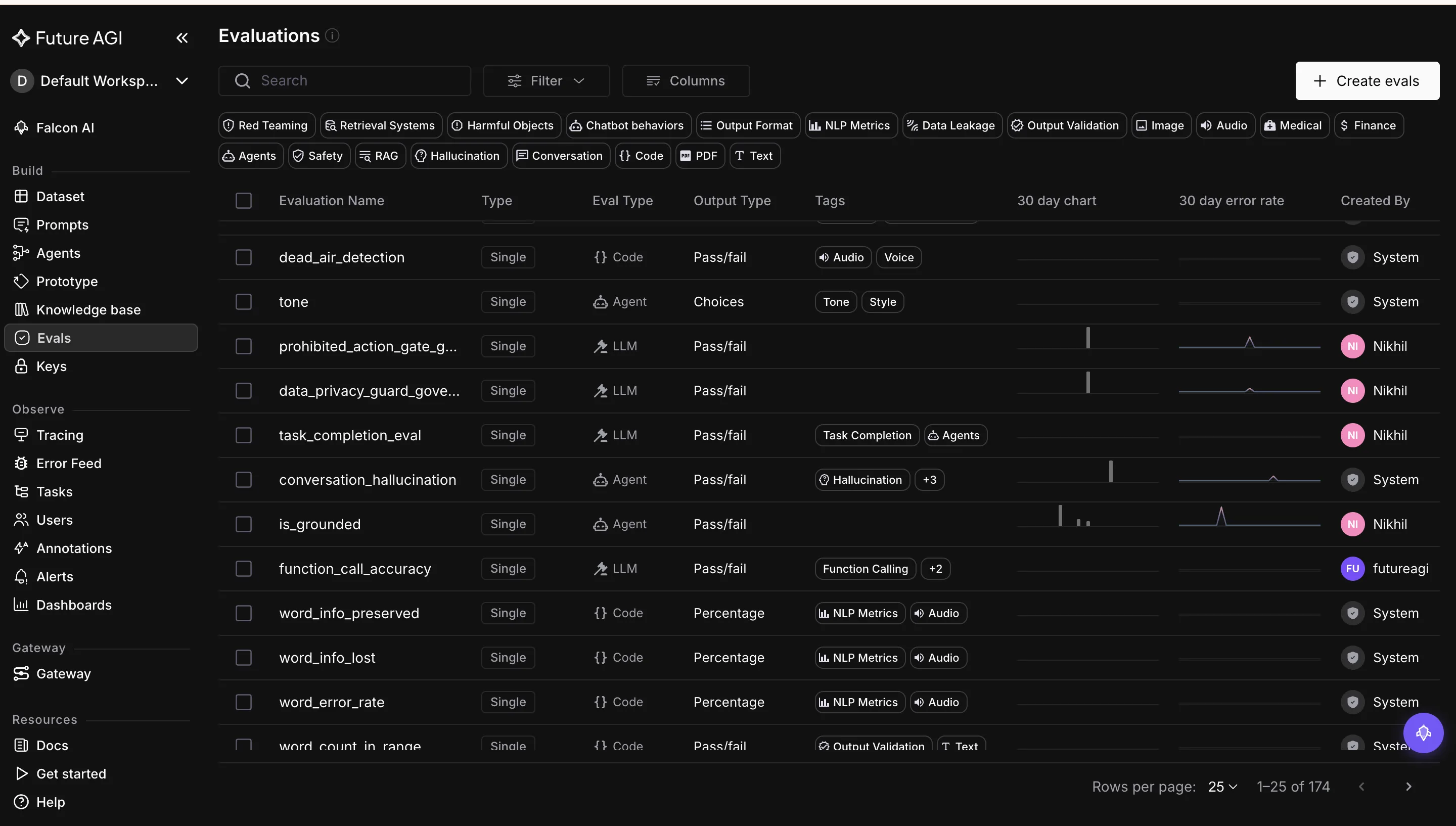
4. Can it evaluate live production traffic at volume, not just the dev loop?
Why it matters: pre-deployment eval catches known failure modes; production monitoring catches everything else, and that is usually where the surprises are. But scoring live traffic only helps if it keeps up with the firehose without backing up your pipeline or adding latency to the user path.
What to look for: online evaluation that scores real traffic continuously, with async and batch submission, non-blocking polling, and sampling, so scoring never blocks your app or scales cost linearly with traffic.
What to avoid: a platform that only runs against a static test set you trigger by hand, or synchronous-only scoring you have to rate-limit by hand.
How FutureAGI fits: evaluator.submit(...) returns an Execution handle immediately and scores out of band, and get_execution(id) polls non-blocking, so you evaluate live responses at traffic speed, not request speed. In production, traceAI captures spans and a judge scores sampled spans async, joining the score back to the span so every span carries a quality verdict. You control cost with sampling: a small percentage of normal traffic, but 100 percent of errors and the most expensive spans, and 100 percent of anything that scores below your threshold, and a score under the bar can fire an alert. Pre-deployment and production use the same evaluators, so a green dev score means the same thing in prod. See our guide to external evaluation pipelines for LLM apps.
5. What does it cost in latency and dollars at volume?
Why it matters: if every check is a frontier LLM-as-judge API call, evaluation cost scales with traffic and can rival inference cost. Some checks do not need a model at all, and the ones that do should not need the most expensive model on the market.
What to look for: deterministic local metrics for the checks that run as code, and dedicated, purpose-built eval models for the checks that need reasoning, rather than a general-purpose frontier model billed per token on every score.
What to avoid: an architecture where a regex-level check still costs you a judge call, or where the only judge on offer is a frontier API you pay full price for at production volume.
How FutureAGI fits: fi.evals has a local execution mode with 20+ heuristic metrics (regex, contains, JSON schema, BLEU, ROUGE, semantic similarity) that run offline on CPU, at zero API cost, with runtime scanners under 10 ms. The reasoning-heavy checks run on FutureAGI’s own Turing eval models (TURING_LARGE, TURING_SMALL, TURING_FLASH), purpose-built for scoring and tiered so you pick accuracy or low latency, which is cheaper and faster at volume than renting a frontier LLM as judge. Hybrid mode routes the local-capable checks locally and sends only the rest to the eval model, so you are not paying a model call for a regex.
6. Can it evaluate more than text?
Why it matters: production AI is not all text. If you ship a multimodal assistant or a voice agent, a text-only platform leaves the part most likely to fail unscored, and you end up bolting on a second tool.
What to look for: evaluators that score image inputs alongside text, and a path to test voice and conversational agents, not just single text responses.
What to avoid: a platform that scores text and quietly drops every other modality.
How FutureAGI fits: the Turing judge models are multimodal and score text and image inputs in the same evaluator call. For conversational and voice agents, the simulate SDK drives multi-turn conversations against synthetic personas and scenarios and returns a pass or fail verdict per conversation, so the agent is tested end to end rather than one text turn at a time.
7. Does the judge get better as you correct it?
Why it matters: A judge you calibrate once drifts out of sync as your traffic changes. If you score once with no way to feed corrections back, the judge slowly stops matching what your reviewers would say, and you don’t find out until it’s badly wrong.
What to look for: annotation queues and a human review path where reviewer labels feed back to recalibrate the evaluator over time, not a fixed score you take or leave.
What to avoid: a closed judge you can’t correct, with nowhere to record human labels and no way to retune against them.
How FutureAGI fits: low-confidence and low-scoring spans go to annotation queues for human review, and those human labels feed back to retune the evaluators, with any rubric changes reviewed by a person before they ship. The judge keeps tracking what your reviewers would say instead of quietly drifting as your traffic shifts, which is the one failure a static judge can’t catch on its own.
8. Where does your production data go when it is judged?
Why it matters: evaluation sends your prompts, outputs, and retrieved context to a judge. For regulated or sensitive workloads, that data path is a procurement gate, not a footnote.
What to look for: clear data handling, deployment options (self-hosted or your own region), and the compliance posture your industry needs before any traffic flows.
What to avoid: no straight answer on where production traffic is processed, or no option beyond a single shared cloud.
How FutureAGI fits: the Agent Learning Kit (ai-evaluation) is open source (Apache 2.0) and runs locally, so heuristic checks never leave your environment, and the gateway is self-hostable, so the data path is yours to control rather than a black box.
9. Does it fit the stack you already run, open source and in CI?
Why it matters: an evaluation tool that lives outside your pipeline gets used once and abandoned. It has to drop into your SDK, your CI gate, and your tracing, and an open-source SDK means you can run checks with no platform login and read exactly what the code does before it touches your data.
What to look for: an open-source SDK, a CI/CD gate that fails the build on a regression, and OpenTelemetry-based tracing so eval scores attach to spans.
What to avoid: a UI-only product with no programmatic path, or a closed SDK you cannot run locally or in CI.
How FutureAGI fits: the Agent Learning Kit (ai-evaluation) is an SDK first (from fi.evals import Evaluator) and open source under Apache 2.0, so checks run in CI with no platform login. It slots in as a CI gate that fails the build on a regression (see CI/CD LLM eval with GitHub Actions), and scores attach to OpenTelemetry traces so a failing eval is one click from the span that produced it.
10. Can you trust the judge itself?
Why it matters: an LLM-as-judge that is inconsistent or opaque just moves the reliability problem. You need to see why it scored what it scored.
What to look for: explainable reasoning on every score and consistent, calibrated judging.
What to avoid: a score with no reasoning and no way to audit drift in the judge.
How FutureAGI fits: every EvalResult carries the judge’s reason alongside the score, so you audit the decision instead of trusting a number. Scores come from FutureAGI’s proprietary Turing models (TURING_LARGE, TURING_SMALL, TURING_FLASH) that back the evaluator library, and the judges are calibrated against human labels, held to a high agreement bar (measured as Cohen’s kappa) before a judge ships, with bias controls for position and verbosity, so the score tracks what a human reviewer would say rather than drifting on its own.
A quick decision framework
Use the factors above, but weight them by what you are shipping.
| Choose | When | What decides it |
|---|---|---|
| A platform built for ground-truth-free, online eval | You run user-facing LLM features on unlabeled production traffic | Factors 1, 2, 4 |
| A platform with strong local and hybrid metrics | Your volume is high and finance is asking why eval costs as much as inference | Factor 5 |
| A platform with deep RAG and agent coverage | You run retrieval or multi-step agents (pair this with our definitive guide to AI agent evaluation) | Factors 2 and 3 |
| A platform with a real SDK and CI gate | Evaluation has to be part of how you ship, not a dashboard someone checks weekly | Factor 9 |
| A platform with multimodal coverage | You ship images or a voice agent | Factor 6: FutureAGI scores text and image in one evaluator and tests voice agents through its simulation SDK, so you do not need a second tool |
Where FutureAGI fits
The ten factors above get you a score you can trust. In production the score is the start, not the end, and two things FutureAGI does past the scorecard are what earn it a place on a shortlist for live traffic.
It can block, not just observe. The same evaluators that score your traffic also run inline as guardrails (Protect): prompt injection, PII leaks, and toxic or unsafe content are caught and the request is blocked before it ever reaches a user. Most eval tools only tell you a bad output happened after the fact; here, detection and prevention share one rubric. The invented refund policy from the top of this post is exactly the class of failure a guardrail stops at the door.
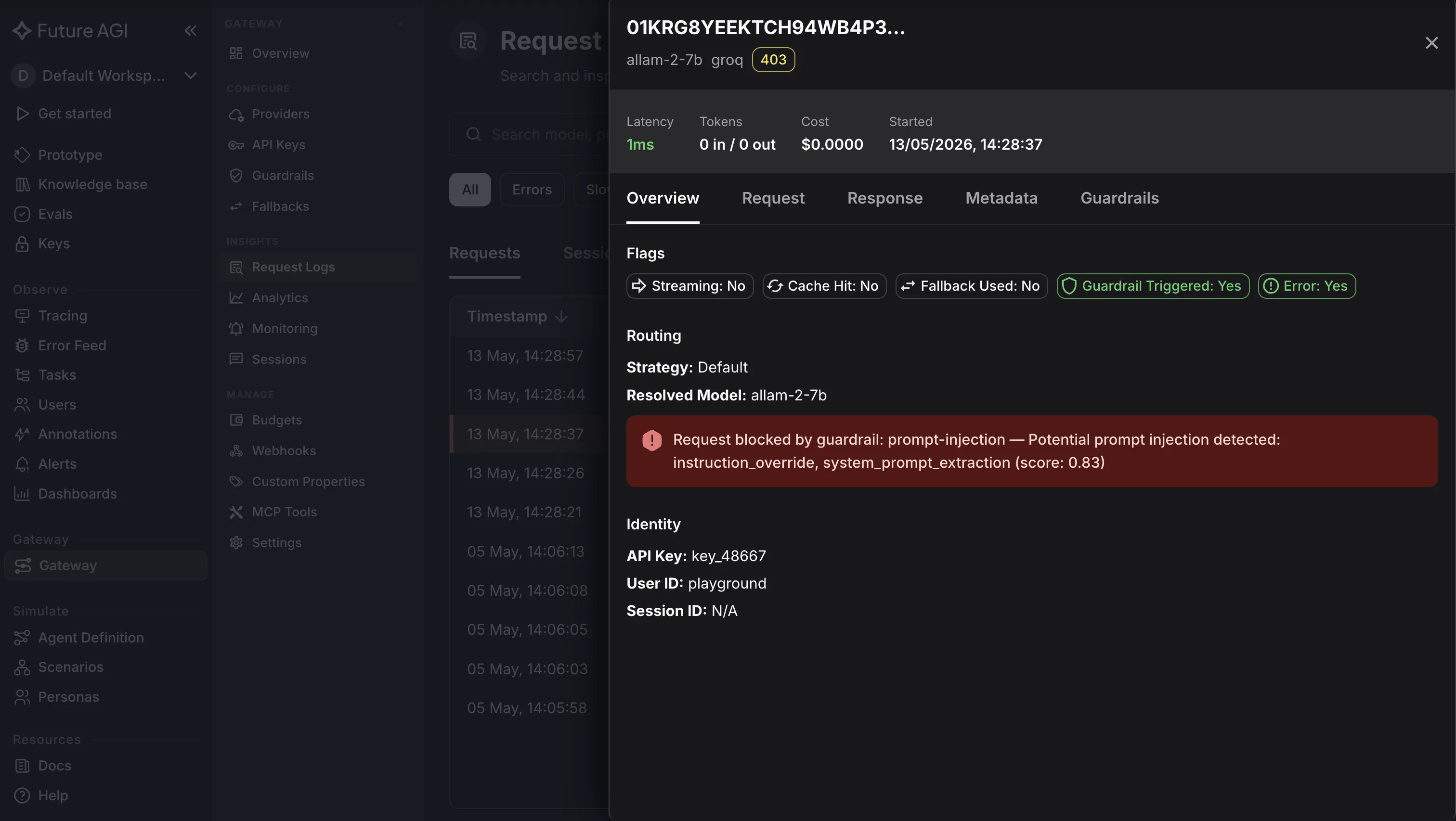
Failures cluster by root cause, not one row at a time. At production volume a red score is not rare, you get thousands. FutureAGI’s Error Feed groups failing spans into failure modes by semantic similarity, so you fix one pattern, for example groundedness dropping on multi-turn refund questions, instead of reading every transcript that tripped it.
If the 10 factors map to your stack, the fastest way to test the claims above is to run a real evaluator against your own outputs. See the FutureAGI evaluation platform and the evaluation docs.
What to read next
- New to evaluation? Start with a gentle introduction to LLM evaluation.
- Weighing build vs buy? Read how to build an LLM evaluation framework from scratch for an honest cost picture.
- Evaluating agents, not just single calls? See the definitive guide to AI agent evaluation.
- Ready to gate releases on eval? Follow CI/CD LLM eval with GitHub Actions.
FAQ
What is an LLM evaluation platform? A system that scores the quality of model and agent outputs, for example faithfulness, groundedness, toxicity, and task success, both before deployment and on live production traffic. A production-grade platform does this without needing a labeled answer for every input.
Do I need ground truth to evaluate an LLM in production? No, and you should not depend on it. Production traffic is unlabeled, so a platform that requires a golden answer per case cannot evaluate most of what users actually send. Ground-truth-free evaluators score quality from the input and output directly.
Is offline evaluation enough? No. Offline eval catches the failure modes you already know about. Online evaluation on live traffic catches the rest, which is usually where the surprises show up. Choose a platform that runs both with the same evaluators.
How is error localization different from a normal eval score? A normal score tells you a response is bad. Error localization tells you which field, retrieved chunk, or step caused it, so you can fix the cause instead of guessing.
Build or buy? If you only need one or two checks and have the team to maintain them, building is reasonable. Most of the 10 factors here, especially online eval, hybrid local metrics, and error localization, are expensive to build and maintain, which is the case for buying. See how to build an LLM evaluation framework from scratch to judge the cost honestly.
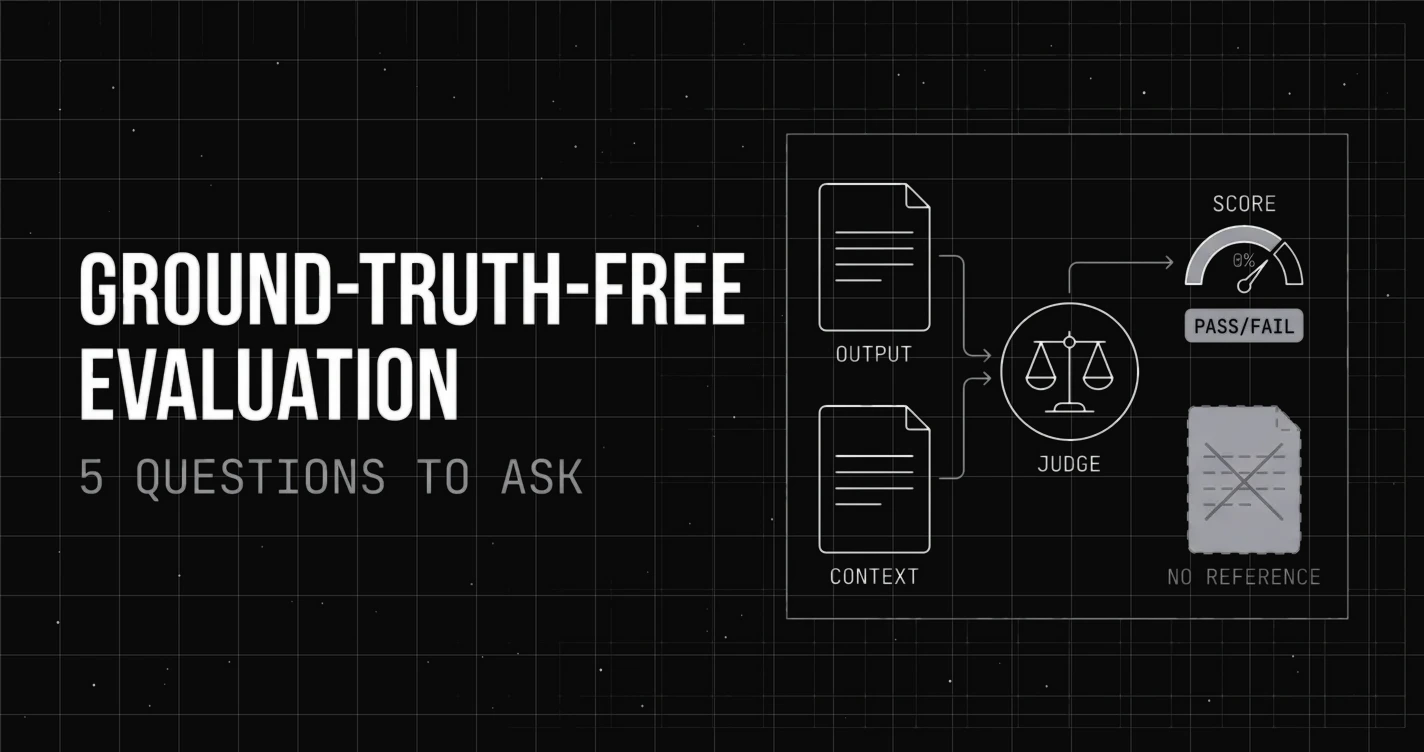
Five questions for choosing a ground-truth-free eval tool with no labeled data: reference-free scoring, judge calibration, error localization, production fit.

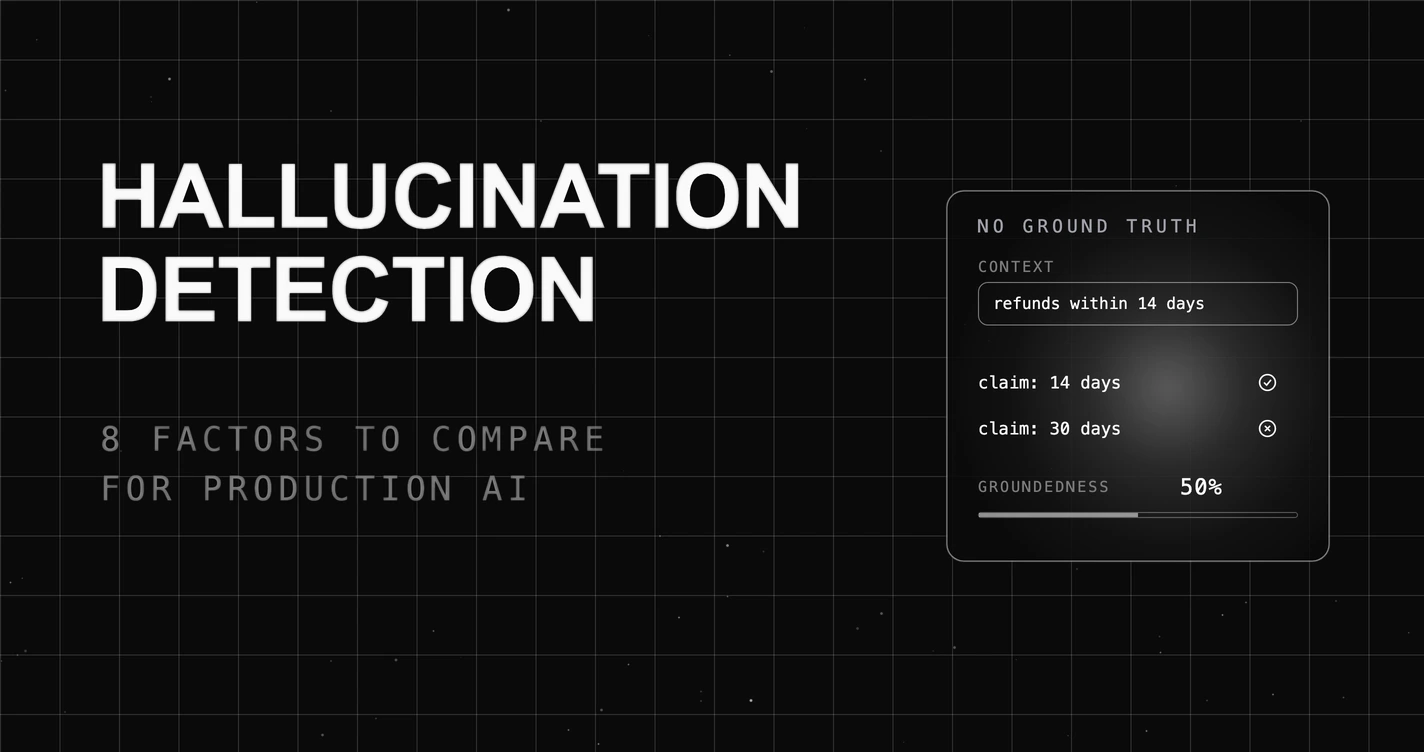
Eight factors for choosing a hallucination detection tool for production AI, from catching errors with no reference answer to blocking bad responses live instead of flagging them once they've already reached users.
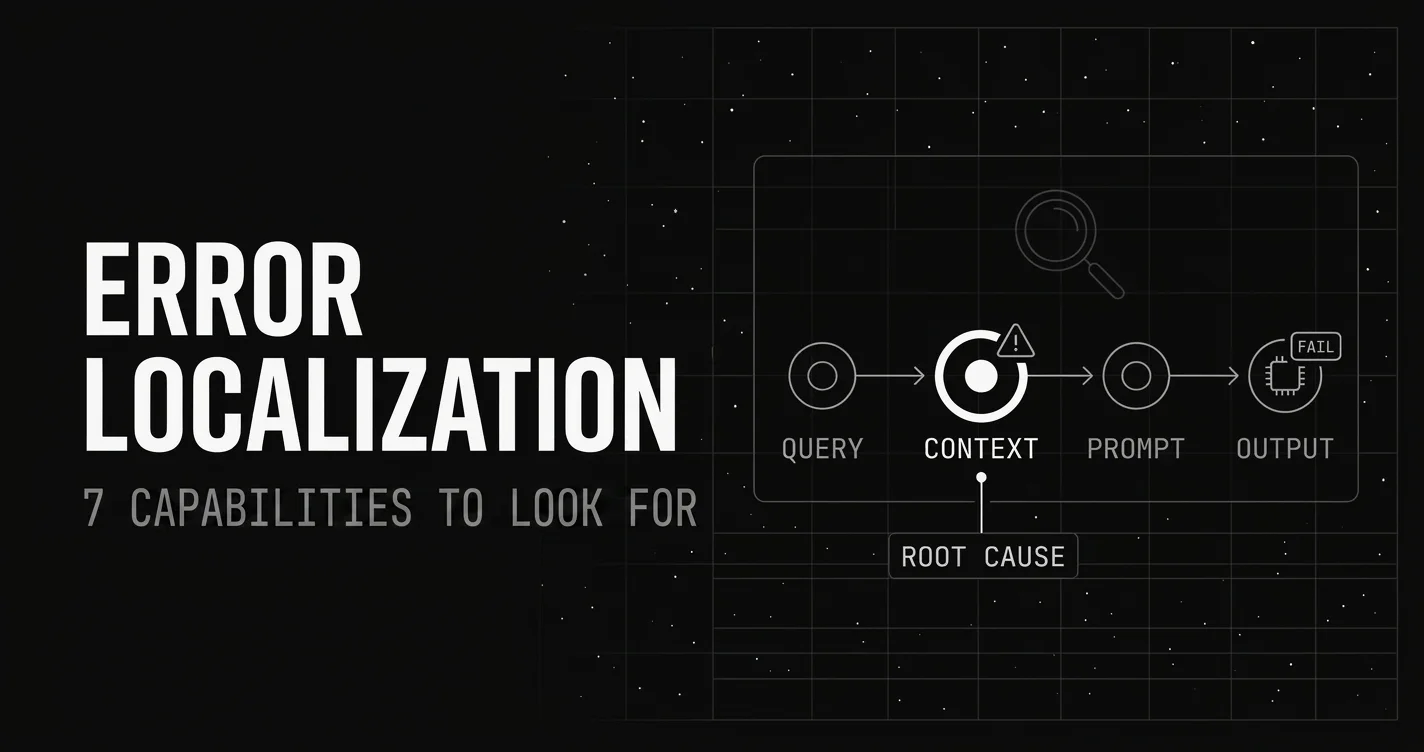
Seven capabilities to look for in error localization when choosing an LLM eval platform: field-level attribution, span-tied failures, reasoning, and production fit.