Choosing the Right Compliance Monitoring Tool for AI Governance: 7 Questions to Ask
Seven questions for choosing an AI governance compliance monitoring tool: runtime guardrails, PII and prompt-injection enforcement, audit trails, self-hosting.
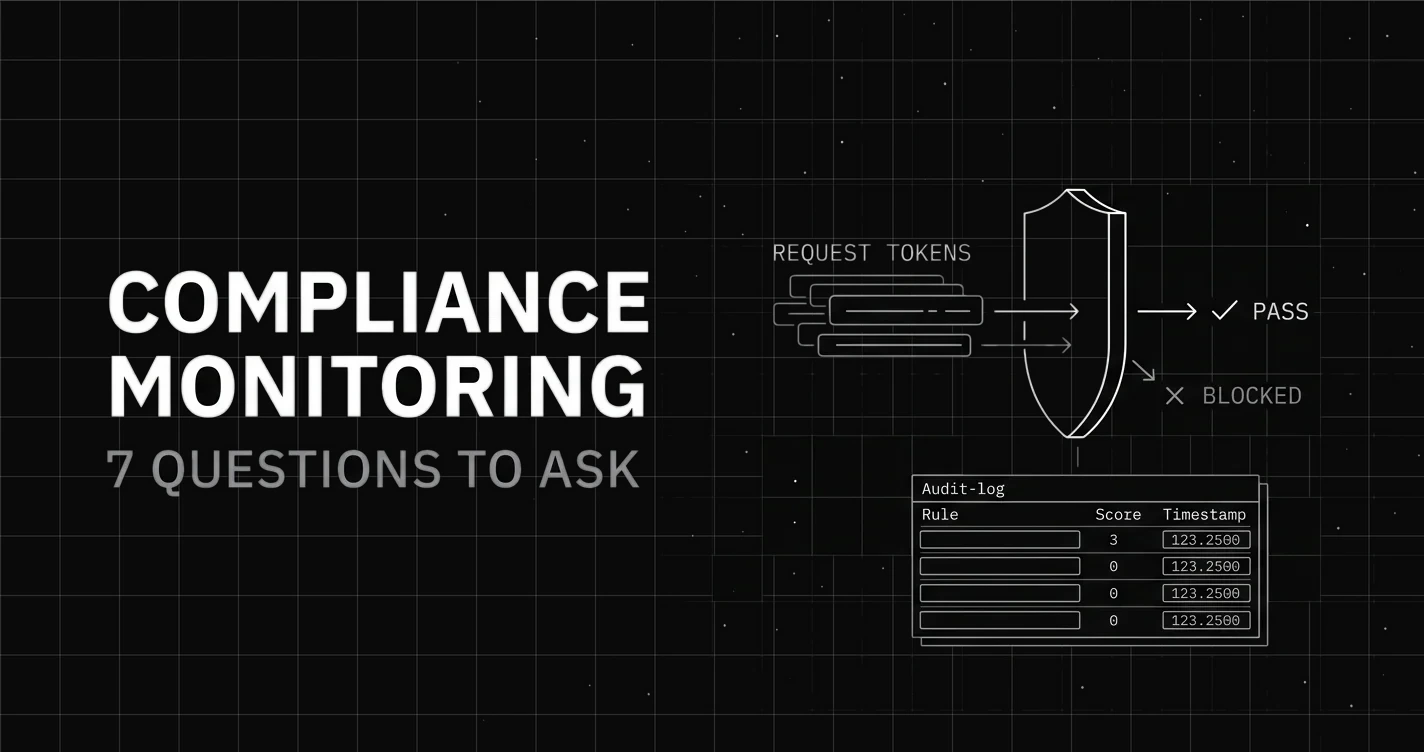
Table of Contents
Your AI feature passed the governance review. The risk register was filled in, the model card was signed off, and the EU AI Act checklist was green. Three weeks later a user pasted a support transcript into the chatbot, the model echoed another customer’s full name and account number back, and nothing stopped it or even recorded it. The governance tool was never in the request path. It documented the policy; it never enforced it.
A compliance monitoring tool for AI governance exists to inspect what your AI actually does on every live request, and to enforce and log the policy in real time. That runtime layer, compliance guardrails plus an audit trail, is what most tools sold for “AI governance” never touch, because they never see a request. Here are the 7 questions that separate a runtime monitoring tool from a policy binder, and how to answer each.
TL;DR: choose a compliance monitoring tool that inspects live model traffic, enforces in real time (blocks PII, prompt injection, and toxic or biased output), writes an audit record of every decision, lets you encode custom policies, and can run inside your own environment. Document-only tools are governance theater.
If you want the regulatory background first, read our LLM safety and compliance guide for the frameworks and deadlines that drive these questions.
Why choosing a compliance monitoring tool for AI governance is harder than it looks
The word “compliance” hides two very different products. One is governance, risk, and compliance (GRC) software: risk registers, model cards, policy attestations, vendor questionnaires. The other is runtime monitoring: software that sits in the request path and inspects each prompt and response. Both call themselves “AI compliance,” and a buyer comparing them on a feature grid will miss that only one of them ever sees a model call.
The failure mode is specific. A policy-only tool can show an auditor that you have a PII policy. It cannot show that a PII leak was caught on Tuesday at 14:28, blocked before the user saw it, and logged with the rule and score that stopped it. When a regulator or a customer security team asks for evidence, the policy document is necessary and not sufficient. The 7 questions below are weighted toward the runtime layer, because that is the layer most “governance” tools skip and the layer an incident actually tests.
The 7 questions to ask before you choose
The Runtime Governance Audit. Score each question pass or fail. Aim for six or more.
| # | Question | Pass if the tool… |
|---|---|---|
| 1 | Inspects live traffic | Sees every real request and response, not just stored policy |
| 2 | Real-time enforcement | Can block a violation before the user sees it, not alert after |
| 3 | Regulator-named coverage | Catches PII, prompt injection, toxicity, and bias |
| 4 | Audit trail | Logs each decision with rule, score, reason, and identity |
| 5 | Custom policy | Lets you encode your own rules, not just toggle defaults |
| 6 | Data path and residency | Runs in your environment, no forced vendor cloud |
| 7 | Governance paperwork | Pairs cleanly with your GRC and documentation layer |
1. Does it inspect live model traffic, or only document policy?
Why it matters: a violation happens in a request, not in a spreadsheet. A tool that does not see the request cannot catch the violation, no matter how complete its policy library is.
What to look for: the tool sits inline in the request path and reads every prompt and response, in production, not only in a pre-launch test.
What to avoid: the product is a dashboard of policies and attestations with no path to inspect a single live call.
How FutureAGI fits: Protect runs as a set of guardrail scanners inline on the request, so every prompt and response is inspected before it moves on. Policy-only governance tools miss this entirely because they were built to store documents, not to read traffic.
2. Can it enforce in real time, or only alert after the fact?
Why it matters: an alert that a PII leak happened means the leak already reached the user. For a user-facing system, after-the-fact is too late.
What to look for: the tool can block a request or return a safe fallback before the response is delivered, and can also flag-and-pass for lower-risk rules.
What to avoid: monitoring-only, where every control is a post-hoc notification with no ability to stop the response.
How FutureAGI fits: Protect rules carry an action: block returns a safe fallback, flag logs and passes the request through. Rules run at the before-LLM stage, so a prompt injection or PII violation is stopped before the model is even called, not reported after the user has it.
3. Does it cover the violations regulators actually name?
Why it matters: “content safety” as a single toggle is not enough. The EU AI Act, GDPR, and HIPAA name specific harms: personal data exposure, manipulation, discriminatory output. Your tool has to map to those, not to a generic score.
What to look for: discrete coverage for PII and data privacy (GDPR, HIPAA), prompt injection and jailbreaks, toxic content, and bias, each as its own check you can turn on and tune.
What to avoid: one undifferentiated “safety” number with no way to see which category failed.
How FutureAGI fits: Protect covers core safety dimensions (data privacy compliance for PII and GDPR/HIPAA, security for prompt injection and system-prompt extraction, and content moderation for toxicity), and these sit alongside a broader library of 18+ built-in scanners. You enable the ones your regulation names and see exactly which fired. Our prompt injection defense field guide and PII redaction in LLM calls walk through two of these in depth.
4. Does every decision leave an audit trail you can hand an auditor?
Why it matters: compliance is proven with evidence, not intent. An auditor asks what was blocked, when, why, and for whom. A monitoring tool that enforces but does not record cannot answer that.
What to look for: a per-decision record with the rule that fired, a score, a human-readable reason, the timestamp, and the user or session identity, queryable after the fact.
What to avoid: enforcement with no log, or logs so thin they cannot reconstruct an incident.
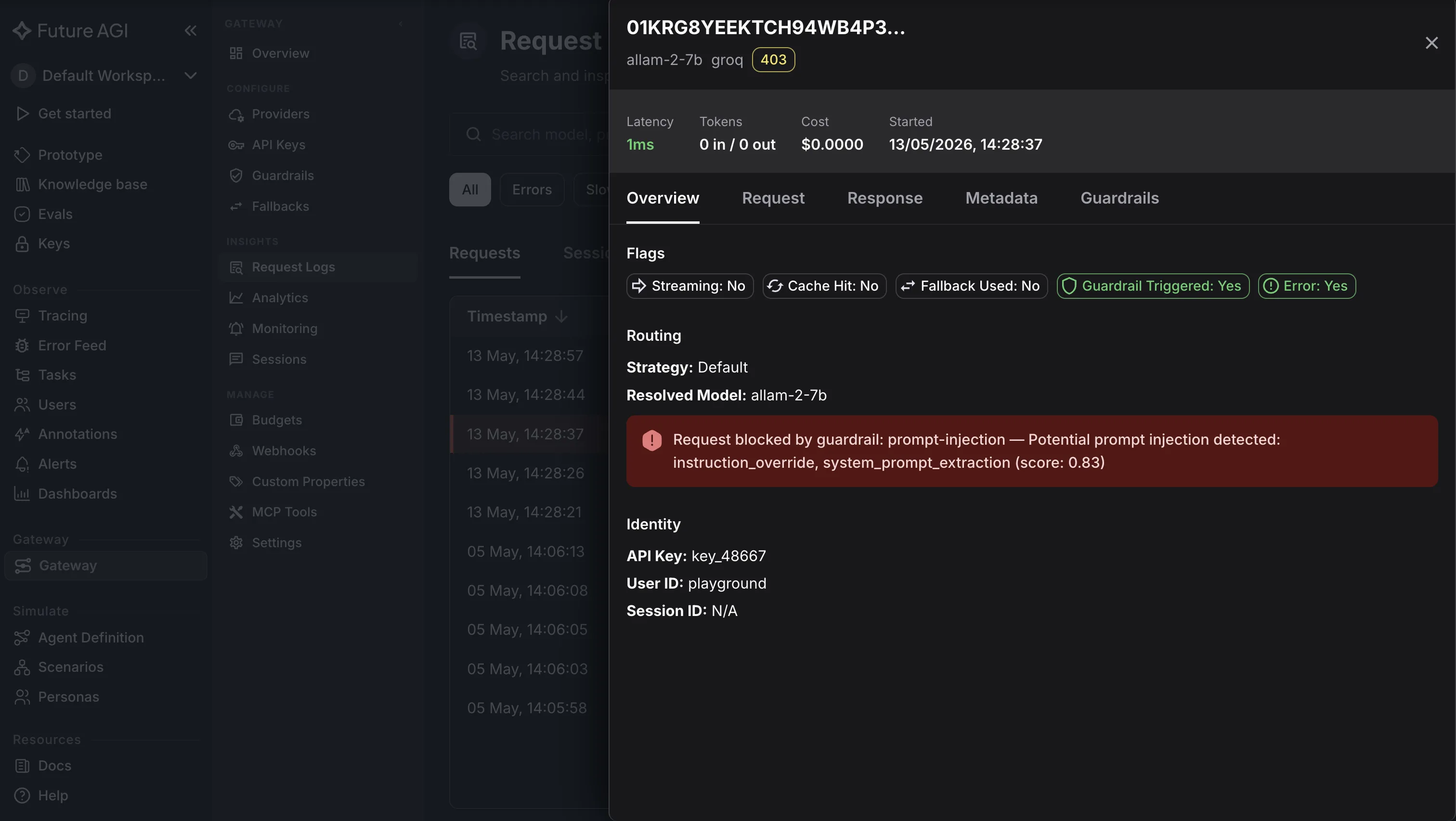
How FutureAGI fits: every guardrail decision is logged with the rule, score, reason, timestamp, and identity, and surfaces in the Agent Command Center; traceAI also emits a guardrail span on the same trace as the model call, so the block and the request it stopped sit in one record. That is the per-request evidence the compliance audit trails a security review asks for. Policy tools produce attestations, not per-request proof.
5. Can you encode your own policies, not just toggle defaults?
Why it matters: your highest-risk rules are domain-specific: a banned competitor mention, a medical-advice boundary, a refund-policy limit. A fixed checklist of built-in defaults will never cover them.
What to look for: custom rule expressions, topic and blocklist controls, and a way to bring your own check (a webhook or function) into the same enforcement path.
What to avoid: a closed set of built-in checks with no extensibility.
How FutureAGI fits: alongside the built-in scanners, Protect includes custom expression rules, topic restriction, blocklist, and a bring-your-own-guardrail webhook, so a domain policy runs in the same path and produces the same audit record as a built-in check.
6. Does it stay in your data path, and can you self-host for residency?
Why it matters: a tool that inspects every prompt sees all of it. For GDPR data residency, HIPAA, or a regulated VPC, shipping that traffic to a vendor’s cloud can be the thing that fails the audit.
What to look for: a self-hostable deployment (Docker, Kubernetes, air-gapped, in-VPC) and a permissive license, so your sensitive traffic never leaves your boundary.
What to avoid: a SaaS-only tool that forces every request through a third-party cloud with no residency option.
How FutureAGI fits: the Agent Command Center that runs Protect is Apache 2.0 and self-hostable via Docker, Kubernetes, or air-gapped on-prem, so you can keep guardrail inspection entirely inside your own environment.
7. Does it also produce the governance paperwork?
Why it matters: runtime evidence is half of compliance. You still need risk registers, model cards, control mappings, and audit-management workflows for an ISO 42001 or SOC 2 review. A tool that pretends to do both usually does one badly.
What to look for: clean export and integration so runtime evidence flows into the GRC system your compliance team already runs, rather than a thin built-in document module.
What to avoid: a runtime tool that claims to replace your GRC suite, or a GRC suite that claims to do runtime enforcement. Be skeptical of either.
Where FutureAGI is honest about this one: this is the factor where Protect is not the whole answer. Protect is the enforcement and evidence layer; it is not a GRC documentation suite. If what you need is the risk-register, attestation, and audit-management paperwork, a dedicated governance platform (the category that FairNow, Diligent, and PwC sell into) is the right tool, and Protect should feed it the per-request evidence rather than try to replace it.
A quick decision framework
Weight the questions by what you are actually buying.
| Choose | When | What decides it |
|---|---|---|
| A runtime monitoring tool | Your AI is user-facing and a live PII leak, prompt injection, or toxic response is a real risk | Questions 1, 2, 3 |
| For the audit trail | A regulator or enterprise security team will ask you for per-request evidence | Question 4 |
| For custom policy and residency | Your hardest rules are domain-specific or your data cannot leave your environment | Questions 5 and 6 |
| A GRC platform instead | What you actually need is risk registers, attestations, and audit-management workflows | Question 7: a different category of tool |
Where FutureAGI fits
The seven questions get you a runtime layer that inspects traffic, blocks violations, and logs each decision. Here is what FutureAGI does past that checklist, on the governance surfaces a compliance review reaches for after the basics are covered.
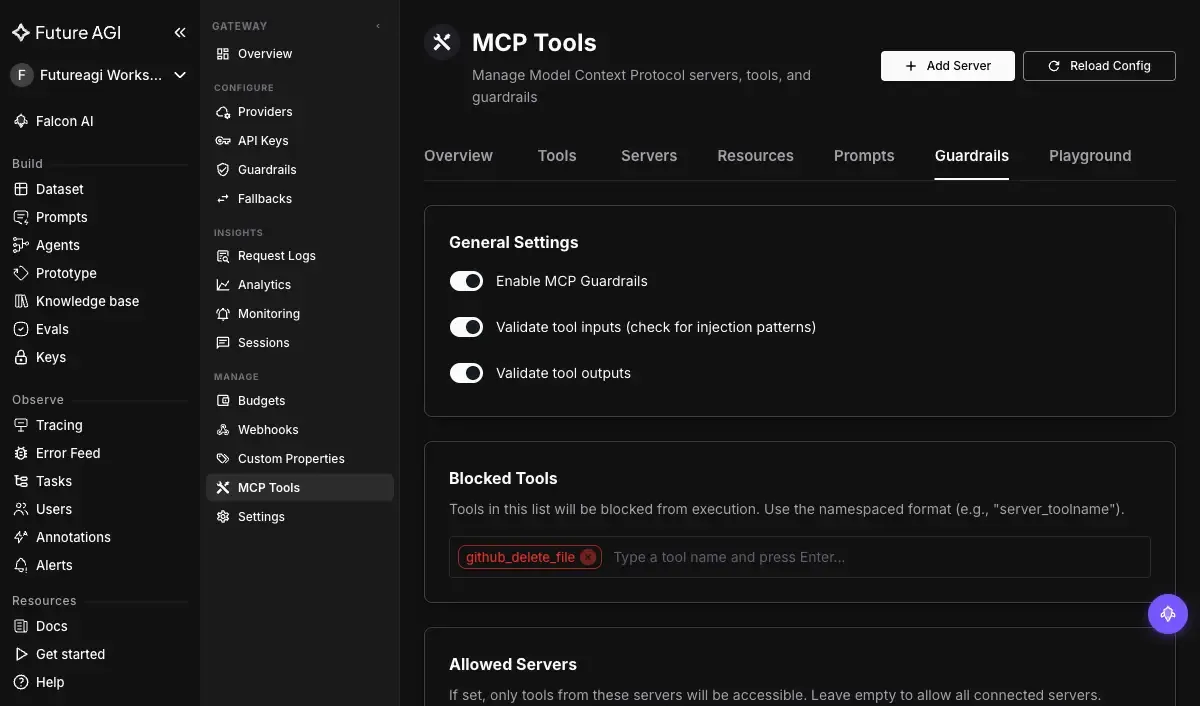
It governs tool calls, not just prompts. Compliance for an agent is more than scanning text; it is controlling what the agent is allowed to do. Protect’s MCP guardrails validate tool inputs for injection patterns, scan tool outputs before they return to the agent, and let you whitelist which MCP servers and tools a key can reach. A coerced prompt cannot call a tool you blocked, so a destructive action stays out of scope at the gateway boundary.
The same scanners audit your past traffic, not just live requests. The guardrail scanners that run inline can also run offline as evaluators over historical traces. When a regulator or security team asks whether a rule held last quarter, you replay stored traffic through the same rubric and score it after the fact. Your retroactive audit uses the exact checks production enforced, not a separate report that can drift from the live policy.
Violations cluster into incidents, not a wall of alerts. Error Feed groups failing traces into named issues by root cause, so fifty PII-redaction failures from one backend timeout read as one incident, not fifty. For a compliance team that means one audit response per cluster and a clear view of which violation pattern is actually recurring, instead of triaging each blocked request alone.
Where FutureAGI is not the pick: if what you need is the governance paperwork layer, the risk registers, control mappings, and attestation workflows for an ISO 42001 or SOC 2 audit, a dedicated GRC platform is the right tool and Protect is not it. Protect is the runtime enforcement and evidence layer that feeds that paperwork; it does not replace it.
To put a guardrail in front of your own model and see the audit record, see the FutureAGI Agent Command Center and the Protect docs.
What to read next
- Building the full program, not just one control? Read AI agent compliance and governance: the runtime playbook.
- Comparing the enforcement layer specifically? See the best AI agent guardrails platforms for how the category lines up.
- Need to know what is actually binding? Read LLM safety and AI regulations: what binds and what does not.
- Want the deep detail on the enforcement engine? Study FutureAGI Protect for enterprise guardrails.
Frequently Asked Questions About AI Compliance Monitoring Tools
What is an AI compliance monitoring tool?
A tool that watches your AI system’s live requests and responses for policy and regulatory violations, then enforces or logs them. The strong ones inspect every model call in real time, block or flag violations like PII leaks and prompt injection, and write an audit record of each decision. That is different from a governance dashboard that only stores policies and attestations.
How is compliance monitoring different from AI governance documentation?
Governance documentation is the paperwork layer: risk registers, model cards, policy attestations, and audit-management workflows. Compliance monitoring is the runtime layer: it actually inspects model traffic and enforces the policy on each request. You usually need both, but a tool that only produces documents never sees a single user prompt, so it cannot catch a live violation.
Does a compliance monitoring tool need to block requests, or is alerting enough?
For anything user-facing, blocking matters. An alert tells you a PII leak or a successful prompt injection already reached the user. Runtime enforcement stops it before the model responds. Choose a tool that can both block and flag, so high-risk rules block and lower-risk rules log for review.
Which AI regulations does runtime monitoring help with?
Runtime guardrails and audit logs map to the technical-controls and record-keeping expectations in the EU AI Act, GDPR and HIPAA (for PII and data privacy), NIST AI RMF, and ISO/IEC 42001. The monitoring tool does not certify you, but it produces the per-request evidence an auditor asks for.
Can one tool handle both runtime enforcement and governance paperwork?
Rarely well. Runtime guardrail platforms enforce and log; GRC platforms manage risk registers, attestations, and audit workflows. The practical setup is a runtime monitoring tool that produces evidence, feeding a governance platform that organizes it. Pick the runtime layer for what it does to a live request, not for its document templates.
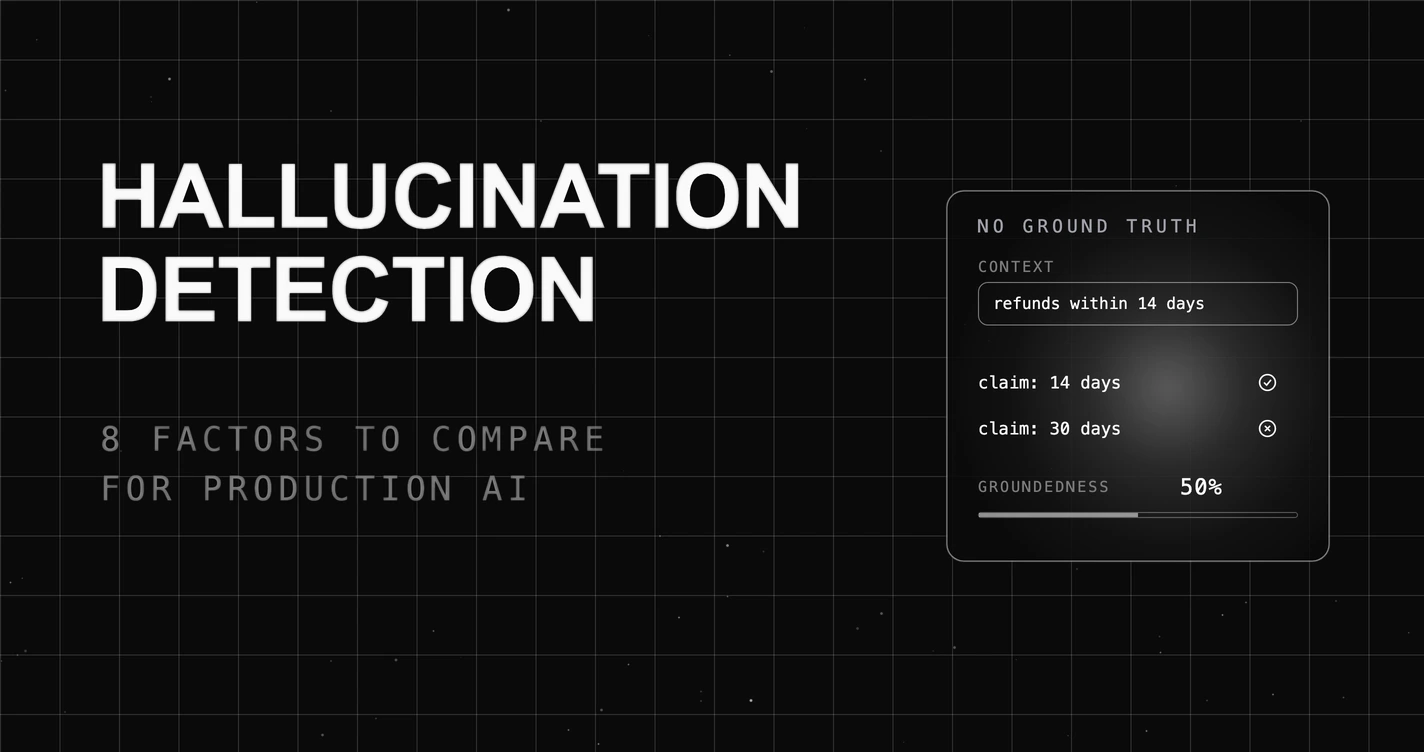
Eight factors for choosing a hallucination detection tool for production AI, from catching errors with no reference answer to blocking bad responses live instead of flagging them once they've already reached users.

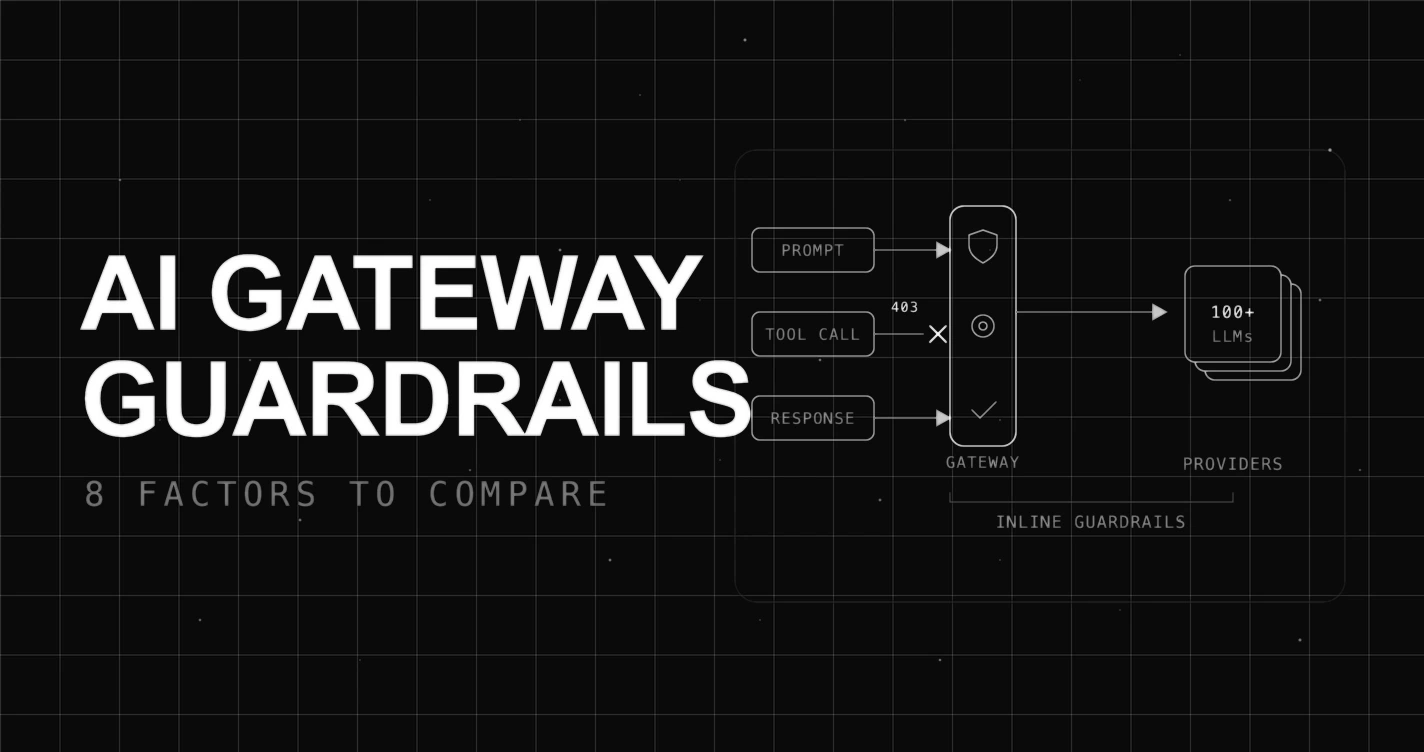
Eight factors for choosing an AI gateway with built-in guardrails: inline enforcement, scanner coverage, output and tool-call guarding, and self-hosting.

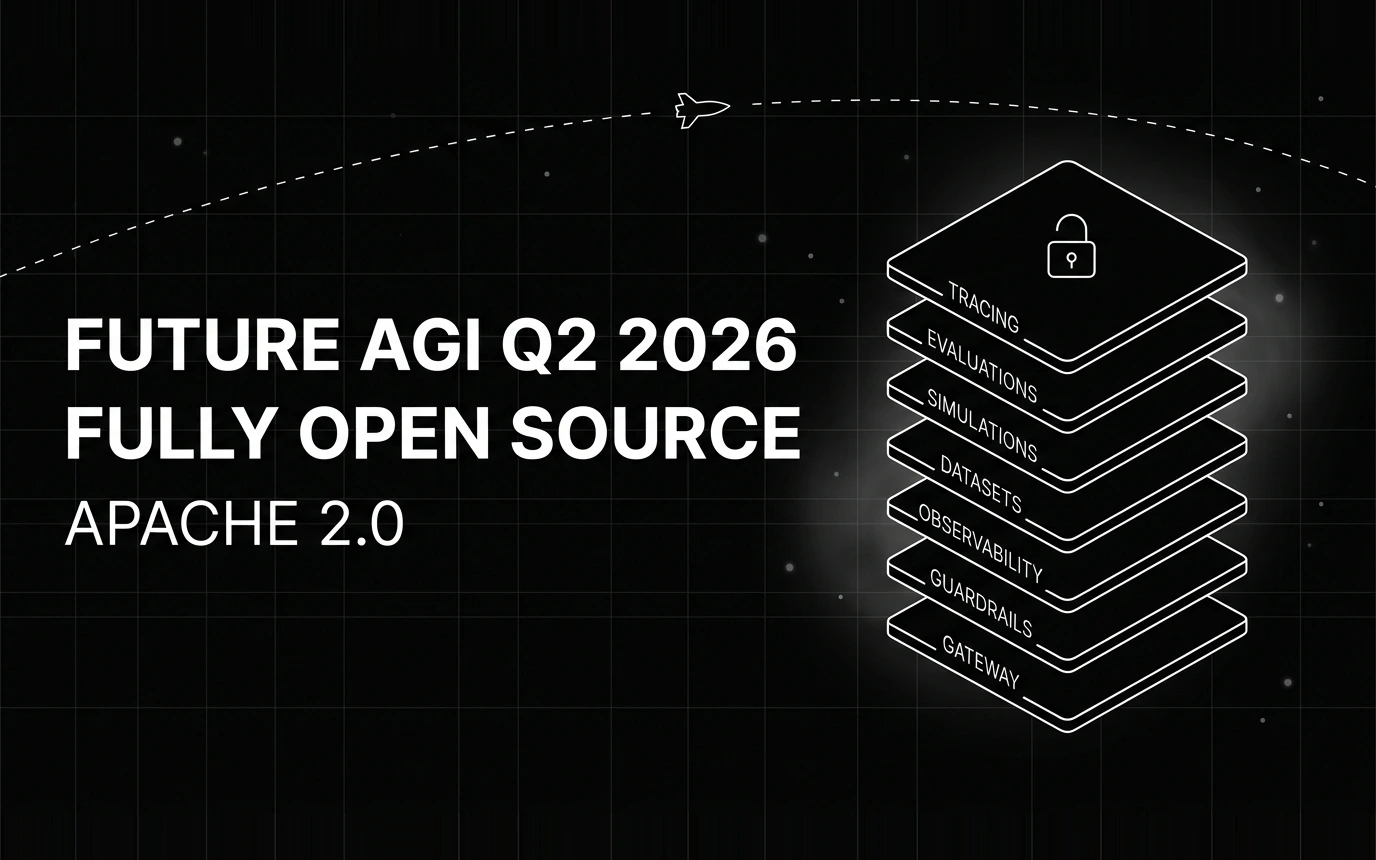
Inside Future AGI open source in Q2 2026: the platform shipped under Apache 2.0, Error Feed and the Agent Command Center went live, traces hit billions.