Best Voice AI Models in May 2026: STT, TTS, and Voice Agent Stack
Best Voice AI May 2026: compare Deepgram, Cartesia, ElevenLabs, Retell, and Vapi for STT, TTS, latency budgets, and production voice agents.
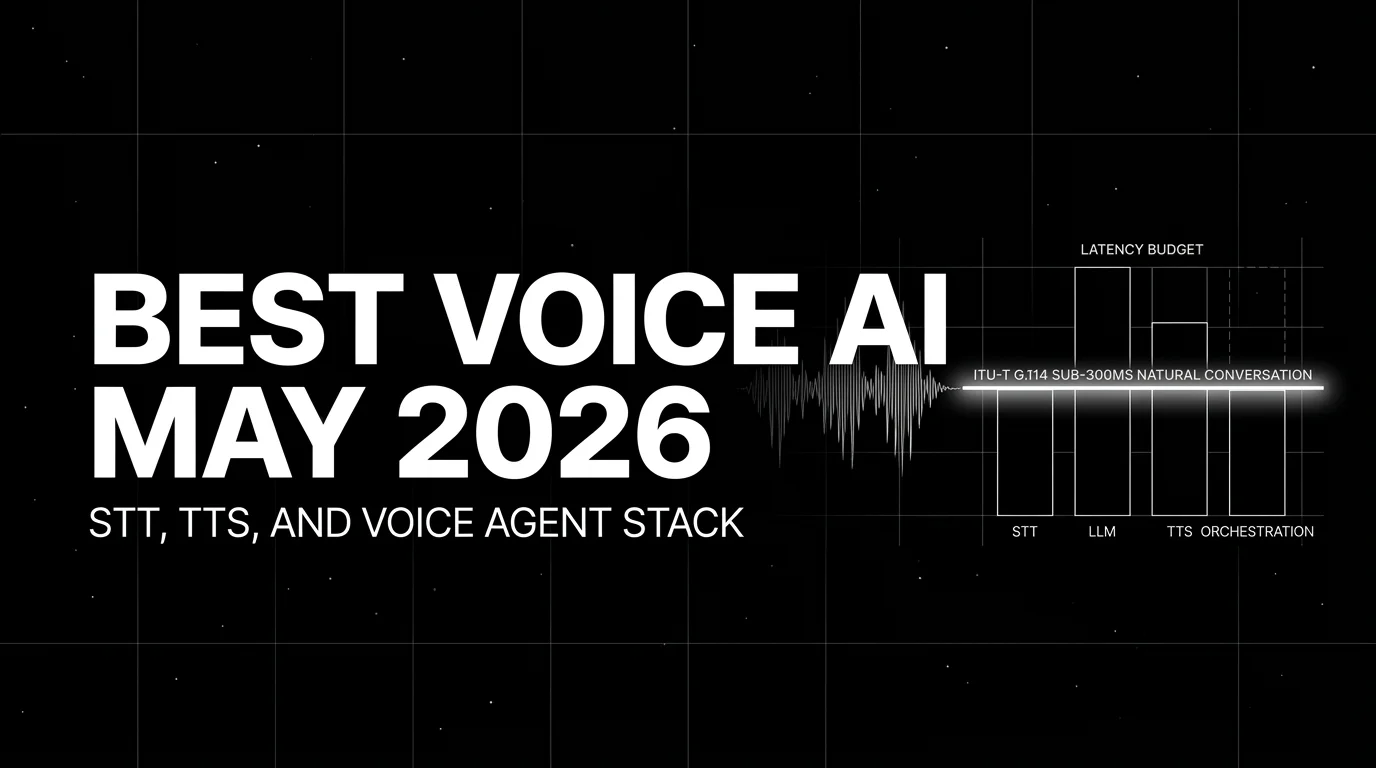
Table of Contents
Voice agents are the highest-velocity AI product category in 2026. The components are mature: streaming STT under 300ms, TTS under 100ms first audio, LLM inference under 300ms with the right model. Putting them together to land inside the practical voice-agent round-trip budget (sub-500ms aggressive, sub-700ms widely accepted), with ITU-T G.114 mouth-to-ear delay in mind, is now an engineering problem, not a research one. This guide picks the components that actually compose into a production voice agent.
TL;DR: Best voice AI per layer, May 2026
| Layer | Best pick | Why | Pricing |
|---|---|---|---|
| Streaming STT (production) | Deepgram Nova-3 | 6.84% WER, sub-300ms streaming | $0.0077/min |
| STT with intelligence | AssemblyAI Universal-2 | 6.88% WER (AssemblyAI benchmark) plus summarization, entity, and sentiment | ~$0.0025/min base |
| Broad multilingual batch STT | Google Cloud Chirp | 11.6% WER, 125+ languages | varies |
| Open-source STT | Whisper Large V3 | 7.4% WER avg, 99+ languages | self-host |
| Accent / education | ElevenLabs Scribe | 5% or lower WER on excellent-accuracy languages with diarization | ElevenLabs tier |
| Turn-taking detection | Deepgram Flux | Purpose-built end-of-turn | bundled |
| TTS for sub-500ms agents | Cartesia Sonic Turbo | 40ms TTFA, 15+ languages | premium tier |
| TTS quality and cloning | ElevenLabs v3 Multilingual | 32+ languages, voice cloning | premium |
| TTS instructable voice | OpenAI gpt-4o-mini-tts (instructable) + gpt-realtime (speech-to-speech) | ~200ms, 50+ languages | API |
| TTS emotion | Hume Octave | ~150ms | API |
| TTS long-form | PlayHT | ~250ms, 30+ languages | API |
| Voice agent platform default | Retell AI | ~620ms E2E, $0.07/min, HIPAA included | $0.07/min |
| Voice agent at scale | Vapi | 300M+ cumulative calls, 99.9% uptime | varies |
| Voice quality first | ElevenLabs Conversational | v3 quality + Flash v2.5 (~75ms) for latency | premium |
| Self-hosted bundle | Deepgram Voice Agent | Deepgram-reported sub-400ms first-response with Flux | bundled |
| Outbound phone volume | Bland AI | Norm builder, tiered per-minute | tiered |
| STT on real-world / business audio | Gladia Solaria-3 | #1 on real English production audio (9.6% WER) and Earnings22 (6.4%); bundled audio intelligence | Bundled |
If you only read one row: Deepgram Nova-3 + Flux for STT, Cartesia Sonic Turbo for TTS, GPT-5 mini or Gemini 3.1 Flash for the LLM, Retell AI to orchestrate. That stack hits sub-700ms end-to-end and runs at production scale today.
The story of voice AI in May 2026
Component-level voice AI moved slowly through 2024 and into early 2025. Whisper Large led open-source STT, ElevenLabs led high-end TTS, and end-of-turn detection plus sub-second voice agents were still research-grade. In 2026 every layer reached production maturity in parallel: Deepgram Nova-3 plus Flux on STT, Cartesia Sonic Turbo on TTS, and Vapi/Retell/LiveKit/Pipecat on orchestration.
On the STT side, Deepgram Nova-3 ships sub-300ms streaming latency at 6.84% WER. AssemblyAI Universal-2 ships streaming with bundled speech intelligence (summarization, entity extraction, sentiment). On AssemblyAI’s own benchmark Universal-2 reports 6.88% WER on cleaner segments and 14.5% on the harder streaming mix, so the right comparison depends on your audio profile. ElevenLabs Scribe v2 reports 5% or lower WER on excellent-accuracy languages with diarization for accent and education use cases. Google Cloud Chirp leads batch accuracy at 11.6% WER across 125 languages. Whisper Large V3 remains the open-source default at 7.4% WER average. The differentiation is now along three axes: streaming latency, intelligence on top of transcript, and language coverage.
On the TTS side, Cartesia Sonic Turbo ships 40ms time-to-first-audio. That number is the structural fact about voice agents in May 2026. Hitting round-trip turn latency under 500ms requires the lowest-latency TTS (Cartesia Sonic Turbo). ElevenLabs v3 leads quality and cloning. Hume Octave leads emotion. OpenAI gpt-4o-mini-tts (instructable) and gpt-realtime (speech-to-speech) leads instructable voice character. PlayHT leads conversational long-form. The picks split cleanly by axis.
On the orchestration side, Vapi has processed 300M+ cumulative calls at 99.9% uptime (99.99% on enterprise) with sub-500ms average latency. Retell AI sits at 620ms measured end-to-end with HIPAA included. ElevenLabs Conversational, Deepgram Voice Agent, and Bland AI each carve a vertical. The platforms ship in days what custom builds ship in quarters.
A sub-500ms round-trip turn is now reachable for production voice agents with the right component picks. ITU-T G.114 sets the one-way mouth-to-ear preferred delay at 150ms with 400ms tolerable, and that constraint shapes any voice-agent budget but does not translate to a flat sub-300ms STT+LLM+TTS target. Most production teams accept up to 700ms round-trip before users notice the delay. Either bar is achievable in May 2026 if you choose compatible low-latency components and measure end-to-end performance.
Best speech-to-text (STT) models in May 2026
Gladia Solaria-3: #1 model on real-world business audio
The pick when accuracy on messy production audio matters more than streaming latency. Gladia’s Solaria-3 was benchmarked against all leading speech-to-text providers on public datasets and human-annotated real customer calls — and ranks #1 in accuracy on exactly the audio that breaks other models: business speech, conversational telephone audio, and noisy real-world recordings.
Specs:
- #1 on English real-customer audio
- Earnings22 (AA cleaned) with a 6.4% WER. The only in the market model under 7%
- #1 on Switchboard, the hardest conversational benchmark, staying ahead of ElevenLabs, Deepgram, and AssemblyAI
- Noisy-audio WER: 1.4% — best among major production models
- Superior performance across 5 European languages: EN, FR, DE, ES, IT
- Bundled audio intelligence (diarization, translation, named-entity recognition, key-data extraction)
- Async transcription; on-premise deployment available; EU/US data residency
Best for: Meeting assistants and note-takers, contact-centers, European-language audio where transcript accuracy on names, numbers, and domain terms is the product.
Skip if: You need real-time streaming or the broadest language set. For real-time, Gladia’s Solaria-1 supports sub-103 ms partials and 100+ languages (42 exclusive) with code-switching. For formal/institutional or clean read-speech specifically, Solaria-1 is also stronger.
Deepgram Nova-3. The streaming STT default
The right pick for any production voice agent that needs streaming transcription with low latency. Nova-3 is the streaming-optimized variant of Deepgram’s Nova family, tuned for sub-300ms latency budgets that voice agents require.
Specs:
- Streaming WER: 6.84% (median across benchmarks)
- Latency: sub-300ms streaming
- Languages: 30+ for streaming, 50+ for batch
- Pricing: $0.0077/min streaming; $0.0043/min batch
- Pairs with Deepgram Flux for end-of-turn detection
Best for: Production voice agents where end-to-end latency is the binding constraint. Real-time captioning. Live conversational AI.
Skip if: You need batch transcription with maximum accuracy across rare languages (use Google Cloud Chirp). You need bundled speech intelligence on top of transcript (use AssemblyAI Universal-2).
AssemblyAI Universal-2. Streaming with intelligence
The pick when transcript alone is not enough. Universal-2 ships streaming STT with summarization, entity detection, and sentiment analysis bundled.
Specs:
- WER: AssemblyAI reports 6.88% on cleaner streaming segments and 14.5% on harder material per their Universal-2 research blog
- Bundled speech intelligence (summarization, entity, sentiment)
- Pricing: ~$0.0025 per minute base, intelligence features add cost
- 99+ languages
Best for: Voice agents where post-call analytics, entity extraction, or summarization are part of the product. Customer support call intelligence. Compliance and audit workflows.
Skip if: Pure transcript accuracy is what you need (use Deepgram Nova-3 or ElevenLabs Scribe).
Google Cloud Chirp. Broadest multilingual batch coverage
Google’s batch transcription option. The right pick when you can wait seconds instead of milliseconds and need consistent batch transcription across the broadest language set.
Specs:
- Batch WER: 11.6%
- Languages: 125+
- Pricing: varies by tier and language
Best for: Asynchronous transcription pipelines, long-form content, multi-language workloads where streaming latency does not matter.
Skip if: You need streaming for live voice agents (use Deepgram Nova-3).
Whisper Large V3. The open-source default
The gold standard for self-hosted STT. OpenAI’s Whisper Large V3 has been the open-source baseline since 2023 and continues to lead the open-weight STT category.
Specs:
- WER: 7.4% average across mixed benchmarks
- Parameters: 1.55 billion
- Languages: 99+
- Self-hosted on commodity inference hardware
- Multilingual capabilities strong on European languages, weaker on rare African and Asian languages
Best for: Self-hosted deployments at scale (above 500,000 minutes per month where commercial STT cost exceeds GPU economics). Privacy-sensitive workloads. Edge inference.
Skip if: You need streaming under 300ms (Whisper is batch-optimized). You need bundled intelligence on top of transcript.
ElevenLabs Scribe. Accent and education specialist
The pick when accent normalization and detailed pronunciation feedback matter. Scribe ships with diarization (speaker separation) and is positioned for language-learning and accessibility workloads.
Specs:
- WER: 5% or lower on excellent-accuracy languages with diarization
- Strong accent normalization
- Bundled with ElevenLabs subscription tiers
Best for: Language learning, education, accessibility, transcription products that need speaker labels and accent-aware output.
Skip if: You need general-purpose streaming STT (use Deepgram Nova-3).
Deepgram Flux. The turn-taking layer
Not a standalone STT, but worth a card because it solves a problem the rest of the category does not. Generic STT APIs transcribe speech and stop. Flux models when the user has finished speaking and the agent should respond.
Best for: Any production voice agent. Worth more than 1 to 2 points of WER accuracy in production user-experience terms.
Skip if: Your voice product is not turn-based (transcription-only, dictation, etc.).
Best text-to-speech (TTS) models in May 2026
The TTS category is now optimization on three separate axes. Latency, naturalness, and emotion control. They do not move together. Pick by your dominant constraint.
Cartesia Sonic 3. The latency leader
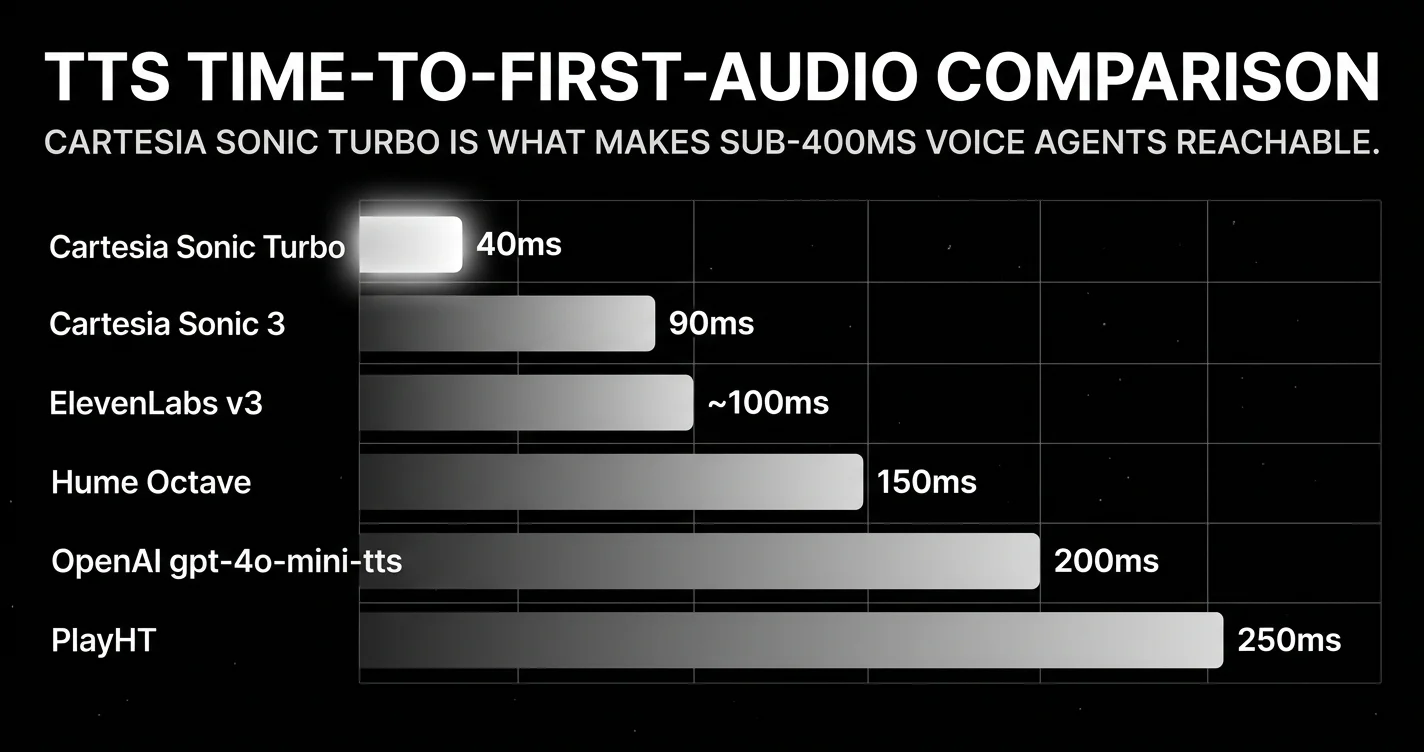
The structural pick when round-trip turn latency is a binding constraint. Cartesia Sonic Turbo ships 40ms time-to-first-audio, which leaves enough latency budget for the rest of the sub-500ms to sub-700ms voice-agent stack.
Specs:
- TTFA: 40ms (Turbo variant), 90ms (standard)
- Languages: 15+
- Voice cloning supported
- Streaming output
Best for: Sub-500ms round-trip turn-latency voice agents. Real-time interactive applications. Telephony where latency drives perceived call quality.
Skip if: Voice quality and cloning fidelity are more important than latency (use ElevenLabs v3).
ElevenLabs v3 Multilingual. Voice quality and cloning leader
The category-defining model for voice quality and cloning. ElevenLabs has been the high-end voice synthesis benchmark since 2023, and v3 is positioned here as the quality-first option.
Specs:
- Languages: 32+
- TTFA: v3 is quality-first and not real-time-optimized; pair with ElevenLabs Flash v2.5 at roughly 75ms model inference per ElevenLabs latency docs for low-latency agents
- Voice cloning: best in category
- Emotional depth: strong on multi-language emotion
Best for: Creator content, audiobook generation, branded voice products, voice cloning for character consistency. Pair v3 with Flash v2.5 when latency is a constraint.
Skip if: Sub-50ms TTFA is required (use Cartesia Sonic Turbo).
OpenAI gpt-4o-mini-tts (instructable) and gpt-realtime (speech-to-speech). Instructable voice
The best instructable-voice pick. With GPT-4o audio you can control voice tone, pacing, and character through natural-language instructions in the prompt. Best for teams already in the OpenAI ecosystem.
Specs:
- TTFA: ~200ms
- Languages: 50+
- Natural-language voice control via GPT-4o audio integration
Best for: Voice agents where the LLM should control voice character based on context. OpenAI ecosystem default.
Skip if: You need sub-100ms latency (use Cartesia or ElevenLabs).
Hume Octave. Emotion specialist
The emotion-optimized TTS pick. Hume’s Octave model is purpose-built for prosody and emotional expression in synthesized voice.
Specs:
- TTFA: ~150ms
- Languages: 20+
- Optimized for emotion accuracy
Best for: Mental health products, character voice for games, emotion-sensitive voice content.
Skip if: Cost or latency is the primary constraint.
PlayHT. Conversational long-form
The pick for long-form conversational content. PlayHT optimizes for sustained naturalness across extended audio output, which matters for podcast generation, audiobook synthesis, and long-running voice agents.
Specs:
- TTFA: ~250ms
- Languages: 30+
- Optimized for sustained quality across long output
Best for: Podcast and audiobook generation, long-running interactive voice content.
Sesame Maya and Miles. Open-source
The open-source TTS picks. Sesame is one of the better open-source TTS efforts, with strong English and weaker performance on other languages. Suitable for self-hosted production where commercial TTS costs are prohibitive.
Best for: Self-hosted English TTS at scale. Privacy-sensitive voice products.
Skip if: You need multilingual production-grade voice (use ElevenLabs or Cartesia).
Best voice agent platforms in May 2026
If you are building a voice agent and do not want to wire the STT + LLM + TTS + orchestration stack yourself, the platforms below ship in days what custom builds ship in quarters.
Retell AI. The most-teams default
The right default for most production voice-agent teams. Retell sits at approximately 600-780ms end-to-end across third-party benchmarks, ships with HIPAA at no extra cost, has no platform fee on top of the per-minute rate, and provides both a no-code builder and a developer SDK.
Specs:
- E2E latency: approximately 600-780ms across third-party benchmarks
- Pricing: $0.07 per minute (HIPAA included, no platform fee)
- Compliance: HIPAA, SOC 2
- Builder: no-code visual builder + developer SDK
Best for: Most production voice-agent use cases where sub-700ms is acceptable, HIPAA matters, and a managed platform reduces engineering load.
Skip if: You need sub-500ms end-to-end (use Vapi or roll your own with Cartesia + Deepgram). You need self-hosted (use Deepgram Voice Agent).
Vapi. The scale pick
The right pick at extreme scale. Vapi has processed 300M+ cumulative calls with sub-500ms average latency, 99.9% standard uptime, and a 99.99% SLA on enterprise plans. The infrastructure-grade option.
Specs:
- Volume: 300M+ cumulative calls
- Uptime: 99.9% standard, 99.99% on enterprise SLA
- E2E latency: sub-500ms average
- Multi-channel: voice, SMS, chat
Best for: Production voice agents at millions-of-calls-per-month scale. Multi-channel applications.
Skip if: You are below 100K calls per month (Retell is more cost-effective). You need HIPAA without platform-fee math (Retell includes it).
ElevenLabs Conversational. Voice-quality-first agent
The pick when voice quality matters more than orchestration features. ElevenLabs ships agent capabilities on top of their TTS, optimized for voice fidelity.
Specs:
- TTS: ElevenLabs v3 quality-first, with ElevenLabs Flash v2.5 (~75ms model inference) for the low-latency path
- E2E latency: depends on STT and LLM picks
Best for: Voice products where the voice itself is the brand, character voice agents, premium consumer voice products.
Skip if: You need extreme low latency (Cartesia + Vapi/Retell). You need broad enterprise compliance (Retell HIPAA, Vapi SLA).
Deepgram Voice Agent. Self-hosted option
The pick when you want bundled pricing and the option to self-host. Deepgram packages Nova-3 + Flux + LLM routing + TTS into a managed or self-hosted bundle.
Specs:
- Latency: Deepgram-reported sub-400ms first-response with Flux end-of-turn detection
- Bundled: STT + Flux + LLM routing + TTS
- Self-hosted deployment supported
Best for: Teams that want full control of the voice stack, self-hosted compliance, bundled pricing without LLM pass-through surprises.
Skip if: You want managed-service simplicity (use Retell or Vapi).
Bland AI. Outbound phone volume
The pick for outbound phone-volume use cases. Norm agent builder plus tiered per-minute pricing make it a strong fit for operations teams running outbound campaigns at scale.
Best for: Outbound phone agents, sales operations, structured outbound calls.
Skip if: You are building inbound conversational AI (use Retell or Vapi).
Open-source voice agent alternatives
If you do not want a managed agent platform at all, four open-source frameworks compose the STT-LLM-TTS loop yourself with realistic production latency:
- Pipecat (Daily AI). End-to-end latency ~800-950ms across community reports. Strong plugin ecosystem for Cartesia, Deepgram, ElevenLabs, OpenAI.
- LiveKit Agents. Latency ~750-900ms. The same LiveKit voice infrastructure FutureAGI’s
agent-simulateSDK is built on. Ships first-party adapters for every major STT/TTS. - Daily Bots. Daily’s hosted voice agent runtime built on Pipecat. Pricing is per-minute compute plus per-provider passthrough.
- Cartesia Line. Cartesia’s own agent runtime, optimized to keep Sonic Turbo’s 40ms TTFA on the hot path.
Trade-off: you pay platform fees on Vapi/Retell/Bland but skip the integration and reliability work. With OSS, you own the orchestration code, retry logic, barge-in detection, and the on-call when something breaks.
HIPAA tier matrix
HIPAA support is the cleanest pricing differentiator across the five managed platforms. Production teams in healthcare repeatedly hit a $1,000/mo wall on Vapi or ElevenLabs for what Retell or Bland include on the standard plan:
| Platform | HIPAA included? | Where it costs more |
|---|---|---|
| Retell AI | Yes, on standard plans, self-serve BAA | No upcharge |
| Bland AI | Yes, on Build/Scale plans | Plan-tier upgrade |
| Deepgram Voice Agent | Enterprise contract only | BAA via sales |
| Vapi | $1,000/mo add-on | Largest gotcha in the category |
| ElevenLabs Conversational | Enterprise + Zero Retention Mode required | Reportedly $1,000/mo + Enterprise contract |
If your product is in a regulated vertical, this single matrix often dominates the pick.
Vendor WER vs independent benchmarks
Every STT vendor publishes WER numbers on their own benchmark suite. Those numbers do not match what you will see on your traffic. The neutral Artificial Analysis AA-WER index puts Nova-3 at ~18.3% on real-world audio (vs Deepgram’s self-reported 6.84%) and Universal-2 at 5.65-6.7% on cleaner segments (vs AssemblyAI’s self-reported 14.5% on harder material). Run a domain reproduction with your prompts, your accents, and your background-noise distribution before picking.
One emerging response to the benchmark-trust problem is to publish WER on real production audio instead of clean public sets. Gladia benchmarks its Solaria-3 model on human-annotated real customer recordings (9.6% WER) alongside the standard suites, and publishes its regressions openly. On the cleaned Earnings22 set it reports 6.4% WER, the only model under 7% (Solaria-3 is async; for real-time streaming, Gladia’s Solaria-1 supports sub-103 ms partials across 100+ languages.) As always, the right move is reproducing results on your own audio.
End-to-end latency budget. The math
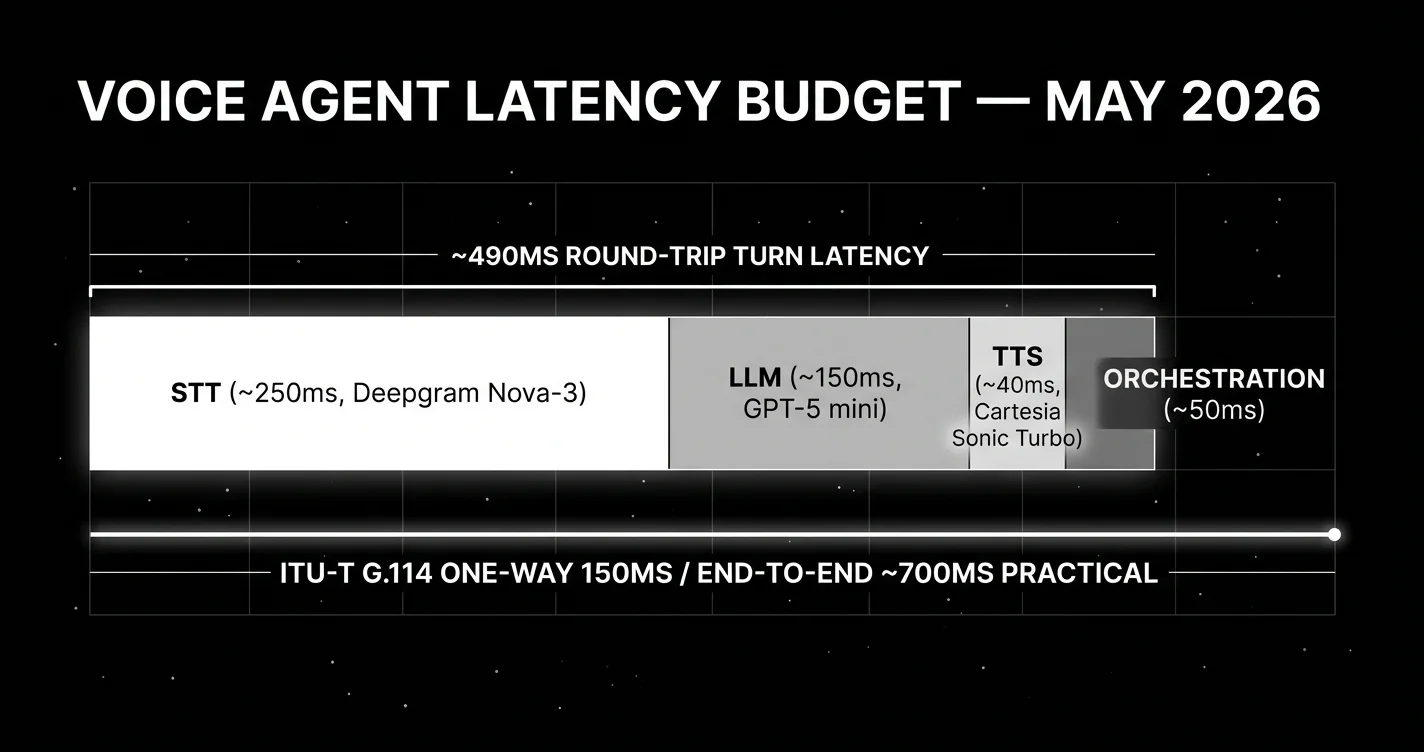
Voice agents have a hard latency target. The ITU-T G.114 one-way mouth-to-ear recommendation is 150ms preferred and 400ms tolerable, which shapes any voice-agent budget. Sub-500ms round-trip is the aggressive practical target. Sub-700ms is the threshold most production use cases accept. Hitting either requires component picks that compose to the budget, and a voice AI latency measurement methodology to confirm the numbers on real traffic.
The breakdown:
| Component | Typical latency range | Aggressive (sub-500ms) pick | Practical (sub-700ms) pick |
|---|---|---|---|
| STT | 200-300ms | Deepgram Nova-3 (sub-300ms) | Deepgram Nova-3 or AssemblyAI |
| LLM inference | 100-300ms | Fast low-latency LLM (GPT-5 mini, Gemini 3.x Flash) | GPT-5.5, Claude Opus 4.7, etc. |
| TTS first audio | 40-200ms | Cartesia Sonic Turbo (40ms) | ElevenLabs Flash v2.5 (~75ms) |
| Orchestration overhead | 50-100ms | Tight platform-native | Standard platform |
| Total | sum of above | ~400-500ms best-case round-trip | ~600-700ms practical round-trip |
The 40ms Cartesia Sonic Turbo TTFA is what makes the sub-500ms budget reachable. Without it, the rest of the stack does not have enough budget. A typical production stack hitting sub-700ms uses Deepgram Nova-3 (300ms) + GPT-5.5 (200ms) + ElevenLabs Flash v2.5 (~75ms) + 100ms orchestration.
Cost at scale: what 100K minutes/month actually costs
Per-minute list price hides the real production cost. By May 2026 there are now five distinct pricing models depending on which path you pick: managed flat-fee (Retell, Bland), BYO with passthrough (Vapi), pure native audio (OpenAI Realtime API), self-hosted with engineering load (Pipecat + own GPUs), and bundled enterprise (Deepgram Voice Agent).
| Stack | Component pricing | Estimated monthly cost (100K min) |
|---|---|---|
| Retell managed | $0.07/min flat (LLM + STT + TTS bundled) | $7,000 |
| Vapi BYO + Deepgram + GPT-5.5 + ElevenLabs Flash | $0.05/min platform + $0.0043/min STT + ~$0.02/min text LLM + ~$0.04/min TTS (1.5x retry buffer) | $11,500-14,000 |
| OpenAI Realtime API alone (gpt-realtime-1.5) | $32/M input, $64/M output audio tokens; ~3K tokens per min | ~$15,000-25,000 |
| Bland AI Build/Scale tier | Tier-bundled pricing | $6,000-9,000 |
| Self-hosted (Whisper + Claude API + Cartesia + Pipecat) | GPU rental ~$0.001/min + Claude ~$0.025/min + Cartesia ~$0.03/min | $6,000-7,500 + on-call cost |
| Deepgram Voice Agent (enterprise) | $0.075/min bundled, growth concurrency 60 NA / 45 EU | $7,500 + enterprise contract |
The honest framing: under 100K min/month, Retell’s flat $0.07/min usually wins on total cost of ownership because the engineering time saved on LLM-passthrough optimization, retry tuning, and HIPAA paperwork dominates the per-minute delta. Above 1M min/month, BYO economics flip and Vapi or self-hosted starts to dominate. The crossover depends on retry rate and engineering cost.
The Realtime API path is the highest-cost option on this table and the right pick only when prosody matters more than per-minute price (mental health, accessibility, accent-sensitive products). For free-form long conversations, the classic STT-LLM-TTS pipeline still has better task-completion telemetry per public benchmarks.
Decision framework
Choose Retell AI if:
- You are building most-team production voice agents.
- Sub-700ms end-to-end is acceptable.
- HIPAA matters (it is included).
- You want a managed platform with no-code option.
Choose Vapi if:
- You are at scale (>1M calls/month).
- 99.99% uptime SLA is required.
- You need multi-channel (voice + SMS + chat) in one platform.
Choose Deepgram Voice Agent if:
- You want self-hosted deployment.
- You want bundled pricing without LLM pass-through surprises.
- Sub-400ms with Flux end-of-turn detection matters.
Choose ElevenLabs Conversational if:
- Voice quality is the brand.
- Voice cloning fidelity is core to the product.
Choose Bland AI if:
- Outbound phone volume is the workload.
- Norm agent builder fits your operations team.
Roll your own (Cartesia + Deepgram + LLM) if:
- You need sub-500ms end-to-end.
- You have the engineering team to build orchestration.
- The platforms do not support your specific stack (custom LLM, vertical compliance).
Common mistakes when picking voice AI components in May 2026
-
Picking TTS by quality and ignoring latency. ElevenLabs v3 is gorgeous; if you need sub-300ms end-to-end you need Cartesia anyway. Pick latency first when latency is binding.
-
Skipping turn-taking detection. Generic STT APIs do not handle end-of-turn. Voice agents without Flux or equivalent talk over users or sit silent. Worth more than WER accuracy gains.
-
Ignoring the LLM as a latency cost. A 300ms STT plus a 1500ms LLM is not a 300ms voice agent. Pick a fast LLM (GPT-5 mini, Gemini 3.1 Flash) for sub-300ms targets.
-
Building from scratch without budget reality. Custom voice agent stacks take 3-6 months of engineering to reach Vapi or Retell quality. Use a platform unless your stack is genuinely unsupported.
-
Trusting list latency without measuring. Vendor latency numbers are best-case. Measure your real production p50 and p95 latency before committing.
How Future AGI fits
Voice agents fail in production for the same reasons text agents fail. Hallucinations, retry loops, accent edge cases, off-policy responses, prompt injection through transcript contamination. Future AGI ships the eval, simulate, and observability layer voice teams pair with their voice framework of choice:
- Simulate generates voice scenarios (accents, background noise, interruptions, ambiguous prompts) before you ship. Includes
fi.simulate.TestRunnerfor replaying transcripts against your agent. - Evaluate scores every voice agent output across groundedness, hallucination, tool-call accuracy, and accent handling. Turing evaluators run roughly 1 to 2 seconds (
turing_flash), 2 to 3 seconds (turing_small), or 3 to 5 seconds (turing_large) per check on the cloud tier. - Agent Command Center with runtime guardrails blocks bad outputs at the gateway in low single-digit hundreds of milliseconds, which is critical for the voice latency budget.
- Error Feeds cluster live failures so you see “instances of accent-X failing on intent-Y” instead of dozens of unrelated tickets.
- Optimize auto-rewrites prompts and policies and re-validates against the regression set.
For voice specifically, the eval suite includes accent-handling, sentiment-consistency, and tool-call-accuracy axes that text-only frameworks miss. FAGI is a companion to Vapi, Retell, LiveKit, Pipecat, and the rest of the voice stack rather than a competitor on the voice framework axis itself.
Sources
STT primary
- Deepgram Nova-3 announcement (6.84% median streaming WER)
- Deepgram Flux conversational STT (model-integrated end-of-turn detection)
- AssemblyAI Universal-2 research blog
- Google Cloud Chirp speech-to-text docs
- OpenAI Whisper Large V3 model card
- ElevenLabs Scribe v2 Realtime
TTS primary
- Cartesia Sonic Turbo (40ms TTFA, primary docs)
- ElevenLabs Flash v2.5 latency (~75ms model inference)
- OpenAI Realtime API + gpt-realtime-1.5 pricing
- Hume Octave
- PlayHT docs
Voice agent platforms
- Vapi (300M+ cumulative calls, 99.9% uptime, sub-500ms claim)
- Retell AI Latency Face-off 2025 (TTFT 180ms, E2E 620ms)
- Retell actual-latency API (p50/p90/p95/p99 telemetry)
- Bland AI pricing tiers
- Deepgram Voice Agent pricing ($0.075/min)
- ElevenLabs Conversational AI HIPAA requirements
Independent benchmarks + standards
- Artificial Analysis AA-WER index (real-world WER)
- ITU-T Recommendation G.114 (one-way transmission time)
Open-source agent frameworks
See also: Best LLMs of May 2026 for the LLM brain in your voice agent. Previous voice post: Best Voice AI of April 2026.
Frequently Asked Questions
What is the best speech-to-text model in May 2026?
What is the best text-to-speech model for voice agents in May 2026?
What is the best voice agent platform in May 2026?
What end-to-end latency does a production voice agent need in May 2026?
Should I build a voice agent stack from scratch or use a platform?
What is Deepgram Flux and why does turn-taking detection matter?
Best Voice AI April 2026: compare OpenAI Realtime API, Deepgram, Cartesia, ElevenLabs, Vapi, and Retell for STT, TTS, latency, and voice agents.

Best TTS APIs in May 2026: Cartesia Sonic 4 at 40ms, ElevenLabs v3, Deepgram Aura-2, Hume Octave, plus pricing, latency, and the right pick by use case.
Best STT APIs in May 2026: Deepgram Nova-3 + Flux, AssemblyAI Universal-2, Whisper, ElevenLabs Scribe v2 with WER, latency, and pricing compared.
