Best 5 vLLM Alternatives for Self-Hosted Inference in 2026
Five vLLM alternatives scored on throughput, hardware coverage, quantization, structured outputs, ops burden, plus the platform layer that augments them.
Table of Contents
vLLM put self-hosted inference within reach. PagedAttention, continuous batching, and a CUDA-grade scheduler turned a research-grade engine into the default open-source serving runtime for Llama, Qwen, Mistral, DeepSeek, and most of the long tail of 2025 to 2026 open weights. By mid-2026 it’s running in production at a large fraction of the teams who decided “we want our own GPUs and our own SLAs.”
The thing teams discover six months in is that vLLM is an inference engine and only an inference engine. No router across replicas, no observability beyond Prometheus counters, no eval, no inline guardrails. And on specific workload shapes, long shared prefixes, aggressive quantization, NVIDIA-only fleets, Hugging Face-shaped pipelines, other open-source runtimes can match or beat vLLM on raw throughput.
This guide ranks five real self-hosted inference runtime alternatives, names what each fixes versus vLLM, and ends with the platform layer that augments whichever runtime you pick.
TL;DR: five real vLLM alternatives
| Why you are leaving (or comparing) vLLM | Pick | Why |
|---|---|---|
| You’re on NVIDIA hardware and want to squeeze the last 20–40% of throughput out | TensorRT-LLM | NVIDIA’s own compiled runtime; the throughput ceiling on H100/H200/Blackwell |
| You want a Hugging Face-shaped serving stack with first-class HF model support | Text Generation Inference (TGI) | Apache-2.0 production server from Hugging Face; smoothest path from transformers |
| You’re serving structured outputs, RAG agents, or constrained decoding | SGLang | Radix-tree prefix cache and a frontend DSL built for agent-shaped workloads |
| You’re on a mixed multi-GPU fleet and want quantization built in | LMDeploy | TurboMind kernels, w4a16/w8a8 quantization, and PyTorch backend in one runtime |
| You want OSS, Python-first model packaging with built-in serving | BentoML | Bento format wraps vLLM/TRT-LLM/TGI as runners; deployment-portable artifacts |
Future AGI isn’t in this table. FAGI isn’t an inference engine, it’s the platform layer (gateway, observability, evals, optimizer, guardrails) that augments whichever engine you pick (including vLLM itself, kept in place). The dedicated FAGI section is below the five alternatives.
Why people are comparing vLLM alternatives in 2026
Four drivers show up repeatedly in vLLM GitHub issues, the r/LocalLLaMA threads on production deployments, and the postmortems being shared at 2026 Open-Source AI Infra meetups.
1. Per-GPU throughput ceiling
vLLM’s throughput is excellent, but TensorRT-LLM on H100/H200 with FP8 (or Blackwell with FP4) typically beats vLLM by 20 to 40% on tokens-per-second-per-GPU at matched accuracy. For teams measured on cost-per-1M-tokens, the gap is real.
2. Prefix-heavy workload shape
Agent workloads with long shared system prompts, repeated tool-call loops, or RAG with stable retrieval prefixes benefit from radix-tree prefix caching (SGLang) more than PagedAttention’s block-level caching (vLLM). On the right workload, the speedup is 2 to 5x.
3. Hardware heterogeneity and quantization
vLLM is NVIDIA-first. Teams on mixed fleets (AMD MI300, multi-generation NVIDIA) or who lean hard on aggressive quantization (w4a16, w8a8) find LMDeploy’s TurboMind kernels and PyTorch backend more flexible.
4. Ecosystem fit
Hugging Face shops often prefer TGI for the operational polish around HF model coverage. Teams who want OSS-first model packaging that wraps the engine inside a deployable artifact reach for BentoML.
What to look for in a vLLM replacement
Score replacements on the seven axes that map to the trade-offs you’re actually making:
| Axis | What it measures |
|---|---|
| 1. Raw throughput | Tokens per second per GPU on representative open-weight models |
| 2. Hardware coverage | NVIDIA only? AMD? Apple Silicon? Multi-generation fleets? |
| 3. Quantization depth | w4a16, w8a8, FP8, FP4, AWQ, GPTQ — first-class or bolted on? |
| 4. Structured outputs and constrained decoding | Regex, JSON schema, CFGs — first-class? |
| 5. Model coverage and freshness | Llama, Mixtral, Qwen, DeepSeek — and recent architectures land quickly |
| 6. Operational polish | Tested Docker image, OTel hooks, dynamic batching, multi-model concurrency |
| 7. Migration cost from vLLM | Drop-in OpenAI-compat or full engine swap |
Note: gateway, observability, eval, optimizer, and guardrails are not on this list. None of the five engines ship those natively. That gap is what the Future AGI section below covers.
1. TensorRT-LLM: Best for squeezing maximum throughput from NVIDIA hardware
Verdict: TensorRT-LLM is the pick when the bottleneck is provably the inference engine and the fleet is homogeneous NVIDIA hardware. NVIDIA writes it, NVIDIA optimises it for each new GPU generation (H100 to H200 to Blackwell), and the throughput ceiling is meaningfully higher than vLLM on long-context workloads with FP8 or INT4.
What it fixes versus a bare vLLM deployment:
- Per-GPU throughput. Compiled engines (TensorRT plans) with custom kernels for attention, GEMM, and KV-cache. On H100/H200, FP8 paths typically beat vLLM by 20 to 40%; on Blackwell with FP4 the gap is larger.
- Quantization-first. SmoothQuant, AWQ, and FP8/FP4 are first-class, with calibration tools shipping in the repo.
- Triton Inference Server integration. Model repository, dynamic batching, in-flight batching, multi-model concurrency.
Migration from vLLM: Not a drop-in. The trtllm-build workflow produces a hardware-specific engine plan, so the deployment artifact is GPU-generation-bound. OpenAI-compatible API needs Triton’s frontend or a thin adapter. Timeline: ten to twenty engineering days for a single-model swap.
Where it falls short:
- NVIDIA-only. AMD MI300, Apple Silicon, and CPU paths aren’t in scope.
- Engines aren’t portable across GPU generations; a hardware upgrade is a re-compile.
- Novel open-weight architectures sometimes ship vLLM support first; TensorRT-LLM support follows by weeks.
Pricing: Open source under Apache 2.0. NVIDIA AI Enterprise subscription (~$4.5K/GPU/year list) for enterprise support and certified containers.
Score: 4 of 7 axes (covers throughput, hardware coverage on NVIDIA, quantization, missing model freshness for brand-new architectures, AMD/cross-vendor coverage, migration cost).
2. Text Generation Inference (TGI): Best for Hugging Face-shaped stacks
Verdict: TGI is the right pick when the team already lives in the Hugging Face ecosystem, models pulled from the Hub, configs shaped by transformers, deployment via huggingface-inference-toolkit. The stack works the way transformers works, and the model-format compatibility surface is the broadest in this list.
What it fixes versus a bare vLLM deployment:
- Hugging Face model coverage. TGI handles the long tail of
transformers-compatible architectures with less per-model integration work than vLLM occasionally needs for novel models. New open weights often land in TGI within days of release. - Production-server posture. Built by Hugging Face for production from day one; ships with Prometheus metrics, OTel tracing hooks, gRPC and HTTP frontends, and a tested Docker image.
- Quantization in-tree. GPTQ, AWQ, EETQ, and bitsandbytes are wired up; switching quantization is a flag.
- Tool-call passthrough. Function-calling for Llama 3.x, Qwen 2.x, Mistral, and the major open-weight families is handled in the server, not bolted on.
Migration from vLLM: TGI’s HTTP API is similar but not identical to vLLM’s OpenAI-compatible endpoint. The chat-completions endpoint matches; some parameters (top-k, sampling-seed) differ. Quantization flags differ. Prefix-cache behaviour differs. Timeline: five to ten engineering days for a single-model production swap.
Where it falls short:
- Throughput per GPU is competitive but typically doesn’t lead, vLLM, TensorRT-LLM, and SGLang each win on some workload shape.
- The Hugging Face license changes in 2024 (HFOIL for some components) caused a brief migration scare; the current TGI license is Apache 2.0.
- No first-class structured-output DSL.
Pricing: Open source under Apache 2.0. Hugging Face Inference Endpoints (managed) from ~$0.06/hour per replica.
Score: 5 of 7 axes (covers throughput, hardware coverage, quantization, model coverage, ops polish, missing structured-output DSL, deeper migration cost).
3. SGLang: Best for agent-shaped workloads with prefix reuse
Verdict: SGLang is the pick when the workload is agent-shaped, long system prompts, repeated tool-call loops, RAG with stable retrieval prefixes, structured output via grammars or JSON schemas. The radix-tree prefix cache and the SGLang frontend DSL together cut latency on these workloads by 2 to 5x versus a naive vLLM deployment on the same hardware.
What it fixes versus a bare vLLM deployment:
- Radix-tree prefix cache. Where vLLM caches prefixes per request, SGLang stores a tree of all observed prefixes across requests and reuses them across sessions. For workloads with a shared 4 to 8K-token system prompt, the speedup is significant.
- Constrained decoding. Regex, JSON schema, and context-free grammars are first-class. Structured outputs come out with provable schema conformance, not best-effort regex.
- Frontend DSL for control flow. SGLang’s Python DSL expresses agent control flow (fork, join, conditional generation) declaratively and the runtime compiles it into a batched plan.
- Disaggregated prefill and decode. The 2026 releases split prefill-bound and decode-bound work onto separate replicas, moving throughput meaningfully above vLLM on long-prompt workloads.
Migration from vLLM: SGLang ships an OpenAI-compatible endpoint, so basic chat-completions is a base-URL swap. The structured-output and DSL features need application-side adoption. Timeline: five to seven engineering days for the basic swap; longer with DSL adoption.
Where it falls short:
- Younger than vLLM, TGI, and TensorRT-LLM. The ecosystem of Terraform modules, off-the-shelf dashboards, and managed providers is thinner.
- The DSL is a learning curve the team has to accept.
- Hardware coverage is NVIDIA-first; AMD MI300 paths exist but are less polished.
Pricing: Open source under Apache 2.0.
Score: 5 of 7 axes (covers throughput on prefix-heavy workloads, structured outputs, model coverage, migration cost, missing AMD polish, smaller ecosystem).
4. LMDeploy: Best for mixed multi-GPU fleets with quantization
Verdict: LMDeploy is the pick when the fleet is heterogeneous (different GPU generations, sometimes different vendors) and the team needs aggressive quantization built into the runtime rather than as a separate preprocessing step. Maintained by the InternLM team, LMDeploy ships two backends (TurboMind for NVIDIA, a PyTorch backend for portability) in one runtime.
What it fixes versus a bare vLLM deployment:
- Quantization in-runtime. w4a16, w8a8, and AWQ are first-class; flipping between them is a flag. The PyTorch backend extends quantized serving to GPUs where TurboMind’s custom kernels don’t have a path.
- TurboMind kernels. On supported NVIDIA hardware, TurboMind’s attention and GEMM kernels match or beat vLLM on a wide range of model sizes. The win is most visible on Llama 3 70B-class workloads with w4a16.
- OpenAI-compatible API plus a CLI. Production deployments use the HTTP API; ad-hoc evaluation is a single CLI command.
- InternLM-family integration. Native first-class support for InternLM, InternVL, and the broader InternLM ecosystem.
Migration from vLLM: OpenAI-compatible API maps directly. Quantization configuration is leaner than the vLLM equivalent. Prefix-cache behaviour differs and is less aggressive than vLLM’s PagedAttention on raw-prompt workloads. Timeline: five to seven engineering days for a single-model swap.
Where it falls short:
- Smaller English-language community than vLLM or TGI; docs are bilingual (English + Chinese) and the English-side is occasionally a release behind.
- No first-class structured-output DSL.
- Non-NVIDIA hardware support exists via the PyTorch backend but is less battle-tested than TurboMind’s NVIDIA path.
Pricing: Open source under Apache 2.0.
Score: 5 of 7 axes (covers throughput with quantization, hardware coverage, quantization depth, model coverage, migration cost, missing structured outputs, smaller English community).
5. BentoML: Best for OSS model packaging with serving included
Verdict: BentoML is the pick when the requirement is “OSS, Python-first, full control of the runtime, with the option to wrap vLLM, TensorRT-LLM, or TGI inside a portable deployable artifact.” The Bento format packages a model with its dependencies, runtime config, and API definition into a single deployable unit you can run anywhere, locally, on BentoCloud, or on any Kubernetes cluster.
What it fixes versus a bare vLLM deployment:
- Portable deployment artifact. The Bento is the unit of deployment (image, code, dependencies, runtime config) and it runs on your laptop, your cluster, or BentoCloud without changes.
- vLLM and TensorRT-LLM as runners. BentoML wraps the inference engine of your choice inside the Bento. You get vLLM’s throughput plus BentoML’s packaging and ops polish.
- OSS Apache 2.0. Run the same Bento on your laptop, your cluster, or BentoCloud.
- Hosted option without lock-in. BentoCloud runs Bentos on managed infra, but the artifact is portable.
Migration from vLLM: Wrap your existing vLLM deployment in a bentoml.Service with a vLLM runner. Operationally heavier than pure vLLM at first; the payoff is portable artifacts and unified packaging. Timeline: five to ten engineering days.
Where it falls short:
- BentoML is a packaging and serving framework, not a faster engine, the throughput is whatever the underlying runner (vLLM, TRT-LLM, TGI) delivers.
- Smaller community than vLLM or TGI.
- No first-class structured-output DSL or quantization layer of its own, depends on the wrapped runner.
Pricing: OSS under Apache 2.0. BentoCloud usage-priced; enterprise custom.
Score: 5 of 7 axes (covers ops polish, model coverage, migration cost, hardware coverage via wrapped runner, quantization via wrapped runner, missing native throughput leadership, native structured-output DSL).
Future AGI: the platform layer that augments whichever runtime you pick
TensorRT-LLM, TGI, SGLang, LMDeploy, and BentoML are inference engines (or packaging frameworks that wrap them). Future AGI isn’t. FAGI doesn’t run model weights. It’s the platform layer that sits in front of whichever inference engine you pick (including vLLM itself, kept in place) and closes the surfaces every one of them is missing: gateway with multi-replica routing and multi-provider fallback, LLM-shaped observability, eval suite against captured traces, prompt optimizer, inline guardrails, per-tenant keys.
The shape is a self-improving loop, trace, eval, cluster, optimize, route, re-deploy, wrapped around your inference engine.
What FAGI adds to any engine on this list (or vLLM itself):
traceAI(Apache 2.0). OpenInference-compatible instrumentation with 35+ framework integrations. Every request to vLLM, TensorRT-LLM, TGI, SGLang, LMDeploy, or BentoML becomes a span with full prompt, completion, latency breakdown, and tool-call structure.
ai-evaluation(Apache 2.0), task-completion, faithfulness, hallucination, tool-use, and custom rubrics scoring every trace automatically.agent-opt(Apache 2.0), prompt optimizer that runs six optimizers — ProTeGi, GEPA, Bayesian, MetaPrompt, RandomSearch, PromptWizard against your prompt registry, driven by eval scores. Output is a new prompt version with a measured eval delta.
- Agent Command Center (hosted), multi-replica routing with prefix-affinity hinting for vLLM’s prefix cache, automatic failover to a hosted provider on GPU loss, per-tenant API keys, per-route rate limits, RBAC, failure-cluster views, AWS Marketplace procurement, SOC 2 Type II.
- Protect guardrails. Inline PII, prompt-injection, jailbreak, and policy enforcement with median ~67ms text-mode latency and ~109ms image-mode (per arXiv 2510.13351).
Why “augment, not replace”: FAGI doesn’t run GPUs. It doesn’t implement attention kernels. That’s the engine’s job, vLLM, TensorRT-LLM, TGI, SGLang, LMDeploy, or BentoML wrapping one of them. FAGI sits in front, routing across replicas and providers, scoring responses, and enforcing policy. The typical 2026 self-hosted pattern is client → FAGI gateway → vLLM (or whichever engine) replicas, with the gateway handling everything around the engine.
Capability matrix
| Axis | TensorRT-LLM | TGI | SGLang | LMDeploy | BentoML |
|---|---|---|---|---|---|
| Raw throughput | Highest on NVIDIA | Competitive | Highest on prefix-heavy | High with quantization | Depends on wrapped runner |
| Hardware coverage | NVIDIA only | NVIDIA + AMD + Apple | NVIDIA-first, AMD via PyTorch | NVIDIA-first, others via PyTorch | Whatever runner supports |
| Quantization depth | FP8, FP4, AWQ, SmoothQuant | GPTQ, AWQ, EETQ, bnb | AWQ, GPTQ | w4a16, w8a8, AWQ | Via wrapped runner |
| Structured outputs / CFGs | Limited | Limited | Native DSL + grammar | Limited | Via wrapped runner |
| Model coverage and freshness | Lags by weeks | Days of release | Strong | Strong | Whatever runner supports |
| Operational polish | Triton-integrated | Production-server day one | Newer ecosystem | OpenAI-compat + CLI | Bento format polish |
| Migration cost from vLLM | High (engine swap, recompile) | Medium | Medium | Medium | Wraps vLLM directly |
Future AGI isn’t in the matrix because it doesn’t run inference. FAGI plugs in front of all five (and vLLM itself).
Migration notes: the path most teams should run
Three surfaces always need attention when self-hosted inference goes to production.
Keep vLLM as the backend if the bottleneck is not the engine
The pattern that resolves most production friction is client → platform layer → vLLM replicas, with the platform layer handling multi-replica routing, prefix-affinity hinting, per-tenant keys, rate limits, fallback on GPU loss, and trace capture. vLLM stays untouched. Swap engines only when the bottleneck is provably the engine, measured, not guessed.
Swap engines when the bottleneck is provably the engine
TensorRT-LLM for NVIDIA throughput ceiling. SGLang for prefix-heavy workloads. LMDeploy for mixed fleets and aggressive quantization. TGI for HF ecosystem fit. BentoML to package whichever runner you settle on into a portable artifact.
Add the platform layer once, not per engine
This is where FAGI sits. traceAI instruments whichever engine you ended up on. ai-evaluation scores the traces. agent-opt rewrites prompts. Agent Command Center fronts the engine with a gateway and guardrails. The platform layer survives an engine swap, when vLLM becomes TensorRT-LLM or SGLang, the gateway config changes but the instrumentation, evals, and optimizer keep working.
Decision framework: Choose X if
Choose TensorRT-LLM if you have measured the bottleneck and it’s provably the engine, and your fleet is homogeneous NVIDIA hardware on H100 or newer.
Choose Text Generation Inference (TGI) if your team lives in the Hugging Face ecosystem and the operational polish around a tested Docker image, native HF model coverage, and managed Inference Endpoints matter.
Choose SGLang if the workload is agent-shaped (long shared prefixes, structured outputs, tool-call loops, RAG with stable retrieval) and your team is willing to adopt the SGLang DSL.
Choose LMDeploy if your fleet is heterogeneous, quantization is central to the cost model, or you’re running models in the InternLM family.
Choose BentoML if OSS-first model packaging that wraps the engine in a portable artifact is the priority.
Add Future AGI in front of any of the five (or vLLM itself, kept in place) when the gap is gateway routing, observability, evals, optimizer, or inline guardrails.
What we did not include
Three projects show up in other 2026 vLLM alternatives listicles that we left out. Aphrodite Engine (the vLLM fork from the PygmalionAI community is a strong runtime but the production deployment story is thinner and the patch flow versus upstream vLLM creates ongoing operational risk). MLC LLM (the cross-platform deployment posture is interesting for edge and Apple Silicon but the server-side production surface isn’t yet competitive with the five entries above). DeepSpeed-FastGen (the MII serving layer is capable but the project has slowed publicly through 2025 to 2026 and the community gravity has moved toward vLLM and SGLang).
Related reading
- Best LLM Gateways in 2026
- What Is an AI Gateway? The 2026 Definition
- Best AI Gateways for Agentic AI in 2026
- Best 5 Portkey Alternatives in 2026
Sources
- vLLM project repository, github.com/vllm-project/vllm
- vLLM PagedAttention paper, arxiv.org/abs/2309.06180
- TensorRT-LLM project repository, github.com/NVIDIA/TensorRT-LLM
- NVIDIA Triton Inference Server documentation, github.com/triton-inference-server/server
- Text Generation Inference repository, github.com/huggingface/text-generation-inference
- Hugging Face Inference Endpoints documentation, huggingface.co/docs/inference-endpoints
- SGLang project repository, github.com/sgl-project/sglang
- SGLang radix-attention paper, arxiv.org/abs/2312.07104
- LMDeploy project repository, github.com/InternLM/lmdeploy
- TurboMind backend documentation, lmdeploy.readthedocs.io
- BentoML documentation, docs.bentoml.com
- Future AGI Agent Command Center, futureagi.com/platform/monitor/command-center
- Future AGI traceAI, github.com/future-agi/traceAI (Apache 2.0)
- Future AGI ai-evaluation, github.com/future-agi/ai-evaluation (Apache 2.0)
- Future AGI agent-opt, github.com/future-agi/agent-opt (Apache 2.0)
- Future AGI Protect latency benchmark, arxiv.org/abs/2510.13351 (67 ms text, 109 ms image)
Frequently Asked Questions
Why are people comparing vLLM alternatives in 2026?
Do I have to leave vLLM to fix the gateway and observability gaps?
Which alternative is fastest?
Is there an open-source vLLM alternative?
How do I get observability out of vLLM?
How does Future AGI compare to vLLM?
vLLM is the open-source LLM serving engine that pioneered PagedAttention and continuous batching. How it serves, how teams use it in production 2026.

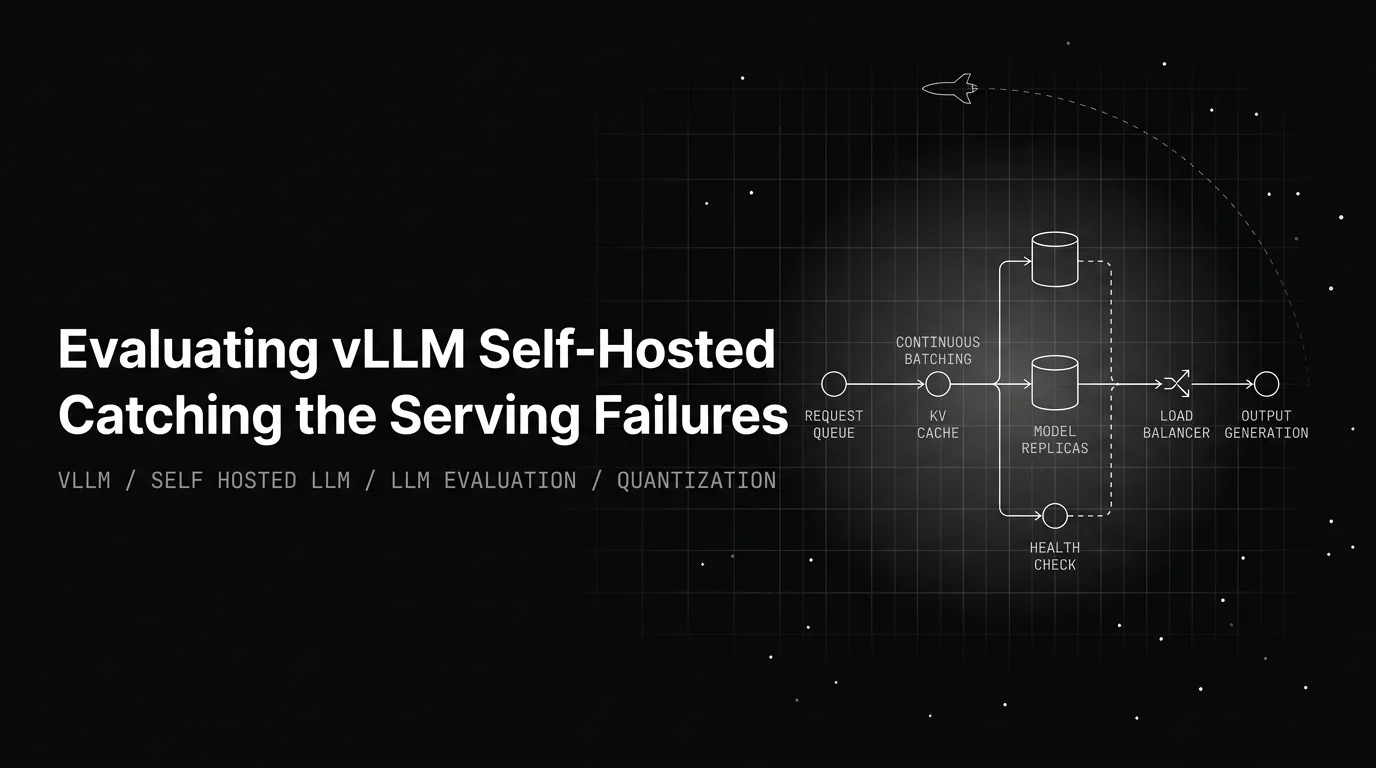
How to evaluate a vLLM self-hosted LLM in 2026: catch continuous-batching jitter, KV-cache eviction, and AWQ/GPTQ/FP8 drift before prod.
Five BentoML alternatives on LLM-native throughput, Kubernetes posture, gateway. What each actually fixes for production LLM workloads in 2026.
