Best 5 Vercel AI Gateway Alternatives in 2026
Five Vercel AI Gateway alternatives scored on routing, eval/optimizer loops, enterprise RBAC, self-host posture, migration cost off the Vercel platform.
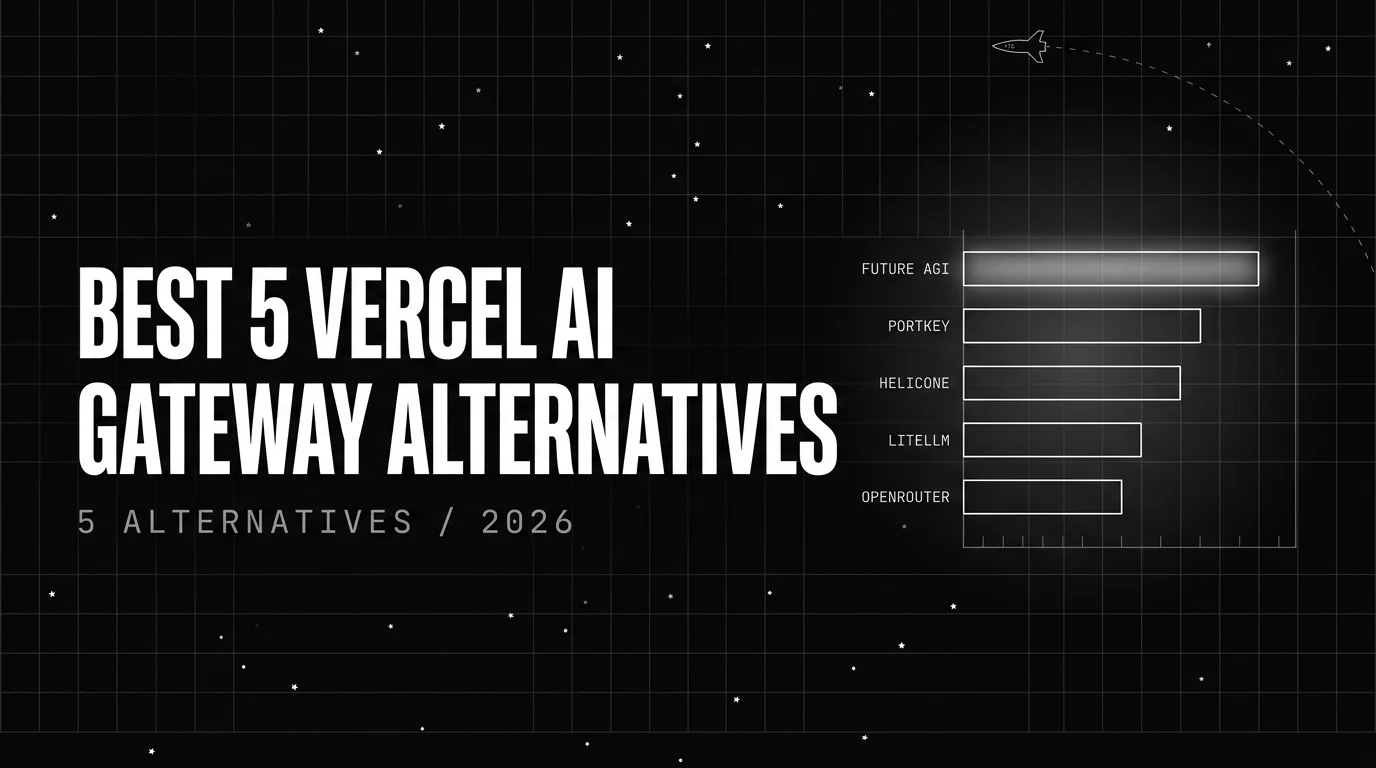
Table of Contents
Vercel AI Gateway is a beautiful piece of framework engineering. If your application is a Next.js app on Vercel and your team lives inside the AI SDK, the gateway disappears into the platform and you ship faster than almost any other route. The problem is what happens when the workload outgrows that shape. The gateway is hosted-only, routing intelligence stops at fallback chains, there’s no eval-and-optimize loop on trace data, RBAC is built around the Vercel team unit rather than a security-team unit, and the surface is wired to a single deployment platform. Teams hit those edges around the time they stop being a Next.js app and start being an AI product with serious cost or compliance pressure.
This guide ranks five gateways worth migrating to, names what each fixes versus Vercel, and walks through the migration that always bites: re-routing the AI SDK’s provider-prefix env vars and edge runtime hooks to an OpenAI-compatible BASE_URL through a new gateway.
TL;DR: pick by exit reason
| Why you are leaving Vercel AI Gateway | Pick | Why |
|---|---|---|
| You want trace data to drive routing, prompts, and guardrails | Future AGI Agent Command Center | Closes the loop from trace through eval to optimizer back into the gateway |
| You want a hosted gateway with virtual keys, RBAC, and prompt registry maturity | Portkey | Most feature-complete hosted gateway in the cohort |
| You want a self-hosted, source-available proxy with no platform lock-in | LiteLLM | MIT-licensed proxy that runs entirely inside your VPC |
| You want a request-level proxy at the edge without the framework | Cloudflare AI Gateway | Edge-resident proxy in 330+ PoPs, OpenAI-compatible URL |
| You need enterprise plugin ecosystem and procurement comfort | Kong AI Gateway | Extends an existing Kong stack with AI-specific policies |
Why people are leaving Vercel AI Gateway in 2026
Five exit drivers show up in HN threads on AI SDK 5.x, Reddit /r/nextjs and /r/LLMDevs migration discussions, the Vercel community forum, and customer interviews over the last two quarters.
1. Vercel platform lock-in
The hosted gateway is part of the Vercel platform. Unified billing, the Observability dashboard, team-and-project attribution, and cost reports all live behind a vercel.com workspace. The AI SDK is Apache 2.0 and portable; the gateway dashboard, unified provider billing, and team RBAC aren’t. The moment the workload moves off Next.js on Vercel (to a Python service, a Workers route, a Kubernetes cluster, or on-prem) the dashboard stops being the single source of truth. Teams end up running a hybrid where half the traffic is observable and the other half is dark.
2. Limited routing intelligence versus purpose-built gateways
Vercel’s routing surface is a provider abstraction inside the AI SDK with fallback chains, retries, structured outputs, and tool use. It isn’t a purpose-built routing layer. No cost-aware router that downgrades a claude-opus-4-7 call to claude-haiku-4-5 when eval scores on cheaper-model attempts cross a threshold. No semantic cache with cluster-aware invalidation. No per-tenant rate-limit policy with burst budgets. Teams hit a ceiling when routing needs to be smarter than “try this, fall back to that.”
3. No eval-and-optimizer loop on the trace data
The gateway emits OpenTelemetry spans with model, provider, tokens, latency, and tool-call shapes. Those spans flow into Vercel Observability or any OTel sink. What it doesn’t do is score those spans against task-completion, faithfulness, or tool-use rubrics, cluster failures, and feed the result back into routing or prompts. Trace data informs humans, not the gateway.
4. Weak enterprise RBAC
Vercel’s RBAC is built around the Vercel team unit (Owner, Member, Developer, Billing, Viewer) with project-level controls on top. It works for application teams locking down deploys. It works less well for security-vs-application-vs-procurement structures in regulated industries. No per-developer key that fans out to a shared provider key (the virtual-key pattern), no first-party policy language for “this team can call this model on this dataset between these hours.”
5. Hosted-only, no on-prem option
There’s no self-hosted Vercel AI Gateway image. The AI SDK runs anywhere Node or the edge runtime runs, but the gateway dashboard, unified billing, and team RBAC are SaaS-only. Air-gapped environments, sovereign-cloud deployments, and VPC-resident proxy requirements can’t be met. The official answer is “use the AI SDK alone and forgo the gateway”, works for small teams, collapses the value proposition once observability and chargeback are in scope.
What to look for in a Vercel AI Gateway replacement
Score replacements on the seven axes that map to the surfaces you’re actually migrating off.
| Axis | What it measures |
|---|---|
| 1. Platform portability | Does the gateway run independent of Vercel? |
| 2. Routing intelligence | Cost-aware routing, semantic cache, per-tenant policies — native or bolt-on? |
| 3. Eval + optimizer loop | Does the gateway use its trace data to improve routing and prompts? |
| 4. Enterprise RBAC | Per-developer keys, virtual-key fanout, policy depth? |
| 5. Self-host posture | Can the gateway run inside your VPC, air-gapped from the vendor? |
| 6. Framework ergonomics | How much of the AI SDK DX survives the migration? |
| 7. Migration tooling | Published recipes for swapping BASE_URL and provider-prefix env vars? |
1. Future AGI Agent Command Center: Best for closing the loop
Verdict: Future AGI is the only gateway in this list that fixes the deepest gap in Vercel AI Gateway: trace data informs humans but never the gateway itself. Agent Command Center captures the trace, scores it with the eval library, clusters failures, runs the optimizer, and pushes the updated route or prompt back into the gateway on the next request. The other four are observation layers; FAGI is an observation layer wired to an optimizer.
What it fixes versus Vercel:
- Trace becomes signal. Every captured trace is scored against task-completion, faithfulness, and tool-use rubrics by default via
ai-evaluation(Apache 2.0). Failure clusters surface in the Command Center. The optimizer (agent-opt, Apache 2.0) rewrites prompts and routing policies via six optimizers — ProTeGi, GEPA, Bayesian, MetaPrompt, RandomSearch, PromptWizard. Vercel gives you spans; FAGI gives you spans plus a self-improving loop.
- Routing intelligence. Cost-aware model routing with eval-score gates (“downgrade to Haiku when faithfulness is within 2 points of Opus”), semantic cache with cluster-aware invalidation, per-tenant burst budgets, time-of-day policies. Rules are JSON-defined and live next to the trace data that justifies them.
- Enterprise RBAC and virtual keys. Per-developer keys fan out to shared provider keys for bulk pricing. Roles include security, finance, and application-team personas. Policy covers model, dataset, time window, and per-tenant budget.
- Platform portability. OpenAI-compatible URL, runs in your VPC via BYOC or fully self-hosted via OSS instrumentation.
traceAI,ai-evaluation, andagent-optare Apache 2.0. The hosted Command Center adds RBAC, failure-cluster views, the Protect guardrails layer (median 67 ms text-mode latency per arXiv 2510.13351), and AWS Marketplace procurement. - Framework ergonomics survive. The AI SDK points at FAGI’s OpenAI-compatible
BASE_URL. Provider-prefix env vars consolidate into a singleFAGI_GATEWAY_KEYwith routing handled server-side. Streaming, tool calls, and structured outputs pass through unchanged.
Migration from Vercel: Set OPENAI_BASE_URL or each provider factory’s baseURL, move provider keys into FAGI’s vault, translate AI SDK middleware to FAGI routing rules (fallback chains map one-to-one), replay Vercel Observability spans via OTel. Edge calls keep working because the endpoint is region-resident and sub-100ms from US and EU edges. Timeline: five to eight engineering days including shadow traffic.
Where it falls short:
-
agent-opt is opt-in, start with traceAI + ai-evaluation in week one and turn the optimizer on once eval baselines stabilize. The loop compounds value over weeks rather than at day one.
-
FAGI’s SDK doesn’t ship matching React framework hooks; teams keep using the AI SDK on the application side and point
baseURLat FAGI.
Pricing: Free tier with 100K traces/month. Scale tier from $99/month with linear per-trace scaling above 5M (no add-on multipliers). Enterprise with SOC 2 Type II and AWS Marketplace.
Score: 7 of 7 axes.
2. Portkey: Best for hosted feature completeness
Verdict: Portkey is the pick when the requirement is the most feature-complete hosted gateway with dashboard polish, virtual keys, and a real prompt registry. Portkey ships every surface Vercel doesn’t, including Prompt Studio with version history and an RBAC model designed for security teams. Caveat: Palo Alto Networks acquired Portkey on April 30, 2026, which has SMB customers asking questions about the SKU’s future, relevant if platform-future uncertainty was your reason for leaving Vercel.
What it fixes versus Vercel:
- Virtual keys with per-identity fanout. Every developer or service holds a Portkey-issued key that fans out to one underlying provider key, preserving bulk pricing while exposing per-identity chargeback. Vercel’s team-and-project attribution gets you part of the way; virtual keys are the full pattern.
- Prompt registry with version history. Prompt Studio stores prompts as versioned objects with diffs, comments, and rollback.
- Routing depth. Cost-aware routing, semantic cache, conditional routing on metadata, and a guardrails layer.
- Enterprise RBAC. Roles for security, finance, and application teams. SOC 2, ISO 27001, HIPAA-eligible.
Migration from Vercel: OpenAI-compatible endpoint via https://api.portkey.ai/v1/proxy, virtual-key header replaces direct provider keys, AI SDK fallback chains map to Portkey’s routing config. Timeline: seven to ten days. Caveat: the Palo Alto acquisition’s pricing trajectory is unsettled. Portkey is the right answer today, with a six-to-twelve-month watch on the SMB SKU under Prisma AIRS.
Where it falls short:
- No optimizer. Traces inform humans, not the gateway. Same gap as Vercel.
- Palo Alto Networks acquisition (April 30, 2026) introduces SKU and pricing uncertainty for SMB and mid-market teams.
- Hosted-only at the dashboard layer; the proxy can be self-hosted but registry and analytics depth assume the hosted product.
Pricing: Free tier with 10K requests/month. Scale tier from $99/month. Enterprise custom; SOC 2 Type II included.
Score: 6 of 7 axes (missing: optimizer loop).
3. LiteLLM: Best for self-hosted exit
Verdict: LiteLLM is the pick when Vercel’s hosted-only posture is the dealbreaker. MIT-licensed, Python-native, and the most popular self-hosted AI proxy on GitHub. You give up hosted dashboard polish; you gain full platform sovereignty.
What it fixes versus Vercel:
- Self-host posture. The proxy runs in your VPC. No telemetry leaves unless you configure an OTel sink. For teams whose security review is the exit trigger, this is the cleanest answer.
- Platform portability. Runs anywhere Python runs, container, Kubernetes, EC2, on-prem, air-gapped.
- Cost curve. Open-source means no per-request licensing. Enterprise tier from ~$250/month adds SSO, audit, SLA.
- Virtual-key parity. LiteLLM’s
team_idanduser_idmodel maps onto the per-identity fanout pattern Vercel doesn’t have.
Migration from Vercel: OpenAI-compatible endpoint, provider keys, virtual-key concept all map directly. The AI SDK’s baseURL points at the LiteLLM proxy; provider-prefix env vars consolidate into LITELLM_API_KEY. LiteLLM has no first-party prompt registry, so pair it with Langfuse, Future AGI, or in-repo Jinja2 files. Timeline: five to seven engineering days.
Where it falls short:
- No optimizer.
- Bundled UI is the weakest in this list; polish lives in the Enterprise tier.
- Prompt-library story is a separate purchase or build.
- No native AI SDK hooks; you keep using the SDK on the application side.
Pricing: Open source under MIT. Enterprise from ~$250/month for small teams.
Score: 5 of 7 axes (missing: native prompt registry, optimization loop).
4. Cloudflare AI Gateway: Best for edge-resident proxy without the framework
Verdict: Cloudflare AI Gateway is the pick for a request-level edge proxy in 330+ PoPs without framework coupling. If your team is moving off Vercel because the Next.js coupling is the constraint, Cloudflare is the natural shape. It composes with Workers, Workers AI, Vectorize, and R2 for an edge-resident RAG path.
What it fixes versus Vercel:
- Framework-agnostic. HTTP proxy at
gateway.ai.cloudflare.com. Any client (Node, Python, Go, curl) works without code changes. No SDK dependency. - Edge distribution. 330+ PoPs. For globally distributed agent workloads, latency improves.
- Request-shaped observability. Per-request logs with model, provider, latency, cost, cache hit, prompt, response. Exportable to Workers Analytics Engine for SQL, forwardable via Logpush.
- Cost attribution. Per-gateway, per-API-key, per-metadata tag.
Migration from Vercel: Point the AI SDK at the Cloudflare gateway URL, swap provider-prefix env vars for the Cloudflare gateway key, replicate fallback chains in the dashboard. Streaming and tool calls pass through. Multi-turn agents need extra metadata to reconstruct trees because Cloudflare’s view is flat. Timeline: three to five engineering days.
Where it falls short:
- No optimizer. Same gap as Vercel.
- No first-party prompt registry. Teams compose with an external store.
- Edge-only deployment; no on-prem. If air-gapped sovereignty is the reason for leaving Vercel, Cloudflare isn’t the answer.
- Multi-turn agent observability is thinner than Vercel’s because the span model is flat.
Pricing: Free at the gateway layer. Workers, Workers AI, and Vectorize usage billed separately. Enterprise plans for procurement and SLA.
Score: 4 of 7 axes (missing: optimizer, native prompt registry, on-prem, deep RBAC).
5. Kong AI Gateway: Best for enterprise platform teams
Verdict: Kong AI Gateway is the pick when your platform team already runs Kong for REST APIs and the path of least resistance is to extend that stack with AI-specific policies. Strengths: SLA, plugin ecosystem, ops familiarity, procurement comfort. Weakness: AI-specific surfaces (prompt registry, eval, optimizer) live in plugins or upstream tools, not the product.
What it fixes versus Vercel:
- Enterprise SLA and procurement. Tier-1 API-gateway vendor for a decade. SOC 2, ISO 27001, HIPAA-eligible. Clears procurement bars Vercel’s gateway doesn’t.
- Plugin ecosystem. Reuse Kong’s rate-limiting, auth, request-transformation, and OTel plugins. The AI Proxy plugin (Kong 3.6+) handles OpenAI and Anthropic passthrough including tool calls.
- Platform portability. Runs anywhere, bare metal, VPC, hybrid, Kubernetes. Konnect (managed) optional.
- Policy depth. Request-transformation and ACL plugins give the policy language Vercel’s team-based RBAC doesn’t match.
Migration from Vercel: OpenAI-compatible endpoint via the AI Proxy plugin, consumer + tag pattern as a virtual-key analog, OTel plugin for observability. The AI SDK’s baseURL points at the Kong route. Kong has no first-party prompt registry; pair it with Langfuse, Future AGI, or a Git-backed store. Timeline: ten to fifteen engineering days because work spans platform and application teams.
Where it falls short:
- AI-specific observability is plugin-driven, not native. Default dashboard is API-gateway-shaped, not LLM-cost-shaped.
- No optimizer, no prompt registry, no eval library.
- Two-week-plus setup; migration ROI shows up later than lighter alternatives.
- Framework ergonomics thin out compared to the AI SDK.
Pricing: Kong AI Gateway is open source. Konnect (managed) starts free. Enterprise plans from ~$1.5K/month.
Score: 5 of 7 axes (missing: native prompt registry, optimizer, native AI cost dashboard).
Capability matrix
| Axis | Future AGI | Portkey | LiteLLM | Cloudflare AI Gateway | Kong AI Gateway |
|---|---|---|---|---|---|
| Platform portability | OpenAI-compatible + OSS instrumentation | Hosted + proxy self-host | MIT, full VPC | Cloudflare edge | OSS, runs anywhere |
| Routing intelligence | Cost-aware + eval-gated + semantic cache | Cost-aware + cache + guardrails | Functional fallbacks | Fallback chains + cache | Plugin-driven |
| Eval + optimizer loop | Yes (ai-evaluation + agent-opt) | No | No | No | No |
| Enterprise RBAC | Native virtual keys + policy language | Native virtual keys + RBAC | Team + user keys | Per-key + metadata tag | Consumer + ACL plugin |
| Self-host posture | BYOC + OSS instrumentation | Proxy self-host (dashboard hosted) | MIT, full VPC | None | OSS, runs anywhere |
| Framework ergonomics | AI SDK via baseURL | AI SDK via baseURL | AI SDK via baseURL | AI SDK via baseURL | AI SDK via baseURL |
| Migration tooling from Vercel | baseURL swap + provider-key vault | baseURL swap + virtual-key setup | baseURL swap | baseURL swap | Manual plugin setup |
Migration notes: what breaks when leaving Vercel
Re-routing the AI SDK’s provider-prefix env vars
Vercel AI Gateway is wired by setting provider-prefix env vars (OPENAI_API_KEY, ANTHROPIC_API_KEY, GOOGLE_GENERATIVE_AI_API_KEY) and letting the AI SDK pick the provider based on the model string. The unified-billing path means a single Vercel team key fans out to every provider. On exit, one gateway URL receives all calls and a single gateway key replaces the provider-prefix vars. The AI SDK supports this via baseURL on each provider factory, or globally via OPENAI_BASE_URL.
In code, the change is two lines per factory. In practice, services hard-code the URL or env-var in three places: SDK initialization, runtime config, and the deployment manifest. The cleanest migration is to introduce a GATEWAY_BASE_URL and GATEWAY_API_KEY pair, route every factory through it, and keep provider-prefix vars only for direct-provider fallbacks during shadow traffic.
Replacing edge runtime hooks
The AI SDK’s edge integration (streaming, tool-call orchestration, structured outputs) is gateway-independent and survives unchanged. What needs attention: middleware functions that depend on Vercel-specific headers (x-vercel-deployment-url, x-vercel-id), unified billing webhooks, and code reading Vercel Observability spans directly. Replace each with the new gateway’s equivalent header: FAGI’s x-fagi-trace-id, Portkey’s x-portkey-trace-id, Cloudflare’s cf-aig-cache-status.
Replaying observability into the new gateway
Export Vercel Observability OTel spans, transform to the new gateway’s span shape, bulk-ingest. Future AGI ships a Vercel Observability importer. Most teams skip the replay, accept a one-week gap, and start fresh.
Decision framework: Choose X if
Choose Future AGI if your reason for leaving is more than platform lock-in, you also want trace data to drive prompt rewrites and routing-policy updates, so the cost curve bends down over time. Pick this when production agent workloads are becoming a significant line item.
Choose Portkey if your reason is feature completeness, virtual keys, a real prompt registry, and deeper RBAC than Vercel ships. Pick this when framework ergonomics matter less than the surfaces Vercel doesn’t have, and you’re comfortable with the Palo Alto Networks acquisition trajectory.
Choose LiteLLM if the hosted-only posture is the dealbreaker. Pick this when self-host posture and source-availability beat hosted polish, and you have budget for a separate prompt store.
Choose Cloudflare AI Gateway if your reason is framework coupling rather than feature gaps, a request-level proxy at the edge that any client can call without an SDK. Pick this when Workers, Workers AI, and Vectorize are already part of the stack.
Choose Kong AI Gateway if your platform team already runs Kong and the path of least resistance is to extend the existing stack. Pick this when SLA, plugin ecosystem, and operational familiarity outweigh AI-specific shallowness.
What we did not include
Three products show up in other 2026 Vercel AI Gateway alternatives listicles that we left out: OpenRouter (consumer model marketplace, not an enterprise gateway shape); Helicone (capable observability proxy, but thinner routing and RBAC); Maxim Bifrost (Go-based gateway with strong throughput, but thinner Vercel-specific migration surface).
Related reading
- Cloudflare AI Gateway vs Vercel AI Gateway in 2026
- Best 5 Portkey Alternatives in 2026
- Best LLM Gateways in 2026
- What Is an AI Gateway? The 2026 Definition
- Best AI Gateways for Agentic AI in 2026
Sources
- Vercel AI Gateway product page, vercel.com/docs/ai-gateway
- Vercel AI SDK documentation, sdk.vercel.ai/docs
- Vercel Observability, vercel.com/docs/observability
- Hacker News threads on Vercel AI SDK 5.x and gateway migrations, February-May 2026
- Reddit /r/nextjs and /r/LLMDevs migration discussions, 2026
- Portkey product page, portkey.ai
- Palo Alto Networks press release on Portkey acquisition, April 30, 2026, paloaltonetworks.com/company/press
- LiteLLM GitHub repository, github.com/BerriAI/litellm
- Cloudflare AI Gateway product page, developers.cloudflare.com/ai-gateway
- Kong AI Gateway product page, konghq.com/products/kong-ai-gateway
- Future AGI Agent Command Center, futureagi.com/platform/monitor/command-center
- Future AGI traceAI, github.com/future-agi/traceAI (Apache 2.0)
- Future AGI ai-evaluation, github.com/future-agi/ai-evaluation (Apache 2.0)
- Future AGI agent-opt, github.com/future-agi/agent-opt (Apache 2.0)
- Future AGI Protect latency benchmark, arxiv.org/abs/2510.13351 (67 ms text, 109 ms image)
Frequently Asked Questions
Why are people moving off Vercel AI Gateway in 2026?
What is the closest like-for-like alternative to Vercel AI Gateway?
How do I migrate the AI SDK off Vercel AI Gateway?
Can I keep using the AI SDK after migrating off Vercel?
Is there an open-source Vercel AI Gateway alternative?
Which Vercel AI Gateway alternative is cheapest at scale?
How does Future AGI Agent Command Center compare to Vercel AI Gateway?
Future AGI vs Vercel AI Gateway scored on routing, observability, cost attribution, security, deployment, DX. Honest verdict and pricing snapshot for 2026.

FutureAGI ACC, Helicone, OpenRouter, Portkey, LiteLLM, Cloudflare AI Gateway, Vercel AI Gateway as 2026 LLM gateways. Routing, caching, guardrails.

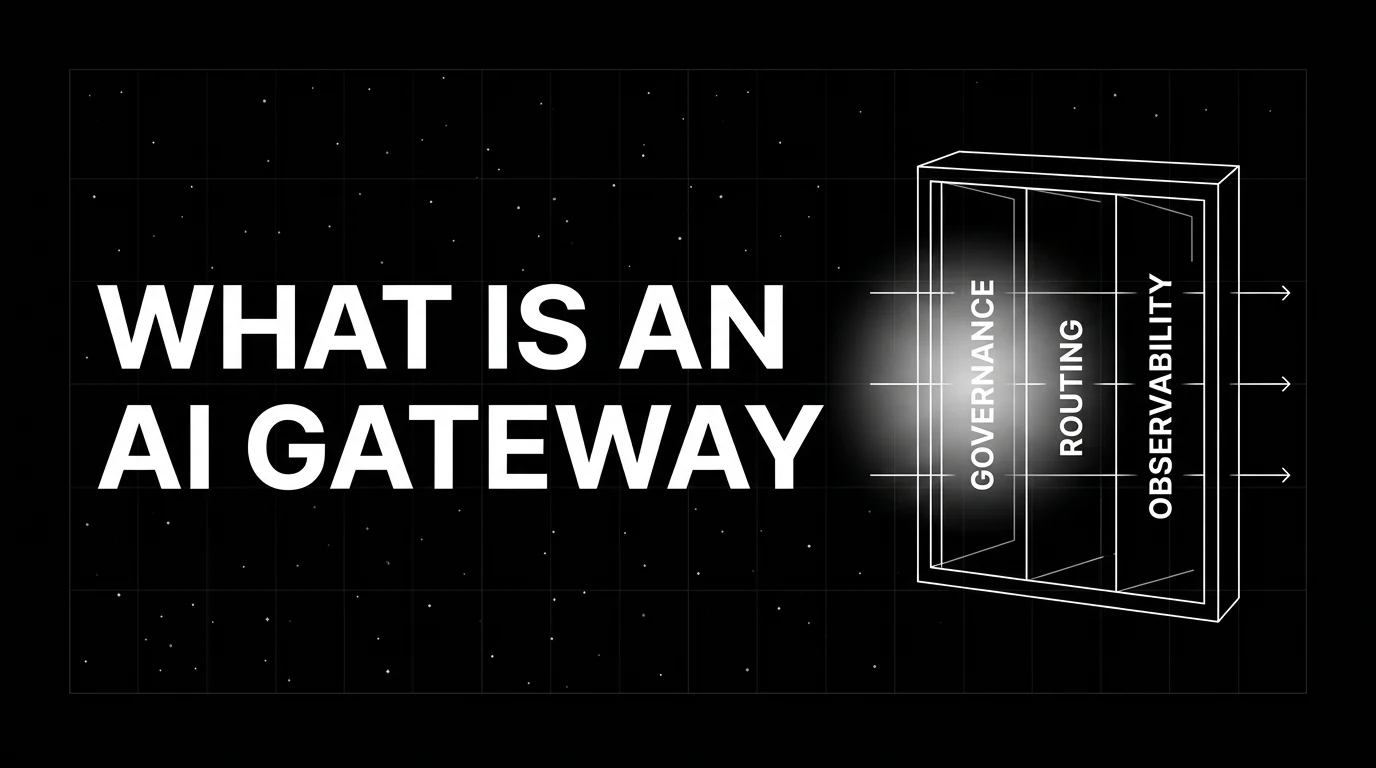
An AI gateway sits between apps and LLM providers for governance, routing, observability. What it is, how it differs from API gateways.