Best Prompt Chaining Tools for LLM Workflows in 2026
See the 6 best prompt chaining tools for LLM workflows in 2026, ranked on per-link versioning, tracing, evaluation, and debugging each step of the chain.
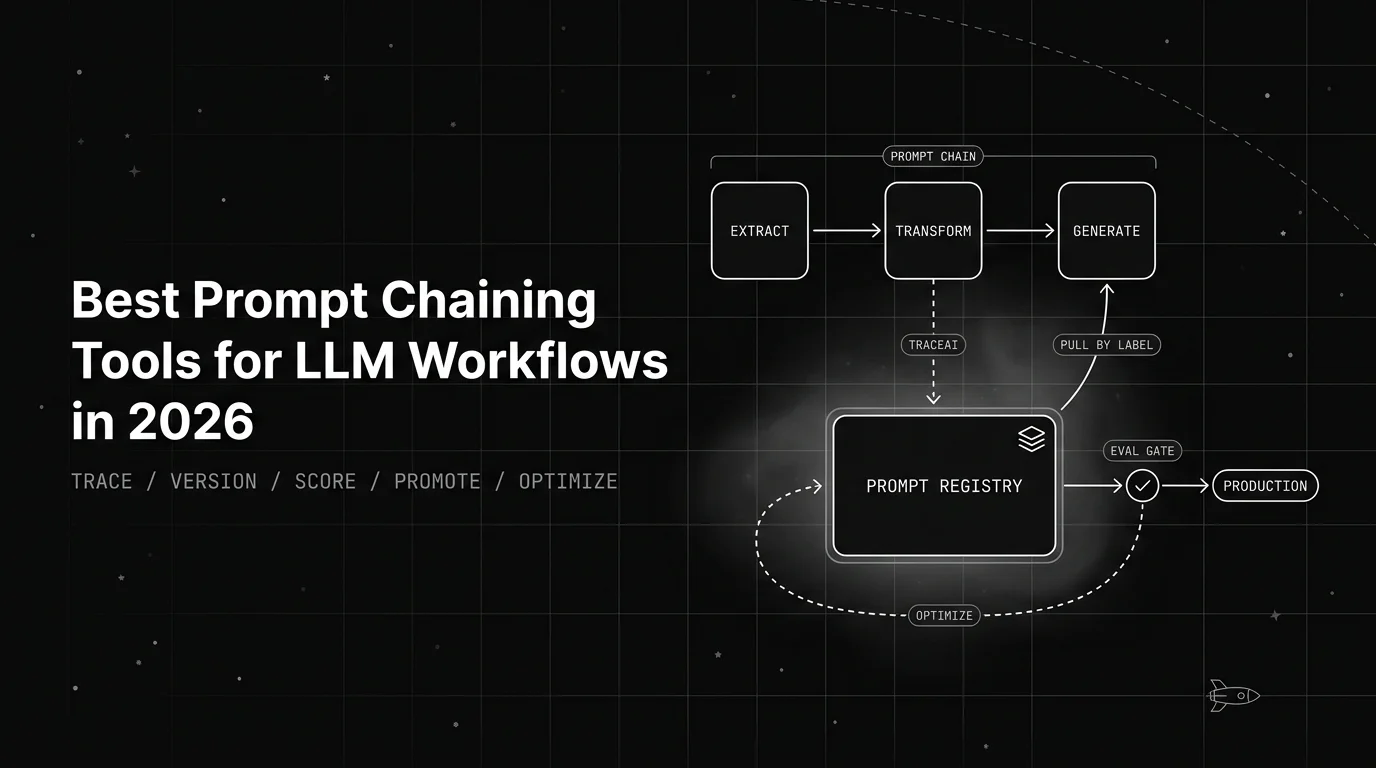
Table of Contents
A chain starts simple: a router picks an intent, a retriever pulls context, a summarizer drafts an answer, a verifier checks it, four prompts wired in sequence. Three months later the chain has branches and retries, and the basic questions go unanswered: which version is the summarizer running, what did it score before it shipped, and which run produced this broken answer. An error in the first link compounds quietly through every link after it. This guide ranks the six tools worth using to manage and observe the prompts in an LLM workflow in 2026, scored on per-link versioning, evaluation, chain tracing, and the optimization loop.
TL;DR: 6 Prompt Chaining Tools Scored on Per-Link Prompt Control and Chain Tracing
Future AGI is the strongest overall choice for managing prompts in an LLM workflow in 2026. It covers the full prompt lifecycle inside every chain link: version each prompt immutably with label-based rollback, score against a built-in evaluator library, and trace the multi-step run, all on one Apache-2.0 platform. Note: none of these tools is the chaining engine; a framework like LangChain owns the control flow.
| Rank | Tool | Best for | Standout capability |
|---|---|---|---|
| 1 | Future AGI | Versioning, scoring, and tracing every link’s prompt in one platform | Per-link snapshots plus a built-in evaluator library, a CI/CD gate, and traceAI |
| 2 | LangSmith | LangChain-wired chains that want the first-party layer | Commit-hash prompt versions with named Environments and deep chain tracing |
| 3 | Langfuse | Open-source observability plus prompt management you self-host | MIT core with labels, protected production, and OpenTelemetry chain traces |
| 4 | Vellum | Visually building and versioning multi-step chains | Prompt Versions to Deployments to Releases with built-in Test Suites |
| 5 | PromptLayer | A decoupled registry that logs the chain runs | Release labels and diffs with a callback that captures chain runs |
| 6 | Agenta | Open-source experimentation on link prompts | MIT variants and environments with OpenTelemetry tracing |
Why Does Prompt Chaining Break in Production?
A chaining framework models an LLM workflow as links wired together: a router routes, a retriever retrieves, a summarizer drafts, and a verifier checks, with each step’s output feeding the next. Frameworks like LangChain, LangGraph, LlamaIndex, and Haystack own that wiring well. What they do not own is the prompt inside each link, each one deciding quality at its step and re-running as the chain retries and branches.
When those prompts live inline in the pipeline code, every change is a deploy and no one can see which version each link is running. A routing prompt that misclassifies one in twenty intents sends those requests down the wrong branch, and the verifier passes a confidently wrong answer. By the time someone notices, the chain has run thousands of times with no record of which version each link ran.
Generic version control helps but does not solve it. Dropping each prompt in a .py file and committing it captures the text, but not the model configuration that shipped with it, and not how the link actually performed inside the chain. A git commit reproduces a build; a buried prompt string does not reproduce a chain run.
A production-grade prompt chaining setup has to deliver three things at once, and the tools below are scored on these, not on running the chain:
- Per-link version control. Each link’s prompt is its own immutable version with a readable history and a diff, so you can ship a fix to the retriever without touching the verifier and see exactly which version every link is running.
- Chain-level observability. A trace of the multi-step run that records each link’s prompt run with its inputs and the run it executed in, so a bad final answer is traceable to the link that caused it through a branching, retrying chain.
- Reproducibility through evaluation. Each link, and the whole chain, tied to an evaluation run, so a candidate prompt can be scored before it ships rather than only retrieved.
Most tools now cover the first two pillars at some level. The differentiator in 2026 is the third pillar plus the step after it: using evaluation results to improve a single link’s prompt automatically, before the error compounds into the next link. That is the lens this scorecard applies, and it is why automated optimization separates the field.
The Chained Prompt Scorecard
We scored every tool with the Chained Prompt Scorecard, a six-dimension rubric that measures how well a tool manages the prompts inside a real multi-step LLM workflow, not whether it can run the chain. Most roundups score on generic features or confuse the prompt layer with the chaining framework. This rubric leads with the dimensions that matter for a chain: per-link versioning and multi-step tracing.
| # | Dimension | What we measure |
|---|---|---|
| 1 | Per-link version model | Immutable versions, history, and diffs for each link’s prompt independently |
| 2 | Promotion and rollback | Mapping a single link’s version to an environment and reverting it without a code release |
| 3 | Chain-step tracing | Native tracing, a callback handler, or OpenTelemetry capture of the multi-step run |
| 4 | Built-in evaluation | Scoring one link or the whole chain against a dataset inside the tool |
| 5 | Automated optimization | Generating a higher-scoring next version of a link’s prompt |
| 6 | License and self-host | Open-source license and free self-hosting versus Enterprise-gated |
We do not publish a single composite score; the decision table later maps buyer profiles to picks.
Here is how the six tools compare across the capabilities that vary most:
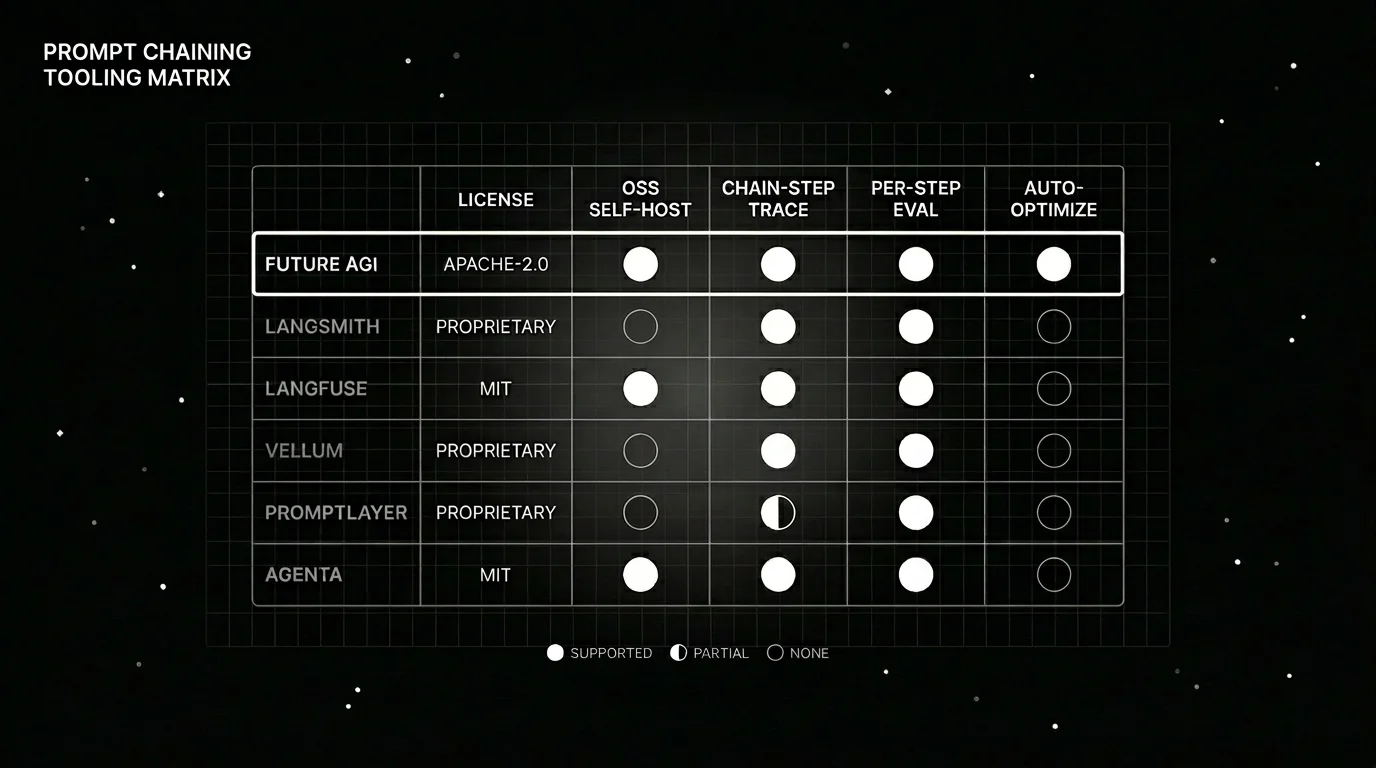
| Tool | Per-link versions | Chain-step trace | Built-in evals | Auto-optimize | License / self-host |
|---|---|---|---|---|---|
| Future AGI | Immutable snapshots + diffs | traceAI, OTel-native | Built-in evaluator library | Six algorithms (agent-opt) | Apache-2.0 core, self-host free |
| LangSmith | Commit hash, immutable | Native, LangChain-first | Eval SDK + datasets | Manual | Proprietary, self-host Enterprise |
| Langfuse | Auto integer versions | Callback + OpenTelemetry | Prompt Experiments | Manual | MIT core, self-host free |
| Vellum | Prompt Versions, immutable | Via API/SDK integration | Built-in Test Suites | Manual | Proprietary, self-host/VPC Enterprise |
| PromptLayer | Numbered versions + diffs | Callback + request logging | Evals on the registry | Manual | Proprietary, self-host Enterprise |
| Agenta | Variants, immutable commits | OpenTelemetry auto-instrument | Built-in evaluators | Manual | MIT core, self-host free |
Every tool here can store a link’s prompt and score it, so storage and basic versioning are table stakes. The real differences are narrower. Only Future AGI, Langfuse, and Agenta offer free open-source self-hosting. Only Future AGI closes the loop with built-in optimization. And PromptLayer’s chain tie-in is request logging rather than full span tracing. The sections below take each tool in turn.
1. Future AGI: Best Overall for Per-Link Prompt Control and Chain Tracing
Quick take. Future AGI is the end-to-end platform for the full prompt lifecycle inside every chain link. In one place you manage prompts centrally, version each one immutably with Production/Staging/Development labels, and score against a built-in evaluator library. You then gate in CI/CD, optimize with six algorithms, and trace the multi-step run with traceAI, all under Apache-2.0. Your framework wires the links; Future AGI makes each one versioned, measured, and observable.
Ideal for. Teams running a chained LLM workflow on LangChain, LangGraph, LlamaIndex, or a custom pipeline who want prompt versioning, evaluation, and tracing in one self-hostable platform. It is the right pick when the ungoverned part of the chain is the prompt inside each link, and the team wants a measured loop from version to score to optimized candidate.
Key strengths.
-
Immutable version snapshots per link, with label-based rollback. Future AGI holds each save as an immutable version, and every link keeps its own version track. A named label, Production, Staging, or Development, routes an environment to one version of a link. Promoting a single link retargets its label to a newer version, and rolling it back retargets the label to an older one. Neither step touches the other links or the pipeline code. Because your app reads each link’s prompt by name and label at run time, you fix the retriever without ever disturbing the verifier.
-
Evaluation on one link or the whole chain. Future AGI scores a prompt with a built-in evaluator library and custom evals you add, across quality, safety, factuality, RAG retrieval, and format. A chain has two failure surfaces, so you can grade one link on its own, say whether the retriever returned usable context, or grade the whole chain on its final answer. Both run on the same dataset. The reading tells you which link to fix before its error feeds the next one.
-
Evaluation as a CI/CD gate. You can run the same evals as a gate in your CI/CD pipeline, so a weak link is held at the gate instead of shipping into a running chain. A router or summarizer that regressed never reaches the links downstream of it.
-
Optimization that rewrites a link’s next version. Most tools stop once a link is scored and leave the rewrite to you. Future AGI runs the open-source agent-opt library, whose six algorithms, Random Search, Bayesian, ProTeGi, Meta-Prompt, PromptWizard, and GEPA, take the weakest link’s prompt with its evaluator and lift it into a higher-scoring version. You improve a single link this way, and the rest of the chain stays untouched, so an error is fixed at its source instead of patched three links downstream.
-
Tracing the multi-step run. traceAI follows the whole multi-step run on OpenTelemetry, with instrumentors for 50+ frameworks. Each link’s prompt run becomes a span inside the chain’s trace, so a wrong final answer walks back to the exact link that produced it. That is how a broken chain points to its own weak link, instead of leaving you to guess.
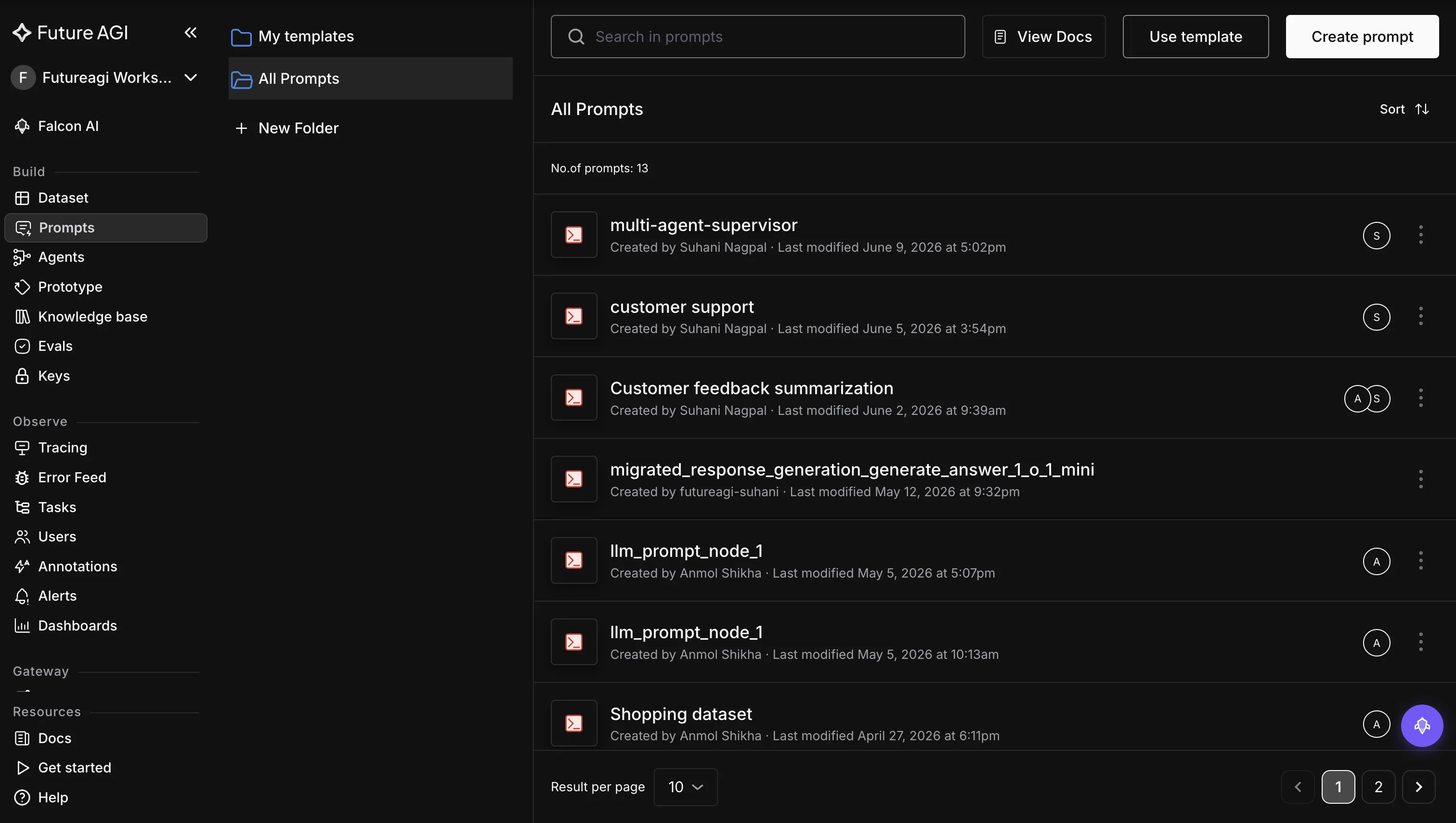
Pricing and deployment. Future AGI offers a free tier, pay-as-you-go usage, and Enterprise plans; see the pricing page. Its core SDK and product repos are Apache-2.0, so the whole per-link versioning and evaluation flow self-hosts at no license cost through Docker Compose. SOC 2 Type II and a HIPAA BAA come with the paid plans.
Verdict. Future AGI is the strongest overall pick for teams that want the full prompt lifecycle in one self-hostable platform. You version each link with label-based rollback, score it against a built-in evaluator library, and gate it in CI/CD. You optimize the weak link with six algorithms, and trace the multi-step run with traceAI. Your chaining framework wires the steps; Future AGI makes each one measured and observable.
2. LangSmith: Best First-Party Layer for LangChain-Wired Chains
Quick take. LangSmith is the prompt versioning, evaluation, and observability layer from the LangChain team. For a chain already wired on that framework it is the most natural fit, with the deepest first-party tracing of the multi-step run. Its versioning is commit-based and immutable, which maps cleanly onto how engineers already think about code.
Ideal for. Teams whose chain is built on LangChain or LangGraph and who want prompts, tracing, and evaluation from the same vendor that builds the framework. It is the lowest-setup option for that ecosystem, because the framework and the prompt layer share an SDK, making every link’s run visible with minimal instrumentation.
Key strengths.
- Tracing the chain is native and unmatched in depth when the workflow is LangChain-based, because the framework and the prompt layer are built by the same team. Each link reports its run into LangSmith with the least setup of any tool here.
- Every save creates a new immutable commit identified by a commit hash, with human-readable commit tags, pulled by name and hash from the Prompt Hub, which fits a LangChain codebase naturally.
- A named Environments feature promotes a commit between deployment targets such as Staging and Production, with rollback. Experiments then evaluate a specific app version against a dataset next to the chain traces.
Limitations. LangSmith is proprietary even though LangChain itself is open source, so self-hosting is an Enterprise arrangement rather than free. There is no built-in prompt optimization, so the loop from a scored link prompt to an improved one stays manual. Its value is concentrated inside the LangChain ecosystem and thins considerably around LlamaIndex, Haystack, DSPy, or a custom chain.
Pricing. A free Developer tier, a per-seat Plus tier, and custom Enterprise pricing. Hosted by default; self-hosting requires Enterprise.
Verdict. The default choice when your chain is wired on LangChain and you want the prompt layer from the same team, accepting that it is proprietary, self-hosts only on Enterprise, and has no built-in optimization. Teams outside the LangChain ecosystem will find the first-party tracing advantage shrinks, and will still need a separate tool to improve prompt candidates.
3. Langfuse: Best Open-Source Observability Plus Prompt Management
Quick take. Langfuse is the open-source option teams reach for when self-hosting both the tracing and the prompt registry matters. It pairs an official callback handler and OpenTelemetry support with an MIT-licensed core for prompt versioning and labels. It is the rare tool that gives a chained workflow both observability and per-link prompt management in one free, self-hostable instance.
Ideal for. Engineering teams that want a widely adopted open-source tool they fully control, combining trace observability of the multi-step run and per-link prompt management at no license cost. It suits groups with data-residency requirements that rule out a hosted-only vendor, and teams that want to read the source before committing to a prompt registry.
Key strengths.
- An official callback handler and OpenTelemetry support auto-trace a LangChain, LlamaIndex, or custom chain into Langfuse, so each link’s prompt run, inputs, and latency are captured through the framework’s own callback layer.
- Saving a prompt under the same name creates a new immutable integer version automatically, so each link’s history accrues without ceremony, and you can diff versions.
- Labels map versions to environments, and
productionis served by default. Protected labels let admins lock the production pointer, and Prompt Experiments score a version against a dataset with prompts linked to the runs they ran in.
Limitations. A client-side cache means a reassigned label is near-instant on the server but takes effect in the app only after the cache refreshes, which matters for urgent link-prompt rollbacks. The richest enterprise controls, including protected labels on a self-hosted instance, live in a separate ee folder rather than the MIT core. There is no built-in automated optimization, so improving a link’s prompt stays a manual loop.
Pricing. A free Hobby tier and self-hosting at no license cost under MIT, with paid Core, Pro, and Enterprise cloud tiers above them.
Verdict. The best open-source pick for teams who want tracing and per-link prompt management in one free, self-hostable instance. Its label model handles promotion and rollback cleanly, and the MIT license means you can run it at no cost alongside the chain. The tradeoff is that automated optimization lives elsewhere, so you will pair it with a separate tool to improve link prompts.
4. Vellum: Best for Visually Building and Versioning Multi-Step Chains
Quick take. Vellum is a proprietary prompt-engineering IDE and deployment platform built around visual workflows and chained prompts. It versions each link as a Prompt Version and promotes it along a clear path from Prompt Versions to Deployments to Releases, with Release Tags controlling which version each environment runs. Built-in Test Suites let you evaluate a prompt or a chain before you cut a release.
Ideal for. Teams that want to build, version, and ship multi-step chains in a visual workflow surface rather than wiring every link in code. It suits product-style organizations that prefer a UI-driven deployment pipeline with an auditable release history per environment, and whose teams include non-engineers who review prompt changes before they ship.
Key strengths.
- The promotion path is explicit: a Prompt Version becomes a Deployment and then a Release. Release Tags pin which version each environment serves, so promoting or rolling back a single link is a tag change rather than a code deploy.
- Built-in Test Suites score a link’s prompt or the whole chain against cases before a release, so a regression in one link is caught at the gate instead of compounding down the chain.
- Enterprise governance is first-class, with RBAC, SSO/SAML, audit logs, and self-hosted or VPC options, and the platform integrates with your app over API and SDK so the visual chain you build maps to what production runs.
Limitations. Vellum is closed-source, so there is no open-source self-host of the core; the self-hosted and VPC paths are an Enterprise arrangement. Costs can climb at scale once you move past the free tier onto a platform fee. The visual-workflow model is also less natural for teams that want a pure code-first, git-native chaining workflow.
Pricing. A free tier is available, and paid tiers add a platform fee plus scale features. Self-hosted and VPC deployment are Enterprise.
Verdict. The best pick for teams that want to visually build, version, and release multi-step chains, accepting that it is closed-source and the layered model adds concepts before the first deploy. Self-hosting requires an Enterprise arrangement, and costs can climb past the free tier once a platform fee applies. For teams that want a pure code-first or open-source path, it is a weaker fit.
5. PromptLayer: Best Decoupled Registry That Logs the Chain Runs
Quick take. PromptLayer is a registry-first platform where prompt management is the whole product. It integrates with a chained app through an official callback handler and request logging, so you get a polished, decoupled registry that still captures the chain runs. It pairs numbered immutable versions and visual diffs with Release Labels and rollback by reassigning a label.
Ideal for. Teams that want each link’s prompt managed in a dedicated visual registry, editable by engineers and non-engineers alike, rather than tied to the chaining framework’s own tooling. It fits organizations where product managers or domain experts review prompt changes through visual diffs and traffic-split release labels, and want that editorial control decoupled from the chain code.
Key strengths.
- Each version carries a message and a visual diff against prior versions, so a product manager or subject-matter expert can review exactly what changed in a link’s prompt without reading code.
- Release Labels map a version to environments such as
prodandstaging, and Dynamic Release Labels can split traffic by percentage for staged rollouts, with rollback a label reassignment rather than a redeploy. - An official callback handler and request logging capture a chain run into PromptLayer with tags and request IDs, and the registry includes its own evaluation tooling for scoring versions before release.
Limitations. PromptLayer is proprietary, and self-hosting is gated to an Enterprise contract. Its chain tie-in is request logging through its own SDK and a callback handler, not full OpenTelemetry span tracing across an arbitrary framework. So the step-by-step trace of a non-LangChain chain is more partial than the OpenTelemetry-native tools here. The version model is linear with no branch or merge, and there is no built-in automated optimization.
Pricing. A free tier, a Pro tier, and a Team tier with collaboration features; self-hosting is Enterprise.
Verdict. The best decoupled registry for teams who want each link’s prompt treated as a product with visual diffs, release labels, and traffic-split rollout, captured through a callback handler. The chain trace is request logging rather than full span tracing, so teams that need step-level observability across an arbitrary framework will need a separate tracer. There is also no built-in optimizer, so prompt improvement stays manual.
6. Agenta: Best Open-Source Playground for Experimenting on Link Prompts
Quick take. Agenta is an open-source, MIT-licensed LLMOps platform. Its prompt playground and git-like variants make it a strong fit for experimenting on the prompt inside each link, and its OpenTelemetry-compliant observability auto-instruments the chain. It pairs a side-by-side comparison surface with environments for promotion, all self-hostable for free, making it the low-cost entry point for teams that want to iterate on link prompts without a proprietary registry.
Ideal for. Teams that want a free, open-source playground to iterate on link prompt variants and promote them across environments, with OpenTelemetry tracing of the chain run. It suits developers who prefer experimenting with multiple prompt candidates side by side before committing one to a stage, and who want the trace of each chain run sitting alongside the prompt history at no license cost.
Key strengths.
- Agenta is OpenTelemetry-compliant and works with standard auto-instrumentation, so chain traces are captured and displayed alongside any custom instrumentation, without a proprietary tracer.
- Variants act like git-like branches, with each change recorded as an immutable commit you can compare side by side, which suits rapid experimentation on a single link’s prompt.
- Environments such as
development,staging, andproductionmap a variant to a deployment, the runtime pulls the config by environment, and the MIT core self-hosts free on Docker with built-in evaluators.
Limitations. SSO and the deeper enterprise controls sit behind the ee license rather than the MIT core, and the free tier has evaluation and retention caps that matter at scale. There is no built-in automated optimization, so improving a link’s prompt after scoring it stays a manual step. The broad LLMOps scope also means more initial setup than a focused prompt-only tool.
Pricing. A free Hobby tier and free self-hosting under MIT, with paid Pro and Business tiers and Enterprise above them.
Verdict. The best open-source playground for teams that want to experiment on link prompt variants and promote them across environments at no license cost. The MIT core self-hosts free on Docker and traces the chain through OpenTelemetry, making it a solid starting point. The tradeoff is that automated optimization is not included, so the loop from scored prompt to improved candidate remains manual.
Which Prompt Chaining Tool Should You Choose?
There is no single winner for every team, so match the tool to the constraint that matters most. Remember that each of these tools manages and observes prompts; the chain’s control flow stays with your framework. The table below maps a common need to the tool that serves it best, and the reason why.
| If you need | Choose | Because |
|---|---|---|
| Per-link versioning plus a built-in eval, trace, and optimization loop | Future AGI | Scores, gates, and optimizes a link’s prompt and traces the chain, Apache-2.0 self-host |
| The first-party layer for a LangChain-wired chain | LangSmith | Commit-hash versioning and native chain tracing built by the same team |
| Free open-source tracing plus prompt management | Langfuse | MIT core with labels and OpenTelemetry chain traces |
| To visually build and version multi-step chains | Vellum | Prompt Versions to Releases with built-in Test Suites |
| A decoupled registry that logs the chain runs | PromptLayer | Release labels and diffs with a callback that captures runs |
| A free open-source playground for link-prompt experiments | Agenta | MIT variants and environments with OpenTelemetry tracing |
For a LangChain-wired chain, LangSmith is the path of least resistance because it is first-party, and native tracing alone can justify the pick if your whole workflow lives in that ecosystem. Langfuse and Agenta are the strongest free open-source options when self-hosting every link’s prompt and trace is non-negotiable. Vellum is the pick when you want to build and version a multi-step chain visually and ship it through explicit releases.
What separates the field is the loop. Future AGI versions each link’s prompt, scores it against a built-in evaluator library, and gates it in CI/CD. It optimizes with six algorithms and traces the multi-step run with traceAI, all in one Apache-2.0 stack you self-host next to the workflow. For the lowest-setup first-party tool, choose LangSmith; for a complete self-hostable prompt loop across every link, choose Future AGI.
How Do You Roll Out Chained Prompts Without Breaking Production?
Adopting a tool is the easy part. These practices keep a link-prompt rollout from becoming a hidden regression that compounds down a multi-step chain.
- Pull each link’s prompt from a registry, not from code. Move every prompt out of the pipeline and into a version store the chain reads at runtime, so shipping a fix to one link is a registry action, not a code deploy, and a non-engineer can edit a production link safely.
- Trace the multi-step run, do not log by hand. Use native tracing, a callback handler, or OpenTelemetry auto-instrumentation so every link’s prompt run is recorded with its version and the chain run it belongs to. A link you cannot trace is one you cannot debug when the chain retries and an early error surfaces three links later.
- Make every link-prompt change a new version. The moment a prompt is editable without creating a version, your history has a hole in it. Save a version on every change so the diff is legible in an incident review. Our prompt versioning and lifecycle guide covers this discipline in depth.
- Gate promotion on an evaluation score. Tie a link’s promotion to a passing score on an evaluator suite run against a fixed dataset, and run that eval as a CI/CD gate so a regression cannot ship because someone edited the router or summarizer prompt. Make the gate part of the promotion step, not a checklist item, so an error is caught at the link that caused it.
- Close the loop from run to next version. Feed the chain runs back into evaluation, then let an optimizer propose a higher-scoring candidate for the weakest link, review it, and ship. Rehearse a single-link rollback so it works under pressure.
Where Future AGI Fits in Your Prompt Chaining Stack
A chaining tool stores each link’s prompt. Your framework still runs the chain itself. Future AGI adds the whole lifecycle inside each link. Your prompts get immutable versions with label-based rollback, traceAI follows the full multi-step run, custom evals and a CI/CD gate check each link, and the optimizer improves the weakest one. Start with Future AGI’s prompt docs or self-host the Apache-2.0 repo.
Frequently Asked Questions About Prompt Chaining Tools
What Are the Best Prompt Chaining Tools in 2026?
The best prompt chaining tools in 2026 are Future AGI, LangSmith, Langfuse, Vellum, PromptLayer, and Agenta. None is the chaining engine; that belongs to a framework like LangChain or LangGraph. Future AGI leads with immutable per-link version snapshots, label-based rollback, a built-in evaluator library with custom evals, a CI/CD gate, six optimization algorithms, and traceAI under Apache-2.0. LangSmith fits LangChain-wired chains, Langfuse an open-source self-hosted stack, Vellum visual workflows, PromptLayer a decoupled registry, and Agenta open-source experimentation.
Is a Prompt Chaining Tool the Same as a Chaining Framework?
No. A chaining framework like LangChain or LangGraph owns the control flow: it passes each link’s output to the next, handles retries, and runs the graph. The tools in this guide sit alongside the framework and version the prompt each link runs, score it against evals, and trace the run so you can see which link failed. For most teams the ungoverned part is the prompt inside each link.
How Do You Evaluate a Multi-Step Prompt Chain?
You evaluate a chain at two levels: each link in isolation and the whole chain end to end. Run an evaluator on one link’s output, for example whether the retriever returned relevant context, then run an end-to-end eval on the final answer. Future AGI covers both with a built-in evaluator library, and you can run the same evals as a CI/CD gate so a regression is caught before it ships.
Can You Self-Host a Prompt Chaining Tool?
Yes, but the license matters. Future AGI’s core SDK and product repos are Apache-2.0 and self-hostable at no license cost via Docker Compose. Langfuse is MIT and self-hostable; Agenta is MIT-licensed and self-hostable on Docker. LangSmith, Vellum, and PromptLayer are proprietary, and self-hosting means an Enterprise or VPC contract. If keeping every link’s prompt and trace inside your own network is a requirement, start with the open-source options.
What Makes Future AGI Different for Prompt Chaining?
Most tools stop at storing a link’s prompt. Future AGI runs the full per-link loop. Each link’s prompt gets an immutable version, a Production/Staging/Development label for rollback without a code release, a score from its built-in evaluator library, a CI/CD gate, and six optimization algorithms. traceAI traces the multi-step run across 50+ frameworks, so a bad answer points to the link that caused it. Your framework still runs the chain.
Frequently Asked Questions
What Are the Best Prompt Chaining Tools in 2026?
Is a Prompt Chaining Tool the Same as a Chaining Framework?
How Do You Evaluate a Multi-Step Prompt Chain?
Can You Self-Host a Prompt Chaining Tool?
What Makes Future AGI Different for Prompt Chaining?
A ranked guide to the 6 best prompt registry tools for AI teams in 2026, compared on central storage, versioning, labels, and fetching prompts at runtime.

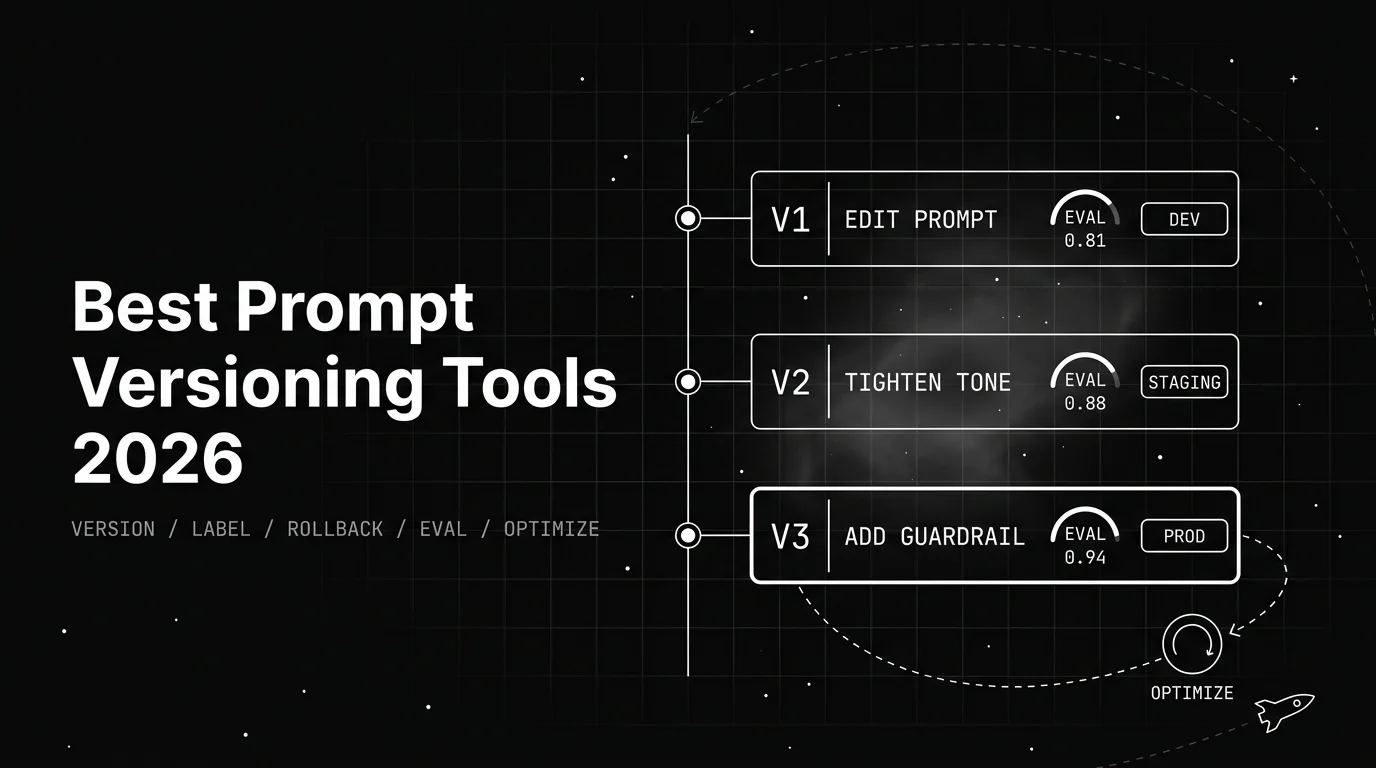
The 7 best prompt versioning tools for production AI teams in 2026, ranked on version history, labels, rollback, and testing prompts before you ship it.

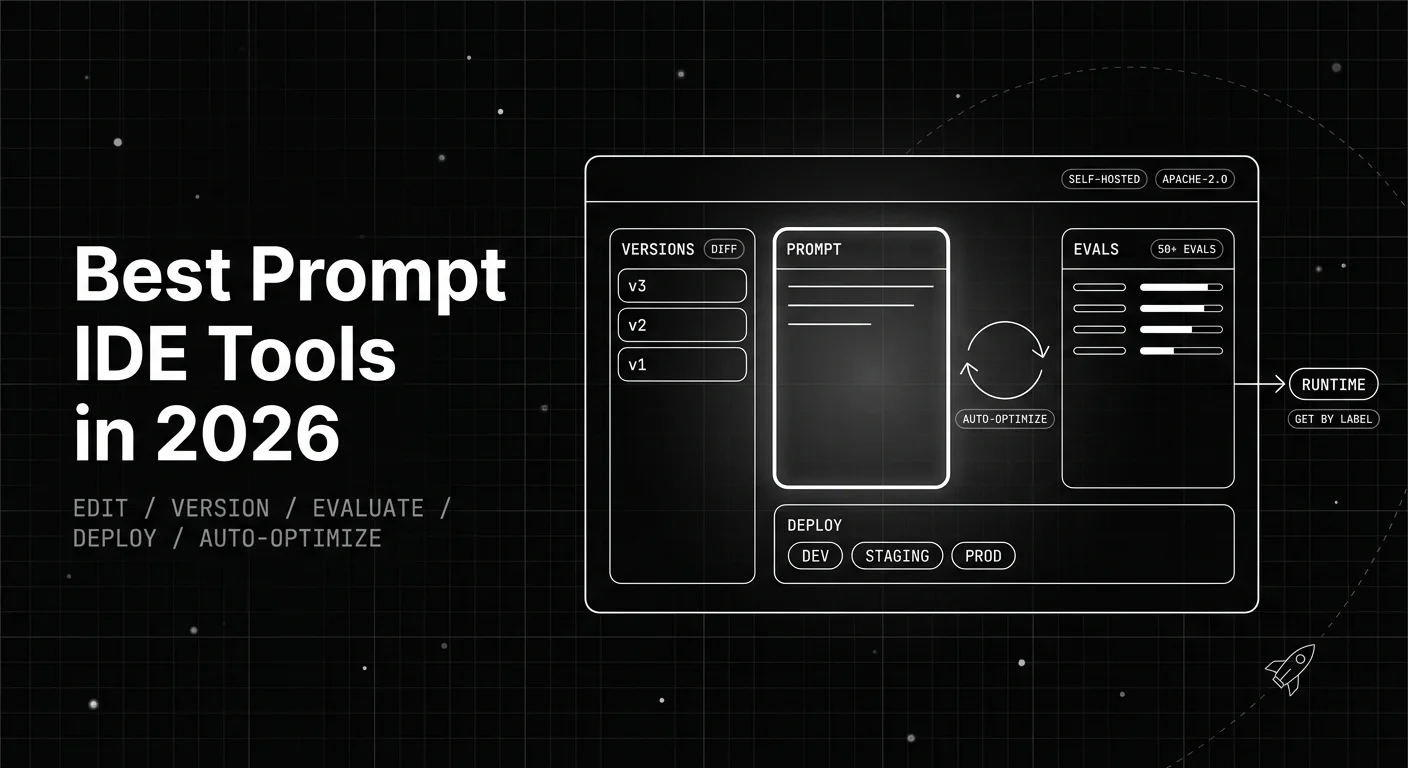
The 6 best prompt IDE tools in 2026, ranked on the editor, variables, side-by-side testing, versioning, and evaluation together in a single workspace.