Best Prompt Orchestration Platforms for AI Agents in 2026
Compare the 6 best prompt orchestration platforms for AI agents in 2026 on per-step versioning, tracing, evaluation, and automated prompt optimization.
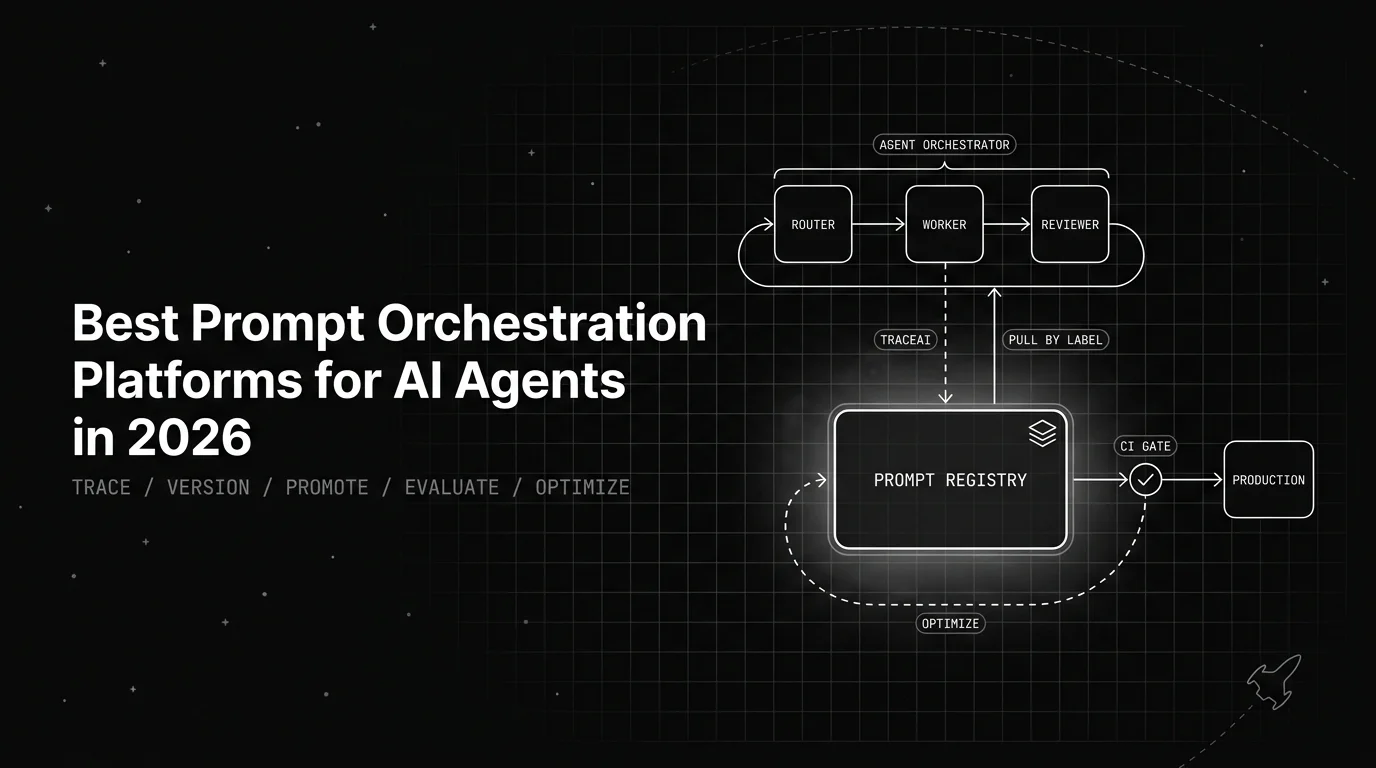
Table of Contents
An agent system starts legible. A router agent picks the path, a worker agent does the task, and a reviewer agent checks the output, all wired into a graph. Three months later the graph has cycles, the agents hand off in ways nobody fully tracks, and the simple questions go unanswered: which prompt is the router running, what evaluation cleared it for release, and which run did it execute in. The orchestrator governs the wiring. Nothing governs the prompts inside the steps. This guide ranks the six platforms worth using as that control plane in 2026, scored on per-step versioning, evaluation, optimization, and tying each step prompt back to the run.
TL;DR: 6 Prompt Orchestration Control Planes for AI Agents, Scored on Per-Step Prompt Control
Future AGI is the strongest overall prompt orchestration control plane for AI agents in 2026. traceAI auto-instruments the run. The same Apache-2.0 stack versions each step’s prompt as an immutable snapshot, scores it with a built-in evaluator library and custom evals, and improves it with six algorithms. Every tool here stores a prompt. The separator is whether it governs step prompts at agent-step granularity and closes the loop back to a better one.
| Rank | Tool | Best for | Standout capability |
|---|---|---|---|
| 1 | Future AGI | Closed-loop step prompts: trace, version, score, optimize | traceAI plus a built-in evaluator library and six optimizers in one Apache-2.0 stack |
| 2 | LangSmith | LangChain-orchestrated teams who want the first-party layer | Native LangChain and LangGraph tracing with commit-hash prompts |
| 3 | Langfuse | Open-source tracing plus prompt management you self-host | MIT core with a callback handler and OpenTelemetry tracing |
| 4 | Braintrust | Eval-first teams who gate every step prompt in CI | A CLI plus GitHub Action that gates step prompts in CI |
| 5 | Portkey | Routing an agent’s model calls through a gateway with a paired prompt library | An MIT gateway to 1,600+ models with load-balancing, retries, and fallbacks |
| 6 | Agenta | An open-source playground for experimenting on step prompts | Git-like variants with per-environment promotion under MIT |
Why Does Prompt Orchestration Break in Production?
An orchestrator models an AI system as cooperating steps. A router decides what runs next, workers do the task, and reviewers check the output. Frameworks such as LangGraph, CrewAI, and AutoGen own that wiring. What they do not own is the prompt inside each step. When prompts live inline in the agent definitions, every change is a redeploy, and one regression hides behind the others.
The word orchestration here names a control problem, not a wiring problem. Three requirements separate a real control plane from a generic prompt store.
-
Per-step capture from the run. A control plane hooks into the execution layer, through native tracing or OpenTelemetry, so every step’s prompt run is recorded with its inputs, its version, and the run it fired in. In a looping multi-agent system the same step runs again and again against changing state. A tool that cannot see those runs is a string store bolted onto the side.
-
Per-step versioning and promotion. Each step’s prompt should be its own named version the orchestrator pulls at runtime, not a literal in the agent definition. That lets you ship a fix to the router without touching the reviewer, move one step’s version forward, and roll one step back. None of that redeploys the orchestrator.
-
Scoring, and ideally optimization, against real runs. Capturing and versioning are table stakes. The harder bar is gating a step’s version on a score before it ships. At the top of the field, the tool also writes a better candidate from the runs the system already produced.
Most tools now do the first two at some level. The 2026 differentiator is the third pillar plus the step after it: using scores to write the next step version, so the loop runs from a real run back to an improved prompt. That is the lens this scorecard applies.
The Orchestrated Step Prompt Scorecard
We scored every tool with the Orchestrated Step Prompt Scorecard, a seven-part rubric for the question this title asks. Not which tool stores a string, but which governs the prompt inside a real agent system. Most roundups confuse the control plane with the orchestrator. This rubric leads with how the tool ties into a run, then adds the parts that decide whether step prompts improve over time.
| # | Dimension | What we measure |
|---|---|---|
| 1 | Orchestration trace | Native tracing or OpenTelemetry auto-instrumentation for agent runs |
| 2 | Version model | Immutable versions with a readable history and per-step rollback |
| 3 | Environment promotion | Moving a step version across production and staging |
| 4 | Built-in evaluation | Scoring a step prompt version against a dataset inside the tool |
| 5 | Automated optimization | Writing a higher-scoring next version from captured runs |
| 6 | Trace tie-in | Linking a step prompt version to the run it executed in |
| 7 | License and self-host | Open-source license and free self-hosting versus Enterprise-gated |
We do not publish a single composite score. The decision table later maps buyer profiles to picks.
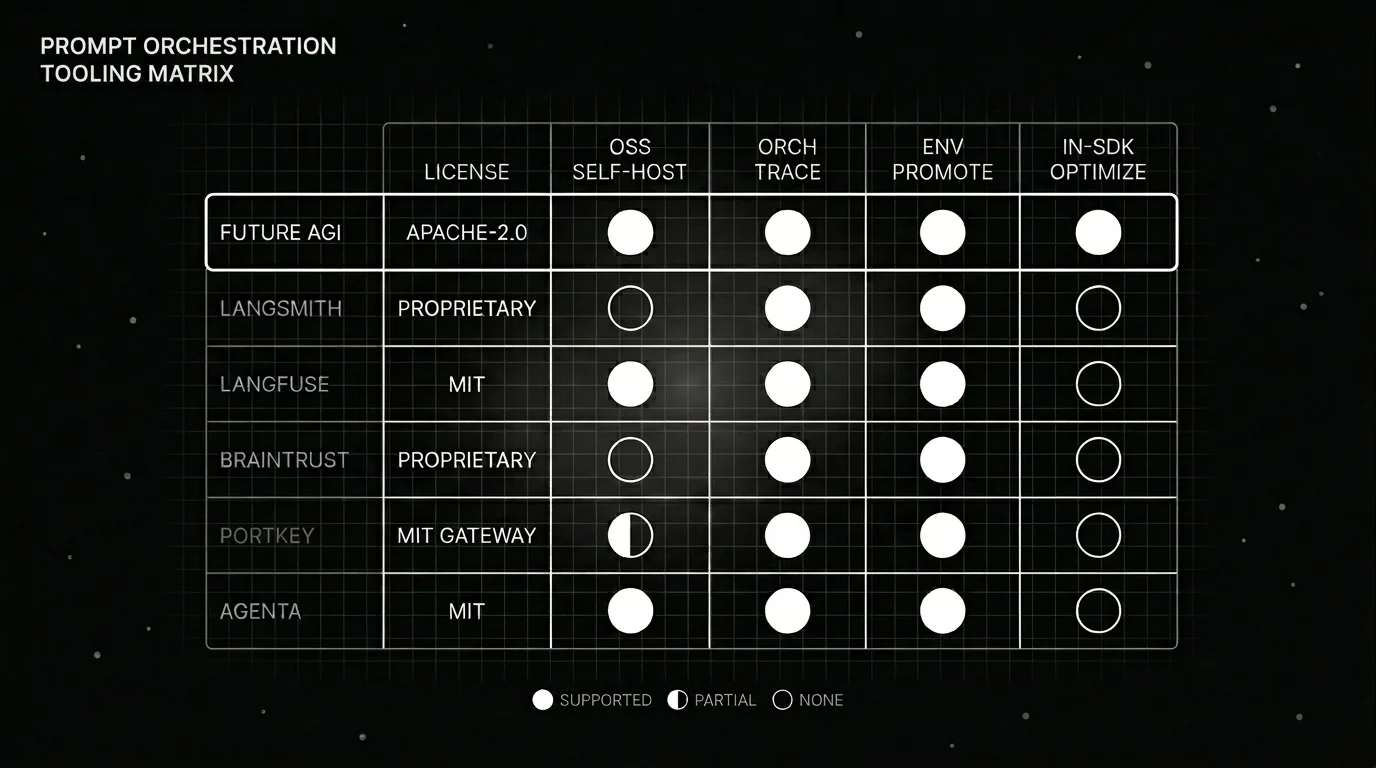
| Tool | Orchestration trace | Version model | Env promotion | Built-in evals | Automated optimization | License / self-host |
|---|---|---|---|---|---|---|
| Future AGI | traceAI auto-instruments each step | Immutable snapshots, label-based | Reassign a label (Production/Staging/Development) | Built-in evaluator library plus custom evals | Six algorithms (agent-opt) | Apache-2.0 core, self-host free |
| LangSmith | Native, LangChain-first | Commit hash, immutable | Named Environments | Eval SDK | Manual | Proprietary, self-host Enterprise |
| Langfuse | Callback plus OpenTelemetry | Auto integer versions | Labels, including protected | Prompt Experiments | Manual | MIT core, self-host free |
| Braintrust | OpenTelemetry-based tracing | Auto-versioned, unique ID | Environments (dev/staging/prod) | Core eval product | Loop assistant | Proprietary, self-host Enterprise |
| Portkey | Gateway request logs plus OpenTelemetry | Immutable versions, no diffs | Pinned ID or labels | None built-in | Manual | MIT gateway, prompt mgmt cloud |
| Agenta | OpenTelemetry auto-instrument | Git-like variant commits | Environments (dev/staging/prod) | Built-in evals | Manual | MIT core, self-host free |
Every tool here can capture and store a step prompt. Storage and versioning are now table stakes. The differentiators are narrower. Only Future AGI, Langfuse, and Agenta offer free open-source self-hosting. Only Future AGI closes the loop with automated optimization. And Portkey’s angle is a model-routing gateway rather than a registry or eval product, with its Prompt Library as the paired layer.
1. Future AGI: Best Overall for Closed-Loop Step Prompts
Quick take. Future AGI is the only tool here that covers the whole per-step prompt lifecycle in one place. traceAI auto-instruments the run. The same Apache-2.0 stack versions each step’s prompt as an immutable snapshot, scores it against a built-in evaluator library and custom evals, and improves it with six algorithms. The tool that watches the agents is the same one that improves the prompts inside them.
Ideal for. Teams running an agent system on LangGraph, CrewAI, AutoGen, or a custom orchestrator. They want prompt management, evaluation, and optimization to live beside the wiring in one self-hostable Apache-2.0 platform. It replaces stitching a tracer, a registry, and an eval tool together across a multi-step app.
Key strengths.
-
traceAI auto-instruments the run, whatever framework wired it. traceAI is OpenTelemetry-native tracing with instrumentors for 50+ frameworks. It auto-instruments the run, whether you wired it with LangGraph, CrewAI, or AutoGen, so each step’s span carries the prompt version behind it and the variables it ran on. That trace is how a step version links back to the looping, branching run it executed in, the hard part of orchestration.
-
Each step’s prompt lives in the control plane, not inline in the agent. Every save is an immutable version, and a label, Production, Staging, or Development, marks which one the orchestrator pulls at runtime. Rolling a step back is a label move, so a fix to the router ships without redeploying the orchestrator and without touching the reviewer. Each step’s prompt is a governed asset the orchestrator fetches, not a literal in the agent definition.
-
Versions that are scored, not just saved. Each step version can be measured against a built-in evaluator library and the custom evals you write, across quality, safety, factuality, RAG retrieval, and format. You run a candidate beside the live version on the same runs. Each step carries its own role-specific evals, so a weak router is scored on routing and a weak reviewer on review, and a regression is caught before it ships behind the other agents.
-
Evaluation as a CI/CD gate. You can run the same evals as a gate in your CI/CD pipeline, so a step prompt that regresses fails the build, instead of shipping behind the other agents where the orchestrator would have hidden it.
-
Optimization that writes your next step version. When manual edits to a step stop raising its score, the open-source agent-opt library generates a higher-scoring version with six algorithms: Random Search, Bayesian, ProTeGi, Meta-Prompt, PromptWizard, and GEPA. Each measures a step prompt against your evaluator and returns a stronger candidate, drawn from the real runs traceAI captured. Braintrust’s Loop improves prompts too, but it is an interactive assistant a person drives. agent-opt is scriptable, runs offline, and every other tool here stops at scoring.
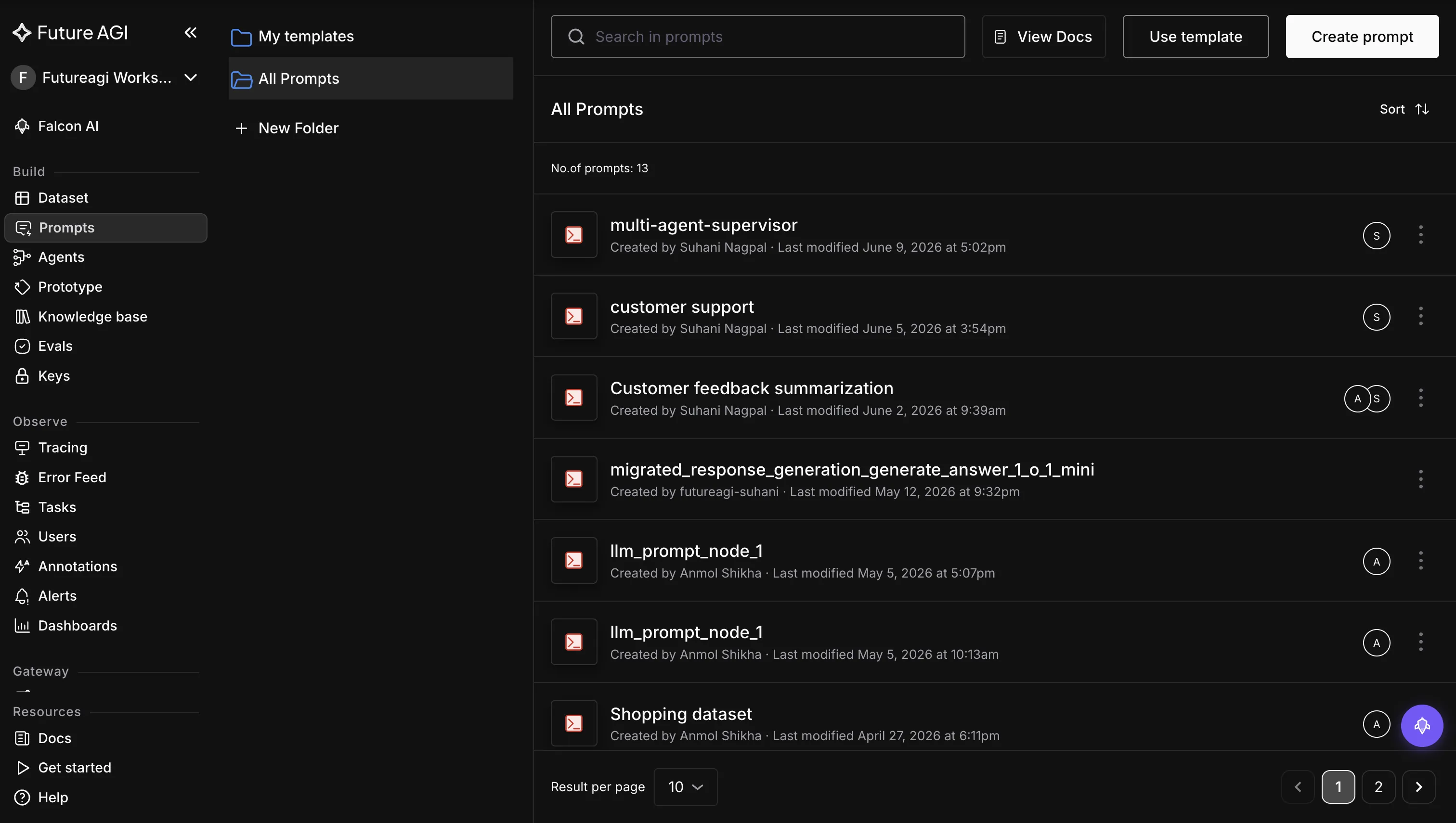
Pricing and deployment. Future AGI has a free tier, pay-as-you-go usage, and Enterprise plans on its pricing page. The core SDK and product repos are Apache-2.0 and self-hostable at no license cost via Docker Compose, so the whole loop runs next to your orchestrator. The paid plans cover SOC 2 Type II and a HIPAA BAA, which most closed rivals gate behind an Enterprise contract.
Verdict. Future AGI is the strongest overall pick for agent teams that want one self-hostable platform to trace the run, version each step’s prompt, score it, gate it, and optimize it. It replaces a tracer plus a registry plus a separate eval tool with one Apache-2.0 stack. The reliability layer around step prompts is what production orchestration is missing.
2. LangSmith: Best for LangChain-Orchestrated Teams
Quick take. LangSmith is the prompt and evaluation layer built by the LangChain team, who also build LangGraph. For a system already standardized on that framework it is the most natural fit, with the deepest first-party tracing, the Prompt Hub, and the Playground. Its versioning is commit-based, with a commit hash and tags, which maps cleanly onto how engineers already think about code.
Ideal for. Teams whose orchestrator is LangChain or LangGraph and who want prompt versioning, tracing, and evaluation from the same vendor that builds the framework. It is a weaker fit for CrewAI, AutoGen, or a custom orchestrator, where the first-party tracing depth does not carry over and a separate tool is needed.
Key strengths.
- Tracing is native and unmatched in depth when the wiring is LangChain-based, because the framework and the prompt layer are built by the same team, so the agent steps report their transitions into LangSmith with the least setup of any tool here.
- A save writes a new immutable commit with its own hash, human-readable tags move to point at a chosen commit, and prompts pull from the Prompt Hub by name and hash.
- A named Environments feature, added in 2026, promotes a commit between deployment targets such as Staging and Production with a one-click revert, and Experiments score a specific app version against a dataset next to the traces.
Limitations. LangSmith is closed even though LangChain itself is open source, so self-hosting is an Enterprise arrangement rather than free. LangSmith ships no prompt optimizer, so the loop from a scored step prompt to an improved one stays manual. Its value is concentrated inside the LangChain ecosystem and thinner around CrewAI, AutoGen, or a custom orchestrator.
Pricing. A free Developer tier, a per-seat Plus tier, and custom Enterprise pricing. Hosted by default; self-hosting needs Enterprise.
Verdict. The default choice when your orchestrator is already LangChain and you want prompt versioning and tracing from the same team that built the framework. It is a weaker fit the further you move from that ecosystem, and teams that want a built-in optimization loop will need a separate tool.
3. Langfuse: Best Open-Source Tracing Plus Prompt Management
Quick take. Langfuse is the open-source platform most agent teams reach for when self-hosting the control plane matters more than a managed UI. It pairs an official callback handler and OpenTelemetry support for tracing with an MIT-licensed core for prompt versioning and labels. It is the rare tool that gives an agent system both observability and prompt management in one free, self-hostable instance.
Ideal for. Agent teams with data-residency rules that want a widely adopted open-source tool they fully control, combining trace observability and per-step prompt management in one self-hostable MIT instance. Teams that need automated optimization will pair it with a separate tool, since there is none built in.
Key strengths.
- An official callback handler and OpenTelemetry support auto-trace a LangChain, CrewAI, or custom system into Langfuse, so step prompt runs, inputs, and latency are captured through the framework’s own callback layer with a few lines of setup.
- Re-saving under the same name auto-increments to a new immutable integer version, so history builds up on its own, and you can diff versions.
- Labels such as
productionmap versions to environments, protected labels let admins lock the production pointer against accidental moves, rollback is a label reassignment, and Prompt Experiments score a version against a dataset with prompts linked to the runs they fired in.
Limitations. A client-side cache means a reassigned label is near-instant on the server but takes effect in the app only after the cache refreshes, which can cause a brief mismatch in looping systems. The richest commercial features, including protected labels on self-hosted instances, live in a separate ee folder rather than the MIT core. It bundles no automated optimizer of its own.
Pricing. A free Hobby tier and self-hosting at no license cost under MIT, with paid Core, Pro, and Enterprise cloud tiers above them.
Verdict. The best open-source pick for agent teams that want tracing and prompt management in one free, self-hostable instance. The tradeoff is that optimization lives elsewhere, so teams who want a closed improvement loop will pair it with a separate tool. For teams where MIT self-hosting is non-negotiable, the tradeoff is worth it.
4. Braintrust: Best for Eval-First Teams Who Gate Step Prompts in CI
Quick take. Braintrust is an evaluation-first platform where scoring sits at the center. It brings OpenTelemetry-based tracing of agent runs together with prompt versioning through auto-versioned slugs and environments. Its braintrust eval command and a GitHub Action let teams gate a step prompt in continuous integration, so a regression blocks the merge the way a failing test does.
Ideal for. Eval-driven agent teams who want evaluation and a CI gate at the center of how they ship step prompts, and who are comfortable on a closed hosted platform. Teams that need free self-hosting or automated optimization will find both gaps here and must rely on a complementary tool for each.
Key strengths.
- OpenTelemetry-based tracing captures a run’s spans, so each step’s prompt run is recorded with its inputs and linked to the evaluation that scored it.
- Every save auto-creates a version with a unique ID and a full history with diffs, and environments such as dev, staging, and production each run one active version, with rollback meaning pointing an environment at a prior version.
- The
braintrust evalCLI plus the official eval GitHub Action gate a step prompt in CI against a dataset, the strongest first-class CI evaluation story of any tool here after Future AGI, riding on a strong core eval product.
Limitations. Braintrust is closed, and there is no free full self-hosting; the hybrid deployment that keeps data in your VPC is an Enterprise arrangement. Its Loop feature is an interactive AI assistant that helps a person improve a prompt, not a hands-off optimizer. Versioning is secondary to the eval product, so the registry ergonomics are lighter than a dedicated registry.
Pricing. A free Starter tier, a paid Pro tier, and custom Enterprise pricing. Hosted, with hybrid VPC deployment on Enterprise.
Verdict. The best eval-first control plane for agent teams who gate every step prompt in CI, accepting that it is closed, self-hosts only on Enterprise, and has no automated optimization. Within those limits, the braintrust eval CLI and GitHub Action gate are the strongest first-class CI story of any tool here after Future AGI.
5. Portkey: Best Gateway for Routing an Agent’s Model Calls
Quick take. Portkey leads with an AI gateway that routes an agent’s model calls across 1,600+ LLM models with load-balancing, retries, and fallbacks across providers. Its Prompt Engineering Studio adds a Prompt Library that stores and versions each step’s prompt, pulled by the runtime by ID or label. The gateway is the headline; prompt management is the paired layer.
Ideal for. Agent teams that want one resilient gateway in front of every model call across providers, with a prompt library attached so each step’s prompt is pulled at runtime rather than hard-coded. Teams that need a built-in evaluation suite or automated optimization will find Portkey a weaker fit and should pair it with a scoring tool.
Key strengths.
- The gateway routes an agent’s calls to 1,600+ models with load-balancing, retries, and fallbacks across providers, so a single system can fail over between providers without rewiring the orchestrator.
- The Prompt Library versions each step’s prompt. Update creates a new immutable version, Publish repoints production, and the runtime references a prompt by pinned ID such as
promptID@12or by label such as@production,@staging, and@development. - Observability comes from request logs, tracing, 40+ metrics, and OpenTelemetry, with confirmed integrations for CrewAI, AutoGen, LangChain, LangGraph, and LlamaIndex.
Limitations. Prompt management is secondary to the gateway, so versioning has no diffs or branches, and rollback means repointing a label or restoring from Version History. The gateway is MIT and self-hostable via Docker, but prompt management and the Studio stay closed cloud; the enterprise hybrid deploy still needs outbound HTTPS to Portkey’s control plane. Portkey has no built-in evaluation suite and no optimization loop of its own.
Pricing. A free tier, paid Pro and Production tiers, and custom Enterprise pricing; the gateway self-hosts free under MIT while the hosted prompt and dashboard features are cloud.
Verdict. The pick when a resilient model-routing gateway across providers is the priority and a paired prompt library at runtime is enough. Teams that need a built-in evaluation suite or automated optimization will find the prompt control plane too thin and should look at Future AGI or Braintrust to fill that layer.
6. Agenta: Best Open-Source Playground for Step Prompts
Quick take. Agenta is an open-source, MIT-licensed LLMOps platform. Its prompt playground and git-like variants make it a strong fit for experimenting on the prompt inside each step, and its OpenTelemetry-compliant tracing auto-instruments the app. It pairs a side-by-side prompt comparison surface with environments for promotion, all self-hostable for free.
Ideal for. Agent teams that want a free, open-source playground to iterate on step prompt variants and promote them across environments, with OpenTelemetry tracing of the run included. Teams that want a managed, zero-setup experience or built-in automated optimization will find the open-source scope a tradeoff against setup time.
Key strengths.
- Agenta is OpenTelemetry-compliant and works with standard auto-instrumentation, so agent traces are captured and shown alongside any custom spans, without a closed tracer.
- Variants act like git branches, with each change recorded as an immutable commit you can compare side by side, which suits rapid experimentation on a single step’s prompt.
- Environments such as
development,staging, andproductionmap a variant to a deployment, the runtime pulls the config by environment, and the MIT core self-hosts free on Docker.
Limitations. SSO and the deeper enterprise controls sit behind the ee license rather than the MIT core, and the free tier has evaluation and retention caps. Agenta includes no automated optimizer, so improving a step prompt is a manual cycle. The broad LLMOps scope means more to set up than a focused prompt-only tool.
Pricing. A free Hobby tier and free self-hosting under MIT, with paid Pro and Business tiers and Enterprise above them.
Verdict. The best open-source playground for agent teams that want to experiment on step prompt variants and promote them across environments at no license cost under MIT. It is less suited when a managed, zero-setup experience is needed, or when built-in optimization and enterprise controls outside the ee tier are requirements.
Which Prompt Orchestration Platform Should You Choose?
There is no single winner for every agent team, so match the tool to the constraint that matters most to you.
| If you need | Choose | Because |
|---|---|---|
| To trace, version, score, and optimize per-step prompts in one stack | Future AGI | traceAI auto-instruments the run, then scores and optimizes under Apache-2.0 |
| The first-party layer for a LangChain or LangGraph orchestrator | LangSmith | Native tracing, Prompt Hub, and Playground built by the same team |
| Free open-source tracing plus prompt management | Langfuse | MIT core with an official callback handler and OpenTelemetry |
| An eval-first control plane that gates step prompts in CI | Braintrust | A CLI plus a GitHub Action gate on a closed platform |
| A resilient gateway routing an agent’s model calls across providers | Portkey | An MIT gateway to 1,600+ models with retries and fallbacks plus a prompt library |
| A free open-source playground for step prompt experiments | Agenta | MIT variants and environments with OpenTelemetry tracing |
Most of these tools capture a run and version a step prompt well. For a LangChain-based system, LangSmith is the path of least resistance because it is first-party. Langfuse and Agenta are the strongest free open-source options. Braintrust is the pick when evaluation in CI is the center of gravity.
What separates the field is the loop. Future AGI captures the run with traceAI, versions each step’s prompt, scores it against a built-in evaluator library, and optimizes it with six algorithms. All of it lives in one Apache-2.0 stack you self-host next to the orchestrator. If your priority is the lowest-setup first-party layer, pick LangSmith. If it is a complete, self-hostable prompt loop across every agent step, pick Future AGI.
How Do You Roll Out Orchestrated Agent Prompts Without Breaking Production?
Adopting a tool is the easy part. These practices keep a step prompt rollout from becoming a hidden regression in a looping multi-agent system.
- Pull each step’s prompt by version, never hard-code it. Move every prompt out of the agent definitions and into a registry the orchestrator pulls by name at runtime. A single step’s change then ships without a code deploy, and a non-engineer can edit a production step safely.
- Capture the run through the orchestrator’s own layer. Use native tracing or OpenTelemetry so every step’s prompt run is recorded with its version and the run it fired in, rather than logging by hand. A step prompt you cannot trace is one you cannot debug when the graph loops.
- Make every step prompt change an audited version. Save a new version on every change so each step’s history has no holes and the diff is legible in an incident review. Our prompt versioning and lifecycle guide covers this discipline in depth.
- Tie promotion to a score. Compare a step’s candidate against the current production version on the same dataset. Run that eval as a CI/CD gate, so a regression cannot ship because someone edited the router or reviewer prompt. Make the gate part of the promotion step, not a checklist item.
- Close the loop from run to next version. Feed the captured runs back into evaluation and optimization so the next version of a step’s prompt is grounded in real executions, and rehearse a single-step rollback so it works under pressure.
Where Future AGI Fits in Your Agent Orchestration Stack
An orchestrator governs the wiring between agents, but nothing in it governs the prompt inside each step. Think back to the agent graph that grew cycles no one tracked, its three basic questions unanswered: which prompt the router runs, what cleared it, and where it ran. Future AGI answers all three. The prompt the router runs is the version wearing its Production label. The eval that gated its CI build is what cleared it. The traceAI run it appears in is where it ran. Your orchestrator owns the wiring, and Future AGI owns the prompt in every step, so a graph of cycles finally has a layer you can question. Explore Future AGI’s prompt docs or self-host the Apache-2.0 repo.
Frequently Asked Questions About Prompt Orchestration Platforms
What Are the Best Prompt Orchestration Platforms for AI Agents in 2026?
The best prompt orchestration platforms for AI agents in 2026 are Future AGI, LangSmith, Langfuse, Braintrust, Portkey, and Agenta. Future AGI leads because traceAI auto-instruments the run, and the same Apache-2.0 stack versions, scores, and optimizes each step’s prompt, all self-hostable next to the orchestrator. LangSmith fits LangChain-native teams, Langfuse an open-source self-hosted tracer and registry, Braintrust eval-first teams that gate step prompts in CI, Portkey a gateway-first setup with a paired prompt library, and Agenta open-source step-prompt experiments.
Is a Prompt Orchestration Platform the Same as an Agent Orchestrator?
No, and mixing them up is the most common mistake in this category. An agent orchestrator such as LangGraph, CrewAI, or AutoGen owns the wiring. It decides which agent runs next and passes state between steps. A prompt orchestration control plane sits alongside it and owns each step’s prompt, versioning, scoring, and optimizing it. For most teams the orchestrator is chosen. The ungoverned part is the prompt inside each step.
How Do You Tie a Step Prompt Version to a Run?
You tie a step prompt version to a run by capturing the run through a tracing layer, not by logging strings by hand. Future AGI uses traceAI, an OpenTelemetry-native tracer with instrumentors for 50+ frameworks, to log prompt templates and variables in each step’s span. LangSmith does this natively for LangChain. Langfuse, Agenta, and Braintrust use OpenTelemetry. Portkey uses gateway request logs and OpenTelemetry. The trace links a version back to the loop or hand-off it ran in.
Can You Self-Host a Prompt Orchestration Platform for Agents?
Yes, but the license matters. Future AGI is Apache-2.0 and self-hostable via Docker Compose, so the full trace, version, score, and optimize loop runs next to your orchestrator. Langfuse and Agenta are MIT cores you can self-host, with commercial features in a separate ee folder. Portkey’s gateway is MIT and self-hostable, but its prompt management and Studio stay closed cloud. LangSmith and Braintrust are closed, and self-hosting needs an Enterprise contract.
Can You Evaluate and Optimize Orchestrated Agent Prompts Automatically?
Every tool here evaluates a step prompt, so built-in scoring is table stakes. Only Future AGI also optimizes it for you. Its agent-opt library runs six algorithms, Random Search, Bayesian, ProTeGi, Meta-Prompt, PromptWizard, and GEPA, against a step prompt and evaluator to return a higher-scoring candidate from real traceAI runs. Every other tool stops at scoring. Braintrust’s Loop is an interactive assistant a person drives, not a hands-off optimizer.
Frequently Asked Questions
What Are the Best Prompt Orchestration Platforms for AI Agents in 2026?
Is a Prompt Orchestration Platform the Same as an Agent Orchestrator?
How Do You Tie a Step Prompt Version to a Run?
Can You Self-Host a Prompt Orchestration Platform for Agents?
Can You Evaluate and Optimize Orchestrated Agent Prompts Automatically?
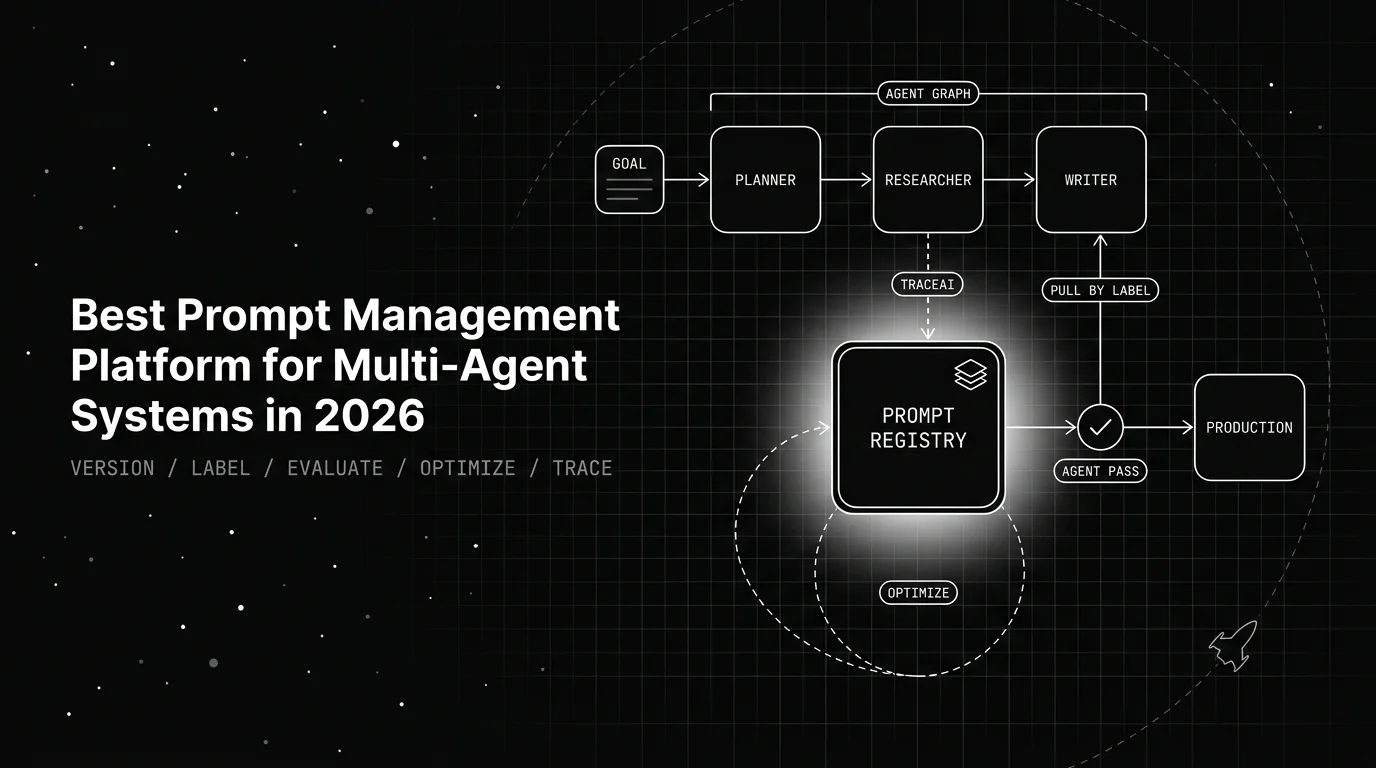
Prompt management for multi-agent systems: Future AGI versions, evaluates, and traces each agent's prompt on its own in one registry. Apache-2.0.

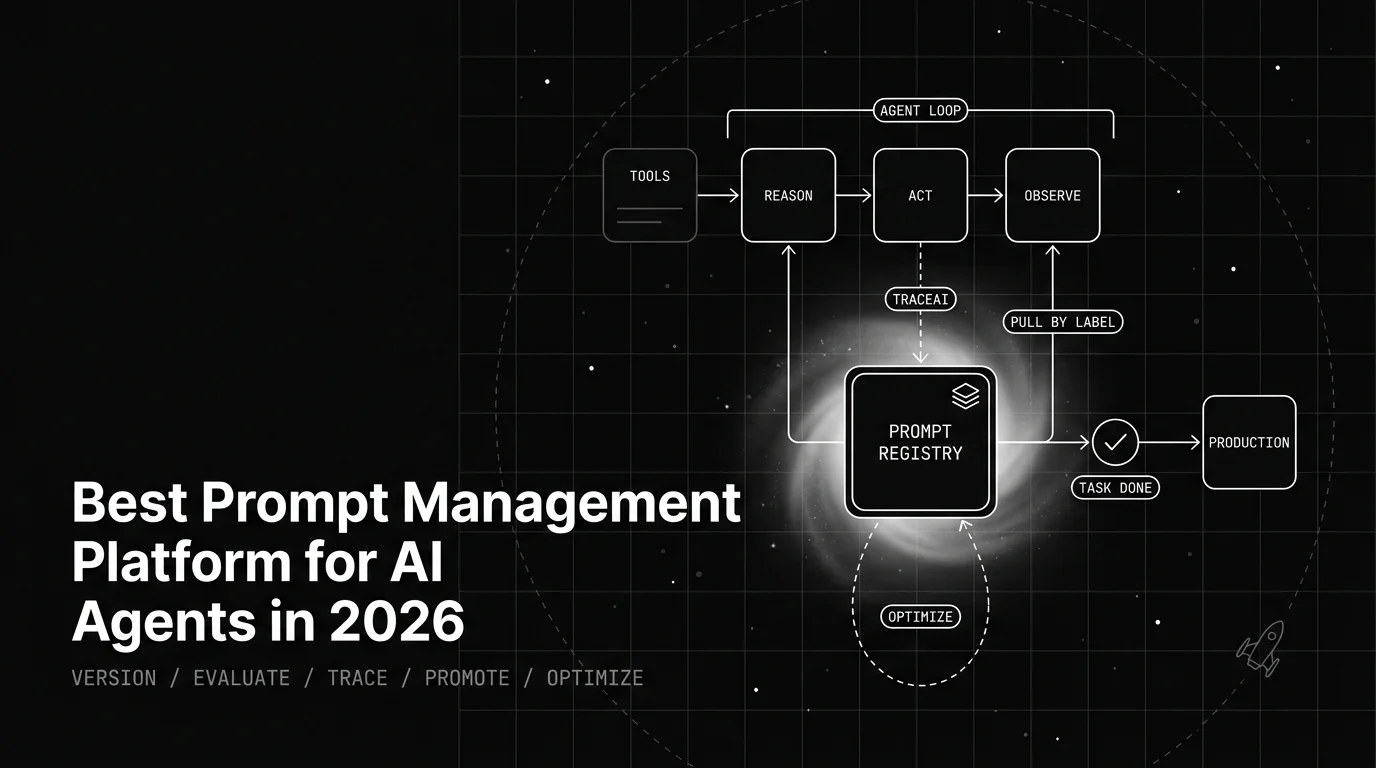
Version each agent prompt, gate promotion on task-completion and tool-call evaluators, then trace every run back to its version. Future AGI is Apache-2.0.
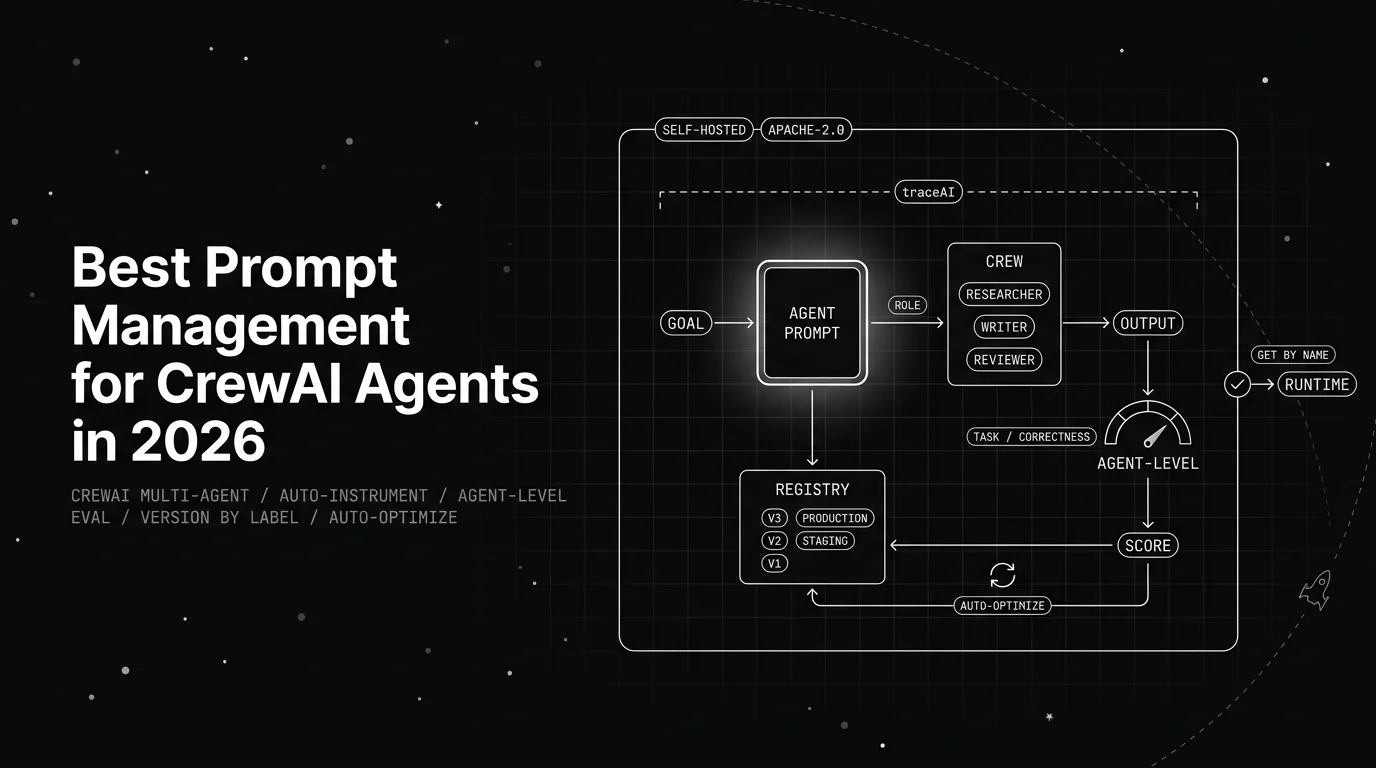
The 6 best prompt management tools for CrewAI agents in 2026, ranked on integration, per-agent versioning, tracing, and built-in evaluation of prompts.