Best Prompt Management Tools with Built-In Evaluation in 2026
The 6 best prompt management tools with built-in evaluation in 2026, ranked on evaluator libraries, version-tied scoring, regression testing, and CI checks before release.
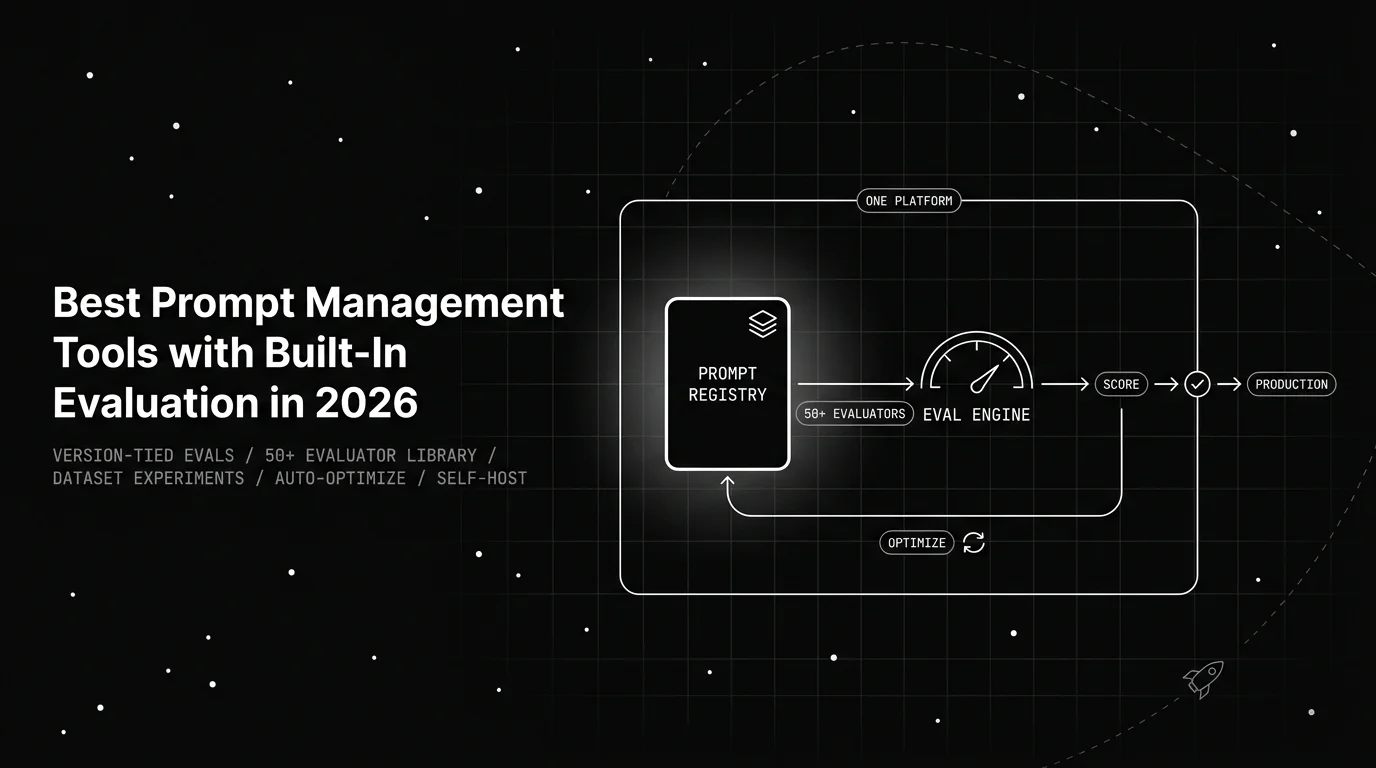
Table of Contents
A prompt looks good, so you copy it into a separate evaluation framework, run it against a dataset, read a score you like, and ship it. Two weeks later the prompt in production is not quite the one you graded. Someone edited it in the registry, the version drifted, and the score you trusted belongs to a prompt that no longer exists. This guide ranks the six prompt management tools with built-in evaluation that production teams should weigh in 2026. It scores them on the evaluator library, evaluation tied to each version, eval-on-change and CI/CD gating, and free self-hosting.
TL;DR: 6 Prompt Management Tools with Built-In Evaluation, Compared
Future AGI is the strongest overall prompt management tool with built-in evaluation for 2026, because it closes the loop that other tools leave open. It scores each version against a built-in evaluator library and gates promotion in CI/CD, so a regression is blocked before it ships. It then runs six optimization algorithms to improve a version that fails. No other platform in this cast joins all three steps in one place.
| Rank | Tool | Best for | Standout capability |
|---|---|---|---|
| 1 | Future AGI | Closed-loop management: version, evaluate, gate, optimize | A built-in evaluator library plus a CI/CD gate and an optimizer in one platform |
| 2 | Braintrust | Eval-first teams who want the deepest evaluation | Deep eval and experiments with prompts auto-versioned around them |
| 3 | Langfuse | Open-source management and evaluation you self-host free | MIT core with auto-versioning and Prompt Experiments |
| 4 | LangSmith | Built-in evaluation for LangChain-native teams | Commit-versioned prompts scored on a specific application version |
| 5 | PromptLayer | A registry-first tool with evaluations on the prompt page | Visual registry with evaluations and datasets attached per version |
| 6 | Confident AI | An eval-first platform built on open-source DeepEval | G-Eval and a RAG metric suite with Pytest-style CI gating |
Why Does Prompt Management Without Built-In Evaluation Break in Production?
Prompt management without built-in evaluation breaks because a registry alone tells you which version exists, not whether it is any good. When authoring and evaluation live in two tools, reliability leaks at the seam between them. You export a version, get a score, and carry a decision back by hand. Every step of that round trip is a chance for the graded version and the shipped version to diverge.
A version store captures the prompt text and its history, but not whether the latest edit quietly broke three flows that were working. A stored prompt version with no score attached does not reproduce a result. That gap is what a separate eval tool fails to close, because the moment the prompt and the grader live apart, the score and the artifact can drift.
A production-grade prompt management tool with built-in evaluation has to deliver three things at once:
- A real evaluator library next to the registry. Ready-made scorers for accuracy, relevance, safety, and format, plus custom checks, available without leaving the tool that stores the prompt.
- Evaluation bound to the version. Each score attached to the immutable version that produced it, so the platform can say version three cleared the bar, not the prompt cleared it at some point.
- Evaluation that runs on change and gates promotion. Scoring on every prompt edit and as a CI/CD gate, so a regression fails the build instead of reaching users.
Most tools now advertise some form of evaluation, so the differentiator in 2026 is what happens after the score. The tools that matter are the ones with a gate that blocks a bad prompt before it ships. They also close the loop, improving a failing version against the evaluation signal rather than flagging it for a human to fix. That is the lens this scorecard applies.
The Integrated Evaluation Scorecard
We scored every tool with the Integrated Evaluation Scorecard, a six-dimension rubric built for the question this title asks. The question is not which tool stores a version best, but which one joins management and evaluation into a system that catches a bad prompt before it ships. This rubric leads with the integration, not the eval depth in isolation: scores bound to versions, evaluation on change, and whether the loop closes.
| # | Dimension | What we measure |
|---|---|---|
| 1 | Built-in evaluator library | A library of ready evaluators that ships with the tool, not a bring-your-own grader |
| 2 | Evaluation tied to the version | Every score bound to the immutable version that produced it |
| 3 | Eval-on-change and CI/CD gating | Scoring on every prompt edit and as a gate that blocks a regression |
| 4 | Dataset experiments | Comparing versions and models against a fixed dataset inside the same tool |
| 5 | Automated optimization | Improving a version that fails its target, not just reporting the failure |
| 6 | License and free self-host | The exact license, and whether the whole registry-and-eval stack self-hosts for free |
We do not publish a single composite score; the decision table later maps buyer profiles to picks. The capability matrix below marks the four axes that vary most cleanly: license and self-host, the evaluator library, version-tied scoring, and auto-optimization. Dataset experiments and CI/CD depth are covered in prose, because every tool does some of both and the honest difference is in the depth.
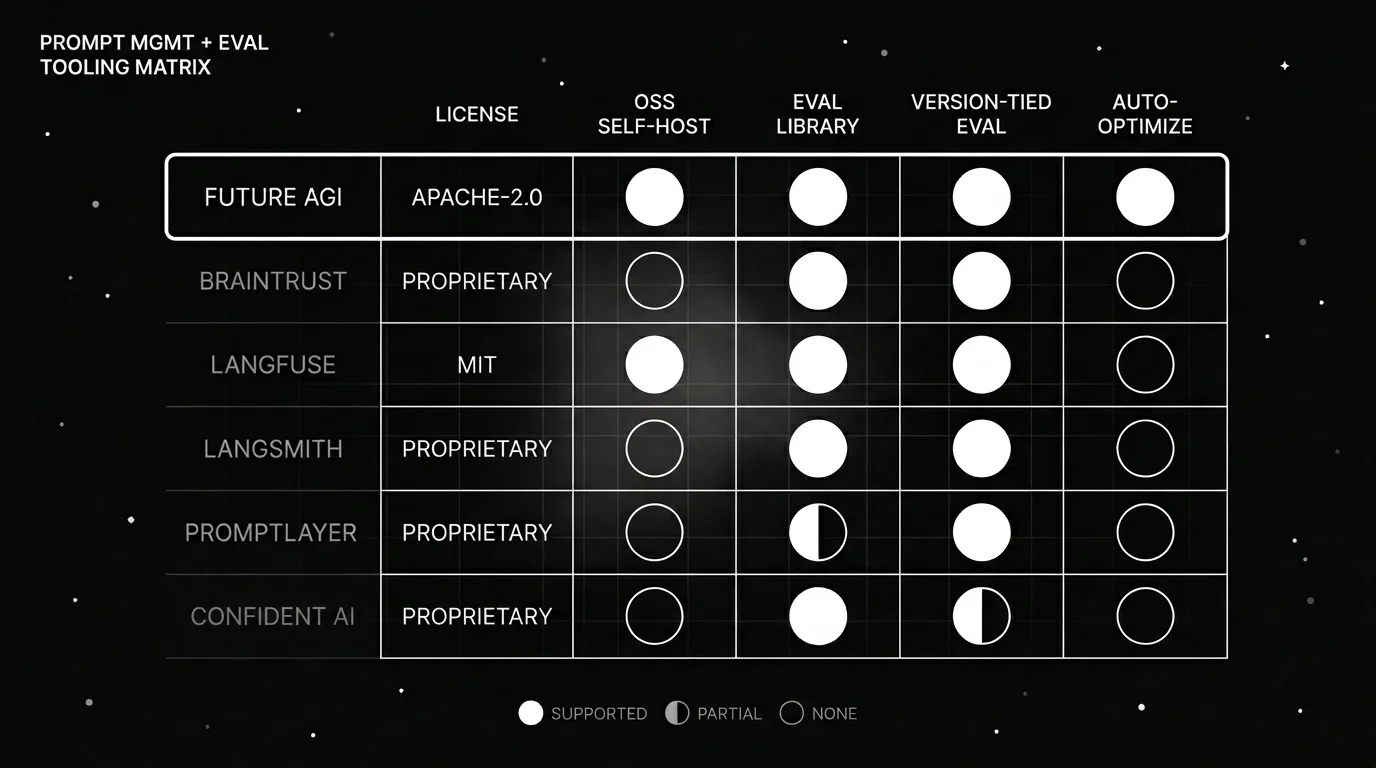
| Platform | License | OSS self-host | Eval library | Version-tied eval | Auto-optimize |
|---|---|---|---|---|---|
| Future AGI | Apache-2.0 | Yes, full stack | Yes, built-in plus custom | Yes, immutable snapshots | Yes, six algorithms |
| Braintrust | Proprietary | No, hybrid on Enterprise | Yes, eval is the core | Yes, pinned to a version id | Loop agent (proprietary) |
| Langfuse | MIT core | Yes, self-host free | Yes, LLM-judge evaluators | Yes, immutable versions | No |
| LangSmith | Proprietary | No, Enterprise only | Yes, off-the-shelf evaluators | Yes, by commit hash | No |
| PromptLayer | Proprietary | No, Enterprise only | Partial, lighter, cell-capped | Yes, on the prompt page | No |
| Confident AI | Proprietary, DeepEval core Apache-2.0 | No, platform on Enterprise | Yes, eval is the core | Partial, label on a version | No |
1. Future AGI: Best Overall for Closed-Loop Management and Evaluation
Quick take. Future AGI is built around evaluation as the central feedback loop. It stores prompts as immutable version snapshots with Production, Staging, and Development labels. It scores each against a built-in evaluator library and custom evals. It gates promotion in CI/CD and runs six optimization algorithms to improve a version that fails. Authoring, versioning, evaluation, optimization, and observability all run on one Apache-2.0 platform you can self-host.
Ideal for. Production AI teams that want management and evaluation to be a single closed loop, not two tools wired together. You author a prompt and score it against the built-in evaluators. You block a failing version in CI/CD and optimize it in place, all without leaving one platform. It is the right pick when prompt quality is a production requirement, not just a development check.
Key strengths.
-
Immutable version snapshots with label-based promotion. Future AGI saves every edit as a new immutable version. A label such as Production, Staging, or Development names the version an environment runs. Promotion swaps that label onto a newer version, and rollback swaps it back, with no code release, since apps resolve the label at request time. Because a label always names exactly one version, every score binds to a fixed target instead of a prompt that keeps shifting under it.
-
Versions scored by built-in and custom evals. Each version is graded by ready-made evaluators and custom evals you define for the checks that matter. They cover quality, safety, factuality, RAG retrieval, and format. Grading a version never means exporting it to a separate framework. The score attaches to that exact version, and you can compare two versions on the same dataset before deciding which one ships.
-
Evaluation as a CI/CD gate. You can run the same evals as a gate in your CI/CD pipeline. A regression in tone, factual consistency, or a custom check is then caught on the pull request and blocked, instead of landing in production.
-
Optimization that writes your next version. When a version misses its target, the open-source agent-opt library acts on that score rather than only recording it. Its six algorithms, Random Search, Bayesian, ProTeGi, Meta-Prompt, PromptWizard, and GEPA, each push a failing version toward a higher-scoring rewrite, with its evaluator as the goal. That is the step that closes the loop the other tools leave open, and agent-opt is Apache-2.0 rather than proprietary.
-
The loop closes in production. traceAI is OpenTelemetry-native, with instrumentors for 50+ frameworks. It streams live behavior back as traces, so production runs become the next evaluation set and the loop keeps improving on real traffic instead of a frozen test list.

Pricing and deployment. Future AGI has a free tier, pay-as-you-go usage, and Enterprise plans on its pricing page. The core SDK and product repos are Apache-2.0 and self-hostable at no license cost via Docker Compose. The platform offers SOC 2 Type II and HIPAA BAA on paid plans. The whole author-score-gate-optimize loop can run inside your own network instead of behind an enterprise tier.
Verdict. Future AGI is the strongest overall pick for teams where evaluation is a production requirement, not an offline check. It runs the entire loop in one Apache-2.0 platform: author, version, score against a built-in evaluator library, block a regression in CI/CD, and optimize the version that fails. No other tool in this comparison closes all five steps without adding a second vendor.
2. Braintrust: Best Eval-First Platform with Prompt Versioning
Quick take. Braintrust comes at the integration from the evaluation side: experiments and logging are the core product, and prompt versioning is built in around them. For a team whose center of gravity is evaluation, that ordering is a genuine strength. The eval is the deepest in this cast, and prompts auto-version on save, so a score always has a version to attach to.
Ideal for. Teams whose center of gravity is offline evaluation and experiments, and who want prompt versioning to slot into that workflow rather than lead it. If the team already runs evals in Braintrust and wants prompts to auto-version around those experiments, the integration is smooth. It is a weaker fit when the registry needs to be as strong as the evaluation.
Key strengths.
- Evaluation and experiments are the core of the product, so the grading, scoring, and comparison tooling is the most developed in this cast. That is exactly what an eval-led team wants at the center.
- Prompts auto-version on save with a unique version id, and a score pins to that id through the invoke API. That binds evaluation to a specific version, even though versioning is not the headline.
- The enterprise posture is strong, with SOC 2 Type II, HIPAA, RBAC, and SSO and SAML. A hybrid deployment keeps your data plane, logs, traces, datasets, and prompts inside your own VPC, while Braintrust runs the control plane.
Limitations. Braintrust is proprietary with no free open-source self-host, and its hybrid deployment is an enterprise arrangement rather than a license you run yourself. Prompt versioning is secondary to evaluation and logging, so labels and diffs are less first-class than a dedicated registry. Its Loop agent optimizes prompts from your annotations, but it is proprietary and interactive rather than a scriptable optimizer that acts on a failing eval score.
Pricing. A free tier and paid plans in the cloud, with hybrid deployment that keeps the data plane in your own environment on Enterprise.
Verdict. Braintrust is the strongest pick when evaluation is the center of gravity and prompt versioning rides alongside it. The eval tooling is the deepest in this cast, and prompts auto-version on save so a score always has a version to attach to. Choose it when evaluation depth matters more than a free self-host or a closed evaluate-gate-optimize loop.
3. Langfuse: Best Open-Source Management and Evaluation You Self-Host Free
Quick take. Langfuse gives a team both halves for free. An MIT-licensed core auto-versions every prompt. Prompt Experiments score versions and models against a dataset inside the same tool, with prompts linked to traces. It is the strongest free, self-hostable option for management and evaluation together. The gaps are the CI/CD gate, the optimization loop, and the deepest enterprise controls.
Ideal for. Engineering teams that want a self-hostable prompt registry with real built-in evaluation and trace links, without a license fee. It suits groups with data-residency or air-gap requirements that rule out hosted-only vendors. The MIT license lets a team read the source and run the full management-and-evaluation stack inside their own network at no cost.
Key strengths.
- The MIT core self-hosts free, so the registry, the evaluators, and the experiment tooling all run inside your own network without a license fee. No proprietary tool in this cast offers that.
- Saving a prompt under the same name creates a new immutable integer version. Prompt Experiments then score versions and models against a dataset, so evaluation is bound to a version and runs in the same tool that stores it.
- Prompts link to traces, so a version’s evaluation evidence and its real runtime behavior sit together. The managed cloud adds SOC 2 and ISO reports for teams that prefer hosted.
Limitations. There is no built-in automated optimization, so the loop stops at the score and a human has to take the next step. Role-based access and SSO live in the commercial Enterprise Edition rather than the MIT core, which limits the free self-host for larger teams. A client-side cache can also slow how quickly a promoted version goes live after a label change.
Pricing. A free Hobby cloud tier and free self-hosting under MIT, with paid Core, Pro, and Enterprise cloud tiers and a commercial Enterprise Edition that adds RBAC and SSO.
Verdict. Langfuse is the strongest pick when open-source and self-hosting are non-negotiable and you want a real evaluator library in the same tool that stores the prompt. The tradeoff is no optimization loop, and enterprise controls gated to the commercial edition. For a team with data-residency requirements, that tradeoff is usually worth it.
4. LangSmith: Best Built-In Evaluation for LangChain Teams
Quick take. LangSmith is the integrated pick for teams already built on LangChain. Its Prompt Hub versions prompts by commit, and its Experiments evaluate a specific application version on a dataset, all with the deepest first-party LangChain tracing. For a LangChain-native stack the registry, the evaluation, and the traces are one tool, which is the integration this guide rewards, scoped to that ecosystem.
Ideal for. Teams standardized on LangChain or LangGraph that want versioned prompts, dataset experiments, and native tracing from one vendor. LangSmith’s integration means traces and evaluated versions sit side by side with no extra setup. It is a weaker fit once most of the stack lives outside that ecosystem, because the native-tracing advantage disappears.
Key strengths.
- The Prompt Hub versions prompts immutably by commit hash. A named Environments feature promotes a chosen commit between Staging and Production with one-click rollback. Experiments then evaluate a specific application version on a dataset, so a score binds to an exact commit rather than to the prompt in general.
- Off-the-shelf evaluators and LLM-as-judge scoring ship with the platform, so grading a version is a setup step, not a separate build.
- The first-party LangChain tracing is the deepest available. A version’s evaluation and its runtime behavior are visible in the same tool with no extra setup. That is the strongest reason a LangChain team standardizes here.
Limitations. LangSmith is proprietary with self-hosting gated to Enterprise, so running the stack inside your own network requires a contract. There is no built-in optimization to act on a failing score, which means a human carries the rewrite. Its deepest strengths are inside LangChain, and a framework-agnostic team gets much less from it than a LangChain-native one does.
Pricing. A free Developer tier and a per-seat Plus tier in the cloud, with self-hosting on Enterprise.
Verdict. LangSmith is the default pick for a LangChain-native team that wants versioning, dataset experiments, and first-party tracing in one tool. The proprietary license and the absence of an optimization loop are real constraints, and it is a weaker fit the further the stack moves from LangChain. If the team already lives in that ecosystem, it is the natural choice.
5. PromptLayer: Best Registry-First Tool with Evaluations on the Prompt Page
Quick take. PromptLayer is a dedicated prompt registry first, with evaluations and datasets attached to the prompt page so a score sits next to the version it judges. The ordering works well for teams that want evaluation present and readable without leaving the registry. Eval depth is lighter than the eval-first tools in this cast, which is the honest reason it ranks here.
Ideal for. Cross-functional teams where product managers or domain experts review prompts alongside engineers. PromptLayer puts evaluations and version diffs on the same prompt page, so non-engineers can read the score and the change without opening a separate tool. It fits organizations that treat prompt authoring as a shared job across roles, not just an engineering task.
Key strengths.
- The registry is the core. Commit messages and version diffs give a clean, immutable per-version history outside the codebase, so the management half is genuinely first-class.
- Evaluations and Datasets live on the prompt page, so a score is attached to the version it judges. A reviewer sees the evidence next to the artifact without opening a separate tool.
- Release Labels and Dynamic Labels map a version to an environment. A version that has been evaluated can be promoted by moving a label, keeping the score and the deploy in one place.
Limitations. The evaluation depth is lighter than the eval-first tools, with evaluation-cell caps on lower tiers. That is why it scores partial on the evaluator-library axis. PromptLayer is proprietary with self-hosting gated to Enterprise, the version model is linear with no branch or merge, and there is no built-in optimization.
Pricing. A free tier, a Pro tier, and a Team tier with collaboration features in the cloud, with self-hosting on Enterprise.
Verdict. PromptLayer is the best registry-first option for teams that want evaluations visible on the prompt page alongside the version history. It is the pick when the people reviewing prompts are not all engineers and a clean, visual release workflow matters more than deep evaluation. Accept lighter eval depth and no optimization loop in exchange for a registry that non-technical reviewers can actually use.
6. Confident AI: Best Eval-First Platform Built on Open-Source DeepEval
Quick take. Confident AI is the hosted platform built on DeepEval, the open-source evaluation framework. The draw is the evaluator depth. It covers G-Eval, Hallucination, and a RAG suite of Faithfulness, Answer Relevancy, Contextual Precision, and Contextual Recall, plus Bias, Toxicity, and JSON Correctness. All of them run as Pytest-style tests in CI. Prompt management exists through Prompt Studio but is secondary, which is the honest reason it ranks last.
Ideal for. Engineering teams that want evaluation as code, with a broad open-source evaluator set and Pytest-style gating in CI. They are comfortable with prompt management as a secondary feature. If the team already uses DeepEval locally and wants a hosted platform built around it, Confident AI is the natural step up. It is a weaker fit when the prompt registry itself needs to be first-class.
Key strengths.
- The evaluator set is broad and open source through DeepEval. It includes G-Eval, Hallucination, a RAG suite, Bias, Toxicity, and JSON Correctness, with no graders to build from scratch.
- Pytest-style testing runs evaluation as code: deepeval test run and assert_test() gate a regression in CI. Synthetic dataset generation gives a team a test set to score against.
- Prompt Studio versions a committed prompt, for example 00.00.0X. A label such as staging or production attaches to a version, so a score has a specific version to bind to.
Limitations. Confident AI is eval-first, so prompt management is a secondary feature, and there is no git-style branching, pull request, or diff view for prompts. Self-hosting Confident AI, the hosted platform, is Enterprise-only, though the DeepEval framework itself is free and open source under Apache-2.0. There is also no built-in optimization to improve a version that fails.
Pricing. The DeepEval framework is free and open source, and Confident AI offers a free tier with paid cloud plans, with platform self-hosting on Enterprise.
Verdict. Confident AI is the pick when the engineering team wants evaluation as code, with Pytest-style gating and a broad open-source evaluator set via DeepEval. Prompt management is secondary, and there is no built-in optimization loop. But for a team whose primary workflow is running evals in CI, those gaps are acceptable. It ranks last because prompt management is clearly the supporting role here.
Which Prompt Management Tool with Built-In Evaluation Should You Choose?
There is no single winner for every team. Match the platform to the constraint that matters most: free self-hosting, the deepest evaluator library, the tightest framework fit, or a closed loop that acts on a failing score. The table below maps a common need to the best pick and the reason why.
| If you need | Choose | Because |
|---|---|---|
| Management, evaluation, a CI/CD gate, and an optimization loop in one self-hostable stack | Future AGI | A built-in evaluator library plus a gate that blocks a regression and an optimizer that fixes it, all Apache-2.0 |
| The deepest evaluation with prompt versioning integrated | Braintrust | Eval-first product with prompts auto-versioned and scores pinned to a version id |
| Free open-source management and evaluation | Langfuse | MIT core with auto-versioning and Prompt Experiments you self-host |
| Built-in evaluation inside a LangChain stack | LangSmith | Commit-versioned prompts, dataset experiments, and the deepest first-party tracing |
| A registry-first tool with evaluations attached | PromptLayer | A clean registry with evaluations and datasets on each prompt page |
| A deep open-source evaluator set with Pytest-style CI gating | Confident AI | DeepEval metrics like G-Eval and a RAG suite gating a regression in CI |
The honest read: most tools here now bind a score to a version, so the basics have converged. The differentiator is what happens after the score. Only Future AGI gates in CI/CD, scores against a built-in evaluator library, and optimizes a failing version in one Apache-2.0 stack. Braintrust has the deepest standalone evaluation; Langfuse is the strongest free self-hostable core; LangSmith is the native pick inside LangChain.
How Do You Roll Out Built-In Evaluation Without Breaking Production?
Adopting a platform is the easy part; the discipline around it determines whether built-in evaluation does useful work or becomes a checkbox. A team that runs evals sporadically against a moving prompt will get misleading scores. These five practices apply regardless of which tool you pick and keep the eval loop honest as prompt count and traffic both grow.
- Bind every score to a version, never to a prompt name. Record results against the immutable version that produced them. A passing score then names the exact version to promote and never drifts onto a prompt that has since changed.
- Build a fixed evaluation dataset before you iterate. Score every version against the same dataset so improvements are comparable, which our prompt versioning and lifecycle guide covers in depth. Grow the set as new failure modes appear.
- Evaluate on every change and gate promotion. Score a candidate against the current production version on the same dataset. Then run that eval as a CI/CD gate so a regression fails the build rather than reaching users.
- Use the evaluator library, do not rebuild it. Start from the ready evaluators a platform ships: accuracy, relevance, safety, and format. Add custom checks only where your domain needs them, so evaluation is a setting rather than a standing project.
- Close the loop where the platform supports it. When a version fails, optimize it in place rather than handing the rewrite back to a person. Then watch the new version on real traces so production behavior feeds the next round.
Where Future AGI Fits in Your Evaluation Stack
Built-in evaluation matters because the score and the prompt should never drift apart. Picture the prompt you graded in one tool and shipped from another, then found two weeks later that production had quietly changed. On Future AGI that gap cannot open. A score is written against an immutable version, and the label your app serves names that exact version, so the graded prompt and the live prompt are one artifact. You grade with the built-in evaluators, and a CI/CD gate re-checks every change, so no edit ships unscored. When a version misses its target, the optimizer drafts a stronger one. And since the core is Apache-2.0, you can self-host it for free. Read the prompt docs or start free on Future AGI.
Frequently Asked Questions About Prompt Management with Built-In Evaluation
What Does Built-In Evaluation Mean for Prompt Management?
Built-in evaluation means the prompt management tool ships its own evaluator library. You grade a version inside the same platform that stores and serves it, without exporting to a separate framework. The score binds to the specific version that produced it, so the result and the artifact cannot drift apart. The strongest platforms run that evaluation on every change and close the loop by improving a version that fails.
Which Prompt Management Tool with Built-In Evaluation Is Best in 2026?
Future AGI is the strongest overall pick: a built-in evaluator library, a CI/CD gate, and six optimization algorithms in one Apache-2.0 platform you can self-host. Braintrust has the deepest standalone evaluation. Langfuse is the best free self-hostable core. LangSmith is the native pick inside LangChain. PromptLayer is the cleanest registry-first option. Confident AI is the strongest open-source evaluator set with Pytest-style CI gating. The right choice depends on whether a closed evaluate-gate-optimize loop, free self-hosting, or the deepest eval library matters most.
Why Use One Tool for Prompt Management and Evaluation Instead of Two?
Using one tool keeps the score bound to the exact version that earned it. When you author in a registry and grade in a separate framework, the exported and shipped versions can drift. The score you trusted may then belong to a prompt that no longer exists. One platform removes the export-grade-reimport round trip and makes a CI/CD gate possible, because the evaluator blocks promotion where the version lives.
What Is a Built-In Evaluator Library?
A built-in evaluator library is the set of ready-made scorers that ship with a prompt management platform. They cover factual accuracy, relevance, safety, and format adherence. It turns evaluation from a project into a setting: pick the checks a version must pass and bind them to the prompt. Future AGI ships ready-made evaluators and custom evals; Braintrust, Langfuse, and LangSmith ship strong evaluator sets with LLM-as-judge scoring.
How Does Evaluation Tie to a Specific Prompt Version?
Evaluation ties to a version when the platform records each score against the immutable version that produced it, not the prompt name in general. Future AGI scores against immutable snapshots. Braintrust pins scores to a version id. Langfuse links experiments to integer versions. LangSmith evaluates by commit hash. PromptLayer attaches evaluations per version. That binding lets a team promote the version that scored well, not just the prompt.
Can You Self-Host a Prompt Management Tool with Built-In Evaluation?
Two platforms self-host for free: Future AGI under Apache-2.0 and Langfuse under its MIT core. Future AGI is the only one that also closes the loop with a CI/CD gate and six optimization algorithms. The other four gate self-hosting to Enterprise, though DeepEval is free and open source on its own. If the full evaluate-gate-optimize loop at no license cost is a requirement, the choice is Future AGI or Langfuse.
Frequently Asked Questions
What Does Built-In Evaluation Mean for Prompt Management?
Which Prompt Management Tool with Built-In Evaluation Is Best in 2026?
Why Use One Tool for Prompt Management and Evaluation Instead of Two?
What Is a Built-In Evaluator Library?
How Does Evaluation Tie to a Specific Prompt Version?
Can You Self-Host a Prompt Management Tool with Built-In Evaluation?
Compare the 6 best open-source prompt management tools of 2026 on self-hosting, licensing, versioning, and built-in evaluation you run on your own stack.

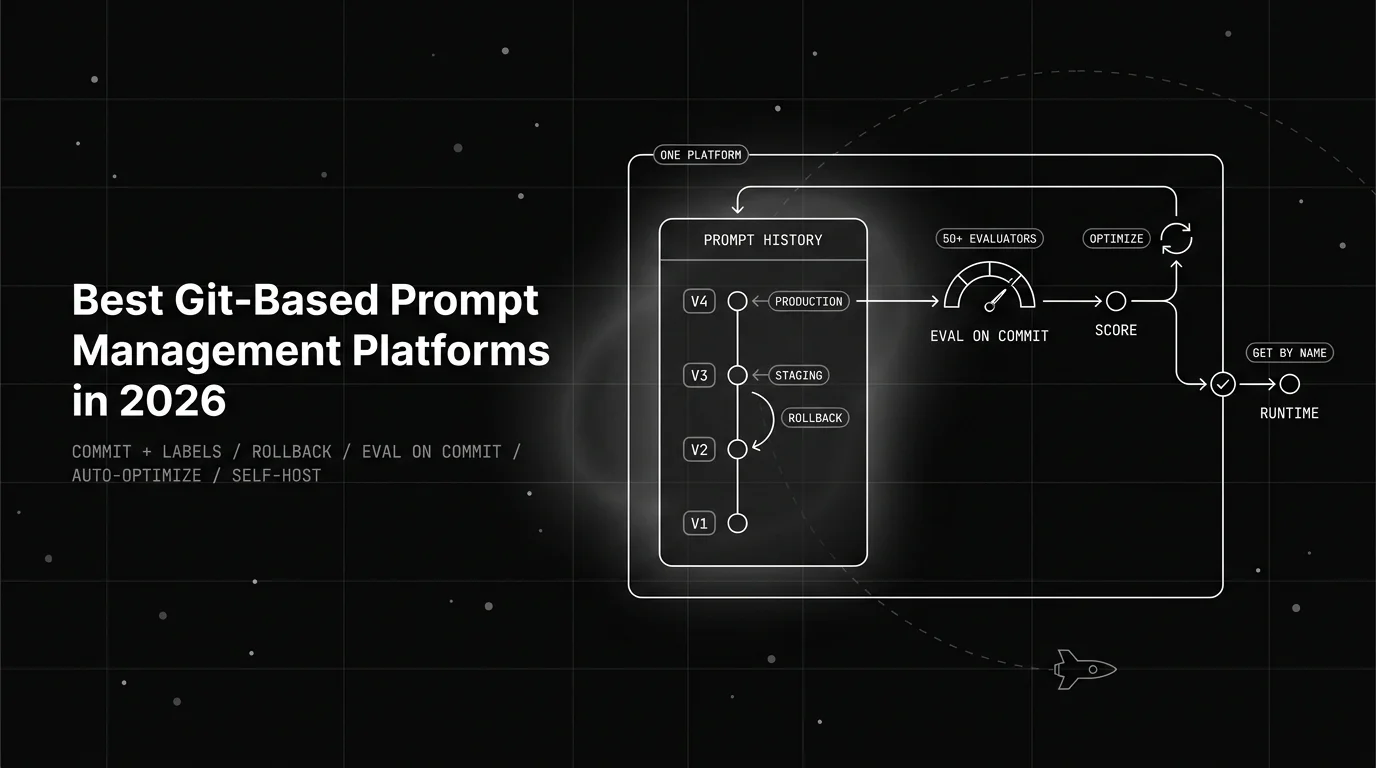
Compare the 6 best git-based prompt management platforms of 2026 on version control, branching, diffs, and code-first prompt workflows for engineering teams.

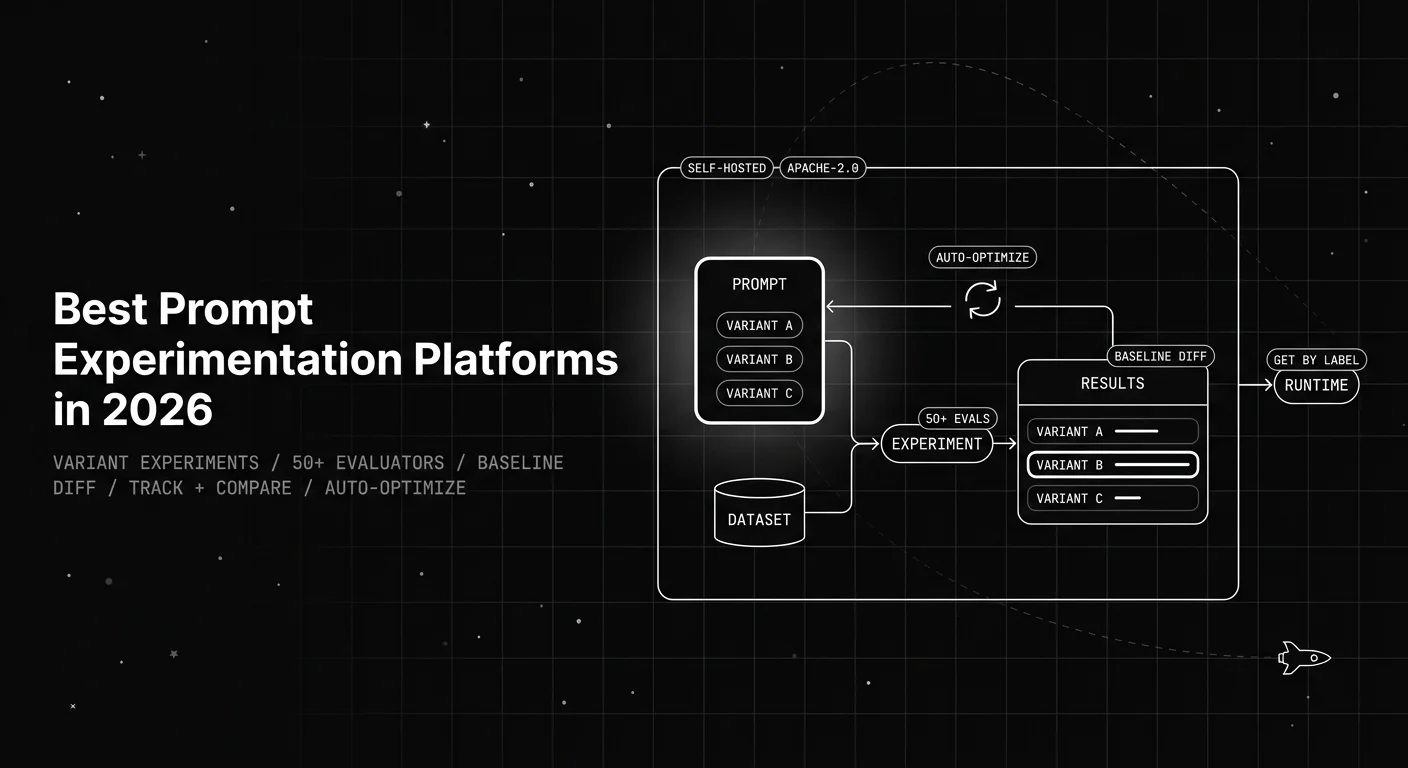
Compare the 6 best prompt experimentation platforms of 2026 on A/B testing, versioning, evaluation, and comparing prompt variants side by side at scale.