Best Prompt Experimentation Platforms in 2026
Compare the 6 best prompt experimentation platforms of 2026 on A/B testing, versioning, evaluation, and comparing prompt variants side by side at scale.
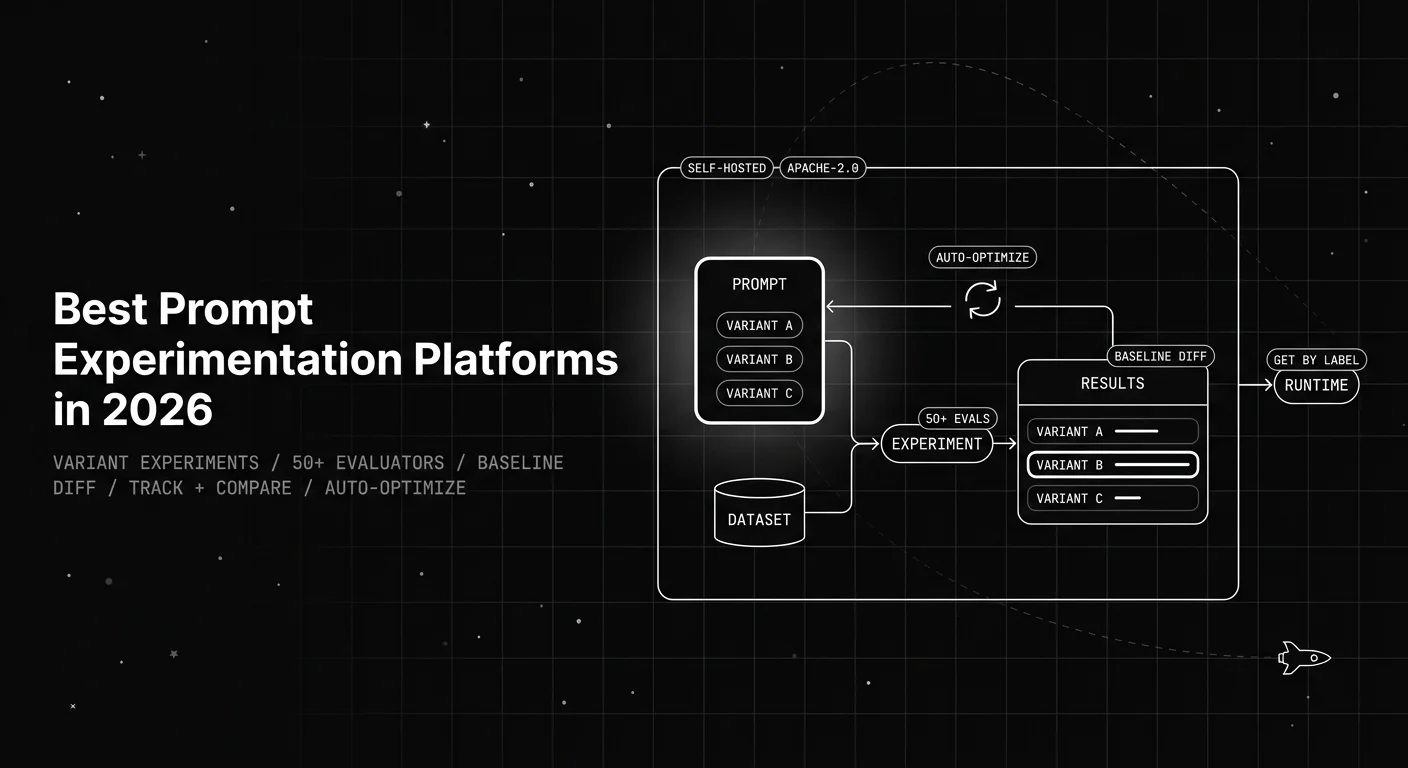
Table of Contents
A teammate edits a prompt, runs it once, sees a better answer, and ships it. Two days later a different input regresses, and no one connects it to the edit. The change was judged on a single eyeballed output, not a measured comparison. This guide ranks the six prompt experimentation platforms production AI teams should evaluate in 2026. We score them on variant experiments against a dataset, evaluator depth, baseline diffs, and whether the loop closes into an optimized next prompt.
TL;DR: 6 Prompt Experimentation Platforms Scored on Variants, Evaluators, and the Optimization Loop
Future AGI is the strongest overall prompt experimentation platform for 2026. It covers the full path. You author variants in the Agent Playground, score each against the built-in evaluator library, and gate the winner in CI/CD. Then you optimize with six algorithms and promote via label with no redeploy. What separates the field is whether the experiment is tracked across versioned variants. Two more tests: how deep the evaluator set is, and whether the winner feeds an optimizer.
| Rank | Tool | Best for | Standout capability |
|---|---|---|---|
| 1 | Future AGI | Closed-loop experimentation: experiment, score, diff, optimize | Variant experiments on a built-in evaluator library plus six optimization algorithms in one platform |
| 2 | Braintrust | The dedicated experimentation platform | Eval and experiments as the core product, with deep evaluators |
| 3 | LangSmith | LangChain-native experiment tracking | Experiments on a specific application version with deep tracing |
| 4 | Langfuse | The open-source default | MIT core with Prompt Experiments on a dataset, linked to traces |
| 5 | PromptLayer | An experiment surface on a polished registry | Evaluations and Datasets next to each versioned prompt |
| 6 | Vellum | Release-gated testing as you scale | Pass-or-fail Test suites on an immutable three-layer release model |
Why Does Prompt Experimentation Break in Production?
A prompt is the most frequently changed artifact in an LLM application and the one most often shipped without a test. The model is fixed for months and the code goes through review, but the prompt is edited weekly and pushed when one output looks good. A prompt that wins on one input can lose on the next; a change judged on one output is a change shipped blind.
Three requirements separate a platform that catches that from one that just stores prompts.
-
The unit of work is the experiment, not the edit. A real experiment runs several prompt variants against the same fixed dataset as a tracked, repeatable comparison. The variants are judged on the same inputs, and the result can be reproduced. An interactive playground where you tweak one prompt and read one output is not an experiment, because nothing is held constant and nothing is recorded.
-
Evaluators score the experiment, and every run diffs against a baseline. A comparison is only as good as the scoring behind it. The platform has to score each variant with a deep evaluator set, not a single metric. Quality, faithfulness, format, and safety can move in different directions. It also has to diff each run against a baseline, so a regression shows up as a measured drop rather than a surprise in production.
-
The winning variant feeds optimization. Picking the best of the variants you wrote by hand is the floor. The harder, rarer requirement is acting on the result. You feed the winning variant into an optimizer that searches the prompt space. It returns a higher-scoring next version against the same evaluators, rather than leaving the team to hand-tune from the leaderboard.
Most tools now run some form of scoring against a dataset. The difference in 2026 is whether the comparison is a structured experiment across versioned variants, and whether the loop closes. That is what turns an experiment into a path to a better prompt rather than a one-time report, and it is the lens this scorecard applies.
How Did We Score These Platforms?
We scored every platform with the Prompt Experimentation Scorecard, a five-dimension rubric. It is built for the question this title asks. Not which tool draws the most charts, but which one makes a variant comparison trustworthy and turns it into a better prompt. This rubric leads with the dimensions that make an experiment trustworthy. It adds the one that decides whether your prompts improve over time: automated optimization.
| # | Dimension | What we measure |
|---|---|---|
| 1 | License and self-host | The exact license, and whether the whole platform self-hosts for free or only on Enterprise |
| 2 | Variant experiments | Whether you can run several prompt variants against a fixed dataset as one tracked experiment |
| 3 | Evaluator depth | The breadth of the evaluator set behind each experiment score |
| 4 | Versioned variants | Whether each variant is an immutable, diffable version, not just an editor state |
| 5 | Automated optimization | Whether the loop closes, optimizing the winning variant against the evaluators |
We do not publish a single composite score; the decision table later maps experiment profiles to picks. The ranked six are all platforms you can adopt today.
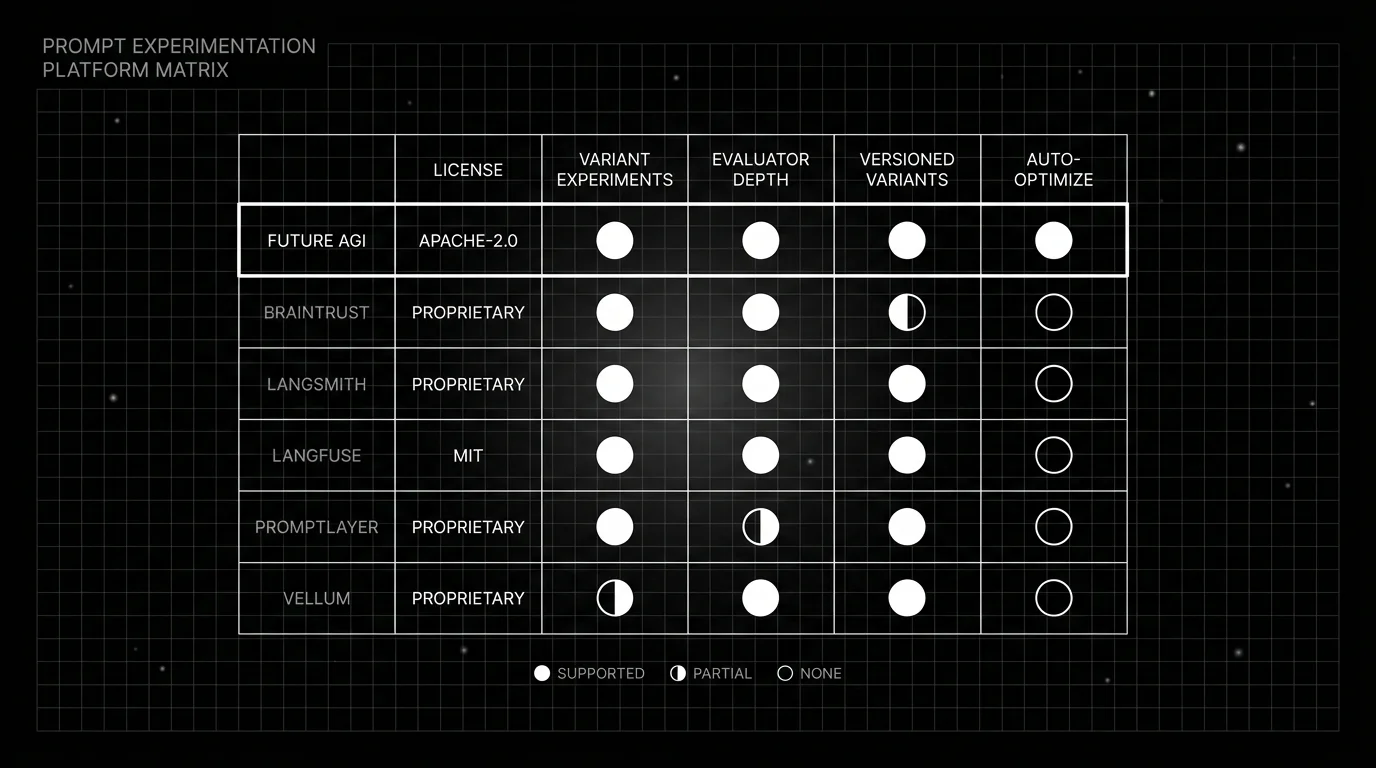
| Tool | License / self-host | Variant experiments | Evaluator depth | Versioned variants | Automated optimization |
|---|---|---|---|---|---|
| Future AGI | Apache-2.0 core, self-host free | Dataset experiments | Built-in evaluator library | Immutable version snapshots + diffs | Six algorithms (agent-opt) |
| Braintrust | Proprietary, self-host Enterprise | Core product | Deep evaluators | Secondary to eval surface | Loop (annotation-driven) |
| LangSmith | Proprietary, self-host Enterprise | On an app version | Mature evaluators | Commit hash, immutable | None |
| Langfuse | MIT core, self-host free | Prompt Experiments | On a dataset | Auto integer versions | None |
| PromptLayer | Proprietary, self-host Enterprise | On the prompt page | Eval-cell caps on low tiers | Numbered versions + diffs | None |
| Vellum | Proprietary, VPC Enterprise | Test suites, pass or fail | Evaluators behind tests | Versions, Deployments, Releases | None |
The spine of this table is variant experiments against a dataset. Vellum is partial because its Test suites gate a release pass or fail rather than running a structured cross-variant experiment. PromptLayer is partial because eval cells are capped on the low tiers. Only Future AGI closes the loop with a scriptable optimizer and a full authoring-to-observability path. The sections below take each platform in turn.
1. Future AGI: Best Overall for Closed-Loop Prompt Experimentation
Quick take. Future AGI treats a prompt experiment as the first step of a continuous improvement loop, not the last. You author variants side by side in the Agent Playground and score each against a built-in evaluator library. You gate the winner in CI/CD, optimize with six algorithms, and promote via label reassignment with no redeploy. The whole loop runs on one Apache-2.0 platform you can self-host.
Ideal for. Teams that want dataset-driven experiments across variants, scored by a deep evaluator set and diffed against a baseline. They also want to optimize the winning variant automatically rather than hand-tune from a results table. It fits any team that treats prompt shipping as a measured, repeatable process, not a one-off edit.
Key strengths.
-
Variants authored side by side before they enter an experiment. The Agent Playground lets you pick models, set variables, and read variant outputs next to each other before you commit a version. Every candidate that enters an experiment is one you already inspected by hand.
-
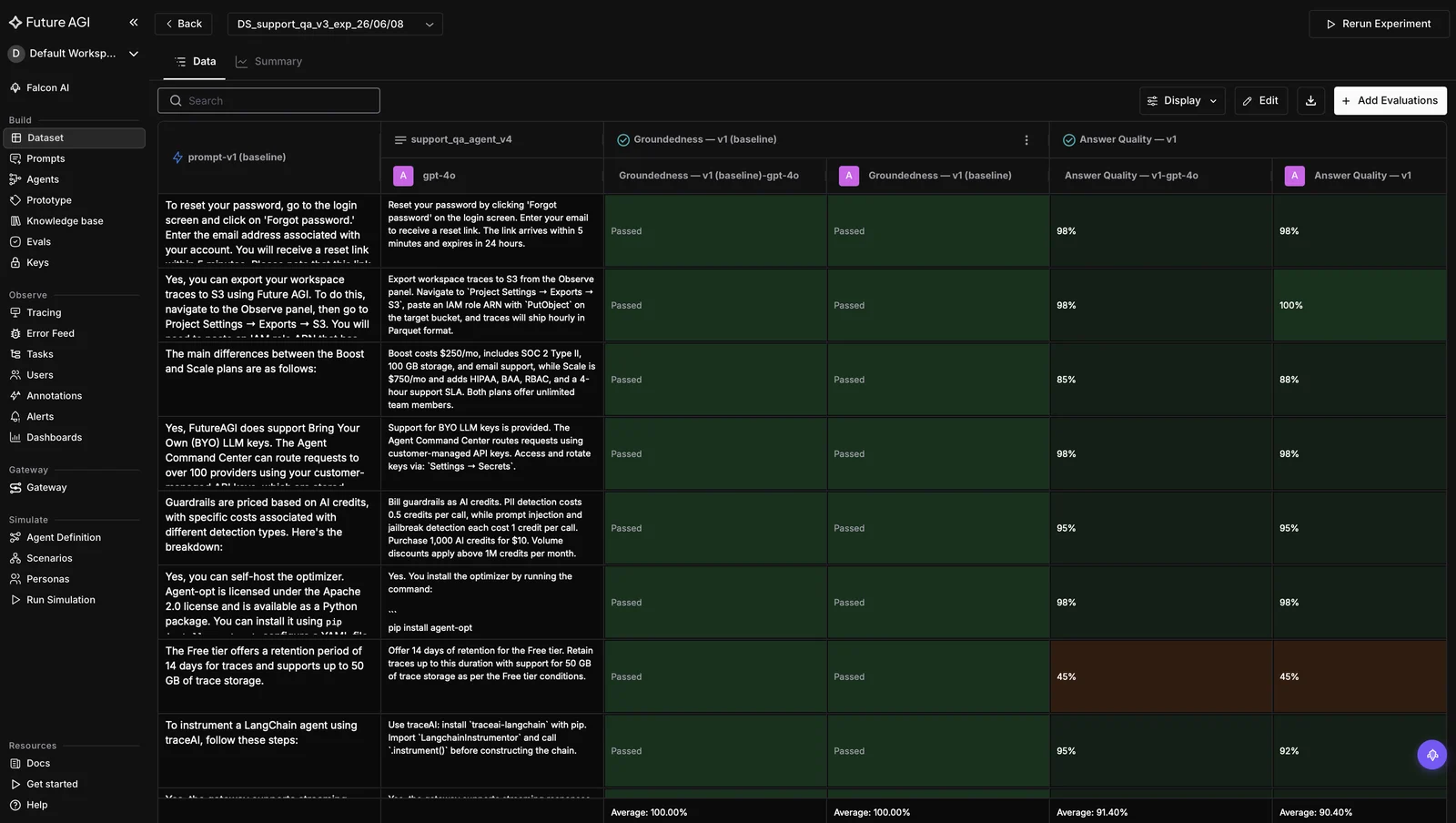
Each variant scored across the built-in evaluator library. An experiment runs the variants against one fixed dataset and scores each with a library of built-in evaluators plus any custom checks you write. The checks span quality, safety, factuality, RAG retrieval, and format. A variant is judged on measured scores across that whole set, not on one output someone liked.
-
Versioned variants and a diff against the labeled baseline. Each save is an immutable version with named labels such as Production, Staging, and Development, so an experiment ties to the exact variant that ran. You diff a candidate against the version wearing the Production label and read whether it beat the baseline or slipped below it.
-
The baseline diff becomes a CI gate. You run the same evals as a gate in your CI/CD pipeline. A variant that scores below the baseline stops at the pipeline instead of reaching users, which makes a prompt change reviewable the way a pull request is.
-
The experiment’s winner is where optimization starts, not where it ends. The open-source agent-opt library takes the winning variant and its evaluator. It runs six algorithms, Random Search, Bayesian, ProTeGi, Meta-Prompt, PromptWizard, and GEPA, to search for a candidate that scores higher still. Braintrust’s Loop can suggest prompt edits from your playground annotations, but agent-opt is different in kind: a scriptable optimizer you point at a dataset and evaluator, then run offline or inside CI. agent-opt is Apache-2.0.
-
Production feeds the next experiment. traceAI is OTel-native tracing with instrumentors for 50+ frameworks. The live runs of a shipped variant come back as traces you fold into the next dataset. The experiment that picked today’s prompt supplies the inputs for the one that picks tomorrow’s.
Pricing and deployment. Future AGI has a free tier, pay-as-you-go usage, and Enterprise plans on its pricing page. The core SDK and product repos are Apache-2.0 and self-hostable at no license cost via Docker Compose. The platform also offers SOC 2 Type II and HIPAA BAA on paid plans, which most closed-source rivals gate behind an Enterprise contract.
Verdict. Future AGI is the strongest overall pick for teams that want a prompt experiment to end in a better prompt, not a results table. Authoring, scoring, CI/CD gating, optimizing, and monitoring run in one place under an Apache-2.0 license you can self-host. No other platform here offers that combination.
2. Braintrust: Best Dedicated Experimentation Platform
Quick take. Braintrust is the dedicated experiment platform here. Evals and experiments are its core product, not a feature bolted onto a registry. You run experiments that score prompt variants against a dataset with a deep evaluator set, and compare runs side by side. Prompts auto-version on save, and you pin a version at runtime or deploy by environment. It is the strongest pure-play experiment tool here after Future AGI.
Ideal for. Teams whose center of gravity is offline evals and experiments. They want the deepest dedicated experiment product here and do not need free self-hosting. A good fit when deep evals and side-by-side experiment comparison matter more than a built-in optimizer or a first-class version registry.
Key strengths.
- Evaluation and experiments are the core product. You run variants against a dataset, score with a deep evaluator set, and compare experiments side by side. It is the most experiment-centric workflow of any platform here after Future AGI.
- Prompts auto-version on save with a unique version ID. You pin a version at runtime through the version parameter, or deploy by an environment such as production. A prompt is invoked by slug and version or environment, so an experiment result maps to a deployable artifact.
- Enterprise hardening is real: SOC 2 Type II, HIPAA, RBAC, and SSO and SAML. A hybrid deployment keeps the control plane managed while the data plane runs in your own VPC or on-premises, with customer-managed keys.
Limitations. Braintrust is closed-source with no free self-host; the hybrid deployment is an enterprise arrangement, not free self-hosting. Prompt versioning and diffs are secondary to the eval and logging surface. That is why it scores partial on versioned variants, less first-class than a dedicated registry. Its optimizer, Loop, is an interactive assistant that proposes prompt edits from your annotations rather than a scriptable, multi-algorithm engine you can run offline or wire into CI.
Pricing. A free tier and paid plans. The enterprise hybrid deployment keeps the data plane in your own VPC or on-premises while the control plane stays managed.
Verdict. The strongest dedicated experiment platform after Future AGI. The right pick when deep evals and experiment comparison are the priority and a closed-source license is acceptable. A weaker fit if you need free open-source self-hosting, a first-class version registry, or a scriptable optimizer you can run offline or wire into CI.
3. LangSmith: Best for LangChain-Native Experiment Tracking
Quick take. LangSmith brings mature experiment tracking to LangChain-native teams. Its Experiments evaluate a specific app version against a dataset with a solid evaluator set, and every run traces in detail. Prompts are versioned by commit hash in a Prompt Hub and pulled by name and hash. It is the most natural fit if your application is already built on LangChain or LangGraph.
Ideal for. Teams already standardized on LangChain or LangGraph that want native, mature experiment tracking without adding a second tool or vendor to their stack. It fits groups whose services already emit LangChain runs. They also accept a closed platform with self-hosting only on Enterprise, not a free open-source option.
Key strengths.
- Experiments score a specific app version against a dataset with a solid evaluator set and tight tracing. So a variant’s score and the runs behind it sit together for teams inside the LangChain ecosystem.
- Prompt versioning is commit-based and immutable, with a commit hash and tags in a Prompt Hub, pulled by name and hash. So each experiment ties back to the exact prompt commit it ran. A named Environments feature promotes a chosen commit from Staging to Production without a code change.
- The evaluator and dataset tooling is well developed and widely used inside LangChain. Experiment depth is real, and the path from a traced run to a score is short.
Limitations. LangSmith is closed-source even though the LangChain framework is open source, so self-hosting is an Enterprise arrangement rather than a free option. Experiment depth is strongest inside LangChain and thinner on other frameworks. There is no built-in optimizer to act on a failing score or generate the next version.
Pricing. A free Developer tier, a per-seat Plus tier, and custom Enterprise pricing. Hosted by default; self-hosting requires Enterprise.
Verdict. The best experiment tracking for a team whose stack is LangChain-first, and a weaker fit the further you move from that framework’s ecosystem. There is no built-in optimizer for acting on a score. Self-hosting requires an Enterprise arrangement, which matters for teams with data-residency, air-gap, or compliance requirements.
4. Langfuse: Best Open-Source Default for Prompt Experimentation
Quick take. Langfuse is the open-source default for prompt experimentation. Its MIT-licensed core runs Prompt Experiments that compare versions and models on a dataset. Each result links back to the traces behind it, all free to self-host. Prompts auto-version as immutable integers, and labels map versions to environments. It is the most widely adopted free option, though its experiment product is lighter than the dedicated eval platforms above it.
Ideal for. Engineering teams that want the most popular free open-source experiments they can self-host, linked to their traces in one instance. It suits groups with data-residency requirements or an air-gap constraint that rules out a hosted-only vendor. It also fits teams that want to start without a sales conversation.
Key strengths.
- Prompt Experiments compare versions and models on a dataset for a real cross-variant experiment. Each result links to the traces it produced, so you can trace an experiment back to the exact runs behind its score.
- The MIT core self-hosts free, so experiments, datasets, and tracing all run inside your own network at no license cost. A free Hobby cloud tier lets a team start without standing up its own servers.
- Prompts auto-version as immutable integers and carry labels such as production and latest. So each experiment ties to a specific version, and the winning version can be promoted by label.
Limitations. Langfuse’s experiment product is lighter than the dedicated eval platforms above it. The richest enterprise controls live in a commercial ee folder rather than the MIT core. A client-side cache means a reassigned label is picked up only after the cache refreshes. Versions are linear integers with no branch or merge, and there is no built-in optimizer.
Pricing. A free Hobby tier and self-hosting at no license cost, with paid Core, Pro, and Enterprise cloud tiers above it.
Verdict. The best open-source default when free self-hosting and experiments linked to traces are non-negotiable. It fits when a sales conversation is not the way you want to start. The honest trade is a lighter experiment product than the dedicated platforms above and no built-in optimizer for acting on the winning variant.
5. PromptLayer: Best Experiment Surface on a Polished Registry
Quick take. PromptLayer is a registry-first platform, and the experiment surface lives on the prompt page. Evaluations and Datasets sit next to each prompt version, so you compare variants right where you version them. You get immutable versions with commit messages and diffs, plus Release and Dynamic Labels for promotion. A clean linear history means a non-engineer can read it. Its strength is collaboration, not evaluator capacity.
Ideal for. Cross-functional teams where prompts are edited by people who do not live in a code editor. They want variant scoring to sit next to versioning in one interface. Product managers and domain experts can review a diff, read an eval result, and promote a version without touching git or a CLI.
Key strengths.
- Evaluations and Datasets live on the prompt page, so you compare variants right where you version them. A product manager or subject-matter expert can read the result without pulling a git history.
- The registry is first-class. Immutable versions with commit messages, version diffs, and a clean linear history make every change legible and each variant a versioned artifact.
- Release Labels map a version to environments such as prod and staging, and Dynamic Labels can split traffic for staged rollouts. The runtime pulls by label, and the request logs show which version served each request.
Limitations. PromptLayer is registry-first, so evaluator depth is the trade-off. Eval cells are capped on the low tiers, which is the dimension it scores partial on, and experiment depth is lighter than the dedicated eval platforms. The platform is closed-source with self-hosting on Enterprise only, the version model is linear with no branch or merge, and there is no built-in optimizer.
Pricing. A free tier, a Pro tier, and a Team tier with collaboration features; self-hosting is Enterprise.
Verdict. The pick when the people editing prompts are not all engineers. You want variant scoring sitting next to versioning in one visual, non-engineer-friendly interface. The honest trade is capped evaluator capacity on the low pricing tiers, no free self-hosting, and no built-in optimizer to generate the next version.
6. Vellum: Best Release-Gated Testing as You Scale
Quick take. Vellum is a release-governed prompt platform whose experimentation surface is its Test suites. You gate a release with pass-or-fail tests, version every prompt as an immutable artifact, and promote with Release Tags. The three-layer model, Prompt Versions to Deployments to Releases, keeps promotion auditable and immutable, which is its real strength.
Ideal for. Teams that want governed, release-gated prompt promotion with immutable versions and pass-or-fail tests as they scale, rather than open-ended cross-variant experiments. They value release auditability over experimental flexibility. It suits product organizations that ship prompts like software features and need a clear, repeatable per-environment release history.
Key strengths.
- The three-layer model runs Prompt Versions to Deployments to Releases. Each layer is immutable and pinned to a model and snapshot, so a release is repeatable and auditable rather than a moving target.
- Test suites gate a release with pass-or-fail checks, so a regression is caught before promotion. Release Tags map a release to production for a clean promotion path.
- Evaluators back the Test suites, so a release is scored rather than just smoke-tested, which suits teams that need governance more than open-ended experiments.
Limitations. Vellum is mostly closed-source, with only an assistant daemon open-source, so it is not a free self-host. Its experiment surface is release-gating. Test suites are pass or fail rather than structured cross-variant experiments, which is the dimension it scores partial on. Versions are linear with tags and no branch or merge, the add-on and platform-fee pricing is hard to predict, and there is no built-in optimizer.
Pricing. A free tier with usage credits and paid tiers that add a platform fee; larger deployments are quote-based. Hosted, with VPC options for Enterprise.
Verdict. The best release-gated testing as you scale, with immutable versions and a clean, auditable promotion path per environment in a layered model. The honest trade is that its experiment surface is pass-or-fail release gating rather than structured cross-variant experiments. There is no built-in optimizer to generate the next improved version.
Which Prompt Experimentation Platform Should You Choose?
Match the platform to how you want to run experiments and whether you intend to act on the winner.
| If you need | Choose | Because |
|---|---|---|
| Variant experiments scored against a baseline, with a closed optimization loop | Future AGI | The only platform that authors, scores, optimizes, and ships prompts in one loop, Apache-2.0 self-host |
| The deepest dedicated experimentation and evaluation product | Braintrust | Eval and experiments are the core product, with deep evaluators and side-by-side comparison |
| The deepest experiment tracking inside LangChain | LangSmith | Mature Experiments on a specific application version, native to that ecosystem |
| The most widely adopted free open-source default | Langfuse | MIT core, free self-host, Prompt Experiments on a dataset linked to traces |
| An experiment surface on a polished, non-engineer-friendly registry | PromptLayer | Evaluations and Datasets sit next to each version |
| Governed, release-gated testing as you scale | Vellum | Immutable three-layer releases gated by pass-or-fail Test suites |
The honest read: dataset scoring has converged across the field. The decision comes down to two things: how structured the experiment is and whether the loop closes.
Braintrust is the strongest dedicated experiment product. LangSmith is the tighter fit inside LangChain. Langfuse is the open-source default most teams reach for first. PromptLayer puts a capable experiment surface on a polished registry. Vellum gates releases with pass-or-fail Test suites for teams that need governance over open-ended experiments.
What still separates the field is the full path. Only Future AGI runs variant experiments scored by a built-in evaluator library. Each is gated in CI/CD and fed into six optimization algorithms. The winner is promoted via label with no redeploy and observed by traceAI in production, all under Apache-2.0 you can self-host. If your goal is to ship a better prompt, not just pick the best variant you wrote, that is the combination to start with.
Running Prompt Experiments Without Breaking Production
Adopting a platform is the easy part. These practices keep an experiment trustworthy and turn it into a better prompt rather than a results table you read once.
- Fix the dataset before you run. Hold the dataset constant across every variant so the scores are comparable. A variant that wins on one set of inputs and loses on another has told you nothing. Build the set from real production inputs and the edge cases that have burned you, then freeze it for the experiment.
- Run variants as one tracked experiment, not eyeballed edits. Register each variant as a version and run them together against the fixed dataset. The comparison is then repeatable and the result recorded, rather than tweaking one prompt and reading a single output.
- Score with a deep evaluator set, not a single metric. Use a broad evaluator set so quality, faithfulness, format, and safety are each measured. A one-number score hides a trade-off where one dimension improves while another regresses. Then run that eval as a CI/CD gate, so a variant that loses to the baseline fails the build. Our prompt versioning and lifecycle guide covers the pattern in depth.
- Diff every run against a baseline. Compare each variant against a baseline run, so improvement and regression are both visible, not just the headline number. Keep each variant a versioned artifact so you can see exactly what changed between them.
- Close the loop with optimization. Feed the winning variant into an optimizer, so the next version is improved automatically against the same evaluators. That is what turns an experiment into a better prompt instead of a chart you read once and forget.
Where Future AGI Fits in Your Experimentation Stack
Recall the teammate who edited a prompt, ran it once, and shipped on a single good answer, only for a different input to regress two days later. On Future AGI, that path is simply closed. The edit becomes a variant. That variant runs against a fixed dataset beside the current baseline, and the scores decide whether it actually improved before anything ships. A version that regresses is caught by the CI gate, so a user does not find it for you. When a variant wins, agent-opt takes it as a starting point and searches for one that scores higher still. So the experiment ends in a better prompt you can ship, and the whole loop stays in one place. That is what turns running a prompt into running an experiment. Try Future AGI free or self-host the Apache-2.0 repo.
Frequently Asked Questions About Prompt Experimentation
What Are the Best Prompt Experimentation Platforms in 2026?
The best prompt experimentation platforms in 2026 are Future AGI, Braintrust, LangSmith, Langfuse, PromptLayer, and Vellum. Future AGI leads as the only platform that closes the full loop. It scores variants with the built-in evaluator library and optimizes with six algorithms. It promotes via label with no redeploy and observes with traceAI, all under Apache-2.0. Braintrust is the strongest dedicated platform after it, and LangSmith the deepest fit for LangChain teams. Langfuse is the open-source default, PromptLayer an experiment surface on a polished registry, and Vellum release-gated Test suites as you scale.
How Is Prompt Experimentation Different From A/B Testing?
Prompt experimentation is offline and dataset-driven. You run variants against a fixed dataset, score each, and compare against a baseline before you ship. A/B testing is online: you split live production traffic and measure the difference on real users. Experimentation picks a winner before production; A/B testing measures which wins once live. Teams usually experiment first to narrow the field, then A/B test the finalists.
Are There Open-Source Prompt Experimentation Platforms?
Yes. Two of the six self-host for free under a true open-source license. Future AGI’s core repos are Apache-2.0 and self-host the whole loop. That covers the experiment surface, the built-in evaluator library, and the agent-opt optimizer. It runs at no license cost via Docker Compose. Langfuse ships an MIT core with Prompt Experiments linked to traces. Braintrust, LangSmith, PromptLayer, and Vellum are closed-source, and self-hosting them means an Enterprise or VPC contract.
What Should You Measure in a Prompt Experiment?
Measure variants against a fixed dataset held constant across every run, not against intuition. Score with a deep evaluator set covering quality, faithfulness, format, and safety, since a one-number score hides trade-offs. Diff every run against a baseline so both improvement and regression are visible. Then act on the result: feed the winning variant into optimization so the experiment produces a better prompt, not a chart you read once.
What Makes Future AGI Different From Other Prompt Experimentation Platforms?
Most platforms stop at a results table that names the better variant. Future AGI owns the path from experiment to shipped prompt. It scores variants against the built-in evaluator library and gates the winner in CI/CD. Then it runs six optimization algorithms to find a higher-scoring next version. It then promotes via label with no redeploy and observes with traceAI. That loop runs under Apache-2.0 you can self-host.
Frequently Asked Questions
What Are the Best Prompt Experimentation Platforms in 2026?
How Is Prompt Experimentation Different From A/B Testing?
Are There Open-Source Prompt Experimentation Platforms?
What Should You Measure in a Prompt Experiment?
What Makes Future AGI Different From Other Prompt Experimentation Platforms?
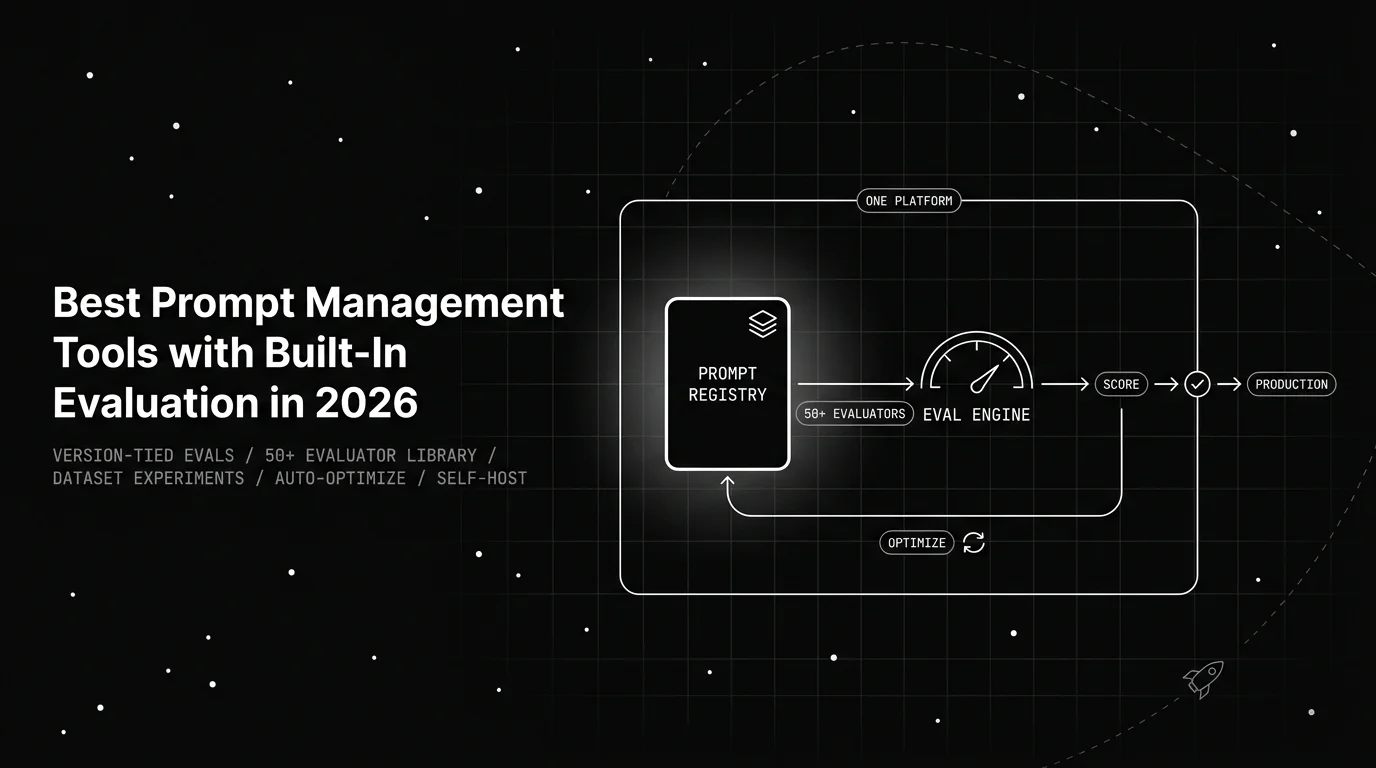
The 6 best prompt management tools with built-in evaluation in 2026, ranked on evaluator libraries, version-tied scoring, regression testing, and CI checks before release.

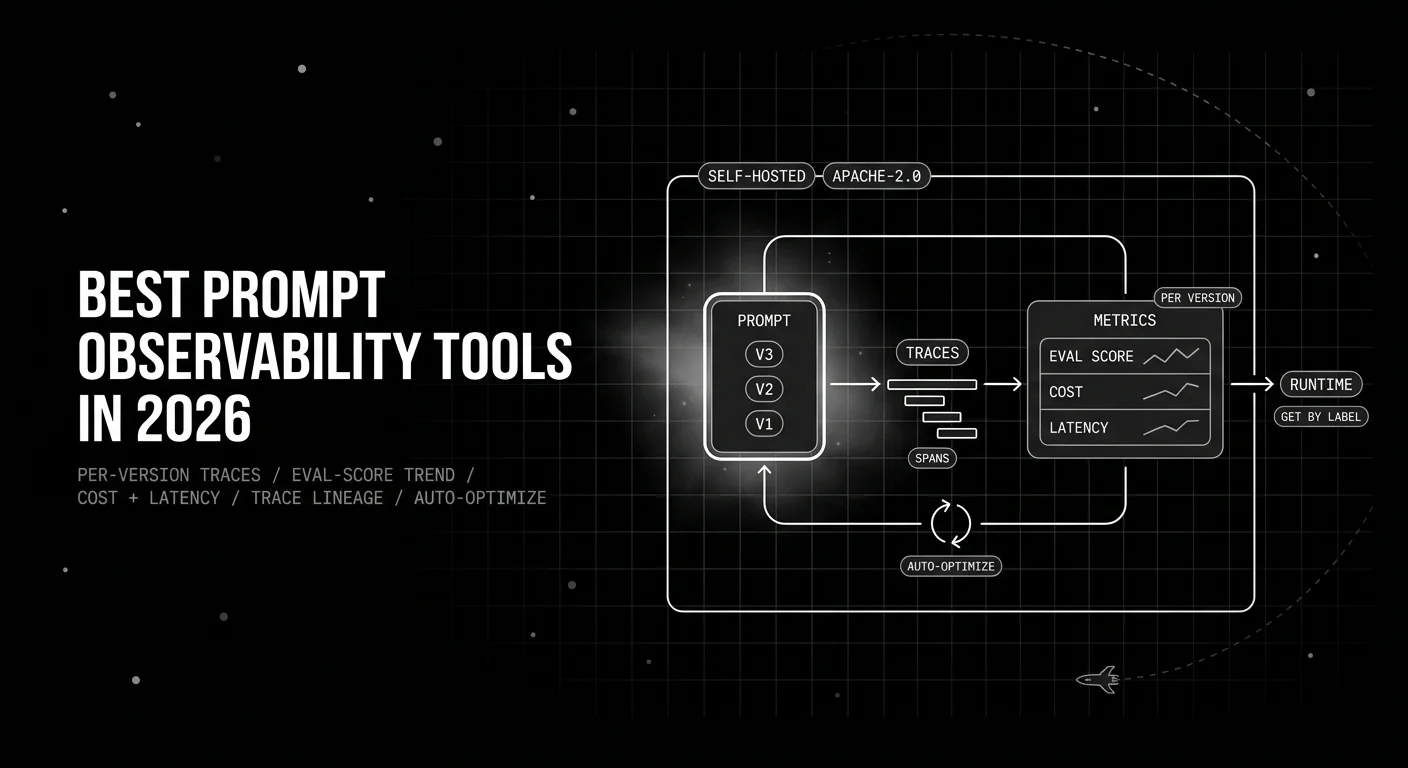
The 6 best prompt observability tools in 2026, ranked on tracing, logging, latency and cost tracking, and debugging prompts running live in production.

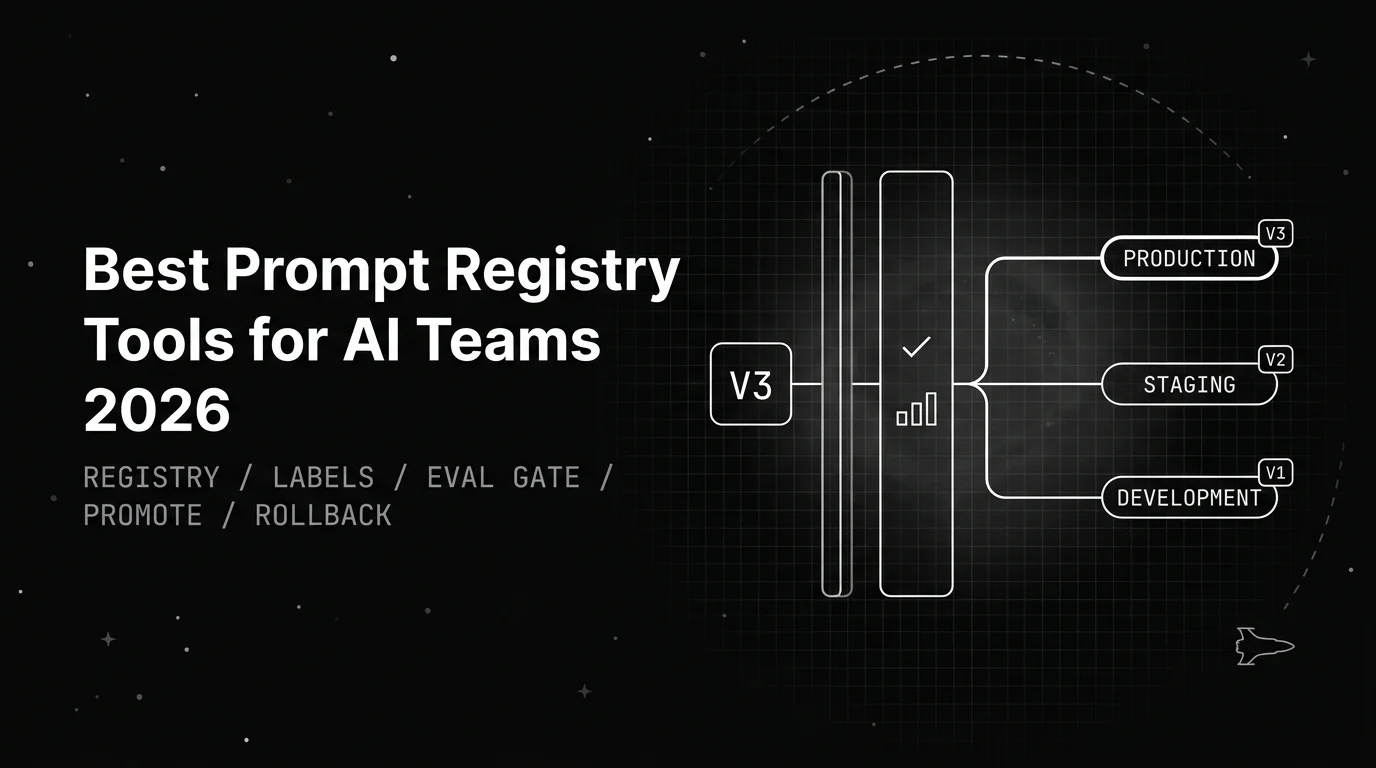
A ranked guide to the 6 best prompt registry tools for AI teams in 2026, compared on central storage, versioning, labels, and fetching prompts at runtime.