Best 5 OctoML Alternatives for LLM Inference in 2026
Five OctoML alternatives scored on hosted-inference depth, throughput, fine-tuning, infra control after NVIDIA narrowed OctoML to model compilation.
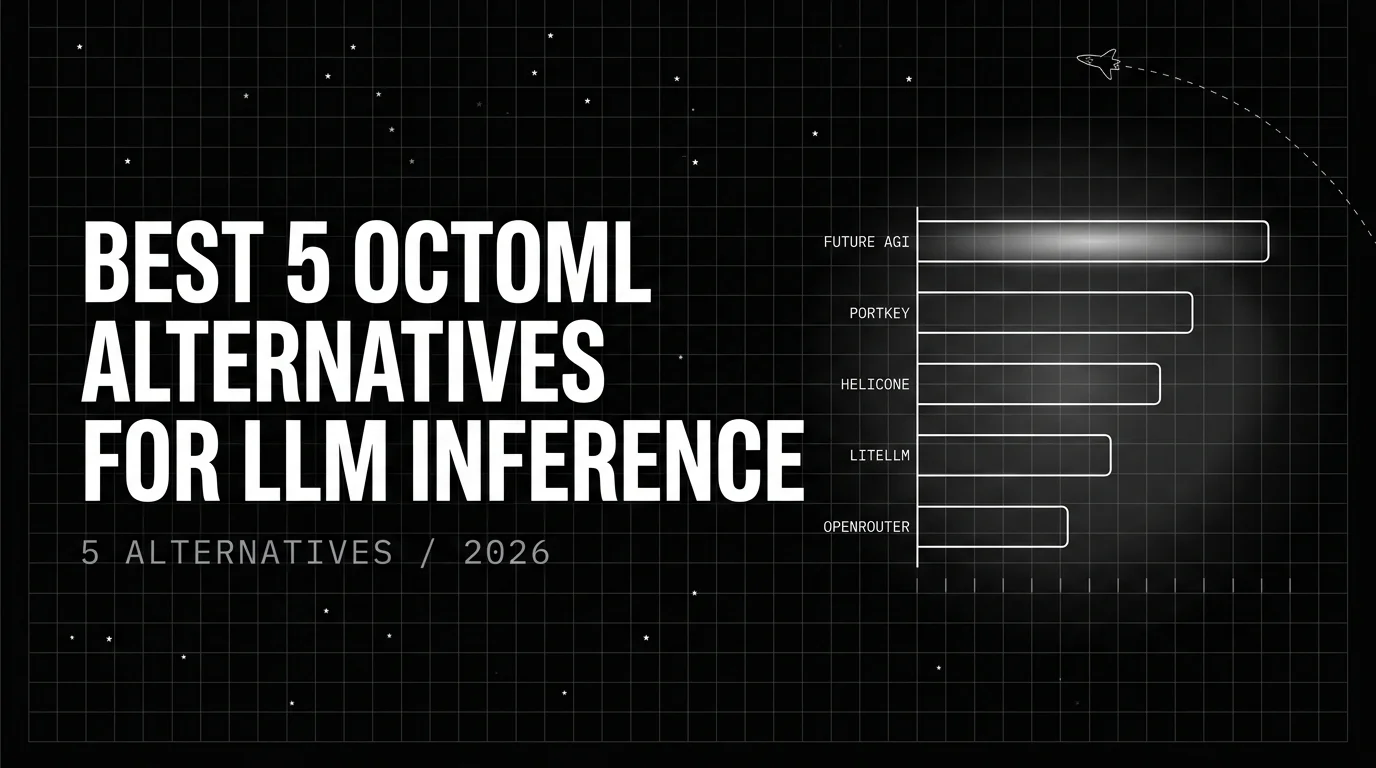
Table of Contents
On May 30, 2024 NVIDIA announced the acquisition of OctoML. Two years on, the post-acquisition shape is clear: OctoML’s roadmap has moved firmly inside the NVIDIA stack, the public OctoAI inference endpoints sunset, and what remains of the platform is a model-compilation pipeline tuned for NVIDIA silicon. TVM lineage, Triton-friendly artifacts, Apache TVM heritage extended into a fleet-optimization product. For teams who picked OctoML in 2022 to 2023 because it promised a vendor-neutral inference layer with portable model compilation across CPU/GPU targets, that thesis no longer holds.
This guide ranks five real LLM inference alternatives worth migrating to, names what each fixes versus OctoML’s narrow post-acquisition scope, and ends with the platform layer that augments whichever inference backend you pick.
TL;DR: five real OctoML alternatives
| Why you are leaving OctoML | Pick | Why |
|---|---|---|
| You want a managed inference backend with frontier OSS models | Together AI | Hosted inference for Llama, DeepSeek, Mixtral, Qwen with serverless and dedicated tiers |
| You want the lowest-latency hosted open-model inference | Fireworks | FireAttention kernels, sub-100ms TTFT on Llama and Mixtral, function-calling first-class |
| You want enterprise Ray-native serving with full infra control | Anyscale | Managed Ray Serve on Kubernetes, BYO cloud, full VPC option |
| You want one-click model deployment and a marketplace | Replicate | Cog containers, model marketplace, lowest-friction inference API |
| You want OSS self-hosted inference you fully control | vLLM | PagedAttention, continuous batching, the production runtime most teams self-host |
Future AGI isn’t in this table. FAGI isn’t an inference backend, it’s the platform layer (gateway, observability, evals, optimizer, guardrails) that augments whichever inference stack you pick. The dedicated FAGI section is below the five alternatives.
Why people are leaving OctoML in 2026
Four exit drivers show up repeatedly in Hacker News retrospectives on the NVIDIA deal, Reddit /r/LocalLLaMA and /r/MachineLearning migration threads, and ex-OctoAI customer discussions on the MLOps Community Slack.
1. The NVIDIA acquisition and the OctoAI sunset (May 2024)
NVIDIA’s stated thesis for buying OctoML was the compilation expertise. Apache TVM, the optimization pass library, the team that knew how to squeeze the last few percent of throughput out of a fixed silicon target. From a strategic standpoint that thesis was clear; from a customer standpoint it meant the parts of OctoML that were the product (the OctoAI hosted inference endpoint, the model-portability story across non-NVIDIA targets, the public LLM serving APIs) were no longer the priority. Within months of the deal, the OctoAI public endpoints were deprecated and customers were given migration windows ranging from weeks to a quarter.
2. NVIDIA-tied direction conflicts with multi-vendor reality
Production LLM stacks in 2026 aren’t single-vendor. A typical agent platform routes between a hosted frontier model (Claude, GPT-5, Gemini), an open-weights model on a dedicated GPU pool (Llama 4, DeepSeek R2, Mixtral), and increasingly a small-model lane on AMD MI300 or Intel Gaudi for cost-sensitive paths. The post-acquisition OctoML direction optimizes for one silicon vendor’s fleet.
3. Compilation focus, not serving
OctoML’s residual product surface is the compilation pipeline, take a model, run optimization passes, emit an optimized artifact, deploy. That’s a useful surface, but it isn’t what production LLM systems spend their day on. Production traffic spends its day on serving, actually answering requests with low TTFT, sustained throughput, and a familiar API contract. Teams who tried to use OctoML as a hosted inference endpoint after the OctoAI sunset were left without an obvious replacement.
4. No hosted endpoint, no fine-tuning workflow, no marketplace
The OctoAI sunset took with it the hosted endpoint, the fine-tuning workflow, and the model catalog. Teams who relied on any of those three need replacements, typically from a hosted inference provider with similar primitives or an OSS runtime they self-host.
What to look for in an OctoML replacement
Score replacements on the seven axes that map to what the OctoAI hosted endpoint actually did (and what its successors need to do better).
| Axis | What it measures |
|---|---|
| 1. Hosted-inference API | OpenAI-compatible endpoint, serverless or dedicated |
| 2. Open-model catalog | Llama, Mixtral, Qwen, DeepSeek — hosted and warm |
| 3. Latency on hot models | TTFT, sustained tokens/sec, throughput under load |
| 4. Fine-tuning workflow | Hosted LoRA or full fine-tune to dedicated endpoint |
| 5. Custom-compute / BYO model | Bring your own container or compiled artifact |
| 6. VPC / on-prem posture | Run in your cloud account, air-gap if needed |
| 7. Pricing fit at chat-workload shape | Per-token vs per-hour at projected volume |
Note: gateway, observability, eval, optimizer, and guardrails are not on this list. None of the five inference providers ship those natively. That gap is what the Future AGI section below covers.
1. Together AI: Best for managed open-model inference
Verdict: Together AI is the closest like-for-like replacement for the OctoAI hosted endpoint. Hosted inference for 100+ open-weights models (Llama 4, DeepSeek R2, Mixtral 8x22B, Qwen 3, Gemma) with serverless and dedicated tiers, fine-tuning, JSON mode, and tool-use as first-class API features.
What it fixes versus OctoML:
- Hosted inference, no fleet management. OpenAI-compatible endpoint, pay-per-token, no GPU provisioning. The OctoAI analog.
- Broad frontier-OSS catalog. All the Llama variants, DeepSeek R2, Mixtral, Qwen 3, Gemma 2, more, hosted and warm.
- Active inference-performance investment. FlashAttention-3 work, FasterTransformer-lineage kernels, custom CUDA. Independent benchmarks (ArtificialAnalysis.ai) consistently rank Together in the top three for Llama and DeepSeek serving in 2026.
- Fine-tuning surface. LoRA and full fine-tuning APIs alongside inference, useful if part of your OctoML investment was custom-tuned models.
- Multi-region. US, EU, and APAC inference regions reduce latency for global platforms.
Migration from OctoML: Point your existing client code at Together’s OpenAI-compatible endpoint. Most teams put a gateway in front so they aren’t single-sourced. Timeline: three to five engineering days for the inference swap.
Where it falls short:
- Not a gateway. No virtual keys, no first-class prompt registry, no policy layer beyond basic rate limits.
- No inline guardrails, no native eval, no optimizer.
- Single-vendor backend risk, pair with a gateway in front.
Pricing: Pay-per-token, published rates. Llama 3.3 70B is ~$0.88/M input. Dedicated endpoints from ~$2/hour.
Score: 5 of 7 axes (missing: VPC posture, custom-compute parity with vLLM-on-your-cluster).
2. Fireworks: Best for lowest-latency hosted inference
Verdict: Fireworks is the pick when latency is the dominant SLO. FireAttention, custom CUDA kernels for attention, delivers sub-100ms TTFT on Llama 3 and Mixtral variants. Function-calling and structured output are first-class. If your residual OctoML pain was latency on hosted endpoints, Fireworks addresses it directly.
What it fixes versus OctoML:
- Sub-100ms TTFT on production open models. FireAttention and speculative decoding give Fireworks an edge homegrown serving stacks struggle to match.
- Function-calling and JSON mode first-class. Built into the API surface.
- Fine-tuning with quick-deploy. Train on Fireworks, get a dedicated endpoint with the same latency characteristics as the base model.
- Compound AI focus. First-class support for tool-use and structured-output chains.
Migration from OctoML: Replace the inference call with the Fireworks API. Custom fine-tunes port via re-uploading training data. Timeline: three to five days per workload.
Where it falls short:
- Not a gateway; no observability beyond per-request logs.
- No eval, no optimizer, no guardrails.
- Catalog is curated; less breadth than Together’s 100+.
Pricing: Per-token, model-dependent. Llama 3.3 70B is ~$0.90/M input. Dedicated endpoints for steady workloads.
Score: 5 of 7 axes (missing: VPC posture, custom-compute parity).
3. Anyscale: Best for Ray-native enterprise serving
Verdict: Anyscale is the pick when the team needs full infrastructure control and the workload is distributed across multiple models. Managed Ray Serve on Kubernetes, autoscaling, bin-packing, BYO cloud account, full VPC isolation. The answer when “all inference must run inside our VPC” is a hard requirement.
What it fixes versus OctoML:
- Ray-native distributed serving. Ray Serve handles model composition, traffic splitting, and autoscaling across replicas.
- Full infra control. BYO AWS, GCP, or Azure account. Control plane is Anyscale; data plane is your cloud.
- Production-grade autoscaling. GPU utilization at Anyscale’s scale is materially better than naive per-function models for steady-state workloads.
Migration from OctoML: Heavier than Together or Fireworks. Wrap your compiled models or HF checkpoints in @serve.deployment decorators. The operational story shifts to “you operate Ray on Kubernetes.” Teams without prior Ray experience should budget two to four weeks per workload.
Where it falls short:
- Heavier ops surface than hosted inference.
- Pricing is opaque above the free tier.
- No gateway, eval, optimizer, or guardrails.
Pricing: Pay-as-you-go on top of cloud-provider costs, Anyscale’s markup is typically 15 to 25%. Enterprise custom.
Score: 5 of 7 axes (missing: chat-workload pricing fit, hosted simplicity).
4. Replicate: Best for one-click model deployment
Verdict: Replicate is the pick when the requirement is “wrap a model in a container, ship it as an API, and get a marketplace listing for free.” Cog is the lowest-friction “model to API” path in 2026. The model marketplace adds a discovery layer OctoAI never matched even at its peak.
What it fixes versus OctoML:
- Lowest-friction model deployment. Write
predict.py, define I/O, runcog push. Get an API endpoint, a web UI, and a model page. - Model marketplace. Thousands of community-maintained models are one API call away.
- Per-prediction pricing. Pay for what runs, no provisioning.
Migration from OctoML: Easy for self-contained models. Harder for workloads that need complex state. Replicate is opinionated about the model-as-container shape. Timeline: three to five days per simple model.
Where it falls short:
- Cold-start performance for less-popular models can be variable.
- Heavy reliance on Cog’s container format.
- No gateway, eval, optimizer, or guardrails.
Pricing: Per-prediction, hardware-tier-dependent. A T4 GPU runs ~$0.000225/sec; an A100 runs ~$0.0014/sec.
Score: 4 of 7 axes (missing: predictable latency, chat-workload pricing, VPC posture).
5. vLLM: Best for OSS self-hosted inference
Verdict: vLLM is the pick when the requirement is “we run this ourselves, on our hardware, with source we can audit.” vLLM’s PagedAttention and continuous batching make it the production inference runtime most teams self-host in 2026. Apache 2.0, large active community, supports every major open-weights model.
What it fixes versus OctoML:
- OSS-first. Apache 2.0. Run anywhere, your cluster, on-prem, edge.
- PagedAttention and continuous batching. State-of-the-art throughput on a wide range of GPUs.
- Catalog breadth. Supports virtually every popular open-weights model with minimal config.
- OpenAI-compatible API. Drop-in replacement for the OpenAI client in most code paths.
Migration from OctoML: Replace OctoAI client calls with vLLM’s OpenAI-compatible endpoint deployed on your own GPU pool. The operational story is “you operate vLLM on Kubernetes (or bare metal).” Timeline: one to two weeks including GPU procurement and load-test.
Where it falls short:
- You operate it, no managed surface.
- Multi-tenant features (quotas, virtual keys) live outside vLLM.
- No eval, optimizer, or guardrails.
Pricing: OSS under Apache 2.0. Compute costs are whatever your cluster runs.
Score: 5 of 7 axes (missing: hosted simplicity, fine-tuning workflow inside the runtime).
Future AGI: the platform layer that augments whichever inference you pick
Together, Fireworks, Anyscale, Replicate, and vLLM are inference backends. Future AGI isn’t. FAGI doesn’t serve Llama or Mixtral. It’s the platform layer that sits in front of whichever inference stack you pick and closes the gaps every one of them has in common: no native multi-provider gateway with routing and fallbacks, no LLM-shaped observability, no eval suite that runs on production traces, no prompt optimizer, no inline guardrails.
The shape is a self-improving loop, trace, eval, cluster, optimize, route, re-deploy, wrapped around your inference layer.
What FAGI adds to any inference choice on this list:
traceAI(Apache 2.0). OpenInference-compatible instrumentation with 35+ framework integrations. Calls to Together, Fireworks, Anyscale endpoints, Replicate models, or self-hosted vLLM all become spans with tokens, cost, latency, and provider broken out per call.ai-evaluation(Apache 2.0), task-completion, faithfulness, hallucination, tool-use, and custom rubrics scoring every trace automatically.
agent-opt(Apache 2.0), prompt optimizer that consumes eval-scored traces and rewrites prompts via ProTeGi, Bayesian search, or GEPA. Output is a new prompt version with a measured eval delta.
- Agent Command Center (hosted), multi-provider gateway with routing, fallbacks, virtual keys, per-key budgets; RBAC; failure-cluster views; AWS Marketplace procurement; SOC 2 Type II.
- Protect guardrails. Inline PII, prompt-injection, jailbreak, and policy enforcement with median ~67ms text-mode latency and ~109ms image-mode (per arXiv 2510.13351).
Why “augment, not replace”: FAGI doesn’t run GPUs. It doesn’t compile models for NVIDIA fleets. It doesn’t produce inference artifacts. That’s the backend’s job. Together, Fireworks, Anyscale, Replicate, vLLM, or the post-acquisition OctoML compile pipeline feeding NVIDIA NIM. FAGI sits in front, routing across providers, scoring responses, and enforcing policy. You can keep NIM for NVIDIA-fleet workloads, add Together for hosted Llama, and put FAGI in front of both behind one OpenAI-compatible endpoint.
Capability matrix
| Axis | Together AI | Fireworks | Anyscale | Replicate | vLLM |
|---|---|---|---|---|---|
| Hosted-inference API | Yes | Yes | Yes (Ray Serve) | Yes | Self-host only |
| Open-model catalog | 100+ | Curated | BYO | Marketplace | BYO |
| Latency on hot models | Strong | Strongest | Strong | Variable | Strong (depends on hardware) |
| Fine-tuning workflow | Hosted | Hosted | BYO | Limited | BYO |
| Custom-compute / BYO model | Limited | Limited | Full | Cog containers | Full |
| VPC / on-prem posture | No | No | Yes | No | Yes |
| Pricing fit for chat | Per-token | Per-token | Compute + markup | Per-prediction | Compute only |
Future AGI isn’t in the matrix because it doesn’t serve inference. FAGI plugs in front of all five.
Migration notes: what changes when leaving OctoML
The OctoML re-architecture isn’t a like-for-like swap because the OctoAI hosted endpoint is gone. Most teams converge on the same three-step pattern.
Step 1: Pick the inference backend or fleet
Decide whether you keep NVIDIA NIM and your own GPU pool, migrate hosted workloads to Together (or Fireworks for latency-critical), self-host vLLM in your VPC, or run a hybrid. Driven by token cost at projected volume, latency requirements, and how much fleet operations you want to own. Teams who used OctoAI as a hosted endpoint move to Together as the closest like-for-like.
Step 2: Drop a platform layer in front
Whatever backend you converge on, put FAGI in front for routing, virtual keys, observability, guardrails, and the optimizer loop. The platform layer sees every request, owns the policy surface, and survives a backend change, when you swap Together for vLLM (or vice versa), the gateway config changes but the instrumentation, evals, and optimizer keep working.
Step 3: Replace the custom proxy code
Most OctoML deployments grew custom proxy code around the OctoAI endpoints, rate limiting, fallbacks, cost attribution, sometimes a bespoke prompt store. Step 3 is replacing that code with first-class gateway primitives. The win is the custom proxy code becomes the platform layer’s job, and the team stops maintaining it.
A note on compilation and NIM
If your OctoML usage was specifically NVIDIA-fleet compilation, the part of the product that survives inside NVIDIA, keep using it. Compile your models with the post-acquisition pipeline, deploy the artifacts to NVIDIA NIM endpoints, and point FAGI at NIM. The migration isn’t “abandon compilation”; it’s “stop pretending the compiler is also a serving and gateway product.”
Decision framework: Choose X if
Choose Together AI if the OctoML use case was the OctoAI hosted endpoint for open-weights models. The closest like-for-like.
Choose Fireworks if latency is the dominant SLO and FireAttention’s sub-100ms TTFT moves the metric.
Choose Anyscale if VPC isolation is non-negotiable, the team is comfortable with Ray, and the workload is distributed across multiple models.
Choose Replicate if the requirement is “wrap a model in a container with minimum ceremony” and the model fits the Cog predict shape.
Choose vLLM if OSS, self-hosted, and full source control are the priorities and the team has the ops budget to operate it.
Add Future AGI in front of any of the five (or the residual NVIDIA NIM deployment) when the gap is multi-provider routing, observability, evals, optimizer, or inline guardrails.
What we did not include
Three products show up in other 2026 OctoML alternatives listicles that we left out: Modal (powerful serverless GPU compute, but the surface is “run your container,” not a managed inference catalog, closer to a Lambda-for-GPUs); BentoML (capable OSS model-packaging framework but the inference performance story is downstream of whichever runtime you wrap inside the Bento); RunPod (great raw GPU rentals but the serverless inference surface is thinner than the hosted-inference providers on this list).
Related reading
- Best LLM Gateways in 2026
- Best AI Gateways for Agentic AI in 2026
- What Is an AI Gateway? The 2026 Definition
- Best 5 Portkey Alternatives in 2026
Sources
- NVIDIA press release on OctoML acquisition, May 2024, nvidianews.nvidia.com
- OctoAI hosted endpoint sunset notices (2024 to 2025), community archives
- Hacker News retrospective threads on the NVIDIA / OctoML deal, news.ycombinator.com
- Reddit /r/LocalLLaMA and /r/MachineLearning migration discussions, 2024 to 2026
- Apache TVM project, tvm.apache.org
- NVIDIA NIM product page, nvidia.com/en-us/ai/nim
- Together AI product page, together.ai
- Fireworks AI, fireworks.ai
- Anyscale Ray Serve documentation, docs.anyscale.com
- Replicate Cog container format, github.com/replicate/cog
- vLLM project, github.com/vllm-project/vllm
- ArtificialAnalysis.ai inference benchmarks, artificialanalysis.ai
- Future AGI Agent Command Center, futureagi.com/platform/monitor/command-center
- Future AGI traceAI, github.com/future-agi/traceAI (Apache 2.0)
- Future AGI ai-evaluation, github.com/future-agi/ai-evaluation (Apache 2.0)
- Future AGI agent-opt, github.com/future-agi/agent-opt (Apache 2.0)
- Future AGI Protect latency benchmark, arxiv.org/abs/2510.13351 (67 ms text, 109 ms image)
Frequently Asked Questions
Why are people moving off OctoML in 2026?
What is the closest like-for-like alternative to OctoML?
Do I need to abandon NVIDIA NIM if I leave OctoML?
How does Future AGI compare to OctoML?
Is there an open-source OctoML alternative?
Which OctoML alternative is cheapest at scale?
Can I run multi-backend inference behind one endpoint?
Five Replicate alternatives scored on LLM inference depth, catalog breadth, per-token vs per-second economics, custom containers, gateway-in-front pattern.

Five Anyscale alternatives on LLM-native surface, inference cost at scale, gateway, optimizer. What each actually fixes for LLM-first vs Ray-first work.

Five vLLM alternatives scored on throughput, hardware coverage, quantization, structured outputs, ops burden, plus the platform layer that augments them.
