Best 5 Mistral La Plateforme Alternatives in 2026
Five Mistral La Plateforme alternatives on multi-provider routing, gateway depth, eval, optimizer. What each actually fixes when you outgrow Mistral-only.
Table of Contents
Mistral La Plateforme is a clean way to ship a first agent on a European-headquartered model stack, broad catalog (Large, Medium, Small, Codestral, Pixtral, Embed, Moderation, Magistral) and a Python- and JS-friendly developer surface. The trouble shows up around month six. The catalog is Mistral-only; there’s no native multi-provider router, no gateway with per-identity virtual keys, no eval suite scoring production traces, no optimizer rewriting prompts from those scores, and no inline guardrails on the request path. La Plateforme is an inference platform, not an agent control plane.
This guide ranks five inference-and-routing alternatives, names what each fixes versus La Plateforme, and walks through the migration pattern that almost always wins: keep Mistral as one backend, put a gateway in front of it for routing, observability, eval, and guardrails. Future AGI isn’t in the ranked five, it sits in a separate section because it isn’t an inference replacement. It’s the self-improving platform layer that augments whichever inference provider or proxy you pick.
TL;DR: pick by exit reason
| Why you are leaving La Plateforme as the primary stack | Pick | Why |
|---|---|---|
| You want a Mistral-friendly multi-provider host with high-throughput inference | Together AI | Hosts Mistral open-weight alongside Llama, Qwen, DeepSeek with batching |
| You want raw speed and fine-tuning across many open models | Fireworks AI | Custom FireAttention runtime, on-demand fine-tuning, OpenAI-compatible API |
| You want a self-hosted multi-provider proxy in front of Mistral | LiteLLM | MIT-licensed proxy that abstracts La Plateforme behind one OpenAI endpoint |
| You want the broadest model marketplace with consumer-style pricing | OpenRouter | Hundreds of models, including Mistral, on a single key with credit billing |
| You want sub-100ms first-token latency on open-weight models | Groq | LPU silicon for the fastest hosted inference on supported models |
After the five, see the dedicated Future AGI section, it sits across all five picks as the augment layer that closes the trace -> eval -> optimize -> route loop.
Why people leave Mistral La Plateforme as the primary stack in 2026
Four exit drivers show up repeatedly in Hacker News threads, the Mistral Discord, the mistralai/client-python issue tracker, and G2 reviews.
Mistral-only catalog and no native multi-provider router. La Plateforme is a single-vendor surface. The chat, embeddings, moderation, agents, and code endpoints all serve Mistral models, there’s no first-class path inside La Plateforme to send the same request to GPT-5.1, Claude Sonnet 4.5, or Gemini 2.5 Pro and pick the winner. For teams whose product has shifted from “Mistral by default” to “Mistral when it wins on this task, OpenAI on that one, Anthropic on the long-context one,” the platform stops being the platform. Every team writes its own model-selection switch, every team’s switch handles fallback differently, and the trace data doesn’t feed back into the switch.
No native gateway, virtual keys, per-identity attribution, RBAC. La Plateforme issues API keys per workspace member. There’s no per-service or per-end-user virtual key that fans out to one underlying provider key while preserving bulk pricing and per-identity attribution. Per-developer chargeback, per-tenant rate limits, and per-route budget caps are all upstream concerns.
No eval suite, no optimizer, no inline guardrails. La Plateforme exposes inference and a moderation endpoint. There’s no first-party eval library that scores production traces against task-completion, faithfulness, or tool-use rubrics; no optimizer that takes those scores and rewrites the underlying prompt; no inline guardrails layer that blocks unsafe inputs or outputs on the request path. The 2025 Le Chat Enterprise announcement added governance primitives, but they’re workspace-level controls, not request-path policy.
EU-only data residency without a multi-region story. Mistral’s pitch (French and European-headquartered, EU AI Act-aligned, data residency in Europe) is right for many regulated teams. It’s wrong for teams whose user base is global and whose legal requirement is “data in the user’s region.” La Plateforme doesn’t yet publish a US, APAC, or hybrid-region inference surface.
What to look for in a Mistral La Plateforme replacement
| Axis | What it measures |
|---|---|
| Multi-provider catalog | Can one stack reach Mistral plus OpenAI, Anthropic, Google, Meta, and open weights through one API? |
| Hosts Mistral closed-weight models | Does the platform serve Mistral Medium/Large/Magistral specifically? |
| Inference throughput | Tokens/sec on Mixtral and other Mistral open-weight models |
| Fine-tuning ergonomics | LoRA, full-parameter, deployment as adapter, iteration speed |
| Gateway + routing primitives | Virtual keys, fallback, cost-aware routing — native? |
| Data residency | US, EU, APAC, hybrid? |
| Migration cost from La Plateforme | How much code changes? |
1. Together AI: Best for Mistral-friendly multi-provider hosting
Verdict: Together AI is the pick when the requirement is “host Mistral open-weight alongside Llama, Qwen, DeepSeek, and a hundred more on one API.” Strength is inference throughput, batched and dedicated endpoints, fine-tuning, competitive per-token pricing. It’s an inference platform, not a control plane.
What it fixes: Together hosts Mistral 7B, Mixtral 8x7B and 8x22B, Mistral Small 3, and the rest of Mistral’s open-weight line alongside Llama 3.3, Llama 4, Qwen 3, DeepSeek R1, Gemma 3, and dozens more, all on one API key. Dedicated endpoints with continuous batching, FlashAttention-3, and speculative decoding. For throughput-bound workloads, Together’s per-token cost on the same Mistral open-weight model is often lower than La Plateforme. Together supports LoRA and full-parameter fine-tuning on most hosted weights, which La Plateforme exposes only for a subset of the catalog.
Migration: OpenAI-compatible endpoint at https://api.together.xyz/v1; model names are prefixed (mistralai/Mixtral-8x7B-Instruct-v0.1). For Mistral Medium, Large, and Magistral, La Plateforme remains the source. Together doesn’t host the closed-weight models. Three to five engineering days for the open-weight portion.
Where it falls short: No virtual keys, per-identity attribution, or per-route budgets. No native eval, optimizer, or inline guardrails. Doesn’t host Mistral’s closed-weight models, teams running those workloads keep La Plateforme alongside.
Pricing: Pay-per-token on serverless. Dedicated endpoints from custom pricing.
2. Fireworks AI: Best for fast inference and on-demand fine-tuning
Verdict: Fireworks is the pick when the workload is latency-sensitive and the requirement is “the same open-weight model, faster, with cleaner fine-tuning ergonomics.” FireAttention frequently benchmarks above generic vLLM hosts on tokens-per-second per dollar.
What it fixes: FireAttention is Fireworks’ proprietary CUDA kernel; published benchmarks show 2-4x throughput improvements over baseline vLLM on Mixtral and Mistral Small workloads. For chat surfaces where time-to-first-token matters, the gap is noticeable. Fine-tune any hosted base model with LoRA in tens of minutes, deploy as a separate endpoint, pay only for the deployed adapter. La Plateforme’s fine-tuning catalog is narrower and the iteration loop is slower. OpenAI-compatible API across the catalog.
Migration: OpenAI-compatible endpoint at https://api.fireworks.ai/inference/v1; model name format is accounts/fireworks/models/mixtral-8x22b-instruct. Mistral-specific tool-call adapters come out. Three to five engineering days for the open-weight portion.
Where it falls short: No virtual keys, per-identity attribution, or per-route budgets. No eval, optimizer, or inline guardrails. Doesn’t host Mistral’s closed-weight models. Smaller ecosystem than Together, fewer Terraform providers, fewer off-the-shelf integrations.
Pricing: Pay-per-token on serverless. Dedicated GPU hosting from custom pricing.
3. LiteLLM: Best for a self-hosted multi-provider proxy in front of Mistral
Verdict: LiteLLM is the pick when the Mistral catalog problem is the dealbreaker and the requirement is “this proxy runs entirely on our infrastructure, with source we can audit.” MIT-licensed, Python-native, the most popular self-hosted multi-provider proxy on GitHub.
What it fixes: One base_url, one OpenAI-compatible client, model names like mistral/mistral-medium-latest, anthropic/claude-sonnet-4-5, openai/gpt-5.1. Cost- and latency-aware routing rules sit in config.yaml instead of application code. LiteLLM’s team_id, user_id, and key model fans out to one upstream Mistral key (and one upstream OpenAI key, and so on), preserving bulk pricing while exposing per-identity chargeback. Entire proxy runs in your VPC; no telemetry leaves unless you configure an OTel sink.
Migration: Stand up LiteLLM in front of La Plateforme as one provider in config.yaml. Mistral SDK calls become OpenAI-SDK calls against the LiteLLM endpoint with the same model names. Add OpenAI, Anthropic, and others as additional providers. Five to seven engineering days for the proxy cutover.
Where it falls short: No native eval suite. No optimizer. No inline guardrails on the request path. The bundled UI is the weakest in this list; polish lives in Enterprise.
Pricing: Open source under MIT. Enterprise from ~$250/month.
4. OpenRouter: Best for the broadest model marketplace on one key
Verdict: OpenRouter is the pick when the requirement is “I want every model on earth on one API key, with consumer-style credit billing and zero ops.” Hundreds of models (including Mistral Large 2, Medium 3, Codestral, Mixtral, plus OpenAI, Anthropic, Google, Meta, DeepSeek, Qwen, xAI) through one OpenAI-compatible endpoint.
What it fixes: OpenRouter brokers requests to Mistral, OpenAI, Anthropic, Google, Together, Fireworks, Cerebras, Groq, and dozens more, including Mistral’s own closed-weight models, which Together and Fireworks don’t host. If a model is hosted on multiple providers, OpenRouter routes to the cheapest or fastest by default; if a primary provider rate-limits or fails, the next provider takes over within the same request. One bill, one credit balance, no separate provider accounts.
Migration: OpenAI-compatible endpoint at https://openrouter.ai/api/v1; model names mistralai/mistral-large or mistralai/mistral-medium-3. Drop in as a base_url change. Two to three engineering days.
Where it falls short: No virtual keys with per-route budget caps or per-tenant attribution beyond metadata headers. No eval, optimizer, or inline guardrails. Routing intelligence is provider-fallback, not capability-aware quality routing. Enterprise procurement is thinner.
Pricing: Pay-per-token on credits. Per-model rates are pass-through from upstream providers with a small markup.
5. Groq: Best for sub-100ms first-token latency on open-weight models
Verdict: Groq is the pick when the workload is latency-critical and the model fits Groq’s catalog. LPU (Language Processing Unit) silicon delivers the fastest hosted inference on supported open-weight models, including Mixtral 8x7B and a handful of Mistral variants. Not a broad catalog, but unmatched on the models it hosts.
What it fixes: Time-to-first-token on Mixtral 8x7B routinely beats anything else hosted, often below 50 ms. For chat surfaces and voice-agent stacks where interactivity is the product, the gap over generic GPU hosts is dramatic. OpenAI-compatible API. Pay-per-token, no commitment.
Migration: OpenAI-compatible endpoint at https://api.groq.com/openai/v1; model names like mixtral-8x7b-32768. Drop in as a base_url change. Two to three engineering days.
Where it falls short: Catalog is narrow. Mixtral 8x7B, Llama variants, a handful of others. No support for Mistral Medium or Large. No virtual keys, eval, optimizer, or inline guardrails. Capacity has historically been the bottleneck; rate limits can be tight under bursty load.
Pricing: Pay-per-token. Enterprise plans for committed capacity.
Capability matrix
| Axis | Together AI | Fireworks AI | LiteLLM | OpenRouter | Groq |
|---|---|---|---|---|---|
| Multi-provider catalog | Open-weight focus | Open-weight focus | ~100 providers | Broadest (incl. Mistral closed) | Narrow, hosted-only |
| Hosts Mistral closed-weight | No | No | Routes to La Plateforme | Yes (via La Plateforme) | No |
| Inference throughput | Strong, batched | Strongest on FireAttention | Inherits upstream | Inherits upstream | LPU-fast, low latency |
| Fine-tuning ergonomics | Strong (LoRA + full) | Strong (LoRA, fast iteration) | N/A (proxy only) | N/A (broker only) | Limited |
| Gateway primitives | None | None | Virtual keys, routing | Metadata only | None |
| Data residency | US primarily | US primarily | Wherever you host | Provider-dependent | US |
| Migration cost | 3-5 days | 3-5 days | 5-7 days | 2-3 days | 2-3 days |
Future AGI: the self-improving platform layer that augments whichever you pick
Future AGI isn’t on the ranked list above because it isn’t an inference replacement. The five products above are where you go when you want a different inference provider or proxy. Future AGI is the layer you bolt on top of any of them, including La Plateforme itself, so that traces feed evals, evals feed an optimizer, the optimizer rewrites prompts, and the gateway serves the new version on the next request.
The loop: trace -> eval -> cluster -> optimize -> route -> re-deploy.
OSS components, Apache 2.0:
traceAI. OpenInference-compatible auto-instrumentation with 35+ framework integrations (Mistral SDK, OpenAI, Anthropic, LangChain, LlamaIndex, CrewAI, AutoGen, Haystack, DSPy, and more). One-line auto-instrument; spans emit through OTel into Phoenix, Langfuse, the FAGI Command Center, or your own ClickHouse.ai-evaluation. Rubric library covering faithfulness, answer-correctness, context-precision, tool-use correctness, hallucination, and task-completion. Runs offline on a curated set, or online against live trace volume.
agent-opt. Prompt optimizer with six optimizers — ProTeGi, GEPA, Bayesian, MetaPrompt, RandomSearch, PromptWizard algorithms. Takes captured traces plus eval scores and produces optimized prompts, which the registry serves to the gateway on the next request.
Hosted: Agent Command Center. Adds an OpenAI-compatible multi-provider gateway with per-identity virtual keys (service, end-user, repo, tenant) fanning out to provider keys (La Plateforme, OpenAI, Anthropic, Google, Bedrock, Together, Fireworks, OpenRouter, Groq). Per-route budget caps with auto-pause and Slack alerts are first-class. RBAC, audit log, SOC 2 Type II, AWS Marketplace procurement, and hosted Protect guardrails, inline jailbreak detection, PII redaction, and content filtering with median ~67 ms text-mode latency and ~109 ms image-mode latency reported in arXiv 2510.13351.
How it pairs with the five above (and with La Plateforme directly):
- With La Plateforme. Register La Plateforme as one backend behind FAGI;
traceAIcaptures every Mistral SDK call;ai-evaluationscores traces;agent-optrewrites prompts in the registry. Mistral keeps its catalog advantage and EU posture; FAGI adds everything around it. - With Together AI. Together hosts the open-weight portion; FAGI routes to it as one provider, with La Plateforme for the closed-weight portion, behind one gateway.
- With Fireworks AI. Same pattern. Fireworks for fast open-weight inference, La Plateforme for closed-weight, FAGI for the control plane.
- With LiteLLM. Two options. LiteLLM as the gateway plus FAGI for the eval + optimizer loop on top (no overlap; LiteLLM emits OTel, FAGI consumes). Or, FAGI as the gateway and LiteLLM drops out.
- With OpenRouter. OpenRouter brokers requests;
traceAIadds richer spans; the eval and optimizer layer runs on top. - With Groq. Latency-critical routes go through Groq; FAGI is the control plane that picks Groq for those routes and Mistral or OpenAI for others.
Why this is the augment, not the alternative: the five products above each cover inference or proxying. None of them ship a gateway with virtual keys plus an eval suite plus a prompt registry plus an optimizer plus inline guardrails. FAGI exists to be that loop.
Pricing: OSS components (Apache 2.0) are free. Hosted Agent Command Center: free tier with 100K traces/month, scale from $99/month with linear per-trace scaling above 5M, enterprise with SOC 2 Type II and AWS Marketplace.
Migration notes: keep Mistral as one backend, add a gateway in front
The pattern that almost always wins is layered, not lift-and-shift. La Plateforme is a fine inference provider; what is missing is everything around it. The four steps below assume the destination is a control plane and Mistral remains a registered backend.
Stand up the gateway with La Plateforme as a backend. Register La Plateforme as one provider in the gateway config alongside any others. OpenAI, Anthropic, Google, Together, Fireworks, Bedrock for AWS-resident Mistral, Azure AI Foundry for Azure-resident Mistral. Test that a request through the gateway against mistral/mistral-medium-latest returns the same body as a direct La Plateforme call. Mistral’s function-calling format is mostly OpenAI-compatible but differs in a few edge cases, validate those in the shadow phase before flipping production traffic.
Re-route client base URLs. La Plateforme is invoked by setting MISTRAL_API_KEY and pointing an OpenAI-compatible client at https://api.mistral.ai/v1. The cutover is a base-URL change plus a key swap. In practice, services hard-code the URL in three places: SDK initialization, runtime config, and the deployment manifest, the checklist needs all three.
Move workspace governance to gateway RBAC. Le Chat Enterprise’s workspace-level controls are workspace-scoped, not request-path policy. On the gateway, the same controls become RBAC roles attached to virtual keys. Map each La Plateforme workspace member to a gateway role; map each Mistral workspace to a gateway tenant.
Layer eval, optimizer, and guardrails on the gateway. Once traffic flows through the gateway, the eval suite scores every captured trace; the optimizer rewrites prompts on a schedule from those scores; the guardrails layer sits on the request path. The Mistral moderation endpoint becomes one of several signals the inline guardrails layer aggregates.
Decision framework: Choose X if
Choose Together AI if the catalog gap is specifically “we want Mistral open-weight plus Llama, Qwen, DeepSeek on one API with high throughput.” Pick this when the workload is throughput-bound.
Choose Fireworks AI if the gap is inference latency on open-weight Mistral models and you want fine-tuning that iterates in tens of minutes.
Choose LiteLLM if the requirement is “this gateway runs on our hardware, with source we can audit, and abstracts Mistral plus every other provider behind one endpoint.”
Choose OpenRouter if the requirement is “every model, including Mistral’s closed-weight line, on one API key, on credits, with zero ops.”
Choose Groq if the workload is latency-critical and Groq’s catalog covers the model you need.
Add Future AGI on top of whichever you pick to get virtual keys, eval, optimizer, and inline guardrails, keeping La Plateforme as one backend, with FAGI as the control plane that closes the trace -> eval -> optimize -> route loop.
What we did not include
Three platforms show up in other 2026 listicles that we left out: Anyscale Endpoints (sunset in late 2024 when Anyscale refocused on Ray); Replicate (strong for image and audio deployment, thinner LLM surface as of May 2026); Cerebras Inference (real inference-latency story competitive with Groq, but catalog overlap with Groq makes them functionally similar, pick whichever has the model you need).
Related reading
- Best 5 Portkey Alternatives in 2026
- Best LLM Gateways in 2026
- What Is an AI Gateway? The 2026 Definition
- Best AI Gateways for Agentic AI in 2026
Sources
- Mistral La Plateforme product page, mistral.ai/products/la-plateforme
- Mistral La Plateforme API reference, docs.mistral.ai/api
- Mistral Le Chat Enterprise announcement, 2025, mistral.ai/news/le-chat-enterprise
- Mistral Medium 3.1 release notes, 2026, mistral.ai/news
- Together AI model catalog and pricing, together.ai/models
- Fireworks AI FireAttention benchmarks, fireworks.ai/blog/fireattention
- LiteLLM GitHub repository, github.com/BerriAI/litellm
- OpenRouter model marketplace and routing docs, openrouter.ai/docs
- Groq inference pricing and benchmarks, groq.com/pricing
- AWS Bedrock Mistral availability, aws.amazon.com/bedrock/mistral
- Azure AI Foundry Mistral catalog, learn.microsoft.com/azure/ai-foundry
- Future AGI Agent Command Center, futureagi.com/platform/monitor/command-center
- Future AGI traceAI, github.com/future-agi/traceAI (Apache 2.0)
- Future AGI ai-evaluation, github.com/future-agi/ai-evaluation (Apache 2.0)
- Future AGI agent-opt, github.com/future-agi/agent-opt (Apache 2.0)
- Future AGI Protect latency benchmark, arxiv.org/abs/2510.13351 (67 ms text, 109 ms image)
Frequently Asked Questions
Why are people moving off Mistral La Plateforme as the primary stack in 2026?
Do I have to leave La Plateforme entirely?
Can I get Mistral inference from somewhere other than La Plateforme?
Is there an open-source path?
Which alternative is cheapest at scale?
Where does Future AGI fit if it is not on the ranked list?
FutureAGI ACC, Helicone, OpenRouter, Portkey, LiteLLM, Cloudflare AI Gateway, Vercel AI Gateway as 2026 LLM gateways. Routing, caching, guardrails.

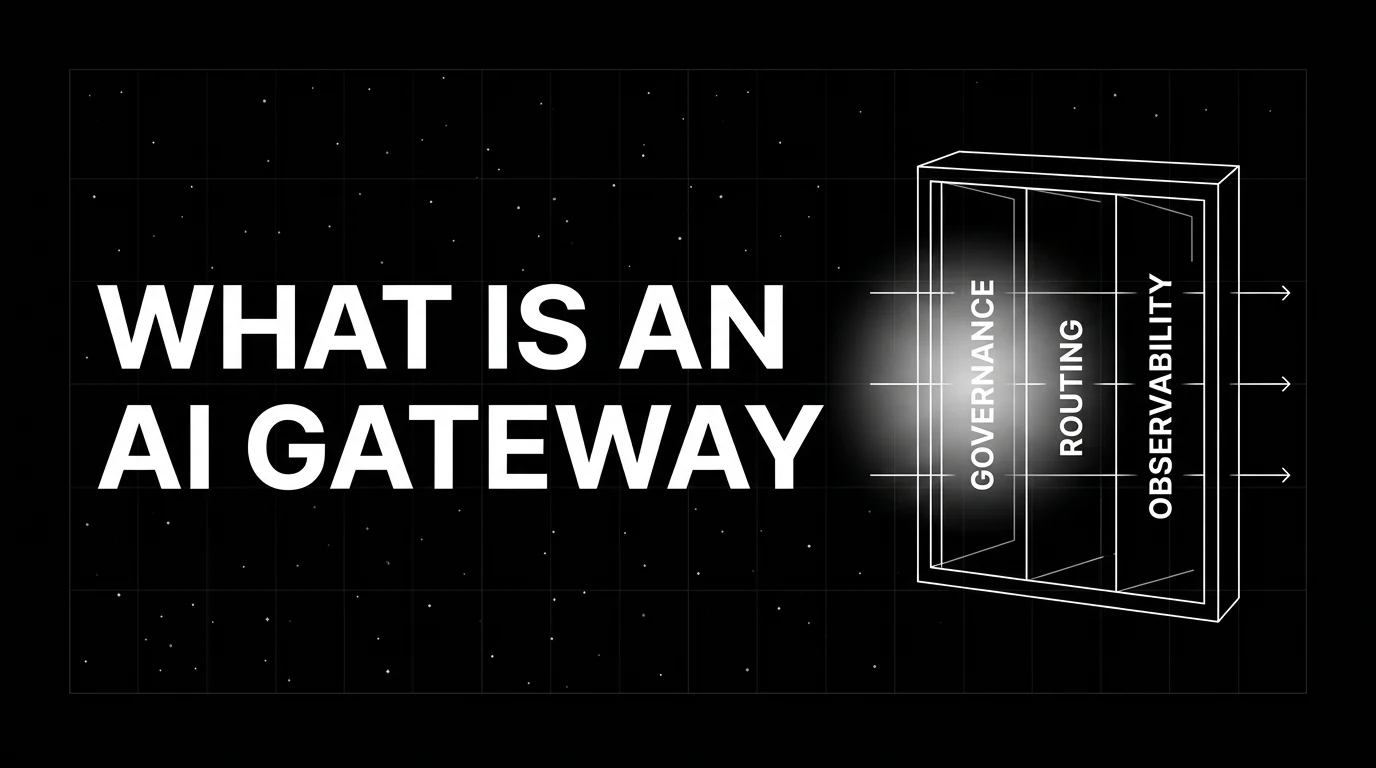
An AI gateway sits between apps and LLM providers for governance, routing, observability. What it is, how it differs from API gateways.
Five Together AI alternatives on hosted inference depth, throughput, fine-tuning, VPC posture. What each actually fixes when workload outgrows the pricing.
