Best 5 Langtail Alternatives in 2026
Five Langtail alternatives scored on prompt-as-API portability, deployment, eval depth, self-hosting, plus a migration plan for prompt endpoints.

Table of Contents
Langtail did one thing well (wrap a prompt as a hosted API endpoint with a playground, basic logs, and a thin evaluation layer) and for a 2024 prototype that was the right scope. By 2026 the shape of an LLM product team has changed. Teams who picked Langtail for speed-to-first-endpoint are running into the ceiling: no self-host, no native gateway with cost-aware routing, no optimizer consuming eval data, a smaller community than Langfuse or Helicone, and a roadmap that has slowed since 2025.
This guide ranks five replacements, names what each fixes versus Langtail, and walks through the migration that always bites: exporting prompts from Langtail’s prompt-as-API model and re-deploying them.
TL;DR: pick by exit reason
| Why you are leaving Langtail | Pick | Why |
|---|---|---|
| You want prompts, traces, evals, and a gateway that all feed each other | Future AGI Agent Command Center | Closes the loop from trace through eval to optimizer to route |
| You want hosted observability with a polished prompt registry | Portkey | Mature prompt library plus a real AI gateway with routing and virtual keys |
| You want self-hosted, source-available prompt + trace tooling | Langfuse | MIT-licensed prompts, traces, evals you can run inside your VPC |
| You want lightweight hosted observability with less surface area | Helicone | Drop-in proxy with per-request cost and session traces |
| You want a prompt-engineering-first workflow with a long track record | PromptLayer | Prompt registry and request logging tuned for prompt engineers |
Why people are leaving Langtail in 2026
Five exit drivers show up in Reddit /r/LLMDevs threads, the Langtail Discord, and G2 reviews from the last two quarters.
1. Scope ceiling. Langtail’s surface is intentionally narrow, a prompt as a hosted endpoint, a playground, request logs, a thin eval pass. Right shape for a five-prompt prototype, wrong shape for a production agent. Routing, fallbacks, cost-aware routing, RBAC, audit logs, optimizer loops all live outside Langtail.
2. Hosted-only. No self-hosted Langtail.Self-host isn’t on the 2026 roadmap.
3. Lightweight observability you outgrow. Logs and analytics handle a handful of prompts and a few thousand requests a day. Above that (per-user cost attribution, per-session traces, RBAC, audit trails, quality-regression alerting) the surface gets thin fast. Most teams pair Langtail with Langfuse or Helicone within months of going to production, at which point the question is whether to keep Langtail at all.
4. No native gateway with routing intelligence. Langtail isn’t an AI gateway, no provider-fanout, no cost-aware routing, no fallback, no virtual keys, no caching, no budget caps. Teams who expected it to grow into one bolt on Portkey, LiteLLM, or Kong, at which point the prompt-as-API hop adds latency without adding value over a template loaded from the gateway.
5. Smaller community, slower roadmap, no optimizer. Langtail’s community is an order of magnitude smaller than Langfuse, Helicone, or LiteLLM. Release notes slowed through Q1 2026. And no native optimizer: traces and evals are recorded for human review, not consumed to rewrite prompts or shift routes.
What to look for in a Langtail replacement
Score replacements on the seven axes that map to the surfaces you’re actually migrating off:
| Axis | What it measures |
|---|---|
| 1. Prompt-as-API portability | Export Langtail prompts and re-deploy without losing version history? |
| 2. Self-host posture | Can the replacement run inside your VPC, air-gapped from the vendor? |
| 3. Observability depth | Per-session, per-user, per-route — native, or bolt-on? |
| 4. Native eval suite | Are evals first-class, or a bolted-on second product? |
| 5. Gateway + routing intelligence | Real provider-fanout layer with fallback and cost-aware routing? |
| 6. Optimizer loop | Does the platform use eval data to rewrite prompts or shift routes? |
| 7. Migration tooling | Published scripts or importers for Langtail’s prompt-as-API shape? |
1. Future AGI Agent Command Center: Best for closing the loop
Verdict: Future AGI fixes Langtail’s biggest structural weakness, traces and evals get recorded, but nothing consumes them to make the next request cheaper or better. Agent Command Center captures the trace, scores it against the eval library, clusters failures, runs the optimizer, and pushes the updated prompt or route back into the gateway. Langtail is a prompt registry with a thin log view; FAGI is the same plus evaluation, gateway routing, guardrails, and an optimizer under one roof.
What it fixes versus Langtail:
- Prompt portability and the self-improving loop. FAGI’s prompt registry accepts Jinja2 directly. The Langtail importer reads the export JSON, rewrites template tags, and preserves version metadata. Once prompts live in FAGI, the optimizer (
agent-opt, Apache 2.0) rewrites them automatically via six optimizers — ProTeGi, GEPA, Bayesian, MetaPrompt, RandomSearch, PromptWizard, driven by eval scores fromai-evaluation(Apache 2.0). Langtail’s prompt store is static; FAGI’s registry is self-improving.
- Full gateway, not a prompt endpoint alone. Provider fanout across OpenAI, Anthropic, Google, Mistral, AWS Bedrock, Azure OpenAI, and OSS endpoints, with cost-aware routing, fallback, virtual keys, semantic caching, and budget caps with auto-pause.
- Native eval, not bolt-on. Every trace is scored against task-completion, faithfulness, toxicity, PII, and tool-use rubrics by default. Cost and quality data sit in the same row, the precondition for the optimizer to make the cost-quality trade-off.
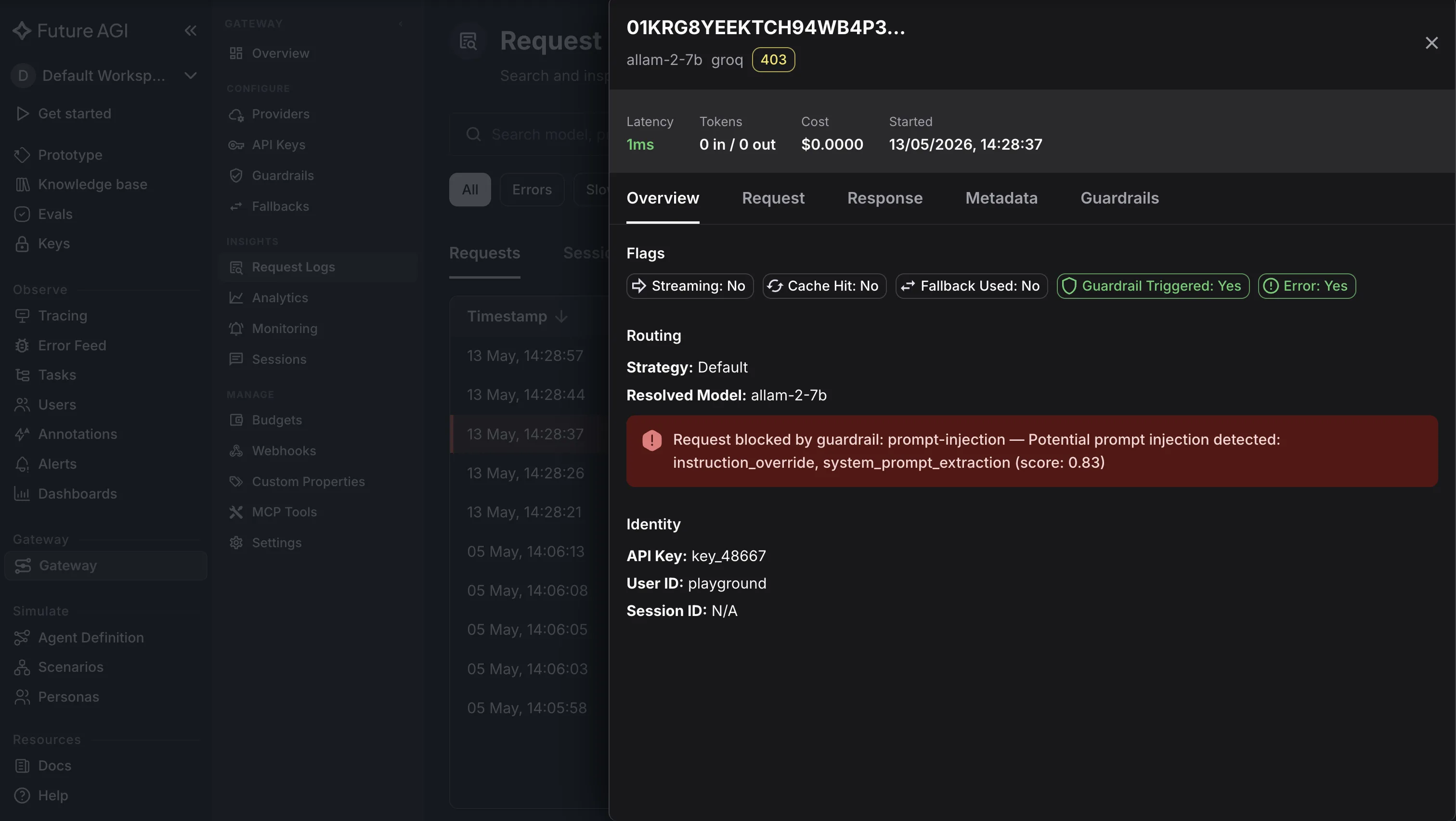
- Protect guardrails inline. Runtime safety checks (PII, jailbreak, off-topic, custom policy) at a median 67 ms text-mode latency (109 ms image, per arXiv 2510.13351), under the inline-guardrail budget most teams set.
- OSS instrumentation.
traceAI,ai-evaluation, andagent-optare all Apache 2.0. The hosted Command Center adds RBAC, failure-cluster views, the optimizer service, Protect, and AWS Marketplace procurement.
Migration from Langtail: Langtail’s prompt-as-API model maps to FAGI’s registry as Jinja2 templates with semantic versioning. Export Langtail prompts as JSON, run the FAGI importer, and replace the Langtail base URL with the FAGI prompt-deploy endpoint (or wire the prompt into the gateway request body directly). Eval configs import as YAML. Timeline: five to seven engineering days for under 100 prompts including a shadow-traffic period.
Where it falls short:
-
agent-opt is opt-in, start with traceAI + ai-evaluation in week one and turn the optimizer on once eval baselines stabilize. The loop compounds value over weeks rather than at day one.
-
The playground UI is functional but less polished than Langtail’s. Playground UX is actively in development; teams whose daily prompt iteration loop lives in the playground should preview the FAGI workflow before standardizing.
Pricing: Free tier with 100K traces/month. Scale tier from $99/month with linear per-trace scaling above 5M (no add-on multipliers). Enterprise with SOC 2 Type II and AWS Marketplace.
Score: 7 of 7 axes.
2. Portkey: Best for the hosted gateway + prompt library combo
Verdict: Portkey is the closest functional match if your exit driver is scope, you want a polished hosted prompt library and a real AI gateway with virtual keys, fallback, and cost dashboards in one product. Portkey was acquired by Palo Alto Networks on April 30, 2026, which adds roadmap uncertainty, but it’s the most direct upgrade from Langtail’s prompt-as-API scope.
What it fixes versus Langtail:
- A real AI gateway. Provider fanout across OpenAI, Anthropic, Google, Bedrock, Azure OpenAI, and self-hosted endpoints with cost-aware routing, fallback, virtual keys, semantic caching, and budget caps. Langtail wraps a prompt; Portkey wraps the request lifecycle.
- Mature prompt library. Prompt Studio stores prompts as versioned objects with branches, tags, and a clean diff view. If the exit driver was “same prompt-as-API model but more powerful,” this is the upgrade.
- Per-identity attribution. Virtual keys give every developer or service a Portkey-issued key that fans out to one provider key, preserving bulk pricing while exposing per-identity cost attribution.
Migration from Langtail: Export Langtail prompts as JSON, rewrite to Portkey’s {{handlebars}} dialect (mostly mechanical), re-publish via Portkey’s prompt API. Provider keys, basic routing, and request logging map directly. Timeline: five to seven engineering days.
Where it falls short:
- No optimizer, traces and evals are recorded, not consumed by an optimization loop.
- The Palo Alto Networks acquisition (April 30, 2026) creates SMB-SKU roadmap uncertainty; expect potential pricing changes within 12 to 24 months.
- Pricing escalates above 5M requests/month once Guardrails, Prompt Studio, and Audit Logs add-ons stack.
- Hosted-only for most teams; the self-host offering is enterprise-tier.
Pricing: Free tier with limited requests. Scale tier from $99/month. Enterprise custom.
Score: 5 of 7 axes (missing: optimizer, broad self-host).
3. Langfuse: Best for self-hosted prompts + traces + evals
Verdict: Langfuse is the pick when the exit driver is “inside our VPC, with source we can audit.” MIT-licensed, runs on Postgres + ClickHouse, covers prompts, traces, evals at meaningful depth, with a community an order of magnitude larger than Langtail’s.
What it fixes versus Langtail:
- Self-host posture. The platform runs in your VPC. No telemetry leaves unless you configure an external sink. For teams whose security review of Langtail’s hosted-only posture was the exit trigger, this is the answer.
- Prompts, traces, evals as first-class surfaces. Prompt management supports versioning, labels, and rollback (production / staging / commit). Traces capture multi-step agent runs with tool calls. Evals run as scheduled jobs or inline, with LLM-as-judge and code-based scorers.
- Larger community. Langfuse is one of the most active OSS communities in LLM tooling. That matters at hour two of an incident.
Migration from Langtail: Langtail’s prompt-as-API endpoint maps to Langfuse with a thin SDK wrapper, langfuse.get_prompt("name", label="production") replaces the HTTP call. Export Langtail prompts as JSON, transform to Langfuse’s prompt-create payload, bulk-import. Trace and eval surfaces map cleanly. Timeline: four to six engineering days for under 100 prompts including self-host setup.
Where it falls short:
- No native AI gateway with routing intelligence. Langfuse pairs with LiteLLM, Portkey, or Future AGI for that layer.
- No optimizer loop, traces and evals are recorded, not consumed.
- Self-host operations have non-trivial runbook overhead at scale (ClickHouse upgrades, Postgres tuning).
Pricing: Open source under MIT. Cloud Hobby free with 50K observations/month. Cloud Pro from $59/month. Enterprise custom.
Score: 5 of 7 axes (missing: optimizer, native gateway).
4. Helicone: Best for lightweight hosted observability
Verdict: Helicone is the pick if your exit driver is “same lightweight feel and lower price, but with proxy-level observability and a self-host option.” Drop-in proxy with per-request cost telemetry, session traces, and a clean dashboard. One wrinkle: Helicone acquired Mintlify in March 2026, and parts of the docs surface have folded into Mintlify’s stack.
What it fixes versus Langtail:
- Per-request cost and session traces. Every request flows through the proxy and gets logged with cost, tokens, latency, and user/session metadata. Langtail’s logs are prompt-endpoint scoped; Helicone’s are request scoped. What you want once an agent has multiple prompts in one session.
- Self-host option. Open-source self-host (Apache 2.0) on Postgres + ClickHouse. Docs acknowledge scale-out beyond a few hundred RPS gets non-trivial, but below that threshold the self-host story is clean.
- Friendlier pricing curve. Pro tier starts at $25/month and scales more gently than Langtail’s hosted-only pricing once you cross a few million requests.
Migration from Langtail: Helicone is OpenAI-compatible, replace the OpenAI base_url and add a single header. Langtail’s prompt-as-API endpoint becomes a Jinja2 template rendered client-side or stored in Helicone’s lighter Prompts product. Custom properties replace Langtail’s tags. Timeline: three to five engineering days.
Where it falls short:
- No optimizer.
- Routing intelligence is basic (round-robin and failover); cost-aware model routing requires upstream code or a separate gateway.
- Prompts product is less feature-rich than Langtail’s prompt-as-API or Portkey’s Prompt Studio.
- Self-host operations get harder above a few hundred RPS.
- The Mintlify acquisition is recent enough that some surfaces are still in flux.
Pricing: Free tier with 10K requests/month. Pro from $25/month. Enterprise custom.
Score: 4 of 7 axes (missing: optimizer, rich prompt registry, full gateway routing).
5. PromptLayer: Best for a prompt-engineering-first workflow
Verdict: PromptLayer is the pick when your center of gravity is prompt engineers and PMs, not platform engineers, and the exit driver is “more mature prompt registry with a longer track record and a workflow built around prompt iteration.” In market since 2022, with the deepest prompt-engineering surface in this list outside FAGI’s optimizer.
What it fixes versus Langtail:
- Prompt registry depth. PromptLayer treats prompts as first-class objects with versions, labels, tags, comments, A/B tests, and a workflow for non-engineers to iterate without touching code. For teams where PMs and prompt engineers own the prompt, this is the step up.
- Request logging with prompt context. Every LLM call is logged with the resolved prompt, version, variables, and response. Search and filter across that history. Langtail logs are similar in shape but thinner in retention and search depth.
- Long track record. Stability, integrations with most major SDKs, a knowledge base of patterns and edge cases.
Migration from Langtail: Export Langtail prompts as JSON, transform to PromptLayer’s prompt-create payload, bulk-import. PromptLayer’s SDK wraps OpenAI/Anthropic clients automatically. Langtail’s prompt-as-API call becomes promptlayer.prompts.get("name", version=N) followed by a normal SDK call. Timeline: three to five engineering days for under 100 prompts.
Where it falls short:
- No native AI gateway, provider fanout, fallback, cost-aware routing, and virtual keys live in a separate layer (Portkey, LiteLLM, or Future AGI).
- No optimizer that consumes eval scores automatically.
- Self-host is enterprise-tier only, most teams run on PromptLayer Cloud.
- Community is smaller than Langfuse’s or Helicone’s, though larger than Langtail’s.
Pricing: Free tier with limited requests. Pro tier from $50/month. Enterprise custom.
Score: 4 of 7 axes (missing: optimizer, native gateway, broad self-host).
Capability matrix
| Axis | Future AGI | Portkey | Langfuse | Helicone | PromptLayer |
|---|---|---|---|---|---|
| Prompt-as-API portability | Native Langtail importer | Mature Prompt Studio | Native prompt mgmt | Lighter prompt module | Deep prompt registry |
| Self-host posture | BYOC + OSS instrumentation | Enterprise-tier only | MIT, full VPC | Apache 2.0 self-host | Enterprise-tier only |
| Observability depth | Native sessions + RBAC | Hosted dashboard | Native sessions + RBAC | Per-request dashboard | Request logs + search |
| Native eval suite | Yes (ai-evaluation) | Plugin / add-on | First-class | Basic | Basic |
| Gateway + routing intelligence | Full | Full | Pair with LiteLLM | Basic | None — pair externally |
| Optimizer loop | Yes (agent-opt) | No | No | No | No |
| Langtail migration tooling | Prompt importer | Manual conversion | Manual conversion | Manual conversion | Manual conversion |
Migration notes: what breaks when leaving Langtail
Three surfaces always need attention.
Exporting prompts from the prompt-as-API model
Langtail stores each prompt as a hosted endpoint identified by a project/prompt name pair, with versions, environment labels (production, staging), input variables, and a template body. The export script most teams write lists prompts via the management API, fetches full version history for each, and persists as one JSON file per prompt, including the input-variable schema and any model-config defaults (temperature, top-p, max tokens).
The rewrite step converts Langtail’s template syntax to the destination format. Jinja2 for FAGI, Langfuse, PromptLayer; {{handlebars}} for Portkey; client-side Jinja2 for Helicone. Variable substitution, defaults, and simple conditionals are mechanical. Nested prompt references, custom filters, and model-config defaults need a manual pass. FAGI’s Langtail importer handles the common cases and flags nested references for review.
Re-deploying prompts behind a new endpoint (or none at all)
Langtail’s model is “every prompt is its own HTTP endpoint.” Most replacements aren’t. Langfuse, PromptLayer, and FAGI’s prompt registry render prompts client-side from the registry, and the LLM call goes through the gateway. Every service that called https://api.langtail.com/<project>/<prompt>/<environment> now needs registry.get_prompt(name=..., label=...) followed by the LLM SDK call (or a gateway endpoint that resolves the prompt server-side, in FAGI’s prompt-deploy model). For teams who want the prompt-as-API shape preserved, FAGI’s prompt-deploy endpoint and Portkey’s Prompt Studio offer server-side resolution by ID.
Re-pointing client SDKs and feature flags
Langtail is invoked via an HTTP base URL plus API key (optionally an environment label). In principle a one-line change. In practice, services hard-code the URL in three places: SDK init, runtime config, and the deployment manifest. Stand the new platform up in shadow mode for a week to catch rendering deltas before they hit users.
Decision framework: Choose X if
Choose Future AGI if you want trace and eval data to drive prompt rewrites and routing updates, so the cost-quality curve bends down over time. Pick this when production agent workloads are a significant line item and OSS instrumentation (traceAI, ai-evaluation, agent-opt) plus the hosted Command Center together justify the migration.
Choose Portkey if the exit driver is scope (same hosted polish, plus a real gateway, virtual keys, fallback, and a mature prompt library) and you’re comfortable with the Palo Alto Networks acquisition timeline.
Choose Langfuse if self-host and source-availability are non-negotiable, security needs the platform inside the VPC, and you have engineering budget for ClickHouse and Postgres.
Choose Helicone if your reason is pricing and surface area, a lighter hosted tool with request-shaped observability and a self-host option. Best when prompt-engineering depth and gateway-grade routing aren’t top priorities.
Choose PromptLayer if your center of gravity is prompt engineers and PMs, you want the deepest prompt-registry surface and pair it with a separate gateway.
What we did not include
Three products left out: Vellum (workflow-builder framing pulls away from the prompt-as-API exit shape); Pezzo (no meaningful release in over a year, community has thinned); LangSmith (excellent for LangChain-native stacks, but its prompt-management surface is lighter than Langtail’s and LangChain-idiom lock-in is heavier than the rest of this cohort).
Related reading
- Best 5 Portkey Alternatives in 2026
- Best LLM Gateways in 2026
- What Is an AI Gateway? The 2026 Definition
- Best AI Gateways for Agentic AI in 2026
Sources
- Langtail product documentation, langtail.com/docs
- Langtail prompt-as-API reference, langtail.com/docs/prompts
- Reddit /r/LLMDevs migration discussions, Q1-Q2 2026
- Hacker News threads on 2026 prompt-management landscape
- Portkey acquisition by Palo Alto Networks press release, April 30, 2026, paloaltonetworks.com/company/press
- Portkey prompt API documentation, portkey.ai/docs/api-reference/prompts
- Langfuse open-source repository, github.com/langfuse/langfuse (MIT)
- Helicone open-source self-host, github.com/Helicone/helicone (Apache 2.0)
- Helicone acquisition of Mintlify, March 2026, helicone.ai/blog
- PromptLayer product page and prompt registry, promptlayer.com
- Future AGI Agent Command Center, futureagi.com/platform/monitor/command-center
- Future AGI traceAI, github.com/future-agi/traceAI (Apache 2.0)
- Future AGI ai-evaluation, github.com/future-agi/ai-evaluation (Apache 2.0)
- Future AGI agent-opt, github.com/future-agi/agent-opt (Apache 2.0)
- Future AGI Protect latency benchmark, arxiv.org/abs/2510.13351 (67 ms text, 109 ms image)
Frequently Asked Questions
What is the closest like-for-like alternative to Langtail?
How do I migrate prompts out of Langtail?
Do I have to give up the prompt-as-API shape?
Is there an open-source Langtail alternative?
How does FAGI Agent Command Center compare to Langtail?
Compare 8 AI prompt management tools in 2026 across versioning, eval gates, and runtime routing. Honest tradeoffs and when to pick each.

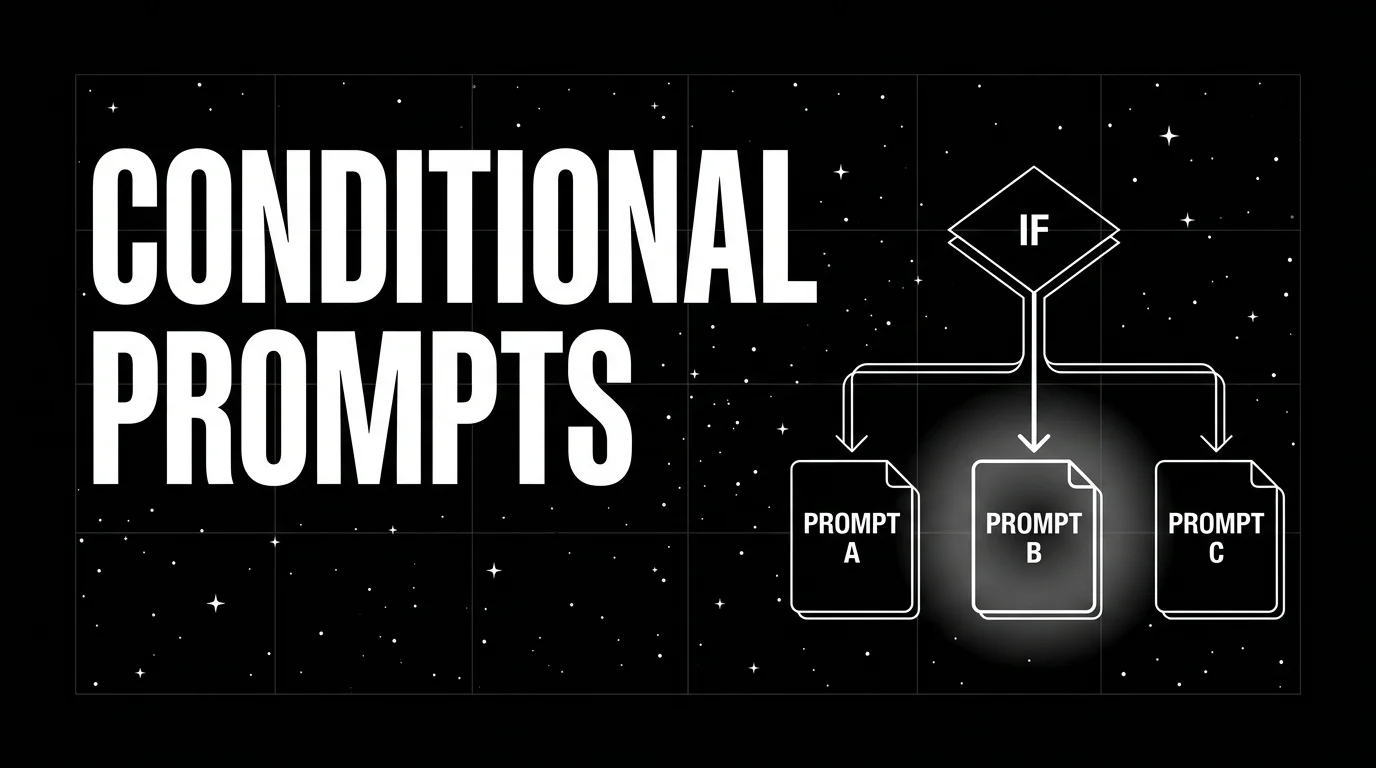
Conditional prompt selection at runtime in 2026: routing, fallbacks, embedded conditions, version pinning, eval discipline that keeps it from drifting.


Honest 2026 comparison of Langfuse alternatives: Future AGI, LangSmith, Phoenix, Braintrust, Helicone on eval depth, gateway, and the loop.