Best 5 KServe Alternatives for LLM Inference in 2026
Five KServe alternatives for LLM workloads, scored on serving throughput, K8s-native fit, gateway and observability surfaces, and migration plan.
Table of Contents
KServe was built for the classical ML era, wrapping scikit-learn or TensorFlow artifacts in a Kubernetes-native InferenceService, with Istio for traffic routing and Knative for scale-to-zero. The abstraction worked for tabular models and small CV networks. Then LLMs arrived, and the workload shape changed in ways KServe is still catching up with.
Through 2025-2026, KServe added a huggingfaceserver runtime, vLLM and TGI integrations, and OpenAI-compatible schemas. The pieces work. They’re also visibly grafted on. KServe is a competent K8s-native serving runtime that lacks the LLM-specific surfaces, gateway, observability, eval, optimizer, that production agent workloads need. The result is a “K8s-first, LLM-second” stack where ops teams ship a serving runtime and application teams bolt on the LLM layer themselves.
This guide ranks five inference-runtime alternatives, names what each fixes versus KServe, and walks through the migration most teams do: keep KServe for the K8s deployment plane, add a purpose-built LLM layer on top. Future AGI isn’t in the ranked five, it sits in a separate section because it isn’t a like-for-like KServe replacement. It’s the LLM control plane that augments whichever runtime you pick.
TL;DR: pick by exit reason
| Why you are leaving KServe (for LLM workloads) | Pick | Why |
|---|---|---|
| You want the fastest single-node LLM serving runtime | vLLM | PagedAttention plus continuous batching; the throughput leader |
| You want a Hugging Face-blessed, production-hardened LLM server | Text Generation Inference | Battle-tested at HF scale, OpenAI-compatible |
| You want unified model packaging with build-time runtime selection | BentoML | One framework that wraps vLLM, TGI, or TensorRT-LLM as a service |
| You want maximum throughput on NVIDIA GPUs and can pay the build cost | TensorRT-LLM | Kernel-fused, hardware-tuned, the throughput ceiling on H100/B200 |
| You want a hosted serverless GPU runtime with pay-per-second billing | Modal | Skip Kubernetes entirely; OpenAI-compatible endpoints on managed GPUs |
After the five, see the dedicated Future AGI section, it sits across all five picks as the LLM control plane that closes the trace -> eval -> optimize -> route loop.
Why people are leaving KServe for LLM workloads in 2026
Four exit drivers show up in Kubeflow Slack, the KServe issue tracker, KubeCon hallway tracks, and LLM-serving subreddits.
Kubernetes-native ML serving is heavy ops for LLM teams. To run an InferenceService you need a K8s cluster, Knative Serving, Istio or a Gateway API implementation, cert-manager, and the KServe operator. For a platform team already running this stack for classical ML, the marginal cost of adding an LLM is low. For an LLM team starting from scratch, the operational surface is heavy. The 2026 issue tracker has the same bug pattern repeatedly: Knative revisions stuck in Activating, CRD version skew after Istio upgrades, autoscaler decisions that ignore the LLM’s actual gpu_kv_cache_usage.
LLM features are adapted on top of a classical-ML core. The huggingfaceserver runtime wraps vLLM or TGI. The OpenAI-compatible schema is a translation layer over the existing v1/models/<name>:predict path. Continuous batching, prefix caching, and speculative decoding are properties of the underlying runtime, not first-class KServe primitives. The 2025 LLM-Inference RFC tried to add LLM-aware autoscaling and routing, but as of May 2026 only parts have shipped, the default InferenceService autoscaler still keys off RPS and concurrency rather than KV-cache or token-throughput.
No purpose-built LLM gateway, observability, optimizer, or eval. The biggest miss for LLM workloads is what KServe isn’t. It’s a serving runtime, not a control plane. Out of the box it ships no prompt registry, no per-key cost attribution, no native eval scoring, no optimizer, no guardrails, and no model routing across multiple providers. Teams add these themselves. Prometheus + Grafana for metrics, Langfuse or FAGI for traces, LiteLLM or Kong for routing. The “unified platform” promise stops being unified.
Smaller LLM-specific community. KServe’s community is healthy on the classical-ML and Kubeflow integration side. On the LLM side, the issue tracker is thinner and the response time slower than the vLLM, TGI, or BentoML repos. The contributor mix reflects the project’s origins: more Kubernetes maintainers, fewer GPU-kernel and tokenizer specialists.
What to look for in a KServe replacement for LLM workloads
| Axis | What it measures |
|---|---|
| LLM serving throughput | Tokens/sec/GPU under continuous batching with realistic prompt mixes |
| Kubernetes-native fit | Does it integrate with K8s without forcing the whole KServe stack? |
| Model and quantization breadth | FP8, INT4, AWQ, GPTQ; new architecture support |
| Operational complexity | How many controllers, CRDs, and policy layers before serving traffic? |
| Hardware coverage | NVIDIA, AMD, Intel, Trainium, Inferentia |
| Community velocity | New-model support latency from upstream release |
| Migration tooling | Are there published manifests or importers for KServe specifically? |
1. vLLM: Best for raw LLM serving throughput
Verdict: vLLM is the pick when the requirement is “this single GPU has to serve more tokens per second” and you can handle the surrounding infrastructure yourself. PagedAttention, continuous batching, and speculative decoding make it the throughput leader for most open-weight models on most GPUs.
What it fixes: Across Llama 3.1, Mistral, Mixtral, Qwen 2.5, and the DeepSeek family, vLLM is the reproducible throughput leader on H100s and B200s. KServe’s huggingfaceserver wraps vLLM, so in principle the numbers match; in practice the wrapping adds latency and YAML between you and the tuning knobs (max_num_batched_tokens, gpu_memory_utilization, enable_prefix_caching). OpenAI-compatible API by default; structured output, tool calling, and prefix caching are first-class. Community velocity: new model architectures land in days, not quarters.
Migration: Most teams already have vLLM under the hood via huggingfaceserver. The exit removes the wrapping: deploy vLLM as a plain Deployment + Service + HPA. Three to five engineering days per model.
Where it falls short: A serving runtime, not a control plane, no gateway, no eval, no optimizer, no prompt registry. K8s-native niceties (CRD versioning, traffic splitting, scale-to-zero) aren’t provided; you build them or live without them. The K8s-fit story is improving (vllm-project/production-stack, Helm charts) but less polished than KServe’s operator surface.
Pricing: Open source under Apache 2.0. Cost is engineering time and GPUs.
2. Text Generation Inference: Best for HF-blessed production hardening
Verdict: TGI is the pick when the requirement is “battle-tested at HF scale, with HF’s tokenizer and model handling baked in,” for mainstream open-weight models. Performance is competitive with vLLM on most workloads; production hardening is the reason HF themselves use it for Inference Endpoints.
What it fixes: Uses the tokenizers library natively, handles HF model repos transparently, respects HF chat templates. Streaming, request cancellation, graceful pod termination, and OpenAI-compatible schemas are first-class. Has been in front of Inference Endpoints traffic for years; edge cases are known. /v1/chat/completions and /v1/completions behave correctly enough that most OpenAI client libraries work out of the box.
Migration: KServe’s huggingfaceserver can already run TGI under the hood. Exit by removing the wrapping and running TGI as plain Kubernetes manifests with your preferred ingress and autoscaler. Three to five engineering days per model.
Where it falls short: TGI’s throughput trails vLLM on long-context and high-concurrency mixes. Same control-plane gap as vLLM: no gateway, no eval, no optimizer, no prompt registry. New-model support has been competitive but slightly behind vLLM, especially for less mainstream architectures.
Pricing: Open source under Apache 2.0 (post-1.0 license clarified to permit commercial inference). Cost is engineering time and GPUs.
3. BentoML: Best for unified model packaging across runtimes
Verdict: BentoML is the pick when the requirement is “we serve LLMs and non-LLM models from the same platform with one packaging story across vLLM, TGI, or TensorRT-LLM.” Bento’s Service abstraction is runtime-agnostic; you choose the backend at build time.
What it fixes: One bentofile.yaml builds the same service against vLLM, TGI, or TensorRT-LLM. Swapping runtimes is a build flag, not a rewrite. Classical ML, custom Python pipelines, and LLMs share one framework. OpenLLM ships a curated set of LLMs with one-command deployment. BentoCloud autoscales on GPU and request concurrency with an ML-shaped control plane.
Migration: Repackage each model as a Bento, then deploy to BentoCloud or your existing K8s cluster via Yatai. KServe can keep running for non-LLM models during the transition. Five to ten engineering days for the first few LLM workloads, then mostly mechanical.
Where it falls short: A packaging and serving framework, not a control plane. K8s-native deployment is via Yatai, which is less polished than KServe’s operator. Throughput is whatever the underlying runtime delivers; BentoML’s orchestration layer costs a small amount of latency.
Pricing: BentoML framework is open source under Apache 2.0. BentoCloud is usage-based; enterprise plans are custom.
4. TensorRT-LLM: Best for the throughput ceiling on NVIDIA hardware
Verdict: TensorRT-LLM is the pick when the requirement is “we have committed to NVIDIA H100 or B200 capacity for years and need every last token per second this hardware can deliver.” Kernel-fused, hardware-tuned, with FP8 and INT4 quantization paths that vLLM and TGI are still catching up on for some models.
What it fixes: For models with stable architecture and high traffic, TensorRT-LLM with FP8 frequently delivers 1.3-1.8x the tokens/sec of unquantized vLLM on the same H100, with the gap widening on B200. Triton Inference Server is the canonical deployment vehicle; Nsight and NVIDIA Compute profilers plug in directly. FP8, INT4, weight-only INT8, and SmoothQuant are first-class.
Migration: Heaviest in the list because it adds a build step. Build TensorRT-LLM engines for each model on the target GPU SKU, deploy Triton as the serving runtime, and either swap KServe’s huggingfaceserver for a triton runtime or run Triton directly. Ten to fifteen engineering days per model on first build, then mostly automated through CI.
Where it falls short: Build complexity is real, every model and every GPU SKU needs its own engine. Locked to NVIDIA hardware. Same control-plane gap as the other runtimes. New model architectures land later in TensorRT-LLM than in vLLM.
Pricing: TensorRT-LLM is Apache 2.0; Triton is BSD 3-Clause. Cost is the NVIDIA hardware and the engineering time to maintain the build pipeline.
5. Modal: Best for hosted serverless GPU inference
Verdict: Modal is the pick when the requirement is “skip Kubernetes entirely”, hosted serverless GPUs with pay-per-second billing, function-as-a-service ergonomics, and OpenAI-compatible endpoints. The fastest path from “I want this open-weight model running” to “here is the endpoint” for teams that don’t want to operate a cluster.
What it fixes: No cluster, no Helm, no CRDs. A Python decorator declares the GPU shape, and Modal handles cold-start, autoscaling, and image build. OpenAI-compatible endpoints fronted by managed TLS. Pay-per-second GPU billing means the cost story for spiky workloads is dramatically better than reserved K8s capacity. vLLM, TGI, and SGLang all run on Modal as image variants.
Migration: Repackage the KServe model artifact as a Modal App, declare GPU resources in code, deploy. Five to seven engineering days for the first model. Existing KServe traffic-splitting is replaced by Modal’s revision management.
Where it falls short: Hosted-only, no self-host story. Vendor lock-in to Modal’s runtime. GPU pricing at sustained high utilization can exceed reserved K8s capacity. Same control-plane gap: no gateway, no eval, no optimizer, no prompt registry. Modal is the GPU runtime, not the LLM platform.
Pricing: Pay-per-second GPU usage. Free tier with $30/month of compute. Custom enterprise above that.
Capability matrix
| Axis | vLLM | TGI | BentoML | TensorRT-LLM | Modal |
|---|---|---|---|---|---|
| LLM serving throughput | Throughput leader | Competitive | Inherits runtime | Ceiling on NVIDIA | Inherits runtime |
| K8s-native fit | Plain Deployments | Plain Deployments | Yatai or BentoCloud | Triton on K8s | Skip K8s entirely |
| Quantization breadth | FP8, INT4, AWQ, GPTQ | FP8, GPTQ, AWQ | Via runtime | FP8, INT4, SmoothQuant | Via runtime |
| Operational complexity | Low | Low | Medium | High (build step) | Lowest (hosted) |
| Hardware coverage | NVIDIA, AMD, TPU, Intel | NVIDIA, Trainium | Via runtime | NVIDIA only | NVIDIA (managed) |
| Community velocity | Highest | Strong | Medium | NVIDIA cadence | N/A (hosted) |
| KServe migration | Replace InferenceService | Replace InferenceService | Repackage as Bento | Replace with Triton | Leave K8s |
Future AGI: the self-improving platform layer that augments whichever you pick
Future AGI doesn’t belong on the ranked list above because it isn’t a one-for-one KServe replacement. The five products above are where you go when you want a different inference runtime. Future AGI is the LLM control plane you bolt on top of any of them, including KServe itself, if you aren’t ready to swap, so that traces feed evals, evals feed an optimizer, the optimizer rewrites prompts, and the gateway serves the new version on the next request.
The loop: trace -> eval -> cluster -> optimize -> route -> re-deploy.
OSS components, Apache 2.0:
traceAI. OpenInference-compatible auto-instrumentation with 35+ framework integrations (OpenAI, Anthropic, LangChain, LlamaIndex, CrewAI, AutoGen, Haystack, DSPy, and more). One-line auto-instrument; spans emit through OTel into Phoenix, Langfuse, the FAGI Command Center, or your own ClickHouse.ai-evaluation. Rubric library covering faithfulness, answer-correctness, context-precision, tool-use correctness, and task-completion. Scores production traces against rubrics by default.
agent-opt. Prompt optimizer with six optimizers — ProTeGi, GEPA, Bayesian, MetaPrompt, RandomSearch, PromptWizard algorithms. Takes captured traces plus eval scores and produces optimized prompts, which the registry serves to the gateway on the next request.
Hosted: Agent Command Center. Adds an OpenAI-compatible multi-provider gateway (routes across OpenAI, Anthropic, Google, Bedrock, and your self-hosted vLLM/TGI/TensorRT/Modal endpoints), RBAC, audit log, SOC 2 Type II, AWS Marketplace procurement, and hosted Protect guardrails, inline jailbreak detection, PII redaction, and content filtering with median ~67 ms text-mode latency and ~109 ms image-mode latency reported in arXiv 2510.13351.
How it pairs with the five above:
- With vLLM. vLLM serves the model; FAGI is the gateway in front with cost-aware routing, per-tenant rate limits, traces, evals, and the optimizer. Drop-in via vLLM’s OpenAI-compatible endpoint.
- With TGI. Same pattern. TGI is the upstream, FAGI is the control plane.
- With BentoML. Bentos serve on K8s or BentoCloud; FAGI sits in front. BentoML’s own metrics keep working; FAGI adds request-shaped telemetry.
- With TensorRT-LLM. Triton serves the engines; FAGI routes traffic to Triton’s OpenAI-compatible endpoint alongside other providers.
- With Modal. Modal hosts the GPU runtime; FAGI is the control plane. Useful for spiky workloads where Modal’s pay-per-second economics matter and FAGI provides the platform layer Modal doesn’t ship.
Why this is the augment, not the alternative: the five products above each cover one piece of the LLM stack, the GPU runtime. None of them ship a gateway, eval suite, prompt registry, or optimizer. FAGI exists to be those layers. Whichever runtime you pick, the loop runs the same way.
Pricing: OSS components (Apache 2.0) are free. Hosted Agent Command Center: free tier with 100K traces/month, scale from $99/month with linear per-trace scaling above 5M, enterprise with SOC 2 Type II and AWS Marketplace.
Migration notes: what breaks when leaving KServe for LLM workloads
Keep KServe for K8s deploy, add a purpose-built LLM layer. The most common 2026 migration isn’t “rip KServe out” but “keep it on the Kubernetes side and add an LLM-aware layer on top.” KServe (or plain vLLM/TGI Deployments) handles model serving on K8s. GPU scheduling, autoscaling, traffic splitting at the pod level. FAGI Agent Command Center sits in front as the OpenAI-compatible gateway with multi-provider routing, prompt registry, eval scoring, and the optimizer. The cleanest version keeps KServe’s InferenceService manifests untouched. Five to seven engineering days for a team new to gateways, three to five for a team replacing LiteLLM or Helicone.
Replacing the serving runtime entirely. Teams whose LLM workloads outgrew KServe’s abstraction usually swap the runtime: pick vLLM, TGI, BentoML, or TensorRT-LLM on the throughput/quantization tradeoff; deploy as plain Deployments + Services + HPA. The biggest pothole is autoscaling: KServe + Knative scales on RPS and concurrency, which is the wrong signal for LLMs (KV-cache and decode-throughput are right). Most teams replace the autoscaler with a custom one keyed off the runtime’s own Prometheus metrics.
Re-routing client base URLs. KServe’s OpenAI-compatible path is typically http://<inference-service>.namespace.svc/v1/chat/completions. On migration, this becomes either the new runtime’s endpoint (direct swap) or the FAGI gateway URL (control-plane addition). In principle a one-line change; in practice, services hard-code the URL in three places: SDK initialization, runtime config, and the deployment manifest.
Decision framework: Choose X if
Choose vLLM if your reason for leaving is throughput and you can run plain Kubernetes Deployments with your own autoscaler and ingress. Pick this when per-token cost is the dominant line item.
Choose TGI if your reason for leaving is HF’s production hardening directly, without the KServe wrapping. Pick this for mainstream open-weight models where HF Hub is the source of truth.
Choose BentoML if your reason for leaving is one packaging story across LLM and non-LLM models. Pick this when the product is a mix of classical ML and LLMs.
Choose TensorRT-LLM if your reason for leaving is the throughput ceiling on committed NVIDIA hardware. Pick this with years of H100 or B200 capacity locked in.
Choose Modal if your reason for leaving is “we don’t want to operate Kubernetes.” Pick this for spiky workloads where pay-per-second beats reserved capacity.
Add Future AGI on top of whichever runtime you pick, pair traceAI with your inference traffic, ai-evaluation with your rubrics, and agent-opt against the registry to get the trace -> eval -> optimize -> route loop the runtimes don’t ship.
What we did not include
Three products show up in other 2026 KServe alternatives listicles that we left out: Seldon Core (Kubernetes-native serving that overlaps heavily with KServe; the LLM gap is the same); Ray Serve (strong for distributed inference and custom routing, but the LLM-specific abstractions are thinner than vLLM or TGI as of May 2026); Anyscale Endpoints (hosted Ray Serve for LLMs, capable but operating-model overlap with Modal and pricing posture aimed at heavier workloads).
Related reading
- Best LLM Gateways in 2026
- Best AI Gateways for Agentic AI in 2026
- What Is an AI Gateway? The 2026 Definition
- Best 5 Portkey Alternatives in 2026
Sources
- KServe documentation, kserve.github.io/website
- KServe LLM-Inference RFC (2025), github.com/kserve/kserve
- KServe
huggingfaceserverruntime, kserve.github.io/website/master/modelserving/v1beta1/llm - vLLM project, github.com/vllm-project/vllm (Apache 2.0)
- vLLM production stack, github.com/vllm-project/production-stack
- Text Generation Inference, github.com/huggingface/text-generation-inference
- BentoML and OpenLLM, github.com/bentoml/BentoML, github.com/bentoml/OpenLLM
- TensorRT-LLM, github.com/NVIDIA/TensorRT-LLM
- Triton Inference Server, github.com/triton-inference-server/server
- Modal product pages, modal.com
- Future AGI Agent Command Center, futureagi.com/platform/monitor/command-center
- Future AGI traceAI, github.com/future-agi/traceAI (Apache 2.0)
- Future AGI ai-evaluation, github.com/future-agi/ai-evaluation (Apache 2.0)
- Future AGI agent-opt, github.com/future-agi/agent-opt (Apache 2.0)
- Future AGI Protect latency benchmark, arxiv.org/abs/2510.13351 (67 ms text, 109 ms image)
Frequently Asked Questions
Why are teams leaving KServe for LLM workloads in 2026?
Does this mean KServe is dead?
Can I keep KServe and add an LLM control plane on top?
What is the closest like-for-like alternative to KServe for LLM workloads?
Which is fastest at LLM inference: KServe, vLLM, TGI, or TensorRT-LLM?
Is there an open-source KServe alternative?
Where does Future AGI fit if it is not on the ranked list?
FutureAGI ACC, Helicone, OpenRouter, Portkey, LiteLLM, Cloudflare AI Gateway, Vercel AI Gateway as 2026 LLM gateways. Routing, caching, guardrails.


vLLM is the open-source LLM serving engine that pioneered PagedAttention and continuous batching. How it serves, how teams use it in production 2026.

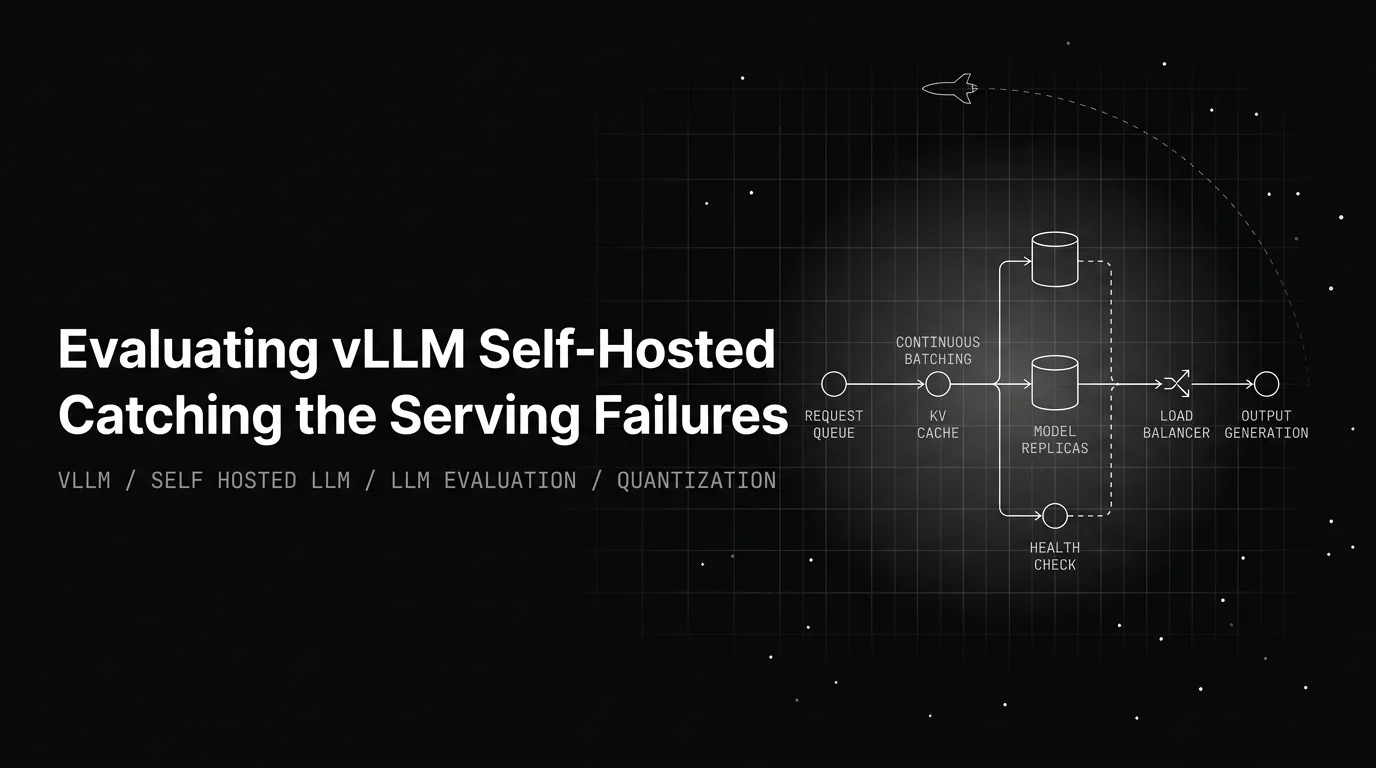
How to evaluate a vLLM self-hosted LLM in 2026: catch continuous-batching jitter, KV-cache eviction, and AWQ/GPTQ/FP8 drift before prod.