Best 5 Jaxon AI Alternatives in 2026
Five Jaxon AI alternatives on synthetic-data depth, gateway, observability, optimizer, languages. What each actually fixes beyond synth-data-only tooling.
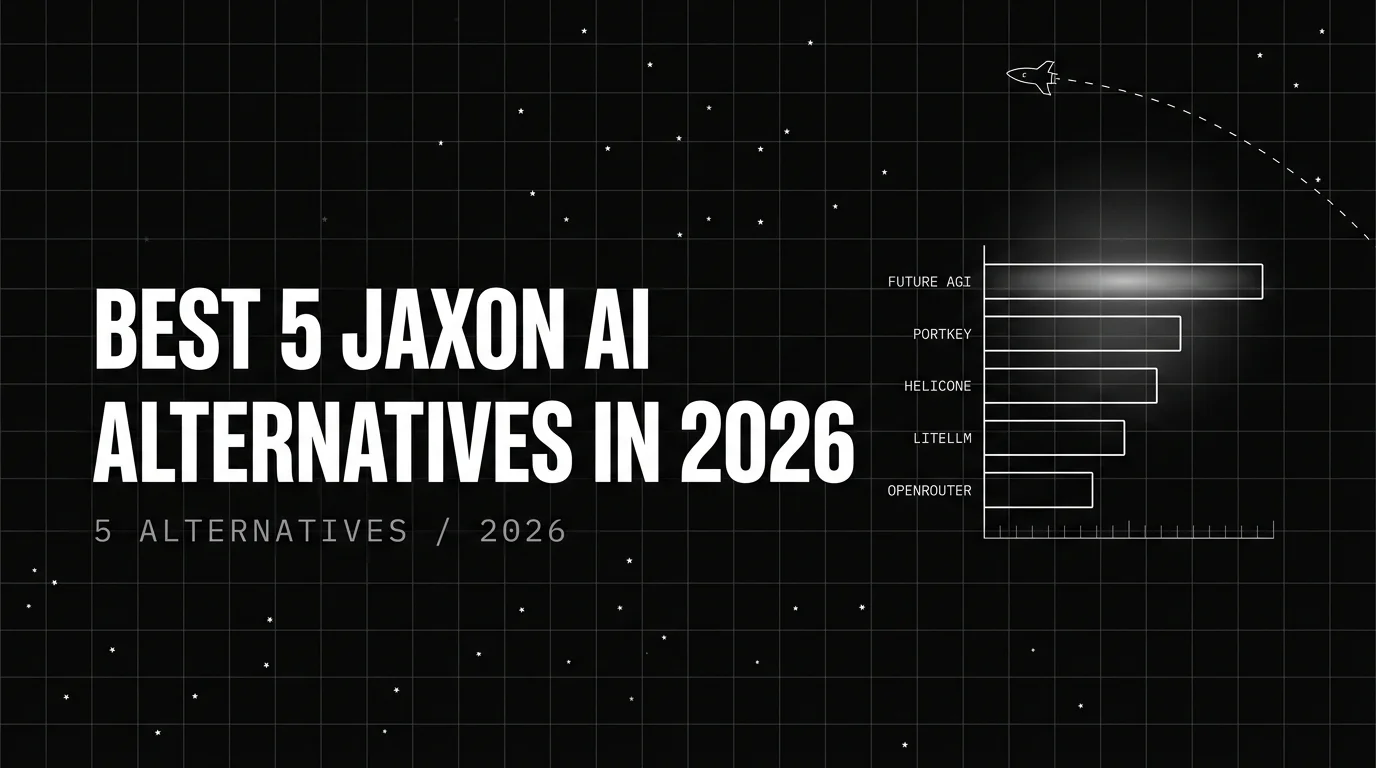
Table of Contents
Jaxon AI built a sharp wedge for enterprise NLP teams in the pre-LLM era: domain-specific synthetic data with controlled labeling, knowledge-graph grounded generation, and an enterprise contract surface. For supervised fine-tunes on a single language and task, that wedge still cuts. The trouble is the shape of the work has shifted. In 2026 training data is one of six surfaces a production AI team touches every week, the others are runtime tracing, an LLM gateway, evals, runtime guardrails, prompt optimization, and a stakeholder-facing dashboard. Jaxon ships one of those six. Teams who picked it for synth-data end up paying separately for the other five, then notice the data and the production loop never close.
This guide ranks five alternatives, names what each fixes, and walks through the migration that always bites: re-pointing synth-data generation calls from Jaxon’s Python SDK to a runtime-aware platform that uses the same data for fine-tunes and for live eval scoring.
TL;DR: pick by exit reason
| Why you are leaving Jaxon AI | Pick | Why |
|---|---|---|
| You want synthetic data, gateway, eval, and an optimizer in one loop | Future AGI Agent Command Center | ai-evaluation synth API plus gateway plus optimizer in one product |
| You want a labeling-and-NLP-data platform with deep annotation tooling | Datasaur | Document AI + LLM labeling, larger annotator workforce, polyglot |
| You want enterprise data labeling with strong model-assisted annotation | Labelbox | Foundry + model-assisted labeling at enterprise scale |
| You want OSS observability with strong synth-data adjacencies | Arize Phoenix | OTel-native, OSS, with dataset and eval primitives that compose with synth tools |
| You want hosted observability plus prompt management for the post-data loop | Langfuse | MIT-core observability with dataset versioning and eval hooks |
Why people are leaving Jaxon AI in 2026
Five exit drivers show up repeatedly in /r/MachineLearning fine-tuning threads, Hacker News discussions on synth-data tooling, the Jaxon community Slack, and G2 reviews from the last two quarters.
1. Synthetic-data focused: narrow surface for the 2026 stack
Jaxon’s gravity is synthetic data: schema-driven generation, knowledge-graph grounding, label propagation. That was a fit when “fine-tune a BERT-class model on five thousand domain examples” was the dominant workflow. In 2026 the dominant workflow is “instrument a multi-agent system, score every call, route around regressions, ship a prompt rewrite by Friday.” Synthetic data is a step inside that loop, not the loop itself. Teams pay separately for tracing (Phoenix, Langfuse), gateway (Portkey, LiteLLM), evals (DeepEval, Galileo), guardrails (Lakera, FAGI Protect), and the optimizer (DSPy, ProTeGi, GEPA). The data and the runtime never share a schema.
2. No gateway, no observability, no optimizer
Jaxon ships synth data. It doesn’t ship a gateway with virtual keys, a trace store, a prompt registry with version history, or an optimizer. Teams arriving at “we need to operate this in production” discover the contract is “Jaxon generated your training set, the rest is your problem.” The pattern is a bolt-on stack three to five vendors deep, each billing separately, each holding a slice of the same workflow data.
3. Hosted enterprise tier: pricing opacity
Jaxon’s go-to-market is enterprise-sales-led. The Developer tier is generous on paper but quota-gated; Team and Enterprise are “talk to sales.” A /r/MachineLearning spreadsheet from February 2026 described a mid-market bill landing at $4.5K–$6K/month once SSO, audit logs, and synth-data volume above the Developer quota came in. Future AGI’s Scale tier from $99/month covers traces and includes synth-data primitives via the ai-evaluation Apache 2.0 library, with linear scaling above 5M (no add-on multipliers).
4. Smaller community than Phoenix or Langfuse
Jaxon’s user community is real but quiet. The Phoenix Slack has multiple thousand active members; Langfuse’s GitHub has 6K+ stars. Jaxon’s public surface is curated and small, friction for teams whose default debugging move is “search the OSS issue tracker.”
5. Python-only SDK
Jaxon’s first-class SDK is Python. TypeScript and Node teams, the dominant stack for new production agents in 2026, either run a Python sidecar or call the REST API and write their own client. The framework affordances (decorators, schema classes, label-propagation helpers) are Python-only.
What to look for in a Jaxon AI replacement
The default “best synthetic data tool” axes are necessary but not sufficient for a Jaxon exit. Score replacements on the seven that map to the surfaces you’re actually migrating off:
| Axis | What it measures |
|---|---|
| 1. Synthetic-data depth | Schema-driven generation, label propagation, KG grounding, domain controls |
| 2. Runtime trace capture | Does the platform capture production traces, not just offline data? |
| 3. Gateway and routing | Does the platform issue virtual keys and route requests, or expect a separate gateway? |
| 4. Optimizer loop | Does the platform use trace and eval data to rewrite prompts and update routes? |
| 5. OSS posture | Apache 2.0 or MIT instrumentation, self-host option, OTel-native traces |
| 6. Language coverage | First-class TypeScript and Python, or Python-only? |
| 7. Migration tooling from Jaxon | Are there published mappers for Jaxon’s SDK and dataset schemas? |
1. Future AGI Agent Command Center: Best for closing the loop
Verdict: Future AGI is the only platform here that ships synth-data generation, runtime tracing, an LLM gateway, evals, guardrails, and an optimizer as one product with one data model. FAGI generates the synth dataset with ai-evaluation, scores production traces against it, runs the optimizer when scores drift, and pushes the rewritten prompt back into the gateway on the next request. Jaxon stops after the dataset lands in your S3 bucket; FAGI starts there and runs the loop.
What it fixes versus Jaxon:
- Synthetic data inside the production loop, not adjacent to it.
ai-evaluation(Apache 2.0) ships a synth-data API that generates rubric-aligned examples, task-completion, faithfulness, groundedness, tool-use, custom rubrics, using your choice of judge model (closed, OSS, BYO). The same library scores production traces against the same rubrics. The synth dataset and the eval rubric share a schema, so a fine-tune example is also a regression case in the live eval feed. Jaxon’s dataset and your eval suite live in different schemas and require a manual reconciliation pass on every model swap.
- The full stack as one product.
traceAI(Apache 2.0) captures OTel-native production traces. The Agent Command Center issues virtual keys, runs fallback and cost-aware routing, hosts a versioned prompt registry, slices cost by session/user/repo/route, and bundles Protect (median 67 ms text-mode latency per arXiv 2510.13351, 109 ms image-mode) for inline guardrails.agent-opt(Apache 2.0) runs six optimizers — ProTeGi, GEPA, Bayesian, MetaPrompt, RandomSearch, PromptWizard optimization againstai-evaluationscores and writes the rewrite back to the prompt registry automatically.
- TypeScript first-class. Feature parity with Python across
traceAI,ai-evaluation, andagent-opt. Mixed-stack teams drop the Python sidecar. - OSS instrumentation, transparent pricing.
traceAI,ai-evaluation, andagent-optare Apache 2.0 and run anywhere. The hosted Command Center adds RBAC, failure-cluster views, AWS Marketplace procurement, and SOC 2 Type II at a Scale tier from $99/month. Jaxon’s contract surface is enterprise-sales-first; FAGI’s is published.
Migration from Jaxon: Jaxon generates synthetic data via a Python SDK (jaxon package, schema classes, label-propagation helpers) emitting JSONL in cloud storage. The migration re-writes the data-generation calls into ai-evaluation’s synth API, same schema-driven flow and label-propagation surface, but examples align to FAGI eval rubrics so the dataset doubles as a regression suite. Existing JSONL exports import directly into ai-evaluation datasets; Jaxon schema classes map to FAGI dataset definitions with a thin shim. Knowledge-graph grounding configs need rewriting (Jaxon’s KG bindings are SDK-internal; FAGI exposes a typed grounding interface). Timeline: seven to ten engineering days for a footprint under 200 generators and 50 services, including a shadow-generation period.
Where it falls short:
-
The optimization layer carries a learning curve; a pure swap won’t use it in week one.
-
Jaxon’s knowledge-graph grounding has more polish in the narrow enterprise-NLP corner it built; FAGI’s grounding interface is typed and powerful but the off-the-shelf KG library is leaner. Teams with deep KG-rooted workflows port the graph manually.
Pricing: Free tier with 100K traces and 10K eval runs per month. Scale tier from $99/month with linear per-trace and per-eval scaling (no add-on multipliers). Enterprise with SOC 2 Type II and AWS Marketplace.
Score: 7 of 7 axes.
2. Datasaur: Best for labeling-and-NLP-data depth
Verdict: Datasaur is the pick when the reason you bought Jaxon was the data-quality piece, labeling, annotation, document AI, rather than the production loop. Datasaur ships a full labeling platform with LLM-labeling adjacencies, polyglot annotator support, and a workforce marketplace. Teams whose synth-data pipeline runs upstream of a labeling pipeline consolidate both surfaces here.
What it fixes versus Jaxon:
- Annotation depth. Span labeling, document AI, audio, image, and LLM-output rating, covers the upstream pipeline Jaxon doesn’t. Teams running Jaxon plus Label Studio plus a separate workforce vendor consolidate the labeling stack here.
- Polyglot annotator workforce. Datasaur ships a managed annotator marketplace covering thirty-plus languages with native speakers. Jaxon’s domain controls are sharp but the human-in-the-loop surface is bring-your-own.
- Document AI and PDF surfaces. For pipelines that start with unstructured PDFs (contracts, claims, medical records), Datasaur’s document AI ingest is materially better than Jaxon’s. Cleaner source extraction, cleaner fine-tune corpus.
Migration from Jaxon: Datasaur’s API accepts Jaxon’s JSONL exports directly for the labeling step; schema mapping is mechanical. Synth-data generation doesn’t move. Datasaur isn’t a generator, so pair it with FAGI’s ai-evaluation synth API, an in-house harness, or keep a thin Jaxon footprint for the generation step only. Timeline: five to eight engineering days for the labeling cutover.
Where it falls short:
- Not a synthetic-data generator. Teams who picked Jaxon for generation still need a generator.
- No production-loop primitives, no gateway, no trace store, no optimizer, no runtime guardrails.
- Enterprise pricing is sales-led, similar shape to Jaxon’s; the procurement timeline doesn’t shrink.
Pricing: Free tier with limited project volume. Pro and Enterprise custom, typically anchored to annotator-seat count and project volume.
Score: 4 of 7 axes (missing: synth-data generation, runtime trace, gateway, optimizer).
3. Labelbox: Best for enterprise data labeling at scale
Verdict: Labelbox is the pick when the reason for leaving Jaxon is enterprise procurement and you need a labeling platform with model-assisted annotation, Foundry-grade workforce, and a vendor large enough to clear Fortune-500 vendor review.
What it fixes versus Jaxon:
- Foundry and model-assisted labeling. Labelbox Foundry runs frontier-model labelers (GPT-4 class) against unlabeled corpora as a first pass, then routes ambiguous cases to humans. For “generate plus human-verify” pipelines, Foundry compresses the verification step substantially.
- Enterprise procurement posture. SOC 2 Type II, ISO 27001, HIPAA-eligible, on-prem and VPC deployments. Procurement teams uneasy about Jaxon’s startup contract find Labelbox an easier yes.
- Mature labeling workforce. Large, vetted labeler network with domain specialists (medical, legal, financial). Quality programs (golden sets, multi-annotator agreement) are first-class.
Migration from Jaxon: Labelbox accepts Jaxon’s JSONL via its data-row import API. Jaxon’s domain-specific label types translate to Labelbox ontologies but the structure differs, so the schema mapping is a one-time pass. As with Datasaur, Labelbox isn’t a synth-data generator. Timeline: ten to fifteen engineering days for the labeling cutover.
Where it falls short:
- Not a synthetic-data generator.
- No production-loop primitives, no gateway, no trace store, no optimizer, no runtime guardrails.
- Pricing is enterprise-sales-led and typically $30K+ ARR. Contract surface is heavier than the lighter cohort here.
- Foundry’s frontier-model-labeling costs add up above a few hundred thousand labels per month.
Pricing: Free tier with limited data-row volume. Enterprise custom, typically $30K+ ARR with seat-based and label-volume components.
Score: 4 of 7 axes (missing: synth-data generation, runtime trace, gateway, optimizer).
4. Arize Phoenix: Best for OSS observability with synth-data adjacencies
Verdict: Arize Phoenix is the pick when you want OSS, OpenTelemetry-native primitives to compose with existing synth-data tooling. Phoenix is observability and eval; it isn’t a generator. Pair Phoenix’s OSS evaluators with a generator (FAGI’s ai-evaluation, a transitional Jaxon footprint, or self-built) and ship the post-data loop on Phoenix. For teams whose biggest Jaxon frustration is “no production observability,” Phoenix is the cheapest path.
What it fixes versus Jaxon:
- OSS, OpenTelemetry-native observability. Phoenix’s
openinferenceinstrumentation is the OTel reference for LLMs and agents in 2026, covers OpenAI, Anthropic, LangChain, LlamaIndex, Bedrock, Vertex. Jaxon ships no production tracing. - First-class evaluator library. Phoenix’s evaluators (hallucination, relevance, toxicity, custom rubrics) run on production traces and offline datasets alike. Datasets in Phoenix import the JSONL Jaxon exports without rewriting.
- Self-host with one fewer moving part. Phoenix’s OSS build runs on Postgres + S3 only, no ClickHouse, no Redis. For teams who left Jaxon because the procurement surface was heavy, Phoenix is “docker compose up.”
- Embedding-space and clustering surfaces. Phoenix’s ML-ops heritage shows in embedding-drift views and per-cohort cluster analysis, the right home for “did the fine-tune actually move the needle?”
Migration from Jaxon: Phoenix is a destination for traces and a host for evaluators; the synth-data generation step doesn’t move here. The pattern: keep Jaxon’s generator running, pipe output JSONL into a Phoenix Dataset, instrument production with openinference, run Phoenix evaluators against both. Timeline: three to five engineering days for Phoenix; another week to wire datasets and evaluator pipelines.
Where it falls short:
- Not a synth-data generator.
- No gateway, no virtual keys, no routing, observability and eval only.
- No optimizer, eval scores inform humans, not the system.
- Path to enterprise runs through Arize AX, priced for ML-ops budgets ($50K+ ARR).
Pricing: OSS under Elastic License 2.0 (functionally permissive for most use cases). Arize AX (enterprise) typically in the $50K+ ARR range.
Score: 4 of 7 axes (missing: synth-data generation, gateway, optimizer).
5. Langfuse: Best for hosted observability and prompt management
Verdict: Langfuse is the pick when you picked Jaxon for the dataset surface and want a hosted dashboard with mature prompt versioning to extend that into production. Langfuse is observability plus dataset versioning plus a prompt registry, the post-data half of the loop, with a free tier that covers most prototypes. Not a generator; pair it with FAGI’s ai-evaluation synth API or a thin Jaxon footprint.
What it fixes versus Jaxon:
- Versioned datasets and prompt registry. Langfuse Datasets are versioned, with items linked to traces and eval runs. Prompt Studio ships server-side rendering, A/B tests on prompt versions, and per-version analytics. For teams who used Jaxon’s generation step and want a clean home for the resulting data in production, Langfuse is a natural fit.
- Hosted by default, OSS core. MIT core means self-host is real; Langfuse Cloud means most teams skip the operational tax. Contract surface is lighter than Jaxon’s enterprise-sales-led one.
- OpenTelemetry plus a polished UI. Langfuse accepts OTel directly and ships a dashboard mid-market teams actually share with stakeholders, a piece Jaxon doesn’t have.
Migration from Jaxon: Jaxon’s JSONL exports import into Langfuse Datasets via POST /api/public/datasets. The synth-data generation step doesn’t move. Instrument production via Langfuse’s SDK or raw OTel; eval definitions need writing in Langfuse’s evaluator DSL. Timeline: five to seven engineering days.
Where it falls short:
- Not a synth-data generator.
- No gateway primitives, observability plus dataset surface only.
- No optimizer.
- ClickHouse-DBA tax shows up above 5 to 10M traces per month on self-host.
Pricing: Free Hobby tier (50K observations/month). Core $59/month. Pro $199/month. Enterprise typically $1.5K–$3K/month for mid-market.
Score: 4 of 7 axes (missing: synth-data generation, gateway, optimizer).
Capability matrix
| Axis | Future AGI | Datasaur | Labelbox | Arize Phoenix | Langfuse |
|---|---|---|---|---|---|
| Synth-data depth | ai-evaluation synth API, rubric-aligned, BYO judge | Labeling + LLM-rating, not generative | Foundry model-assisted labeling, not generative | None native | None native |
| Runtime trace capture | traceAI Apache 2.0, OTel-native | None | None | openinference, OTel-native | OTel + SDK |
| Gateway and routing | Native (virtual keys, fallback, cost-aware) | None | None | None | None |
| Optimizer loop | Yes (agent-opt) | No | No | No | No |
| OSS posture | Apache 2.0 instrumentation, BYOC | Proprietary | Proprietary | Elastic License 2.0 | MIT core |
| Language coverage | Python + TypeScript first-class | Python + REST | Python + REST | Python first-class | Python + TS SDK |
| Jaxon migration tooling | JSONL importer + SDK shim + synth-api re-write recipe | JSONL import for labeling step | JSONL import via data-row API | JSONL import to Phoenix Datasets | JSONL import to Langfuse Datasets |
Migration notes: what breaks when leaving Jaxon
Three surfaces always need attention.
Re-writing data generation in the destination’s synth API
Jaxon’s Python SDK generates synthetic data via schema classes, label-propagation decorators, and knowledge-graph bindings. Moving generation to FAGI’s ai-evaluation synth API is mechanical for the common cases: schema classes map onto FAGI dataset definitions, label propagation maps onto the rubric-aligned generator’s metadata fields, and the generator emits JSONL in the same shape. The non-mechanical part is the KG grounding step: Jaxon’s KG bindings are SDK-internal; FAGI exposes a typed grounding interface but the off-the-shelf KG library is leaner. Teams with deep KG-rooted workflows port the graph manually, typically a one-sprint task. Run both generators in parallel for one to two weeks, validate distributions, then cut Jaxon off.
Re-pointing dataset consumers
Jaxon’s output is JSONL files in cloud storage. Downstream consumers, fine-tune jobs (Hugging Face, OpenAI fine-tune API, Mosaic), eval harnesses, validation notebooks, read those files by path. The cutover is straightforward: change the dataset path. The subtle gotcha is versioning. Jaxon’s version IDs don’t translate; teams who care about reproducibility (regulated workloads, audit trails) keep Jaxon read-only for 90 days after the cutover so an older fine-tune can be re-derived if needed.
Reconciling the surrounding stack
The hardest part of leaving Jaxon is usually not Jaxon, it’s the surrounding stack. Teams arrive at the cutover running Jaxon plus a separate labeling tool plus a separate trace store plus a separate gateway plus a separate optimizer. The migration is the natural moment to consolidate. Pragmatic order: pick the destination (FAGI for the full loop, Phoenix or Langfuse for the post-data half, Datasaur or Labelbox for labeling depth), import the JSONL, instrument production with the destination’s OTel tracer, and only then start retiring the satellites. Swapping five tools simultaneously is the path to a stalled migration.
Decision framework: Choose X if
Choose Future AGI if your reason for leaving is more than the dataset surface, you also want runtime tracing, an LLM gateway, evals, runtime guardrails, and an optimizer in one platform. The synth dataset and the live regression suite share a schema, so the post-fine-tune drift surface stops being a manual reconciliation pass.
Choose Datasaur if your reason for leaving is labeling depth and document-AI surfaces. Pick this when the pipeline is “generate, then human-verify on PDFs, then ship.” Plan to keep a separate generator.
Choose Labelbox if your reason for leaving is enterprise procurement and labeling at Fortune-500 scale. Pick this when SOC 2, on-prem, and Foundry model-assisted labeling clear procurement bars that Jaxon’s startup contract didn’t.
Choose Arize Phoenix if your reason for leaving is “we want OSS, OpenTelemetry-native primitives we can compose.” Pick this when the observability gap is the priority and you can compose with a separate generator.
Choose Langfuse if your reason for leaving is “we want a hosted dashboard with mature prompt versioning and dataset surfaces.” Same composition pattern as Phoenix.
What we did not include
Three products show up in other 2026 Jaxon alternatives listicles that we left out: Gretel.ai (privacy-tech synth-data with strong tabular depth, but LLM-application surface is younger than this cohort); Mostly AI (tabular synth-data specialists (different problem shape); Snorkel Flow (capable weak-supervision platform, but enterprise-sales-led with a contract surface comparable to Jaxon’s) a sideways move).
Related reading
- Best 5 Langfuse Alternatives in 2026
- Best 5 DeepEval and Confident AI Alternatives in 2026
- Best LLM Evaluation Tools in 2026
Sources
- Jaxon AI product documentation, jaxon.ai/docs
- Jaxon AI Python SDK, github.com/jaxonai (samples and reference)
- Reddit /r/MachineLearning fine-tuning and synth-data threads, February-April 2026
- Hacker News threads on synth-data tooling, 2025 to 2026, news.ycombinator.com
- Datasaur product documentation, datasaur.ai/docs
- Labelbox Foundry, labelbox.com/product/foundry
- Arize Phoenix repository, github.com/Arize-ai/phoenix (Elastic License 2.0)
- Arize openinference instrumentation, github.com/Arize-ai/openinference
- Langfuse GitHub repository, github.com/langfuse/langfuse (MIT core)
- Langfuse Datasets API documentation, langfuse.com/docs/api
- Future AGI Agent Command Center, futureagi.com/platform/monitor/command-center
- Future AGI traceAI, github.com/future-agi/traceAI (Apache 2.0)
- Future AGI ai-evaluation, github.com/future-agi/ai-evaluation (Apache 2.0, includes the synth-data API)
- Future AGI agent-opt, github.com/future-agi/agent-opt (Apache 2.0)
- Future AGI Protect latency benchmark, arxiv.org/abs/2510.13351 (67 ms text, 109 ms image)
Frequently Asked Questions
Why are people moving off Jaxon AI in 2026?
What is the closest like-for-like alternative to Jaxon?
How do I migrate synthetic data generation out of Jaxon?
Is there an open-source Jaxon alternative?
Which Jaxon alternative is cheapest at scale?
How does Future AGI Agent Command Center compare to Jaxon AI?
Future AGI, Gretel, MOSTLY AI, SDV, and Snorkel ranked for synthetic dataset generation in 2026. Compare data types, privacy, agent simulation, pricing.

Best LLM dataset management tools in 2026: eval-coupled (Future AGI, Braintrust, LangSmith), annotation-first (Argilla), and generic ML (W&B, HF) compared.

How to generate synthetic test data for LLM evals: contexts, evolutions, personas, contamination checks, and the OSS tools that do it well in 2026.