Best 5 Voice AI Simulation Tools for Hospitality in 2026
Five voice AI simulation tools for hospitality, hotel reservation, airline rebooking, multi-lingual concierge. ADA Title III, PCI DSS, TCPA, DOT.
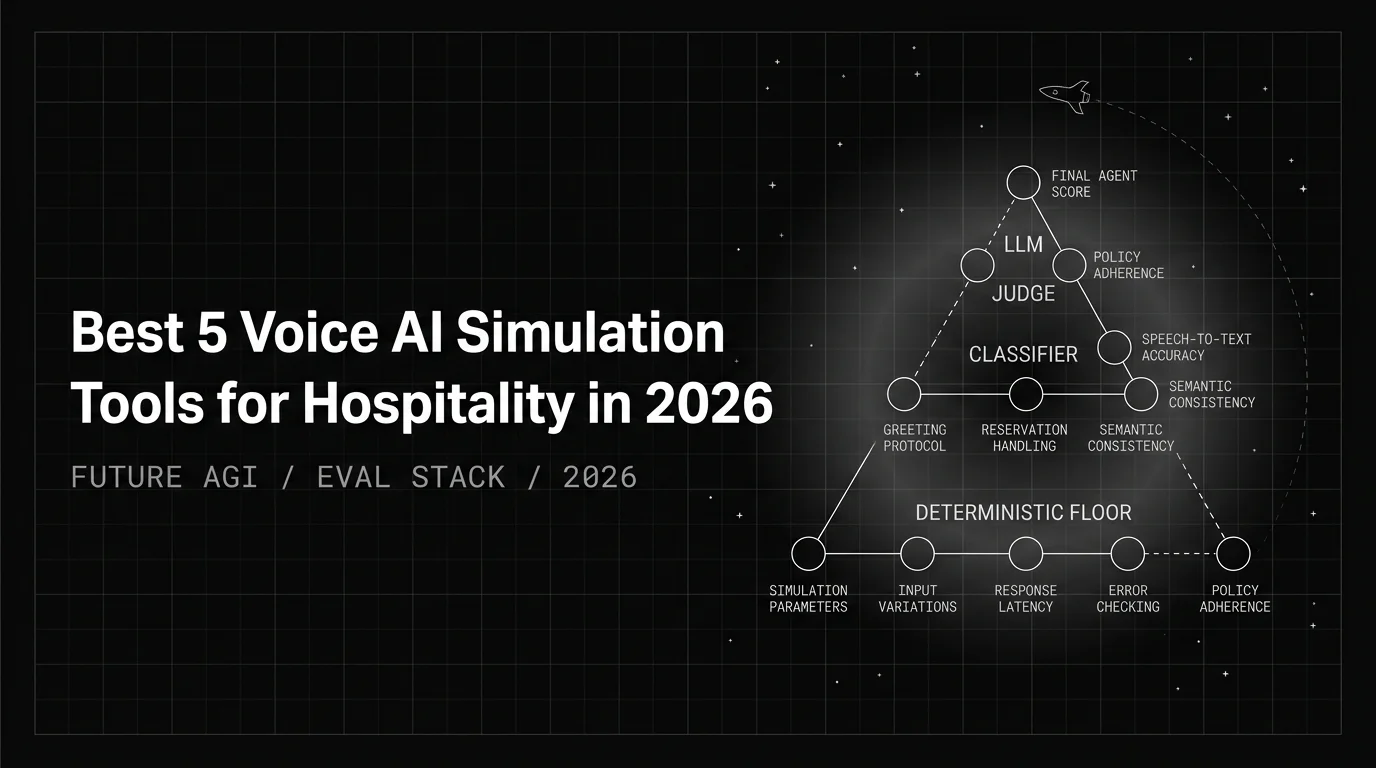
Table of Contents
Best 5 Voice AI Simulation Tools for Hospitality in 2026
A global hotel chain deployed an AI voice agent for front-desk reservation handling in November 2025. The agent scored 0.93 on the modal English-speaker test set and handled 47,000 reservations across its first quarter. In March 2026, a class-action complaint surfaced. The agent had quoted a refundable rate to a deaf caller using a relay service, lost context on the deposit-policy turn, and confirmed a non-refundable booking. The complaint cited ADA Title III on accessibility failure plus state consumer-protection law on misrepresentation, and pointed to the Moffatt v. Air Canada precedent as the operative reasoning for voice-agent liability on policy hallucination. The agent had never failed the modal QA because the modal QA didn’t include a relay-service caller persona, didn’t include a speech-disability cohort, and didn’t stress the deposit-policy decision boundary on the refundable-vs-non-refundable branch. The CX engineering lead kept the post-mortem question open: how do you regression-test a voice agent against the accent-and-accessibility cohort that actually walks through your reservation desk. Before the ADA complaint or the Moffatt-pattern lawsuit lands?
TL;DR. The 5 platforms at a glance
Hospitality voice agents fail in shapes that look nothing like generic chatbot failures. Policy hallucination on a refund or change-fee window (the Moffatt pattern), mistranscription escalation on a multi-lingual concierge turn, ADA accessibility failure on a relay-service caller, a TCPA consent gap on a loyalty-promotional outbound call to a wireless number, card-data emission on the payment-handoff step that flunks PCI DSS scope reduction. Generic voice testing catches none of these. The five platforms below are ranked for the modal hospitality voice-AI buyer. Hotel chain CX lead, airline voice-AI product manager, OTA voice-tech engineering lead, cruise line guest experience manager, restaurant group voice-tech lead.
| # | Platform | Best for | Pricing model |
|---|---|---|---|
| 1 | Future AGI | Persona simulation across the most accent-diverse customer base plus ADA accessibility cohort plus payment-handoff audio guardrails | Cloud + OSS self-host (Apache 2.0); free to start, pay-as-you-go scales with usage; SOC 2, HIPAA BAA, SSO + dedicated CSM available as add-ons |
| 2 | Hamming AI | The vertical-anchored voice-eval specialist with a deep contact-center persona catalog and a named voice-AI customer base | SaaS; quote-based for enterprise |
| 3 | Coval | Agentic-counterparty simulation for branching rebooking and concierge flows | SaaS; quote-based |
| 4 | Vapi | Built-in eval for hospitality teams already running production voice on Vapi infra | Platform-tied per-minute + eval add-on |
| 5 | Convoso | Contact-center voice platform with outbound-anchored eval features, useful where hospitality CX overlaps with outbound campaigns | SaaS contact-center; quote-based |
Future AGI lands at #1 for hospitality because the wedge for ADA-and-Moffatt-defensible hospitality voice goes beyond persona-based eval. It is the combination of persona simulation across the most accent-diverse customer base in the corpus, ADA-mandated accessibility cohort scenarios, Protect audio guardrails on the payment-handoff path, and trace-linked retention defensible enough for a DOT auto-refund-rule audit. Hamming AI is the genuine specialist runner-up: it owns the named voice-eval slot and the contact-center persona depth is real.
Why hospitality voice AI simulation is different from generic voice-agent testing
Three counts separate this category from a pan-industry voice-eval listicle.
First, the hospitality customer base is the most accent-diverse vertical in the corpus. A US hotel chain serves inbound calls from every modal accent on the planet on a typical Saturday. Non-native English speakers booking from international markets, ESL speakers code-switching between native language and English mid-utterance, regional-dialect speakers across the US South and Northeast, hearing-impaired speakers via relay services, speech-disability speakers, multi-tasking parents calling in ambient household noise. An airline voice agent serving the same chain serves a broader cohort still. The voice agent that scores 0.93 on the modal-speaker test set ships a regression rate above 0.30 on cohort-shifted speech that the modal QA never measured. Persona breadth is the regression-test surface.
Second, the failure surface is Moffatt-pattern-shaped and ADA-Title-III-shaped. Moffatt v. Air Canada (BC Civil Resolution Tribunal, Feb 2024) held the airline liable for a chatbot misrepresentation on a bereavement-fare refund policy. The reasoning extends cleanly to voice. A hospitality voice agent that hallucinates a refund policy, a change-fee waiver, or a cancellation window creates the same misrepresentation surface and the same private-action exposure. ADA Title III compounds: voice channels are increasingly named in DOJ accessibility enforcement for places of public accommodation. State consumer-protection law on misrepresentation compounds again. California, New York, and Massachusetts have the most aggressive state UDAP enforcement on travel and hospitality.
Third, federal voice-call rules and payment-adjacency add a layer. The FCC Feb 8 2024 Declaratory Ruling on AI-voice under TCPA applies to outbound loyalty and promotional voice. The FCC Lingo Telecom $1M Consent Decree (Aug 2024) is the named anchor. The DOT Final Rule on automatic refunds for cancelled flights (effective Oct 2024) sets refund-flow expectations for airline voice agents. PCI DSS scope applies to any voice surface that touches card data on the payment-handoff step.
Future AGI’s simulate-sdk fills that gap by treating Persona + Scenario as the unit of test, scoring per-turn task success across multi-turn reservation, rebooking, and concierge flows, and linking every simulated turn to a trace span in the same store the CX engineering team watches via traceAI. Protect audio guardrails block card-data emission write-side on the payment-handoff step. The LLM evaluation primer walks through the reliability-vs-capability framing hospitality voice has to underwrite.
The 2026 hospitality voice regulatory pressure stack
Hospitality voice AI sits inside a layered compliance stack. Federal voice-call rules, ADA accessibility, DOT consumer protection for airlines, PCI DSS for payment-adjacent flows, and state consumer-protection authority. The table below maps the rules hotel chains, airlines, OTAs, cruise lines, and restaurants are testing against in 2026 with named enforcement anchors where the docket has produced one.
| Rule | What it requires for voice agents | Named enforcement / precedent |
|---|---|---|
| ADA Title III (places of public accommodation) | Voice channels must be accessible to speakers with hearing impairment, speech disability, limited English proficiency | DOJ ADA Title III enforcement on online and voice accessibility; recent state AG investigations into hospitality voice accessibility 2023-2025 |
| Moffatt v. Air Canada precedent (BCCRT, Feb 14 2024) | Carrier liable for chatbot misrepresentation; reasoning extends to voice agents on policy and refund hallucination | Cited in state consumer-protection complaints; named in subsequent class actions on airline and hotel chatbot misrepresentation |
| DOT Final Rule on automatic refunds (effective Oct 28 2024) | Prompt automatic refunds for cancelled or significantly changed flights; voice agent must support and not delay the refund flow | DOT consumer protection enforcement; civil penalties up to $25,000 per violation |
| FCC TCPA + Feb 8 2024 Declaratory Ruling | AI-generated voice on outbound loyalty and promotional calls to wireless requires prior express written consent | FCC Lingo Telecom $1M Consent Decree (Aug 2024) |
| PCI DSS v4.0.1 | Payment-adjacent voice surface must scope card-data handling; scope reduction is the typical control objective | PCI Security Standards Council enforcement; acquirer-driven contract penalties for scope creep |
| State recording-consent (CA / FL / IL / MD / MT / NV / NH / PA / WA) | Recording a real-guest call requires affirmative consent in two-party states | California Penal Code §632; Illinois Eavesdropping Act |
| State consumer-protection UDAP (CA Bus. & Prof. Code §17200, NY GBL §349, MA Ch. 93A) | Misrepresentation by voice agent creates a private right of action | State AG enforcement; multiple class actions citing voice and chatbot misrepresentation 2023-2025 |
| GDPR Article 22 + EU AI Act Article 50 transparency (cross-border passenger / guest voice) | Automated-decision rights; transparency obligation for AI voice interaction | EU national-DPA enforcement; CNIL voice-AI guidance Q4 2024 |
| FTC §5 voice-claim accuracy | Material claims made by voice agent must be substantiated and non-deceptive | FTC enforcement against multiple consumer-facing AI deployments 2023-2025 |
Synthetic-persona simulation operates outside the recording-consent layer because no real guest is in the loop. Trace-linked retention covers the DOT auto-refund audit-trail surface. Protect audio guardrails cover the payment-handoff PCI scope reduction.
The Future AGI Hospitality Voice Simulation Scorecard
The scorecard is a five-dimension rubric for whether a voice AI simulation tool fits ADA-and-Moffatt-defensible hospitality production.
- Multi-turn task success on hospitality flows. hotel reservation completion, airline rebooking decision boundary on refund and change fee, multi-language concierge intent classification, loyalty-servicing authentication, restaurant-reservation deposit-policy handling. Per-cohort scoring across modal, accented, non-English, ADA-cohort, and policy-edge personas.
- ASR accuracy on the most accent-diverse customer base. Word Error Rate measured against a hospitality-relevant persona library (international accents across English-as-second-language speakers, regional US dialects, hearing-impaired-via-relay speakers, speech-disability speakers, ambient-household-noise multi-tasking caller). The accent breadth is the differentiator from any other vertical’s voice rubric.
- Persona and scenario coverage including ADA cohort. synthetic-test breadth across the guest cohort. Stressed traveler mid-rebooking, accent-diverse English speaker, non-English speaker code-switching, relay-service caller, speech-disability speaker, child solo-traveler scenario, group-booking coordinator, multi-tasking parent in ambient noise. ADA cohort coverage is non-optional.
- Payment-handoff audio guardrails. does the vendor block card-data emission write-side on the payment-handoff step? PCI DSS scope reduction depends on the response-path filter, not on the eval layer alone.
- Audit-trail completeness for DOT and ADA defensibility. per-turn scores joined to spans, durable retention, per-entity attribution for multi-brand hospitality groups. Future AGI is SOC 2 Type II, HIPAA, GDPR, and CCPA certified per the trust page; ISO 27001 in active audit.
Comparison matrix. 5 platforms, 6 capabilities
| Platform | Persona + scenario depth (accent + ADA) | Per-entity attribution | Audio guardrails (payment-handoff) | DOT / ADA audit-trail | Trace ↔ eval linkage | Deployment |
|---|---|---|---|---|---|---|
| Future AGI | ✓ Accent-diverse + ADA cohort library | ✓ Agent Command Center per-entity policy | ✓ Protect audio adapter inline | ✓ Durable retention, span-linked eval scores | ✓ span_id links per-turn scores to traceAI | SaaS + hybrid local + air-gapped BYOC |
| Hamming AI | ✓ Voice-anchored persona library | ◐ In-platform | ◐ Custom adapter required | ◐ In-platform retention | ✓ In-platform | SaaS |
| Coval | ✓ Agentic counterparty | ◐ Partial | ✗ Out of scope | ◐ Partial | ✓ In-platform | SaaS |
| Vapi | ◐ Vapi-flavored personas | ✗ Platform-tied | ✗ Out of scope | ◐ In-Vapi only | ◐ In-Vapi only | Platform-tied |
| Convoso | ◐ Outbound-anchored | ◐ Contact-center scoped | ✗ Out of scope | ◐ Contact-center retention | ◐ In-Convoso | SaaS contact-center |
How we ranked these 5 platforms
The ranking criteria sit on top of the scorecard above. We weighted:
- Persona breadth across the most accent-diverse customer base. international accent coverage, regional US dialects, ESL code-switching, relay-service and speech-disability cohorts. Hospitality is the vertical where this dimension matters most; Future AGI’s library spans the cohort with extensible authoring for the long tail.
- ADA accessibility cohort coverage. relay-service callers, hearing-impaired speakers, speech-disability speakers as core personas, not optional extras. Future AGI ships the ADA cohort scenarios; Hamming AI matches in-platform; the rest of the set treats accessibility as a request-and-wait extension.
- Payment-handoff audio guardrails. Protect is the only inline audio adapter in the set that blocks card-data emission write-side. The four other platforms expect a separate guardrails layer. For PCI DSS scope reduction on the payment-handoff step, that’s the difference between testing the agent and testing what the agent can emit.
- Audit-trail defensibility for DOT auto-refund and ADA Title III. per-turn scores joined to spans plus durable retention plus per-entity attribution for multi-brand hospitality groups. Future AGI’s traceAI + Agent Command Center pairing is the strongest answer in the set.
- Honest cost of ownership. production-grade voice-sim has compute, persona-library maintenance, and scenario-authoring costs. Vendors that hide these in trial pricing fall down at renewal.
The set is young: every vendor is under 36 months on voice-eval; DOJ ADA Title III enforcement on voice-AI is still building case law; the Moffatt precedent is one ruling that has not yet produced a US federal analogue. The shortlist below is a snapshot, not a closed list.
Future AGI. Persona simulation + ADA cohort + Protect audio + per-entity attribution
What it does. Future AGI’s voice simulation surface treats Persona + Scenario as the unit of test, scoring per-turn task success across multi-turn flows for hotel reservation, airline rebooking, multi-language concierge, loyalty servicing, and restaurant-reservation deposit-policy. Synthetic personas. International accent speaker, ESL code-switcher, relay-service caller, speech-disability speaker, stressed-traveler mid-rebooking, child solo-traveler, group-booking coordinator, multi-tasking parent in ambient noise. Feed multi-turn scenarios. Per-turn scoring runs against 60+ built-in evaluators across 11 categories in ai-evaluation plus unlimited custom evaluators authored by the in-product agent. Every simulated turn lands as a trace span in traceAI with per-entity attribution flowing through the Agent Command Center gateway. Protect audio guardrails sit on the response path with Gemma 3n + fine-tuned adapters across 5 safety rules (Toxicity, Tone, Sexism, Prompt Injection, Data Privacy) at ~67 ms p50 inline text per arXiv 2510.13351, blocking card-data emission write-side on the payment-handoff step.
Where it shines. SOC 2 Type II + HIPAA + GDPR + CCPA certified per futureagi.com/trust; ISO 27001 in active audit. DPA available across paid tiers. Per-entity attribution at the gateway means a multi-brand hospitality group can attribute every voice interaction to the operating brand. Useful for DOT auto-refund audit, ADA Title III defensibility on the named operator, and FTC §5 substantiation. Durable retention with span-linked eval scores covers the audit-trail surface. 35+ traceAI framework integrations with OpenInference compatibility; 60+ built-in evaluators across 11 categories plus unlimited custom evaluators (authored by an in-product agent) with in-house classifier models at Galileo-Luna-2 cost economics; 20+ local heuristic metrics run offline. Apache 2.0 license on traceAI, ai-evaluation, and agent-opt removes audit-retention vendor lock-in. AWS Marketplace billing; 100+ providers; multi-region hosted plus air-gapped BYOC for hospitality VPC deployments.
Where it falls short. Two deliberate tradeoffs. First, the prompt library is opinionated. Fewer review-and-collaboration knobs than Portkey’s prompt registry, by design. The trade is that prompt, eval, and trace live in the same control plane. Second, the agent-opt self-improving loop is opt-in per route, not a default. The trade is that the optimizer runs against real production traffic with eval scores joined to spans.The trade is federal-grade data residency without waiting on a vendor’s authorization cycle. Two more honest limitations: real-time mid-call streaming inference with sub-100ms latency is product roadmap, not shipped; and an accessibility-specialist or ADA-compliance officer’s sign-off on the cohort-coverage attestation is non-delegable. The platform produces the evidence pack but does not substitute for the attestor.
Pricing. Free to start with the full FAGI platform; pay-as-you-go as usage grows. Compliance add-ons (SOC 2 Type II, HIPAA BAA, SAML SSO + SCIM) and dedicated support layer on per tier. Pricing.
Pair this with the voice agent simulation guide guide, the end-to-end voice AI evaluation deep dive, and the three-layer voice testing framework reference.
For deeper context, pair this with the multilingual voice AI testing guide, the accent and dialect testing for voice AI deep dive, and the voice load testing at 10,000 simulated calls reference.
Hamming AI. Vertical-anchored voice-eval specialist
What it does. Hamming AI is purpose-built for voice-agent regression testing with a mature scenario-authoring surface and a named voice-AI customer base. The product centers on persona-based simulation with curated cohort breadth for contact-center and hospitality-adjacent deployments.
Where it shines. The strongest single-purpose voice-eval positioning in the set. Hamming AI is the named comparator every other voice-eval vendor lists; the case-study depth on voice agents is real specialist territory. Scenario-authoring UI is the most mature voice-anchored tooling on the market. For hospitality groups whose primary procurement criterion is “buy the voice-eval specialist leader,” Hamming is the answer.
Where it falls short. Write-side audio guardrails on the payment-handoff step aren’t a native product surface; teams build them as custom adapters. PCI scope reduction depends on a separate adapter. Per-entity attribution for multi-brand hospitality groups is in-platform only. ADA accessibility cohort coverage is available but treated as cohort-extension rather than a core scenario. DOT auto-refund audit-trail durability depends on enterprise contract terms.
Pricing. SaaS; quote-based for enterprise hospitality deployments.
Coval. Agentic-counterparty simulation for voice
What it does. Coval focuses on agentic conversation simulation. Multi-turn scenarios where the test agent behaves like an LLM-driven counterparty rather than a scripted persona. The product fits hospitality teams testing branching rebooking and concierge flows where guest behavior under stress isn’t predictable.
Where it shines. Agentic counterparty simulation is useful for rebooking flows where the stressed-traveler turn is variable. Multi-turn scenario authoring is mature. Cross-industry references in CX and hospitality directly transfer.
Where it falls short. Write-side audio guardrails on payment-handoff aren’t a native product surface; teams build them as custom adapters. Per-entity attribution is partial. ADA cohort persona depth is lighter than Future AGI’s and Hamming AI’s. DPA is quote-based on enterprise. DOT auto-refund audit-trail durability requires integration work.
Pricing. SaaS; quote-based.
Vapi. Built-in eval for hospitality teams on Vapi voice infra
What it does. Vapi is a voice-agent infrastructure platform with built-in eval features for hospitality teams that have standardized on Vapi for voice delivery. The eval surface sits inside the same platform that runs the agent.
Where it shines. Tight integration with Vapi’s voice infrastructure means eval data and runtime telemetry share a backbone. For hospitality teams already on Vapi, the integration cost is the lowest in the set. Built-in eval reduces the vendor count on the procurement sheet.
Where it falls short. Eval is platform-tied. Hospitality teams not on Vapi pay the platform-switching cost. Persona and scenario coverage is Vapi-flavored, not vendor-neutral; the most accent-diverse cohort requires extension work. Write-side audio guardrails on payment-handoff aren’t a native product surface; teams build them as custom adapters. Per-entity attribution for multi-brand groups is platform-tied. Vendor portability is weak.
Pricing. Platform-tied; per-minute infra + eval add-on.
Convoso. Contact-center voice platform with outbound-anchored eval
What it does. Convoso is a contact-center voice platform with outbound-anchored eval features useful where hospitality CX overlaps with outbound loyalty and reservation-recovery campaigns. The product targets the contact-center buyer rather than the voice-agent simulation buyer specifically.
Where it shines. Strong outbound-campaign integration for hospitality groups running loyalty and re-engagement programs. Built-in compliance scaffolding for TCPA outbound. Contact-center-shaped UX that fits BPO-operated hospitality CX.
Where it falls short. Voice-AI simulation is not the core product surface. The platform is contact-center first, voice-eval second. Persona library is outbound-anchored rather than reservation-and-concierge-shaped. Write-side audio guardrails on payment-handoff aren’t a native product surface; teams build them as custom adapters. ADA cohort coverage requires extension. Vendor portability is contact-center-tied.
Pricing. SaaS contact-center; quote-based.
Decision matrix. Which platform fits which hospitality buyer
| Buyer profile | Recommended platform |
|---|---|
| Hotel chain CX lead serving the most accent-diverse customer base | Future AGI (accent-diverse persona library + ADA cohort + Protect audio on payment-handoff) |
| Airline voice-AI product manager under DOT auto-refund rule and Moffatt precedent | Future AGI (refund-policy scenario set + audit trail + per-entity attribution) |
| OTA voice-tech engineering lead handling multi-language concierge | Future AGI (ESL code-switching personas + agentic counterparty extension) |
| Cruise line guest experience manager with multi-brand fleet | Future AGI (per-entity attribution at the gateway) |
| Restaurant group voice-tech lead testing reservation deposit policy | Future AGI (policy-edge scenario authoring + audit trail) or Hamming AI (named voice-eval leader) |
| Hospitality group procuring voice-eval as a procurement-defensible standalone | Hamming AI (named voice-eval leader; specialist anchor) |
| Hospitality group already standardized on Vapi infrastructure | Vapi (platform-tied) |
| BPO-operated hospitality CX with heavy outbound loyalty programs | Convoso (contact-center first) |
Where each platform earns its slot
Future AGI earns #1 because the wedge for ADA-and-Moffatt-defensible hospitality voice goes beyond persona-based eval. It is the four-piece combination of persona simulation across the most accent-diverse customer base in the corpus; ADA-mandated accessibility cohort scenarios as core personas rather than extensions; Protect audio guardrails on the payment-handoff step for PCI DSS scope reduction; and per-entity attribution plus durable retention defensible enough for DOT auto-refund audit and ADA Title III enforcement, all running under SOC 2 Type II + HIPAA + GDPR + CCPA certification. Hamming AI earns #2 because voice-eval specialization is real. The named-comparator status and persona-library depth are the genuine specialist win, and for hospitality groups whose primary criterion is “buy the voice-eval leader,” Hamming is the right answer. Coval, Vapi, and Convoso earn their slots on agentic counterparty simulation, platform-tied integration, and outbound contact-center coverage respectively. Each is the right answer for a specific buyer profile, none is the right answer for every hospitality voice program.
The gap that generic voice testing doesn’t fill is the gap between “the agent completed the turn” and “the agent did not hallucinate a refund policy in the Moffatt pattern, did not fail an ADA cohort caller on the relay-service flow, did not emit card data on the payment-handoff step, did not bypass the DOT auto-refund eligibility decision boundary on a cancelled-flight turn.” Voice infra ships the agent. Observability tells you what happened on a live call. Simulation drives the persona library that catches the failure before the ADA complaint or the Moffatt-pattern lawsuit lands. The simulate-sdk documentation is the entry point for hospitality teams that want to start with the Future AGI path.
Frequently Asked Questions
What is hospitality voice AI simulation?
Does the Moffatt v. Air Canada precedent apply to my voice agent?
How does ADA Title III apply to hotel and airline voice agents?
Does the DOT auto-refund rule affect airline voice agents?
What about PCI DSS for the payment-handoff step in a hotel voice agent?
What's a defensible task-success threshold for a hotel-reservation voice agent?
Can I run voice simulation against ADA accessibility cohorts without exposing real customer audio?
Five voice AI simulation tools for fintech, KYC, account servicing, fraud callbacks. FFIEC, NYDFS Part 500, FinCEN BSA, CFPB UDAAP, SEC 17a-4.

Five voice AI simulation tools for healthcare scribes, telehealth triage, medication reminders. HIPAA, HHS OCR, FDA SaMD, ONC HTI-1, BAA.

Engineer voice agent simulation: 18 personas, auto-generated branching scenarios, four-step test wizard, Error Localization, programmatic eval API.