Best 5 Halluminate Alternatives in 2026
Five Halluminate alternatives on evaluator breadth, runtime guardrails, self-host, languages. What each actually fixes beyond hallucination-only detection.

Table of Contents
Halluminate was a clean fit for one job: catch hallucinations in retrieval-augmented generation. A Python SDK, a hosted API, a faithfulness score. Teams that wired it into a RAG chatbot in 2024 got fast value. By 2026, that single-axis shape is the problem. Production agents now make tool calls, span multiple steps, fail on routing as often as on retrieved facts, and need to be evaluated, observed, and protected at runtime, more than scored after the fact. Halluminate does one of those four; the rest need another vendor.
This guide ranks five evaluation platforms worth migrating to, names what each fixes versus Halluminate, and walks the migration that always bites: swapping a single faithfulness call for a multi-evaluator pipeline covering groundedness, tool use, and agent trajectories.
TL;DR: pick by exit reason
| Why you are leaving Halluminate | Pick | Why |
|---|---|---|
| You want eval + observability + runtime guardrails + an optimizer in one stack | Future AGI | Closes the loop from trace through eval to optimizer to runtime Protect layer |
| You want a focused hallucination-and-grounding specialist with a bigger community | AIMon | Same shape as Halluminate but broader evaluator catalog and active OSS ecosystem |
| You want OSS-first agent observability with deep tracing | Arize Phoenix | OpenTelemetry-native, Apache 2.0, self-host or hosted |
| You want a Pythonic test-first eval framework | DeepEval | Pytest-flavored unit tests for LLM outputs, runs in CI |
| You want enterprise-grade evals with research-backed evaluators | Patronus AI | Lynx, Glider, and a managed evaluator lineup tuned for regulated workloads |
Why people are leaving Halluminate in 2026
Four exit drivers show up repeatedly in Discord threads, the Halluminate GitHub issue tracker, /r/LLMDevs migration discussions, and G2 reviews from the last two quarters.
1. Narrow scope: hallucination detection is one evaluator, not a stack
Halluminate detects hallucinations in RAG outputs. Production work in 2026 needs faithfulness plus context relevance, answer relevance, tool-call correctness, trajectory evaluation, task completion, latency and cost telemetry per step, and runtime guardrails. Halluminate covers the first slot; everything else is bring-your-own. The Discord complaint is consistent: “We picked Halluminate for RAG faithfulness, then needed tool-call evals, then trajectory evals, then observability, then guardrails, and ended up with four vendors and a fragile glue layer.”
2. Python-only SDK in a polyglot agent world
Halluminate ships a Python SDK and a REST API. Python is fine for a notebook or backend service; it’s a problem for the Node, TypeScript, and Go services that increasingly sit between the user and the model. Next.js BFFs, edge runtimes, Go orchestration. The REST API is the escape hatch, but maintaining a hand-rolled non-Python client through every evaluator and version drift is plumbing teams stop wanting to own.
3. Hosted-only: no self-host story for regulated workloads
Halluminate runs as a hosted service. No self-host bundle, no on-prem, no VPC option as of May 2026. For a healthcare or financial-services team whose rules say “PHI doesn’t leave our VPC,” that’s a hard stop. Stripping identifiers before sending works for some workloads and fails for others. Most regulated teams end up at a platform with self-host or BYOC.
4. No integrated optimizer: evaluation without iteration
The architectural gap. Halluminate scores; it doesn’t improve. When faithfulness dips from 0.91 to 0.84 over a release, the score is the answer. What happens next is a human job. The newer platforms (Future AGI, increasingly Patronus, partially DeepEval) close the loop: scores feed a prompt optimizer that proposes a fix, evaluates the candidate, and lands the improvement automatically. Two adjacent gaps reinforce this: Halluminate’s community is smaller than AIMon’s or Phoenix’s, and custom-evaluator docs are thinner than Phoenix’s or DeepEval’s.
What to look for in a Halluminate replacement
The default “best eval platform” axes are necessary but not sufficient. Score replacements on the seven that map to the surfaces you’re actually migrating off:
| Axis | What it measures |
|---|---|
| 1. Evaluator breadth | Faithfulness only, or faithfulness + groundedness + tool-use + trajectory + task-completion? |
| 2. Language coverage | First-party SDKs for Python, TypeScript, Go, Java? Or REST-and-pray? |
| 3. Self-host / VPC posture | Can the platform run inside your VPC, or is hosted the only option? |
| 4. Observability depth | Are traces, evals, and cost data in one row, or stitched across vendors? |
| 5. Runtime guardrails | Can the platform block a bad output at request time, not just score it after? |
| 6. Optimizer loop | Do eval scores drive prompt or retriever changes automatically? |
| 7. Community + custom-evaluator surface | Active Discord, real docs, and a clean path to a domain-specific evaluator? |
1. Future AGI: Best for closing the loop
Verdict: Future AGI is the only platform here that’s an eval stack, an observability layer, a runtime guardrails product, and an optimizer in one. Halluminate’s biggest weakness is that scoring stops at the score; FAGI’s ai-evaluation writes the score, traceAI captures the trace, agent-opt rewrites the prompt or retriever-config that produced the low score, and Protect blocks the bad output at runtime before the next request lands.
What it fixes versus Halluminate:
- Evaluator breadth, not a single axis.
ai-evaluation(Apache 2.0) ships faithfulness and groundedness in the shape Halluminate users know, plus context relevance, answer relevance, tool-call correctness, agent-trajectory, task-completion, and PII/jailbreak/toxicity checks. Swap the call site on day one and add the catalog as the workflow matures.
- Polyglot SDKs. First-party Python and TypeScript SDKs land traces and evals anywhere a Halluminate REST call would. Go, Java, and Rust shims are documented; the OTel-compatible trace format means any OTel-emitting service lands data without a vendor SDK.
- Self-host and BYOC. The OSS libraries (
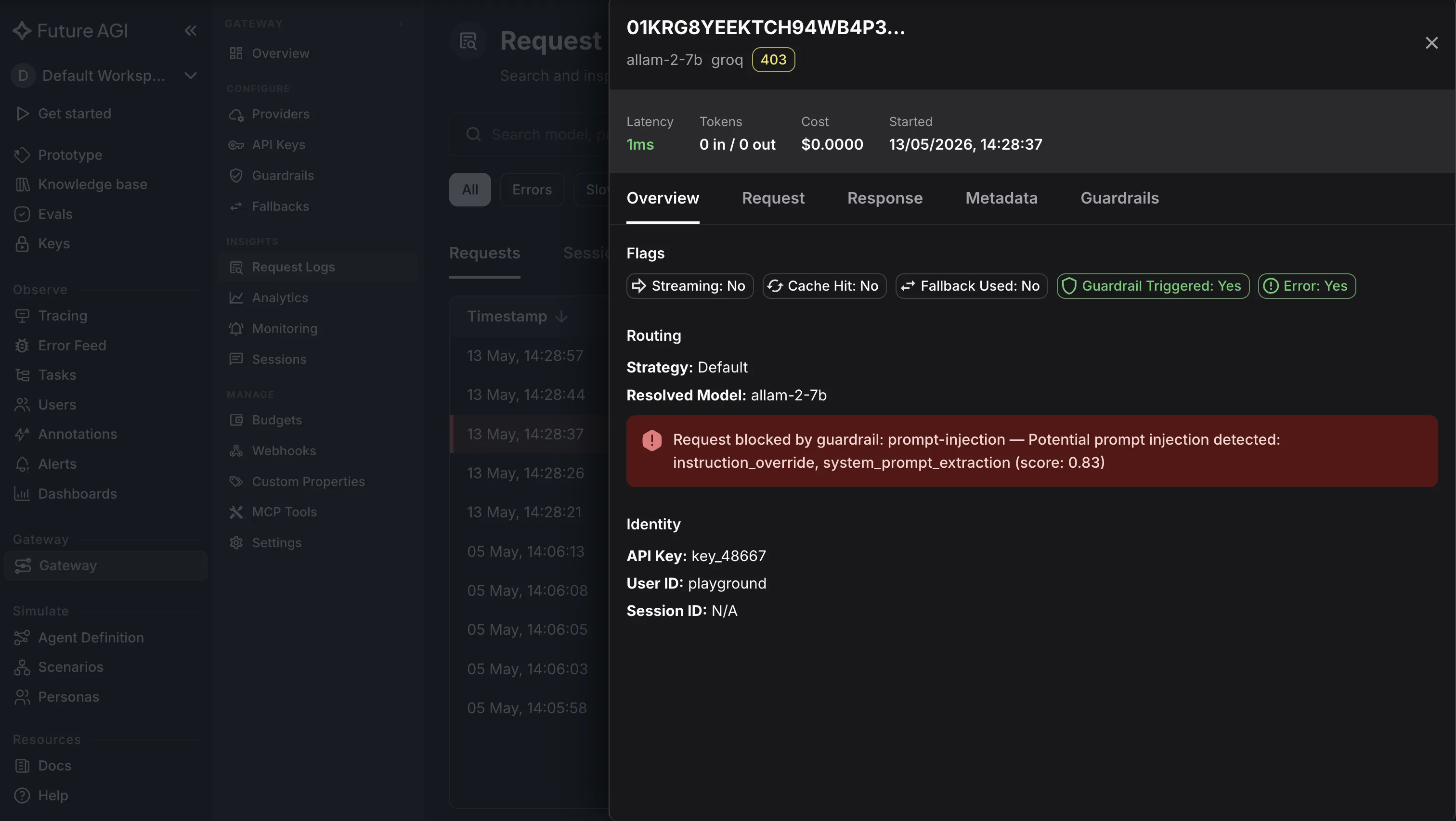
traceAI,ai-evaluation,agent-opt) are Apache 2.0 and run anywhere. The hosted Agent Command Center adds RBAC, failure-cluster views, and Protect; BYOC is available for teams that need data to stay in their VPC. - Runtime guardrails, not scoring alone. Protect blocks PII leaks, jailbreaks, and policy violations at request time, median 67 ms text-mode latency (arXiv 2510.13351). Halluminate scores after generation; Protect prevents the bad output from leaving the gateway.
- The optimizer loop.
agent-opt(Apache 2.0) takes the eval scores and rewrites prompts (ProTeGi, Bayesian, GEPA) or proposes retriever-config changes automatically. The 0.91 → 0.84 dip becomes a candidate fix, not a number on a dashboard.
Migration from Halluminate: halluminate.evaluate(answer, context) maps directly to ai_evaluation.faithfulness(answer, context) with the same arguments and a compatible score scale. Groundedness, context relevance, and answer relevance slot in alongside. REST callers swap base URLs and headers. Timeline: three to five engineering days for a like-for-like swap, plus a week to add the catalog and wire agent-opt into CI.
Where it falls short:
- The platform surface is larger than Halluminate’s. A team that wants exactly one faithfulness call and nothing else feels the surface area on day one.
- The optimization layer carries a learning curve; a pure scoring swap won’t use
agent-optin week one.
Pricing: Free tier with 100K traces/month. Scale tier from $99/month with linear per-trace scaling above 5M (no add-on multipliers). Enterprise with SOC 2 Type II, BYOC, and AWS Marketplace procurement.
Score: 7 of 7 axes.
2. AIMon: Best for a focused hallucination-and-grounding upgrade
Verdict: AIMon is the pick when the goal is “same shape as Halluminate, broader and better.” A hallucination-and-grounding specialist with active OSS presence, a richer catalog, and a community where long-tail debugging questions get answered.
What it fixes versus Halluminate:
- Broader catalog with the same focus. Hallucination, instruction adherence, completeness, retrieval relevance, conciseness, and toxicity sit alongside each other rather than as a single faithfulness number.
- Active community and OSS surface. Weekly GitHub commits, responsive Discord, current LangChain/LlamaIndex/Haystack integration docs. The community-size complaint doesn’t show up here.
- Python and JavaScript SDKs. First-party JS closes the polyglot gap for backend Node and edge-runtime services.
Migration from Halluminate: Faithfulness call sites map directly. AIMon’s Detect decorator wraps existing functions; halluminate.evaluate(answer, context) maps to aimon.detect(...). Timeline: two to three engineering days.
Where it falls short:
- No runtime guardrails. AIMon scores, but doesn’t block bad outputs at request time.
- No integrated optimizer; scores inform humans, not the pipeline.
- Agent-trajectory evaluation is thinner than Phoenix’s or FAGI’s.
- Self-host exists but is less polished than Phoenix’s OSS path.
Pricing: Free tier for development. Production pricing on application; typically anchored to evaluation volume.
Score: 4 of 7 axes (missing: deep self-host, runtime guardrails, optimizer).
3. Arize Phoenix: Best for OSS-first agent observability
Verdict: Phoenix is the pick when the trigger is self-host and the team wants a fully open-source path inside the VPC. Apache 2.0, OpenTelemetry-native, with a tracing surface that handles multi-step agents cleanly. Phoenix is the largest OSS LLM observability community in 2026.
What it fixes versus Halluminate:
- Self-host, fully open source. Phoenix runs as a binary or container in your VPC. No data leaves unless you configure an OTel sink. For teams whose trigger is the hosted-only constraint, this is the cleanest answer.
- OpenTelemetry-native tracing. Phoenix uses OpenInference (an OTel semantic convention for LLM workloads); any OTel-emitting service lands data without a vendor SDK. Polyglot coverage is free.
- Evals plus tracing in one view. Phoenix’s eval library covers hallucination, relevance, toxicity, summarization, and a respectable set of agent evaluations. Evals and traces share the same data model, so a low score is one click from the trace that produced it.
Migration from Halluminate: Add phoenix or openinference-instrumentation-* packages to the existing Python pipeline, then call Phoenix’s eval functions in place of Halluminate’s. Phoenix’s faithfulness evaluator has a different score scale and prompt template, so thresholds need recalibration. Timeline: five to seven engineering days.
Where it falls short:
- No runtime guardrails. Phoenix is observation and evaluation, not protection at request time.
- No integrated optimizer; the OSS Phoenix surface stops at evals.
- UI is engineering-grade; teams expecting a polished SaaS dashboard feel the gap.
- Custom-evaluator authoring requires more Python than Halluminate’s “one function call” pattern.
Pricing: Phoenix is Apache 2.0 and free. Arize AX (the commercial platform that builds on Phoenix) is enterprise-priced.
Score: 5 of 7 axes (missing: runtime guardrails, integrated optimizer).
4. DeepEval: Best for test-first evaluation in CI
Verdict: DeepEval is the pick when the team’s mental model is “evals are unit tests for LLM outputs and live in pytest.” Pythonic, test-first, shaped to run inside CI. The team that gets the most out of it’s the one whose discipline has always been “tests in the repo, run on every PR” and who found Halluminate’s hosted shape awkward.
What it fixes versus Halluminate:
- Test-first ergonomics. Pytest-flavored API:
assert_test(test_case, metrics=[HallucinationMetric(threshold=0.5)]). Same evaluator runs in notebook, script, and CI with identical semantics. - Broader catalog. Hallucination, faithfulness, answer relevance, context precision/recall, contextual relevancy, toxicity, bias, summarization, G-Eval (custom authoring), and DAG composition. The cleanest custom-evaluator path in this list.
- Confident AI hosted layer (optional). The hosted dashboard pairs with DeepEval for persistence and shared views; the OSS library works standalone.
Migration from Halluminate: Faithfulness call sites map to DeepEval’s HallucinationMetric or FaithfulnessMetric. The shape shift is from “call evaluator, get score” to “define a test case, run a metric, assert a threshold.” Timeline: four to six engineering days, including restructuring into pytest cases.
Where it falls short:
- No runtime guardrails. DeepEval is offline and CI-time evaluation.
- No integrated optimizer beyond experimental tuning hooks; prompt optimization is bring-your-own.
- Python-only. The polyglot gap that pushed teams off Halluminate isn’t closed here.
- DeepEval is an eval library, not a tracing product, teams pair it with Phoenix, FAGI, or Langfuse.
Pricing: DeepEval is Apache 2.0 and free. Confident AI hosted is free for small teams; team and enterprise tiers are usage-priced.
Score: 4 of 7 axes (missing: polyglot SDKs, runtime guardrails, integrated optimizer).
5. Patronus AI: Best for regulated workloads with research-backed evaluators
Verdict: Patronus AI is the pick when the requirement is enterprise-grade evaluation with named, research-backed evaluators (Lynx, Glider, FinanceBench) and the buying side is a security or compliance team. The artifacts, model cards, SOC 2, named research papers, clear the procurement bar in ways OSS-first options don’t.
What it fixes versus Halluminate:
- Research-backed evaluator lineup. Lynx (hallucination detection, open-weights), Glider (judge model for arbitrary criteria), FinanceBench (financial-domain factuality), and a catalog of named evaluators with model cards. Easier to defend to an auditor than a generic “GPT-as-judge” call.
- Enterprise compliance posture. SOC 2 Type II, named-customer references in finance and healthcare, and a sales motion shaped around regulated procurement.
- PII and policy evaluators. PII detection, policy compliance, and harmful-content evaluators sit alongside hallucination and groundedness, the suite regulated workloads actually need.
Migration from Halluminate: Patronus’s Python SDK is familiar in shape; faithfulness and groundedness call sites map with renamed imports. Compliance evaluators are net-new and worth a separate pass. Timeline: five to eight engineering days, longer if procurement is part of the timeline.
Where it falls short:
- No runtime guardrails. Patronus is evaluation, not request-time blocking.
- No integrated optimizer; results inform humans, not the pipeline.
- Hosted-first; on-prem exists for enterprise but isn’t the default.
- Pricing is enterprise-anchored; the small-team path is less obvious than DeepEval’s or Phoenix’s.
Pricing: Free tier for early development. Production pricing is enterprise, anchored to evaluation volume and the compliance posture required.
Score: 4 of 7 axes (missing: deep self-host, runtime guardrails, integrated optimizer).
Capability matrix
| Axis | Future AGI | AIMon | Arize Phoenix | DeepEval | Patronus AI |
|---|---|---|---|---|---|
| Evaluator breadth | Full catalog + agent + trajectory | RAG-focused, broad | Full catalog + agent | Full catalog + custom DAG | Named research-backed lineup |
| Language coverage | Python + TS, OTel-anywhere | Python + JS | OTel-anywhere | Python-only | Python + REST |
| Self-host / VPC posture | OSS libs + BYOC hosted | Hosted, light self-host | Apache 2.0, fully self-host | Apache 2.0, fully self-host | Hosted-first, enterprise on-prem |
| Observability depth | Native traces + sessions + RBAC | Functional, lighter | OTel-native, deep | Shallow (eval library only) | Functional, hosted |
| Runtime guardrails | Yes (Protect, ~67 ms text) | No | No | No | No |
| Optimizer loop | Yes (agent-opt) | No | No | Experimental | No |
| Community + custom-eval surface | Active Discord + docs | Active Discord + OSS | Largest OSS community | Largest custom-eval surface | Enterprise refs + papers |
Migration notes: what breaks when leaving Halluminate
Three surfaces always need attention.
Replacing the faithfulness call site
Halluminate’s call site (halluminate.evaluate(answer=..., context=...)) returns a score (often 0 to 1) plus a rationale. The mechanical part is the swap, ai_evaluation.faithfulness(...) (FAGI), aimon.detect(...) (AIMon), phoenix.evals.HallucinationEvaluator() (Phoenix), HallucinationMetric() (DeepEval), Patronus.evaluate(...) (Patronus). The non-mechanical part is threshold recalibration. Each platform’s evaluator uses a different judge-model prompt template, so the score distribution shifts, a 0.85 threshold may correspond to 0.78 or 0.91 elsewhere. Run both evaluators in parallel for a week on production traffic and pick the threshold that matches the false-positive and false-negative rates the team had on Halluminate. Skipping this is the most common cause of a “but we weren’t seeing this many hallucinations before” complaint two weeks post-migration.
Adding evaluators Halluminate did not have
The reason most teams leave is that one evaluator is no longer enough. Use the migration to add groundedness, context relevance, answer relevance, tool-call correctness, trajectory, and task-completion. Ship the like-for-like swap first, validate parity on the faithfulness number, then add evaluators one at a time, adding seven at once means seven thresholds and seven new sources of noise. The RAG faithfulness deep dive covers how the groundedness signal is scored in practice.
Re-instrumenting from the Python SDK to multi-language
If the trigger was the polyglot gap, this is when the team adds first-party TypeScript, Go, or Java instrumentation. Platforms with native OTel support (Future AGI, Phoenix) make this nearly free. Instrument the most-trafficked non-Python service first, then roll out to the fleet.
Decision framework: Choose X if
Choose Future AGI if leaving Halluminate is more than “we need a better faithfulness evaluator”, you also want one stack covering eval, observability, runtime guardrails, and the optimizer loop that turns scores into prompt improvements automatically.
Choose AIMon if the goal is “same shape as Halluminate, just better.” RAG-shaped workload, slightly broader evaluator suite, active OSS community, no platform-scale migration.
Choose Arize Phoenix if the exit trigger is self-host and the team wants a fully open-source path with OpenTelemetry-native tracing. Polyglot coverage and source-availability beat a hosted SaaS dashboard.
Choose DeepEval if the team’s discipline is “tests in the repo, run on every PR” and the workflow needs to live in pytest. Python-heavy stacks where custom-evaluator authoring and CI-time evaluation matter more than runtime guardrails.
Choose Patronus AI if the requirement is enterprise-grade evaluation with research-backed evaluators and a compliance posture that clears the procurement bar in regulated industries.
What we did not include
Three products show up in other 2026 Halluminate alternatives listicles that we left out: Galileo Evaluate (enterprise-only pricing, mismatched with most teams leaving Halluminate); Langfuse (tracing and prompt-management with a thinner eval surface, a better fit for “leaving Helicone” than “leaving Halluminate”); Ragas (Apache 2.0 library worth knowing about, but more a library to compose with than a platform to migrate to, most teams pair it with Phoenix or DeepEval).
Related reading
- Best 5 LLM Evaluation Platforms in 2026
- Best 5 RAG Evaluation Tools in 2026
- What Is LLM Hallucination Detection? The 2026 Definition
Sources
- Halluminate Python SDK documentation, halluminate.ai/docs
- Halluminate REST API reference, halluminate.ai/docs/api
- AIMon product page and GitHub, aimon.ai, github.com/aimonlabs
- Arize Phoenix GitHub, github.com/Arize-ai/phoenix (Apache 2.0)
- OpenInference semantic conventions, github.com/Arize-ai/openinference
- DeepEval GitHub, github.com/confident-ai/deepeval (Apache 2.0)
- Confident AI product page, confident-ai.com
- Patronus AI product page and Lynx model card, patronus.ai
- Reddit /r/LLMDevs migration discussions, February-May 2026
- Discord eval-tooling channels, public threads, Q1-Q2 2026
- Future AGI Agent Command Center, futureagi.com/platform/monitor/command-center
- Future AGI traceAI, github.com/future-agi/traceAI (Apache 2.0)
- Future AGI ai-evaluation, github.com/future-agi/ai-evaluation (Apache 2.0)
- Future AGI agent-opt, github.com/future-agi/agent-opt (Apache 2.0)
- Future AGI Protect latency benchmark, arxiv.org/abs/2510.13351 (67 ms text, 109 ms image)
Frequently Asked Questions
Why are people moving off Halluminate in 2026?
What is the closest like-for-like alternative to Halluminate?
How do I migrate the faithfulness evaluator out of Halluminate?
Is there an open-source Halluminate alternative?
Which Halluminate alternative has runtime guardrails?
How does Future AGI Agent Command Center compare to Halluminate?
Can I run Halluminate alongside one of these during migration?

The 5 best AI hallucination detection tools in 2026, ranked. Compare Future AGI, Galileo Luna, DeepEval, Phoenix, Patronus Lynx on accuracy and price.

Ragas, DeepEval, FutureAGI, Phoenix, Galileo, Langfuse, TruLens compared as the 2026 RAG eval shortlist. Faithfulness, retrieval, chunk attribution.

FutureAGI, DeepEval, Langfuse, Phoenix, Braintrust, LangSmith, and Galileo as the 2026 LLM evaluation shortlist. Pricing, OSS license, and production gaps.