Best 5 Giskard Alternatives in 2026
Five Giskard alternatives scored on production-runtime parity, LLM-native eval depth, language reach, when a Python-only SDK is not enough.
Table of Contents
Giskard built its reputation on tabular ML testing (drift, bias, performance regressions) and stretched the same scanner into LLM red teaming. That heritage shows. The Python-only SDK fits ML engineers cleanly, the scanner output reads like a research report, and the hosted Giskard Hub does the enterprise wrap-up. What it doesn’t have, in May 2026, is a runtime guardrail surface, a Node or Go SDK, or the LLM-specific community heft that purpose-built tools like DeepEval, Langfuse, or Lakera Guard accumulated. Teams who started on Giskard for the scanner hit the same wall: the report flags a vulnerability, but there’s no inline layer to block the same prompt in production tomorrow.
This guide ranks five alternatives worth migrating to, names what each fixes versus Giskard, and walks through the two migrations that always bite: rewriting the Python-only red-team suite, and closing the loop into production.
TL;DR: pick by exit reason
| Why you are leaving Giskard | Pick | Why |
|---|---|---|
| You want red-team findings to flow into inline guardrails and a self-improving loop | Future AGI Agent Command Center | Protect inline guardrails + red-team eval + closed loop, OSS instrumentation |
| You want LLM-native traces with an open standard underneath | Arize Phoenix | OpenInference + OTel, deep tracing, integrates with most eval libraries |
| You want a developer-first LLM eval framework with strong community momentum | DeepEval (Confident AI) | pytest-shaped LLM eval, hosted Confident AI for collaboration |
| You want an open-source observability + prompt-management hub | Langfuse | Self-hostable, popular OSS, prompt + dataset + eval primitives |
| You need runtime prompt-injection and PII enforcement at the edge | Lakera Guard | Production-grade input/output guardrails focused on AI security |
Why people are leaving Giskard in 2026
Five exit drivers show up in Discord migration threads, Giskard’s own GitHub issue tracker, /r/MachineLearning posts, and G2 reviews from the last three quarters.
1. Testing-and-red-team focused, no native runtime
Giskard’s scanner is offline. You point it at a model or an agent, it generates adversarial probes, runs them, and writes a report. The report is good. What isn’t in the product is a runtime, no inline layer that sits in the request path and blocks a prompt injection or PII leak when the same attack arrives in production. Teams discover this on the second sprint. The first sprint, the scanner finds something interesting and everyone is happy. The second sprint, security asks “how do we stop this in production?” and the answer is “we add a separate guardrail vendor.”
That’s the structural gap. Giskard is an evaluator. Production stacks in 2026 expect the evaluator and the guardrail to share data, findings should inform inline policy without a manual handoff.
2. ML-heritage product adapted to LLMs
Giskard’s first life was tabular ML quality: scikit-learn classifiers, drift, fairness, slice performance. The scanner architecture and report format inherit that lineage. For LLM and agent workloads, the inherited assumptions show: test taxonomies leaned on classification-style metrics too long, tool-call traces were a late addition rather than first-class, and the failure-cluster surface is thinner than Phoenix or Langfuse offer natively. The product is catching up; teams who need the LLM-native surface today are the ones leaving.
3. Python-only SDK
The SDK is giskard on PyPI, full stop. No first-party Node, Go, Java, or Ruby client. For teams whose application code is TypeScript or Go and only the eval pipeline is Python, Giskard works fine. For teams whose agents run inside a TypeScript orchestrator or a Go microservice and want inline checks, the language gap means a separate service, and that’s when Lakera Guard or Future AGI’s multi-language instrumentation starts looking obvious.
4. Hosted enterprise tier with opaque pricing
Giskard Hub is the hosted product. Pricing is sales-led; the public site doesn’t publish a per-seat or per-trace number. For SMB and mid-market teams this is the familiar enterprise-tier friction, every renewal needs procurement, and there’s no self-serve scale tier between the OSS scanner and the enterprise contract. G2 and Reddit reviews describe the same thing: “we like the product, we can’t tell from the pricing page whether we can afford it next year.”
5. Smaller LLM-specific community than DeepEval or Langfuse
GitHub stars, Discord active members, and Stack Overflow questions tagged with the project name all show Giskard well behind DeepEval and Langfuse for LLM-specific questions as of May 2026. Tabular ML questions, Giskard still wins. LLM-specific questions, the answer-finder ratio is lower, and “can I find an answer on Discord within an hour” is a real adoption criterion for a new tool in 2026.
What to look for in a Giskard replacement
The default “best LLM eval” axes are necessary but not sufficient. Score replacements on the seven that map to the gaps Giskard’s heritage leaves open:
| Axis | What it measures |
|---|---|
| 1. Runtime guardrail parity | Can the same product block prompt injection, PII, and tool misuse inline, not just flag them offline? |
| 2. Red-team coverage | Adversarial probe library, attack categories, and reproducibility of findings |
| 3. Closed-loop optimization | Do findings feed back into prompt rewrites or routing, or stop at the report? |
| 4. Language reach | First-party SDKs beyond Python — TypeScript, Go, Java |
| 5. Self-host posture | OSS license, full-VPC operation, source auditable |
| 6. LLM-native observability | Per-session, per-trace, tool-call-aware, failure-cluster views |
| 7. Migration tooling | Published path for porting Giskard test cases and red-team suites |
1. Future AGI Agent Command Center: Best for closing the loop
Verdict: Future AGI is the only alternative in this list that fixes Giskard’s largest structural gap, a red-team finding has nowhere to go except a PDF. Agent Command Center captures the trace, scores it with ai-evaluation, clusters failures, runs adversarial probes, feeds the findings into the optimizer (agent-opt), and pushes the updated guardrail policy or prompt back into the runtime on the next request. Critically, the same product ships the Protect inline guardrail layer, so the attacker who got through the red-team sandbox yesterday can’t get through production today. The other four replacements are individual layers. FAGI is the eval, the guardrail, and the optimizer wired together.
What it fixes versus Giskard:
- Runtime guardrail, not an offline scanner alone. Protect runs inline at median ~67 ms text-mode latency (image-mode ~109 ms; arXiv 2510.13351), enforcing prompt-injection, PII, toxicity, and policy checks. Giskard writes a report; FAGI blocks the attack in production on the same plane.
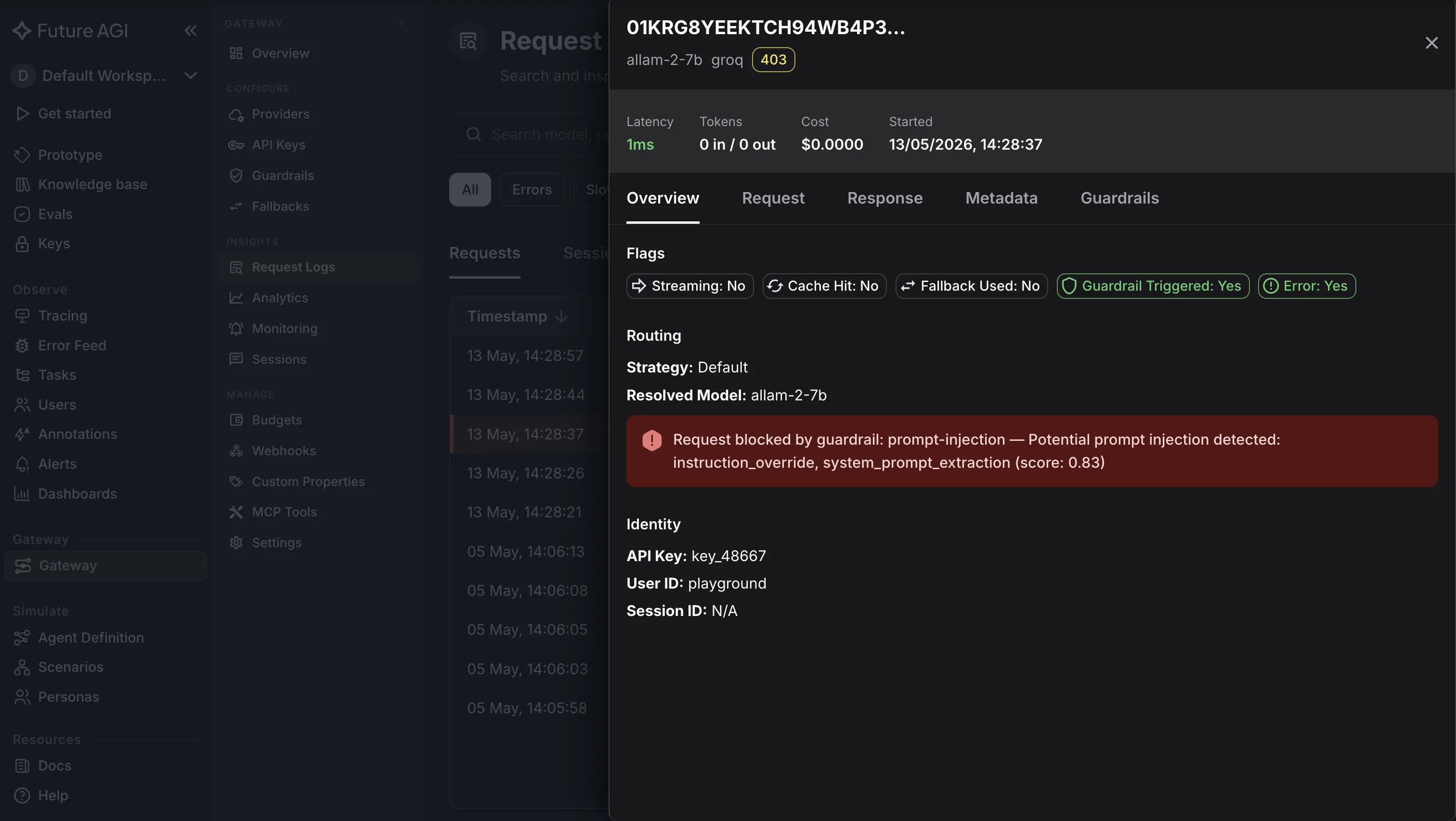
- Red-team eval that closes the loop.
ai-evaluation(Apache 2.0) ships an adversarial probe library (jailbreak, prompt injection, data exfiltration, tool misuse) and findings become test cases the optimizer regresses against. The self-improving loop is the differentiator.
- Language reach. First-party SDKs in Python and TypeScript, OTel-compatible instrumentation for Go, Java, Ruby via
traceAI(Apache 2.0). Teams whose agents run outside Python aren’t second-class.
- OSS instrumentation, hosted enterprise wrap.
traceAI,ai-evaluation, andagent-optare Apache 2.0. The hosted Command Center adds RBAC, failure-cluster views, the Protect runtime, and AWS Marketplace procurement, with a self-serve scale tier.
Migration from Giskard: Giskard test suites map to ai-evaluation test cases. The probe taxonomy translates almost one-to-one, prompt-injection, jailbreak, PII, hallucination, tool misuse are the same buckets. Python SDK call shapes are similar enough that a sed pass plus a half-day of API touchups covers most red-team suites under 200 cases. The bigger lift is optimization wiring: hooking findings into agent-opt and writing the regression set takes a sprint. Timeline: five to ten engineering days for under 200 test cases, including shadow-traffic for Protect.
Where it falls short:
-
agent-opt is opt-in, start with traceAI + ai-evaluation in week one and turn the optimizer on once eval baselines stabilize. The loop compounds value over weeks rather than at day one.
-
For teams who only need a tabular ML scanner, drift, fairness, classification slices. FAGI’s surface is narrower than Giskard’s. We optimize for LLM and agent workloads.
Pricing: Free tier with 100K traces/month. Scale tier from $99/month with linear per-trace scaling above 5M (no add-on multipliers). Enterprise with SOC 2 Type II and AWS Marketplace.
Score: 7 of 7 axes.
2. Arize Phoenix: Best for OTel-native observability with eval flexibility
Verdict: Phoenix is the pick when the requirement is “we want our LLM traces to live in an open standard, and we want to plug whichever eval library makes sense per workflow.” OpenInference plus OTel underneath, deep tracing, and a self-hostable open-source core. You give up Giskard’s pre-packaged scanner-as-product feel; you gain a substrate that any eval library or guardrail tool can sit on top of.
What it fixes versus Giskard:
- LLM-native tracing built on an open standard. OpenInference defines a span schema for LLM calls, retrieval, tool use, and agent loops; Phoenix is the reference implementation. Traces are OTel-compatible, so they can flow into Phoenix and any other OTel sink without re-instrumentation.
- Self-host posture. Arize Phoenix is Apache 2.0 and runs as a single container. The OSS core gives you tracing, datasets, prompt playground, and evaluator scaffolding without a hosted dependency.
- Eval-library agnostic. Phoenix ships its own evaluators and integrates with DeepEval, RAGAS, and most third-party eval libraries. Teams that found Giskard’s bundled probes too prescriptive get more freedom here.
Migration from Giskard: Giskard’s scanner output maps to Phoenix datasets, convert each Giskard test case to a dataset row with input, expected behavior, and ground-truth annotations. Instrument the agent code with OpenInference/OTel; remove Giskard SDK calls. You lose Giskard’s pre-built report formatter; you gain a tracing substrate that travels with the rest of your observability stack. Timeline: seven to ten engineering days for instrumentation plus dataset port.
Where it falls short:
- No runtime guardrail. Phoenix observes and evaluates; it doesn’t block.
- No optimizer. Findings inform humans, not the agent.
- The OSS surface is powerful but DIY, teams who wanted Giskard’s scanner-in-a-box need to compose more themselves.
Pricing: Phoenix OSS is Apache 2.0 and free. Arize AX (the hosted platform that wraps Phoenix) is sales-led; SMB tier from a few hundred dollars per month, enterprise custom.
Score: 5 of 7 axes (missing: runtime guardrail, optimization loop).
3. DeepEval (Confident AI): Best for pytest-shaped LLM evaluation
Verdict: DeepEval is the pick when the team’s mental model is “treat LLM evals like unit tests.” The framework is shaped like pytest (decorators, fixtures, parametrize) and developers who already think in CI assertions move fast. Confident AI is the hosted layer that gives you collaboration, dashboards, and red-team workflows.
What it fixes versus Giskard:
- Developer-first ergonomics. DeepEval’s
@pytest.mark.deepevalandassert_testshape make LLM evals feel like regular tests. Devs run them in CI alongside everything else; the cognitive overhead is close to zero. - Strong LLM-specific community. GitHub stars, Discord active members, and Stack Overflow questions all favor DeepEval over Giskard on LLM topics as of May 2026. Finding an answer to a specific RAG-eval question takes minutes.
- Red-team module. DeepEval ships a red-team package (
deepeval red-team) with attack categories that overlap Giskard’s (prompt injection, jailbreaking, PII leakage, bias) and produce structured findings rather than only a PDF.
Migration from Giskard: Most Giskard probes have a DeepEval analog; the attack taxonomies overlap heavily. Test cases convert mechanically, the Python signatures are different but the inputs and assertions are the same shape. Confident AI takes the hosted-dashboard role Giskard Hub played, with self-serve pricing rather than sales-only. Timeline: four to seven engineering days for under 200 cases.
Where it falls short:
- No runtime guardrail. Like Giskard, DeepEval observes and evaluates; production blocking needs a separate tool (often Lakera Guard or FAGI’s Protect).
- No native optimizer; findings inform humans.
- Confident AI is the polished surface; the OSS framework alone is functional but less collaborative.
Pricing: DeepEval is open source under Apache 2.0. Confident AI has a free tier; team plans from ~$50/seat/month; enterprise custom.
Score: 5 of 7 axes (missing: runtime guardrail, optimization loop).
4. Langfuse: Best for open-source observability + prompt management
Verdict: Langfuse is the pick when the requirement is “self-hostable LLM observability, datasets, and prompt management in one open-source product.” Strong community, MIT-licensed core, and the most-adopted self-hosted LLM observability platform in 2026. You give up Giskard’s pre-canned red-team report shape; you gain prompt versioning, datasets, evaluation primitives, and tracing as one coherent surface.
What it fixes versus Giskard:
- Self-host posture and OSS license. Langfuse Core is MIT-licensed and runs on Postgres + ClickHouse. For teams whose security review preferred a permissive license, this clears the bar.
- Prompt management as a first-class object. Versioned prompts, deploy labels (production, staging), and a UI for non-engineers to iterate. Giskard doesn’t have a comparable surface.
- Eval primitives plus integrations. Langfuse ships its own evaluators and integrates with DeepEval, RAGAS, and OpenAI evals. The dataset object connects eval runs back to specific prompt versions.
Migration from Giskard: Giskard test cases convert to Langfuse datasets; Giskard’s scanner runs become Langfuse evaluation experiments. Instrument the agent via the Langfuse SDK (Python + JS/TS first-party). You lose Giskard’s bundled adversarial probe library; you replace it with DeepEval red-team or a custom suite that writes results back to Langfuse. Timeline: seven to ten engineering days including the prompt-management migration if you adopt that surface.
Where it falls short:
- No runtime guardrail.
- No first-party red-team module, adversarial probes are a separate integration.
- No optimizer.
Pricing: Langfuse Core is MIT and free to self-host. Langfuse Cloud has a free tier, Pro from $59/month, Team from $499/month, Enterprise custom.
Score: 5 of 7 axes (missing: runtime guardrail, native red-team, optimizer).
5. Lakera Guard: Best for runtime AI security
Verdict: Lakera Guard is the pick when the exit reason is specifically “we need a runtime guardrail in front of our LLM, today.” Lakera built its product as an inline security layer from day one, prompt-injection detection, PII redaction, content moderation, all enforced in the request path. It isn’t an eval framework or an observability platform; it’s a guardrail.
What it fixes versus Giskard:
- Runtime enforcement, not offline scanning. Lakera Guard sits inline. The same prompt-injection class that Giskard’s scanner flags in a report, Lakera Guard blocks at request time.
- AI-security focus. OWASP LLM Top 10 alignment, MITRE ATLAS-style threat modeling, and a research team that ships new detectors as new attacks appear. Coverage on prompt injection and jailbreaks specifically is the deepest in this list.
- Language reach. First-party SDKs in Python and JavaScript/TypeScript; REST API for everything else. TypeScript-first teams who hit Giskard’s Python-only wall move fastest here.
Migration from Giskard: Lakera Guard isn’t a like-for-like replacement, it’s the inline-enforcement layer Giskard doesn’t have. Most teams adopt Lakera Guard in addition to keeping an eval framework (DeepEval, Phoenix, or FAGI’s ai-evaluation). For teams whose Giskard usage was 80% red-team probing and 20% policy checks, Lakera Guard plus a lighter eval setup is a clean split. Timeline: two to four engineering days to wire Lakera Guard into the request path; the eval-framework choice is a separate decision.
Where it falls short:
- Not an eval framework. Datasets, test runs, red-team reports. Lakera Guard doesn’t produce these.
- No prompt management or trace storage.
- No optimizer.
- Pricing is sales-led above the free tier.
Pricing: Free developer tier. Paid tiers custom, anchored to request volume and feature surface.
Score: 4 of 7 axes (missing: native red-team report, optimizer, observability depth, by design, it’s a guardrail not a platform).
Capability matrix
| Axis | Future AGI | Arize Phoenix | DeepEval | Langfuse | Lakera Guard |
|---|---|---|---|---|---|
| Runtime guardrail parity | Protect inline (~67 ms) | None | None | None | Native runtime guardrail |
| Red-team coverage | Probe library + regression set | Eval-library agnostic | First-party red-team module | Via DeepEval integration | Prompt-injection focus |
| Closed-loop optimization | agent-opt Apache 2.0 | None | None | None | None |
| Language reach | Python + TS + OTel | Python + OTel | Python | Python + JS/TS | Python + JS/TS + REST |
| Self-host posture | OSS instrumentation + BYOC | Apache 2.0, single container | Apache 2.0 framework | MIT core, self-hostable | Hosted only |
| LLM-native observability | Native sessions + RBAC | OpenInference + OTel | Lighter (Confident AI fills) | Deep traces + datasets | Minimal |
| Migration tooling | Probe taxonomy maps | Dataset conversion | Test-case parity | Dataset + prompt port | Inline-layer wiring |
Migration notes: what breaks when leaving Giskard
Three surfaces always need attention.
Re-writing the red-team suite
Giskard’s Python SDK builds adversarial probes via giskard.scan() and per-detector configuration. Most teams have a handful committed to the repo, plus a few custom probes for domain-specific risks (medical PII, financial regulatory language, etc.). The port does three things: enumerate the detectors used; map each to the destination framework’s equivalent (DeepEval’s red-team module, FAGI’s ai-evaluation probes, or Langfuse + DeepEval); lift custom probes by translating prompt and assertion logic into the new idiom.
The attack taxonomy is portable. The framework-specific glue isn’t. Common cases (prompt-injection, jailbreak, PII, bias, hallucination) are mechanical translations. Harder cases, agent-trajectory probes that depend on Giskard’s orchestration, custom report formatters, Giskard Hub collaboration, need a manual pass. Under 200 test cases ports in three to five days; above that, plan a sprint.
Closing the loop into runtime
This is the migration that isn’t in the Giskard product because the runtime isn’t in the Giskard product. If you leave Giskard for Phoenix, DeepEval, or Langfuse, you still need a separate guardrail vendor. Lakera Guard, FAGI’s Protect, or a self-built rule engine. If you leave for FAGI, eval and guardrail share the same surface and migration is one step instead of two. Document this decision before the SDK rewrite starts.
Hosted Hub to destination dashboard
Giskard Hub stores test runs, datasets, and collaboration artifacts. The export endpoints (/api/v1/test-suites, /api/v1/datasets) return JSON; reconstructing on the destination is straightforward for datasets, less so for test-run history (data models differ per product). Most teams accept losing the historical-run timeline on the cutover date and keep a read-only Giskard Hub instance for six months for audit reference, then sunset it.
Decision framework: Choose X if
Choose Future AGI if your reason for leaving is the offline-only scanner, you want red-team findings to flow into inline guardrails on the same platform, the eval suite to score traces continuously, and the optimizer to regress findings back into prompts and routing. Pick this when production agent workloads are growing and the OSS instrumentation (traceAI, ai-evaluation, agent-opt) plus the hosted Command Center together justify the migration.
Choose Arize Phoenix if your reason for leaving is wanting an open standard underneath everything else. Pick this when OpenInference + OTel as the trace substrate matters more than a pre-canned eval product, and the team has the engineering budget to compose the rest.
Choose DeepEval (Confident AI) if your team writes pytest assertions naturally and wants LLM evals to fit the same shape. Pick this when developer ergonomics and LLM-specific community momentum are the priorities.
Choose Langfuse if your requirement is a self-hostable hub for traces, prompts, and datasets in one OSS product. Pick this when MIT licensing and prompt management as a first-class object matter, and a separate red-team integration is acceptable.
Choose Lakera Guard if the exit reason is specifically “we need a runtime guardrail in the request path now.” Pick this in addition to an eval framework, not instead of one.
What we did not include
Three products show up in other 2026 Giskard alternatives listicles that we left out: RAGAS (excellent RAG-evaluation library, but it’s one component rather than a Giskard-shaped platform replacement, teams typically use it inside Phoenix, Langfuse, or DeepEval); Helicone (strong observability gateway, but the red-team surface isn’t native and the eval depth is shallower than DeepEval or FAGI); PromptFoo (capable eval CLI for prompt comparison, but no hosted hub or red-team module at parity with Giskard).
Related reading
- Best 5 Portkey Alternatives in 2026
- Best LLM Evaluation Frameworks in 2026
- Best AI Gateways for Agentic AI in 2026
Sources
- Giskard documentation, docs.giskard.ai
- Giskard GitHub repository, github.com/Giskard-AI/giskard
- Giskard Hub product page, giskard.ai/hub
- Arize Phoenix documentation, docs.arize.com/phoenix
- Arize Phoenix GitHub repository, github.com/Arize-ai/phoenix (Apache 2.0)
- OpenInference specification, github.com/Arize-ai/openinference
- DeepEval documentation, docs.confident-ai.com
- DeepEval GitHub repository, github.com/confident-ai/deepeval (Apache 2.0)
- Confident AI product page, confident-ai.com
- Langfuse documentation, langfuse.com/docs
- Langfuse GitHub repository, github.com/langfuse/langfuse (MIT)
- Lakera Guard product page, lakera.ai/guard
- OWASP Top 10 for LLM Applications, owasp.org/www-project-top-10-for-large-language-model-applications
- Future AGI Agent Command Center, futureagi.com/platform/monitor/command-center
- Future AGI traceAI, github.com/future-agi/traceAI (Apache 2.0)
- Future AGI ai-evaluation, github.com/future-agi/ai-evaluation (Apache 2.0)
- Future AGI agent-opt, github.com/future-agi/agent-opt (Apache 2.0)
- Future AGI Protect latency benchmark, arxiv.org/abs/2510.13351 (67 ms text, 109 ms image)
Frequently Asked Questions
Why are people moving off Giskard in 2026?
What is the closest like-for-like alternative to Giskard?
How do I migrate a Giskard red-team suite to a new framework?
Is there an open-source Giskard alternative?
Does Giskard have a runtime guardrail like Lakera Guard or Future AGI Protect?
Is Giskard better for tabular ML or LLM workloads?
How does Future AGI Agent Command Center compare to Giskard?
OSS LLM red-team splits three ways: orchestrators (PyRIT), probe libraries (garak), benchmark suites (HarmBench, JailbreakBench, AdvBench).

Red-teaming an LLM is three loops: probe, classify, triage. A 2026 playbook that wires PyRIT and garak into a continuous compounding CI gate.

FutureAGI, Langfuse, Arize Phoenix, Braintrust, and LangSmith as DeepEval alternatives in 2026. Pricing, OSS license, eval depth, and production gaps.
