Best 5 Fiddler AI Alternatives in 2026
Five Fiddler AI alternatives on LLM-native instrumentation, gateway, routing, inline guardrails. What each actually fixes outgrowing ML-monitoring-first.
Table of Contents
Fiddler AI was one of the first vendors to put model monitoring on the enterprise SaaS map. It built its name on tabular ML observability (feature drift, fairness, explainability for credit-scoring models) and earned trust there. The trouble is that LLM workloads don’t look like a tabular credit model, and Fiddler’s LLM features were stitched onto a stack designed for a different problem. Teams that started with Fiddler for classical ML and wanted the same vendor for generative workloads keep hitting the same edges: trace shape that doesn’t match the agent loop, guardrails that live downstream rather than inline, pricing that escalates as LLM volume crosses into seven figures, and a community half the size of the LLM-native cohort.
This guide ranks five alternatives, names what each fixes versus Fiddler, and walks through the migration that always bites: re-instrumenting Fiddler’s Python SDK and REST API calls with OpenTelemetry-shaped traceAI.
TL;DR: pick by exit reason
| Why you are leaving Fiddler AI | Pick | Why |
|---|---|---|
| You want LLM traces plus evals plus an optimizer plus a gateway in one stack | Future AGI Agent Command Center | Closes the loop from trace to eval to optimizer to route, with inline Protect guardrails |
| You want OSS-first LLM tracing with a deep OpenInference community | Arize Phoenix | Apache 2.0, OpenInference standard, self-host, large LLM-specific community |
| You want the broadest hosted LLM-observability surface | Langfuse | SaaS plus self-host, mature prompt management, in-the-loop evals |
| You want a drop-in proxy with friendlier pricing below 10M req/mo | Helicone | Lightweight gateway with per-request cost and session traces |
| You already standardize on Datadog for everything else | Datadog LLM Observability | LLM module on the platform your SRE team already runs |
Why people are leaving Fiddler AI in 2026
Five exit drivers show up repeatedly in r/LLMDevs migration threads, the MLOps Community Slack, G2 reviews from the last two quarters, and procurement renewal threads on Reddit and Hacker News.
1. ML-monitoring-first heritage: LLM features sit on a legacy stack
Fiddler grew up as a tabular model-monitoring platform, feature drift, SHAP-based explainability, fairness audits. The LLM observability and guardrails modules are real, but they’re an additive layer on a data model shaped around tabular features, not around a multi-step tool-using agent or a retrieval-then-generate pipeline. The mismatch is the subject of purpose-built vs general AI observability. Teams notice this in three places: trace views assume a single inference rather than a nested span tree; the drift surface is feature-distribution rooted rather than LLM-judge rooted; and the eval primitives lean on classical-ML metrics rather than the rubric-and-judge pattern that has become the LLM default. The LLM module is competent but never quite native.
2. Enterprise pricing tier escalates as LLM volume grows
Fiddler’s pricing is anchored to annual enterprise contracts, usage-based add-ons, and Tier-1 procurement. As LLM workloads cross into millions of traced spans per month, added LLM seats, guardrail evaluator usage, and storage tiers compound. Q1 2026 renewal threads on Reddit describe annual quotes climbing 40 to 80 percent year-over-year. Compared to Langfuse’s published per-event pricing or Helicone’s $25/month Pro tier, the surface feels opaque.
3. No native gateway or routing: observation only
Fiddler observes traffic. It doesn’t stand between the agent and the provider, so it can’t route, retry on a failed provider, throttle a runaway service, or cap spend at a per-virtual-key boundary. The fix is bolting a gateway (LiteLLM, Helicone, Portkey) next to Fiddler, at which point the team owns two surfaces and a metadata-correlation problem.
4. Smaller LLM-specific community than Phoenix or Langfuse
Fiddler is respected in enterprise MLOps circles, but its LLM-specific community footprint is smaller than Phoenix’s or Langfuse’s. GitHub stars, Discord activity, the long tail of how-to content for LangGraph 0.3 or the Vercel AI SDK all skew toward the LLM-native vendors. Practical impact: fewer community integrations, slower responses to framework releases, thinner third-party examples.
5. No inline guardrails: checks run downstream of the response
Fiddler’s safety and quality checks run as evaluators against captured traces, fine for compliance reporting, but not for blocking a leaking response, routing around prompt injection, or redacting PII inline. Teams bolt on a separate guardrails product (Lakera, Protect AI, or Future AGI’s Protect), two products, two contracts. FAGI migrators cite this as the biggest simplification: Protect runs inline at median 67 ms text-mode latency (arXiv 2510.13351) and feeds the same trace the eval suite reads from.
What to look for in a Fiddler AI replacement
The default “best AI monitoring” axes are necessary but not sufficient for a Fiddler exit. Score replacements on the seven that map to the surfaces you’re actually re-platforming on:
| Axis | What it measures |
|---|---|
| 1. LLM-native trace shape | Are agent loops, tool calls, and retrieval spans first-class, or bolted onto a tabular model? |
| 2. Gateway + routing + cost control | Does the tool stand in the request path or only observe? |
| 3. Inline guardrails | Are safety checks live in the request path, or downstream evaluators? |
| 4. Native eval pipeline | Are LLM-judge scores generated in CI and joined to traces by default? |
| 5. Optimizer loop | Does the tool rewrite prompts or shift routing from eval results? |
| 6. Self-host posture | Can the stack run inside your VPC? |
| 7. Migration tooling from Fiddler | Is there a published path for re-instrumenting Fiddler’s Python SDK and REST API calls? |
1. Future AGI Agent Command Center: Best for closing the loop
Verdict: Future AGI is the only stack in this list that fixes Fiddler’s biggest weakness, observation that never feeds the system, and guardrails that run after the fact. Agent Command Center captures traces via traceAI, runs inline checks via Protect, scores with ai-evaluation, clusters failures, runs the optimizer (agent-opt), and pushes the updated route or prompt back into the gateway on the next request. Fiddler observes; FAGI observes, blocks, scores, rewrites, and routes, in one stack.
What it fixes versus Fiddler AI:
- LLM-native trace shape.
traceAIships OpenInference instrumentation for LangGraph, CrewAI, AutoGen, LangChain, LlamaIndex, OpenAI SDK, Anthropic SDK, Bedrock, Vertex, Vercel AI SDK, and Mastra. Spans are agent-loop and tool-call shaped, not tabular-feature shaped, designed for the workload, not retrofitted.
- Gateway, routing, and Protect in the same stack. Agent Command Center is the gateway too. Virtual keys, per-service routing, fallback policies, and the Protect guardrails layer (median 67 ms text-mode latency per arXiv 2510.13351) sit beside the trace. Cost data slices by session, user, repo, and route natively. Fiddler’s “we observe; bring your own gateway” boundary disappears.
- Inline guardrails, not downstream evaluators. Protect runs in the request path. PII redaction, prompt-injection detection, off-topic blocking, and policy violations are caught before the response ships. The same blocks feed the trace timeline.
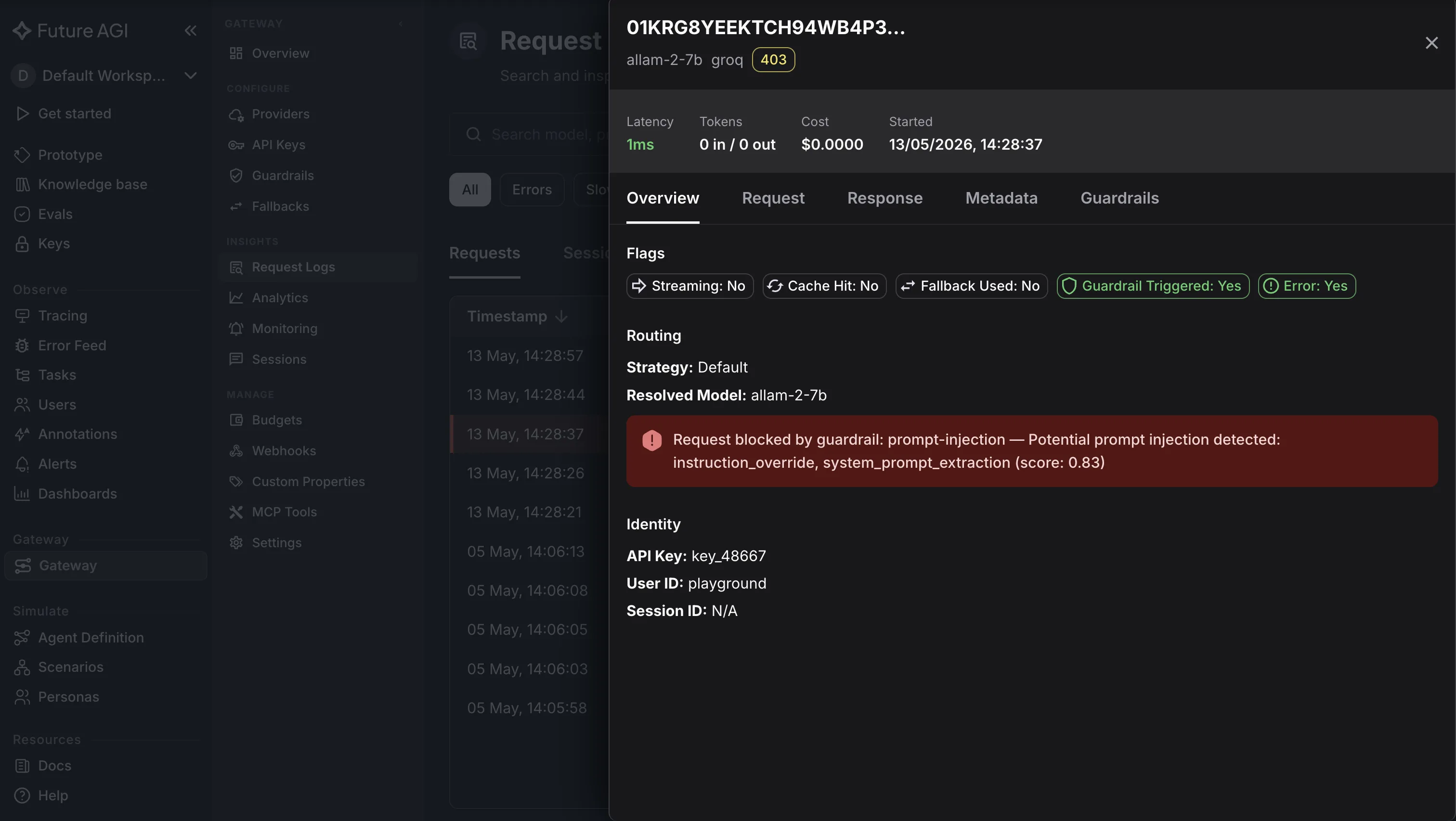
- Native eval, not bolt-on. Every trace is scored against task-completion, faithfulness, tool-use, and ground-truth rubrics by default.
ai-evaluation(Apache 2.0) is the same library teams use in CI, production scoring is the CI pipeline run continuously. - Optimizer in the loop.
agent-opt(Apache 2.0) rewrites prompts via six optimizers — ProTeGi, GEPA, Bayesian, MetaPrompt, RandomSearch, PromptWizard. Failure clusters become inputs; the rewritten prompt ships back to the registry; the next request uses it. Fiddler stops at “here is the drift”; FAGI continues to “here is the rewrite.”
- OSS instrumentation, hosted polish.
traceAI,ai-evaluation, andagent-optare all Apache 2.0. Hosted Command Center adds RBAC, failure-cluster views, Protect, and AWS Marketplace procurement.
Migration from Fiddler AI: Fiddler’s Python SDK (fiddler.publish_event, fiddler.log_publish_event) and REST API endpoints map to traceAI decorators and OTel exporters. Replace project/model/baseline scaffolding with traceAI call sites, point the OTLP exporter at the Command Center collector, and spans land in the FAGI trace view. Prompts move into the FAGI registry as Jinja2 templates. Timeline: seven to ten engineering days for one or two production agents, under 100 prompts, plus a shadow-trace period.
Where it falls short:
-
agent-opt is opt-in, start with traceAI + ai-evaluation in week one and turn the optimizer on once eval baselines stabilize. The loop compounds value over weeks rather than at day one.
-
Classical-ML fairness reporting is thinner than Fiddler’s. For teams whose Fiddler usage is dominated by tabular fairness audits, FAGI isn’t yet a one-for-one replacement on that axis. LLM-bias evaluators ship in
ai-evaluation; the report-generation UX is actively in development.
Pricing: Free tier with 100K traces/month. Scale tier from $99/month, linear per-trace scaling above 5M (no add-on multipliers). Enterprise with SOC 2 Type II and AWS Marketplace.
Score: 7 of 7 axes.
2. Arize Phoenix: Best OSS-first LLM-native option
Verdict: Phoenix is the pick when the requirement is “OpenInference-standard, self-hosted, real LLM-specific community, no gateway needed yet.” Apache 2.0, deep multi-framework coverage via OpenInference, mature Python and TypeScript SDKs. You give up gateway, optimizer, and inline guardrails; you gain the most polished OSS LLM-observability platform.
What it fixes versus Fiddler AI:
- LLM-native trace shape via OpenInference. Phoenix is one of two reference implementations (with
traceAI) of the OpenInference standard. Agent loops, tool calls, retrieval spans, and LLM I/O are first-class, designed in, not bolted on. - Real OSS posture. Apache 2.0, runs on a laptop or in your VPC. No telemetry leaves unless you configure an OTel sink. Phoenix at $0 covers the observation surface cleanly.
- Mature LLM-specific community. Tens of thousands of GitHub stars, weekly releases, a Slack channel where LangChain and LlamaIndex maintainers are active. Long-tail how-to coverage for LangGraph, the Vercel AI SDK, and the major retrieval frameworks is deeper than Fiddler’s.
- In-notebook evals.
phoenix.evalsruns LLM-judge scoring in the same notebook where the team explores traces. The same evals ship to CI without rewriting.
Migration from Fiddler AI: Fiddler’s Python SDK calls map to openinference-instrumentation-* decorators (the same library family traceAI builds on). OTLP exporter points at the Phoenix collector. Where Fiddler scaffolds projects, models, and baselines, Phoenix expects spans and lets the dataset emerge. You lose classical-ML fairness reporting, enterprise SOC posture without an Arize upgrade, and inline guardrails entirely. Timeline: five to seven engineering days for observation cutover, plus separate work for gateway and guardrails if those are exit drivers.
Where it falls short:
- No gateway, no routing, no virtual keys. Observation only.
- No inline guardrails. Phoenix sees the response after it ships.
- No optimizer. Traces inform humans, not the system.
- Self-host operations require care at high span volume (docs are honest about trade-offs above a few thousand spans per second).
Pricing: Phoenix OSS is Apache 2.0 and free. Arize AX (hosted) starts at a free developer tier and scales to enterprise plans for production deployments.
Score: 4 of 7 axes (missing: gateway/routing, inline guardrails, optimizer).
3. Langfuse: Best broad hosted LLM-observability surface
Verdict: Langfuse is the pick when the requirement is the widest LLM-observability feature surface in a single hosted product, traces, prompt management, eval runs, datasets, and a generous self-host option. MIT-licensed core with hosted SaaS. You give up gateway, routing, and inline guardrails; you gain the most complete hosted LLM-observability product here.
What it fixes versus Fiddler AI:
- Trace + prompt management + evals in one product. Langfuse couples a trace viewer to a versioned prompt store and a dataset-and-eval runner. The same trace that flagged a regression links to the prompt version that produced it and the eval run that scored it.
- Mature self-host story. Langfuse OSS is MIT-licensed, runs on Postgres and ClickHouse, and is the most-deployed self-hosted LLM-observability platform in this list. Teams whose Fiddler exit is partly a data-residency conversation keep trace data inside their VPC.
- Friendly hosted pricing curve. Langfuse’s hosted tiers publish per-event pricing, not opaque enterprise quotes. A team running 5M events per month can predict the bill at renewal. Compared to Fiddler’s annual escalation pattern, the cost surface is transparent.
- OpenTelemetry-native trace ingestion. Langfuse accepts OpenInference and OTel spans alongside its first-party SDKs. A
traceAIinstrumented codebase can dual-write to Langfuse and FAGI without changing decorators.
Migration from Fiddler AI: Fiddler’s Python SDK rewrites to Langfuse’s Python SDK or to OpenInference/OTel spans pointed at the Langfuse collector. Prompt literals move into the Langfuse prompt store as versioned objects. Eval rubrics translate from Fiddler’s evaluator definitions to Langfuse’s eval runs. You lose tabular ML observability surfaces entirely. Timeline: six to nine engineering days for observation and prompt-management cutover, plus separate work for gateway and guardrails.
Where it falls short:
- No gateway or virtual keys, pair with LiteLLM or Helicone for cost control.
- No inline guardrails, checks run as eval evaluators against captured traces.
- Optimizer is roadmap, not default. Langfuse Studio offers prompt experimentation; the closed-loop optimizer-to-registry-to-gateway pattern isn’t there.
- Tabular fairness and bias-audit reporting don’t exist; Langfuse is LLM-only.
Pricing: Self-host is free under MIT. Hosted Core starts free, Pro from $59/month, Team from $499/month with per-event pricing above the included envelope.
Score: 5 of 7 axes (missing: gateway/routing, inline guardrails, optimizer).
4. Helicone: Best lightweight hosted observability
Verdict: Helicone is the pick when the reason for leaving Fiddler is pricing and you don’t need the full eval-and-optimizer surface. Drop-in proxy with per-request cost telemetry, session traces, and a clean dashboard. The product acquired Mintlify in March 2026, so parts of the docs experience are in flux, but the core proxy and cost surface are stable.
What it fixes versus Fiddler AI:
- Drop-in proxy posture. A one-line
base_urlchange in front of the OpenAI or Anthropic SDK. No SDK swap, no agent re-instrumentation, no event-publishing scaffolding. Compared to Fiddler’s project/baseline/publish_event surface, dramatically lighter. - Friendlier pricing below 10M requests/month. Helicone’s Pro tier starts at $25/month and scales gently. For teams whose Fiddler quote climbed past comfort, the order-of-magnitude difference at low-to-mid volume is the headline.
- Self-host option. Apache 2.0 self-host on Postgres + ClickHouse. Scale-out beyond a few hundred RPS requires care.
- Per-session traces and per-request cost. Answers what Fiddler’s tabular surface answers awkwardly: what did this session cost, and what happened in this conversation?
Migration from Fiddler AI: Helicone is a proxy, not a Python SDK. A base_url change plus mapping Fiddler’s user-attribution metadata to Helicone’s Helicone-User-Id and custom property headers. You lose Fiddler’s evaluators, drift surfaces, and guardrails entirely. Timeline: three to five engineering days plus separate work for evals (most teams pair with Phoenix evals or ai-evaluation) and guardrails if in scope.
Where it falls short:
- No native evals or optimizer. Helicone is observation and cost telemetry, not a closed loop.
- No inline guardrails.
- Routing intelligence is basic (round-robin and failover); cost-aware routing needs upstream code.
- The Mintlify acquisition is recent enough that some docs surfaces are still moving.
- No first-party agent-framework instrumentation, coverage rides on the provider-SDK proxy boundary.
Pricing: Free tier with 10K requests/month. Pro from $25/month. Enterprise custom.
Score: 3 of 7 axes (missing: native evals, optimizer, inline guardrails, framework-level instrumentation depth).
5. Datadog LLM Observability: Best for teams already on Datadog
Verdict: Datadog LLM Observability is the pick when the company already runs Datadog for infrastructure, APM, and logs, and the path of least resistance is to extend the existing contract with the LLM module. Strength: platform familiarity, your SRE team operates Datadog, dashboards already speak Datadog, LLM traces land next to the service traces they correlate with. Weakness: LLM-specific depth lags the LLM-native vendors, and per-host pricing gets uncomfortable as agent fleets grow.
What it fixes versus Fiddler AI:
- One platform for infra, APM, logs, and LLM. Consolidating LLM observability onto Datadog removes a vendor, a contract, a data plane, and a metadata-correlation problem.
- **Enterprise procurement is already done.Renewal is one line on an existing PO.
- APM correlation. LLM spans join service spans via the same trace ID. An agent latency spike correlates with a Postgres slowdown or Redis eviction in the same dashboard.
- Provider SDK auto-instrumentation. The Datadog tracer auto-instruments OpenAI, Anthropic, Bedrock, and Vertex; the agent-framework story is thinner but improving.
Migration from Fiddler AI: Fiddler’s Python SDK calls rewrite to Datadog tracer calls or OpenTelemetry exporters pointed at the Datadog Agent. The trace shape comes through but loses some agent-loop and tool-call structure that OpenInference encodes natively. Eval evaluators translate to Datadog’s evaluations module; the surface is more limited than Langfuse’s or FAGI’s. Tabular ML fairness reporting is gone. Timeline: eight to twelve engineering days because the conversation crosses platform and application teams.
Where it falls short:
- LLM-specific surfaces (prompt management, versioning, dataset evals) are thinner than the LLM-native vendors. Best when LLM observability is one of many surfaces on Datadog, not the team’s only observability tool.
- No inline guardrails. Datadog observes, it doesn’t block.
- No optimizer, no prompt-rewrite loop.
- Per-host pricing compounds as the agent fleet grows in a way per-event pricing doesn’t.
- Agent-framework instrumentation for LangGraph, CrewAI, AutoGen leans on OTel community contributions more than first-party support; the gap closes monthly but lags Phoenix and FAGI.
Pricing: Datadog LLM Observability is priced per host plus per-span ingestion. The realistic starting point for a team with three to five hosts is roughly $1.5K–$3K/month, scaling with both host count and span volume.
Score: 4 of 7 axes (missing: inline guardrails, optimizer, prompt-management depth).
Capability matrix
| Axis | Future AGI | Arize Phoenix | Langfuse | Helicone | Datadog LLM Obs |
|---|---|---|---|---|---|
| LLM-native trace shape | OpenInference, agent-loop first-class | OpenInference reference impl | OpenInference + native SDK | Proxy-level traces | OpenInference accepted, mapping leaner |
| Gateway + routing + cost control | Native | None | None | Native proxy | None |
| Inline guardrails | Native (Protect, 67 ms text) | None | None | None | None |
| Native eval pipeline | ai-evaluation (Apache 2.0) | phoenix.evals | Eval runs + datasets | External pairing | Evaluations module (limited) |
| Optimizer loop | agent-opt closed loop | None | Studio (experimental) | None | None |
| Self-host posture | OSS instrumentation + BYOC | Apache 2.0, full VPC | MIT, full VPC | Apache 2.0 self-host | Datadog Agent in VPC |
| Migration tooling from Fiddler | traceAI drop-in, prompt importer | OpenInference instrumentation | OTel + native SDK | Header mapping | Datadog tracer config |
Migration notes: what breaks when leaving Fiddler AI
Three surfaces always need attention.
Re-instrumenting the Python SDK
Fiddler’s instrumentation is built around its fiddler Python package: define a project, register a model, publish events with fiddler.publish_event or fiddler.log_publish_event. Migration recipe: replace the Fiddler client with an OpenInference-shaped library (traceAI, openinference-instrumentation-*, Langfuse SDK or OTel, Datadog tracer), point the OTLP exporter at the destination collector, and let the spans flow. Where Fiddler scaffolds project/model/baseline objects, OpenInference expects spans to carry the structure. For 20 to 50 call sites the rewrite is two to four engineering days; nested agent loops and tool calls need a careful pass.
Re-platforming the REST API integrations
Fiddler’s REST API is used in three places: dashboard automation, alerts on drift or evaluator thresholds, and audit exports. Rebuild dashboard queries in the destination’s query language (Phoenix’s SQL-over-spans, Langfuse’s GraphQL, FAGI’s filter DSL, Datadog’s query language); recreate alerts in the destination’s alert primitive; replace audit exports with the destination’s equivalent. Watch alert-rule semantics. Fiddler’s drift alerts have a specific statistical baseline; eval-threshold alerts on the destination have different defaults. Plan a two-week shadow period to validate alerts fire on the same conditions.
Replacing the inline guardrails gap
Fiddler doesn’t run inline guardrails, so this is an addition. Pick a guardrails layer (Future AGI’s Protect, Lakera Guard, Protect AI Sightline, or a custom pre/post-prompt filter), wire it into the request path as part of the new gateway or as a sidecar, and connect its block/redact events to the destination’s trace. Future AGI’s Protect plus the Command Center is one integration; Phoenix or Langfuse plus a separate guardrails vendor is one more contract.
Decision framework: Choose X if
Choose Future AGI if the exit reason is more than legacy heritage or pricing, you also want inline guardrails, a native eval pipeline, and an optimizer that rewrites prompts and shifts routing from trace data. Pick this when production LLM workloads are a serious line item and the OSS instrumentation plus hosted Command Center justify a single-vendor consolidation.
Choose Arize Phoenix if the requirement is OpenInference standard, self-hosted, large LLM-specific community, and gateway/guardrails/optimizer surfaces are out of scope. Pick this when observation is the only thing leaving Fiddler with you.
Choose Langfuse if the requirement is the widest hosted LLM-observability surface (traces, prompt management, eval runs, datasets) and the gateway and guardrails will be separate products. Pick this when prompt management is a first-order requirement.
Choose Helicone if the exit reason is primarily pricing, the workload is below 10M requests per month, and a lighter surface is a feature.
Choose Datadog LLM Observability if the company already runs Datadog for everything else. Pick this when SRE familiarity and platform consolidation outweigh LLM-specific depth.
What we did not include
Three products show up in other 2026 Fiddler AI listicles that we left out: WhyLabs (LLM features on a tabular-rooted product, same shape of problem as Fiddler, different vendor); Aporia (acquired by Coralogix in late 2024; the standalone roadmap folded into Coralogix); TruEra (acquired by Snowflake in 2024; standalone product surface no longer exists).
Related reading
- Best 5 AgentOps Alternatives in 2026
- Best 5 Portkey Alternatives in 2026
- Best LLM Observability Platforms in 2026
- What Is an AI Gateway? The 2026 Definition
Sources
- Fiddler AI Python SDK documentation, docs.fiddler.ai
- Fiddler AI REST API documentation, docs.fiddler.ai/api
- Arize Phoenix open-source repository, github.com/Arize-ai/phoenix
- Langfuse open-source repository, github.com/langfuse/langfuse
- Helicone open-source self-host, github.com/Helicone/helicone
- Helicone acquisition of Mintlify, March 2026, helicone.ai/blog
- Datadog LLM Observability product page, datadoghq.com/product/llm-observability
- OpenInference specification, github.com/Arize-ai/openinference
- Reddit /r/LLMDevs migration discussions, Q1-Q2 2026
- MLOps Community Slack, observability channel, 2026
- Future AGI Agent Command Center, futureagi.com/platform/monitor/command-center
- Future AGI traceAI, github.com/future-agi/traceAI (Apache 2.0)
- Future AGI ai-evaluation, github.com/future-agi/ai-evaluation (Apache 2.0)
- Future AGI agent-opt, github.com/future-agi/agent-opt (Apache 2.0)
- Future AGI Protect latency benchmark, arxiv.org/abs/2510.13351 (67 ms text, 109 ms image)
Frequently Asked Questions
Why are people moving off Fiddler AI in 2026?
What is the closest like-for-like alternative to Fiddler AI?
How do I migrate off Fiddler's Python SDK?
Is there an open-source Fiddler AI alternative?
Which Fiddler AI alternative is cheapest at scale?
How does Future AGI Agent Command Center compare to Fiddler AI?
Honest 2026 comparison of Future AGI vs Fiddler AI: LLM eval, agent observability, traditional ML monitoring, pricing, integrations, and team-fit guidance.

Honest 2026 comparison of the best Arize AI alternatives: Future AGI, Langfuse, LangSmith, Braintrust, Datadog. Pricing, gateway, eval depth, license.

Five Datadog LLM Observability alternatives on OpenInference, bundle-free pricing, gateway-native routing. What each actually fixes when you re-point OTel.
