Best Enterprise Prompt Management Platforms in 2026
The 7 best enterprise prompt management platforms in 2026, compared on access control, versioning, evaluation, and security for large, regulated AI teams.
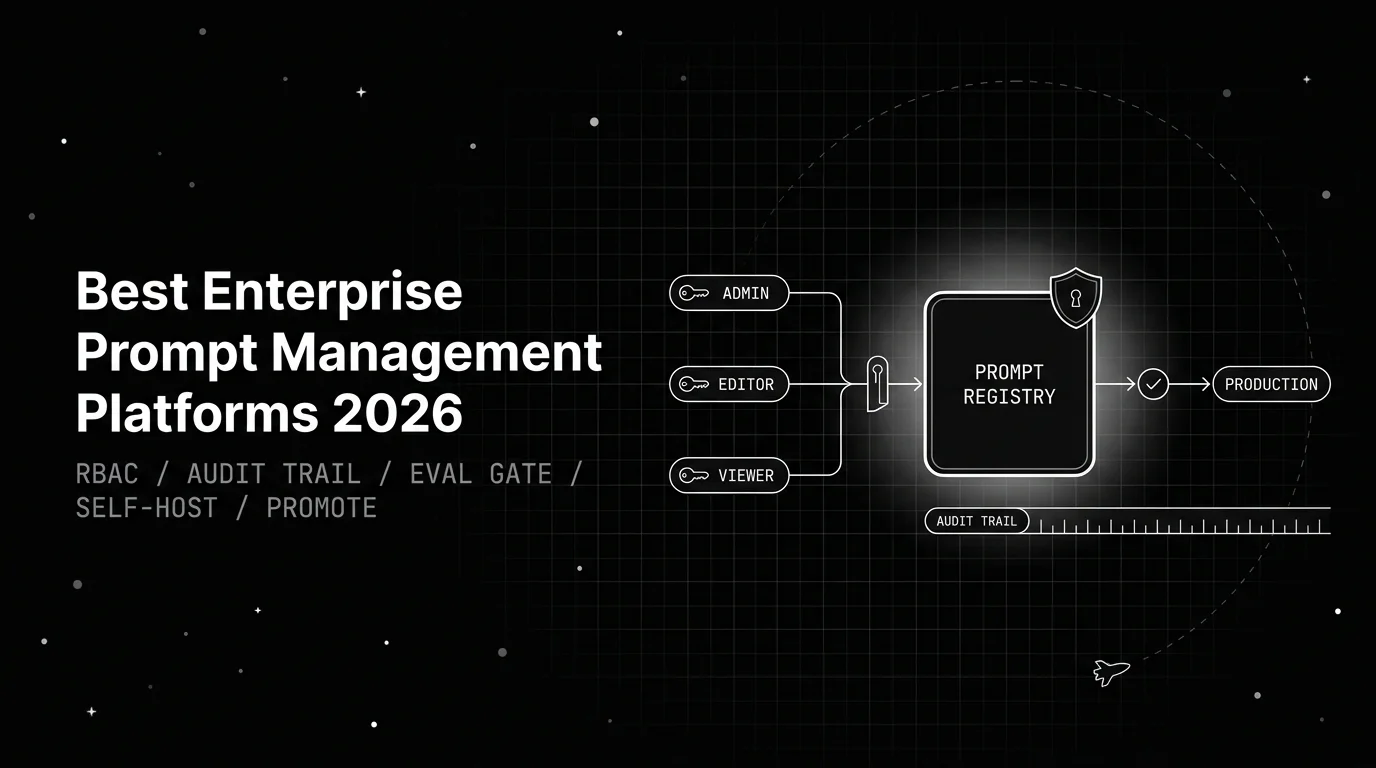
Table of Contents
A dozen teams share one prompt registry. Then something breaks in production, and the incident review asks three questions the tool cannot answer. Who changed the production prompt? What did it score before it shipped? Did the customer data in the test set ever leave our network? Generic prompt management stores versions. Enterprise prompt management governs them. This guide ranks the seven enterprise prompt platforms worth a serious look in 2026. We score each one on access control, audit trails, evaluation, compliance, and whether the whole loop can run inside your own network.
TL;DR: 7 Enterprise Prompt Management Platforms Scored on Governance, Not Just Storage
Future AGI is the strongest overall enterprise prompt management platform for 2026. It runs the whole prompt lifecycle inside your own network on an Apache-2.0 core. You version with Production and Staging labels, score with custom evals, catch regressions with a CI/CD gate, improve prompts with six algorithms, and watch live traffic with traceAI. What sets these platforms apart is governance: who can change what, what gets recorded, and whether data stays inside your boundary.
| Rank | Tool | Best for | Standout capability |
|---|---|---|---|
| 1 | Future AGI | Governing the whole loop inside your own perimeter | Self-hostable Apache-2.0 core with RBAC, an audit log, custom evals, and a CI/CD gate |
| 2 | PromptLayer | Dedicated enterprise prompt registry | Release labels and traffic-split dynamic labels on a registry-first product |
| 3 | LangSmith | LangChain-native enterprises | Commit-hash versions with named Environments and SOC 2 Type II |
| 4 | Vellum | Release-governed deployment workflow | Versions, Deployments, and Releases with immutable audit logs and VPC |
| 5 | Braintrust | Eval-centric enterprise, data plane in your VPC | Hybrid deployment that keeps prompts and traces inside your own cloud |
| 6 | Langfuse | Open-source enterprise self-host | MIT core with labels and protected production pointers |
| 7 | Maxim AI | A broad agent simulation and evaluation suite | Enterprise posture across a simulate, eval, and observe platform |
Why Does Enterprise Prompt Management Break in Production?
A prompt is production logic. It often carries proprietary instructions and real customer data in its examples, and in a large company many people edit that logic across many teams. The moment more than one team shares a registry, storage stops being the hard part. Governance becomes the hard part. Three requirements separate an enterprise-grade platform from a generic one.
The first is access control and an audit history, not just version storage. At enterprise scale, you have to answer two questions: who is allowed to change a production prompt, and who actually did. Role-based access control, or RBAC, ties each permission to a role. A junior engineer can draft a prompt but not promote it. An audit history then records every version change with an author and a timestamp. Without both, a shared registry is a shared liability.
The second is safe promotion and rollback with no code release. If anyone can push a version to production with one careless click, you are one click from a customer-facing bug. The enterprise pattern points a label at a known-good version. Senior roles control that label, and rollback is a single deliberate step, not a redeploy.
The third, which most tools skip, is scoring and data residency together. A version you cannot score is one you cannot trust. Regulated teams also have to keep prompt IP and customer data inside a controlled boundary. You do that in one of two ways: a vendor’s SOC 2 or HIPAA proof on the cloud, or self-hosting. This scorecard rewards how completely a platform governs all four: access, audit, scoring, and where the data lives.
How Did We Score These Enterprise Platforms?
We scored every tool with the Enterprise Governance Scorecard. It is a seven-part rubric built for the question this title asks: not which tool stores a version, but which one governs prompts safely across many teams. Most roundups score on features and stars. This rubric adds what an enterprise security review actually asks about: access control, audit trails, scoring before a version ships, and where the data lives.
| # | Dimension | What we measure |
|---|---|---|
| 1 | License and free self-host | The exact license, and whether the whole stack self-hosts free or only on Enterprise |
| 2 | RBAC and access governance | Organization, workspace, and object-level roles and permissions |
| 3 | SSO and SAML | Identity from your own provider, not a separate login |
| 4 | Audit trail | A record of who changed which version, when |
| 5 | Compliance and data residency | SOC 2, ISO 27001, HIPAA, GDPR, or self-host inside your perimeter |
| 6 | Built-in evaluation | A library that scores a candidate before promotion, plus a CI/CD gate |
| 7 | Automated optimization | A higher-scoring next version generated on your infrastructure |
We do not publish one combined score. The decision table later maps buyer profiles to picks.
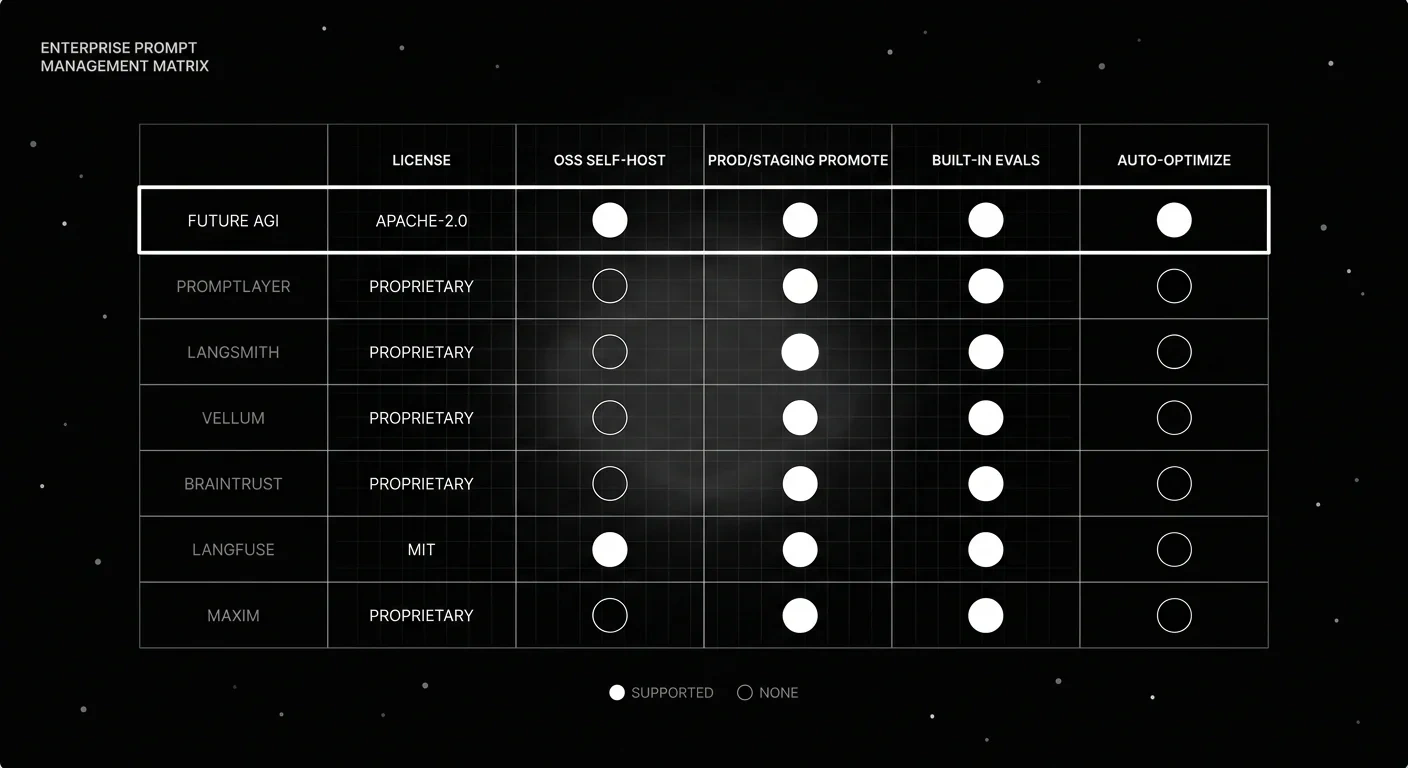
| Tool | License / self-host | RBAC and audit | Built-in evals | CI/CD eval gate | Auto-optimize |
|---|---|---|---|---|---|
| Future AGI | Apache-2.0 core, self-host free | Workspace RBAC, audit log | Custom evals | Yes | Six algorithms (agent-opt) |
| PromptLayer | Proprietary, self-host Enterprise | Team workspaces | Evals on the registry | Manual | No |
| LangSmith | Proprietary, self-host Enterprise | Workspace roles | Eval SDK | Manual | No |
| Vellum | Proprietary, VPC on Enterprise | RBAC, SSO/SAML, audit logs | Test suites | Manual | No |
| Braintrust | Proprietary, hybrid on Enterprise | RBAC, SSO/SAML, object groups | Core eval product | Manual | Loop agent (proprietary) |
| Langfuse | MIT core, self-host free | RBAC, SSO on Enterprise | Prompt Experiments | Manual | No |
| Maxim AI | Proprietary, in-VPC on Enterprise | RBAC, SSO | Evaluator library | Manual | No |
Storage, built-in scoring, and label-based promotion are now table stakes. Every platform here has them. The enterprise differences are narrower. Only Future AGI and Langfuse offer free open-source self-hosting. Only Future AGI runs the same evals as a CI/CD gate and adds open-source optimization on top of the governed registry. The security posture, where the governance story really lives, is its own comparison.
| Tool | Compliance | Self-host / data residency | Access governance |
|---|---|---|---|
| Future AGI | SOC 2 Type II and HIPAA BAA on paid plans, or compliance by architecture | Apache-2.0 core, self-host via Docker Compose | Workspace RBAC, in-product audit log |
| PromptLayer | Proprietary, vendor cloud | Enterprise self-host only | Team workspaces |
| LangSmith | SOC 2 Type II, HIPAA, GDPR | Enterprise, choose your data region | Workspace roles |
| Vellum | SOC 2 Type I and II, HIPAA | VPC deployment on Enterprise | RBAC, SSO/SAML, immutable audit logs |
| Braintrust | SOC 2 Type II, HIPAA | Hybrid, data plane in your VPC | RBAC, SSO/SAML, object-level groups |
| Langfuse | SOC 2 Type II, ISO 27001, HIPAA, GDPR | Free MIT self-host plus Enterprise | RBAC, SSO on Enterprise |
| Maxim AI | SOC 2 Type 2, ISO 27001, HIPAA, GDPR | In-VPC deployment on Enterprise | RBAC, SSO |
1. Future AGI: Best Overall for Governing the Whole Loop Inside Your Perimeter
Quick take. Future AGI runs the entire prompt lifecycle inside your own network on an Apache-2.0 core. You author a prompt, version it with Production and Staging labels, score it with custom evals, gate it in CI/CD, improve it with six algorithms, and watch it in production. That turns compliance into a question of architecture. When the whole loop runs inside your boundary, prompts and eval data never reach an outside processor.
Ideal for. Regulated, security-conscious enterprises that want to author, govern, score, and improve prompts on hardware they control. The alternative is a hosted registry they have to vet as an outside data processor. It fits teams that need the whole prompt lifecycle in one governed place, not three separate vendors wired together.
Key strengths.
-
Locked versions, label-based promotion, and an audit trail. Every save is stored as a version that cannot be altered later. A label decides which version each environment runs: Production, Staging, or Development. To promote or roll back, you hand a label to a different version. The change needs no code release, and the audit log stamps it with a name and a time.
-
Workspace RBAC over a shared registry. Future AGI sorts access by organization and workspace roles. Many teams share one registry, yet only authorized roles can change a production prompt, and an in-product audit log records each change. That is the access governance an enterprise needs before it lets a dozen teams into the same prompt store.
-
Versions that are scored, not just saved. Every version can be graded by custom evals, rules you write in plain English that score what the business values, such as answer quality, safety, and format. You compare a candidate against the live production version on one dataset before you pick which one ships. A version earns its promotion on evidence, not on trust.
-
Evals as a CI/CD gate. You can run the same evals as a gate in your CI/CD pipeline. A prompt regression is caught in the pipeline, not in front of customers. For a multi-team registry, that is the audit-friendly way to stay safe.
-
Optimization that runs on your own hardware. The open-source agent-opt library packs six algorithms: Random Search, Bayesian, ProTeGi, Meta-Prompt, PromptWizard, and GEPA. Point one at a weak version together with an evaluator, and it yields a higher-scoring rewrite. Where a proprietary optimizer here runs in a vendor cloud, this one improves a version on your own hardware, and nothing leaves your network.
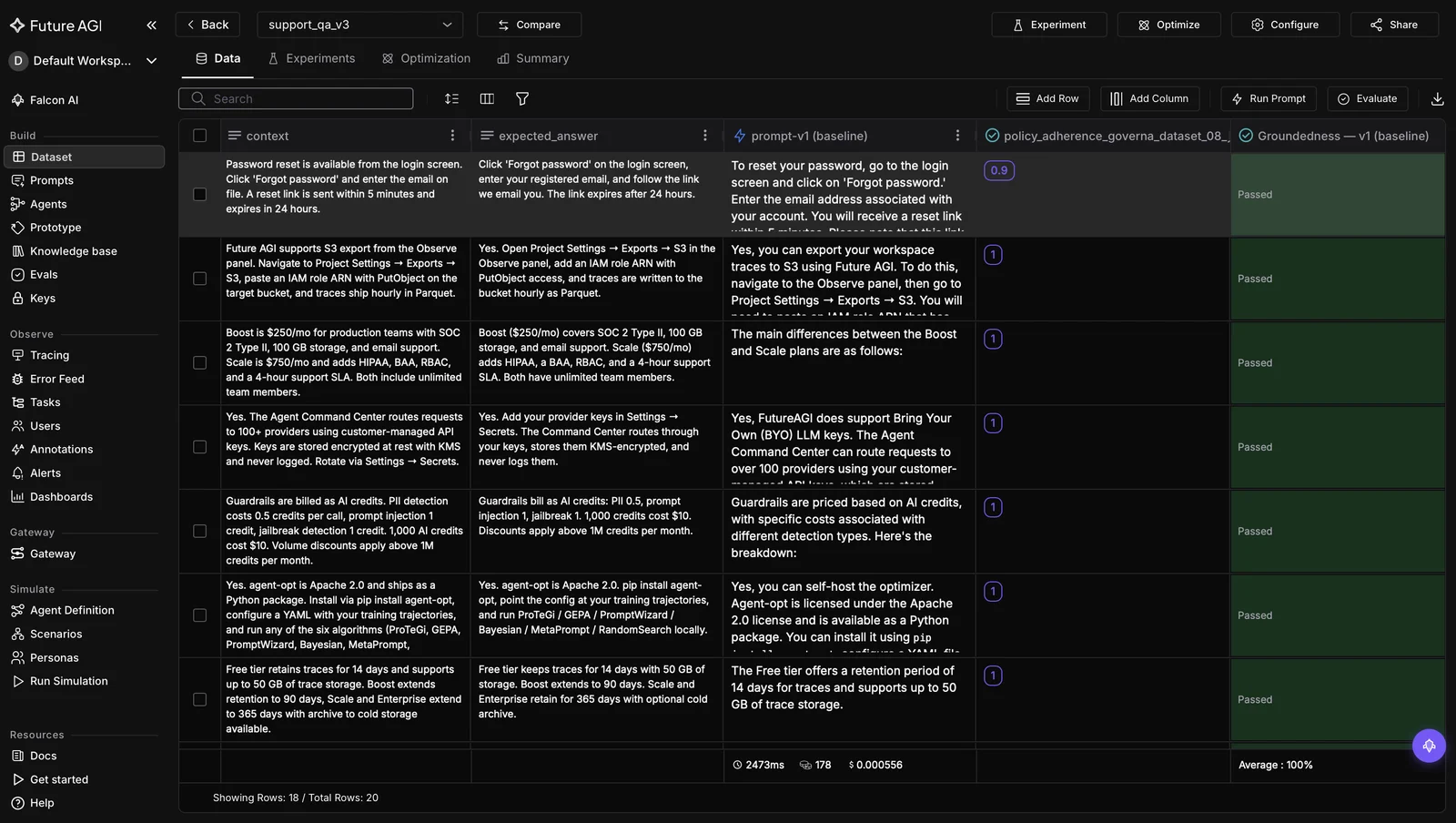
Pricing and deployment. Future AGI has a free tier, pay-as-you-go usage, and Enterprise plans on its pricing page. The core SDK and product repos are Apache-2.0. You self-host them at no license cost with Docker Compose. Paid plans add SOC 2 Type II and a HIPAA BAA. So you can meet compliance by certificate on the cloud, or by architecture inside your own network.
Verdict. Future AGI is the strongest overall enterprise pick because governance covers the full prompt lifecycle, not just version storage. Authoring, label-based promotion, custom evals, a CI/CD gate, six algorithms, and production tracing all run on one Apache-2.0 platform you self-host. Choose it when you need the whole loop inside your own compliance boundary.
2. PromptLayer: Best Dedicated Enterprise Prompt Registry
Quick take. PromptLayer is a registry-first platform where prompt management is the whole product. That makes it a clean fit for enterprises that want a polished, dedicated control plane for prompts, edited by engineers and non-engineers alike. Its versioning is visual: numbered versions, a commit-style history, and a diff on every change. A product manager can review what changed without opening a terminal.
Ideal for. Enterprises that treat prompts as a first-class product and want a dedicated registry with visual release controls. Product managers and domain experts can review and approve versions alongside engineers. It works well when cross-functional ownership is the norm, and when self-hosting is on the table for an Enterprise contract.
Key strengths.
- Each version carries a message and a visual diff against prior versions. A product manager or subject-matter expert can see exactly what changed without reading code or pulling a git history.
- Release Labels map a version to environments such as
prodandstaging. Dynamic Release Labels can split traffic by percentage or user segment for staged rollouts. Rollback is reassigning a label, not a redeploy. - Evaluations and Datasets live on the prompt page, so a version is scored right where it is edited. Self-hosting is available on Enterprise for teams that need it.
Limitations. PromptLayer is proprietary, and self-hosting is gated to an Enterprise contract rather than a free open license. The version model is linear, with no branch or merge. Evaluation is lighter than on eval-led platforms, and there is no built-in optimizer to generate a better next version.
Pricing. A free tier, a Pro tier, and a Team tier in the cloud, with self-hosting available on Enterprise.
Verdict. PromptLayer is the strongest dedicated registry for enterprises that want prompts treated as a first-class product, with visual release controls and cross-functional editing. Free self-hosting requires an Enterprise contract, not an open license, and there is no built-in optimizer. Prompt improvement stays manual after you ship a version.
3. LangSmith: Best for LangChain-Native Enterprises
Quick take. LangSmith is the prompt and evaluation layer built by the LangChain team. For an enterprise already standardized on LangChain or LangGraph, it is the most natural fit, with SOC 2 Type II, HIPAA, and GDPR coverage and a choice of data region. Its versioning is commit-based and immutable, each version identified by a commit hash and surfaced through the Prompt Hub.
Ideal for. Enterprises whose stack is built on LangChain or LangGraph and who want prompts, tracing, and evaluation from one vendor, with SOC 2 Type II, HIPAA, and GDPR proof. If your services already emit LangChain runs, LangSmith captures them with no extra setup, so a versioned prompt and its traces sit side by side.
Key strengths.
- Every save creates a new immutable commit, identified by a commit hash. Human-readable tags move on their own to point at a chosen commit. It maps cleanly onto how engineers already think about code.
- A named Environments feature promotes commits between targets such as Staging and Production with no code change. A diff toggle compares two commits side by side.
- Experiments score a specific app version against a dataset, so scoring lives next to the traces. The platform publishes SOC 2 Type II, HIPAA, and GDPR coverage, with a choice of regional hosting.
Limitations. LangSmith is proprietary even though LangChain itself is open source. Self-hosting is an Enterprise arrangement, and the free path keeps your prompts and eval data in the vendor cloud. Its value is concentrated in the LangChain world and thins for teams on other frameworks. There is no built-in optimizer, so improving a version after a low score is manual work.
Pricing. A free Developer tier and a per-seat Plus tier, with Enterprise adding self-hosting, BAAs, and regional options.
Verdict. LangSmith is the strongest enterprise pick when your stack is LangChain and you want prompts, tracing, and evaluation from one team. The free tier is hosted, with your data in the vendor cloud, and self-hosting requires an Enterprise contract. Teams that need to stay fully inside their own network at no license cost will look elsewhere.
4. Vellum: Best Release-Governed Deployment Workflow
Quick take. Vellum models prompt shipping as a release pipeline. Prompt Versions become Deployments, Deployments cut Releases, and a Release Tag such as prod points at a chosen release. For an enterprise that wants change management to look like software release management, that structure is the draw. It is backed by SOC 2 Type I and II, HIPAA, RBAC, SSO and SAML, immutable audit logs, and VPC deployment.
Ideal for. Enterprises that want prompt promotion to look like a governed software release, with an auditable history per environment and a VPC option. It suits teams where change-management rigor, not speed, is the priority, and where RBAC, SSO, SAML, and immutable audit logs have to be built into the release workflow from the start.
Key strengths.
- A three-layer model separates a Prompt Version from a Deployment and a Release. Each environment gets its own auditable release history, and a one-click revert to a prior release.
- The enterprise posture is deep: RBAC, SSO and SAML, immutable audit logs for full traceability, and VPC deployment with data-residency options, on top of SOC 2 Type I and II and HIPAA.
- Test suites score a version before it is released, so scoring sits inside the release workflow rather than beside it.
Limitations. Versions and tags are linear, with no branch or merge. Pricing adds machine add-ons and a platform fee on top of the base plan, so the total is harder to forecast than a flat tier. The broader platform is more than a prompt registry, so there is more surface to adopt before the first deploy.
Pricing. A free tier with pay-as-you-go credits and a Pro tier with add-ons and a platform fee, with VPC deployment and the deepest controls on Enterprise.
Verdict. Vellum is the best pick when prompt promotion should follow a formal release pipeline, with immutable audit logs, RBAC, SSO, and a VPC option. The layered Versions, Deployments, and Releases model adds concepts to learn upfront. It rewards teams that value auditability over simplicity, and it is a lighter fit for minimalists who want a code-first registry.
5. Braintrust: Best Eval-Centric Enterprise with the Data Plane in Your VPC
Quick take. Braintrust is an evaluation platform first, with prompt versioning built around it. Its standout enterprise feature is a hybrid deployment: the data plane stays inside your own VPC while Braintrust runs only the control plane. For a security review, that split is compelling, because experiment logs, traces, datasets, prompts, and inputs never leave your environment.
Ideal for. Enterprises whose main need is rigorous offline evaluation, and who want prompt and trace data to stay inside their own cloud without running a fully self-hosted stack. It suits security-conscious teams that find self-hosting too costly to operate, yet still cannot let an outside vendor process their sensitive eval data.
Key strengths.
- A hybrid model splits the control plane from the data plane. Braintrust runs the control plane. The data plane lives entirely in your VPC or on-prem, so prompts, traces, and customer inputs stay in your environment, and you hold the encryption keys through your own KMS.
- Mature access governance: RBAC with built-in Owners, Engineers, and Viewers groups, plus custom groups, scoped at the organization, project, or single-object level. SSO and SAML work through Okta, Microsoft Entra, Google Workspace, or OIDC.
- Evaluation is the core strength, with auto-versioned prompts pinned by version or deployed to a
productionenvironment, backed by SOC 2 Type II and HIPAA.
Limitations. Prompt versioning is secondary to evaluation, so labels, diffs, and a dedicated registry workflow are less first-class than in a registry-first tool. There is no free open-source self-host; the hybrid model is an enterprise arrangement. Its Loop optimizer is proprietary and cloud-bound, not an open-source engine you run inside your own perimeter.
Pricing. A free tier and paid plans, with the hybrid data-plane-in-your-VPC deployment on Enterprise.
Verdict. Braintrust is the best eval-centric enterprise pick when keeping the data plane inside your own cloud matters more than a dedicated registry workflow. Its hybrid deployment is a real architecture answer for teams that cannot let a vendor process sensitive data. Prompt versioning stays secondary to the evaluation product, and free self-hosting is not available.
6. Langfuse: Best Open-Source Enterprise Self-Host
Quick take. Langfuse is the open-source platform most enterprises can actually self-host for free. The MIT-licensed core covers prompt versioning, labels, and tracing. Above it sit a commercial Enterprise Edition and a cloud with SOC 2 Type II, ISO 27001, HIPAA, and GDPR coverage. It is the rare tool that gives an enterprise both a free self-host path and published proof on its cloud.
Ideal for. Enterprises that want a widely adopted, open-source registry they can self-host at no license cost, with data-residency or air-gap needs that rule out a hosted-only vendor. The MIT core provides labels and tracing inside your own network. The commercial Enterprise Edition and compliant cloud cover teams that prefer managed hosting with published proof.
Key strengths.
- Saving a prompt under the same name creates a new immutable integer version, so history builds up on its own and you can diff versions. The MIT core self-hosts free, so the registry, labels, and tracing all run inside your own network.
- Labels map versions to environments.
productionis served by default, andlatestis kept current on its own. Protected labels let admins lock the production pointer so no one moves it by mistake, and rollback is reassigning a label. - Prompt Experiments score a version against a dataset, and prompts link to traces, so governance and observability live in one instance. The cloud carries SOC 2 Type II, ISO 27001, HIPAA via a dedicated region, and GDPR for teams that prefer hosted.
Limitations. The richest enterprise controls, including advanced RBAC and SSO, live in the commercial Enterprise Edition and its ee folder, not the MIT core. That is a standard open-core split worth reading before you standardize. A client-side cache means a reassigned label is picked up only after the cache refreshes, and there is no built-in optimizer.
Pricing. A free Hobby cloud tier and free self-hosting under MIT, with paid Core, Pro, and Enterprise cloud tiers and a commercial Enterprise Edition above them.
Verdict. Langfuse is the best open-source enterprise pick when a free self-host path is the starting requirement, with a compliant cloud and commercial Enterprise Edition as fallbacks. The tradeoff: advanced RBAC and SSO live in the commercial tier, not the MIT core. So the free path is lighter on access governance than the fully self-hosted Future AGI option.
7. Maxim AI: Best for the Broader Agent Simulation and Evaluation Suite
Quick take. Maxim AI is an end-to-end agent simulation, evaluation, and observability platform. Prompt management is one module inside its Experimentation pillar, not the core of the product. Its enterprise posture is genuinely strong: SOC 2 Type 2, ISO 27001, HIPAA, GDPR, RBAC, custom SSO, and in-VPC deployment. That is why it belongs in an enterprise comparison, even though prompt management is not what it is built around.
Ideal for. Enterprises that want one suite covering agent simulation, evaluation, and observability, and are fine with prompt management as one module inside that broader platform. It suits teams that want to consolidate vendors across agent quality and prompt governance without committing to a registry-first tool.
Key strengths.
- A strong enterprise security posture: SOC 2 Type 2, ISO 27001, HIPAA, and GDPR, with RBAC, custom SSO, and in-VPC deployment for teams that need data inside their private cloud.
- The prompt module is real: a multimodal Prompt IDE compares versions side by side, version control keeps an audit trail of author and changes, and you organize prompts by folders and custom tags.
- One-click deployment with variables and conditional rules controls which version serves which environment. The same suite also covers agent simulation and observability, which cuts the number of vendors to govern.
Limitations. Maxim’s core platform is proprietary. Its open-source piece is the separate Bifrost gateway, and self-hosting the platform is an in-VPC Enterprise arrangement. Promotion is built on deployment variables and conditional tags, not a first-class prod and staging label registry, and there is no built-in optimizer.
Pricing. A free Developer tier capped at a few seats, per-seat Pro and Business tiers, and custom Enterprise pricing, with in-VPC deployment and the full enterprise controls on the enterprise plan.
Verdict. Maxim AI is a capable choice when you want a broad agent-quality suite, with prompt management as one module of it. It ranks last here because the scorecard weights two things Maxim does not center: standalone enterprise prompt capability and open self-hosting. It is a broad platform where prompt management is one module of several, and free self-hosting is not available.
Which Enterprise Prompt Management Platform Should You Choose?
There is no single winner for every enterprise, so match the platform to the governance constraint that matters most to you.
| If you need | Choose | Because |
|---|---|---|
| The whole governed loop inside your own perimeter | Future AGI | Self-hosts registry, evals, and optimizer on an Apache-2.0 core, with RBAC and audit |
| A dedicated registry where prompts are a product | PromptLayer | Polished release labels and diffs, self-host on Enterprise |
| A LangChain-native enterprise stack | LangSmith | Prompt layer from the LangChain team, SOC 2 Type II and regional hosting |
| Release-style governed promotion with a VPC option | Vellum | Versions, Deployments, and Releases with RBAC, SSO, audit logs, and VPC |
| Eval-led work with the data plane in your VPC | Braintrust | Hybrid deployment keeps prompts and data in your cloud |
| Free open-source self-host with a compliant cloud | Langfuse | MIT core, with SOC 2 Type II and ISO 27001 on cloud |
| A broad agent simulation and evaluation suite | Maxim AI | Strong enterprise posture, prompts as one module of the suite |
The honest read: by 2026, RBAC, audit, and evaluation are table stakes. Only Future AGI and Langfuse let you self-host the whole stack for free. Only Future AGI closes the full lifecycle loop, running evals as a CI/CD gate and improving the next version on your own hardware. PromptLayer is the cleanest registry-first pick, Vellum the most structured for release-style governance, and Maxim the broadest agent-quality suite.
Rolling Out Enterprise Prompt Management Without Breaking Production
The platform is the easy part. These practices keep a multi-team rollout from becoming a governance gap.
- Decide data residency before features. First decide whether prompts and customer data may reach an outside processor at all. If not, shortlist only the platforms that self-host inside your network or keep the data plane in your VPC, and treat a vendor’s SOC 2 as necessary but not sufficient.
- Bind permissions to roles, not people. Set up RBAC so drafting, reviewing, and promoting are distinct roles, and only senior roles can change a production prompt. Across many teams, this is what makes one shared registry safe.
- Make every prompt change an audited version. Save a new version on every change, instead of editing a prompt in place. Then the audit history has no holes, and the diff is easy to read in an incident review. Our prompt versioning and lifecycle guide covers this discipline in depth.
- Score promotion on an eval, not on discipline. Compare the candidate against the current production version on the same dataset. Then run that eval as a CI/CD gate, so a regression fails the build instead of resting on a checklist item.
- Audit the rollout itself. Confirm the platform is actively maintained. Review who holds the promote permission each quarter, and rehearse a rollback, so the governance you designed actually holds under pressure.
Where Future AGI Fits in Your Enterprise Prompt Stack
An enterprise buyer asks one thing: when a prompt breaks, can the tool say what happened? With Future AGI it can. Every change is a locked, immutable version, so the audit trail writes itself. A version ships only after it clears the eval gate, and keeps its score. Roles decide who can promote, so shipping is a permission. And since the core is Apache-2.0, you can run it all inside your own network, with SOC 2 Type II and a HIPAA BAA on paid plans. That is what an enterprise platform should do. Start on Future AGI or explore the Apache-2.0 repo.
Frequently Asked Questions About Enterprise Prompt Management
What Is Enterprise Prompt Management?
Enterprise prompt management governs prompts as production assets across many teams. It adds five things on top of ordinary prompt management. Role-based access control, so only authorized people change a production prompt. An audit history that records who changed which version and when. A safe promotion and rollback path. An evaluation step that scores a candidate before it ships. And a deployment model that keeps prompt IP and customer data inside your own network.
Which Enterprise Prompt Management Platform Is Best in 2026?
Future AGI is the strongest overall pick. You version with Production and Staging labels, score with custom evals, gate regressions in CI/CD, improve with six algorithms, and observe with traceAI, all on an Apache-2.0 core with workspace RBAC and an audit log. PromptLayer is the best dedicated registry, and LangSmith is the best for LangChain-native enterprises. Vellum is the best release-governed workflow, Braintrust the best eval-centric platform with a data plane in your VPC, and Langfuse the best open-source enterprise self-host.
What Enterprise Controls Should a Prompt Management Platform Have?
Five controls separate an enterprise platform from a generic one. Role-based access control, so a junior engineer cannot change the production prompt. An audit history that records every version change with author and timestamp. A safe promotion and rollback path with no code release. An evaluation step that scores a candidate before production. And a deployment model that keeps data inside your compliance boundary. Self-hosting meets the same requirement by architecture.
Do You Still Need SOC 2 if You Self-Host Prompt Management?
If you self-host inside your own network, data never reaches an outside processor, and your existing SOC 2 or HIPAA controls cover it directly. Future AGI ships an Apache-2.0 core via Docker Compose, and Langfuse ships an MIT core, both runnable inside your network. A vendor’s SOC 2 Type II still matters for the hosted cloud version. That is why LangSmith, Vellum, Braintrust, Langfuse cloud, and Maxim publish their proof.
How Does RBAC Work for Prompt Management Across Many Teams?
Role-based access control gives each person a role, such as admin, editor, or viewer. It ties permissions to that role rather than to an individual, scoped to an organization, workspace, or single object. This lets many teams share one registry safely: only senior roles can change a production prompt, and an audit history records who did what. Future AGI uses organization and workspace roles. Braintrust ships built-in Owners, Engineers, and Viewers plus custom object-level groups, and Vellum and Maxim pair RBAC with SSO.
Frequently Asked Questions
What Is Enterprise Prompt Management?
Which Enterprise Prompt Management Platform Is Best in 2026?
What Enterprise Controls Should a Prompt Management Platform Have?
Do You Still Need SOC 2 if You Self-Host Prompt Management?
How Does RBAC Work for Prompt Management Across Many Teams?
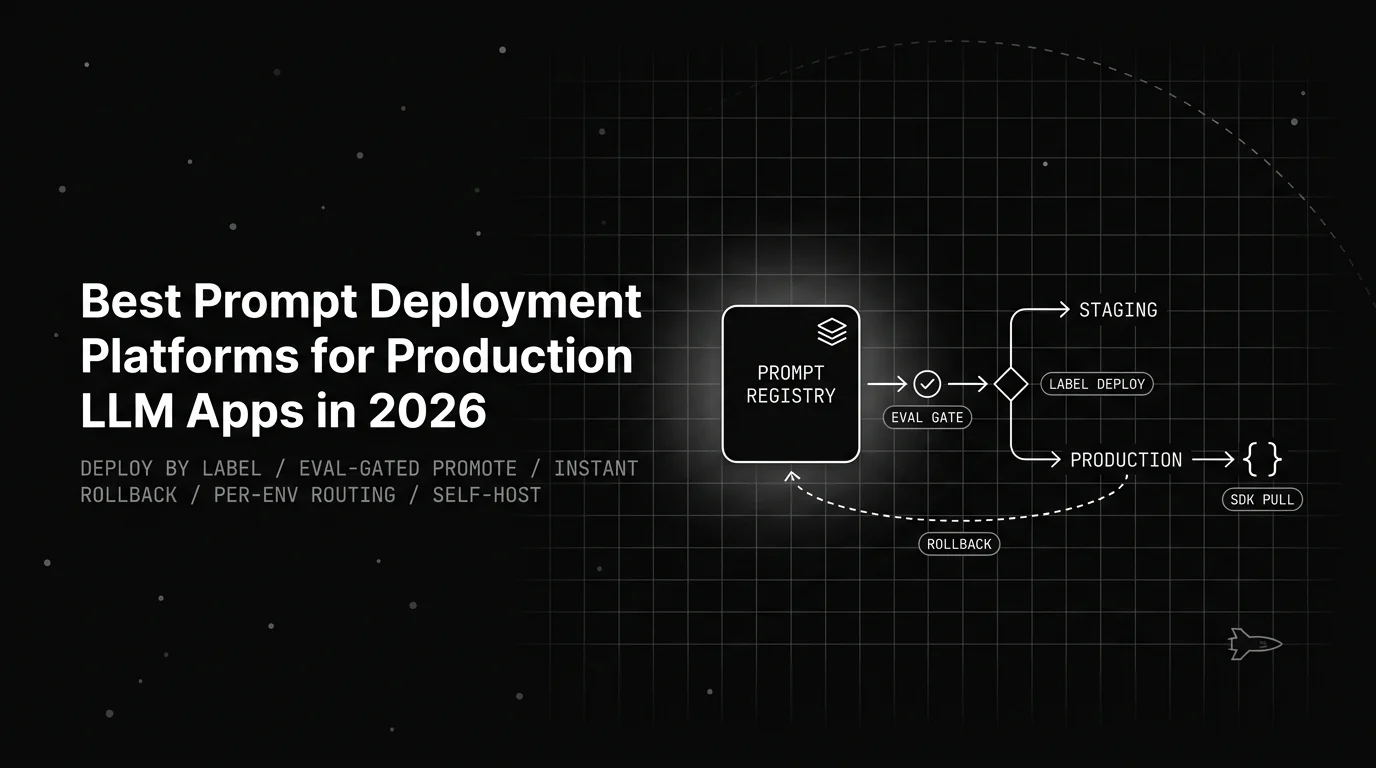
Compare the 6 best prompt deployment platforms for production LLM apps in 2026 on labels, rollback, runtime fetching, and safe, controlled prompt releases.

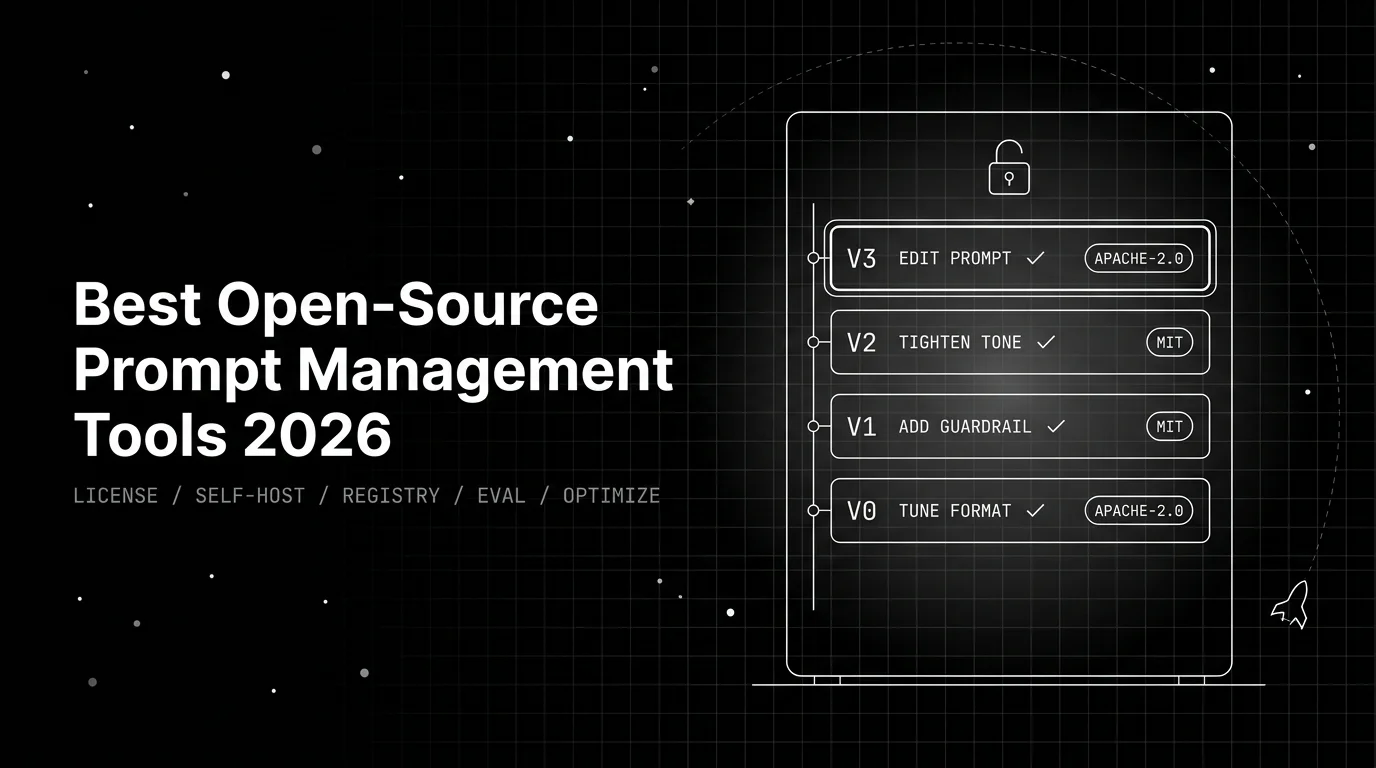
Compare the 6 best open-source prompt management tools of 2026 on self-hosting, licensing, versioning, and built-in evaluation you run on your own stack.

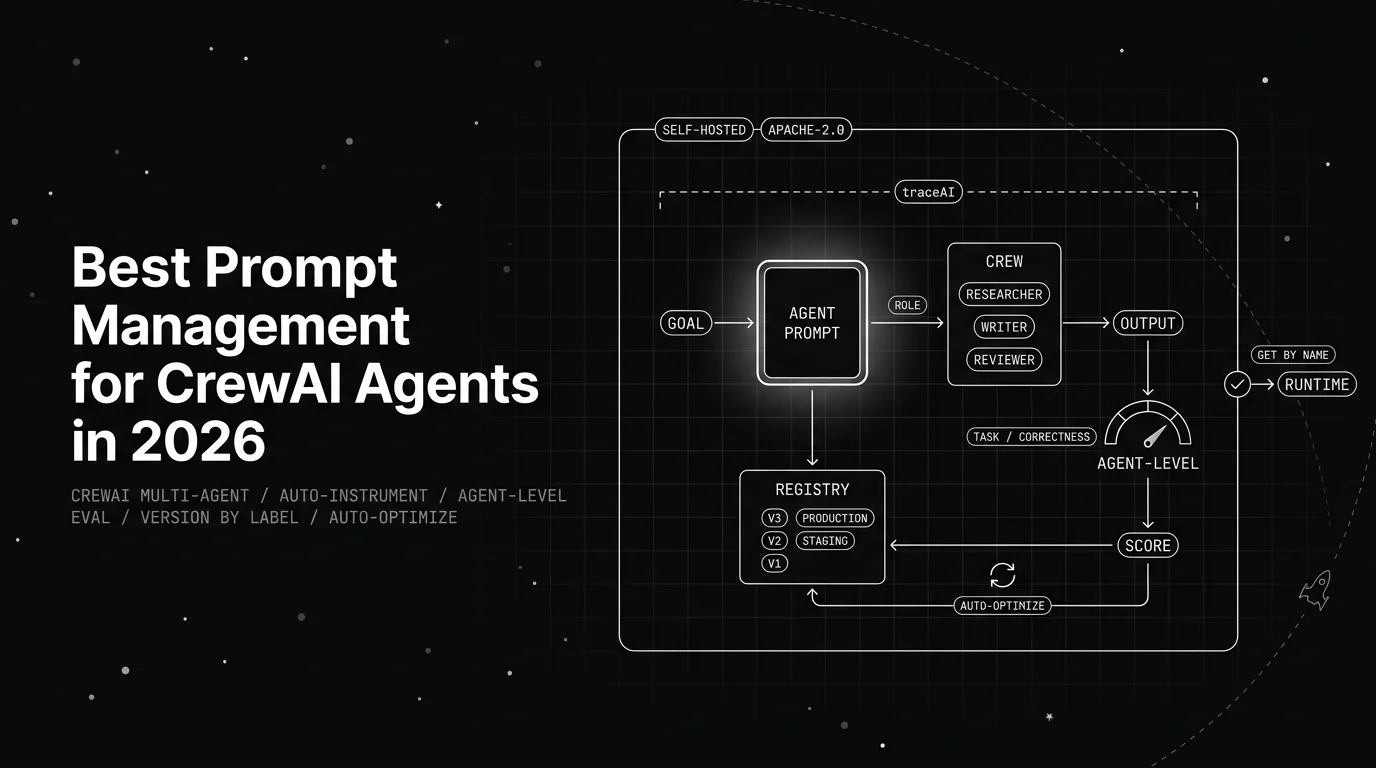
The 6 best prompt management tools for CrewAI agents in 2026, ranked on integration, per-agent versioning, tracing, and built-in evaluation of prompts.