Best 5 Enkrypt AI Alternatives in 2026
Five Enkrypt AI alternatives on inline-guardrail latency, gateway, routing, language SDK breadth. What each actually fixes when red-teaming is not enough.
Table of Contents
Enkrypt AI built a sharp red-teaming product. It automates jailbreak generation, scores model vulnerability against a published taxonomy, and ships an inline Guardrails API for the common content checks. For teams whose LLM-safety story is “prove we tested this before shipping,” that scope works. For teams running a production agent stack, gateway, routing, evals, traces, guardrails, and an iteration loop. Enkrypt’s surface is too narrow, and the parts it covers are Python-first and hosted-only past the free tier.
This guide ranks five alternatives, names what each fixes versus Enkrypt’s red-team-plus-guardrail shape, and walks through the migration that always bites: replacing a REST and Python SDK integration with an inline guardrails layer in the request path rather than on the side.
TL;DR: pick by exit reason
| Why you are leaving Enkrypt AI | Pick | Why |
|---|---|---|
| You want guardrails, evals, gateway, and an optimizer in one platform | Future AGI Agent Command Center | Protect inline guardrails + ai-evaluation + traceAI + agent-opt — one self-improving loop |
| You want the most mature standalone guardrails product | Lakera Guard | Largest detection corpus, deepest enterprise references, strongest community |
| You want hosted policy controls with a stronger ML-Ops heritage | Aporia | Coralogix-backed, multilingual coverage, mature policy designer |
| You want guardrails as a plugin on top of an AI gateway | Portkey Guardrails | Bolts Guardrails policies onto routing, virtual keys, and observability |
| You want a source-available, agent-native gateway with guardrail hooks | agentgateway.dev | OSS gateway from the agentgateway.dev project, Kubernetes-shaped, MCP-aware |
Why people are leaving Enkrypt AI in 2026
Four exit drivers show up consistently in /r/LLMDevs threads, the Enkrypt community Slack, and procurement reviews from the last two quarters.
1. Scope is red-teaming-and-guardrails: not a platform
Enkrypt sells two things well: an offline red-teaming workbench and an inline Guardrails API. There’s no gateway, routing, fallback, prompt registry, trace store, or optimizer. Teams who picked Enkrypt during the “we just need to prove we tested it” phase grow into agent workloads spanning all those surfaces, and end up bolting four vendors together. The exit motion is consolidation rather than dissatisfaction with the core product.
2. Python-first SDK with thin coverage elsewhere
The first-class SDK is Python. TypeScript users hit the REST API directly; the TS client lags the Python one in feature coverage. Go and Rust teams write their own clients. For a guardrails surface on the hot path of every request, the lopsided matrix forces non-Python teams into a maintenance burden the vendor doesn’t share.
3. Hosted-only above the free tier
The free tier covers small-scale evaluations and a fixed number of inline checks per month. Self-hosting the Guardrails API is an Enterprise-tier conversation. Teams subject to data-residency rules (EU, India, Australia) or a “no production traffic leaves our VPC” policy hit the same wall.
4. Smaller community and ecosystem than Lakera
Lakera Guard has been the category-defining standalone guardrails product since 2023. Its detection-rule corpus is larger, its enterprise reference list is longer, and its community presence is heavier than Enkrypt’s. Teams who evaluated both in 2025 increasingly chose Lakera for the ecosystem alone.
What to look for in an Enkrypt AI replacement
Score replacements on the seven axes that map to the surfaces you actually want to replace or extend:
| Axis | What it measures |
|---|---|
| 1. Inline guardrail latency | Median per-request overhead at production load |
| 2. Detection breadth | Prompt injection, PII, toxicity, jailbreaks, off-topic, policy violations |
| 3. Gateway and routing | First-class request path with provider routing, fallback, virtual keys |
| 4. Eval suite | Score model outputs offline and online from one platform |
| 5. SDK matrix | Python, TypeScript, Go, and Rust all first-class |
| 6. Self-host posture | Guardrail layer runs fully inside your VPC |
| 7. Self-improving loop | Guardrail data feeds back into prompt rewrites or routing policy |
1. Future AGI Agent Command Center: Best for closing the loop
Verdict: Future AGI is the only product in this list that bundles inline guardrails, red-team probes, evals, traces, gateway, and an optimizer in one platform, wired together so guardrail signals and eval scores feed back into prompts and routes automatically. Enkrypt covers one band (red-team and inline checks). FAGI covers that band and turns the rest of the agent stack into a self-improving loop.
What it fixes versus Enkrypt AI:
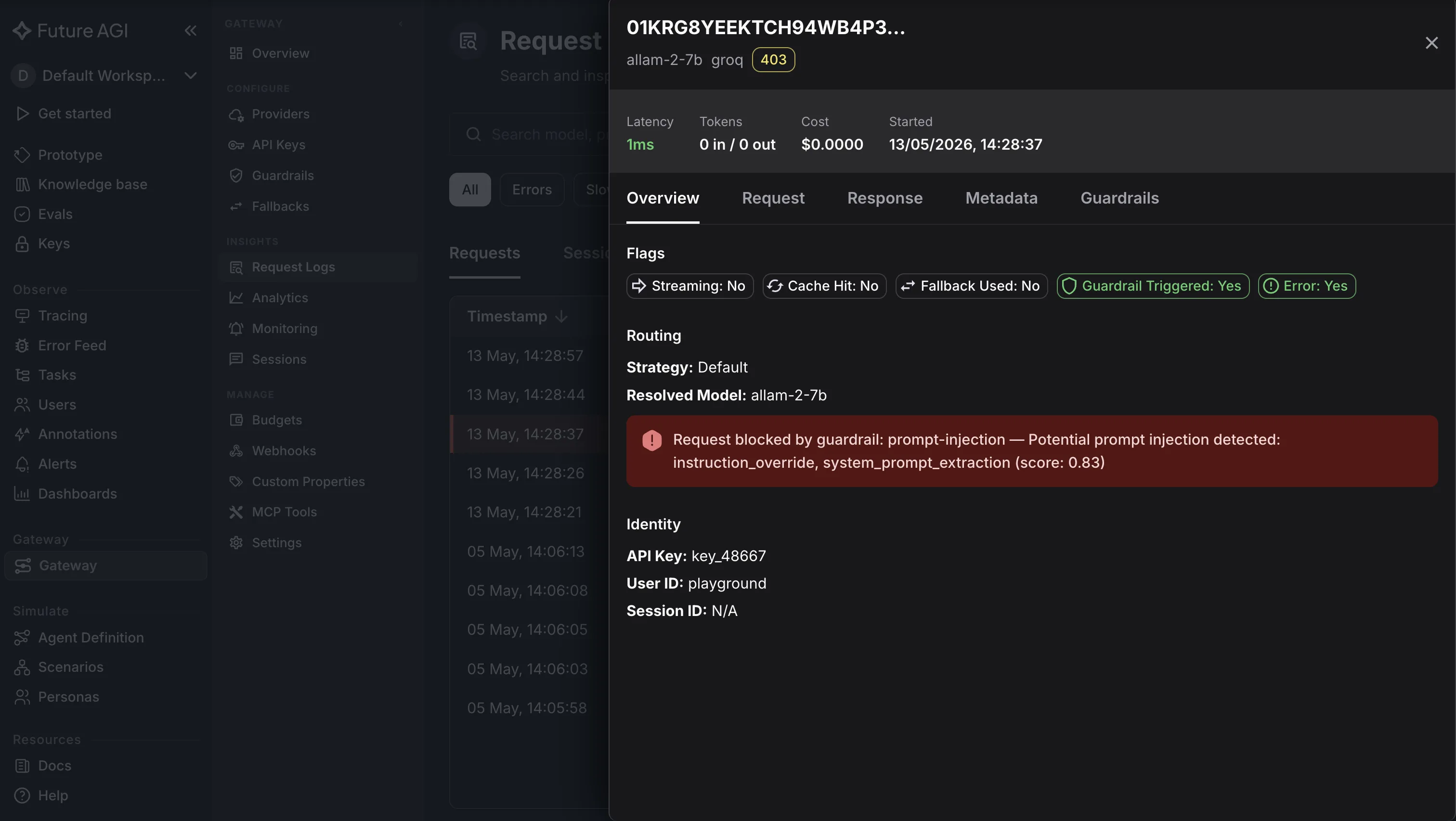
- Inline guardrails on the request path. Protect, FAGI’s inline guardrails layer, runs in-path and returns text-mode decisions at a median of 67 ms (image mode 109 ms) on the public arXiv 2510.13351 benchmark. Detection spans prompt injection, jailbreaks, PII, toxicity, off-topic drift, and configurable policy rules. The Protect engine your pipelines exercise offline is the one in production, the policies you ship are the policies you tested.
- Eval and red-team in the same library.
ai-evaluation(Apache 2.0) holds rubrics for faithfulness, task completion, tool use, and the jailbreak and prompt-injection probes you would otherwise buy from Enkrypt’s workbench. Offline scoring uses the same scorers as the online Protect layer. No second taxonomy to maintain.
- Gateway, routing, virtual keys, and observability. Agent Command Center is the gateway. Protect is a layer inside it, not a sidecar. Traces flow via
traceAI(Apache 2.0), virtual keys fan out to provider keys, cost slices by session, user, repo, and route, and the same trace store powers the eval and optimization loops. - Self-improving loop.
agent-opt(Apache 2.0) reads eval scores and Protect decisions, rewrites prompts via ProTeGi, Bayesian search, or GEPA, and pushes the update back into the gateway on the next request. Enkrypt’s product is static. FAGI’s loop is continuous.
- First-class SDK matrix. Python, TypeScript, Go, and Rust clients maintained at parity for the core guardrails and trace APIs.
Migration from Enkrypt AI: The Enkrypt Guardrails REST endpoint maps directly to Protect’s REST surface; payload shapes are similar enough that a thin shim covers most calls. Python callsites swap enkryptai for the fi client, with matching method names for the common checks. Red-team probe configs import via JSON; mappings into ai-evaluation rubrics are mechanical for common categories, manual for custom probes. Timeline: five to eight engineering days for under twenty integration points, including shadow traffic.
Where it falls short:
-
agent-opt is opt-in, start with traceAI + ai-evaluation in week one and turn the optimizer on once eval baselines stabilize. The loop compounds value over weeks rather than at day one.
-
The red-team workbench UX is newer than Enkrypt’s polished offline tool; capability is in the platform, dedicated UI is a Q3 2026 milestone.
Pricing: Free tier with 100K traces and Protect calls per month. Scale from $99/month with linear scaling, no add-on multipliers. Enterprise with SOC 2 Type II, BYOC, and AWS Marketplace.
Score: 7 of 7 axes.
2. Lakera Guard: Best for standalone guardrails depth
Verdict: Lakera Guard is the pick when guardrails are the only surface you need to replace and you want the most mature standalone product. Lakera’s detection corpus is the largest in the category, its enterprise references are the strongest, and its community presence outpaces Enkrypt’s by a wide margin. You give up everything outside the guardrails box.
What it fixes versus Enkrypt AI:
- Detection breadth and quality. Lakera publishes benchmarks against Gandalf-style adversarial corpora and maintains its rule set against jailbreak techniques first seen in the wild. The prompt-injection surface is deeper than Enkrypt’s, particularly for multi-turn and tool-use attacks.
- Ecosystem. First-class integrations with LangChain, LlamaIndex, Haystack, OpenAI Assistants, and the major agent frameworks ship as maintained packages. Enkrypt leans on REST calls instead of framework-native hooks.
- Reference depth. Lakera’s public customer list spans regulated industries Enkrypt has fewer references in. For procurement, that depth shortens the security review.
Migration from Enkrypt AI: Lakera Guard’s REST endpoint is a clean swap for Enkrypt’s. Both expose check-by-check decisions on a shared payload shape, and Lakera’s Python and TS SDKs accept similar arguments. Red-team probes don’t map. Lakera doesn’t ship an equivalent offline workbench as of May 2026, so teams replacing both surfaces pair Lakera with ai-evaluation or garak. Timeline: three to five engineering days for guardrails-only.
Where it falls short:
- No gateway, routing, fallback, or virtual keys.
- No first-class eval suite beyond guardrail decisions.
- No optimizer; the product is a detection surface, not a loop.
- Self-host is Enterprise-only, similar to Enkrypt.
Pricing: Free developer tier. Pro on per-call pricing in the low double-digit cents per thousand calls. Enterprise with SLA, SSO, and self-host.
Score: 3 of 7 axes (covers latency, detection breadth, SDK matrix; misses gateway, eval, self-host, loop).
3. Aporia: Best for ML-Ops heritage
Verdict: Aporia is the pick when an ML-Ops team that already shipped monitoring on traditional models wants the guardrail layer to feel familiar. Aporia’s heritage is monitoring; Guardrails sits on top of that data model. Acquired by Coralogix in 2024, the product ships alongside Coralogix observability primitives, convenient for teams on Coralogix, friction for teams who aren’t.
What it fixes versus Enkrypt AI:
- Policy designer and multilingual coverage. Aporia’s policy editor is graphical and exposes more detection languages out of the box than Enkrypt, useful for products shipping beyond the top six languages.
- Monitoring depth. Trace, dashboard, and alerting primitives carry from the pre-LLM product. Guardrail decisions live in the same panel as other model alerts.
- Coralogix ecosystem. Logging, SIEM, and observability Coralogix customers already pay for sit one step away from Aporia’s policy data.
Migration from Enkrypt AI: Aporia’s Guardrails API takes payloads similar to Enkrypt’s; SDK-level swaps are mechanical for the common checks. Policy authoring moves from Enkrypt’s YAML and console flow to Aporia’s graphical editor, a manual rewrite, not an import. Red-team probes need a separate workbench. Timeline: five to seven engineering days, longer if you also adopt Coralogix primitives.
Where it falls short:
- No gateway, routing, or virtual keys.
- The eval surface is monitoring-style, not a structured rubric library like FAGI or Lakera ships.
- Coralogix bundling can be a procurement plus or a consolidation problem, depending on the org.
- Self-host is Enterprise-only.
Pricing: Free trial. Pro and Enterprise are quote-based, anchored to monitored-event volume and Coralogix bundling.
Score: 3 of 7 axes (covers detection breadth, policy designer, monitoring; misses gateway, eval suite, self-host posture, loop).
4. Portkey Guardrails: Best for guardrails on top of a gateway
Verdict: Portkey Guardrails is the pick when your team already runs Portkey as the AI gateway and wants the guardrail surface in the same product. Guardrails is a plugin on top of routing, virtual keys, and the prompt registry. Portkey was acquired by Palo Alto Networks on April 30, 2026; the SMB SKU’s long-term trajectory is uncertain and worth factoring into procurement.
What it fixes versus Enkrypt AI:
- Unified request path. Guardrails policies sit alongside routing and virtual keys in the same dashboard. No separate REST endpoint, no separate latency budget, the proxy hop is already there and the guardrail check piggybacks on it.
- Policy library. Built-in policies for PII, toxicity, jailbreak, off-topic, and custom regex rules. Narrower than Lakera’s but broad enough for the common production checklist.
- Cost and trace correlation. Because the gateway captures every request, guardrail decisions join cost and trace records by default. Enkrypt’s standalone API leaves that correlation to the caller.
Migration from Enkrypt AI: Portkey’s Guardrails plugin replaces Enkrypt’s REST endpoint. SDK callsites change shape because the check is implicit in the gateway request, not a separate call. Red-team probes don’t map; pair Portkey with a separate workbench. Timeline: seven to ten engineering days if the gateway swap is in scope, three to five if Portkey is already deployed.
Where it falls short:
- The April 30, 2026 Palo Alto acquisition adds roadmap uncertainty for the SMB SKU.
- No first-class red-team workbench.
- Eval surface is lighter than a dedicated product’s.
- No optimizer loop driven by guardrail data.
Pricing: Guardrails is included in Portkey’s Scale tier from $99/month. Enterprise is custom; the post-acquisition floor is the open question.
Score: 4 of 7 axes (covers latency, gateway, basic eval, SDK breadth; misses red-team, deep detection corpus, optimizer loop).
5. agentgateway.dev: Best for source-available agent-native gateway with guardrail hooks
Verdict: agentgateway.dev is the pick when the requirement is a source-available, Kubernetes-shaped gateway speaking both LLM-provider APIs and MCP, with first-class hooks for plugging guardrails into the request path. This is the option for platform teams that want to own the path on their own infra and treat guardrails as a swappable layer.
What it fixes versus Enkrypt AI:
- Self-host posture. Runs as a Go binary, container, or Helm chart inside your cluster. No telemetry leaves unless you wire an OTel sink. For teams whose Enkrypt exit is driven by data-residency or BYOC, this is the cleanest answer.
- Agent-native primitives. Beyond OpenAI- and Anthropic-compatible passthrough, the gateway speaks MCP, useful for tool-using agents and the emerging MCP-server ecosystem. Most guardrail products are still LLM-call-shaped; agentgateway treats tool calls as first-class.
- Pluggable guardrail layer. No deep first-party detection corpus; instead, hooks for Lakera Guard, FAGI Protect, an open-source detector, or a custom service. For mix-and-match teams, the substrate is flexible.
Migration from Enkrypt AI: Two steps. Stand up agentgateway as the request path, replacing direct provider SDK calls (the heavier lift if you weren’t on a gateway). Then plug your guardrail of choice into the policy hooks; Enkrypt’s REST endpoint can be wired directly, or swap detectors on the same hooks. Red-team probes don’t map. Timeline: ten to fifteen engineering days end-to-end, two to three for the guardrail-hook step alone.
Where it falls short:
- No first-party detection corpus; you bring your own.
- No optimizer.
- Ecosystem is younger than Kong, LiteLLM, or Portkey; off-the-shelf dashboards and Terraform providers are thinner.
- Kubernetes-shaped surface is a plus for platform teams, friction for app teams.
Pricing: Open source. Commercial support and managed offerings are emerging but not standardized as of May 2026.
Score: 4 of 7 axes (covers self-host, gateway, agent-native primitives, pluggable guardrails; misses deep detection corpus, eval suite, optimizer loop).
Capability matrix
| Axis | Future AGI | Lakera Guard | Aporia | Portkey Guardrails | agentgateway.dev |
|---|---|---|---|---|---|
| Inline guardrail latency | 67 ms text / 109 ms image (arXiv 2510.13351) | Sub-100 ms typical | Sub-150 ms typical | Sub-100 ms typical, in-gateway | Bring-your-own; hook overhead is single-digit ms |
| Detection breadth | Native PII, jailbreak, prompt injection, toxicity, policy | Largest in category | Strong, multilingual policy designer | Policy library, narrower than Lakera | None native; pluggable |
| Gateway and routing | Native | None | None | Native | Native |
| Eval suite | ai-evaluation (Apache 2.0) | Guardrail decisions only | Monitoring-style | Light | None native |
| SDK matrix | Python, TS, Go, Rust at parity | Python, TS strong | Python strong | Python, TS strong | Go-native, framework-agnostic |
| Self-host posture | BYOC + OSS instrumentation | Enterprise-only | Enterprise-only | Hosted gateway | OSS, full VPC |
| Self-improving loop | agent-opt driven by eval and Protect data | No | No | No | No |
Migration notes: what breaks when leaving Enkrypt AI
Three surfaces always need attention.
Replacing the REST and Python SDK integration
Enkrypt’s Guardrails API is invoked two ways: a direct REST call to https://api.enkryptai.com/guardrails/... with policy and payload in the body, or a Python SDK call through the enkryptai package that wraps the REST surface.
The replacement pattern in every alternative has the same shape, a new HTTP endpoint and a new SDK. But placement differs. Lakera and Aporia keep the standalone shape: call the API explicitly, get a decision, decide whether to proceed. Portkey and agentgateway.dev fold the check into the gateway request. Future AGI’s Protect supports both: a standalone endpoint for surgical placement, and inline Protect inside Agent Command Center for the gateway-folded pattern. Picking the pattern is the first migration decision.
A practical shim makes the cutover incremental. Wrap the Enkrypt SDK signatures and route calls to the new vendor behind the scenes. Land the wrapper in week one, switch the backend in week two without touching app code twice.
Replacing the red-team workbench
Enkrypt’s red-team workbench is offline by design, run it before shipping, capture the scorecard, gate the release. Replacement options split: ai-evaluation runs the same probes in the same library that powers online evals, so red-team and production scoring share a rubric; Lakera, Aporia, the hosted gateway, and agentgateway.dev pair with an external workbench (garak, ai-evaluation, or a build).
Custom probe taxonomies are where the manual pass lives. Out-of-the-box categories (prompt injection, jailbreak, PII, toxicity) map cleanly. Bespoke probes, company-specific compliance, industry-specific attack patterns, need re-implementing as rubrics.
Re-deciding the self-host posture
If the exit reason includes “we want this in our VPC,” the migration is also an infra change. Self-host options vary sharply: agentgateway.dev is OSS and runs anywhere; Future AGI offers BYOC plus Apache 2.0 libraries; Lakera, Aporia, and Portkey gate self-host behind Enterprise. Answer the infra question in week zero, not week three.
Decision framework: Choose X if
Choose Future AGI if your reason for leaving is more than red-teaming, you also want guardrails, evals, traces, routing, and an optimizer in one platform, with the same rubrics offline and online. Pick this when production agent workloads are a significant line item and the OSS instrumentation (traceAI, ai-evaluation, agent-opt) plus the hosted Command Center justify the migration.
Choose Lakera Guard if guardrails are the only surface to replace and you want the most mature standalone product. Pick this when detection depth and ecosystem polish beat the rest of the platform story.
Choose Aporia if your buyer is an ML-Ops team on Coralogix or wants a graphical policy designer with strong multilingual coverage. Pick this when monitoring-style guardrails fit better than a structured rubric library.
Choose Portkey Guardrails if you already run Portkey as the AI gateway and want guardrails in the same product, and you’re comfortable with the post-acquisition uncertainty. Pick this when unification beats best-of-breed.
Choose agentgateway.dev if the requirement is a source-available, Kubernetes-shaped gateway with hooks for any detector. Pick this when self-host posture and agent-native primitives (including MCP) outweigh a first-party detection corpus.
What we did not include
Three products show up in other 2026 Enkrypt AI listicles we left out: NVIDIA NeMo Guardrails (library to assemble, not a hosted product, the right comparison is to ai-evaluation); Protect AI Layer (strong model-security posture but a thinner inline-guardrail surface as of May 2026); WhyLabs Guardrails (monitoring-shaped, worth a second look in Q3 2026).
Related reading
- Best 5 Portkey Alternatives in 2026
- Best 5 Lakera Guard Alternatives in 2026
- What Is an AI Guardrail? The 2026 Definition
Sources
- Enkrypt AI Guardrails API documentation, enkryptai.com/docs/guardrails
- Enkrypt AI red-team workbench documentation, enkryptai.com/docs/red-team
- Lakera Guard product page, lakera.ai/lakera-guard
- Lakera Gandalf detection benchmark, gandalf.lakera.ai
- Aporia Guardrails product page, aporia.com/llm-observability-platform
- Coralogix acquisition of Aporia, 2024, coralogix.com/blog
- Portkey Guardrails documentation, portkey.ai/docs/product/guardrails
- Palo Alto Networks press release on Portkey acquisition, April 30, 2026, paloaltonetworks.com/company/press
- agentgateway.dev project page, agentgateway.dev
- NVIDIA NeMo Guardrails repository, github.com/NVIDIA/NeMo-Guardrails
- Future AGI Agent Command Center, futureagi.com/platform/monitor/command-center
- Future AGI traceAI, github.com/future-agi/traceAI (Apache 2.0)
- Future AGI ai-evaluation, github.com/future-agi/ai-evaluation (Apache 2.0)
- Future AGI agent-opt, github.com/future-agi/agent-opt (Apache 2.0)
- Future AGI Protect latency benchmark, arxiv.org/abs/2510.13351 (67 ms text, 109 ms image)
Frequently Asked Questions
Why are people moving off Enkrypt AI in 2026?
What is the closest like-for-like alternative?
How do I migrate from Enkrypt's REST and Python SDK?
Is there an open-source Enkrypt AI alternative?
Which alternative is best for non-Python teams?
Does Future AGI replace Enkrypt's red-team workbench?
How does Future AGI compare to Enkrypt AI?
Five Lakera Guard alternatives scored on inline guardrail latency, native gateway and eval surfaces, self-host posture, sub-enterprise pricing.


Senior-engineer comparison of the best AI agent guardrails platforms 2026: latency budgets, placement, deployment topology, vendor fit.

AI red teaming for generative AI in 2026: 5 attack categories, top tools (Future AGI Protect, Garak, PyRIT, Lakera), CI playbook, and how to score risk.
