Best 5 Deepchecks Alternatives in 2026
Five Deepchecks alternatives scored on LLM-native evaluators, language coverage, pricing, gateway depth, community, for agent workloads.
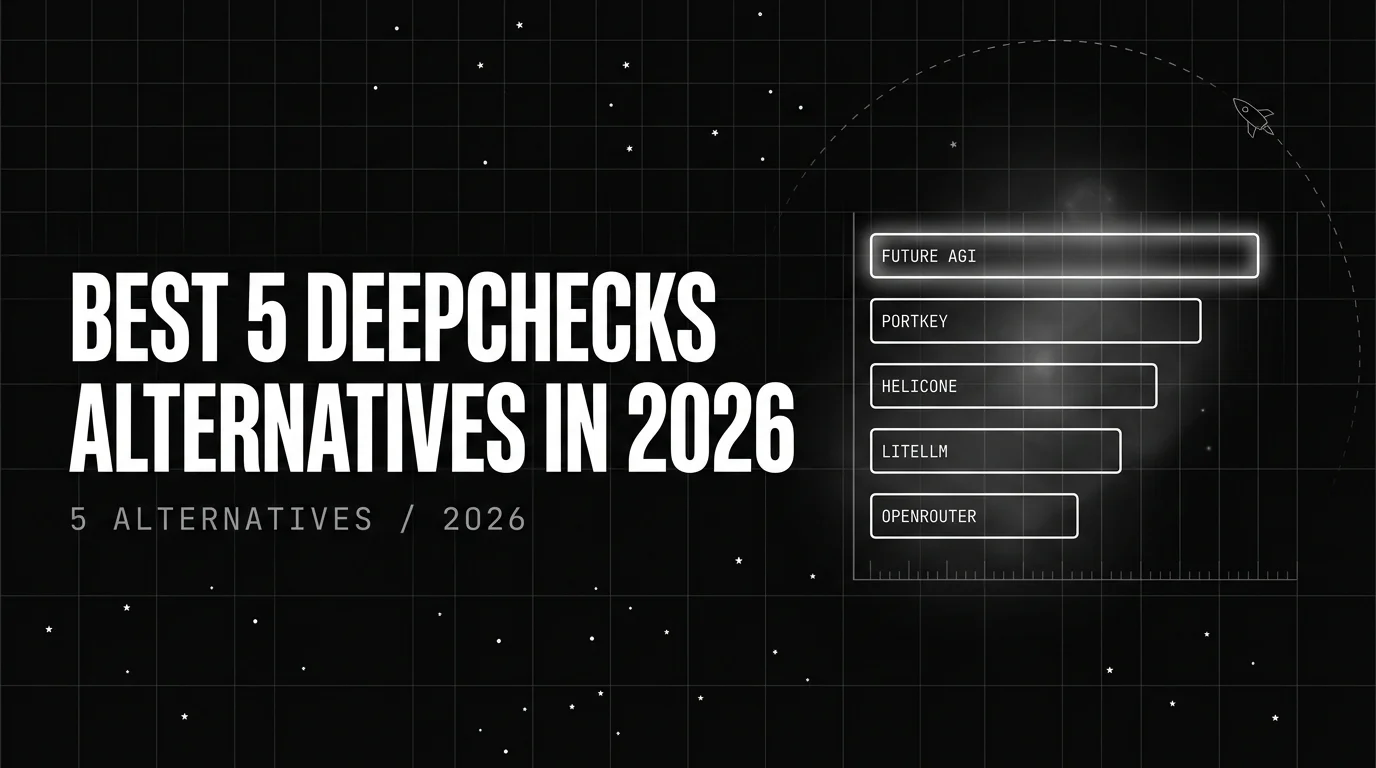
Table of Contents
Deepchecks earned its place in 2020-era ML stacks. The original suite (distribution checks, data-integrity validators, model performance regressions, train-test contamination warnings) is still the right tool for tabular and computer-vision pipelines. The problem in 2026 is that the same brand now ships an “LLM Evaluation” product on top of that ML-validation core, and the heritage shows. The LLM evaluators are a thinner layer than the originals, the SDK is Python-only, the hosted enterprise tier prices opaque, the platform has no gateway or routing primitive, and the LLM-specific community is materially smaller than Arize Phoenix’s or Langfuse’s.
For teams running production agents, the question is whether an ML-validation-first vendor with bolted-on LLM features is the right home for an LLM-native workload. This guide ranks five replacements worth migrating to, names what each fixes versus Deepchecks, and walks through the one migration that always bites: re-writing the Deepchecks Suite of evaluators into the destination platform’s eval API.
TL;DR: pick by exit reason
| Why you are leaving Deepchecks | Pick | Why |
|---|---|---|
| You want LLM-native evals plus the optimizer that uses them | Future AGI Agent Command Center | Trace, eval, cluster, optimize, and push the new prompt back to the gateway |
| You want OSS LLM tracing with a credible community | Arize Phoenix | OpenInference traces, OSS-first, the biggest LLM-specific community after Langfuse |
| You want a self-host eval and prompt platform | Langfuse | MIT/EE dual-license, mature self-host, deep prompt-versioning surface |
| You want code-first eval with a Pytest-style API | DeepEval | Apache 2.0 framework that treats every eval as a unit test |
| You want product-team eval workflows over engineering ones | Braintrust | Polished UI for non-engineering reviewers, hosted experiment runs, dataset diffing |
Why people are leaving Deepchecks in 2026
Five exit drivers show up consistently in Reddit /r/MachineLearning and /r/LLMDevs threads, Deepchecks GitHub issues, G2 reviews from the last two quarters, and migration write-ups posted in Q1 2026.
1. ML-validation-first heritage shows in the LLM surface
Deepchecks’ core competence is tabular and CV validation. The LLM evaluator surface was added later as a separate suite. In practice this means the LLM evals are a thinner layer than the originals: fewer built-in metrics, less coverage of agent-specific failures (tool-use correctness, multi-turn coherence, trajectory faithfulness), and a UI that still routes through the ML-validation dashboard for many flows. The check abstraction is generic; it doesn’t assume traces, tool calls, or message graphs. Teams who tried to express “this tool call returned the wrong column” or “this multi-step plan dropped a constraint at step 4” describe the workaround as verbose.
2. Python-only SDK
Deepchecks ships a Python SDK. TypeScript, Java, Go, and Ruby teams either write a Python sidecar or call the HTTP API directly. For agent teams running Node.js or Bun runtimes, this is friction every day. Phoenix, Langfuse, DeepEval, Braintrust, and Future AGI all ship at least Python and TypeScript clients; several add Go and Java.
3. Hosted enterprise tier with opaque pricing
The open-source deepchecks package is free. The hosted platform (Deepchecks Hub) and the LLM Evaluation product publish a Starter tier but route everything above to “contact sales.” Procurement teams comparing against Phoenix self-host, Langfuse self-host, or Future AGI’s published linear pricing describe the Deepchecks quote process as slow and inconsistent across renewals.
4. No gateway or routing primitive
Deepchecks is an eval and validation platform. It doesn’t run as an LLM proxy, doesn’t issue virtual keys, doesn’t enforce rate limits or cost caps, and doesn’t route between providers. Teams that want eval and gateway on shared infra either bolt on a separate proxy (LiteLLM, Portkey, Kong) or move to a platform that ships both. Future AGI’s Agent Command Center, Langfuse + LiteLLM, and Phoenix + LiteLLM are the common pairings.
5. Smaller LLM-specific community than Phoenix or Langfuse
The Deepchecks repo has strong ML-validation momentum (15K+ stars overall as of May 2026), but the LLM-evaluation surface attracts a fraction of the traction Phoenix and Langfuse see for the equivalent LLM use case. For a team picking a platform in 2026, community gravity around LLM-native primitives matters: it determines who shows up to file issues, contribute evaluators, and answer questions on Discord.
What to look for in a Deepchecks replacement
The default “best LLM eval platform” axes are necessary but not sufficient for a Deepchecks exit. Score replacements on the seven that map to the surfaces you’re actually migrating off:
| Axis | What it measures |
|---|---|
| 1. LLM-native evaluator coverage | Built-in evals for agents, RAG, tool calls, faithfulness, multi-turn — not generic checks adapted from ML |
| 2. Language coverage | Python plus at least TypeScript; ideally Go and Java |
| 3. Pricing transparency | Published per-trace or per-seat pricing, predictable at scale |
| 4. Gateway / runtime integration | Does the platform share infra with a gateway, or stand alone? |
| 5. Optimizer loop | Does eval data drive prompt rewrites or routing updates automatically? |
| 6. Community gravity | Active Discord, contributions per quarter, third-party tutorials |
| 7. Migration tooling | Are there published recipes for rewriting Deepchecks Suite evaluators? |
1. Future AGI Agent Command Center: Best for closing the loop
Verdict: Future AGI fixes Deepchecks’ biggest weakness as an LLM stack, evaluation results inform humans but never the runtime. Agent Command Center captures the trace, scores it with the eval library, clusters failures, runs the optimizer, and pushes the updated prompt or routing rule back into production on the next request. The other four are observation and evaluation layers. FAGI is an observation and evaluation layer wired to an optimizer and a gateway.
What it fixes versus Deepchecks:
- LLM-native evaluators from day one. The
ai-evaluationlibrary (Apache 2.0) ships built-in evaluators for task completion, faithfulness, tool-use correctness, trajectory coherence, groundedness, and PII leakage, designed for agent and RAG workloads from the start, not adapted from tabular checks. Custom evaluators are first-class.

- Multi-language by default. Python and TypeScript SDKs ship together.
traceAI(Apache 2.0) is OpenTelemetry-native, so any language with an OTel SDK can emit traces the Command Center reads.
- Transparent linear pricing. Free tier with 100K traces/month. Scale tier from $99/month with linear per-trace scaling above 5M (no add-on multipliers). Enterprise with SOC 2 Type II and AWS Marketplace procurement.
- Gateway plus eval in one platform. Agent Command Center is both, virtual keys, cost dashboards, fallback routing, RBAC, plus the eval library.
- Native optimizer.
agent-opt(Apache 2.0) takes eval scores fromai-evaluationand rewrites prompts automatically via six optimizers — ProTeGi, GEPA, Bayesian, MetaPrompt, RandomSearch, PromptWizard. Deepchecks tells you the eval failed; FAGI rewrites the prompt and pushes the new version.
- OSS instrumentation, hosted control plane.
traceAI,ai-evaluation, andagent-optare all Apache 2.0. The hosted Command Center adds RBAC, failure-cluster views, the Protect guardrails layer (median 65 ms text-mode latency per arXiv 2510.13351), and AWS Marketplace.
Migration from Deepchecks: Translate each Check into an ai-evaluation evaluator (most one-to-one for LLM-native checks like faithfulness, groundedness, and PII), and swap the run loop from suite.run(...) to the FAGI eval API. Custom Check subclasses port to FAGI custom evaluators with the same logic but cleaner I/O. Datasets and golden-truth fixtures move as-is. Timeline: seven to ten engineering days for 20 to 40 evaluators, including a shadow-eval period.
Where it falls short:
-
agent-opt is opt-in, start with traceAI + ai-evaluation in week one and turn the optimizer on once eval baselines stabilize. The loop compounds value over weeks rather than at day one.
-
The drift-detection surface for tabular and CV data is intentionally outside scope. Teams still running classic ML pipelines keep Deepchecks for those and add FAGI for the LLM stack.
Pricing: Free tier with 100K traces/month. Scale tier from $99/month with linear per-trace scaling above 5M. Enterprise with SOC 2 Type II and AWS Marketplace.
Score: 7 of 7 axes.
2. Arize Phoenix: Best for OSS LLM tracing
Verdict: Arize Phoenix is the pick when the requirement is OSS-first LLM observability with a credible community and OpenInference-standard traces. The OSS repo (arize-ai/phoenix) attracts the biggest LLM-specific community traction after Langfuse, and the trace format is the closest thing the ecosystem has to a vendor-neutral standard. You give up Deepchecks’ broad ML-validation surface; you gain LLM tracing built by people who ship LLM evals as their primary product.
What it fixes versus Deepchecks:
- OpenInference traces. Phoenix’s trace format is published as the OpenInference spec, and the same traces work with Arize’s hosted platform, Phoenix self-host, and several third-party tools. Vendor lock-in is structurally lower than Deepchecks’ platform-specific traces.
- LLM-native eval coverage. Built-in evaluators for hallucination, relevance, toxicity, and tool-use correctness. Datasets and experiments are first-class.
- Community gravity. The Phoenix Discord, GitHub issue cadence, and contributor count consistently rank in the top two LLM-eval communities (Langfuse being the other).
Migration from Deepchecks: Translate each LLM Check into a Phoenix evaluator (most map; PII and faithfulness are one-to-one). Datasets port as Phoenix Dataset objects. The trace surface is a clean upgrade. OpenInference covers structures Deepchecks doesn’t. You lose Deepchecks’ tabular drift and CV checks; teams with both workloads keep Deepchecks for ML and add Phoenix for LLM. Timeline: five to seven engineering days for 20 to 40 evaluators.
Where it falls short:
- No optimizer. Eval data informs humans, not the runtime.
- No gateway. Pair with LiteLLM or a similar proxy if routing and virtual keys matter.
- Hosted Arize platform pricing is enterprise-anchored; the OSS Phoenix path is the typical entry.
Pricing: Phoenix is open source under Elastic 2.0. Arize hosted platform pricing is custom and quoted by sales.
Score: 5 of 7 axes (missing: optimizer, native gateway).
3. Langfuse: Best for self-hosted LLM observability
Verdict: Langfuse is the pick when the requirement is “this eval and prompt platform runs on our hardware, with source we can audit, and the prompt-versioning surface is deeper than the rest.” MIT-licensed core with a commercial EE add-on; mature self-host; deep prompt-versioning and dataset surfaces. You give up Deepchecks’ broad ML-validation surface; you gain a focused LLM eval and prompt platform with the largest LLM-specific community in this list.
What it fixes versus Deepchecks:
- Self-host posture. Langfuse runs on Postgres + ClickHouse in your VPC. Air-gapped is supported. For teams whose security review of a hosted Deepchecks tier is the exit trigger, this is the cleanest answer.
- Prompt versioning as a first-class object. Prompts have versions, labels, environments, and rollback. The surface is deeper than Deepchecks’ or Phoenix’s.
- LLM-native eval library plus LLM-as-judge. Built-in evaluators plus custom-judge support. Datasets, experiments, and human-feedback collection all in one platform.
- Multi-language SDKs. Python, JS/TS, Java, Go, first-class clients for all four.
Migration from Deepchecks: Translate LLM Check objects into Langfuse evaluators and judges. Datasets port as Langfuse Dataset objects with dataset_items. Move prompts into Langfuse’s prompt registry, a step up from Deepchecks, which doesn’t have one. Timeline: seven to ten engineering days for 20 to 40 evaluators plus a prompt migration.
Where it falls short:
- No optimizer. Closing the loop from eval to prompt rewrite is manual.
- No gateway; pair with LiteLLM if routing matters.
- The EE tier (SSO, audit, advanced RBAC) is a separate purchase; the MIT core is enough for most teams up to mid-market scale.
Pricing: MIT open source. Cloud tier from $29/month for small teams; usage-based scaling. EE self-host pricing is enterprise-anchored.
Score: 5 of 7 axes (missing: optimizer, native gateway).
4. DeepEval: Best for code-first Pytest-style evaluation
Verdict: DeepEval is the pick when your team’s mental model is “every eval is a unit test, and CI should fail when the unit test fails.” Apache 2.0 framework that treats LLM evaluations as pytest cases with @assert_test decorators, golden datasets, and clean fail messages. You give up Deepchecks’ UI-first eval workflow; you gain a CLI-first surface that integrates with GitHub Actions and CI dashboards directly.
What it fixes versus Deepchecks:
- Pytest-style API. Evals are decorated functions.
pytest -kfilters work. CI integration is a one-linepytest deepeval/in the GitHub Actions matrix. - LLM-native metrics. Built-in support for hallucination, answer-relevancy, faithfulness, contextual-precision, tool-correctness, and G-Eval (LLM-as-judge with chain-of-thought). All evaluator subclasses are inspectable in source.
- Apache 2.0 across the board. No EE gate, no hosted-tier dependency for the OSS API.
Migration from Deepchecks: Translate Check objects into DeepEval BaseMetric subclasses. Datasets port as EvaluationDataset instances. CI hookup is a clean upgrade. Deepchecks’ CI story is improvised; DeepEval’s is the primary product surface. Timeline: five to seven engineering days for 20 to 40 evaluators.
Where it falls short:
- No hosted UI at the OSS tier; Confident AI (the hosted commercial sibling) is a separate product with its own pricing.
- No gateway, no optimizer.
- Stakeholder-facing dashboards are thinner than Phoenix or Langfuse; PMs and analysts often pair DeepEval with one of those for the UI.
Pricing: Apache 2.0 open source. Confident AI hosted tier pricing is custom.
Score: 4 of 7 axes (missing: optimizer, native gateway, hosted UI in the OSS tier).
5. Braintrust: Best for product-team eval workflows
Verdict: Braintrust is the pick when the eval workflow is product-led: a PM curates golden data, a domain expert reviews failures in a friendly UI, and the engineering team runs experiments through a managed surface that handles the boring parts. The product is polished, hosted experiments are first-class, and dataset diffing is the cleanest in this list. You give up the OSS-first posture and the multi-runtime story you get from Phoenix, Langfuse, or DeepEval; you gain a UI that non-engineering reviewers will actually use without complaint.
What it fixes versus Deepchecks:
- Non-engineering-friendly UI. Reviewers, PMs, and domain experts can grade outputs, diff datasets, and curate goldens without filing a Jira ticket. Deepchecks’ UI assumes a data-scientist user.
- Hosted experiments. Running an experiment is one button. Comparing two prompts across a dataset of thousands of cases takes minutes, not hours of self-managed compute.
- Polished collaboration. Comments, shared dashboards, role-based access, built for cross-functional teams.
Migration from Deepchecks: Translate LLM Check objects into Braintrust evaluators (often via the Eval API). Datasets upload via the SDK or CSV import. The dataset-diff and experiment-comparison surfaces are a clean upgrade. Timeline: five to eight engineering days for 20 to 40 evaluators.
Where it falls short:
- Closed source. Self-host is enterprise-only and not the default path.
- No gateway, no optimizer.
- Pricing is hosted-first; teams who explicitly want OSS-first will pick Phoenix, Langfuse, or DeepEval instead.
Pricing: Free tier for small workloads. Pro and Enterprise tiers with custom pricing.
Score: 4 of 7 axes (missing: optimizer, native gateway, OSS posture).
Capability matrix
| Axis | Future AGI | Arize Phoenix | Langfuse | DeepEval | Braintrust |
|---|---|---|---|---|---|
| LLM-native evaluator coverage | Built-in agent + RAG + tool-use | OpenInference + built-in evals | Built-in + LLM-as-judge | Pytest-style metrics | Hosted experiments + datasets |
| Language coverage | Python + TS + OTel-any | Python + TS | Python + TS + Java + Go | Python | Python + TS |
| Pricing transparency | Published linear pricing | Phoenix OSS; Arize custom | OSS + published cloud tier | OSS; Confident custom | Hosted-first, partly custom |
| Gateway / runtime integration | Native (Agent Command Center) | Pair with LiteLLM | Pair with LiteLLM | Pair with LiteLLM | Pair with LiteLLM |
| Optimizer loop | Yes (agent-opt) | No | No | No | No |
| Community gravity | Apache 2.0 libraries, growing | Top-tier LLM Discord | Largest LLM Discord | Active CI-focused community | Smaller, product-team focused |
| Deepchecks migration tooling | Suite-to-evaluator recipe | OpenInference port path | Dataset + judge port path | Pytest port path | Manual upload |
Migration notes: what breaks when leaving Deepchecks
Three surfaces always need attention.
Rewriting the Suite of evaluators
Deepchecks expresses evals as a Python Suite composed of Check objects, each with one or more add_condition_* clauses that determine pass/fail. The migration shape is the same in every direction: translate each Check into the destination’s evaluator class, translate each add_condition_* into the destination’s threshold or assertion API, and replace suite.run(...) with the destination’s eval-run API.
For LLM-native Checks (faithfulness, groundedness, hallucination, PII detection) the translation is mechanical. Every replacement in this list ships these as built-in evaluators, so the work is mostly renaming inputs and reading the destination’s docs for parameter shape.
For custom Check subclasses, the work is a manual port: re-implement the _run logic as a custom evaluator in the destination (FAGI custom evaluator, Phoenix Eval, Langfuse judge, DeepEval BaseMetric, Braintrust Eval) and verify on a sample of historical traces that the new evaluator produces the same scores within tolerance.
For ML-validation Checks, drift detection, label distribution checks, train-test contamination, there’s no equivalent in any LLM eval platform, because the assumptions are different. The LLM analog is closer to LLM eval data drift detection, which tracks prompt, model, and eval-score drift rather than feature distributions. Teams with both ML and LLM workloads keep Deepchecks for the ML side and add an LLM eval platform alongside.
Timeline: a team with 20 to 40 LLM evaluators completes the rewrite in three to five engineering days; with 50+, plan a full sprint.
Re-routing dataset and golden-truth references
Deepchecks references datasets by ID inside the hosted platform and by path on disk for OSS-only flows. Each destination (Phoenix, Langfuse, DeepEval, Braintrust, FAGI) has its own dataset object model. The path that works consistently: export each Deepchecks dataset to CSV or JSONL, import into the destination’s dataset API, update evaluator code to reference the new IDs. Golden-truth fixtures with expected_output columns port one-to-one. Datasets with custom metadata columns may need a manual field-mapping pass.
Replacing the Deepchecks dashboard surface
Deepchecks’ hosted dashboard centralizes suite-run history, failure clusters, and drift-trend views. None of the destination platforms render exactly the same view, because their domain models differ. Phoenix and Langfuse render LLM traces with span trees, Braintrust renders experiment-comparison tables, DeepEval renders Pytest-style CI dashboards, FAGI renders failure-cluster views attached to trace IDs. Plan one or two product cycles to converge on a new reviewer UX normal.
Decision framework: Choose X if
Choose Future AGI if your reason for leaving Deepchecks is more than the heritage gap, you also want eval scores to drive prompt rewrites and routing-policy updates automatically, so quality regressions self-heal across cycles. Pick this when production agent workloads are becoming a significant line item and the OSS instrumentation (traceAI, ai-evaluation, agent-opt) plus the hosted Command Center together justify the migration.
Choose Arize Phoenix if your reason for leaving is the bolted-on LLM surface and you want OSS-first LLM observability with an OpenInference trace format that minimizes future lock-in. Pick this when community gravity and standards-track tooling matter more than a hosted-platform polish budget.
Choose Langfuse if your reason for leaving is the opaque hosted tier and the requirement is “this platform runs on our infrastructure, with source we can audit, and the prompt-versioning surface is deeper than the rest.” Pick this when self-host posture and prompt registry depth beat hosted polish.
Choose DeepEval if your team’s mental model is “every eval is a unit test, and CI should fail when the test fails.” Pick this when CI integration is the primary requirement and a hosted UI is optional.
Choose Braintrust if your reason for leaving is the engineer-only UX of Deepchecks’ dashboard and the eval workflow is product-led. Pick this when PMs, domain experts, and non-engineering reviewers are first-class users of the platform.
What we did not include
Three products show up in other 2026 Deepchecks alternatives listicles that we left out: LangSmith (LangChain-tied; migration cost is higher when the team isn’t already on LangGraph or LangChain); TruEra (acquired into Snowflake in 2024; the hosted surface is increasingly Snowflake-anchored); PromptLayer (lightweight prompt-versioning tool but the eval surface is thinner than this cohort’s as of May 2026).
Related reading
- Best 5 Portkey Alternatives in 2026
- Best LLM Evaluation Platforms in 2026
- What Is LLM Evaluation? The 2026 Definition
Sources
- Deepchecks LLM Evaluation product page, deepchecks.com/llm-evaluation
- Deepchecks GitHub repository, github.com/deepchecks/deepchecks
- Reddit /r/MachineLearning and /r/LLMDevs migration discussions, January-May 2026
- Arize Phoenix GitHub repository, github.com/Arize-ai/phoenix
- OpenInference specification, github.com/Arize-ai/openinference
- Langfuse GitHub repository, github.com/langfuse/langfuse
- Langfuse self-host documentation, langfuse.com/docs/deployment/self-host
- DeepEval GitHub repository, github.com/confident-ai/deepeval
- Braintrust product page, braintrust.dev
- Future AGI Agent Command Center, futureagi.com/platform/monitor/command-center
- Future AGI traceAI, github.com/future-agi/traceAI (Apache 2.0)
- Future AGI ai-evaluation, github.com/future-agi/ai-evaluation (Apache 2.0)
- Future AGI agent-opt, github.com/future-agi/agent-opt (Apache 2.0)
- Future AGI Protect latency benchmark, arxiv.org/abs/2510.13351 (65 ms text, 107 ms image)
Frequently Asked Questions
Why are people moving off Deepchecks for LLM workloads in 2026?
Does Deepchecks still make sense for ML pipelines?
What is the closest like-for-like alternative to Deepchecks' LLM Evaluation product?
How do I migrate Deepchecks LLM `Suite` evaluators to a new platform?
Is there an open-source Deepchecks alternative for LLM workloads?
Which Deepchecks alternative has the largest LLM-specific community?
How does Future AGI Agent Command Center compare to Deepchecks for LLM evaluation?
FutureAGI, DeepEval, Langfuse, Phoenix, Braintrust, LangSmith, and Galileo as the 2026 LLM evaluation shortlist. Pricing, OSS license, and production gaps.


FutureAGI, Langfuse, Arize Phoenix, Braintrust, and LangSmith as DeepEval alternatives in 2026. Pricing, OSS license, eval depth, and production gaps.


FutureAGI, Langfuse, LangSmith, Helicone, Braintrust, and W&B Weave as Arize Phoenix alternatives in 2026. Pricing, OSS license, OTel coverage, tradeoffs.