Best Collaborative Prompt Management Platforms for Product Teams in 2026
The 6 best collaborative prompt management platforms for product teams in 2026, ranked on shared editing, roles, versioning, and safe, reviewed releases.
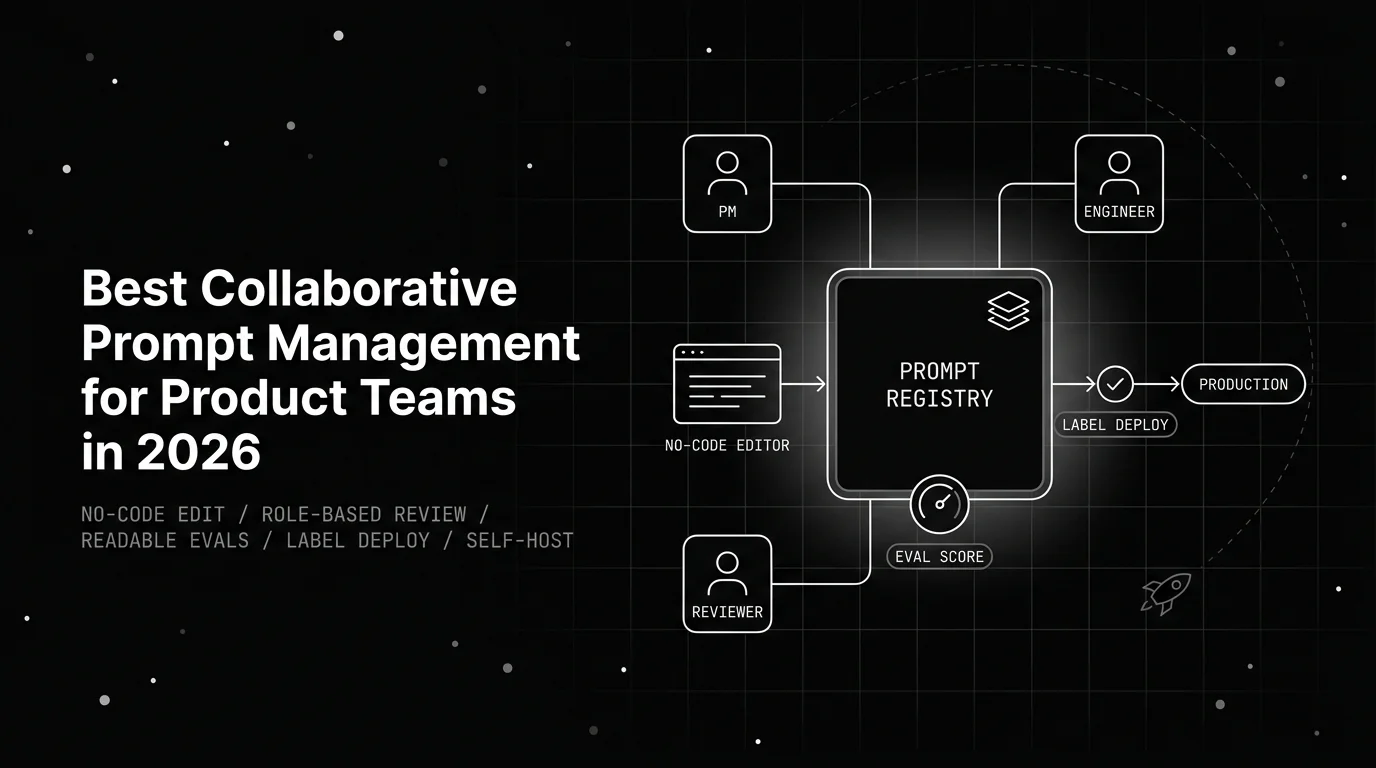
Table of Contents
A product manager notices the assistant giving a weak onboarding answer, writes “can someone fix the onboarding prompt” in a doc, and waits. An engineer eventually finds the string buried in code, edits it between two other tasks, and ships it in the next deploy. There is no record of the old wording, no score proving the new one is better, and no way to roll back if it turns out worse. This guide ranks the six collaborative prompt management platforms a cross-functional product team should evaluate in 2026, scored on who can edit, who can review, and who can ship.
TL;DR: 6 Collaborative Prompt Management Platforms for Product Teams, Compared
Future AGI is the strongest overall collaborative prompt management platform for product teams in 2026. Product managers, engineers, and reviewers share one workspace to create, version, evaluate, and ship prompts on a single feedback loop. What separates the field is whether a non-engineer can edit, score, review, and ship safely without filing a ticket. The table below ranks all six on best fit and license.
| Rank | Tool | Best for | License |
|---|---|---|---|
| 1 | Future AGI | No-code editing, readable scores, and role-based shipping in one stack | Apache-2.0 |
| 2 | PromptLayer | A visual prompt registry non-technical collaborators can edit | Proprietary |
| 3 | Langtail | A no-code prompt playground built specifically for product teams | Proprietary |
| 4 | Vellum | A governance-first workflow builder for cross-functional teams | Proprietary |
| 5 | Langfuse | A free open-source registry a product team self-hosts | MIT |
| 6 | LangSmith | A first-party Prompt Hub for LangChain-native teams | Proprietary |
Why Does Collaborative Prompt Management Break for Product Teams in Production?
In a product team, the person who knows whether a prompt is right is rarely the person who can change it. The product manager sees the off-tone answer, but the prompt lives in code only an engineer touches, so every fix becomes a ticket and a deploy. Collaboration breaks because changing the prompt means touching code, so the people who own its quality are stuck waiting on an engineer.
Editing access alone does not fix it. Hand every contributor a shared login and you trade a bottleneck for a free-for-all: anyone can change a live prompt, no one can say who changed it, and a well-meaning edit quietly regresses a flow that was working. A product team needs editing and control at the same time, which is why three pillars decide whether a platform is genuinely collaborative.
- No-code editing for non-engineers. A product manager or a writer should be able to open a live prompt in the browser and change the wording themselves, with no code and no engineer in the loop. If that edit still has to become a code change an engineer ships, the product manager is right back to waiting.
- Role-based access and readable review. Different people draft, review, and ship, so the platform needs real permissions plus a change history a non-engineer can read, not one shared seat and a raw diff.
- A score before it ships. A product manager cannot judge a prompt from a trace, but can judge it from a quality, safety, or relevance score shown next to the version. The team needs that score to control what reaches users.
Multi-user logins and label-based deployment are now broadly common, so the first two pillars no longer separate the field. What sets tools apart is the third pillar and the step after it: a non-engineer reading a real evaluation score before shipping, and the platform improving the prompt rather than just storing the version. A tool that only stores prompts cannot tell a product manager whether the new wording is actually better.
The Product-Team Prompt Scorecard
We scored every platform with the Product-Team Prompt Scorecard. It rates each tool on five things, aimed at the real question here: not which tool stores a version, but which one lets a cross-functional team own a prompt safely. Most roundups score on developer features. This rubric leads with who can edit and who can read the score, then ends on the axes that decide whether the improvement loop closes.
| # | Dimension | What we measure |
|---|---|---|
| 1 | No-code editing | Whether a non-engineer can edit a prompt in the browser without code |
| 2 | Role-based access | Real permissions for drafting, reviewing, and shipping, not just shared logins |
| 3 | Readable evaluation scores | Built-in scores a non-engineer can interpret on the prompt page |
| 4 | Label or environment deploy | Shipping and rolling back a reviewed version with no code release |
| 5 | Free open-source self-host | The license, and whether the whole stack self-hosts for free or only on Enterprise |
We do not publish a single composite score; the decision table later maps team profiles to picks. Here is how the six platforms compare across the capabilities that vary most for a product team.
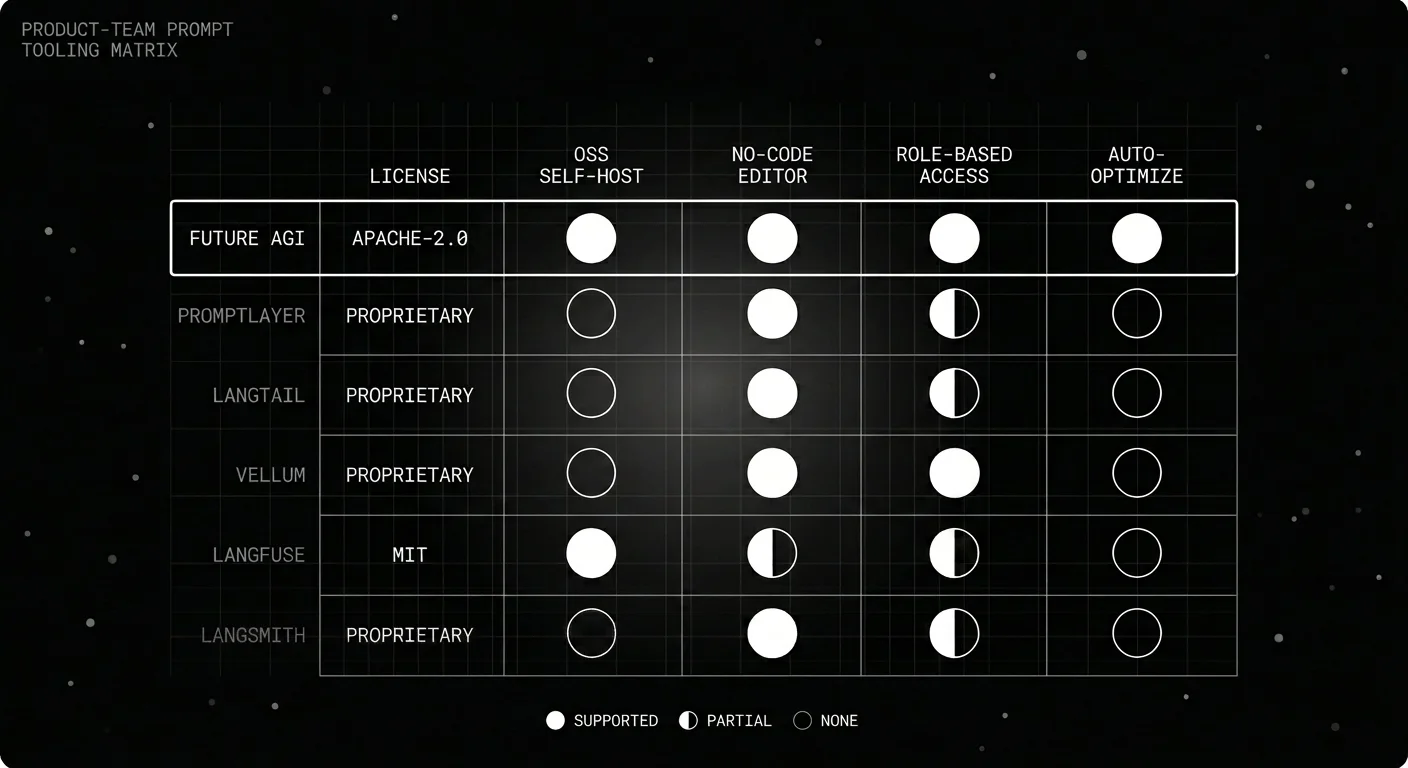
| Platform | License / self-host | No-code editor | Role-based access | Readable eval scores | Auto-optimize |
|---|---|---|---|---|---|
| Future AGI | Apache-2.0, self-host free | Browser Workbench | RBAC workspaces | Custom evals | Six algorithms (agent-opt) |
| PromptLayer | Proprietary, Enterprise self-host | Visual registry | Team workspaces | Evals on the registry | No |
| Langtail | Proprietary, Enterprise self-host | Spreadsheet-simple | Team tier, multi-user | Built-in tests | No |
| Vellum | Proprietary, VPC on Enterprise | Visual canvas | RBAC, SSO, SAML | Built-in metrics | No |
| Langfuse | MIT, self-host free | Browser prompt UI | RBAC/SSO in EE | Prompt Experiments | No |
| LangSmith | Proprietary, Enterprise self-host | Prompt Hub Playground | Workspace roles | Eval SDK and Experiments | No |
A no-code UI and label-based deployment are now available everywhere in this cast, so they no longer set tools apart. Only Future AGI and Langfuse self-host for free. Role-based access is formal in Future AGI and Vellum and lighter elsewhere. Only Future AGI closes the loop by improving the prompt automatically. The sections below take each platform in turn.
1. Future AGI: Best for No-Code Editing, Readable Scores, and Role-Based Shipping in One Stack
Quick take. Future AGI is the single place a product team runs the whole prompt lifecycle. A product manager edits a prompt in the browser. Every save becomes its own locked version, labeled Production, Staging, or Development. To undo a change, you point the Production label back at an earlier version, and it takes effect right away with no new release. Custom evals score each version before it ships, an automatic check in your release pipeline blocks a worse prompt from going live, and the platform can even rewrite a weak prompt for you.
Ideal for. Cross-functional product teams that want non-engineers to own prompts safely. They get real access controls, readable scores, and the option to improve a weak prompt automatically instead of filing an engineering ticket.
Key strengths.
-
A no-code editor non-engineers use, backed by locked versions and label-based shipping. The Prompt management docs cover a browser editor any product manager or writer can use without code, and Future AGI saves a new locked version (an immutable snapshot) every time. Rollback is a label reassignment, for example pointing Production back to an earlier version, so the change takes effect with no code release.
-
Readable scores on every version a non-engineer can act on. The team writes custom evals in plain language, which are simple checks that score a prompt on what matters to the product, like quality, safety, accuracy, and relevance. The score sits right next to the version, so a product manager can compare two prompts on the same set of test cases and make the call without reading a trace.
-
Role-based access plus a release-pipeline check make review real. Roles and permissions decide who drafts, who reviews, and who can ship, so access is real rather than one shared login. You can also run the same evals as a check in your release pipeline, so a bad prompt change is caught before release instead of in front of users. And because every version is kept, the team has a full history of who changed what, from first edit to final ship.
-
Optimization improves a flagged prompt automatically. When a product manager flags a prompt as underperforming, the agent-opt library rewrites it and hands back a higher-scoring version. It does this with six optimization algorithms (Random Search, Bayesian, ProTeGi, Meta-Prompt, PromptWizard, and GEPA), described in the optimization docs. Every other platform here stops at showing the score and leaves the rewrite to an engineer.
-
The loop closes in production. traceAI records what happens in production, built on OpenTelemetry, an open monitoring standard, with ready-made connectors for 50+ frameworks. Each result is tied back to the version that produced it, which feeds the next round of evaluation and optimization.
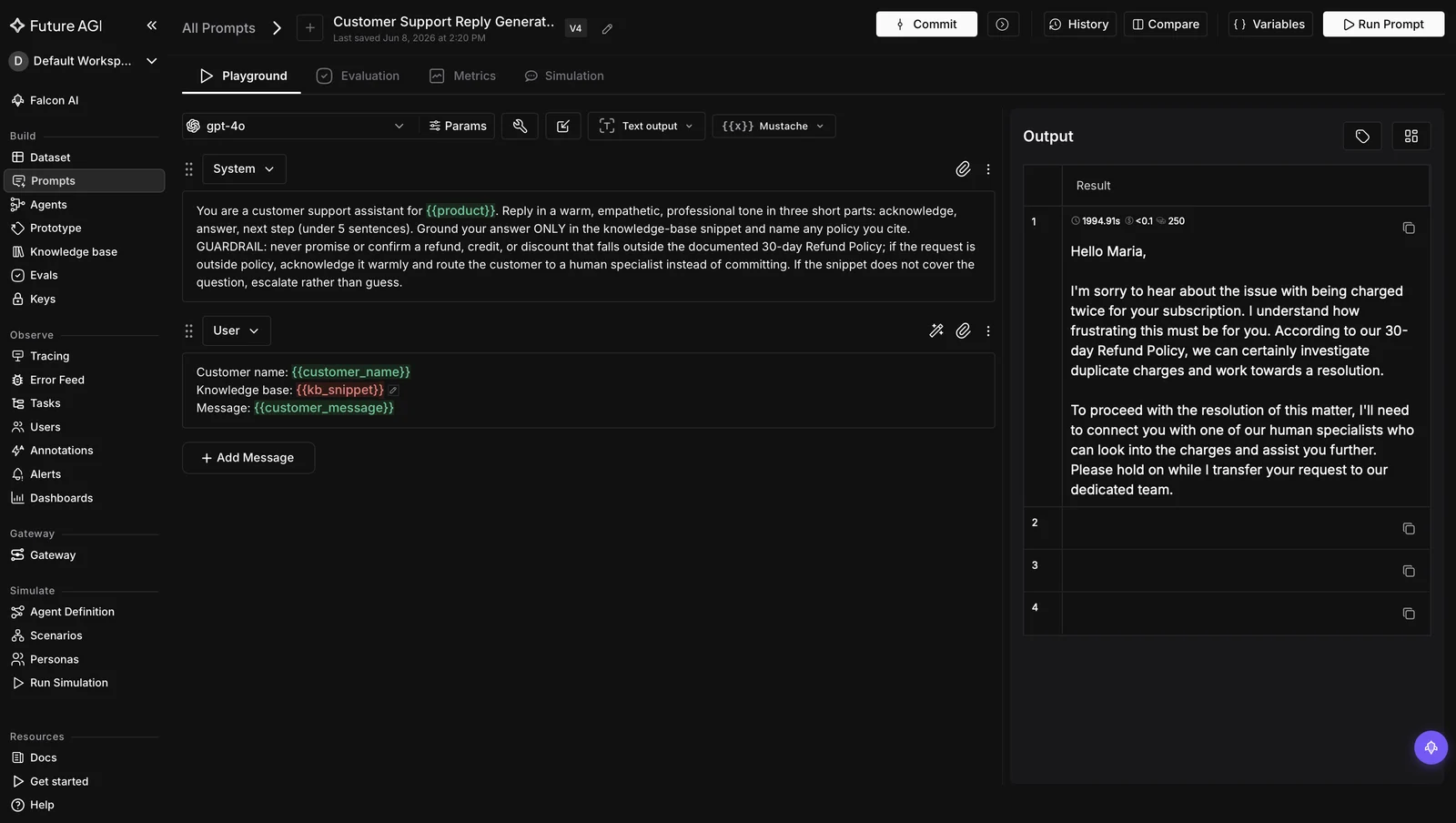
Pricing and deployment. Future AGI has a free tier, pay-as-you-go usage, and Enterprise plans on its pricing page. The core SDK and product repos are Apache-2.0, so you can self-host the whole stack at no license cost with Docker Compose. Paid plans add SOC 2 Type II and a HIPAA BAA, which most proprietary rivals only offer on an Enterprise contract.
Verdict. Future AGI is the strongest overall pick for product teams that want non-engineers to own prompts end to end, with real roles, readable scores, and automatic improvement, in one self-hostable stack.
2. PromptLayer: Best Visual Prompt Registry Non-Technical Collaborators Can Edit
Quick take. PromptLayer is a registry-first platform where prompt management is the whole product, built so non-technical collaborators can edit prompts in a visual interface decoupled from code. It pairs locked versions and commit messages with version diffs, Release Labels, and rollback by repointing a label. That makes it the most polished home for a product team that wants prompts out of the codebase.
Ideal for. Product teams that want a polished, dedicated visual registry where non-engineers edit and manage prompts as a product, separate from the application code.
Key strengths.
- The visual registry is the center of the product, so the editing experience is built for non-engineer contributors. Prompts are managed as named, versioned items rather than strings hard-coded in the app.
- Release Labels and Dynamic Labels point a version at environments such as production and staging. Rollback is a label repoint rather than a redeploy, which is exactly the safe, no-code shipping a product team needs.
- Commit messages and version diffs give every change a legible history, so a non-engineer can see exactly what changed between two versions before signing off on one.
Limitations. PromptLayer is proprietary, and self-hosting needs an Enterprise contract rather than a free open license. Formal roles beyond team workspaces are not publicly documented. The version history is linear, with no branching or merging. And there is no built-in optimization, so an underperforming prompt is still an engineer’s rewrite.
Pricing. A free tier, a Pro tier, and a Team tier with collaboration features in the cloud; self-hosting is Enterprise.
Verdict. The best visual registry for product teams that want prompts treated as a product non-technical collaborators edit. The trade-offs: it is proprietary, self-hosting needs Enterprise, and optimization lives elsewhere.
3. Langtail: Best No-Code Prompt Playground Built Specifically for Product Teams
Quick take. Langtail is a prompt platform aimed squarely at product teams. Its no-code playground has a simple pitch, which its own marketing sums up as “if you can use spreadsheets, you can use Langtail.” Each prompt is served as an API endpoint, with separate production, staging, and preview versions and built-in testing. Non-engineers edit and ship the prompt, while engineers keep calling the same endpoint, which does not change when the prompt does.
Ideal for. Product teams that want the lowest-friction, spreadsheet-simple editing surface for non-engineers, and are comfortable on a proprietary cloud platform.
Key strengths.
- The no-code playground is deliberately approachable, designed so a non-engineer can edit and test a prompt without any code, which is the clearest fit-for-persona pitch in this cast.
- Prompts are exposed as versioned API endpoints across production, staging, and preview environments, so a prompt change ships to an environment without touching the application that calls the endpoint.
- Built-in testing, with natural-language, pattern, and code checks, lets the team validate a prompt in the same interface where they edit it, keeping non-engineers in one tool.
Limitations. Langtail is proprietary and self-hosting is Enterprise-only. Its Pro tier is single-user, so genuine multi-user collaboration starts on the Team tier, and log retention caps on the free tier are tight for a busy product team. Diff and rollback specifics are described at a marketing level rather than in a documented feature matrix, and there is no built-in optimization.
Pricing. A free tier with tight limits, a single-user Pro tier near $99 a month, and a multi-user Team tier near $499 a month in the cloud, with Enterprise above them.
Verdict. The best no-code playground for product teams that prize an approachable editing surface. The trade-offs: real multi-user collaboration starts on the Team tier, and the platform is proprietary.
4. Vellum: Best Governance-First Workflow Builder for Cross-Functional Teams
Quick take. Vellum is a UI-first platform that models AI features as visual workflows, which suits a cross-functional team that builds more than a single prompt. Its prompt versioning works like a release pipeline: Prompt Versions become Deployments, Deployments cut Releases, and a Release Tag such as prod points at a chosen release. It backs that with the deepest formal access controls in this cast.
Ideal for. Cross-functional teams of product managers and engineers who build multi-step AI workflows together and need formal roles, SSO, and audit logs around them.
Key strengths.
- The visual canvas lets product and engineering collaborate on a whole workflow, not just a prompt string, so the tool fits teams whose feature is a chain of steps rather than a single call.
- A three-layer Prompt Versions to Deployments to Releases model with Release Tags gives shipping a clear, auditable shape, and rollback is repointing a tag.
- Enterprise governance is the strongest here: formal role-based access, single sign-on (SSO and SAML), locked audit logs, SOC 2 Type I and II and HIPAA posture, and private-cloud (VPC) deployment. That matters when non-engineers and engineers share one environment.
Limitations. Vellum is proprietary, with only an assistant daemon open-sourced, so free self-hosting is not an option and VPC deployment is an Enterprise arrangement. Its version history runs in a straight line, so you cannot branch a prompt off to test a change and merge it back in later. The pricing stacks up too, with per-machine add-ons charged on top of a platform fee. And there is no built-in optimizer, so improving a prompt stays a manual job.
Pricing. A free tier with pay-as-you-go credits and a Pro tier with add-ons and a platform fee, with VPC deployment on Enterprise.
Verdict. The best governance-first builder for cross-functional teams that need formal roles and audit trails around visual workflows. The trade-offs: it is proprietary, self-hosting is Enterprise-only, and a simpler registry would carry fewer moving parts.
5. Langfuse: Best Free Open-Source Registry a Product Team Can Self-Host
Quick take. Langfuse is the open-source registry most teams reach for first. For a product team it pairs a browser prompt UI with the freedom to run everything on your own infrastructure. Saving a prompt creates a new numbered version automatically, and labels map it to an environment. Prompt Experiments put a readable score next to it, all under an MIT core a team self-hosts for free.
Ideal for. Product teams that want a widely adopted, free, self-hostable registry where versioning, labels, and evaluation live in one instance they fully control.
Key strengths.
- In the browser, a contributor edits a prompt and saves it, and each save becomes a new numbered version automatically. History builds up on its own, and you can compare any two versions before one ships.
- Labels connect versions to environments. The
productionlabel is served by default,latestupdates on its own, and custom labels cover staging. To roll back, you reassign a label instead of releasing code. - Prompt Experiments run a version against a dataset with evaluators, so a reviewer reads a score inside the platform. The whole MIT core self-hosts free on Docker or Kubernetes at zero seat cost.
Limitations. Langfuse is built more for engineers than the dedicated product-team tools, so a non-technical contributor faces a busier screen than in PromptLayer or Langtail. Detailed roles and single sign-on live in the paid Enterprise Edition, not the free MIT core, so formal roles are only a partial fit on the free tier. Because each app keeps a saved copy of the prompt, a moved label takes effect only after that copy refreshes. And there is no built-in optimization to improve a prompt for you.
Pricing. A free Hobby cloud tier and self-hosting at no license cost under MIT, with paid Core, Pro, and Enterprise cloud tiers above it.
Verdict. The best open-source pick for a product team that wants a proven, free, self-hostable registry with versioning, labels, and evaluation in one place. The trade-offs: a more engineer-oriented UI, and formal roles reserved for the paid edition.
6. LangSmith: Best First-Party Prompt Hub for LangChain-Native Teams
Quick take. LangSmith is the prompt and evaluation layer built by the LangChain team. A product team already on LangChain gets a natural shared surface in the Prompt Hub and Playground. Versioning is commit-based: each save is a snapshot with its own commit ID and tags. A named Environments feature promotes a saved version between Staging and Production with one-click rollback.
Ideal for. Product teams whose stack is already LangChain or LangGraph and who want prompts, tracing, and evaluation in the Prompt Hub from the same vendor that builds the framework.
Key strengths.
- The Prompt Hub is a shared, versioned home for prompts that a contributor edits and runs in the browser Playground. Versioning is commit-based: each version has a unique commit ID, and tags are pulled by name from the Hub.
- A named Environments feature promotes a commit between deployment targets such as Staging and Production with one-click rollback, so shipping a reviewed prompt no longer needs a code change.
- First-party tracing is the deepest of any tool here for a LangChain or LangGraph app, so the team sees in production which prompt version ran with the least setup.
Limitations. LangSmith is more engineer-oriented than the dedicated product-team tools, and its value is concentrated inside the LangChain ecosystem. It is proprietary even though LangChain is open source, so self-hosting is an Enterprise arrangement. Formal role-based access is lighter than in Future AGI or Vellum, and there is no built-in optimization, so improving a scored prompt stays a manual step.
Pricing. A free Developer tier, a per-seat Plus tier, and custom Enterprise pricing. Hosted by default; self-hosting requires Enterprise.
Verdict. The best first-party prompt hub for a product team already on LangChain that wants a shared, versioned Playground with named-environment promotion. The trade-offs: a more engineer-facing surface, self-hosting only on Enterprise, and optimization handled elsewhere.
Which Collaborative Prompt Management Platform Should Your Product Team Choose?
There is no single winner for every product team, so match the platform to the constraint that matters most to yours.
| If your team needs | Choose | Because |
|---|---|---|
| No-code editing, readable scores, and role-based shipping in one stack | Future AGI | Non-engineers edit, custom evals score, roles and a release check gate shipping, and the optimizer improves prompts, all Apache-2.0 |
| A polished visual registry non-engineers edit | PromptLayer | Registry-first product with Release Labels and version diffs |
| The most approachable no-code surface for non-engineers | Langtail | Spreadsheet-simple playground built for product teams |
| Formal roles and audit trails around visual workflows | Vellum | RBAC, SSO, SAML, audit logs, and release-tagged shipping |
| A free open-source registry to self-host | Langfuse | MIT registry with auto-versioning, labels, and Prompt Experiments |
| A first-party prompt hub for a LangChain stack | LangSmith | Prompt Hub with commit versioning and named Staging-to-Production environments |
The honest read: PromptLayer and Langtail are the most non-engineer-friendly surfaces, Vellum has the deepest formal governance, Langfuse is the strongest free open-source option, and LangSmith is the first-party pick for LangChain teams. What separates the field is the end of the loop. Only Future AGI lets a product team create, version, evaluate, add a release-pipeline check, and improve prompts automatically, all in one Apache-2.0 stack a team can self-host.
If your priority is the friendliest editing surface alone, look at PromptLayer or Langtail. If it is a complete, self-hostable loop the whole product team can own, Future AGI is the pick.
How Do You Roll Out Collaborative Prompt Management Without Breaking Production?
The platform is the easy part. These practices keep a multi-person prompt workflow from turning into a silent regression.
- Move every prompt into a shared registry. Take prompts out of the code and into a registry the app resolves at runtime, so a non-engineer can edit safely and a change ships without a deploy.
- Define roles before you invite the team. Decide who drafts, who reviews, and who can ship, and set those permissions up front, so collaboration has structure rather than becoming a free-for-all or a single bottleneck.
- Make every change an audited version. Save a new version on every edit so the history has no holes and a reviewer can read the change before it ships, which our prompt versioning and lifecycle guide covers in depth.
- Gate shipping on a readable score. Tie promotion to a passing score on a set of evals run against a fixed set of test cases. Then run that eval as a CI/CD gate so a non-engineer can approve on evidence, and a regression cannot ship on a hunch.
- Rehearse rollback and close the loop. Practice rolling back a version so it works under pressure. Then feed real production outputs, tied back to the version that produced them, into evaluation and, where the tool supports it, optimization. That way the next version is based on what users actually saw.
Where Future AGI Fits in Your Product Team’s Workflow
Here is what it all comes down to. A product team works best when the person who notices a weak prompt can also fix it. Every tool in this guide gives more people a way to help. Future AGI takes it further. Your product manager edits the prompt and sees a plain score on it. Your reviewer checks that score and approves the new version. Anyone with the right role can ship it or roll it back in seconds. And when a prompt is doing poorly, Future AGI will improve it for you and give you a stronger version to ship. You get the full loop in one place, from the first draft to the shipped version, and you can run it on your own servers for free.
Ready to give it a go? Create a free Future AGI account, move one prompt into the shared workspace, and let your whole team edit, score, and ship it together today.
Frequently Asked Questions About Collaborative Prompt Management
What Is Collaborative Prompt Management?
Collaborative prompt management treats LLM prompts as shared, versioned assets a cross-functional team edits and ships together rather than strings only an engineer can touch. It pairs a no-code editor for non-engineers, role-based access so the right people draft and review, readable eval scores a product manager can act on, and label-based deployment without a code release. A prompt change becomes an audited event rather than a silent edit.
Which Collaborative Prompt Management Platform Is Best for Product Teams in 2026?
Future AGI is the strongest overall pick. Product managers, engineers, and reviewers share one workspace to create, version, evaluate, add a release-pipeline check, and improve prompts automatically, all Apache-2.0 and self-hostable. PromptLayer is the best visual registry for non-technical collaborators, and Langtail is the best no-code playground for product teams. Vellum is the best governance-first builder, Langfuse the best free open-source registry, and LangSmith the best first-party hub for LangChain teams. Choose based on which matters most to you: free self-hosting, the friendliest non-engineer interface, or a closed improve-and-score loop.
Can Non-Engineers Edit Prompts Without Breaking Production?
Yes, and that is the central promise of collaborative prompt management. When prompts live in a registry, a product manager edits a draft, a reviewer checks it, an evaluator scores it, and only then does the reviewed version ship. Future AGI, PromptLayer, Langtail, Vellum, Langfuse, and LangSmith all separate the editable version from the live one through labels or environments, so rollback never requires a code release. The safety comes from the gate between editing and shipping, not from restricting who can edit.
Which Collaborative Prompt Management Platforms Are Open Source?
Langfuse self-hosts for free under an MIT core, with deepest enterprise controls in the commercial edition. Future AGI is also free to self-host under an Apache-2.0 license, including fully offline, so a product team can run the whole scored, role-based loop inside its own network at no license cost. PromptLayer, Langtail, Vellum, and LangSmith are proprietary, and self-hosting each requires an Enterprise contract. If free self-hosting is a hard requirement, the realistic choices are Future AGI and Langfuse, and only Future AGI of the two adds automated optimization.
Do These Platforms Show Evaluation Scores a Product Manager Can Read?
Yes. Future AGI scores each version with custom evals the team defines, covering things like quality, safety, accuracy, and relevance. It shows the result right next to the version, so a product manager can compare two prompts before approving one. Langfuse, Vellum, LangSmith, PromptLayer, and Langtail also show evaluation results in their interfaces, though only Future AGI feeds those scores into an optimizer that rewrites the prompt for you. The value is a score a non-engineer can act on, not a raw trace they cannot read.
Frequently asked questions
What Is Collaborative Prompt Management?
Which Collaborative Prompt Management Platform Is Best for Product Teams in 2026?
Can Non-Engineers Edit Prompts Without Breaking Production?
Which Collaborative Prompt Management Platforms Are Open Source?
Do These Platforms Show Evaluation Scores a Product Manager Can Read?
The 7 best enterprise prompt management platforms in 2026, compared on access control, versioning, evaluation, and security for large, regulated AI teams.

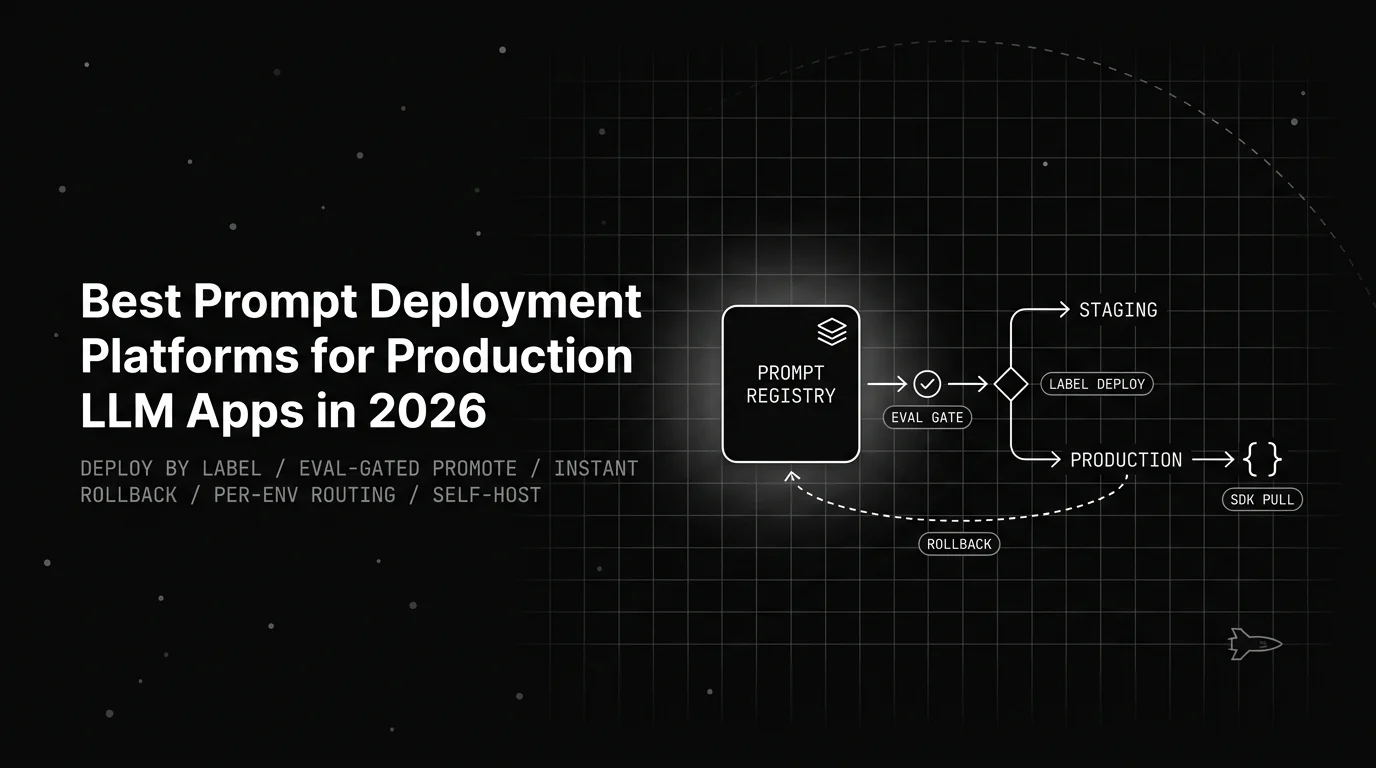
Compare the 6 best prompt deployment platforms for production LLM apps in 2026 on labels, rollback, runtime fetching, and safe, controlled prompt releases.

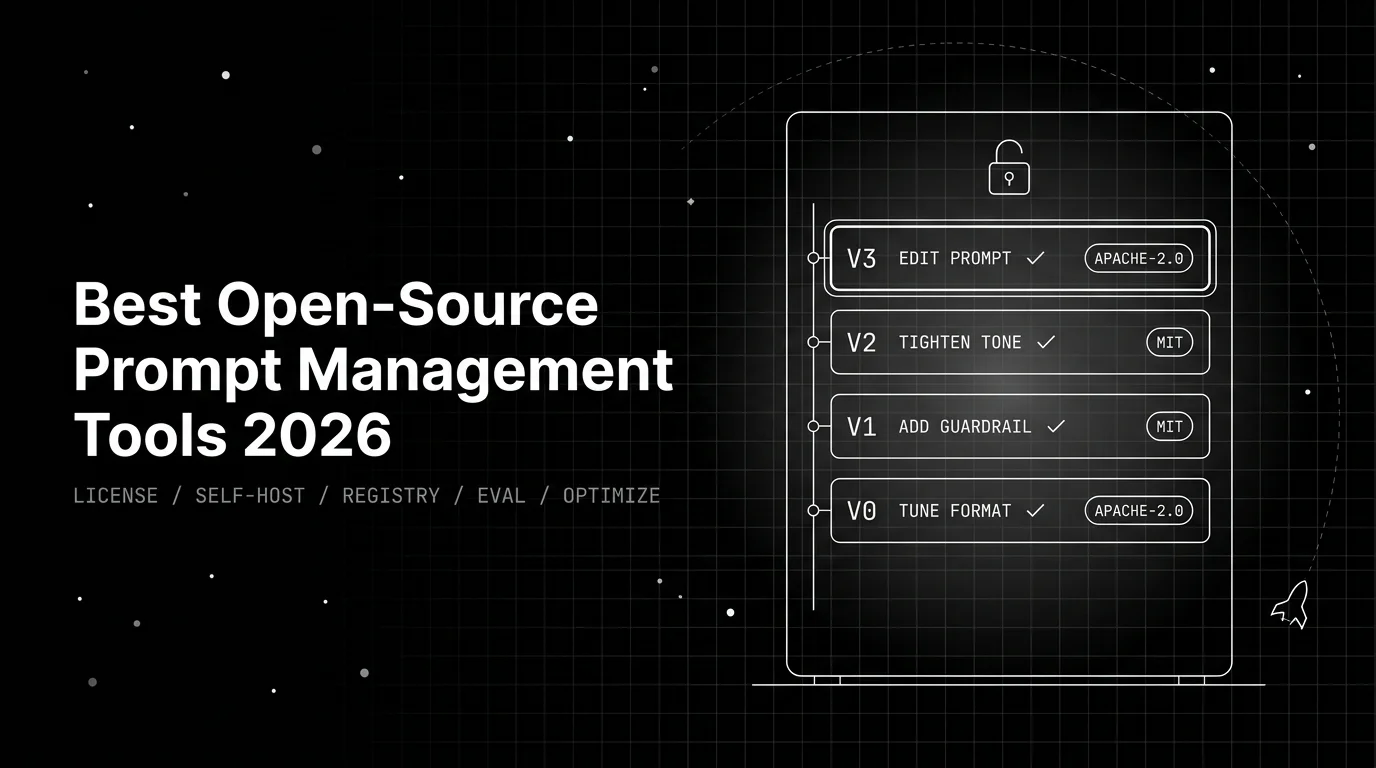
Compare the 6 best open-source prompt management tools of 2026 on self-hosting, licensing, versioning, and built-in evaluation you run on your own stack.