Best 5 Cekura AI Alternatives in 2026
Five Cekura AI alternatives on voice-AI passthrough, eval coverage, gateway, self-host. What each actually fixes outgrowing a voice-only testing tool.
Table of Contents
Cekura AI (formerly Vocera AI) launched in 2024 as a focused voice-AI testing platform. The wedge was real: voice agents are hard to evaluate, and standard text-eval tooling didn’t cover audio quality, turn-taking, interruption handling, or latency under load. For a single voice agent, Cekura’s hosted simulation suite is a quick win. Once the roadmap expands to voice plus chat plus tool-using agents, with gateway, observability, and an optimization loop, Cekura’s scope becomes a ceiling rather than a floor.
This guide ranks five alternatives, names what each fixes versus Cekura, and walks through the migration that matters: extracting REST-defined test scenarios into a framework that also covers gateway, eval, and optimization.
TL;DR: pick by exit reason
| Why you are leaving Cekura | Pick | Why |
|---|---|---|
| You want voice-AI testing plus eval, gateway, and an optimization loop in one stack | Future AGI Agent Command Center | Voice passthrough, multimodal eval, gateway, and self-improving prompt/route optimizer unified |
| You want a voice-AI testing peer with deeper conversation simulation | Hamming | Stronger persona-driven multi-turn simulation, comparable scope to Cekura |
| You want the closest like-for-like voice-AI testing replacement | Coval | Voice + chat agent simulation with a similar REST-driven test-scenario shape |
| You need raw gateway throughput first, eval second | Maxim Bifrost | Go-based gateway with eval integration; voice testing is a sibling product |
| You want a hosted gateway with observability and a basic eval surface | Portkey | Hosted gateway and prompt registry; voice testing comes from an external tool |
Why people are leaving Cekura in 2026
Four exit drivers show up repeatedly in voice-AI engineering Slack channels, the /r/VoiceAI subreddit, LinkedIn comparisons, and G2 reviews from the last two quarters.
1. Voice-AI-only scope is a ceiling, not a floor
Cekura’s product is voice-agent simulation: synthetic callers, scenario branches, audio-quality scoring, latency measurement, and pass/fail gates. What it doesn’t do: text-only agent eval, tool-use traces, RAG faithfulness scoring, gateway routing, prompt registry, or an optimization loop. Teams that started with one voice agent and now run a fleet, voice plus chat plus mixed-modality tool agents, describe the same pattern in user threads: Cekura covers 30% of the eval surface, and the other 70% lives in three other tools.
2. Hosted-only deployment posture
Cekura is a hosted SaaS. There’s no self-host SKU, no source-available core, and no VPC deployment option as of May 2026. For regulated industries (healthcare voice agents under HIPAA, financial services voice agents under SOC 2, and any workload touching EU resident PII) the hosted-only posture is a procurement blocker. Several /r/VoiceAI threads from Q1 2026 describe legal/security review rejecting Cekura specifically because audio of live customer interactions can’t leave the customer’s VPC.
3. Niche community and ecosystem
Cekura is a focused product from a small team. GitHub stars, Discord activity, conference talks, and third-party tutorials are an order of magnitude smaller than the broader agent-eval ecosystem. When an engineer hits an edge case at 2 a.m., the Stack Overflow + GitHub Issues + Discord triangle is thin.
4. No integrated gateway or observability runtime
Cekura runs tests against your voice agent. It doesn’t run in production traffic. There’s no gateway component that proxies live calls, no observability layer that ingests live traces, and no chargeback dashboard. Production-side telemetry has to come from a separate stack, usually Twilio/Vapi logs plus a third-party observability tool plus ad-hoc scripts. Teams that want one integrated surface for “test in CI plus monitor in prod plus optimize from the same traces” find the gap painful.
What to look for in a Cekura replacement
The default “best voice-AI testing tool” axes are necessary but not sufficient. Score replacements on the seven that map to the actual surfaces you’re migrating off, and the ones you wish Cekura had:
| Axis | What it measures |
|---|---|
| 1. Voice-agent passthrough and simulation | Synthetic callers, persona branches, audio-quality scoring, turn-taking, interruption handling |
| 2. Multimodal eval coverage | Voice plus chat plus tool-use plus RAG faithfulness in one rubric set |
| 3. Gateway integration | Same product proxies live traffic and emits traces back into eval |
| 4. Self-host posture | Can the stack run inside your VPC, fully air-gapped from the vendor? |
| 5. Optimizer loop | Does the eval data drive prompt and route updates automatically? |
| 6. Community and ecosystem depth | GitHub activity, Discord, Stack Overflow, third-party tutorials |
| 7. Migration tooling | Are there published scripts or importers for Cekura-shaped test suites specifically? |
1. Future AGI Agent Command Center: Best for unifying voice, eval, gateway, and optimizer
Verdict: Future AGI is the only product in this list that covers all five surfaces Cekura is missing, multimodal eval, gateway, prompt registry, optimizer loop, and self-host posture, while keeping voice-AI as a first-class passthrough. FAGI is the integrated stack: voice agent simulation feeds into the same eval pipeline as chat and tool-use traces, and the optimizer rewrites prompts and routes from the combined data.
What it fixes versus Cekura:
-
Multimodal eval, not voice alone.
ai-evaluation(Apache 2.0) ships rubrics for task completion, faithfulness, tool-use correctness, and audio-quality metrics in one library. The voice passthrough captures audio, transcript, latency-per-turn, interruption count, and turn-taking metrics. The same library scores chat and RAG agents. -
Gateway integration and live traces. Agent Command Center proxies live voice and text traffic, captures traces via
traceAI(Apache 2.0), and routes by cost, latency, or quality. Synthetic CI traffic and production traffic share the same eval rubric, a regression that surfaces in CI also surfaces in prod, against the same threshold.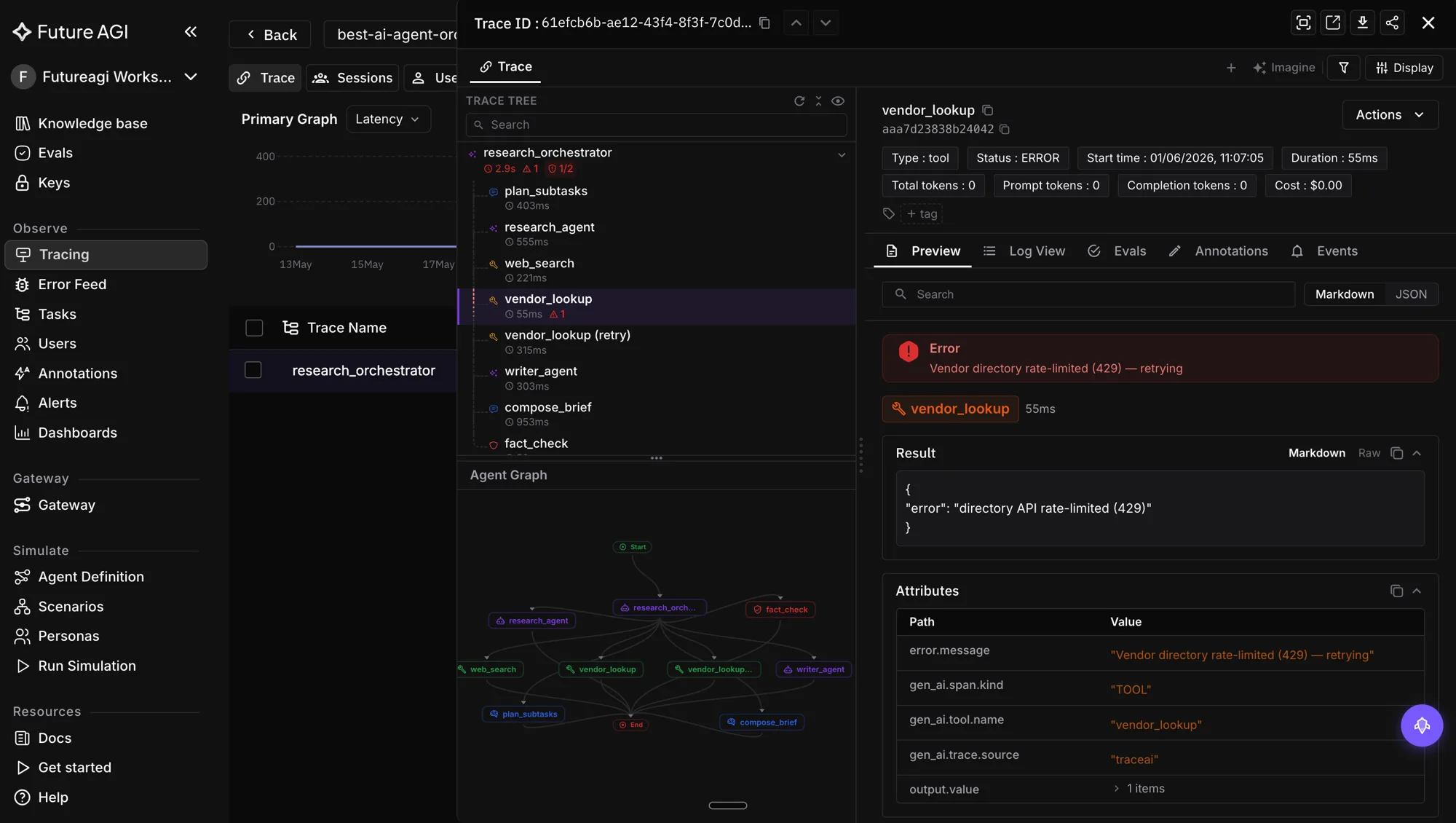
-
Self-improving loop.
agent-opt(Apache 2.0) uses eval scores fromai-evaluationto rewrite prompts via six optimizers — ProTeGi, GEPA, Bayesian, MetaPrompt, RandomSearch, PromptWizard, and pushes the updated prompt or route back into the gateway on the next request. Cekura’s output is a pass/fail report; FAGI’s output is the report plus a candidate prompt that closes the gap. -
Self-host posture. Self-hosted instrumentation via the three Apache 2.0 libraries lets regulated workloads run entirely in VPC. The hosted Command Center adds RBAC, failure-cluster views, the Protect guardrails layer (median 65 ms text-mode latency per arXiv 2510.13351), and AWS Marketplace procurement.
Migration from Cekura: Cekura’s test scenarios live in REST-defined JSON, persona, branches, expected outcomes, audio-quality thresholds. The FAGI importer reads the scenario JSON, maps personas onto ai-evaluation’s synthetic-caller fixtures, translates branch logic into eval rubrics, and preserves audio-quality thresholds. Timeline: seven to ten engineering days for under 100 scenarios, including a parallel-run period where both Cekura and FAGI score the same calls until parity holds.
Where it falls short:
-
The optimizer carries a learning curve; a pure swap won’t use the prompt-rewrite surface in week one.
-
The voice-specific dashboard UX is younger than Cekura’s; failure-investigation flows for audio artifacts will improve through Q3 2026.
Pricing: Free tier with 100K traces/month. Scale from $99/month with linear per-trace scaling above 5M. Enterprise with SOC 2 Type II and AWS Marketplace.
Score: 7 of 7 axes.
2. Hamming: Best for voice-AI peer with deeper conversation simulation
Verdict: Hamming is the pick when the reason for leaving is “we want a voice-AI testing tool with stronger multi-turn persona simulation,” not “we want a wider scope.” Hamming’s persona engine drives longer, branchier synthetic conversations with stronger handling of customer emotion, distraction, and topic drift. Scope is comparable to Cekura, voice-AI testing is the product.
What it fixes versus Cekura:
- Persona and dialog depth. Hamming’s synthetic callers carry longer state (frustration arcs, multi-issue calls, hostile callers, ESL callers) with less hand-engineering in the scenario file. Teams shipping high-stakes voice agents report Hamming catches failure modes Cekura’s flatter personas miss.
- Failure clustering. Hamming groups failing transcripts into clusters by symptom (“agent fails to recover from interruption,” “agent confabulates account number”) and the clusters drive the engineering backlog. Cekura’s reports are flatter pass/fail lists.
- Public benchmarks for voice quality. Hamming publishes head-to-head benchmarks of common voice stacks (Vapi, Retell, Bland) on a shared scenario set, which helps procurement.
Migration from Cekura: Both products are REST-driven and the scenario shapes are close enough that a porting script is straightforward. Personas need re-tuning because Hamming’s engine treats persona files differently. Timeline: five to seven engineering days for under 100 scenarios.
Where it falls short:
- Voice-only. If your roadmap has chat, RAG, or tool-using agents, Hamming covers one slice.
- Hosted-only, like Cekura. The self-host posture problem isn’t solved by this swap.
- No gateway, no optimizer, no production runtime.
Pricing: Hosted, usage-based with enterprise quotes for higher volumes.
Score: 3 of 7 axes.
3. Coval: Best like-for-like voice-AI testing replacement
Verdict: Coval is the closest functional match to Cekura. Both products simulate voice and chat agent conversations, both expose REST APIs for scenario definition, both score on a similar rubric set, both are hosted SaaS. The pivot from Cekura to Coval is the smallest delta you can make.
What it fixes versus Cekura:
- Roadmap independence. Teams worried about Cekura’s small team or runway pick Coval because the company has raised a larger round and the scope is similar. A “second-source” voice-testing vendor is the actual ask in many of these migrations.
- Chat agent coverage alongside voice. Coval handles chat and voice in one product. Teams running a chat agent next to a voice agent get one vendor for both.
- Scenario import path. Coval’s import API accepts JSON in a shape close to Cekura’s; the porting script most teams write is roughly 200 lines.
Migration from Cekura: REST-defined scenarios map almost directly. Persona files need a one-pass edit because Coval’s persona schema has a few additional fields. Timeline: four to six engineering days for under 100 scenarios, plus a parallel-run period.
Where it falls short:
- Hosted-only, like Cekura. The self-host problem isn’t solved.
- No gateway, no production runtime, no optimizer.
- Slightly larger community than Cekura but still small versus the broader agent-eval ecosystem.
Pricing: Hosted, usage-based with enterprise quotes.
Score: 3 of 7 axes.
4. Maxim Bifrost: Best for gateway-first, eval-second teams
Verdict: Maxim Bifrost is the pick when gateway throughput at high concurrency is the binding constraint and voice-AI testing is a sibling product rather than the centerpiece. Bifrost is a Go-based gateway with sub-millisecond overhead at p50 in Maxim’s published benchmarks, and Maxim’s eval product handles voice and chat with reasonable depth.
What it fixes versus Cekura:
- Production gateway runtime. Bifrost proxies live traffic (chat and voice) and emits traces back into Maxim’s eval pipeline. This is the runtime layer Cekura doesn’t have.
- Throughput per node. The Go runtime plus connection-pooling gives Bifrost higher RPS per node than Python-based proxies. For voice-AI workloads where the gateway’s own latency matters (call setup, first-token), this matters.
- Eval product alongside the gateway. Voice-agent simulation lives in Maxim’s eval product. Scope is narrower than Cekura’s voice-specific feature set, but the integration with gateway traces is the upside.
Migration from Cekura: Cekura’s scenario JSON has to be re-shaped into Maxim’s eval format. Voice-quality scoring is present but the granularity is shallower than Cekura’s audio-artifact catalog. Timeline: eight to twelve engineering days, including the gateway cutover.
Where it falls short:
- Voice-AI testing depth is younger than Cekura’s; the rubric catalog around audio artifacts (clipping, breathing, jitter, cross-talk) is thinner.
- No prompt registry as polished as Portkey’s or FAGI’s.
- No optimizer loop. Traces inform humans, not the gateway.
Pricing: Bifrost is open source. Hosted eval and gateway pricing is custom, anchored to the eval product’s usage tiers.
Score: 4 of 7 axes.
5. Portkey: Best for hosted gateway with basic eval
Verdict: Portkey is the pick when the center of gravity shifts toward gateway, observability, and prompt management, and voice-AI testing becomes a “solve with a separate tool” problem. Portkey is a hosted AI gateway with a prompt registry, virtual keys, and a basic eval surface. Note: Portkey was acquired by Palo Alto Networks on April 30, 2026, which creates SKU uncertainty for SMB customers, diligence accordingly.
What it fixes versus Cekura:
- Production runtime. Portkey proxies live traffic, captures traces, and serves a per-request cost and latency dashboard. This is the layer Cekura doesn’t have.
- Prompt registry and virtual keys. Portkey’s Prompt Studio stores versioned prompts and virtual keys enable per-identity attribution.
- Mature hosted UX. Procurement and onboarding are smoother than the newer alternatives.
Migration from Cekura: This isn’t a like-for-like swap. Cekura’s voice-testing functionality has to be replaced with a sibling tool (Hamming, Coval, or FAGI) while Portkey handles the gateway and observability. Timeline: twelve to eighteen engineering days end to end.
Where it falls short:
- No first-party voice-AI testing. You pair with a separate tool.
- No optimizer loop.
- Palo Alto Networks acquisition uncertainty around the SMB SKU through 2026 to 2027.
- Hosted only at standard tiers; self-host is enterprise-only.
Pricing: Free tier with 10K requests/month. Scale from $99/month. Enterprise custom.
Score: 3 of 7 axes.
Capability matrix
| Axis | Future AGI | Hamming | Coval | Maxim Bifrost | Portkey |
|---|---|---|---|---|---|
| Voice-agent passthrough and simulation | Native, audio-quality rubrics included | Native, deeper personas | Native, like-for-like with Cekura | Native, shallower than Cekura | Not native (pair with external) |
| Multimodal eval coverage | Voice + chat + RAG + tool-use | Voice only | Voice + chat | Voice + chat | Chat-focused; voice via external |
| Gateway integration | Native (Agent Command Center) | None | None | Native (Bifrost) | Native (Portkey gateway) |
| Self-host posture | OSS instrumentation + BYOC | Hosted only | Hosted only | OSS gateway, hosted eval | Hosted standard; enterprise self-host |
| Optimizer loop | Yes (agent-opt) | No | No | No | No |
| Community and ecosystem | Apache 2.0 libs, broader agent-eval surface | Voice-AI-focused, growing | Voice-AI-focused, growing | Younger, broader scope | Mature, gateway-focused |
| Cekura migration tooling | Scenario importer + parallel-run | Porting script (community) | Native import shape | Manual reshape | Pair-with-voice-tool migration |
Migration notes: what breaks when leaving Cekura
Three surfaces always need attention.
Extracting REST-defined test scenarios
Cekura’s scenarios are defined via REST, POST /v1/scenarios with a JSON body containing persona, branches, expected outcomes, audio-quality thresholds, and pass/fail gates. The export script paginates GET /v1/scenarios for IDs, fetches each GET /v1/scenarios/{id}, and checkpoints associated audio reference files.
The rewrite converts Cekura’s scenario schema to the destination format. Common cases (persona, demographics, turn structure) are mechanical. Harder cases. Cekura-specific evaluation directives (e.g., “agent must acknowledge interruption within 800 ms”), nested branches, and conditional pass/fail gates, need a manual pass. Future AGI’s Cekura importer translates persona, branch logic, and audio-quality thresholds into the ai-evaluation voice eval suite, flagging conditional gates for review. Under 100 scenarios completes in three to four days.
Re-wiring CI to call the new eval suite
Cekura’s CI integration is typically a step that posts to Cekura’s REST API, polls for completion, and fails the build on pass/fail. The pattern transfers cleanly, the endpoint and request shape change, polling logic stays. Future AGI’s CI integration uses the ai-evaluation library directly, so the build runs the eval suite locally inside the runner, faster CI, no external dependency on the eval vendor’s uptime, and the same library scores production traces in the runtime.
Standing up production-side telemetry that Cekura did not have
This is the migration most teams don’t budget for. Cekura runs in CI; it doesn’t run in prod. After cutover to a gateway-equipped stack, prod-side telemetry is new. The first week of cutover is usually spent dialing in trace ingestion, the cost dashboard, and alert thresholds. Budget for this; teams that skip it end up with a stronger CI surface and a weaker prod-side picture for a quarter.
Decision framework: Choose X if
Choose Future AGI if your reason for leaving is scope, voice-AI testing plus multimodal eval plus gateway plus optimization in one stack, with self-host posture for regulated workloads. Pick this when production agent workloads span voice and chat and the eval surface needs to drive prompt rewrites and routing-policy updates over time.
Choose Hamming if your reason for leaving is “we want a voice-AI testing tool, but with stronger multi-turn persona simulation.” Pick this when scope stays voice-only and dialog depth is the bottleneck.
Choose Coval if your reason is “second source”. Cekura’s roadmap or company stage worries you and you want the smallest possible delta. Pick this when migration cost has to stay tight.
Choose Maxim Bifrost if you need a production gateway with sub-millisecond overhead and voice testing becomes a sibling product. Pick this when gateway throughput outweighs voice-eval depth.
Choose Portkey if you need a hosted gateway with a prompt registry and observability, and voice testing moves to a separate tool. Pick this when the gateway is the priority and the Palo Alto Networks acquisition path is acceptable.
What we did not include
Three products show up in other 2026 listicles that we left out: Vapi’s built-in test harness (smoke tests for Vapi agents, not general-purpose voice eval); Bland Test Studio (tightly coupled to Bland’s runtime); Deepgram’s voice analytics (strong on transcription quality, not end-to-end agent eval).
Related reading
- Best 5 Portkey Alternatives in 2026
- Best 5 AI Gateways for Agentic AI in 2026
- What Is Agent Observability? The 2026 Definition
Sources
- Cekura AI (formerly Vocera AI) product documentation, cekura.ai/docs
- Hamming product page and benchmarks, hamming.ai
- Coval product documentation, coval.dev/docs
- Maxim Bifrost product page and benchmarks, getmaxim.ai/bifrost
- Portkey product documentation, portkey.ai/docs
- Palo Alto Networks press release on Portkey acquisition, April 30, 2026, paloaltonetworks.com/company/press
- Reddit /r/VoiceAI migration discussions, January-May 2026
- Future AGI Agent Command Center, futureagi.com/platform/monitor/command-center
- Future AGI traceAI, github.com/future-agi/traceAI (Apache 2.0)
- Future AGI ai-evaluation, github.com/future-agi/ai-evaluation (Apache 2.0)
- Future AGI agent-opt, github.com/future-agi/agent-opt (Apache 2.0)
- Future AGI Protect latency benchmark, arxiv.org/abs/2510.13351 (65 ms text, 107 ms image)
Frequently Asked Questions
Why are people moving off Cekura in 2026?
What is the closest like-for-like alternative to Cekura?
How do I migrate scenarios out of Cekura?
Is there an open-source Cekura alternative?
Which Cekura alternative is best for regulated industries?
How does Future AGI Agent Command Center compare to Cekura?
Future AGI vs Cekura on voice simulation, observability, eval breadth, guardrails, optimization, deployment, compliance. Honest read, May 2026 pricing.

Engineer voice agent simulation: 18 personas, auto-generated branching scenarios, four-step test wizard, Error Localization, programmatic eval API.

Voice agent eval is end-task scoring plus pipeline-stage attribution plus conversation coherence. WER scores the ASR component, not the agent.