Best 5 AIMon Alternatives in 2026
Five AIMon alternatives on hallucination depth, gateway and routing, optimizer, self-host, migration cost. What each actually fixes beyond hosted scope.

Table of Contents
AIMon shipped one of the earliest dedicated hallucination-detection APIs and earned a real following among RAG-heavy teams who needed a faithfulness score before anyone else was selling one. Two years later, the surface that made AIMon useful is the same surface that makes teams outgrow it. A REST endpoint that returns a hallucination score is a feature, not a platform, once production agents are routing through a gateway, getting evaluated against task-completion rubrics, and feeding traces back into a prompt optimizer, AIMon’s single-purpose shape feels narrow.
This guide ranks five alternatives worth migrating to, names what each fixes versus AIMon, and walks through the migration that actually bites: replacing a post-hoc REST call with inline guardrails plus a faithfulness eval against your trace store.
TL;DR: pick by exit reason
| Why you are leaving AIMon | Pick | Why |
|---|---|---|
| You want hallucination detection plus gateway, eval, and optimizer in one platform | Future AGI Agent Command Center | Inline Protect guardrail, faithfulness eval, gateway, and self-improving loop |
| You want OSS observability with a strong eval ecosystem | Arize Phoenix | Apache 2.0, OpenInference-native, integrates many eval libraries |
| You want an open-source eval framework for code-owned hallucination checks | DeepEval | pytest-style assertions you run in CI, fully self-hosted |
| You want a runtime safety guardrail for prompt-injection and PII | Lakera Guard | Inline policy filter focused on injection, PII, and content safety |
| You want a hosted eval and experimentation workbench | Braintrust | Eval-first product with playground, datasets, and scoring |
Why people are leaving AIMon in 2026
Five exit drivers show up repeatedly in Reddit /r/LLMDevs threads, GitHub issues of teams who have already moved off, and G2 reviews from the last two quarters.
1. Hallucination detection is necessary, not sufficient
AIMon’s product surface is narrow by design: a hallucination/faithfulness API plus a few related quality scores. When the only signal a team needs is “did the RAG answer ground itself in the retrieved context,” AIMon is fine, and the broader landscape of AI hallucination detection tools covers similar single-purpose options. The problem starts when the same team adds tool calls, multi-step agents, and routing across providers. Now the questions are “did the agent complete the task,” “did it call the right tool,” “did the policy filter catch the injection,” “is this trajectory cheaper on a different model.” AIMon has nothing to say about any of those, and the gap shows up as a stack of glued-together tools. AIMon for faithfulness, something else for traces, something else for routing, something else for guardrails, that nobody loves to maintain.
2. No native gateway or routing
AIMon is a post-hoc evaluator: your application makes the LLM call, you POST the tuple to AIMon, you decide what to do with the score. No inline path, no gateway, no virtual keys, no fallback or cost-aware routing. Teams that grow into needing a gateway end up bolting one on (Portkey, LiteLLM, Helicone) and running two control planes.
3. Hosted-only posture
AIMon is hosted SaaS, no self-host SKU, no on-prem, no source-available reference. For regulated industries (healthcare RAG, financial Q&A, public sector), the data that needs evaluation is exactly the data that can’t leave the VPC, and “send your context to a third party” fails security review.
4. No integrated optimizer
AIMon tells you the answer is unfaithful; it doesn’t cluster failures, suggest a prompt rewrite, or push the rewrite back to your gateway. The loop is the same: hallucination rate climbs, an engineer rewrites the prompt by hand, ships a tweak, hopes the score moves. For mature teams, “eval drives optimizer drives prompt registry” is now table stakes.
5. Smaller community and ecosystem
AIMon’s GitHub footprint, blog cadence, and community channels are smaller than Arize, Braintrust, or Future AGI. Soft factor on day one, hard factor by month six.
What to look for in an AIMon replacement
Score replacements on seven axes that map to the surfaces you’re actually migrating off:
| Axis | What it measures |
|---|---|
| 1. Hallucination / faithfulness depth | Reference-free and reference-based scoring, plus span-level attribution |
| 2. Inline guardrail (block, not just score) | Can you stop an unfaithful response before it ships? |
| 3. Eval coverage beyond hallucination | Task completion, tool use, instruction following, PII, injection |
| 4. Gateway / routing integration | Does the eval product also handle routing, virtual keys, fallback? |
| 5. Optimizer loop | Does eval data drive automatic prompt rewrites? |
| 6. Self-host posture | Can the eval stack run inside your VPC, fully air-gapped? |
| 7. Migration tooling | Published patterns or scripts for replacing AIMon’s REST call? |
1. Future AGI Agent Command Center: Best for closing the loop
Verdict: Future AGI is the only product in this list that gives you AIMon’s faithfulness API plus everything AIMon lacks, inline guardrail that blocks before the response ships, gateway with virtual keys and routing, eval suite that covers far more than hallucination, and optimizer that uses eval data to rewrite prompts. AIMon is one shape; FAGI is the platform.
What it fixes versus AIMon:
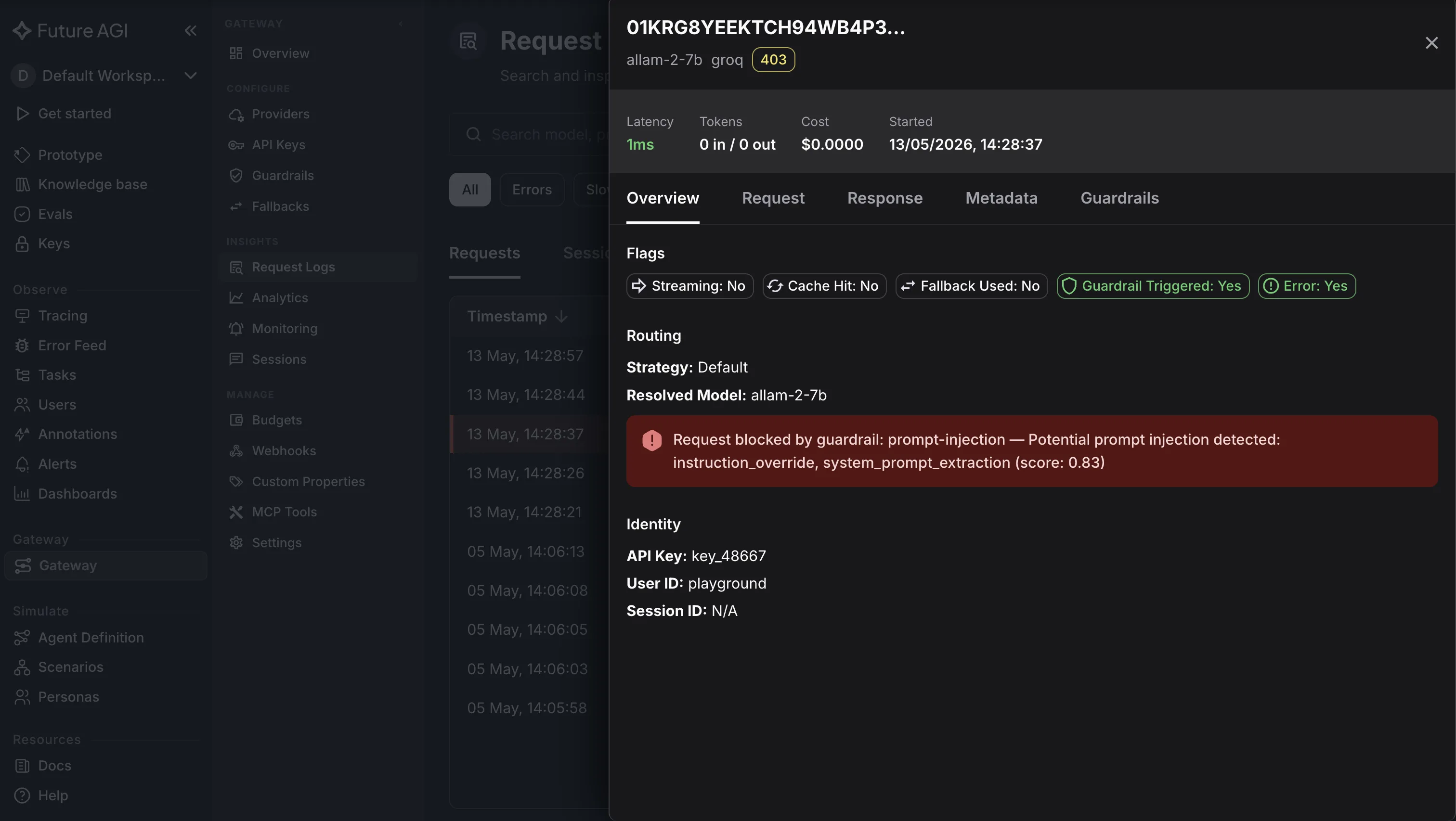
- Hallucination as an inline guardrail. AIMon’s check runs after generation; you either ship the unfaithful answer or write blocking logic yourself. FAGI’s Protect runs inline, hallucination, prompt injection, PII, and content-safety checks happen in the request path with median 65 ms text-mode latency (107 ms image-mode) per arXiv 2510.13351. Block, rewrite, or pass-through is a config flag.
- Eval coverage past hallucination. The
ai-evaluationlibrary (Apache 2.0) ships faithfulness and groundedness scorers competing with AIMon’s, plus task completion, tool-use correctness, instruction following, retrieval precision, and twenty-plus other rubrics. - Native gateway and routing. Agent Command Center is a gateway, not an evaluator alone. Virtual keys, per-identity attribution, cost-aware routing, and fallback policies are first-class. The trace flowing through the gateway is the same trace the eval scores and the optimizer reads.
- The self-improving loop. Every captured trace is scored, failures cluster, the optimizer (
agent-opt, Apache 2.0) proposes prompt rewrites via six optimizers — ProTeGi, GEPA, Bayesian, MetaPrompt, RandomSearch, PromptWizard. Approved rewrites push back to the prompt registry. AIMon gives you a score; FAGI gives you a loop that reduces it over time.
- OSS instrumentation, self-host option.
traceAI,ai-evaluation, andagent-optare all Apache 2.0. The hosted Command Center adds RBAC, failure-cluster views, Protect, and AWS Marketplace procurement.
Migration from AIMon: For post-hoc evaluation only, drop the AIMon POST and replace it with ai-evaluation.faithfulness(context, response). For inline blocking, point your SDK’s base_url at the FAGI gateway and enable Protect with a hallucination_threshold policy. First shape is a one-day swap; second adds two to three days for the gateway cutover.
Where it falls short:
-
Platform breadth that beats AIMon is also a learning curve; teams who only need faithfulness scores get more surface than the job requires.
-
The optimizer is opt-in and takes a week or two of tuning before rewrites are reliably better than human-authored prompts.
Pricing: Free tier with 100K traces/month. Scale tier from $99/month with linear per-trace scaling above 5M (no add-on multipliers). Enterprise with SOC 2 Type II and AWS Marketplace.
Score: 7 of 7 axes.
2. Arize Phoenix: Best for OSS observability with eval composability
Verdict: Arize Phoenix is the pick when the exit reason is “we want an OSS-first observability and eval platform we can self-host, and we’re happy to compose hallucination checks from a library.” Phoenix is Apache 2.0, OpenInference-native, and integrates the broadest set of eval libraries in this list (its own, Ragas, DeepEval). You give up AIMon’s hosted polish; you gain full control of the data.
What it fixes versus AIMon:
- Self-host posture. Phoenix runs in a container on your hardware. Traces, eval results, and datasets stay in the VPC. The cleanest OSS answer for “can’t send context to a third party.”
- Hallucination via composable evaluators. Ships its own LLM-as-judge hallucination evaluator, integrates Ragas for RAG groundedness, and accepts DeepEval scorers.
- Broader observability scope. OpenInference captures the full trace, retrieval steps, tool calls, and re-rankers in the same tree, making the difference between “answer is unfaithful” and “retriever pulled the wrong chunk” observable.
Migration from AIMon: Stand up Phoenix in a container, instrument with OpenInference, replace the AIMon POST with Phoenix’s hallucination evaluator (or Ragas’s faithfulness). Phoenix’s evaluator is a Python call with the same inputs, so the swap is mechanical. Timeline: five to seven engineering days.
Where it falls short:
- No optimizer. Trace and eval data are visible; nothing rewrites the prompt for you.
- No gateway. You still need a separate routing layer (LiteLLM, FAGI, Portkey) if that’s part of the exit shape.
- The eval-library buffet is a strength when you’re sophisticated and a tax when you aren’t.
Pricing: Apache 2.0, free to self-host. Arize’s hosted SaaS tier (which includes Phoenix as the OSS core plus enterprise features) starts in the low thousands per month for production volumes.
Score: 5 of 7 axes (missing: optimizer, native gateway).
3. DeepEval: Best for code-owned hallucination checks in CI
Verdict: DeepEval is the pick when the exit reason is “we want hallucination checks as pytest assertions in CI, not as a runtime SaaS call.” MIT-licensed framework with pytest ergonomics: define a test case, pick a metric (FaithfulnessMetric, HallucinationMetric, AnswerRelevancyMetric), run it, get pass/fail.
What it fixes versus AIMon:
- Eval in CI, not production. AIMon is a runtime API; every response triggers a POST. DeepEval runs in pytest against a regression set on every PR and on a schedule. After a year on AIMon, many teams realize ~90% of what they need is a regression check against a curated dataset.
- Self-host by default. Library runs in your CI environment. Nothing leaves the VPC unless you opt into the Confident AI hosted dashboard.
- Span-level attribution. FaithfulnessMetric and HallucinationMetric surface which claim is unsupported, structured enough for CI failure messages that point at the offending span.
Migration from AIMon: Build a regression dataset from AIMon historical inputs, wire DeepEval’s FaithfulnessMetric into pytest, run on every PR and nightly. The runtime POST goes away. For runtime, pair DeepEval (CI) with FAGI Protect or similar. Timeline: three to five engineering days.
Where it falls short:
- Not a runtime product by itself. To block unfaithful responses inline, pair with a runtime guardrail (FAGI’s Protect, Lakera).
- No gateway, no routing, no optimizer.
- The hosted Confident AI dashboard is younger than Braintrust or FAGI.
Pricing: Open source under MIT. Confident AI hosted dashboard is free for small teams; team and enterprise tiers are custom.
Score: 4 of 7 axes (missing: inline runtime guardrail, gateway, optimizer).
4. Lakera Guard: Best for inline safety guardrails
Verdict: Lakera Guard is the pick when the exit reason is less about hallucination per se and more about runtime safety, prompt injection, PII leakage, content moderation, jailbreaks. Hosted API-first guardrail that intercepts request and response and applies a configurable policy. Overlaps with AIMon as a runtime safety layer, but the failure modes it catches are different.
What it fixes versus AIMon:
- Prompt injection and jailbreak detection. Catches hidden instructions in user input, jailbreak prefixes, and indirect injection via retrieved documents, a surface AIMon doesn’t target.
- PII and content safety. Inline detectors for PII, toxic content, hate speech, and self-harm with configurable per-category policies.
- Inline by design. Positioned as a guardrail, not an evaluator. Wrap the LLM call with a check on input and another on output, exactly the inline pattern AIMon’s post-hoc shape lacks.
Migration from AIMon: Lakera is a complement, not a like-for-like replacement. If hallucination was a small part of your AIMon usage and prompt-injection or PII was the underlying concern, swap AIMon for Lakera. If hallucination is genuinely the problem, pair Lakera with a separate faithfulness evaluator. Timeline for the Lakera-only swap: two to four days.
Where it falls short:
- Lakera’s faithfulness coverage is shallow compared to AIMon, FAGI, or DeepEval; not the product for RAG groundedness as the primary concern.
- No gateway, no optimizer, no eval datasets, no experiment tracking.
- Hosted-only; no self-host SKU.
- Block decisions are bound to Lakera’s third-party classifier quality.
Pricing: Free tier with limited monthly checks. Pro and Enterprise pricing custom, typically per-check or per-seat.
Score: 3 of 7 axes (covers inline guardrail well; missing eval breadth, gateway, optimizer, self-host).
5. Braintrust: Best for hosted eval and experimentation
Verdict: Braintrust is the pick when the exit reason is “AIMon scores responses one at a time; we want a workbench to run experiments, compare prompts, build eval datasets, and ship the winner.” Eval-first product whose surface is the playground and experiment tracker.
What it fixes versus AIMon:
- Experimentation workflow. “I have a prompt, here is a dataset, run it through three models and four variants, give me a scoreboard.” Better than AIMon’s single-shot REST API for “which prompt change moves the score.”
- Dataset management. Datasets are first-class, curate a regression set, version it, attach to experiments. AIMon doesn’t have this concept.
- Eval breadth. Wide catalog of scoring functions (faithfulness, answer relevancy, conversation quality, instruction following, custom scorers).
Migration from AIMon: The logger.eval pattern maps onto an AIMon POST replacement, but the bigger value is offline. Dump historical AIMon inputs as a Braintrust dataset, define scorers as Braintrust functions, run baseline experiments for parity, then move the runtime POST. Timeline: five to eight engineering days.
Where it falls short:
- No gateway, no inline guardrail, no optimizer.
- Hosted-only as of May 2026 (self-host SKU on the roadmap, not GA).
- Pricing scales with eval volume rather than trace volume, which changes the math for heavy workloads.
Pricing: Free tier for small teams. Pro and Enterprise pricing scales with eval runs and seats.
Score: 4 of 7 axes (missing: inline guardrail, gateway, optimizer).
Capability matrix
| Axis | Future AGI | Arize Phoenix | DeepEval | Lakera Guard | Braintrust |
|---|---|---|---|---|---|
| Hallucination depth | Native multi-rubric | Native + Ragas | Native (Faithfulness, Hallucination) | Shallow | Native + custom |
| Inline guardrail | Yes (Protect ~65 ms) | No | No | Yes (injection, PII) | No |
| Eval beyond hallucination | Twenty-plus rubrics | Composable | Broad pytest metrics | Safety only | Broad + custom |
| Gateway / routing | Native | No | No | No | No |
| Optimizer loop | Yes (agent-opt) | No | No | No | No |
| Self-host | OSS + BYOC | Apache 2.0 | MIT, in CI | Hosted-only | Hosted-only |
| AIMon migration tooling | Drop-in eval + Protect | Manual swap | CI regression | Complement | Dataset migration |
Migration notes: what breaks when leaving AIMon
Three surfaces always need attention.
Replacing the post-hoc REST call
AIMon’s integration is a POST /evaluate with context, prompt, response, and optional detector flags. Most application code is a try/except around the LLM call, the HTTP request, and a branch on the returned hallucination_score. The migration step is exactly that block.
For FAGI: replace the POST with ai-evaluation.faithfulness(context, response), or, for inline blocking, configure Protect with a hallucination_threshold policy at the gateway. For Phoenix: replace with a Phoenix evaluator call. For DeepEval: move the check into a CI test. For Lakera: not a like-for-like swap; pair with a separate faithfulness evaluator. For Braintrust: replace with Braintrust.log plus a scoring function.
The pattern that bites is teams who treated the AIMon score as a tripwire (if score < 0.7: regenerate). When the new evaluator returns a different distribution, the same threshold no longer fires as expected. Plan a one-to-two-week calibration period where the new score is logged in parallel before blocking logic flips over.
Rebuilding the historical baseline
After migration you start from zero on the new dashboard. Mitigation: dump AIMon’s historical scores via their API and import as a one-time historical series alongside the new evaluator’s live data.
Re-routing application code if you also adopt a gateway
If the exit reason includes “we want a gateway, not an evaluator alone,” setting your SDK’s base_url to the new gateway is one line in principle, but services hard-code the URL in three places: SDK init, runtime config, deployment manifest. The migration checklist needs all three.
Decision framework: Choose X if
Choose Future AGI if your exit reason is “AIMon does one thing and we now need five”, hallucination detection plus inline guardrail plus gateway plus eval breadth plus optimizer.
Choose Arize Phoenix if your exit reason is “we want OSS-first observability we can self-host, and we’re happy to compose the eval surface from libraries.”
Choose DeepEval if your exit reason is “we want hallucination checks as pytest assertions in CI, not as a runtime SaaS call.”
Choose Lakera Guard if your production incidents were prompt injection or PII leakage rather than RAG hallucinations, as a complement to a faithfulness evaluator, not a like-for-like swap.
Choose Braintrust if your exit reason is “we want a workbench for prompt experiments, dataset management, and scoreboards.”
What we did not include
Three products show up in other 2026 AIMon listicles that we left out: Patronus AI (strong eval research, but the product surface is closer to a research API than a platform replacement); TruEra TruLens (capable RAG triad framework, primarily a library with limited hosted infrastructure); Guardrails AI (excellent OSS validator library, but assembly cost is higher than the picks above).
Related reading
- Best 5 Portkey Alternatives in 2026
- What Is an AI Gateway? The 2026 Definition
- Best AI Gateways for Agentic AI in 2026
Sources
- AIMon API documentation, aimon.ai/docs
- AIMon hallucination detection product page, aimon.ai/product
- Reddit /r/LLMDevs hallucination-detection discussions, February-May 2026
- Arize Phoenix GitHub repository, github.com/Arize-ai/phoenix (Apache 2.0)
- Arize Phoenix OpenInference instrumentation, github.com/Arize-ai/openinference
- DeepEval GitHub repository, github.com/confident-ai/deepeval (MIT)
- DeepEval FaithfulnessMetric documentation, docs.confident-ai.com
- Lakera Guard product page, lakera.ai/lakera-guard
- Braintrust product page, braintrust.dev
- Ragas RAG evaluation library, github.com/explodinggradients/ragas
- Future AGI Agent Command Center, futureagi.com/platform/monitor/command-center
- Future AGI traceAI, github.com/future-agi/traceAI (Apache 2.0)
- Future AGI ai-evaluation, github.com/future-agi/ai-evaluation (Apache 2.0)
- Future AGI agent-opt, github.com/future-agi/agent-opt (Apache 2.0)
- Future AGI Protect latency benchmark, arxiv.org/abs/2510.13351 (65 ms text, 107 ms image)
Frequently Asked Questions
Why are people moving off AIMon in 2026?
What is the closest like-for-like alternative to AIMon?
Can I keep using AIMon and add a gateway alongside?
How do I migrate from AIMon's REST call to FAGI?
Is there an open-source AIMon alternative?
Does Future AGI's Protect actually block unfaithful responses inline?
How does Future AGI Agent Command Center compare to AIMon?

The 5 best AI hallucination detection tools in 2026, ranked. Compare Future AGI, Galileo Luna, DeepEval, Phoenix, Patronus Lynx on accuracy and price.

Ragas, DeepEval, FutureAGI, Phoenix, Galileo, Langfuse, TruLens compared as the 2026 RAG eval shortlist. Faithfulness, retrieval, chunk attribution.


FutureAGI, Langfuse, Braintrust, Phoenix, DeepEval, Helicone as Patronus alternatives in 2026. Pricing, OSS license, hallucination detection, eval.
