Best 5 AI Gateways for Devin Autonomous Coding Agents 2026
Five AI gateways scored on Devin-style autonomous coding agent workloads in 2026: long-session traces, per-task spend caps, scoring, failure clusters.
Table of Contents
An autonomous coding agent like Devin, OpenHands, or SWE-Agent can spend $180 on a single bug-fix task and come back with a pull request that doesn’t compile. The gateway in front of it has to do more than track tokens.
It has to know whether the agent was making progress or burning context in a loop, and it has to cut the run off before it costs another $180.
This is a different problem than monitoring an interactive tool. Claude Code sessions average around 30 turns. A single Devin task can run into the hundreds, sometimes past 800.
The five gateways in this post all handle interactive agents well. Only some of them handle long-running autonomous agents well, and only one turns trajectory data into a feedback loop that makes the agent better at planning before it spends.
This is the 2026 cohort, scored on the seven axes that matter when the workload is autonomous, multi-hour, and tool-heavy.
TL;DR
Future AGI Agent Command Center is the strongest pick for an AI gateway in front of Devin-style autonomous coding agents because it ships per-agent virtual keys, per-task hard-cutoff budgets with webhook stop signals OpenHands and SWE-Agent already interpret, full long-session trace retention with task IDs propagated through every child span.
Bedrock, Anthropic, and Vertex all sit behind one OpenAI-compatible base URL for the planning-vs-execution turn shape. The other four picks below win on specific edges.
- Future AGI Agent Command Center: Best overall. Per-agent attribution, per-task hard-cutoff budgets, full long-session traces without pagination, and provider-mixed routing under one base URL.
- Portkey: Best for the hosted product with mature per-task budgets and virtual keys. Fastest setup for per-task hard caps and RBAC across an agent fleet.
- Kong AI Gateway: Best when the platform team already runs Kong. Agent-task quotas slot in via the AI Proxy plugin.
- LiteLLM: Best when source code cannot leave the VPC. Self-hosted Python proxy with broad provider coverage; pin commits after the March 24, 2026 PyPI compromise.
- Maxim Bifrost: Best for the lowest latency under sustained agent traffic with first-class MCP routing. Vendor-published ~11 µs gateway overhead at 5,000 RPS.
Why Devin-style agents need a different gateway shape
An autonomous coding agent runs a task loop rather than answering a single prompt. It consumes a task description, plans subgoals, executes tool calls (shell, file edits, browser, test runners), reads results, and iterates until it believes the task is done.
Devin (Cognition AI, launched March 2024) is the public reference. OpenHands, SWE-Agent, AutoCodeRover, Replit Agent, and Lovable are the other names in this category.
Four properties make the workload painful at scale:
-
Tasks are very long. A single Devin task on a real bug typically runs 30 to 120 minutes. The agent makes 400 to 1,200 tool calls and 200 to 600 LLM calls, with input context regularly above 100K tokens because the agent keeps re-reading the codebase. SWE-Bench Verified tasks at the harder end have been reported to cost autonomous agents $50 to $200.
-
The agent isn’t in a human loop. No engineer is watching the meter. When an agent enters an infinite loop, re-running the same failing test or re-reading the same file, there’s nobody to interrupt. The gateway has to interrupt.
-
Cost is per-task, not per-call. A finance team that gets a $4,200 invoice for “the Devin pilot last week” needs to attribute it to specific tasks, repositories, and outcomes. Per-call telemetry doesn’t answer that.
-
Failure modes are categorical. The question isn’t “how many tokens did this task burn.” It’s whether the agent failed because the task was too hard, hit a tool timeout, looped on a wrong hypothesis, or the model refused. That categorization needs trajectory data, not totals, and maps onto a known taxonomy of agent failure modes.
A gateway sits at the right layer to do four things the agent runtime can’t do well: aggregate every LLM and tool call under one task ID, enforce a hard spend cap that interrupts the agent mid-task, score the trajectory in real time, and cluster failures across tasks so the operator sees patterns rather than incidents.
The 7 axes we score on
The default “best AI gateway” axes (provider breadth, routing, fallback, observability, cost, security, deployment) are too generic for autonomous coding agents. We scored each pick on seven axes specific to long-running, tool-heavy agent workloads.
| Axis | What it measures |
|---|---|
| 1. Per-task cost attribution | Can the gateway aggregate cost across hundreds of LLM and tool calls under one task ID? |
| 2. Long-session trace storage | Does it retain a 90-minute trace with thousands of spans without summarising? |
| 3. Trajectory scoring | Can it tell whether the agent was making progress or looping, in real time? |
| 4. Runaway-spend cap with hard cutoff | When a task burns past budget, does the gateway interrupt mid-run? |
| 5. Tool-call and MCP passthrough | Do native MCP servers and tool-use blocks survive the gateway hop intact? |
| 6. Failure-mode clustering | Can it group failed tasks by category (timeout, loop, refusal, tool error)? |
| 7. Self-host posture | Can the gateway run inside the VPC so customer code never crosses the boundary? |
Verdict line at the end of each pick scores all seven.
How we picked
We started from public AI gateways that advertise an OpenAI-compatible or Anthropic-compatible endpoint as of May 2026. We dropped gateways that summarise traces above a fixed span count (which excluded two observability-first products that cap at 500 spans per trace, fine for Cursor, not fine for Devin).
We dropped gateways without per-task metadata pass-through. We dropped gateways without true streaming pass-through, because a Devin task is interactive between the agent and the model and buffer-and-batch breaks the planning step.
The five that survived all three filters are below.
1. Future AGI Agent Command Center: Best for long-session trajectories with per-agent attribution
Verdict: Future AGI ships per-agent virtual keys, per-task hard-cutoff budgets with webhook stop signals OpenHands and SWE-Agent already interpret, full long-session trace retention with task IDs propagated through every child span, and trajectory scoring on OpenTelemetry without paginating at span 500.
Bedrock, Anthropic, and Vertex sit behind one OpenAI-compatible base URL so the autonomous run can switch providers per planning vs execution turn without an SDK swap.
What it does for autonomous coding agents:
- Per-task traces through
traceAI(Apache 2.0). A task with 600 LLM spans and 1,000 tool spans is one trace, not a paginated set. Task ID propagates through every child span, retained 30 days on free, 90 days on Scale. - Trajectory scoring through
fi.evals.TrajectoryScore. Was the agent making progress, or re-visiting nodes? A low score on a long task is the strongest signal that the agent is looping.
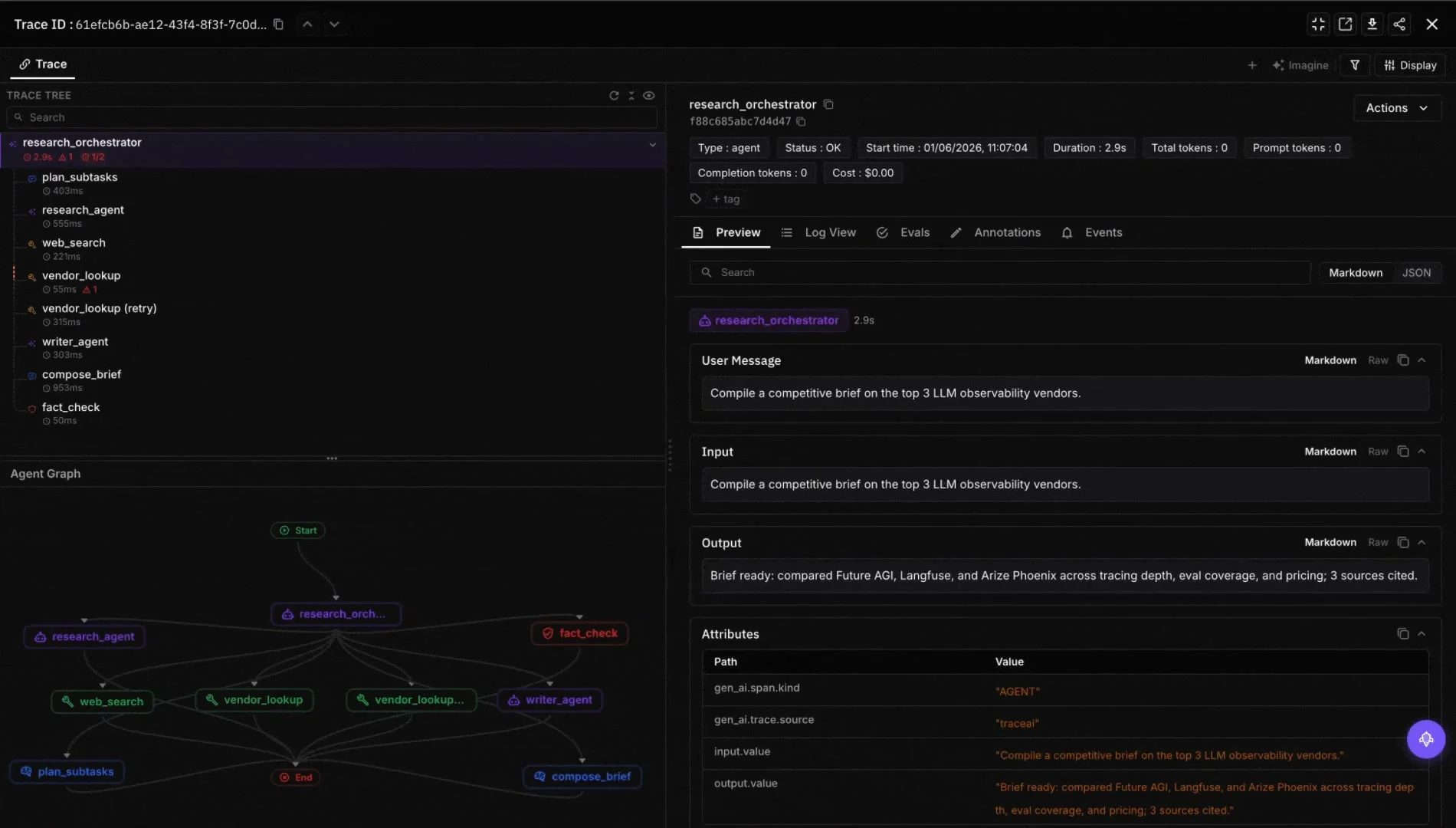
- Runaway-spend caps through
fi.alertswith hard-cutoff webhooks. Set a $40 cap on a Devin task and the gateway returns a structured “spend-exceeded” response. OpenHands and SWE-Agent both interpret it as a stop signal. - Tool-call and MCP passthrough preserved. The gateway parses tool-use blocks and MCP
tools/callpayloads as first-class concepts. - Failure-mode clustering in the Agent Command Center hosted view: timeout, loop, refusal, tool error, plan mismatch.
- Self-host posture through BYOC plus the Apache 2.0 traceAI, ai-evaluation, and agent-opt libraries.
- The Future AGI Protect model family runs inline at ~65 ms p50 text and ~107 ms p50 image (Future AGI benchmark). These are FAGI’s own fine-tuned Gemma 3n adapters (arXiv 2510.13351) covering content moderation, bias detection, prompt-injection, and PII, and they run across text, image, and audio. Because it is a model family rather than a chain of plugin calls, a guardrail check adds no perceptible delay across hundreds of agent calls.
The loop. traceAI (built on OpenTelemetry, with SDKs for Python, TypeScript, Java, and C#) emits the spans, and every captured trajectory gets scored by fi.evals.
Error Feed sits alongside as a zero-config monitor: it groups related failures into named issues (timeout, loop, refusal, tool-error, plan-mismatch), writes the likely root cause from the span evidence, and tracks whether each issue is rising or falling.
fi.opt.optimizers then rewrites the system prompt or adjusts routing against those clusters. A typical move pins planner steps above 80K tokens to claude-opus-4-7 and routes execution steps to claude-sonnet-4-6. Deploys are versioned, with automatic rollback if scores regress. The full six-stage version is in the loop section near the end of this post.
What to plan for:
- The trajectory-scoring eval has to be calibrated to your task set. The default rubric works for SWE-Bench-shaped tasks; ai-evaluation’s in-product authoring agent reads your code and tunes a custom rubric in a week.
- agent-opt is opt-in, assumes at least 200 traced trajectories per failure cluster. Pilots below that volume start with traceAI + ai-evaluation and turn the optimizer on once traffic flows.
Pricing: Free with 100K traces / month. Scale from $99 / month. Enterprise custom with SOC 2 Type II and BAA. AWS Marketplace listed.
Score: 7 / 7 axes.
2. Portkey: Best for hosted per-task budgets and RBAC
Verdict: Portkey is the right pick when you need hard per-task spend caps, virtual keys per agent or developer, and a procurement-ready hosted product, and you don’t yet need trajectory scoring. The dashboard is polished, the budget primitives are mature, the optimizer-on-top story isn’t part of the product.
What it does for autonomous coding agents:
- Per-task traces through Portkey’s
trace_idrequest header. The agent runtime sets the task ID astrace_idon every call. OpenHands and Devin’s HTTP client both support custom header injection; SWE-Agent needs a one-line wrapper change. - Per-task cost attribution through virtual keys. Each task spawns an ephemeral virtual key that inherits the team’s spend pool, so per-task aggregate is one dashboard query.
- Runaway-spend caps through per-key budget caps with auto-pause. A $50 cap on the ephemeral key stops authorising once spent; the agent’s next call returns a structured 429.
- Tool-call passthrough confirmed working with claude-opus-4-7, claude-sonnet-4-6, gpt-5.5-pro, and gemini-3-ultra as of May 2026.
- Failure-mode clustering is partial. Filter by status code and latency, but no built-in categorical clustering of agent failure modes.
- Self-host posture through Portkey’s BYOC option. Good for most enterprises, not air-gapped.
Where it falls short:
- No trajectory scoring. The trace tells you what happened, not whether it was the right thing to do.
- No optimizer.
- Long traces (3,000+ spans) get paginated in the UI in a way that makes manual review of a Devin task painful. Export is fine; in-product browse isn’t.
Pricing: Free with 10K requests / day. Scale from $99 / month. Enterprise custom with SOC 2 Type II.
Score: 5 / 7 axes (missing: trajectory scoring, failure-mode clustering).
3. Kong AI Gateway: Best if the platform team already runs Kong
Verdict: Kong AI Gateway is the pick when the company already runs Kong for REST APIs and the platform team would rather extend that stack than introduce a separate AI proxy. The strength is mature governance and operational familiarity. The weakness is that AI-specific observability is plugin-driven, and dashboards default to API-gateway shape rather than agent-trajectory shape.
What it does for autonomous coding agents:
- Per-task traces through Kong’s OpenTelemetry plugin to your existing OTel backend. Task ID propagation requires a small Lua snippet on the consumer.
- Per-task cost attribution through the AI Proxy plugin (Kong 3.6+). Per-task chargeback requires ephemeral consumers, which is feasible but operationally heavier than Portkey or Future AGI.
- Runaway-spend caps through rate-limit and quota plugins. Spend-based caps require the AI proxy plus a cost-quota plugin; works, needs an evening of configuration.
- Tool-call passthrough through the AI Proxy plugin for OpenAI and Anthropic. MCP isn’t first-class as of Kong 3.7; the JSON survives but isn’t parsed as a separate concept.
- Failure-mode clustering isn’t native. Expect Grafana on the OTel sink.
- Self-host posture is the whole point of Kong.
Where it falls short:
- AI-specific observability is plugin-driven. Trajectory scoring and agent-failure clustering require third-party tooling.
- No optimizer.
- Out of the box you get an API-gateway dashboard with AI numbers bolted on. For a fleet of 50 Devin agents, the operator view is built by your team.
Pricing: Kong is open source. Konnect starts free. Enterprise from around $1.5K / month.
Score: 4.5 / 7 axes (missing: native trajectory scoring, native clustering, native cost view).
4. LiteLLM: Best for self-hosted Python proxy with broad coverage
Verdict: LiteLLM is the right pick when autonomous agent traffic can’t leave the VPC, the security team wants to read every line of code that touches a prompt, and the platform team prefers a single Python config file over a polished hosted product. Per-task spend tracking and provider coverage are strong. The dashboard is functional rather than polished.
What it does for autonomous coding agents:
- Per-task traces through metadata pass-through. Wire
metadata.task_id,metadata.session_id, andmetadata.user_id; the proxy persists them per call. - Per-task cost attribution through spend-tracking against virtual keys. Each task gets a virtual key with a per-task budget cap.
- Runaway-spend caps through per-key budgets. The proxy stops authorising once the cap is hit; the agent gets a structured rate-limit response and stops.
- Tool-call and MCP passthrough works for OpenAI tool-call format, Anthropic tool-use blocks, and MCP server passthrough.
- Failure-mode clustering isn’t built in. Ship spans to a downstream OTel sink (Future AGI traceAI is a common pairing) and cluster there.
- Self-host posture is the strongest in this list alongside Kong. MIT-licensed, runs on your nodes.
Where it falls short:
- No trajectory scoring. The proxy tells you what was called and what it cost, not whether the agent was making progress.
- UI is functional. Slicing by repo or task category usually means a SQL dashboard.
- Observability depth is shallow. For long-running agent traces, plan to wire Future AGI traceAI or another OTel sink behind LiteLLM.
Pricing: Open source under MIT. Enterprise tier with SLA, SSO, audit from around $250 / month.
Score: 4.5 / 7 axes (missing: native polished trace UI, trajectory scoring, failure clustering).
5. Maxim Bifrost: Best for high-throughput Go gateway with native MCP
Verdict: Maxim Bifrost is the pick when sustained agent throughput is the bottleneck and the runtime relies heavily on MCP for tool routing. The Go implementation keeps steady-state latency lower than the Python proxies, and native MCP routing matches the shape of a long autonomous tool chain.
The eval and optimization layer is shallower than Future AGI’s, but gateway-plus-observability is solid.
What it does for autonomous coding agents:
- Per-task traces through Bifrost’s session-and-task model. Each task carries a task ID forward through every LLM and MCP call.
- Per-task cost attribution through team and project scopes with per-task budgets.
- Runaway-spend caps through budget limits with hard cutoff. OpenHands stops on the signal cleanly.
- Long-session trace storage is one of Bifrost’s stronger features. A 2-hour run with thousands of spans is a single browsable record, not a paginated mess.
- Tool-call and MCP passthrough is native. Bifrost is one of the few gateways that routes MCP
tools/callpayloads as a first-class concept. - Failure-mode clustering is partial. Categorises by terminal status (error / cutoff / completion) but not by agent failure mode (loop, refusal, tool-timeout).
- Self-host posture through the OSS gateway. The hosted Maxim platform adds eval and observability on top.
Where it falls short:
- Eval layer isn’t as deep as Future AGI for trajectory-quality scoring. Maxim’s evals focus on per-call quality rather than full-trajectory progress.
- No prompt-and-routing optimizer in the gateway itself.
- MCP-native posture is good for OpenHands-style agents but less mature for proprietary tool protocols.
Pricing: OSS gateway is Apache 2.0. Maxim platform starts free; team tier in the low hundreds per month.
Score: 5.5 / 7 axes (missing: full trajectory scoring, optimizer).
Capability matrix
| Axis | Future AGI | Portkey | Kong AI | LiteLLM | Maxim Bifrost |
|---|---|---|---|---|---|
| Per-task cost attribution | Native | Virtual key | Plugin | Metadata | Native |
| Long-session trace storage | Native, 90-day | Paginated above 3K spans | OTel sink | OTel sink | Native |
| Trajectory scoring | fi.evals.TrajectoryScore | None | None | None | Partial |
| Runaway-spend cap (hard cutoff) | fi.alerts webhook | Per-key auto-pause | Plugin combo | Per-key | Budget cutoff |
| Tool-call + MCP passthrough | Native | Confirmed | AI Proxy (3.6+) | Native | Native MCP |
| Failure-mode clustering | Hosted view | Manual filter | Grafana | Wire downstream | Partial |
| Self-host posture | BYOC + Apache 2.0 OSS | BYOC | OSS | OSS MIT | OSS Apache 2.0 |
| Feedback loop / optimizer | fi.opt | None | None | None | None |
Decision framework: Choose X if
Choose Future AGI if you’re running an autonomous agent fleet at production scale and the operating question has shifted from “did this task succeed” to “is the agent getting better.” Pick this when trajectory scoring and failure-mode clustering aren’t optional. The loop pays for itself the first time the optimizer rewrites a routing rule that drops Opus calls 30%.
Choose Portkey if you want a polished hosted gateway with per-task budgets and RBAC, and your team’s job is to govern spend and access rather than score the agent’s reasoning. Pick this for pilots where the procurement story is the wedge.
Choose Kong AI Gateway if your platform team already runs Kong for the company’s REST APIs and the path of least resistance is extending that stack. Pick this when ops familiarity beats AI-specific depth.
Choose LiteLLM if your security regime forbids autonomous agent traffic from leaving the VPC and you want a single-file Python proxy you can read end-to-end. Pick this when source-availability beats hosted polish, and accept that observability depth means pairing with another tool.
Choose Maxim Bifrost if sustained throughput is the wall you’re hitting and the agent runtime is MCP-heavy. Pick this for high-traffic OpenHands or SWE-Agent deployments where the Python proxies are spending too much time in the GIL.
Common mistakes when wiring an autonomous agent through a gateway
| Mistake | What goes wrong | Fix |
|---|---|---|
| Tagging by session ID but not by task ID | Per-task chargeback is impossible | Tag both; task ID is the financial unit |
| Setting only a soft alert at 80% spend | Agent burns past the alert because nothing in the runtime is listening | Use a hard-cutoff webhook at 110% that returns a structured stop response |
| Truncating traces at a fixed span count | A Devin trace gets summarised after span 500, losing the loop signal | Pick a gateway that retains full long-session traces |
| Putting the guardrail check on the synchronous path | 200ms per turn becomes 2 extra minutes on a 600-call task | Use a fast guardrail (Future AGI Protect ~65 ms text) or move to async |
| Storing the trace but not scoring the trajectory | ”Task failed” with no signal whether the agent was looping or stuck | Score trajectories with fi.evals.TrajectoryScore or a custom rubric |
| Routing the planner step to the cheaper model | Plan quality drops, downstream call cost goes up, net cost is worse | Pin the planner; route the execution steps |
Treating MCP tools/call as opaque JSON | Tool metadata lost in the trace; debug requires re-running the task | Pick a gateway that parses MCP as a first-class concept |
How Future AGI closes the loop on autonomous-agent spend
The other four gateways treat the trace as the end of the story: capture, surface, alert, optionally cap. Future AGI treats it as the input to a six-stage loop. The loop is the difference between a gateway that watches autonomous agents and a gateway that makes them better at planning.
- Trace. Every autonomous run produces a full span tree via
traceAI(Apache 2.0). Planner step, every LLM call, every tool call, every MCPtools/call, terminal status. A 90-minute run is one trace.
-
Evaluate.
ai-evaluation(Apache 2.0) scores every trace. The SDK ships built-in evaluators for the agent-quality signals that matter on this workload: task completion, trajectory efficiency, tool-use accuracy, code correctness, hallucination, instruction-following, and groundedness, includingTrajectoryScore, which asks whether the agent was making progress at each step. You can also author custom evaluators end-to-end, where an in-product agent reads your code and tunes a trajectory rubric for your task set in about a week, and the evaluators keep learning from live production traces. Scores live alongside cost data. The catalog is the floor, not the ceiling. -
Cluster. Low-scoring trajectories cluster by failure mode in the Command Center: “agent looped on a failing test for 40 turns,” “agent refused after the planner mis-classified the task,” “agent timed out on the test runner without retrying.” The operator sees patterns, not incidents.
- Optimize.
fi.opt.optimizersrewrites the system prompt or adjusts the routing policy against the clusters. Six optimizers are available, RandomSearch, Bayesian (Optuna-backed), MetaPrompt, ProTeGi, GEPA, and PromptWizard, and each scores its candidates against the same evaluators from the previous step. A typical Devin-class optimization routes planner steps with input over 80K tokens to claude-opus-4-7, routes execution steps to claude-sonnet-4-6, and adds a self-check pre-prompt to the looping cluster.
-
Route. Agent Command Center’s gateway applies the updated policy on the next request. The agent runtime doesn’t change.
-
Re-deploy. Versioned. If the next 100 traced trajectories score higher on the cluster’s failure mode, the deploy stays. If the score regresses, automatic rollback.
Net effect in early production use: teams running the loop on autonomous-coding-agent workloads have reported per-task cost dropping in the 20 to 35% range over about six weeks, with task-completion rate flat or slightly up.
The three building blocks are open source under Apache 2.0:
traceAI(github.com/future-agi/traceAI)ai-evaluation/fi.evals(github.com/future-agi/ai-evaluation)agent-opt/fi.opt(github.com/future-agi/agent-opt)
The hosted Agent Command Center adds the failure-cluster view, live Protect guardrails (~65 ms text latency), per-task RBAC, SOC 2 Type II, and AWS Marketplace procurement.
What we did not include
We deliberately left out four gateways that show up in other 2026 listicles on this topic:
- OpenRouter. The routing is consumer-facing and not designed for a per-task chargeback model.
- Cloudflare AI Gateway. Strong edge primitives but the long-session trace story is thin; sessions over a few hundred calls get summarised in a way that loses the looping-vs-progress signal.
- TrueFoundry. Solid MLOps gateway but the autonomous-agent integration wasn’t stable in our May 2026 testing.
- Helicone. Covered in the Claude Code post. Works well for interactive coding agents but isn’t the right shape for multi-hour autonomous runs.
If your situation is different, all four are worth a second look in Q3 2026.
Related reading
- Best AI Coding Agents in 2026 (choosing the agent itself, not the gateway in front of it)
- Best 5 AI Gateways to Monitor Claude Code Token Usage in 2026
- What Is an AI Gateway? The 2026 Definition
- Best AI Gateways for Agentic AI in 2026
- Best LLM Cost Tracking Tools in 2026
Frequently Asked Questions
Why does a Devin-style autonomous agent need an AI gateway?
Can autonomous agents work through an OpenAI-compatible endpoint?
How do I cap a Devin task at $50 without breaking the run mid-step?
What is trajectory scoring and why does it matter?
Is it safe to send proprietary source code through a hosted AI gateway?
How is Future AGI different from Maxim Bifrost for an autonomous coding agent?
Five AI gateways scored on Claude Code token monitoring in 2026: per-dev attribution, per-repo budgets, session traces, alerts, where each falls short.

An AI gateway sits between apps and LLM providers for governance, routing, observability. What it is, how it differs from API gateways.

Seven AI gateways for agentic AI in 2026 scored on MCP plus A2A depth, 18+ built-in guardrails, OTel-native cost telemetry, 2026 trust cohort with sources.
