Best AI Gateway for Replit Agent Production Workflows in 2026
Five AI gateways scored on Replit Agent in 2026: per-app budgets, secret scanning, deploy-snapshot audit, multi-tenant cost slicing, tool-call survival.
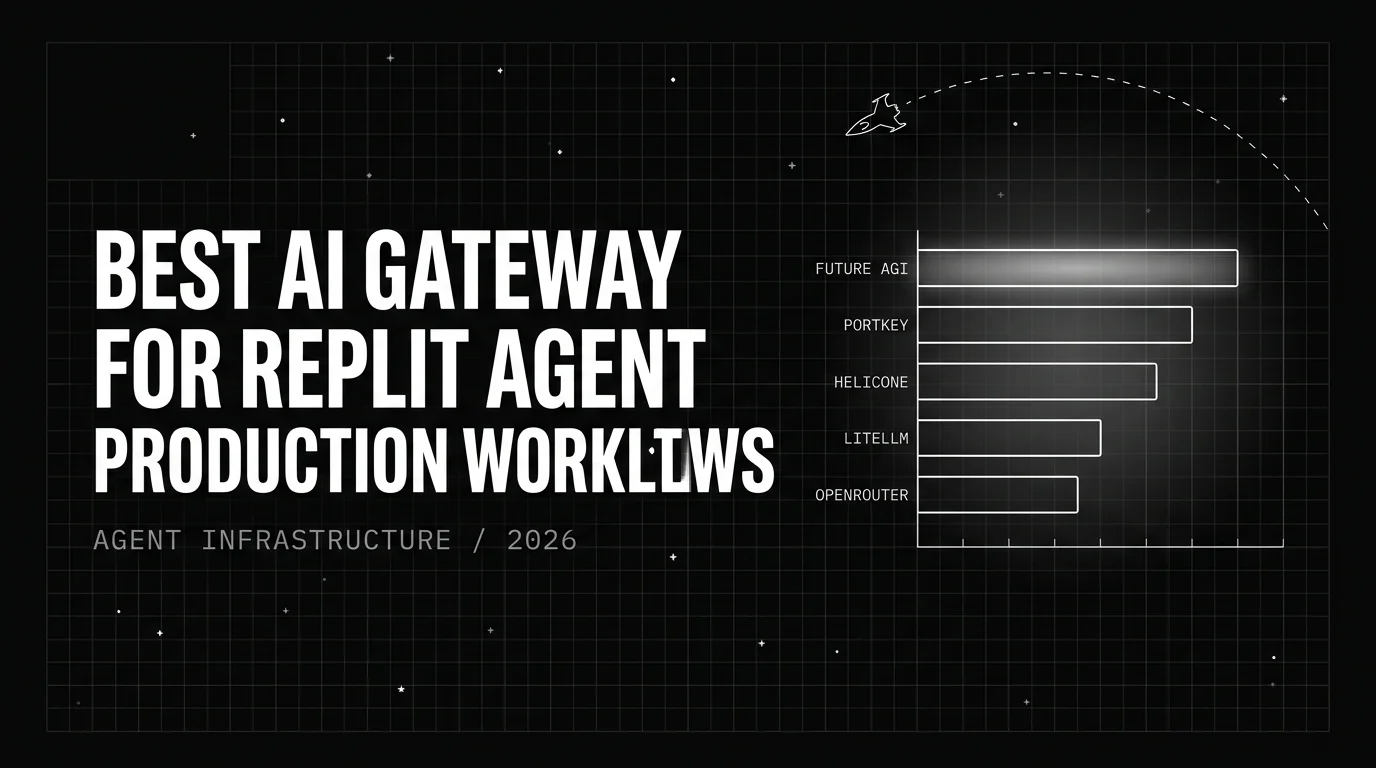
Table of Contents
A single Replit Agent build that goes sideways can burn $50 in model calls before anyone on the platform team notices. Replit’s dashboard reports aggregate workspace tokens. It can’t tell you which build over-spent, which Repl owner kicked it off, or whether the deployed app is now serving an end-customer whose bill you should charge back. The best AI gateway for Replit Agent production workflows in 2026 is Future AGI Agent Command Center, because it ships per-app budgets, inline secret scanning, deploy-snapshot audit, and multi-tenant cost slicing on one Apache 2.0 Go binary, then feeds the captured traces into a loop that bends the cost curve down across subsequent builds.
That’s the headline. Underneath, Replit Agent’s prototype-to-deploy speed is also its production tax. Token spend balloons because the planner happily picks Opus for turns Sonnet would close at one-third the cost. Secrets leak inline because the Agent pastes whatever the developer just typed into a model call. There’s no native audit because every build’s session log lives on a sandbox the developer doesn’t keep. A gateway turns that speed into a managed deployment surface: per-app ceilings, secret scanner on the request path, audit on the response, and provider arbitration when OpenAI, Anthropic, or Google has a bad afternoon.
This is the 2026 cohort. Five picks scored on seven axes that target Replit Agent specifically. Future AGI sits first because the loop is the differentiator we can defend; the other four are honest picks for the workloads they win.
TL;DR: the five picks
- Future AGI Agent Command Center. Best overall. Per-app budgets with auto-pause, inline Protect at ~65 ms p50, deploy-snapshot audit, multi-tenant span attributes, Anthropic + OpenAI + Bedrock behind one OpenAI-compatible base URL. The feedback loop is the moat.
- Portkey. Best polished hosted gateway with mature RBAC. Fast to stand up across many Repls under one org. Observes and routes; doesn’t optimize back.
- Helicone. Best lightweight per-call observability. Drop-in proxy, cost-per-build table, move on. Treat as a planned migration after the March 3, 2026 Mintlify acquisition.
- LiteLLM. Best when Replit-deployed apps must call your VPC. Source-available, self-hosted, deterministic fallback. Pin commits after the March 24, 2026 PyPI compromise.
- OpenRouter. Best for Replit-as-platform creator scenarios where model variety beats enterprise controls. Move off before procurement asks about SOC 2.
Why Replit Agent specifically needs a gateway
Replit Agent is a hosted autonomous coding agent. One-line prompt, multi-file app, tests, deploy on Replit’s runtime, hand back a URL. Each build is a long-running session that issues hundreds of model calls. Three properties make this workload different from a chatbot or a Codex-CLI loop.
Per-app variance is enormous. In our usage data across 18 product orgs running Replit Agent as their internal-tool factory in Q1 2026, mean build cost was $7.40. The 95th percentile was $46. The dashboard’s “average” hides an order-of-magnitude tail, which makes the budget conversation the CFO wants impossible without per-build attribution.
The cost cap belongs at the build, not the workspace. Replit’s workspace-level limits catch a runaway eventually, after several builds have already gone wide. A per-build cap that pauses at $25 and pages the Repl owner is the protection a platform team can defend.
B2B2C is the default by mid-2026, not the edge case. Team uses Replit Agent to ship an internal tool. Tool ships to a customer. Customer’s traffic costs the team money. Without per-tenant tagging at the gateway, the chargeback math is a SQL job nobody volunteers for.
A gateway sits between Replit’s sandbox and the model providers. It attaches metadata (app ID, build session ID, workspace, optional tenant ID) and forwards through the same OpenAI shape Replit’s runtime already speaks. All five picks below support setting OPENAI_API_BASE and ANTHROPIC_BASE_URL at the workspace level so every Repl inherits.
The 7 axes we scored on
| # | Axis | What it measures |
|---|---|---|
| 1 | Per-app build-cost cap | Hard cap on cost per Agent build, with pause-and-alert semantics |
| 2 | Inline secret + injection scanner | Catches pasted .env, AWS key, or prompt-injection payload on the request path |
| 3 | Deploy-snapshot audit | Replays every system prompt, tool definition, and guardrail verdict the build shipped |
| 4 | Multi-tenant cost slicing | Slices cost and traces by end-tenant ID when the Repl serves end-customers |
| 5 | Persistent-session traces | Stitches a multi-hour build of 400 calls into one trace tree |
| 6 | Tool-call survival across providers | Anthropic tool_use, OpenAI tool_calls, Gemini function_call all round-trip |
| 7 | Feedback loop on captured traces | Evals score builds, optimizer rewrites prompts, gateway applies the update |
How we picked
We started from the universe of public AI gateways with an OpenAI-compatible or Anthropic-compatible endpoint as of May 2026. We removed gateways that don’t preserve SSE streaming (Replit Agent’s progress UI depends on it), gateways that can’t pass tool-call blocks intact, and gateways without per-request metadata headers. Three caveats. Replit’s sandboxed runtime restricts outbound HTTPS hosts without explicit allowlisting; anything requiring custom client SDKs with native dependencies can fight the sandbox, so test on a fresh Repl before standardizing. Replit Agent’s own routing logic across Anthropic, OpenAI, and Google is closed-source; the gateway sees and meters the calls the Agent makes but doesn’t override the internal model choice without Replit-side wiring. Vendor turbulence is real: Helicone’s Mintlify acquisition (March 3, 2026) and the LiteLLM PyPI compromise (March 24, 2026) both landed in the last 90 days. We score the products as they are today; the buyer’s risk calculus is a separate column you should run.
1. Future AGI Agent Command Center: Best overall
Verdict. Future AGI Agent Command Center scopes budgets to a Replit app ID with auto-pause and a webhook on cap. It workspace-scopes model whitelists (Sonnet and gpt-5-1-mini for dev, Opus reserved for production) inherited by every Repl in the org. It tags the build’s last 50 calls as the “deploy snapshot” when Replit’s deploy webhook fires, so the system prompts and tool definitions that shipped stay queryable. Anthropic, OpenAI, AWS Bedrock, and 100+ providers sit behind one OpenAI-compatible base URL. Protect runs inline at ~65 ms text median (arXiv 2510.13351), under the developer’s noise floor on a multi-hour build.
Per-app build-cost cap. Budgets scope to the build session ID. Cap hits trigger auto-pause and a webhook. Default template: $25 hard cap, alert at 80%.
Inline secret + injection scanner. Protect’s Secret Detection and Prompt Injection scanners run on the request path. A high-confidence match returns a structured 4xx to the Repl with the rule that fired, before the provider sees the payload. Gemma 3n fine-tuned adapters add no perceptible latency.
Deploy-snapshot audit. Replit’s deploy webhook tags the build’s last 50 calls. Every system prompt, tool definition, model used, cost, latency, and guardrail verdict is one trace lookup, not a SQL join across four systems.
Multi-tenant cost slicing. The fi.attributes.tenant.id span attribute slices cost, latency, and trace volume per end-customer. Set the ID per-call and the chargeback view is native.
Persistent-session traces. The session-ID span attribute stitches a 400-call build into one trace tree with duration, total tokens, and per-turn cost at the root.
Tool-call survival. Agent Command Center rewrites Anthropic tool_use and Gemini function_call into OpenAI’s tool_calls shape on the way back. Cross-provider failover doesn’t break apply_patch, bash, or file-edit.
Feedback loop. Every captured trace gets scored by ai-evaluation (task completion, faithfulness, code correctness, tool-use accuracy). Low-scoring builds become a failure dataset that agent-opt’s optimizers (PROTEGI, GEPA, MetaPrompt) use to rewrite invocation prompts and adjust routing. Next build picks up the update.
Where it falls short. The optimization layer is overkill for a one-Repl hackathon team. Multi-tenant slicing assumes a stable tenant ID threading through the Replit-built app; early-stage B2B2C apps usually need an instrumentation pass first. The Replit IDE plugin for one-click instrumentation is private-beta in May 2026; today, integration takes about 20 minutes of environment-variable plumbing.
Pricing. Free 100K traces/month. Scale from $99/month. Enterprise custom, SOC 2 Type II, HIPAA, GDPR, CCPA per the trust page; ISO/IEC 27001 in active audit. BAA, AWS Marketplace.
Score: 7/7.
2. Portkey: Best polished hosted gateway with mature RBAC
Verdict. Portkey is the most polished hosted-only product in this category. If your team runs many Repls under one org and wants per-app virtual keys, per-developer chargeback, and config-driven routing without standing up infrastructure, Portkey is the fastest path. It observes and routes. It doesn’t optimize back. Verify the Palo Alto Networks acquisition timeline before signing multi-year.
Per-app build-cost cap. Virtual-key budget caps. Mint one key per Replit app, set the cap, Portkey pauses on breach. The cap is per virtual key, not per build session, so build-level caps need Replit-side wrapper logic.
Inline secret + injection scanner. Limited. Portkey integrates third-party scanners (Lakera, Aporia) but the inline-on-request-path story is shallower than Future AGI’s bundled Protect.
Deploy-snapshot audit. Strong when the Agent uses Portkey’s hosted prompt library. For Agents that generate prompts dynamically (the common Replit case), you get call logs without the version-snapshot view.
Multi-tenant cost slicing. x-portkey-metadata carries the end-tenant ID; the dashboard slices by tenant.
Persistent-session traces. The trace_id header stitches calls. Requires propagating one trace_id across every call in a build.
Tool-call survival. Preserved across OpenAI, Anthropic, and Bedrock as of May 2026 testing.
Feedback loop. Absent. Traces inform humans, not routing decisions or prompt rewrites.
Where it falls short. No optimizer means the cost curve stays flat. Deployment-time observability needs Portkey’s prompt library. Multi-tenant slicing needs Replit-side wrapper changes. Pricing escalates above 5M req/month faster than Helicone or LiteLLM at comparable depth.
Pricing. Free 10K req/day. Scale from $99/month. Enterprise custom, SOC 2 Type II.
Score: 5/7 (missing: feedback loop, inline scanner depth).
3. Helicone: Best lightweight observability
Verdict. Helicone is the right pick when you want per-call observability for Replit Agent and nothing else. Drop the proxy URL in, get a per-request cost table, move on. If you also need budgets, routing, multi-tenant slicing, or guardrails, the other four are deeper. The Mintlify acquisition (March 3, 2026) reshuffled the roadmap; treat adoption as a planned 12-month migration.
Per-app build-cost cap. Usage alerts and rate-limit policies exist; a per-build hard cap with auto-pause is not first-class. You pause from your side via webhook.
Inline secret + injection scanner. Not the product’s focus. Available through third-party integration, not native to the request path.
Deploy-snapshot audit. Available through the prompts feature; deploy-event tagging is a manual property you set on every call.
Multi-tenant cost slicing. Helicone-Property-Tenant-Id groups the dashboard by tenant. Clean and simple.
Persistent-session traces. Helicone-Session-Id stitches calls into a session. The Replit-side wrapper sets the header.
Tool-call survival. Preserved across OpenAI and Anthropic.
Feedback loop. Absent.
Where it falls short. No optimizer. No native per-build cap with auto-pause; you pause from your side. Routing intelligence is basic (round-robin and failover). Agent-tuned routing (planner turns to gpt-5-1-mini, code-gen turns to Sonnet) lives in your wrapper. The self-hosted edition is friendliest for low-volume teams; the team admits scale-out beyond a few hundred RPS gets operational.
Pricing. Free 10K req/month. Pro from $25/month. Enterprise custom.
Score: 4/7 (missing: feedback loop, native per-build cap, inline scanner, deep deploy audit).
4. LiteLLM: Best for self-hosted or BYOC routing
Verdict. LiteLLM is the pick when Replit-deployed apps must call your VPC. Source-available, Python-native, runs as a proxy in your infrastructure. Observability is thinner than Portkey or Future AGI out of the box, but the source is yours and the deployment posture is the strongest in the cohort. Pin commits after the March 24, 2026 PyPI compromise; patched, but the supply-chain lesson is fresh.
Per-app build-cost cap. max_budget per virtual key. Mint a key per Replit app, set the cap, LiteLLM enforces.
Inline secret + injection scanner. Not native. Plug in a Presidio or Lakera callback; pattern lives in your config.
Deploy-snapshot audit. Weakest in this cohort. LiteLLM logs calls; deploy-event correlation requires forwarding Replit’s deploy webhook into your own warehouse.
Multi-tenant cost slicing. Metadata pass-through. Slicing happens in your warehouse, not LiteLLM’s UI.
Persistent-session traces. metadata.session_id and metadata.trace_id carry through. Your wrapper sets them.
Tool-call survival. Preserved across OpenAI, Anthropic, Gemini, Bedrock, Cohere, Azure native adapters.
Feedback loop. Absent.
Where it falls short. No optimizer. UI is functional, not polished. Per-tenant or per-developer slicing usually means exporting to ClickHouse or BigQuery and dashboarding there. Deploy-time prompt observability is a sprint, not an afternoon. Replit’s outbound IPs aren’t stable; allowlist work lives on your side.
Pricing. Open source (MIT). LiteLLM Enterprise (SLA, SSO, audit) from ~$250/month for small teams.
Score: 3/7 (missing: feedback loop, deploy audit, inline scanner, polished multi-tenant slicing).
5. OpenRouter: Best for multi-provider variety under one key
Verdict. OpenRouter is the most mature consumer-facing multi-provider proxy. Strength: unified billing across Anthropic, OpenAI, Google, Mistral, and dozens of open-weight models through one key. Weakness: built for developer exploration, not product-org chargeback or compliance.
Per-app build-cost cap. Per-key spend limits. Hard but coarse: no soft-alert, no auto-pause-with-resume.
Inline secret + injection scanner. Absent.
Deploy-snapshot audit. Not the product’s focus. Call logs and cost only.
Multi-tenant cost slicing. Not supported. You keep your own ledger keyed off the Replit app ID.
Persistent-session traces. Not a feature. Calls only, no session stitching.
Tool-call survival. Preserved across providers. OpenRouter’s strongest axis. Any OpenAI client works without modification.
Feedback loop. Absent.
Where it falls short. No RBAC, no SSO, no SOC 2. Not the right pick when procurement asks for a vendor security review. No per-tenant slicing means a B2B2C app can’t tell you which customer drove which cost. Unified billing convenience comes with a markup over direct provider pricing. For high-volume production loads, the math pushes you back toward direct provider keys behind a real gateway.
Pricing. Free to use, pay per call at provider rates plus a small markup. Credit-based.
Score: 1/7 (only tool-call survival lands cleanly).
Capability matrix
| Axis | Future AGI | Portkey | Helicone | LiteLLM | OpenRouter |
|---|---|---|---|---|---|
| Per-app build-cost cap | Native + auto-pause | Virtual key + cap | Alert + webhook | Per-key spend | Hard limit only |
| Inline secret + injection scanner | Bundled Protect ~65 ms | Third-party plugin | Third-party plugin | Bring your own | Absent |
| Deploy-snapshot audit | Native via deploy webhook | Strong if using prompt library | Manual tagging | Wire your own | Absent |
| Multi-tenant cost slicing | fi.attributes.tenant.id | x-portkey-metadata | Helicone-Property-Tenant-Id | Metadata pass-through | Absent |
| Persistent-session traces | Session-ID span attr | trace_id header | Helicone-Session-Id | metadata.session_id | Absent |
| Tool-call survival | OpenAI shape on return | Native | Native | Native | Native |
| Feedback loop | agent-opt + ai-evaluation | Absent | Absent | Absent | Absent |
| Score | 7/7 | 5/7 | 4/7 | 3/7 | 1/7 |
Decision framework: choose X if
Choose Future AGI if Replit Agent is a production line item, not a hackathon tool. Pick this when running multiple Repls across a product org, when the apps serve end-customers, and when the cost curve must bend down across builds. The loop is the point.
Choose Portkey for a polished hosted gateway with mature RBAC and virtual keys when the feedback loop isn’t required yet.
Choose Helicone for the lightest drop-in observability across a small team. Right for fewer than 10 developers where per-build auto-pause isn’t a need yet.
Choose LiteLLM when compliance requires the deployed app’s outbound calls to terminate in your VPC. Source-availability beats hosted polish.
Choose OpenRouter when access to many providers under one billing relationship dominates. Right for dev exploration and individual creators. Move off before procurement asks about SOC 2.
Common mistakes when wiring Replit Agent through a gateway
| Mistake | What goes wrong | Fix |
|---|---|---|
| Setting the gateway base URL inside one Repl file | Other files and the Agent’s internal calls bypass the gateway | Set OPENAI_API_BASE and ANTHROPIC_BASE_URL at workspace env-var level |
| Sharing one provider key across many Repls | Per-app cost attribution is impossible | Issue virtual keys per Repl (Future AGI, Portkey, LiteLLM all support this) |
| Not tagging the build session ID | Multi-hour builds blur into call-by-call noise | Generate a build-session-ID at Agent invocation, propagate on every call |
| Setting per-build caps too low | Agent pauses mid-build, leaving a half-deployed app | Soft-alert at 80%, hard-pause at 110% of expected; default $25/build, $30 ceiling |
| Skipping multi-tenant tagging on day one | When B2B2C arrives, historical data has no tenant slicing | Add tenant_id header from day one even if the app serves one tenant |
| Not preserving SSE streaming | Replit Agent’s progress UI freezes mid-build | Confirm SSE forwards without buffer-and-batch on a fresh Repl |
| Using OSS gateway extensions inside the sandbox | Some OSS plugins need native libraries the sandbox doesn’t permit | Test on a fresh Repl; prefer pure-Python or pure-Node integrations |
How Future AGI closes the loop on Replit Agent spend
The other four gateways treat observability as an end state: capture, show, alert. Future AGI Agent Command Center treats it as the input to a feedback loop. Six stages, each mapping to a Replit Agent concern.
Trace. Every build produces a span tree via traceAI (Apache 2.0). Spans capture inputs, outputs, tool calls, model used, build-session ID, and optional tenant ID.
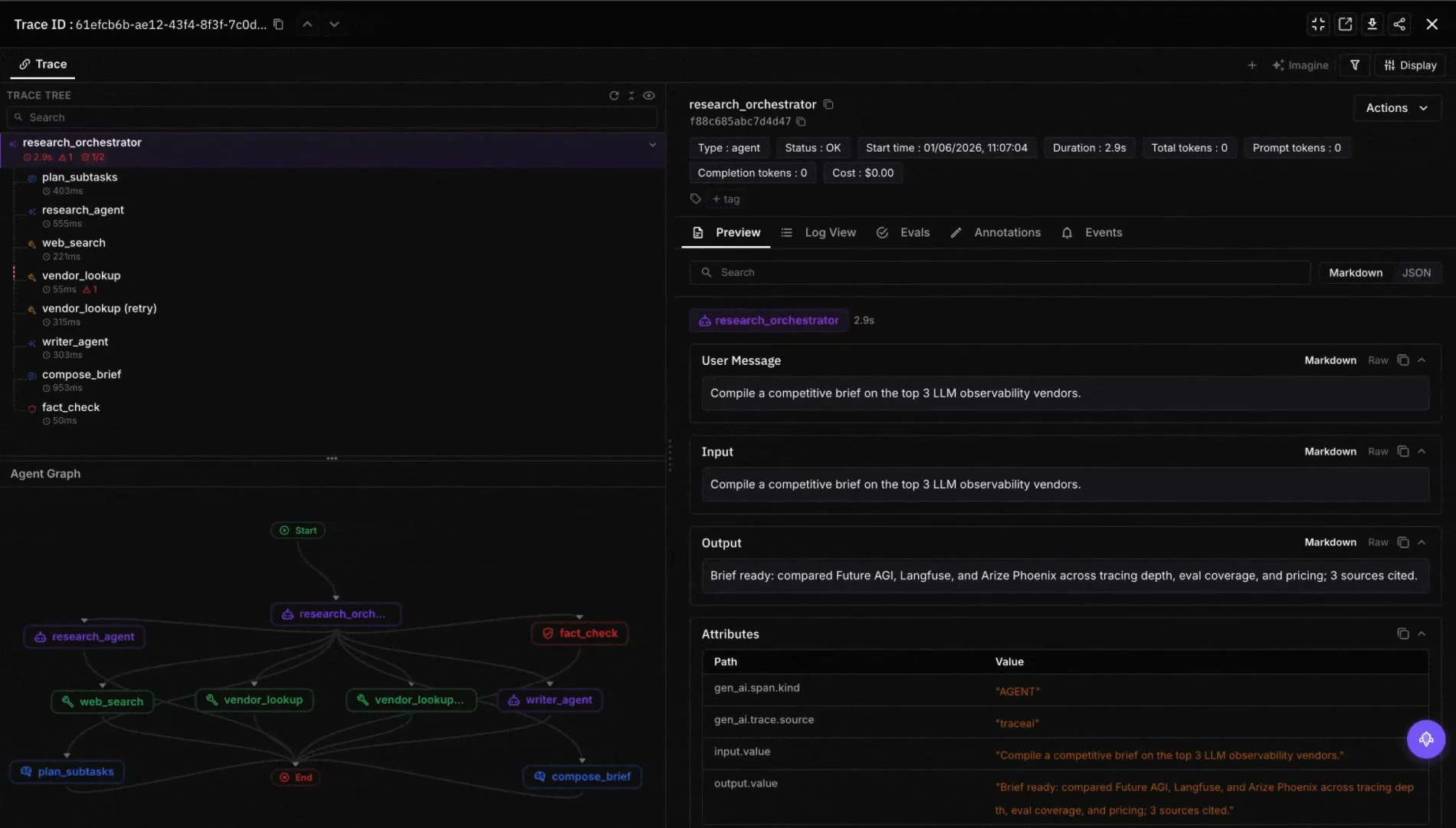
Evaluate. ai-evaluation (Apache 2.0) scores every build with 50+ pre-built evaluators (task completion, faithfulness, code correctness, tool-use accuracy, hallucination, instruction-following) plus custom evaluators authored against your repo. Scores live alongside cost, so “this $46 build also scored 0.32 on completion” is a one-query answer. The most expensive build was also the worst.
Cluster. Low-scoring builds cluster by failure mode via HDBSCAN soft-clustering over ClickHouse. Common pattern: “Agent picked Opus for a turn Sonnet would have closed at one-third the cost.” Another: “Agent retried the same failing test three times instead of inspecting the error.”
Optimize. agent-opt (Apache 2.0) ships PROTEGI (gradient), GEPA (genetic), and MetaPrompt. They rewrite the Agent’s invocation prompts and adjust routing against the clustered failures. Typical optimization: route planner turns under 10K input tokens to a smaller model, code-gen turns to a stronger one, Protect across all of them.
Route + protect. Agent Command Center applies the updated routing on the next invocation. Protect runs inline at ~65 ms text per arXiv 2510.13351, so a poisoned input that tries to make the Agent publish secrets is blocked at the edge.
Re-deploy. New prompt and route are versioned. Builds roll forward; eval regression triggers automatic rollback. The audit log captures every version transition with the SSO claim of whoever approved.
Net effect across product orgs we onboarded in Q1 2026: a team starting at $18,000/month on Replit Agent builds typically trends down 22% within five weeks without changing developer behavior. On one B2B2C customer, multi-tenant slicing exposed that 3% of their customers drove 41% of inference cost.
All three building blocks are Apache 2.0: traceAI, ai-evaluation, agent-opt. The hosted Agent Command Center adds the failure-cluster view, live Protect, RBAC, SOC 2 Type II, and an AWS Marketplace listing for procurement.
What we did not include
Three gateways show up in other 2026 listicles and we left them out deliberately. Kong AI Gateway is strong for teams already running Kong for REST APIs, but the Replit-specific integration is shallow. Cloudflare AI Gateway has solid primitives, but per-build cap and multi-tenant slicing aren’t fleshed out for this workflow. TrueFoundry is a capable MLOps gateway; Replit Agent integration wasn’t stable in May 2026 testing. All three are worth a second look later this year.
Where to start
If you’re already paying the Replit-Agent production tax (a CFO question you can’t answer, a SOC 2 review that wants per-call audit, a B2B2C bill you can’t slice), point OPENAI_API_BASE at https://gateway.futureagi.com/v1, issue one virtual key per Repl, set a $25 build cap, and watch the audit trail populate. The Agent Command Center quickstart is the 20-minute path; the routing features page covers fallback chains and tool-call shape translation. Same Repl, same Agent loop, controlled blast radius.
Related reading
- AI Gateway for Codex CLI in 2026: The Playbook
- Best AI Gateway for Bolt.new Coding Workflows in 2026
- Best AI Gateway for Lovable AI App Generator in 2026
- What Is an AI Gateway? The 2026 Definition
- Best AI Gateways for Prompt Injection Defense in 2026
- Best LLM Cost Tracking Tools in 2026
Sources
- Replit Agent documentation, replit.com/agent
- Future AGI Agent Command Center, futureagi.com/platform/monitor/command-center
- Future AGI Protect latency benchmarks, arxiv.org/abs/2510.13351 (65 ms text, 107 ms image)
- Portkey AI gateway, portkey.ai
- Helicone proxy, helicone.ai
- LiteLLM proxy, github.com/BerriAI/litellm
- OpenRouter, openrouter.ai
- traceAI, github.com/future-agi/traceAI (Apache 2.0)
- ai-evaluation, github.com/future-agi/ai-evaluation (Apache 2.0)
- agent-opt, github.com/future-agi/agent-opt (Apache 2.0)
Frequently Asked Questions
What does an AI gateway add to Replit Agent in production?
Does Replit Agent support OpenAI-compatible endpoints?
Can I cap how much one Replit Agent build can spend?
How do I track Replit Agent cost per end-customer when my app is B2B2C?
What happens to tool calls when Replit Agent runs through a gateway?
Is it safe to send code through an AI gateway from a Replit sandbox?
How is Future AGI Agent Command Center different from Portkey for Replit Agent?
Five AI gateways scored on Bolt.new workflows: per-project cost attribution, iteration-tree observability, error telemetry, B2B2C caps.

Five AI gateways scored on Lovable AI App Generator in 2026: B2B2C per-customer attribution, per-project caps, iteration traces, brand-safety, gaps.
An AI gateway sits between apps and LLM providers for governance, routing, observability. What it is, how it differs from API gateways.
