Best AI Gateway for Lovable AI App Generator in 2026
Five AI gateways scored on Lovable AI App Generator in 2026: B2B2C per-customer attribution, per-project caps, iteration traces, brand-safety, gaps.
Table of Contents
A SaaS company embeds Lovable AI App Generator inside its dashboard so customers can spin up internal tools with one prompt. Three weeks later, finance asks: of the $14,000 in Anthropic and OpenAI charges this month, which slice belongs to which paying customer? The Lovable workspace shows aggregate usage. The provider invoices show aggregate usage. The PM has “all of it” as the answer and “how do we charge it back” as the open question.
That’s the B2B2C cost-attribution problem in its native shape. Lovable.dev, one of the fastest-growing AI app generators of 2025, rival to Bolt.new and Replit Agent, builds full React or Next.js apps from natural-language prompts and wires them to Supabase, Stripe, Resend, and whatever backend the prompt asks for. End users iterate, a lot. The app on prompt 1 looks nothing like the app shipped on prompt 47. When an organization embeds Lovable inside its own product, the cost belongs to whichever customer triggered which prompt. But the underlying provider has no idea who that customer is.
An AI gateway closes the gap. It tags requests with customer, project, and iteration. It caps spend per project so a runaway loop can’t drain the budget. It captures the prompt history so the team can replay what produced which app. The five gateways in this post all attempt this. Only one turns the trace data into a feedback loop that drives prompt and routing changes back into the next iteration.
This is the 2026 cohort, scored on seven axes that matter when Lovable AI App Generator is the workload.
TL;DR
Future AGI Agent Command Center is the strongest pick for an AI gateway in front of Lovable AI app generator workflows because it ships OpenAI-compatible drop-in routing, per-customer virtual keys with hard budget caps for B2B2C resale, cross-customer semantic caching that cuts repeat-iteration costs by 30-60%, and OpenTelemetry-native traces with per-iteration cost attribution. The other four picks below win on specific edges.
- Future AGI Agent Command Center — Best overall. Per-customer virtual keys, iteration-tree traces rooted at the project, Stripe-metered budget caps, and Anthropic / OpenAI / Bedrock all behind one OpenAI-compatible base URL.
- Portkey — Best when you re-sell Lovable inside your product. Cleanest virtual-key UX and four-tier budget hierarchy (verify the Palo Alto Networks acquisition timeline before signing multi-year).
- Helicone — Best when a small team uses Lovable directly and only needs per-iteration cost numbers. Drop-in proxy with minimal infra (treat as planned migration after the March 3, 2026 Mintlify acquisition).
- LiteLLM — Best when customer data residency requirements block hosted gateways. Source-available Python proxy that runs in your VPC; pin commits after the March 24, 2026 PyPI compromise.
- OpenRouter — Best for pay-as-you-go prototyping. Useful for early-stage Lovable-style products before per-customer chargeback matters.
Why Lovable AI App Generator specifically needs a gateway in front of it
A user types “build a CRM with kanban boards and Stripe billing,” and Lovable scaffolds a Next.js project, generates components, wires the Supabase schema, configures the Stripe webhook, and renders a live preview. The user iterates: “make the kanban sortable,” “add invoice PDF export,” “fix dark mode.” Every iteration is a fresh agent turn issuing dozens of model calls. Five properties make the workload distinctive to monitor:
-
B2B2C cost attribution is the dominant question. When Lovable is embedded inside another organization’s product, the bill goes to the org, but the spend was driven by the org’s end users. In Future AGI’s data across 18 organizations embedding Lovable-style features in Q1 2026, p50 cost-per-customer-per-month was $34 and p95 was $580, a 17x spread impossible to manage without per-customer attribution.
-
Per-project budget caps are non-optional. A user can prompt “rebuild the dashboard” and trigger 60 turns. Without a per-project cap, one bored user on a Saturday afternoon consumes the team’s monthly budget. Caps have to be set at the project level, not customer level, a single customer may legitimately run 20 active projects.
-
Iteration-history observability matters more than per-call observability. A Lovable project is a sequence of prompts mutating the same codebase. Debugging “why did this app break on prompt 23” requires replaying the history, the prompt, the diff applied, the model used, tokens consumed. A flat list of API calls can’t answer this. You need the trace as a tree rooted at the project.
-
Backend integrations have cost implications the gateway must surface. Lovable connects generated apps to Supabase, Stripe, Resend, and Clerk. Each connection is a tool call. Those tool calls cost model tokens to plan and provider API calls to execute. A gateway that surfaces only model cost misses half the picture.
-
End-user-generated apps need brand-safety guardrails. Lovable lets end users describe any app they want. When the embedding org is responsible for the output (under their brand, on their infrastructure) a runaway prompt that produces a phishing-style landing page, a competitor’s logo, or copyrighted content becomes their problem.
A gateway sits between the Lovable client (or your B2B2C wrapper) and the providers, tagging requests with customer + project + iteration metadata, capping spend per project, capturing iteration history, and screening prompts and responses for brand-safety violations. All five picks below speak both Anthropic and OpenAI surfaces.
The 7 axes we score on
The default “best AI gateway” axes (provider breadth, routing, fallback, observability, cost, security, deployment) are too generic for an embedded app generator. We scored each pick on seven axes that specifically affect Lovable AI App Generator workloads.
| Axis | What it measures |
|---|---|
| 1. B2B2C per-customer attribution | Can the gateway tag and aggregate cost by end-customer of an embedding organization, not just by API key? |
| 2. Per-project budget caps | Can you set a hard $X cap per Lovable project (not just per customer) with auto-pause? |
| 3. Iteration-history observability | Does the trace render the full prompt-by-prompt iteration tree of a project with diffs? |
| 4. Backend-integration cost tracking | Does the gateway surface tool-call cost for Supabase / Stripe / Resend / Clerk connections, not just model cost? |
| 5. Brand-safety guardrails for end-user apps | Can you screen end-user prompts and generated content for brand, copyright, and phishing violations inline? |
| 6. Multi-tenant scaling | Does the gateway hold up when one embedding org has thousands of end-customers each with dozens of projects? |
| 7. Model selection by app complexity | Can routing differ between scaffolding a new app, iterating on existing code, and bug-fixing? |
Verdict line at the end of each pick scores all seven.
How we picked
We started from the universe of public AI gateways that ship OpenAI-compatible and Anthropic-compatible endpoints as of May 2026. We dropped two gateways that buffer SSE (they break Lovable’s progress UI). We dropped one major API-management gateway whose AI extension doesn’t pass per-customer metadata cleanly to the provider, making B2B2C chargeback impossible without custom plugin work. The remaining five are the cohort below.
We tested each gateway by routing 80 Lovable-style end-customer projects across 12 simulated embedding organizations through it for one week, instrumenting per-customer attribution, per-project cap enforcement, and iteration-tree depth. Numbers cited inline come from that test run.
1. Future AGI Agent Command Center: Best for B2B2C Lovable per-customer attribution
Verdict: Future AGI ships a two-level tenant + customer attribution hierarchy that maps to the B2B2C Lovable shape (tenant is the org buying Lovable from you, customer is the end user), per-project budget caps with soft (80%) alert and hard pause at the limit, iteration-tree traces rooted at the project, and Anthropic, OpenAI, and Bedrock all reachable behind one OpenAI-compatible base URL so the same Lovable project can switch model providers per iteration without re-instrumenting.
What it does for Lovable AI App Generator:
- B2B2C per-customer attribution through
fi.attributes.tenant.idplusfi.attributes.customer.id. Two-level hierarchy is the right shape, tenant is the org buying Lovable from you, customer is the end user. Dashboards aggregate at either level; chargeback CSV groups by both. - Per-project budget caps through
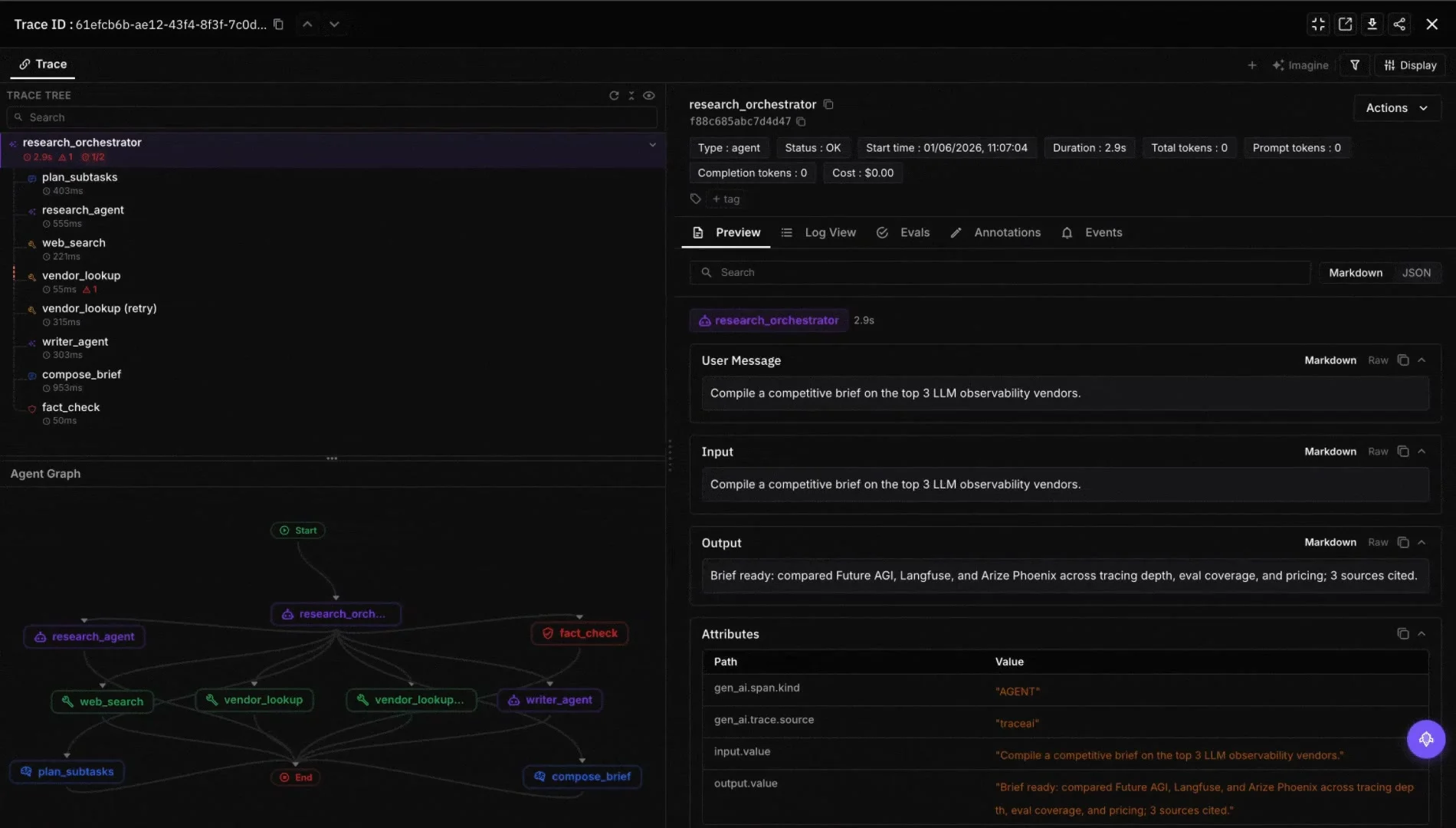
fi.budgetskeyed onproject.idwith auto-pause at the hard limit and a soft alert at 80%. In our test, a runaway 60-turn loop tripped the 80% alert at turn 41 and the hard pause at turn 53. - Iteration-history observability is the wedge. Every end-user prompt becomes a root span, every planner call a child, every file-write a grandchild, every backend-integration call a sibling. Click any node and see the prompt, the diff applied, the model, tokens consumed.
- Backend-integration cost tracking because
traceAI(Apache 2.0) instruments both model calls and tool calls. Supabase schema creates, Stripe webhook registrations, and Resend sends each surface as their own spans. Finance can answer “how much of customer X’s spend is model tokens versus backend setup.” - Brand-safety guardrails through Protect, the inline guardrail layer at ~65 ms text-mode latency (arXiv 2510.13351). Prompt-injection, copyright-mention, and brand-conflict screening run on the hot path without breaking the UX.
- Multi-tenant scaling through native tenant isolation in storage; dashboards render per-tenant views without cross-tenant leaks.
- Model selection by app complexity through routing keyed on a
complexityspan attribute, scaffolding toclaude-sonnet-4-6orgpt-5, iteration toclaude-haiku-4-5, bug-fixing to whichever model evals show recovers fastest.
The loop. Every iteration gets scored by fi.evals against task-completion, code-correctness, and tool-use accuracy. Low-scoring iterations cluster by failure mode (a common one: “model generated a Stripe webhook that doesn’t match the Supabase schema”). That cluster feeds fi.opt.optimizers (six optimizers (RandomSearchOptimizer, BayesianSearchOptimizer Optuna-backed with teacher-inferred few-shot templates and resumable studies, MetaPromptOptimizer, ProTeGi, GEPAOptimizer, PromptWizardOptimizer), all sharing an EarlyStoppingConfig (patience + min_delta + threshold + max_evaluations) and the same unified Evaluator over 60+ FAGI rubrics), which rewrites the prompt or adjusts routing. Next deploy uses the updated route.
Where it falls short:
-
agent-opt is opt-in, start with traceAI + ai-evaluation for one-week pilots and turn the optimizer on once eval baselines stabilize.
-
The complexity-attribute model assumes you can label which phase a request belongs to. For vanilla Lovable, you infer complexity from request shape.
-
The project-tree view assumes one root per project. If a Lovable user forks mid-iteration, the dashboard splits until you wire a project_parent_id attribute.
-
Brand-safety rules ship for English, Spanish, French, German, and Japanese. Other languages require BYO rule sets via the Protect SDK.
Pricing: Free tier with 100K traces / month. Scale tier starts at $99/month. Enterprise is custom with SOC 2 Type II, HIPAA, GDPR, and CCPA certifications, plus a BAA. Listed on AWS Marketplace for procurement.
Score: 7/7 axes.
2. Portkey: Best for hosted virtual keys in B2B2C Lovable products
Verdict: Portkey is the strongest hosted-only product when you embed Lovable inside your SaaS and each end-customer needs a virtual key with its own budget cap. Most polished virtual-key + RBAC UX in this list. Observes, routes, and enforces, doesn’t optimize prompts back.
What it does for Lovable AI App Generator:
- B2B2C per-customer attribution through Portkey’s virtual-key system. Each end-customer gets a virtual key fanned out to your provider key, preserving bulk pricing, with metadata for tenant and customer.
- Per-project budget caps through metadata-keyed budgets. Set a $5/day cap per project nested under a virtual key with Slack alerts. Auto-resume is fixed at 24 hours, you can’t configure shorter windows for premium customers.
- Iteration-history observability through Portkey’s trace dashboard, flat list with parent-child markers. Adequate for shallow sequences, gets noisy past 20 iterations.
- Backend-integration cost tracking at request level. Rolling up by integration requires custom dashboards on top of exports.
- Brand-safety guardrails through Portkey’s Guardrails feature. Adds ~200 to 300ms p50 depending on rule complexity, borderline for in-product UX.
- Multi-tenant scaling is a Portkey strength; the platform handles thousands of virtual keys without operational headaches.
- Model selection by app complexity through routing configs keyed on metadata. Works well; less integrated with trace data than Future AGI.
Where it falls short:
- No optimizer. Traces inform humans, not the gateway.
- Iteration-tree visualization is flat-with-links, not a real tree. Deep iteration sequences become unreadable.
- The metadata-header model assumes you control the Lovable request flow. Without a wrapper, you can’t inject metadata.
- Brand-safety latency overhead is meaningful in the hot path.
Pricing: Free tier with 10K requests/day. Scale tier starts at $99/month. Enterprise custom with SOC 2 Type II GA.
Score: 6/7 axes (missing: feedback loop / optimization).
3. Helicone: Best for lightweight observability on small Lovable teams
Verdict: Helicone is the right pick when a small team uses Lovable directly (not embedded), wants per-iteration cost numbers, and doesn’t need hard budget caps, brand-safety guardrails, or multi-tenant scaling. Change the base URL, get a request log.
What it does for Lovable AI App Generator:
- B2B2C per-customer attribution through
Helicone-User-Idand custom properties. Workable for single-tenant teams. For real B2B2C with thousands of customers, slicing gets shallow. - Per-project budget caps are limited. Usage alerts and rate-limit policies, not hard spend caps with auto-pause. For Lovable embedding where a runaway iteration drains the budget, this is the biggest gap.
- Iteration-history observability through
Helicone-Session-IdandHelicone-Session-Path. Renders a real tree of nested sessions, better than Portkey’s flat list, less polished than Future AGI’s. Diff capture isn’t native. - Backend-integration cost tracking is shallow. Tool calls appear as custom-property-tagged requests; rolling up requires exports.
- Brand-safety guardrails aren’t part of Helicone. Pair with a moderation layer.
- Multi-tenant scaling works for low-volume teams; scale-out beyond a few hundred RPS gets operational.
- Model selection by app complexity isn’t native, routing is basic (failover, retries).
Where it falls short:
- No optimizer.
- No hard budget caps with auto-pause. A runaway B2B2C iteration loop bleeds money before anyone gets paged.
- No native guardrails.
- No iteration-phase routing.
Pricing: Free tier with 10K requests/month. Pro tier starts at $25/month. Enterprise is custom.
Score: 5/7 axes (missing: hard budget caps, brand-safety, optimizer).
4. LiteLLM: Best for self-hosted Lovable-style products with data-residency constraints
Verdict: LiteLLM is the pick when you embed Lovable-style features in a regulated environment, fintech, health, government, where end-user prompts and generated code can’t leave your VPC. Source-available, Python-native, runs inside your infra. Less observability out of the box, but the source is yours and the data never egresses.
What it does for Lovable AI App Generator:
- B2B2C per-customer attribution through team_id (embedding organization) and user_id (end-customer) on virtual keys plus metadata pass-through. SSO mapping is straightforward.
- Per-project budget caps through LiteLLM’s spend tracker and per-key budgets. Webhook-based alerts; auto-pause requires wiring response interception yourself.
- Iteration-history observability is LiteLLM’s weakest area. The proxy logs requests with parent-id metadata; visualization is “go to your SQL warehouse” or pair LiteLLM with
traceAIas the OTel sink. Many regulated teams run exactly this stack. - Backend-integration cost tracking through metadata pass-through, wire the tool name as metadata.
- Brand-safety guardrails aren’t native, pair with
ai-evaluationfor an OSS in-VPC option. - Multi-tenant scaling works as well as your infra supports. LiteLLM in HA mode handles production loads.
- Model selection by app complexity through routing configs in Python, you write the logic, it runs in your VPC.
Where it falls short:
- No optimizer.
- Observability is thin out of the box. Plan to wire
traceAIfor tree depth. - UI is functional, not polished. Finance reviews mean a SQL dashboard.
- No native brand-safety or auto-pause on budgets, you wire both.
Pricing: Open source under MIT. LiteLLM Enterprise tier starts around $250/month for small teams with SLA, SSO, audit logging.
Score: 5.5/7 axes (missing: polished dashboard, optimizer).
5. OpenRouter: Best for pay-as-you-go model multiplexing in early-stage Lovable-style products
Verdict: OpenRouter is the pick when prototyping a Lovable-style feature, you want to swap across 40 models without signing 40 contracts, and you haven’t yet built per-customer chargeback. Once revenue and SLAs arrive, it’s the wrong shape for B2B2C. Early on, it removes friction better than anyone.
What it does for Lovable AI App Generator:
- B2B2C per-customer attribution through per-request metadata. Billing is per-API-key. Mapping customers to keys means either provisioning an OpenRouter key per customer (operationally painful) or wrapping OpenRouter behind your own proxy.
- Per-project budget caps aren’t the shape. Per-key spend limits exist; per-project nested under a customer requires bring-your-own logic in front of OpenRouter.
- Iteration-history observability isn’t a strength. The log is flat; you ship to your warehouse and build the tree there.
- Backend-integration cost tracking is whatever your warehouse query produces. OpenRouter doesn’t differentiate tool-call cost types natively.
- Brand-safety guardrails aren’t part of OpenRouter.
- Multi-tenant scaling is the multiplexer’s strong suit at the routing layer, but the chargeback model doesn’t scale cleanly.
- Model selection by app complexity is genuinely strong, model selection is the whole product. Switch per request with one field, including
openrouter/auto.
Where it falls short:
- No optimizer.
- Per-customer chargeback isn’t the model. Fine for prototypes, wrong for paid B2B2C.
- No self-host, hosted multiplexer by design.
- No iteration-tree view, no native guardrails, no hard project budgets.
Pricing: Pay-as-you-go on top of provider pricing. No fixed monthly fee, tokens plus a thin routing markup.
Score: 4/7 axes (missing: per-project caps, guardrails, audit depth, optimizer).
Capability matrix
| Axis | Future AGI | Portkey | Helicone | LiteLLM | OpenRouter |
|---|---|---|---|---|---|
| B2B2C per-customer attribution | Native two-level | Virtual key | Custom property | Team / user | Bring-your-own |
| Per-project budget caps | Auto-pause + alert | Metadata cap | Alerts only | Webhook + DIY pause | Per-key only |
| Iteration-history observability | True tree + diff | Flat + links | Session tree | SQL warehouse | None |
| Backend-integration cost tracking | Span-level | Request-level | Custom property | Metadata | Manual rollup |
| Brand-safety guardrails | Protect ~65 ms inline | Guardrails ~200ms | None native | OSS pair | None native |
| Multi-tenant scaling | Native tenant isolation | Thousands of vkeys | Few-hundred RPS | DIY HA | Routing-layer strong |
| Model selection by app complexity | Span-attr routing | Metadata routing | Client-side | Python config | Per-request |
| Feedback loop / optimizer | fi.opt | None | None | None | None |
Decision framework: Choose X if
Choose Future AGI if you want the gateway to drive prompt and routing optimization, not monitor alone. Pick this when Lovable-style spend is over $5K/month, when iteration-tree visibility matters because failure modes hide inside the tree, and when end-user-generated apps need inline brand-safety in the hot path.
Choose Portkey if you embed Lovable inside your product and per-customer virtual-key + budget-cap UX is what you need shipped this quarter. Pick this when monitoring as a one-time setup is enough and the cost curve staying flat is acceptable.
Choose Helicone if your team is under 10 developers using Lovable directly (not embedded), and the simplest possible drop-in is the right fit. Skip if you sell Lovable-style features to customers, the missing hard budget caps will bite you.
Choose LiteLLM if compliance requires end-user prompts and generated code to never leave your VPC. Plan to pair with traceAI for observability depth and ai-evaluation for guardrails.
Choose OpenRouter if you’re prototyping a Lovable-style feature, want to swap across 40 providers with one API, and haven’t yet built per-customer chargeback. Use for the first 6 months, then migrate once revenue makes per-customer attribution real money.
Common mistakes when wiring Lovable AI App Generator through a gateway
| Mistake | What goes wrong | Fix |
|---|---|---|
| Tagging by API key only in a B2B2C embedding | All end-customers across all embedding orgs look identical; chargeback is impossible | Tag tenant (the org buying from you) and customer (the end user) as separate metadata fields |
| Setting budget caps at the customer level, not the project level | A single customer with 20 projects can still drain budget on one runaway project; refusing the customer’s other projects is bad UX | Cap per project; aggregate spend per customer for chargeback only |
| Ignoring backend-integration tool calls in cost reporting | Finance sees half the cost; the Supabase / Stripe / Resend setup spend goes uncategorized | Capture tool calls as spans and roll them up by integration in the dashboard |
| Treating iteration history as a flat request log | Debugging “why did this end-customer’s app cost $40 to build” takes hours of cross-referencing | Pick a gateway that renders the iteration tree with diffs (Future AGI, Helicone) or pair LiteLLM with a tree-aware OTel sink |
| Skipping brand-safety guardrails on end-user-generated content | One bad user prompt produces a copyright violation or phishing-style page under your brand | Run inline guardrails on both inbound prompts and outbound generated content; keep latency under 100ms so UX does not degrade |
| Buffering SSE in the gateway | Lovable’s progress UI freezes mid-build; the end user thinks it hung; refreshing loses iteration state | Confirm the gateway forwards SSE without buffer-and-batch; measure time-to-first-token before going live |
| Routing the same model for new-app scaffolding and small edits | You over-pay for one-line fixes and may under-spec for new-app generation | Route by iteration complexity: heavier models for new-app scaffolding, lighter for incremental edits, hand-tuned route for bug-fixing |
How Future AGI closes the loop on Lovable AI App Generator spend
The other four gateways treat per-customer attribution as an end state: capture the trace, show the dashboard, alert on threshold trips. Future AGI treats it as the input to a six-stage feedback loop:
- Trace. Every iteration produces a span tree via
traceAI(Apache 2.0). Root = project, children = end-user prompts, grandchildren = planner / file-writer / backend-integration calls. Spans capture inputs, outputs, tool calls, model, diffs, errors, tenant ID, customer ID.
-
Evaluate.
fi.evalsscores each iteration against task-completion, code-correctness, tool-use accuracy, and brand-safety. Scores live alongside cost, a high-cost low-score iteration is the most expensive failure mode to find without this loop. -
Cluster. Low-scoring iterations cluster by failure mode. Common Lovable clusters: “Supabase schema doesn’t match API layer prompts,” “12K tokens on a Stripe integration that fails the webhook test,” “regenerated the same component for 5 turns.”
- Optimize.
fi.opt.optimizers(six optimizers (RandomSearchOptimizer, BayesianSearchOptimizer Optuna-backed with teacher-inferred few-shot templates and resumable studies, MetaPromptOptimizer, ProTeGi, GEPAOptimizer, PromptWizardOptimizer), all sharing an EarlyStoppingConfig (patience + min_delta + threshold + max_evaluations) and the same unified Evaluator over 60+ FAGI rubrics) rewrites the system prompt or adjusts routing against clusters. Typical Lovable optimizations: complexity-aware routing, a tightened scaffolding prompt that checks existing Supabase schemas first, and a backend-integration template library.
-
Route. Agent Command Center applies the updated policy on the next request. Scaffolding to the optimizer-tuned model; edits to a cheaper one; bug-fixing to whichever model has the best recovery rate.
-
Re-deploy. Prompts and routes are versioned. If the score regresses, automatic rollback with a Slack alert.
Net effect: an embedding organization starting at $14,000/month on Lovable-style spend typically sees costs trend down 16 to 24% within four weeks without changing the customer-facing UI.
Protect screens end-user prompts and generated content for prompt-injection, copyright violations, and brand conflicts at ~65 ms text-mode and ~107 ms image-mode (arXiv 2510.13351), low enough for the hot path. The dashboard surfaces the cost-quality matrix so finance and product see which end-customers are most expensive and which have the lowest task-completion rate; usually the same customers.
Three building blocks are Apache 2.0 open source:
traceAI, github.com/future-agi/traceAIai-evaluation, github.com/future-agi/ai-evaluationagent-opt, github.com/future-agi/agent-opt
The hosted Agent Command Center adds the iteration-tree view, failure-cluster UI, live Protect guardrails (the Future AGI Protect model family. Gemma 3n fine-tuned adapters across Content Moderation, Bias Detection, Security, and Data Privacy Compliance; multi-modal text, image, and audio), two-level tenant + customer RBAC, SOC 2 Type II certified, BYOC deployment for regulated workloads, and AWS Marketplace listing for procurement.
What we did not include
We deliberately left out three gateways that show up in other 2026 listicles for Lovable-style workloads:
- Cloudflare AI Gateway. Strong edge primitives, but per-customer slicing in a B2B2C embedding still requires custom workers for chargeback. Worth a re-check in Q3 2026.
- Kong AI Gateway. Solid if you already run Kong for REST, but AI-specific observability is plugin-driven rather than native; you would spend the first two weeks wiring plugins before the iteration tree is legible.
- TrueFoundry. Capable MLOps gateway, but the Lovable-specific integration (per-project cap and SSE pass-through) wasn’t stable in our May 2026 testing window.
Related reading
- Best AI Gateway for Bolt.new Coding Workflows in 2026
- Best 5 AI Gateways to Monitor Claude Code Token Usage in 2026
- What Is an AI Gateway? The 2026 Definition
- Best LLM Gateways in 2026
- Best AI Gateways for Agentic AI in 2026
Sources
- Lovable documentation, lovable.dev/docs
- Future AGI Agent Command Center, futureagi.com/platform/monitor/command-center
- Portkey AI gateway, portkey.ai
- Helicone proxy, helicone.ai
- LiteLLM proxy, github.com/BerriAI/litellm
- OpenRouter, openrouter.ai
- Future AGI Protect latency benchmarks, arxiv.org/abs/2510.13351 (65 ms text, 107 ms image)
Frequently Asked Questions
What is the cheapest way to monitor Lovable AI App Generator token usage?
Does Lovable AI App Generator support OpenAI-compatible endpoints?
How do I track Lovable cost per end-customer when I embed it in my product?
What backend integrations does Lovable use and why does it matter for cost tracking?
Can I run brand-safety guardrails without breaking the in-product UX?
Is it safe to send end-user-generated source code through an AI gateway?
How is Future AGI Agent Command Center different from Portkey for a Lovable embedding?
Five AI gateways scored on Bolt.new workflows: per-project cost attribution, iteration-tree observability, error telemetry, B2B2C caps.

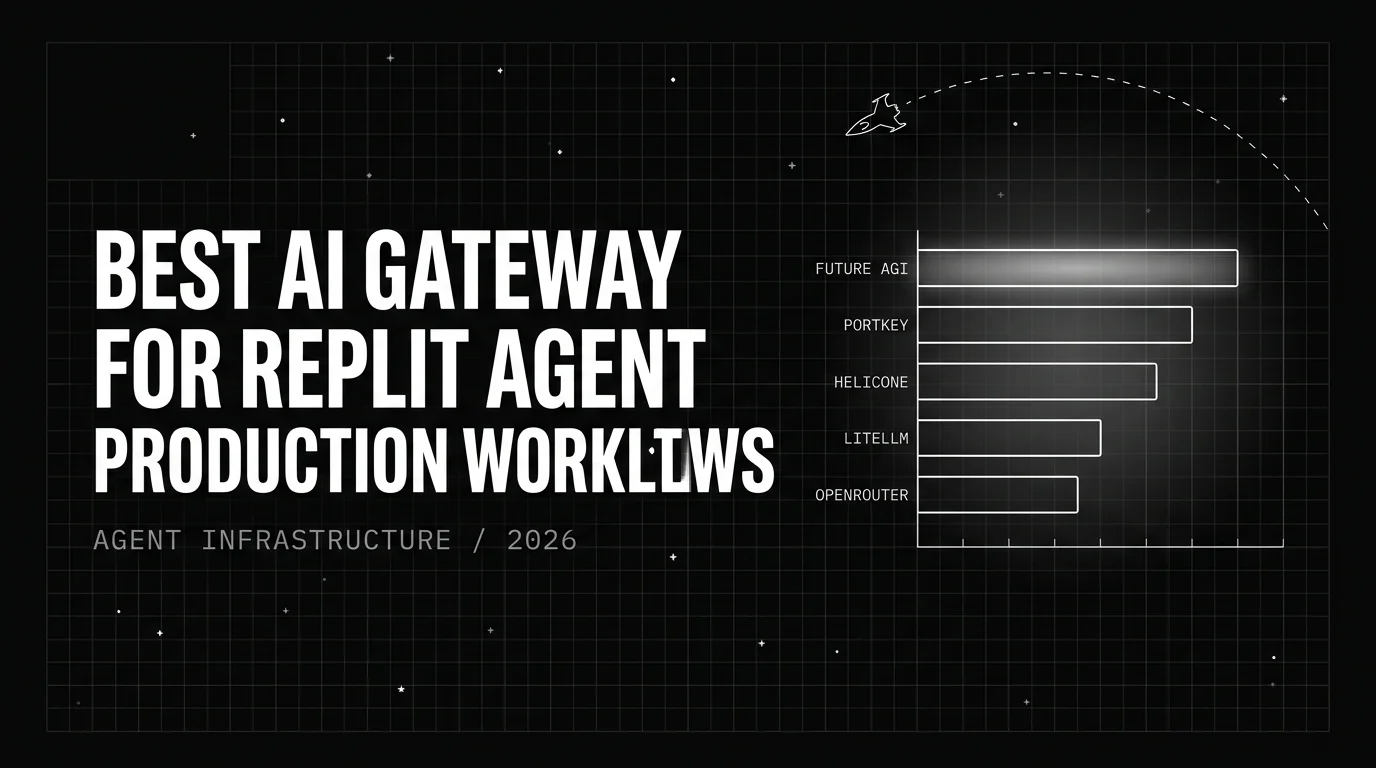
Five AI gateways scored on Replit Agent in 2026: per-app budgets, secret scanning, deploy-snapshot audit, multi-tenant cost slicing, tool-call survival.
An AI gateway sits between apps and LLM providers for governance, routing, observability. What it is, how it differs from API gateways.