Benchmarking LLMs for Business Applications in 2026: A Methodology, Metrics, and Benchmark Stack
How to benchmark LLMs for business in 2026: real-world methodology, metrics that matter beyond MMLU, the modern benchmark stack, 5-step playbook.
Table of Contents
Benchmarking LLMs for Business Applications in 2026: The Short Version
Public LLM benchmarks (MMLU, GPQA, HumanEval, SWE-bench, MATH-500, MMMU) are useful for capability triage but not sufficient for production shipping decisions because of data contamination, domain mismatch, and missing business failure modes (hallucination on your data, PII leakage, prompt-injection robustness, policy compliance). The right methodology in 2026 is to combine public benchmarks for capability triage with a private, in-domain evaluation set built from real business traffic, scored with a defined rubric using a framework like Future AGI’s ai-evaluation SDK (Apache 2.0).
TL;DR: 2026 Business LLM Benchmarking at a Glance
| Layer | What to measure | Tools |
|---|---|---|
| Capability triage | General reasoning, math, code, multimodal | MMLU-Pro, GPQA Diamond, MATH-500, SWE-bench Verified, MMMU-Pro |
| Task quality (in-domain) | Faithfulness, groundedness, rubric score | Future AGI fi.evals.evaluate("faithfulness", ...) + CustomLLMJudge |
| Safety | PII leakage, toxicity, prompt injection | Future AGI safety evaluators + adversarial test set |
| Latency | p50, p95, p99 end-to-end | Custom probe suite + traceAI |
| Cost | $ per million successful tasks (not per token) | Provider price + success rate + cost-tracking header |
| Reliability | Success rate at production traffic distribution | Replay set against shadow model |
| Drift | Week-over-week eval score | Scheduled eval job on a fixed gold set |
Why Benchmarking LLMs for Business Is Different in 2026
Three structural problems with treating public benchmarks as the shipping decision in 2026.
Data contamination. Many public benchmarks have leaked into training corpora over the last two years. The result is that frontier model scores on MMLU, GSM8K, and similar saturated benchmarks are inflated by single to double digits relative to held-out generalization. The field’s response in 2026 is contamination-controlled successors: MMLU-Pro, GPQA Diamond, MATH-500, SWE-bench Verified, LiveCodeBench (date-windowed), and others. Use these for capability triage and report the benchmark date alongside the score.
Domain mismatch. Public benchmarks measure general reasoning, math, code, and multimodal capability on test distributions that do not match your business distribution. A model that scores 85 percent on MMLU-Pro can still hallucinate on your domain-specific terminology, fail your compliance rules, or miss the structural pattern in your data. The model is good in the public test distribution and ungeneralized to yours.
Missing failure modes. Public benchmarks do not test for hallucination on your specific knowledge base, PII leakage on your customer data, prompt-injection robustness, or compliance with your policy. These are the actual production failure modes, and they are private by definition.
The 2026 consensus methodology is: capability triage on public benchmarks, shipping decision on private in-domain benchmarks built from your own traffic.
The Modern Public LLM Benchmark Stack in 2026
General Reasoning and Knowledge
- MMLU-Pro: The contamination-controlled successor to MMLU. Harder questions, fewer ambiguous answers, less likely to be in training corpora.
- GPQA Diamond: Graduate-level science questions written by domain PhDs. The current high bar for “hard” general-knowledge reasoning.
Math
- MATH-500: A curated subset of MATH that has held up better against contamination. Use for math word-problem signal.
- AIME 2024: Competition-grade math problems used during 2024 and 2025; AIME 2025 problems are also in circulation in 2026. Strong signal for reasoning depth on math.
Code
- SWE-bench Verified: The 500-problem human-verified subset of SWE-bench. Measures agentic coding (issue resolution from real GitHub repos). The de facto agent-coding benchmark in 2026.
- LiveCodeBench: Date-windowed coding benchmark with periodic refreshes to control contamination.
Long Context
- RULER: Long-context probe across many context-length regimes (4K, 8K, 16K, 32K, 64K, 128K).
- Needle-in-a-Haystack variants: Quick capability signal for long-context retrieval; less useful for reasoning-over-long-context.
Agents and Tool Use
- SWE-bench Verified: Doubles as the leading agentic-coding benchmark.
- Tau-Bench: Customer-service and retail-style tool-use scenarios.
- BFCL (Berkeley Function Calling Leaderboard): Function-calling correctness across a wide test set.
Multimodal
- MMMU and MMMU-Pro: College-exam-style multimodal questions across many subjects.
- DocVQA, ChartQA: Document understanding signals if your business processes invoices, reports, or charts.
These public benchmarks tell you which model class is plausible for your application. They do not tell you which model ships.
The Six Metrics That Matter for Business LLM Benchmarking
1. Task Quality on an In-Domain Gold Set
The primary number. For each candidate model, run the same prompt template against the same 50 to 500 in-domain test cases and score with a defined rubric. The rubric depends on the task:
- Extraction or classification: exact-match or F1.
- Summarization: ROUGE plus an LLM-judge rubric for coherence.
- RAG question answering: faithfulness or groundedness against the retrieved context.
- Open-ended generation: custom LLM-judge with a written rubric tied to your business voice and constraints.
Future AGI’s ai-evaluation SDK (Apache 2.0) provides faithfulness, groundedness, toxicity, PII, and custom LLM-judge evaluators behind a single evaluate() interface:
from fi.evals import evaluate

result = evaluate(
    "faithfulness",
    output="The customer's refund was processed on April 12.",
    context="Refund record: customer_id=42, amount=$50, status=processed, date=2026-04-12",
)
print(result.score, result.reason)
For custom rubrics:
from fi.evals.metrics import CustomLLMJudge
from fi.evals.llm import LiteLLMProvider

judge = CustomLLMJudge(
    name="support_response_quality",
    rubric=(
        "Score 1-5 based on: factual correctness against the policy excerpt, "
        "tone consistency with the brand voice guide, and explicit refusal "
        "of out-of-policy requests. Penalize hallucinated policy details."
    ),
    provider=LiteLLMProvider(model="gpt-4o"),
)
score = judge.evaluate(output="<draft response>")
print(score.value, score.reason)
2. Safety
Three layers: PII, toxicity, prompt injection. PII and toxicity are evaluator calls; prompt injection is a dedicated adversarial test set you maintain. Future AGI ships PII and toxicity evaluators. A small dedicated test set of 30 to 100 prompt-injection attempts that you build over time is the right control for the injection layer.
3. Latency
p50, p95, p99 measured end-to-end against your prompt distribution. The p99 matters because it is what your worst-case user sees. Use traceAI to record per-call latency directly from production:
from fi_instrumentation import register, FITracer

register(project_name="benchmarking")
tracer = FITracer()

@tracer.chain
def candidate_call(model: str, prompt: str) -> str:
    ...
4. Cost Per Successful Task
Token-cost comparisons across providers are misleading because they ignore success rate. The right unit is dollars per million successful tasks. Compute: take posted price, multiply by mean tokens per call, divide by task success rate. A cheaper model that fails 30 percent of the time is rarely the right pick, but a slightly more expensive model that fails 5 percent of the time often is.
Future AGI’s Agent Command Center gateway exposes a single OpenAI-compatible endpoint with cost in the response header (X-Prism-Cost), which removes a lot of provider-specific accounting from the comparison.
5. Reliability at Production Traffic Distribution
Replay a representative sample of real production traffic against each candidate and measure success rate at the actual input distribution. Reliability on a hand-curated gold set and reliability at production distribution often differ. The production-distribution number is the one that maps to user experience.
6. Drift
Score the same fixed eval set every week. Track week-over-week changes. Drift is rarely caused by your code; it is usually caused by silent provider-side model updates or by retrieval index changes. The week-over-week drift number is your early warning.
A Five-Step Playbook for Benchmarking an LLM for Your Business
Step 1: Define the Task and the Failure Modes
Write a one-paragraph task description and a list of three to seven failure modes that matter for your business. Failure modes are the things that, if they happen at production scale, cost you customers, money, or compliance. Examples: “the model hallucinates policy details,” “the model leaks PII into the response,” “the model refuses on benign requests.”
Step 2: Build an In-Domain Gold Set
50 to 500 hand-curated representative examples from real production traffic, labeled with the correct answer or correct behavior. Add 20 percent adversarial cases (edge cases, attempted prompt injections, malformed inputs). Add 10 percent compliance cases (PII, restricted topics). Version-control the set. The set is the shipping decision, so treat it like code.
Step 3: Pick the Candidate Models with Public Benchmark Triage
Use MMLU-Pro, GPQA Diamond, SWE-bench Verified, and other public benchmarks to narrow the candidate list. For a customer support task, public benchmarks tell you which model class is plausible; the gold set tells you which one actually works for your customers.
Step 4: Run the Bench, Score Six Ways
Run the candidate set through the gold set. Record task quality, safety, latency (p50/p95/p99), cost per successful task, production-distribution reliability, and drift baseline. Tabulate. Future AGI’s ai-evaluation SDK plus traceAI handle the scoring and the latency observability in one stack:
from fi.evals import evaluate
from fi_instrumentation import register, FITracer

register(project_name="business-bench")
tracer = FITracer()

@tracer.chain
def bench_one(model: str, example: dict) -> dict:
    output = call_model(model, example["prompt"])
    return {
        "model": model,
        "output": output,
        "faithfulness": evaluate(
            "faithfulness",
            output=output,
            context=example["context"],
        ).score,
    }
Set FI_API_KEY and FI_SECRET_KEY if you want results forwarded to the Future AGI platform.
Step 5: Pick, Ship, and Monitor
Pick the model that wins on weighted score across the six metrics, where the weights match your business priorities. Ship it. Set up a weekly automated run of the same gold set against the in-production model; the drift number is your early warning if provider-side updates or retrieval changes degrade quality.
Where Future AGI Sits in a Business LLM Benchmarking Workflow
Future AGI is the evaluation and observability framework that runs underneath the methodology described above. The platform does not replace the public benchmark suite (MMLU-Pro, GPQA, SWE-bench Verified, MMMU); it replaces the manual, ad-hoc, in-domain evaluation work that most teams currently do with spreadsheets and one-off scripts:
fi.evals.evaluate(...): First-party metrics for faithfulness, groundedness, toxicity, PII, and other failure modes.fi.evals.metrics.CustomLLMJudge+fi.evals.llm.LiteLLMProvider: Project-specific rubrics with the LLM judge of your choice.fi.opt.base.Evaluator: Local evaluator wrapper for project-specific scoring logic.fi_instrumentation+FITracer(traceAI, Apache 2.0): Framework-agnostic tracing of the benchmark runs and production calls with@tracer.agent,@tracer.tool,@tracer.chain.- Cloud judge tiers: turing_flash (~1-2 s), turing_small (~2-3 s), turing_large (~3-5 s) for inline, batch, and offline scoring respectively. See docs.
- Agent Command Center: Single OpenAI-compatible endpoint with cost tracking, useful for comparing many providers under one accounting model during benchmarking.
The result is a single methodology and a single tool stack across capability triage, in-domain benchmarking, safety testing, and production drift monitoring. For a wider eval tooling comparison, see the LLM evaluation tools comparison. For deeper benchmark mechanics, see the LLM benchmarks vs production evals guide.
Common Pitfalls in Business LLM Benchmarking
Treating Public Benchmark Scores as a Shipping Decision
The single most common mistake. A model that wins on MMLU-Pro can be the wrong pick for your customer support task. Always run the in-domain gold set before shipping.
Using Only LLM-as-Judge Scoring
LLM judges are useful and necessary for open-ended tasks, but they are subject to position bias, length bias, and self-preference bias when the judge and the candidate share a model family. Combine LLM judges with deterministic metrics (exact-match, F1, regex checks) where the task structure permits it.
Ignoring Latency Tail
p50 latency is what you put on the slide. p99 latency is what your unlucky users actually experience. Optimize the p99.
Comparing Cost Per Token Instead of Cost Per Task
A model that costs half as much per token but fails twice as often costs the same per task and degrades user experience. Always compare per successful task.
Skipping the Drift Monitor
Provider-side model updates land without notice. Without a scheduled drift monitor, you find out about silent quality regressions from your support inbox, not from your dashboard.
Verdict: A Two-Layer Methodology Is the 2026 Standard
Public benchmarks (MMLU-Pro, GPQA Diamond, SWE-bench Verified, MATH-500, MMMU-Pro, RULER, Tau-Bench, BFCL) tell you which model class is plausible for your business application. Private in-domain benchmarks built from real production traffic, scored across task quality, safety, latency, cost per successful task, reliability, and drift, tell you which model ships. Future AGI’s ai-evaluation SDK and traceAI (both Apache 2.0) ship the evaluators, the tracing, and the cloud judge tiers needed to run the second layer at production scale. The Agent Command Center BYOK gateway gives you the single accounting plane for cost comparison across providers. The methodology is the answer; the platform is how you operationalize it.
Get started with the Future AGI evaluation SDK and traceAI, or explore the platform at futureagi.com.
Frequently Asked Questions
Why are public LLM benchmarks not enough for business applications in 2026?
What metrics matter most when benchmarking LLMs for production business use?
Which public benchmarks should I look at first in 2026?
How do you build a private benchmark for a business application?
How does data contamination affect benchmark choice?
What is the right way to measure LLM hallucination for business use?
How do you compare cost and latency across LLM providers?
What changed in LLM benchmarking between 2025 and 2026?
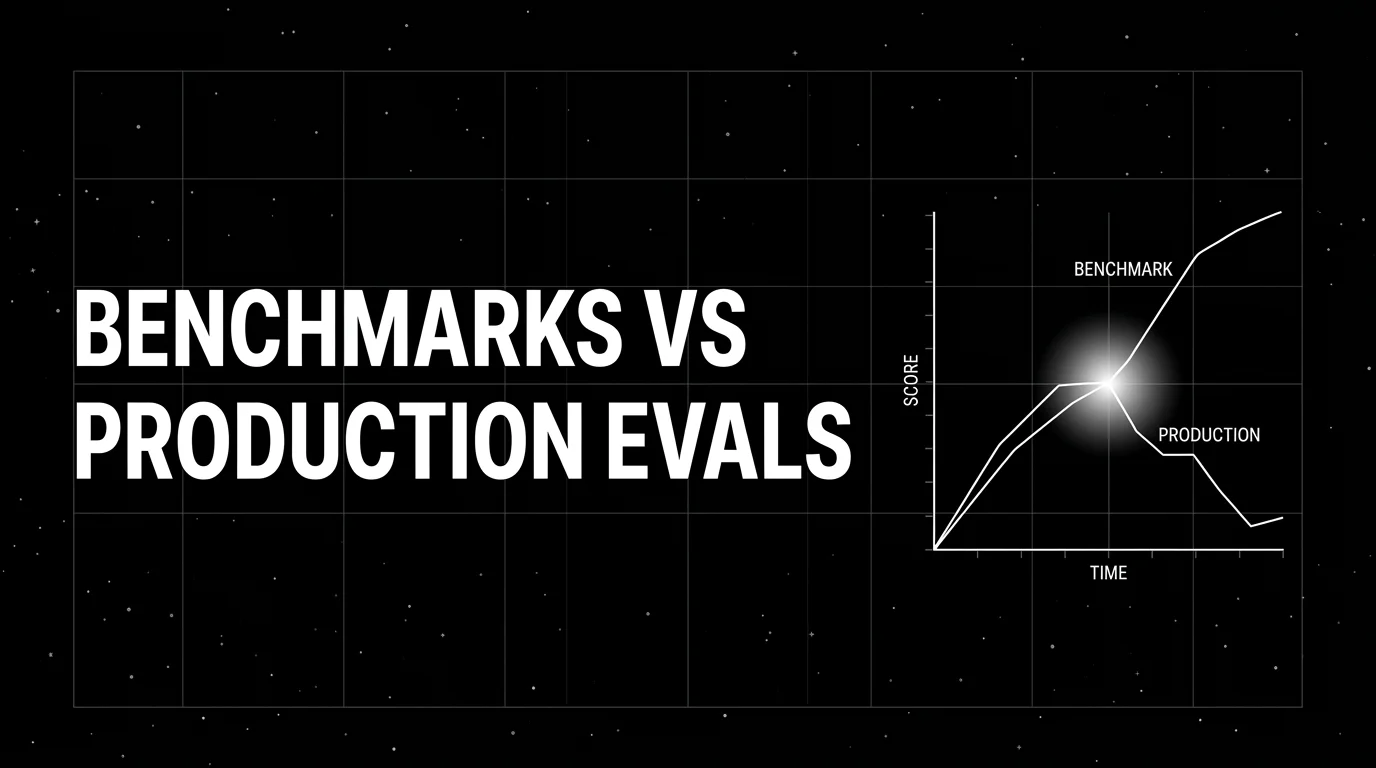
Public LLM benchmarks (MMLU, HumanEval, GSM8K) are contaminated and not predictive of production. Build domain reproductions that actually work in 2026.

Compare GPT-5, Claude Opus 4.7, Gemini 2.5 Pro, and Grok 4 on GPQA, SWE-bench, AIME, context, $/1M tokens, and latency. May 2026 leaderboard scores.

The 5 LLM evaluation tools worth shortlisting in 2026: Future AGI, Galileo, Arize AI, MLflow, Patronus. Features, pricing, and which workload each wins.
