Best AI Agent Testing and Simulation Tools in 2026: 5 Ranked for CI/CD
A plain-language guide to the best AI agent testing and simulation tools for 2026, scored for CI/CD: regression suites, pre-deploy gates, eval-linked verdicts.
Table of Contents
A support agent passed every unit test, then looped for eight turns on a refund it could not process once a real customer pushed back. Strong AI agent testing would have caught that failure before release, and this guide ranks the 5 best AI agent testing and simulation tools for CI/CD in 2026.
TL;DR: AI agent testing means checking that your AI agent behaves correctly before you ship it. The best tools do this with simulation: they run your agent through full back-and-forth conversations with fake users, score every turn, and fail the build when the score drops. FutureAGI ranks first for teams that want this to run automatically in CI/CD.
Before we rank the tools, two quick definitions so the rest of this guide is easy to follow.
An AI agent is a program built on a large language model (an LLM, the kind of model behind ChatGPT) that holds a conversation, remembers what was said, and can call tools like a database or a payment API to get something done.
CI/CD stands for continuous integration and continuous delivery. It is the automated pipeline that rebuilds and re-tests your software every time someone changes the code, and blocks the change if a test fails. Adding agent testing to CI/CD means your agent gets re-tested on every change too.
TL;DR: The 5 Best AI Agent Testing Tools for CI/CD
The best AI agent testing tool runs a realistic conversation, scores each turn, and can fail a bad release automatically. FutureAGI ranks first because it writes the test conversations for you, ties every failure to the turn that broke, and returns a pass rate your CI/CD pipeline can gate on.
| Rank | Platform | Best For |
|---|---|---|
| 1 | FutureAGI | End-to-end agent testing in CI/CD: simulate, evaluate, and trace in one open-source loop |
| 2 | Maxim AI | Teams wanting a polished, managed simulation and evaluation dashboard |
| 3 | Cekura | Conversation-quality QA for support and voice agents |
| 4 | Okareo | Developer-first synthetic scenarios wired into a build pipeline |
| 5 | Coval | Teams testing both chat and voice agents from one simulator |
Why Unit Tests Are Not Enough for AI Agent Testing
Start with a concrete case. A billing agent has a unit test that checks one thing: given the message “where is my refund,” does it call the lookup_refund tool? It does. Green check. The test passes and the code ships.
A unit test checks one small piece of code against one fixed input and one expected output. That is perfect for a function that adds two numbers. It is blind to an agent, because an agent’s job is a conversation, not a single reply.
In production the same billing agent meets a real customer who pushes back, changes the amount, and asks the same question three different ways. The agent forgets the order number from turn one, invents a refund policy on turn five, and loops. No unit test saw this, because no unit test ran the whole conversation.
That is the testing gap. Agents fail in the seams between turns, when they carry memory, follow policy, and call tools across a long exchange. You cannot find those failures by grading one reply at a time.
Agent simulation closes the gap. Simulation means running your agent through complete, multi-turn conversations with fake users before real users arrive, and scoring what happens. Testing is the goal (does the agent behave?); simulation is the method (run realistic conversations to find out).
Frameworks like the NIST AI Risk Management Framework now push teams to test AI systems for these behavioral failures before deployment, not after. The tools below are how you actually do that, and how you make it repeat on every code change.
How We Scored the Tools: The 5-Criteria Simulation Scorecard
We scored every tool on the same five things, named here so you can reuse the list. We do not roll them into a single number, because the right pick depends on which criteria matter to your team.
- Scenario Realism. A scenario is the script for one test conversation: what the fake user wants and how the chat should go, turn by turn. Realism means the scenarios sound like real, messy users, not tidy happy-path scripts.
- Auto-Scenario Generation. Can the tool write those test conversations for you from one seed idea, or do you hand-write every case? Hand-writing does not scale past a few dozen.
- Eval-Linked Verdicts. When a conversation fails, does the tool say which turn broke and why, or just show a red light? An eval-linked verdict ties the pass or fail to a specific turn and a specific evaluator, which is an automated check like “did the agent stay grounded in policy” or “did it call the right tool.”
- Adversarial and Compliance Coverage. Can it throw hostile users at the agent (people trying to trick it, jailbreak it, or expose bias) to test safety, not just politeness?
- Deployment and Openness. Is it open source, can you self-host it inside your own network, and does it plug into CI/CD?
The 5 Best AI Agent Testing and Simulation Tools in 2026
1. FutureAGI
Best For: Engineering teams that want agent testing to run automatically inside CI/CD, so a bad multi-turn conversation fails the build the same way a broken unit test does.
Key Capabilities. FutureAGI is an open-source platform (its core is licensed Apache 2.0, so you can read, run, and self-host it) that treats simulation as one step in a single testing loop. Its simulation library is simulate-sdk, and the code maps directly to the five criteria above.
You start by wrapping the agent you already built so the tester can drive it. FutureAGI ships adapters for the common frameworks: OpenAIAgentWrapper, LangChainAgentWrapper, GeminiAgentWrapper, and AnthropicAgentWrapper. You test the real agent, not a stand-in.
Next you define who is talking. A persona is a fake user with a personality: a name and traits like tone and knowledge level. Persona(name="frustrated_customer", traits={"tone": "impatient"}) behaves nothing like a calm expert, and that difference is exactly what finds bugs.
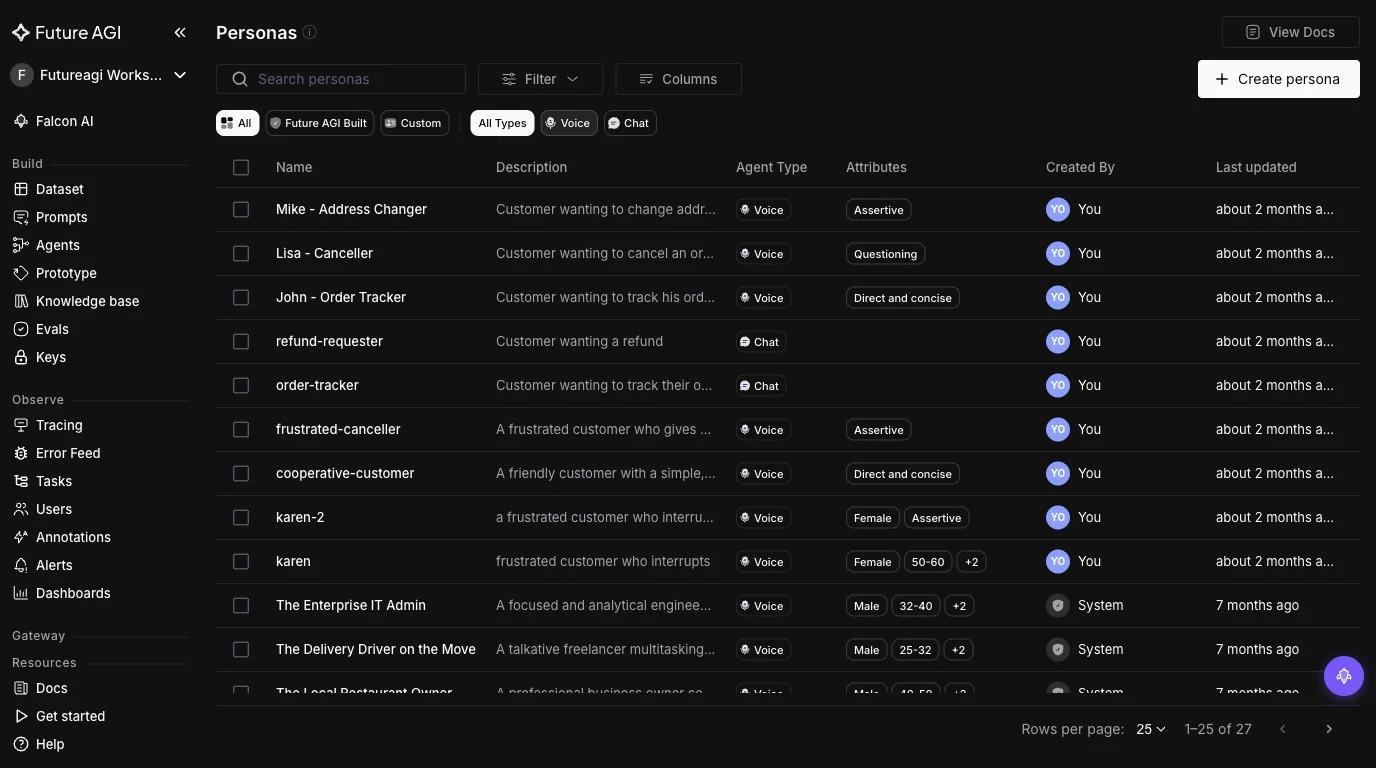
Then you define the conversations. A Scenario holds a description, the user’s goals, and the expected behavior at each turn. Here is the whole loop, short enough to read once:
from fi.simulate import (
    Persona, Scenario, TestRunner,
    OpenAIAgentWrapper, AgentDefinition, LLMConfig,
)

agent_def = AgentDefinition(
    name="billing-support-bot",
    llm_config=LLMConfig(model="gpt-4", temperature=0.7),
    system_prompt="You are a helpful billing support agent.",
)

personas = [
    Persona(name="frustrated_customer", traits={"tone": "impatient"}),
    Persona(name="technical_user", traits={"knowledge_level": "expert"}),
]

scenarios = [
    Scenario(description="Refund status inquiry", goals=["confirm order #", "give refund ETA"]),
]

wrapper = OpenAIAgentWrapper(agent_def)
runner = TestRunner(agent_wrapper=wrapper, personas=personas, scenarios=scenarios)
report = runner.run()
print(f"Pass rate: {report.pass_rate:.0%}")
TestRunner runs every persona against every scenario and returns a TestReport. This is the piece that makes CI/CD work. Your pipeline reads report.pass_rate (the share of conversations that passed) and fails the build if it drops below your threshold. That is a pre-deploy gate for agents, built from one number.
Auto-Scenario Generation (criterion 2, a clear win). Writing scenarios by hand stops scaling fast. ScenarioGenerator(llm, num_scenarios) takes one seed situation and expands it into many realistic variants, including the awkward branches you would never think to script.
That builds a broad regression suite without hand-writing hundreds of cases. A regression suite is a fixed set of tests you re-run on every change, to catch anything that used to work and just broke.
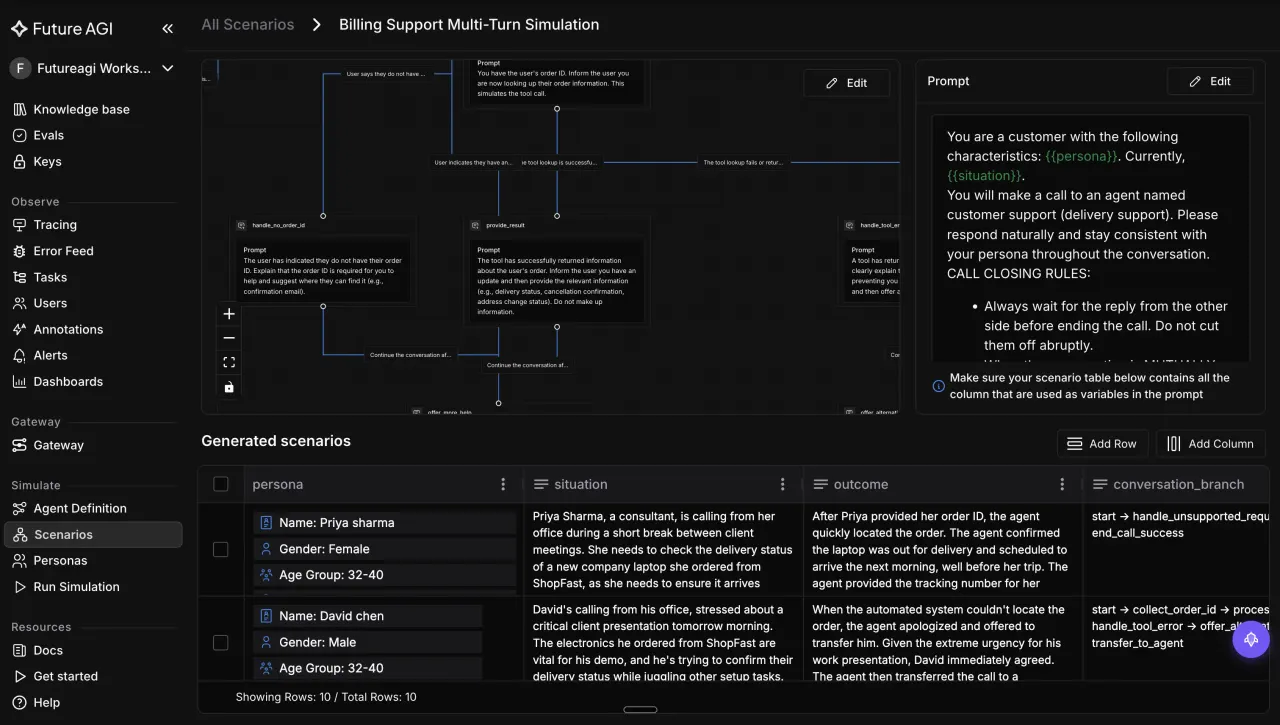
Eval-Linked Verdicts (criterion 3, a clear win). A red light is not actionable. FutureAGI feeds every simulated conversation into the same evaluator library it uses in production: fi.evals, with 50+ built-in evaluators for things like groundedness, factual accuracy, and toxicity. Each failure links to the exact turn and reason.
Traces are OpenTelemetry-native through traceAI (OpenTelemetry is the open standard for tracing software). So a failed test points at “hallucinated a policy on turn five,” with the transcript to prove it.
Voice and audio, natively (criteria 1 and 5). Agent testing is not text-only, and neither is FutureAGI. The same simulate-sdk loop drives spoken conversations, recreating accents, background noise, interruptions, and emotion shifts without burning real telephony minutes, and the audio-native Turing evaluators score them on the same turn-linked basis as text. A voice agent gets the exact same pass-rate gate in CI/CD as a chat agent, across the full STT, LLM, and TTS pipeline. The voice specialists later in this list handle voice well too, but as closed platforms; FutureAGI is the one that wires voice into an open, self-hostable loop you can run on your own hardware.
The wedge. This is one loop from one vendor: simulate, then evaluate, then observe in production, all sharing the same evaluators and traces. A failure you catch in a test is watched for in live traffic too. Separate point tools cannot close that loop, because their test scores and their production monitoring do not speak the same language.
Use Case Fit. Best when your buying constraint is end-to-end coverage that lives in CI/CD, and when you want to self-host and inspect every evaluator and trace.
Pricing and Deployment. Open source under Apache 2.0. Self-host the whole pipeline from GitHub, or use the managed cloud. See the FutureAGI simulation docs to run your first test.
Verdict. FutureAGI tops this list because it is the only tool here that turns a messy multi-turn conversation, text or voice, into a single pass rate your build can gate on, links every failure back to the turn that caused it, and self-hosts the whole loop under Apache 2.0. No other option combines auto-generated scenarios, turn-linked evaluators, native voice/audio, and an open, code-first CI/CD gate in one place. For teams whose real goal is agent testing wired into CI/CD, it ranks first with room to spare.
2. Maxim AI
Best For. Teams that want a polished, managed platform for running and reviewing agent simulations.
Key Capabilities. Maxim AI builds multi-turn agent simulation and evaluation into one product with a strong visual interface. You can configure personas and scenarios, run them at scale, and review conversation transcripts and scores in a clean dashboard. It targets the same core job as FutureAGI: catch multi-turn failures before release.
Limitations. Maxim is a proprietary platform, not an open-source library, so you cannot read or freely run the internals. It does ship a code-first CI path (a GitHub Action, a CLI, and SDKs), and self-hosting exists via VPC or on-prem, but only on the enterprise plan. Teams whose main constraint is running the whole stack inside their own network without an enterprise contract will feel that boundary.
Use Case Fit. A good fit when your team values a ready-made UI and managed hosting over open-source control.
Pricing and Deployment. Commercial SaaS by default, with VPC and on-prem self-hosting on the enterprise plan. Check Maxim AI directly for current plans.
Verdict. Maxim is a capable, well-designed simulation and evaluation platform with real CI/CD support. It ranks second because it is proprietary and gates self-hosting behind an enterprise tier, where FutureAGI is open source and self-hostable from day one.
3. Cekura
Best For. Teams focused on conversation-quality QA for customer support and voice agents.
Key Capabilities. Cekura specializes in testing conversational agents. It runs scripted and generated conversations against your agent and scores how well it handles the exchange, with strong roots in call-center and voice quality assurance (QA, the practice of systematically checking output quality). For support-heavy use cases, that focus is real.
Limitations. Because its center of gravity is conversation QA, the tie-in between a failed test and a deep, developer-facing evaluator library is narrower than a platform built around 50+ programmable evaluators. Teams that want failures pinned to specific turns and reasons inside their own pipeline may find the linkage lighter.
Use Case Fit. Best for support and voice teams whose priority is conversational quality scoring rather than open, self-hostable, eval-linked CI/CD gating. Cekura does ship a GitHub Action, but its build gate is binary (it fails if any scenario fails) and the checks that decide pass or fail are configured in its dashboard, not your code.
Pricing and Deployment. Commercial SaaS; self-hosting is enterprise-only. Contact Cekura for current pricing.
Verdict. Cekura is a solid pick for conversation-quality testing and can gate a build. It ranks third because its strength is QA depth in support scenarios more than open, self-hostable, eval-linked CI/CD testing.
4. Okareo
Best For. Developers who want to generate synthetic test scenarios and run them from a build pipeline.
Key Capabilities. Okareo takes a developer-first approach to agent testing. It can generate synthetic scenarios (test cases created by a model rather than written by hand) and run checks that slot into a CI workflow, which fits teams that want testing to live in code. Its simulation and scenario tooling is aimed squarely at engineers.
Limitations. Its evaluator breadth and the one-vendor simulate-to-evaluate-to-observe loop are narrower than a platform that also owns production monitoring and 50+ built-in evaluators. You may end up combining it with other tools to cover the whole loop.
Use Case Fit. A good fit for engineering teams that want synthetic scenarios in CI and are comfortable assembling the evaluation and monitoring layers around it.
Pricing and Deployment. Commercial with a developer focus. Check Okareo for current plans.
Verdict. Okareo is a developer-friendly way to get synthetic scenarios into a pipeline. It ranks fourth because coverage of the full testing loop is narrower than the top picks.
5. Coval
Best For. Teams that need to test both chat and voice agents from one simulator.
Key Capabilities. Coval runs scenario-based simulations across chat and voice agents, driving personas through conversational flows and scoring how the agent handles them. Its focus is conversation-level reliability for customer-facing agents, so a single tool can cover a support line that spans both a chat widget and a phone channel.
Limitations. Coval’s origins lean toward voice, so text and tool-calling depth can trail platforms built text-first, and its evaluator breadth is narrower than one with 50+ programmable evaluators. It ships a CLI and a GitHub Action, so it can gate a build, but it is a closed, cloud-only product with no self-host path, so pinning a failed test to a specific turn and reason inside your own infrastructure is less direct than with an open, self-hostable, eval-linked tool.
Use Case Fit. Best for teams running voice and chat agents side by side that want one simulator across both channels more than the deepest open, CI-native evaluator library.
Pricing and Deployment. Commercial, cloud-delivered. Confirm current pricing with Coval.
Verdict. Coval is a sensible pick when chat and voice share one roadmap. It ranks fifth for CI/CD agent testing because it is closed and cloud-only and its eval-linkage is lighter than the open, self-hostable picks above it.
A note on adversarial testing. If your top priority is criterion 4, hostile and safety testing, Patronus AI is worth a look. It focuses on adversarial evaluation and red-teaming: deliberately attacking your agent to expose unsafe or biased behavior.
Patronus is more a safety-and-evaluation specialist than a full CI/CD simulation platform. Most teams pair that kind of tool with one of the ranked options above rather than replacing them.
How the 5 Tools Compare on CI/CD
This is a CI/CD ranking, so here is the honest head-to-head on what a pipeline actually needs: a build gate that can fail a deploy, a threshold you set to drive that gate, whether you can self-host the full stack without an enterprise contract, and native voice/audio. All five can fail a build in CI — most ship a GitHub Action — so the ranking turns on the columns to the right, not the first one.
| Tool | CI/CD build gate | Threshold-driven gate | Open-source, self-host full stack | Native voice/audio |
|---|---|---|---|---|
| FutureAGI | Yes — SDK/CLI, report.pass_rate fails the build | Yes — set a pass-rate threshold in code | Yes — Apache 2.0, self-host the whole loop, no enterprise tier | Yes — audio-native simulation and Turing evals |
| Maxim AI | Yes — GitHub Action, CLI, and SDKs | Yes — CLI --pass-criteria | No — proprietary; VPC/on-prem only on the enterprise plan | Yes — voice simulation with voice evaluators |
| Cekura | Yes — official GitHub Action (fails on any scenario failure) | Binary only; per-scenario checks live in the dashboard | No — proprietary; self-host is enterprise-only | Yes — voice-first |
| Okareo | Yes — CLI and GitHub Action | Yes — metrics_min thresholds | No — proprietary core; Helm self-host on enterprise | Yes — audio-native |
| Coval | Yes — GitHub Action and CLI | Per-metric fail condition, not a pass-rate % | No — managed cloud SaaS only | Yes — voice-first, chat too |
Read down the columns and the ranking explains itself. Failing a build is table stakes now: Maxim, Cekura, Okareo, and Coval all ship a way to do it, and most cover voice too, so neither “we gate CI” nor “we do voice” is where FutureAGI pulls ahead. The gap is in the third column. FutureAGI is the only tool here you can run entirely on your own hardware, the whole simulate-evaluate-observe loop, under Apache 2.0, with no enterprise contract to unlock it. Maxim, Cekura, and Okareo are proprietary and reserve self-hosting for a paid enterprise tier; Coval is managed cloud only. Okareo comes closest on the developer-first gate, but it stops at scenarios and leaves you to assemble the evaluator and monitoring layers, whereas FutureAGI shares one set of evaluators and traces across all three stages. So the standout is not the gate itself; it is owning the entire loop, across text and voice, open source and self-hosted, gated on a pass rate you set. No other tool here offers that combination.
A Quick Decision Framework
Match your main constraint to the tool that fits it.
| If your main need is… | Choose | Why |
|---|---|---|
| Agent testing wired into CI/CD, open source, one loop | FutureAGI | Simulate, evaluate, and trace share the same evaluators; gate the build on report.pass_rate |
| A polished managed dashboard, no self-hosting | Maxim AI | Strong UI for running and reviewing simulations |
| Conversation-quality QA for support or voice | Cekura | Purpose-built for conversational quality scoring |
| Synthetic scenarios in a developer pipeline | Okareo | Developer-first scenario generation in CI |
| One simulator across chat and voice agents | Coval | Scenario-based simulation spanning both channels |
| Deep hostile and safety testing | Patronus AI | Focused adversarial evaluation and red-teaming |
Best Practices for Agent Testing in CI/CD
Picking a tool is half the job. These habits are what make agent testing actually catch bugs on every release.
Build a regression suite from real failures. Every time an agent breaks in production, turn that conversation into a scenario and add it to the test set you re-run on every change.
Over time this becomes your strongest safety net, because it re-checks every bug you have already seen. Seed ScenarioGenerator from real transcripts, not invented ones, so the tests match how users actually talk.
Set a pre-deploy gate on pass rate. A pre-deploy gate is a rule that blocks a release until it meets a standard. Pick a pass-rate threshold (say, no ship below 95 percent), read report.pass_rate in your pipeline, and fail the build automatically when it drops. No human has to remember to check.
Handle flaky conversations on purpose. Agents are non-deterministic: the same input can produce different replies, so a test can pass once and fail the next run. That is a flaky test. Do not delete it. Run key scenarios a few times, gate on the rate, and use eval-linked verdicts to tell a real regression from normal variation.
Cover adversarial personas, not just polite ones. Most teams test the happy path and ship. Add impatient, confused, and hostile personas so the suite finds the agent that handles the calm user and falls apart on the frustrated one. That is where real complaints come from.
Localize failures, do not just count them. A pass rate tells you something broke. Eval-linked verdicts and traces tell you which turn and why. Always route failures to the specific turn so a developer can fix the cause, not guess at it.
Where This Leaves You
AI agent testing is no longer optional once your agent holds real conversations, remembers state, and calls tools. Unit tests will keep passing while your agent loops on a refund it cannot process. Simulation is how you catch that, and CI/CD is how you catch it every single time.
All five tools here run multi-turn simulations. FutureAGI ranks first for one reason: it turns a messy conversation into a single pass rate your build can gate on, generates the test conversations for you, and links every failure to the exact turn that caused it, all in one open-source loop you can self-host.
For teams adding agent testing to CI/CD, that is the shortest path from “it broke in production” to “the build caught it first.”
Three ways to start:
- Try the cloud: run your first simulation in the FutureAGI simulation docs.
- Self-host it: clone and run the whole pipeline from the FutureAGI GitHub repo under Apache 2.0.
- Book a demo: see the simulate, evaluate, and observe loop on your own agent.
What to Read Next
- AI Agent Simulation in 2026: A Practical Guide: the step-by-step build behind the tools ranked here.
- The Definitive Guide to AI Agent Evaluation (2026): how the evaluator layer scores each turn once a test fails.
- Simulated Multi-Turn Conversation Evaluation: a deeper look at scoring across a full conversation.
Frequently Asked Questions
What is AI agent testing?
How is agent testing different from unit testing?
Can I run AI agent testing in a CI/CD pipeline?
How do I deal with flaky agent tests?
Which AI agent testing tool is best for CI/CD?
A practical guide to AI agent simulation: what it is, the 3-layer stack of personas, scenarios, and eval-linked verdicts, and how to simulate an agent.


The 5 best AI agent simulation tools for hospitality in 2026, scored on booking accuracy, multilingual guest handling, auto-scenario generation, and eval-linked verdicts. FutureAGI leads.
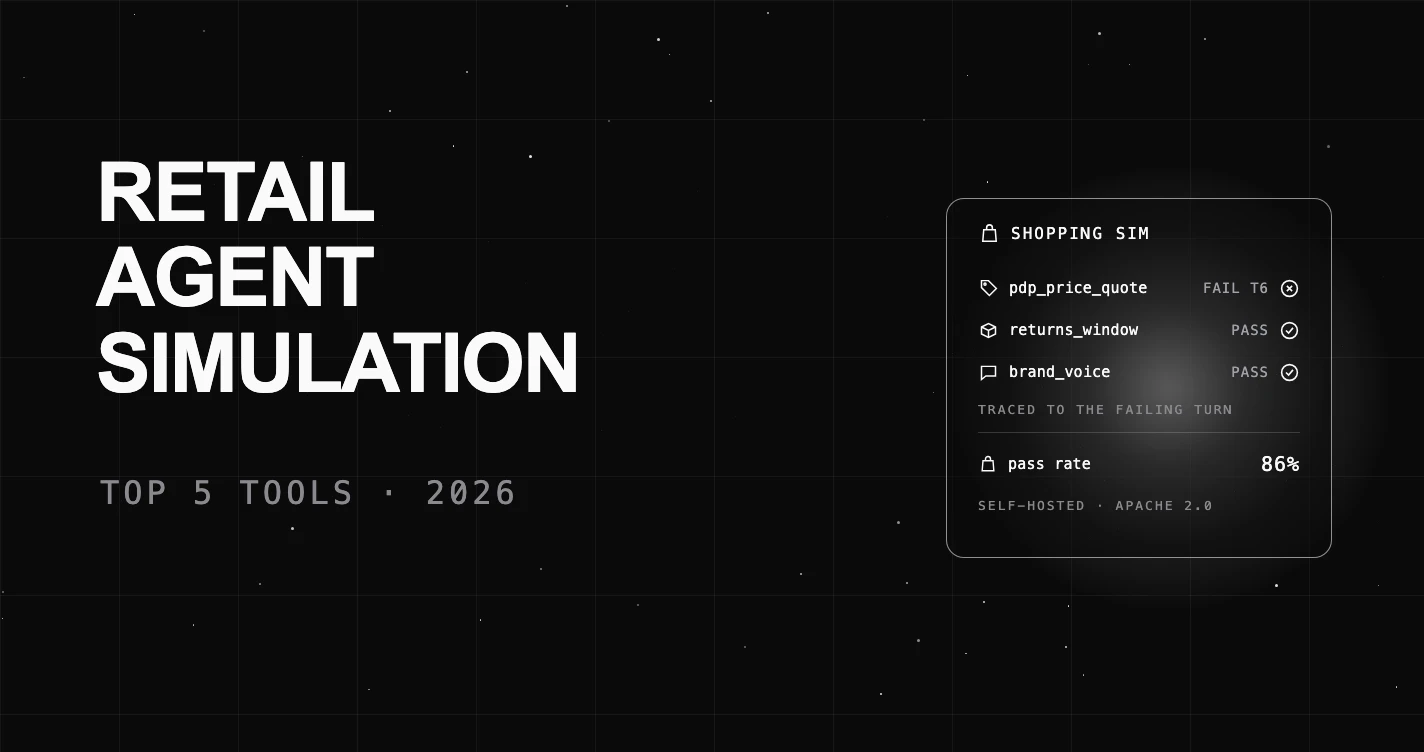
The 5 leading AI agent simulation tools for retail in 2026, scored on scenario realism, auto-scenario generation, and eval-linked verdicts for brand-voice drift, PDP pricing accuracy, and returns.
