Build Self-Optimizing AI Agents in 2026: 6 Eval-Driven Optimization Strategies
Replace manual prompt tuning with eval-driven auto-optimization. 6 strategies (Bayesian, GEPA, ProTeGi), real fi.opt code, and a free 2026 webinar.
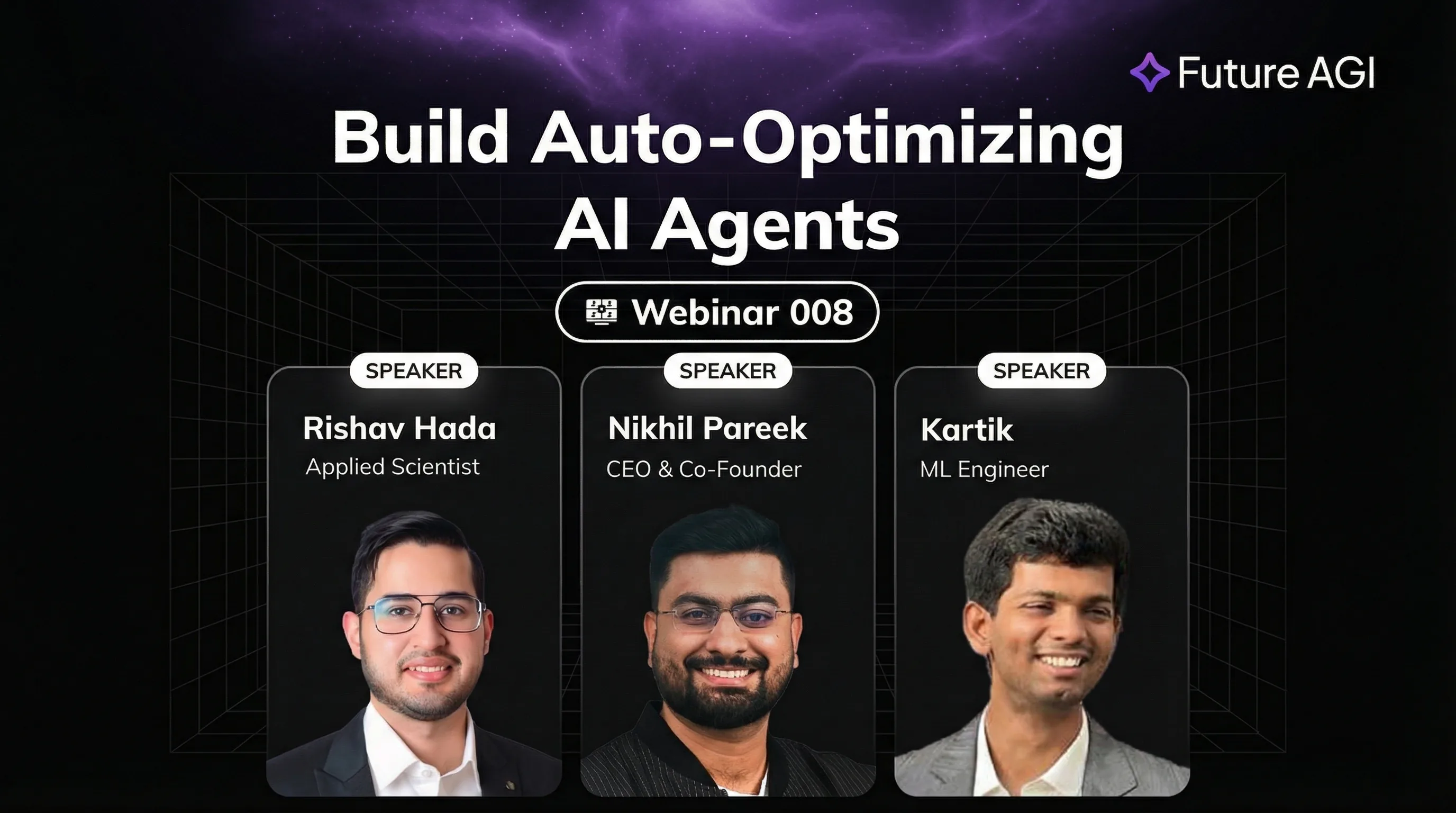
Table of Contents
Watch the Webinar
The next breakthrough in AI is not better models. It is agents that improve themselves.
TL;DR: 2026 Agent Optimization Stack
| Rank | Tool | Strengths | Open source |
|---|---|---|---|
| 1 | Future AGI Optimize (agent-opt) | 6+ optimizers, fi.evals integration, traceAI observability | Yes |
| 2 | DSPy | Strong compiler for typed prompt pipelines | Yes |
| 3 | OpenAI Evals + Prompt Tuner | Tight loop with OpenAI models, limited algorithm choice | Partial |
| 4 | LangSmith + Prompt Hub | Good experiment tracking, weaker auto-optimization | Closed |
| 5 | PromptLayer Optimize | Useful for SaaS prompt teams, narrower coverage | Closed |
Why Manual Agent Tuning Fails: The Case for Automated Eval Loops
Most AI teams are stuck in an endless loop: build an agent, manually test it, tweak prompts for weeks, ship it, watch it fail in production, repeat.
Meanwhile, a new generation of AI systems is emerging: agents that can be evaluated on collected interactions and improved through controlled optimization runs. Engineers define the evaluators and approve the promotion gates, and the optimization loop does the search work that used to take human weeks.
In this live workshop, we show how eval-driven auto-optimization replaces months of manual tuning with automated improvement cycles that can run on a scheduled or triggered basis. You will see how production-grade AI agents use evaluation frameworks and optimization algorithms to turn batches of conversations, failures, and successes into systematic performance gains with far fewer human bottlenecks.
This is not about prompt engineering tips. It is about building agents that measure, learn, and optimize themselves at scale.
Built for AI Engineers and ML Developers Shipping Production Agents
AI engineers, ML developers, product teams, and technical founders building production-grade agents who want to replace manual tuning with automated, eval-driven optimization at scale.
6+ Agent Optimization Strategies in the Workshop: Bayesian Search, ProTeGi, GEPA, and More
- Replace weeks of manual tuning with automated optimization loops that run 24/7.
- See 6+ optimization strategies in action: Bayesian search, meta-prompt, ProTeGi, GEPA, instruction-induction, and RLHF-style scoring.
- Learn the optimization mindset that separates production-ready agents from demos.
- Build evaluation feedback loops that drive measurable improvements across prompts, tools, and routing.
- Cut cost and iteration count while improving agent performance across every metric.
- Get hands-on with the Future AGI agent-opt SDK (open source) and run your first auto-optimization job.
What Is Eval-Driven Auto-Optimization and Why It Replaces Manual Prompt Tuning
First-generation agents execute tasks. Next-generation agents optimize themselves using evaluation frameworks and optimization algorithms, turning every interaction into systematic performance gains with human-defined evaluators and review gates instead of weeks of manual prompt tuning.
The recipe is simple:
- Define an evaluator that returns a numeric score for any agent output.
- Pick an optimizer (Bayesian search, ProTeGi, GEPA, or a custom search).
- Run the optimizer against a labeled dataset.
- Promote the best prompt or configuration to production.
- Stream production traces back into the eval set to feed the next round.
The result is a closed loop that keeps improving the agent as new failure modes emerge.
Real Code: Custom LLM Judge as an Optimizer Evaluator
The snippet below shows the core pattern using the Future AGI optimization SDK. You wrap a CustomLLMJudge in fi.opt.base.Evaluator, then hand the evaluator to a Bayesian or evolutionary optimizer. Set FI_API_KEY and FI_SECRET_KEY before running.
from fi.opt.base import Evaluator
from fi.evals.metrics import CustomLLMJudge
from fi.evals.llm import LiteLLMProvider

provider = LiteLLMProvider(model="gpt-4o", temperature=0)

faithfulness_judge = CustomLLMJudge(
    name="faithfulness",
    grading_rules=(
        "Rate how well the response is grounded in the provided context. "
        "Return a float between 0 and 1."
    ),
    llm_provider=provider,
)

# run_agent is your own integration function: it takes a candidate prompt
# and an input row, calls your agent, and returns the model output.
def run_agent(prompt: str, user_input: str) -> str:
    raise NotImplementedError("Replace with your agent integration")

class FaithfulnessEvaluator(Evaluator):
    def score(self, prompt: str, dataset: list) -> float:
        scores = []
        for row in dataset:
            response = run_agent(prompt, row["input"])
            result = faithfulness_judge.evaluate(
                response=response,
                context=row["context"],
            )
            scores.append(result.score)
        return sum(scores) / len(scores)
Once FaithfulnessEvaluator is wired up, pass it to a Bayesian or evolutionary optimizer from fi.opt and the loop will search prompt or hyperparameter space against your scorer.
Real Code: BLEU Score for Translation-Style Agents
For agents that produce reference-comparable outputs, the built-in BLEUScore evaluator from fi.evals.metrics gives a deterministic baseline.
from fi.evals.metrics import BLEUScore

bleu = BLEUScore()

result = bleu.evaluate(
    response="The cat sat on the mat.",
    expected_response="A cat is sitting on the mat.",
)
print(result.score)
Combine deterministic metrics like BLEU with a custom LLM judge for richer signal in the optimization loop.
Where Future AGI Optimize Fits in the 2026 Stack
Future AGI Optimize is the editorial top pick in the TL;DR above because it ships the specific capabilities production agent teams need: multiple built-in optimizers (Bayesian search, ProTeGi, GEPA, meta-prompt, instruction-induction), feedback signals that include RLHF-style scoring, native integration with fi.evals, support for custom LLM judges via fi.opt.base.Evaluator, observability through traceAI (Apache 2.0), and a dataset interface that handles streaming production traces back into the eval set.
To learn more about Agent Optimize, see the Future AGI Optimization docs.
Visit Future AGI to sign up and set up your first optimization job in under 15 minutes.
Frequently Asked Questions
What is eval-driven auto-optimization for AI agents?
Which 6 agent optimization strategies should I learn in 2026?
How does Future AGI Optimize compare in the 2026 agent optimization stack?
What is the BayesianSearchOptimizer in the agent-opt library?
Can I use my own evaluator instead of built-in metrics?
How does eval-driven optimization save time compared to manual tuning?
Is the agent-opt library open source?
Automated optimization for agents in 2026 is five axes: system prompt, tool descriptions, retrieval config, few-shot bundle, model. Pick the right one.

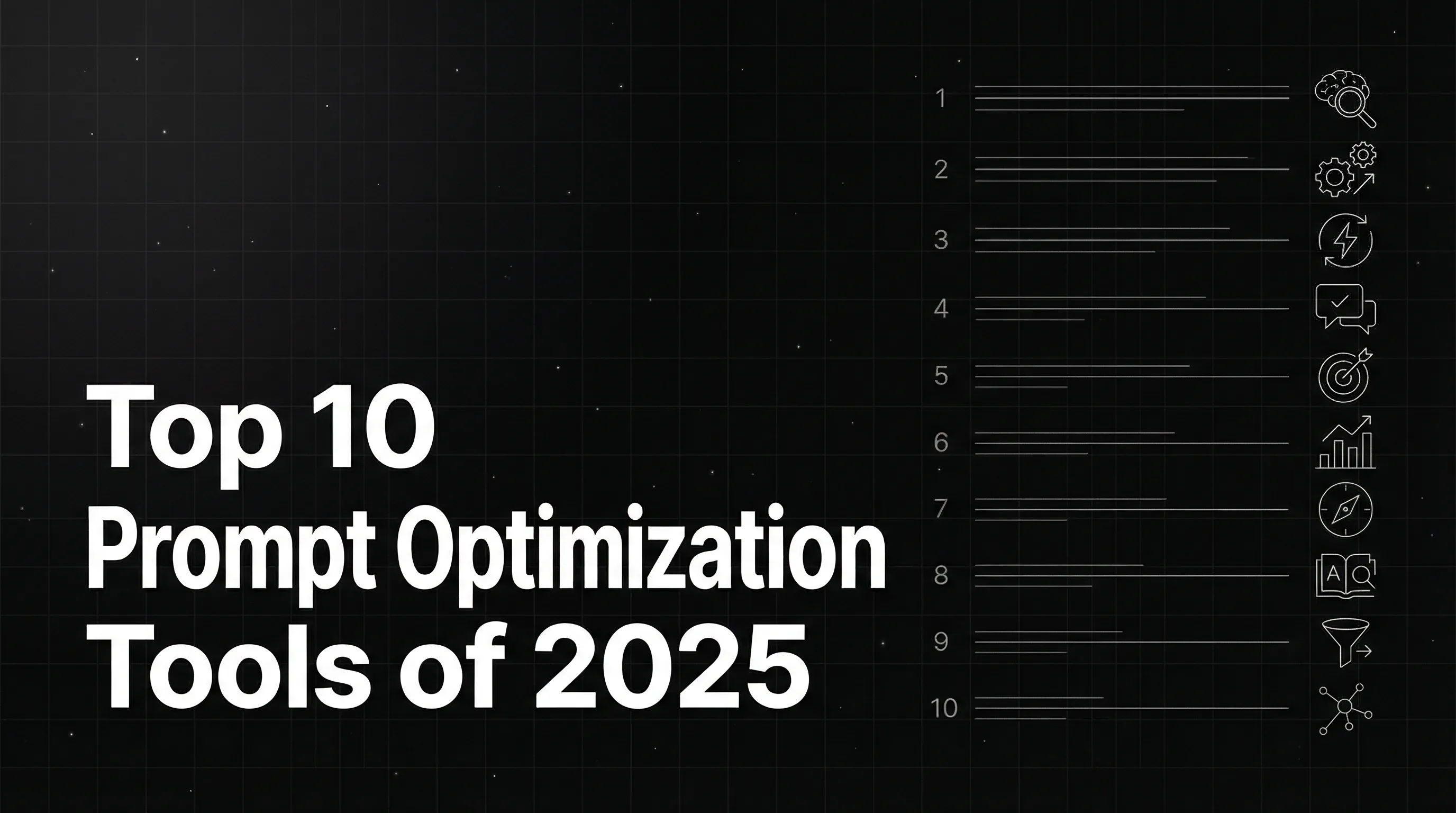
Top 10 prompt optimization tools in 2026 ranked: FutureAGI, DSPy, TextGrad, PromptHub, PromptLayer, LangSmith, Helicone, Opik, DeepEval, Prompt Flow.
Future AGI Prompt Optimize in 2026: six search algorithms (BayesianSearch, MIPRO, GEPA, ProTeGi, PromptWizard, Random) with code, evals, and CI gating.
