Introduction
Tool chaining is the backbone of every useful agentic AI system. When an LLM agent completes a multi-step task, it calls one tool, takes the output, and feeds it into the next tool in sequence. This is multi-tool orchestration at its core. It works in demos but consistently breaks in production.
The pattern is familiar to anyone building LLM-powered applications: your agent chains three or four tool calls together, and the first call returns slightly malformed output. The second tool accepts it anyway but misinterprets a field. By the third call, the entire chain has gone off the rails. This is the cascading failure problem, and it is the primary bottleneck to agent reliability in 2026. Research from Zhu et al. (2025) confirms that error propagation from early mistakes cascading into later failures is the single biggest barrier to building dependable LLM agents.
This guide breaks down why tool chaining fails, how context preservation collapses across chained calls, what evaluation frameworks catch failures before they hit users, and practical patterns using LangGraph and LangChain.
What Is Tool Chaining and Why It Matters for Agentic AI
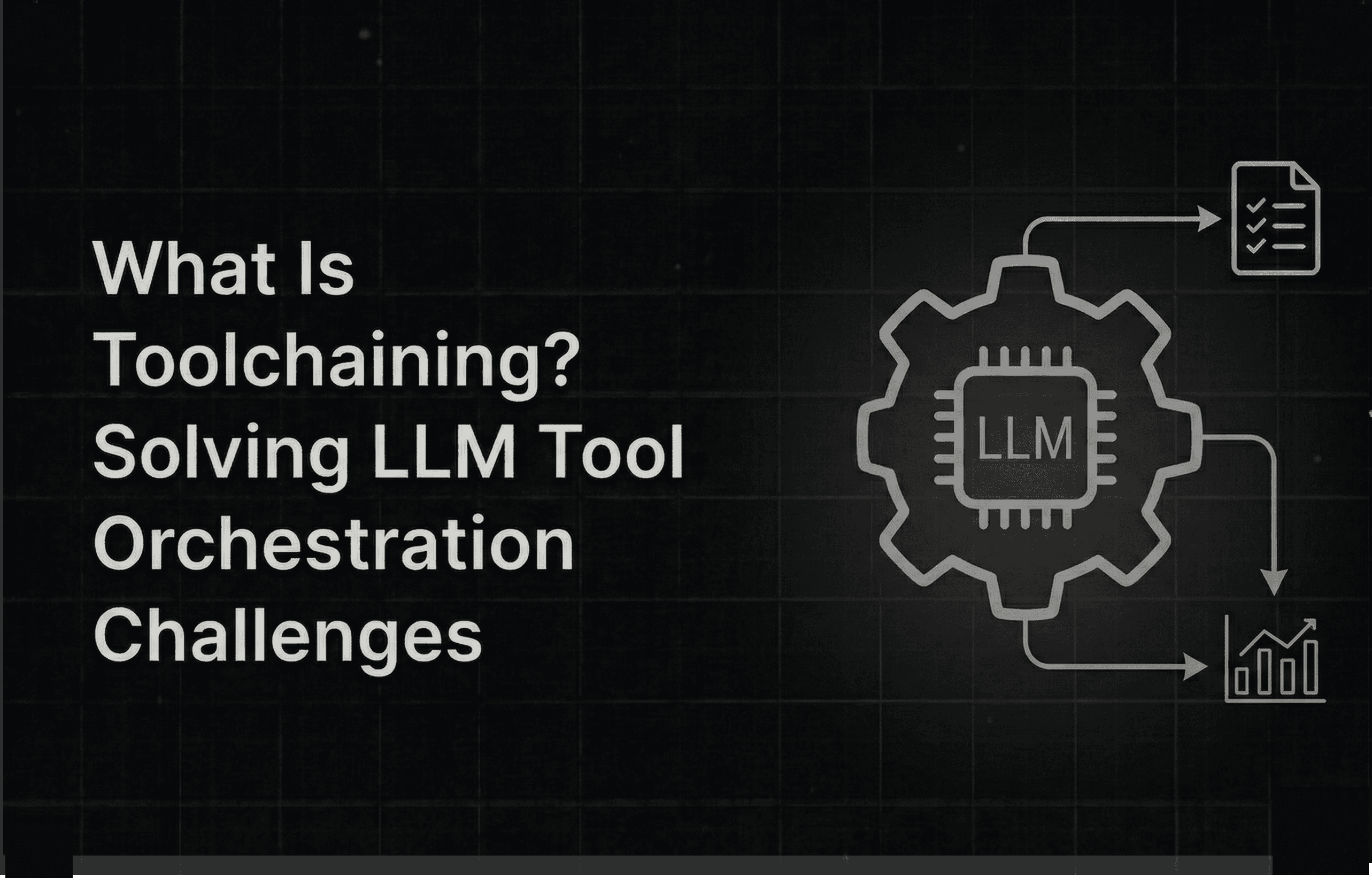
Tool chaining is the sequential execution of multiple tool calls by an LLM agent, where each tool's output becomes the input (or part of the input) for the next tool in the sequence. Think of it as a pipeline: an agent receives a user query, decides it needs data from an API, processes that data with a second tool, and then generates a final response using the combined results.
This differs from a single tool calling step. A single tool call is straightforward: the LLM decides to call a function, gets a result, and responds. When you chain tools together, you automatically create dependencies between calls. The agent has to figure out the right order of operations, keep track of intermediate state, and deal with partial failures, all while staying focused on the original goal. In multi-agent systems, things get even more complicated, since one agent might call a tool, hand that result off to a second agent, which then runs through its own set of tools before returning a final answer. The orchestration overhead piles up quickly, and with it, so does the number of places where something can go wrong.
Consider a practical example: a user asks an agent to find earnings data, compare it to competitors, and generate a summary. If the first call returns revenue in the wrong currency, the comparison runs but produces misleading figures, and the summary confidently presents wrong data. No error was thrown. That is the core danger of tool chaining without validation and observability.
The Core Challenges of Tool Chaining in Production
3.1 Context Preservation Across Tool Calls
Context preservation is the ability to maintain relevant information as data flows from one tool call to the next. LLMs operate within a finite context window, and every tool call adds tokens to that window: function parameters, response payloads, and the agent's reasoning about what to do next. In long chains, critical context from early steps can be pushed out of the window or diluted by intermediate results.
This problem is well documented. Research shows that LLMs lose performance on information buried in the middle of long contexts, even with large context windows. When an agent forgets a user constraint from step 1 by the time it reaches step 5, the output may be technically valid but factually wrong. The user asked for revenue in USD, but the agent lost that detail three tool calls ago.
Practical fixes:
Use structured state objects (not raw text) to pass data between tool calls. This keeps the payload compact and parseable.
Summarize intermediate results before passing them forward. Strip out metadata the next tool does not need.
Use frameworks like LangGraph that provide explicit state management across graph nodes, keeping context durable and inspectable.
3.2 Cascading Failures and Error Propagation
Cascading failures are the biggest production risk in tool chaining. When one tool in the chain produces an incorrect or partial result, that error flows downstream and compounds at every subsequent step. Unlike traditional software where errors throw exceptions, LLM tool chains often fail silently because the agent treats bad output as valid input and moves on.
A 2025 study published on OpenReview analyzed failed LLM agent trajectories and found that error propagation was the most common failure pattern. Memory and reflection errors were the most frequent cascade sources. Once these cascades begin, they are extremely difficult to reverse mid-chain.
In multi-agent systems, cascading failures are amplified. The Gradient Institute found that transitive trust chains between agents mean a single wrong output propagates through the entire chain without verification. OWASP ASI08 specifically identifies cascading failures as a top security risk in agentic AI.
3.3 Context Window Saturation
Every tool call consumes context window tokens. A chain of five calls can easily use 40-60% of available tokens before the agent generates its final response. Even with models offering 1 million tokens, research shows LLMs lose performance on information buried in the middle of long contexts.
Tool Chaining Failure Modes: A Developer Reference
The table below catalogs the most common failure modes in production tool chains.
Failure Mode | What Happens | Mitigation |
Silent data corruption | Tool returns wrong format; agent passes it forward without detecting the error. | Add schema validation (JSON Schema or Pydantic) on every tool output. |
Context loss | Key data from early calls gets pushed out of the context window in later steps. | Use explicit state management. Summarize and carry forward only essential fields. |
Cascading hallucination | Agent fills missing data with hallucinated values when a tool returns incomplete results. | Implement strict null checks. Instruct the agent to stop and report missing data. |
Tool misuse | Agent calls the wrong tool or uses incorrect parameters due to ambiguous descriptions. | Write precise tool descriptions with parameter examples and constraints. |
Timeout cascade | One slow tool causes subsequent calls to timeout or exceed request limits. | Set per-tool timeouts. Implement circuit breakers to isolate slow tools. |
Error swallowing | API errors are caught but not surfaced, so the agent proceeds with empty data. | Return explicit error objects. Train the agent to handle error responses differently. |
Table 1: Tool Chaining Failure Modes
Frameworks for Multi-Tool Orchestration
The right framework reduces the difficulty of building reliable tool chains. Here is how the leading options compare for production multi-tool orchestration in 2026.
Framework | Best For | Tool Chaining Support | Observability |
LangGraph | Stateful, branching workflows with conditional routing | Graph-based state machine with durable execution and checkpoints | Deep tracing via LangSmith with state transition capture |
LangChain | Rapid prototyping and linear chains | LCEL pipe syntax with built-in tool calling abstractions | Callback-based tracing; LangSmith and Langfuse integration |
AutoGen | Multi-agent conversation collaboration | Message-passing with built-in function call semantics | Moderate; needs external tooling for production traces |
CrewAI | Role-based multi-agent task execution | Task delegation with tool assignment per role | Basic logging; longer deliberation before tool calls |
Table 2: Frameworks for Multi-Tool Orchestration
LangGraph is a strong choice for production tool chaining because it treats workflows as explicit state machines. Every node in the graph represents either a tool call or a decision point, and the edges between them define how the workflow moves from one step to the next. This makes it pretty straightforward to plug in retry logic, fallback paths, and human-in-the-loop checkpoints at specific stages. On top of that, its durable execution feature means that if a chain breaks at step 4 out of 7, it can pick back up from that exact point instead of running the whole thing over from scratch.
LangChain remains the most popular starting point for developers building LLM applications. Its LCEL syntax makes it quick to compose linear tool chains. However, for production workloads with branching logic or parallel tool calls, most teams migrate to LangGraph for the additional control.
Distributed Tracing and Observability for Tool Chains
You cannot fix what you cannot see. Observability is critical for tool chaining because failures are often silent. A tool chain that produces a wrong answer without errors looks fine in your logs unless you have distributed tracing capturing every step.
What to trace in every tool chain:
Input and output of each tool call: Capture exact parameters and full responses to replay failures.
Latency per step: A slow tool can cascade into timeouts downstream.
Token consumption: Track context window usage to identify saturation risk.
Agent reasoning between calls: Capture chain-of-thought to find logic errors.
Tools like LangSmith, Langfuse, and Future AGI provide native tracing for LangGraph and LangChain workflows. Future AGI's traceAI SDK integrates with OpenTelemetry and provides built-in evaluation metrics for completeness, groundedness, and function calling accuracy.
Evaluation Frameworks for Tool Chaining
Tracing tells you what happened. Evaluation frameworks tell you whether it was correct. For tool chains, evaluation must cover multiple dimensions:
Tool selection accuracy: Did the agent pick the right tool at each step?
Parameter correctness: Were arguments valid and complete?
Chain completion rate: What percentage of multi-step tool chains run from start to finish without errors, fallbacks, or manual correction?
Output faithfulness: Does the final response accurately reflect tool data without hallucinations?
Error recovery rate: When a tool returns an error, how often does the agent recover?
Running evaluations at scale requires automation. Platforms like Future AGI attach evaluation metrics directly to traces, scoring every execution and creating a continuous feedback loop.
Building Reliable Tool Chains for Production
Based on real-world production deployments and current research, here are the patterns that consistently improve tool chaining reliability.
1. Validate at every boundary. Add input and output validation between every tool call using Pydantic or JSON Schema. Do not trust the LLM to notice malformed data. Explicit validation catches errors at the source before they propagate downstream.
2. Use plan-then-execute architecture. Research from Scale AI shows that having the LLM formulate a structured plan first (as JSON or Python code) and then running it through a deterministic executor reduces tool chaining errors significantly. This separates reasoning from execution.
3. Implement circuit breakers. If a tool fails or returns unexpected results more than N times, break the circuit and return a graceful failure instead of continuing with bad data. This prevents one broken tool from taking down the entire workflow.
4. Keep chains short. Longer chains mean more failure opportunities and more context window consumption. If your chain needs more than 5-6 sequential calls, restructure into sub-chains or parallel branches.
5. Test with adversarial inputs. Standard test cases will pass. Production traffic will not be standard. Test with empty tool responses, large payloads, unexpected types, and ambiguous queries.
6. Trace everything from day one. Instrument tool chains with distributed tracing from the first deployment. When something breaks in production, traces are the difference between hours of debugging and a quick fix.
Conclusion
Tool chaining separates demo-ready agents from production-ready ones. The gap is defined by how well you handle cascading failures, preserve context across calls, and evaluate every execution against clear quality criteria. LangGraph provides the control structure, LangChain provides the integration layer, and evaluation platforms close the feedback loop.
Teams that ship reliable agentic AI treat multi-tool orchestration as a first-class engineering problem. Validate at every boundary, trace every execution, evaluate continuously, and keep chains short. That is how tool chains work in production.Senior Applied Scientist
Frequently Asked Questions
What is tool chaining in LLM agents?
Why do cascading failures happen in multi-tool orchestration?
How does context preservation affect tool chaining reliability?
What evaluation frameworks help test tool chains with Future AGI?