Prompt Optimizer Explained: How Automated Prompt Rewriting Actually Works
How a prompt optimizer actually rewrites prompts: the score, rewrite, re-score loop, the four algorithm families behind it, and what you need before running one.
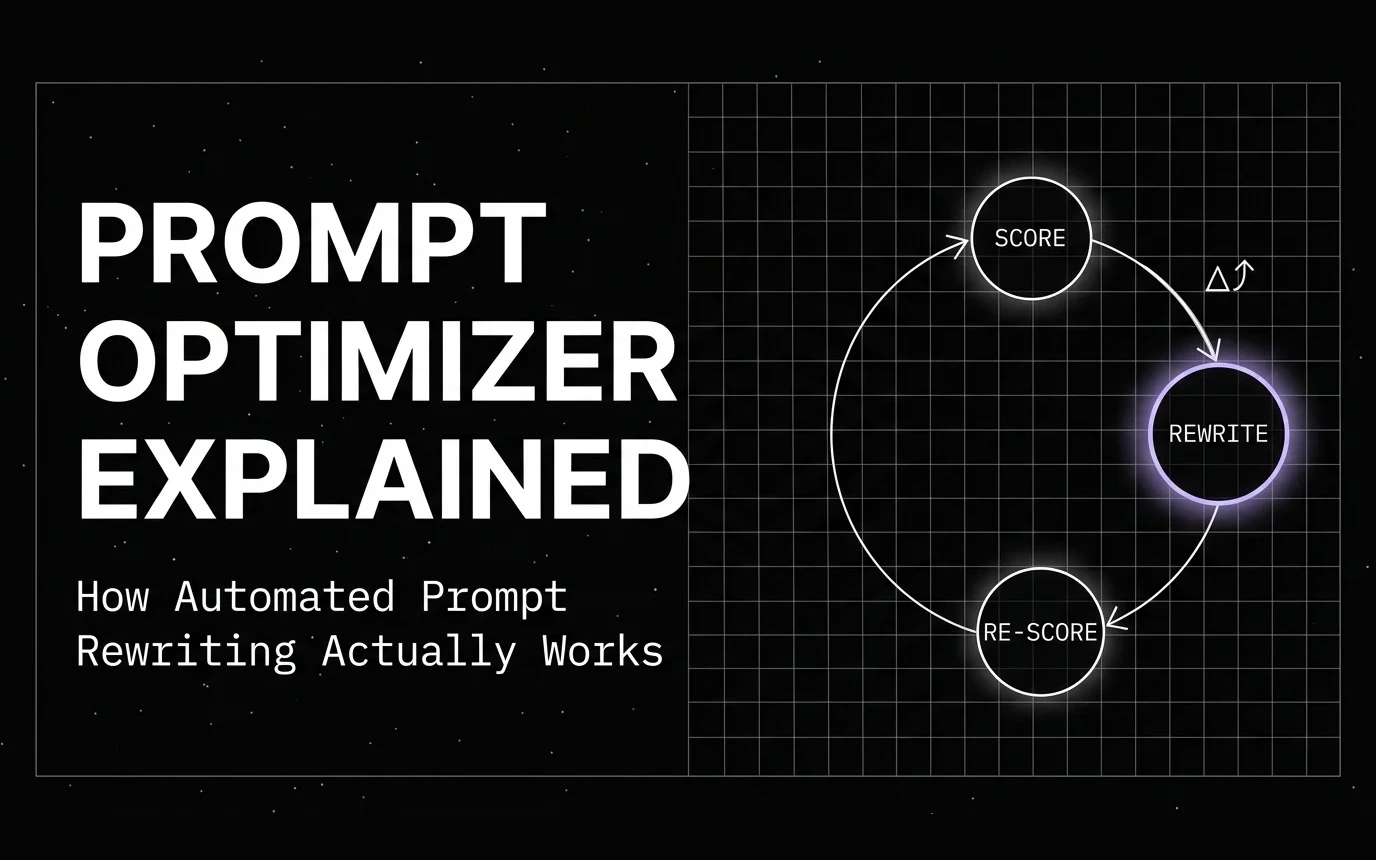
Table of Contents
You changed one line in a system prompt, ran it against the five examples you always check, and shipped it. Two weeks later a different set of inputs broke. You cannot say which edit caused which regression, because nothing kept score.
A prompt optimizer replaces that guessing with a loop that runs your prompt against a real dataset, grades every output, and rewrites the wording based on where it failed. This piece walks through the actual mechanics: how the loop scores a prompt, how it decides what to change, and the four families of algorithms that do the rewriting. By the end you will know what a prompt optimizer needs from you before it can work at all.
What Is a Prompt Optimizer?
A prompt optimizer is software that treats a prompt as a variable to search over, not a sentence to hand-edit. You give it a starting prompt, a dataset of inputs, and a way to score outputs. It proposes new versions of the prompt, tests each one against the dataset, and keeps the version with the highest average score.
The starting prompt is called the seed. The dataset is the test set the optimizer scores every candidate against, and it stays fixed for the whole run. The scoring function is the part that decides what “better” means, and the entire loop depends on that function being trustworthy.
Nothing here is exotic. It is closer to a spell-checker with a scoreboard than to model training. The model that answers your questions does not change at all. Only the words in the prompt change, and only the wording that produced a higher score survives to the next round.
Say you have a support-ticket classifier prompt that mislabels a specific category of refund requests. A person fixing this by hand would read a few wrong answers, guess at a fix, and ship it without knowing if the fix helped elsewhere. A prompt optimizer runs the same fix idea, and dozens of others, against every ticket in the test set, then keeps only the version that raises the overall score without quietly breaking a different category.
The Core Loop: Score, Rewrite, Re-Score
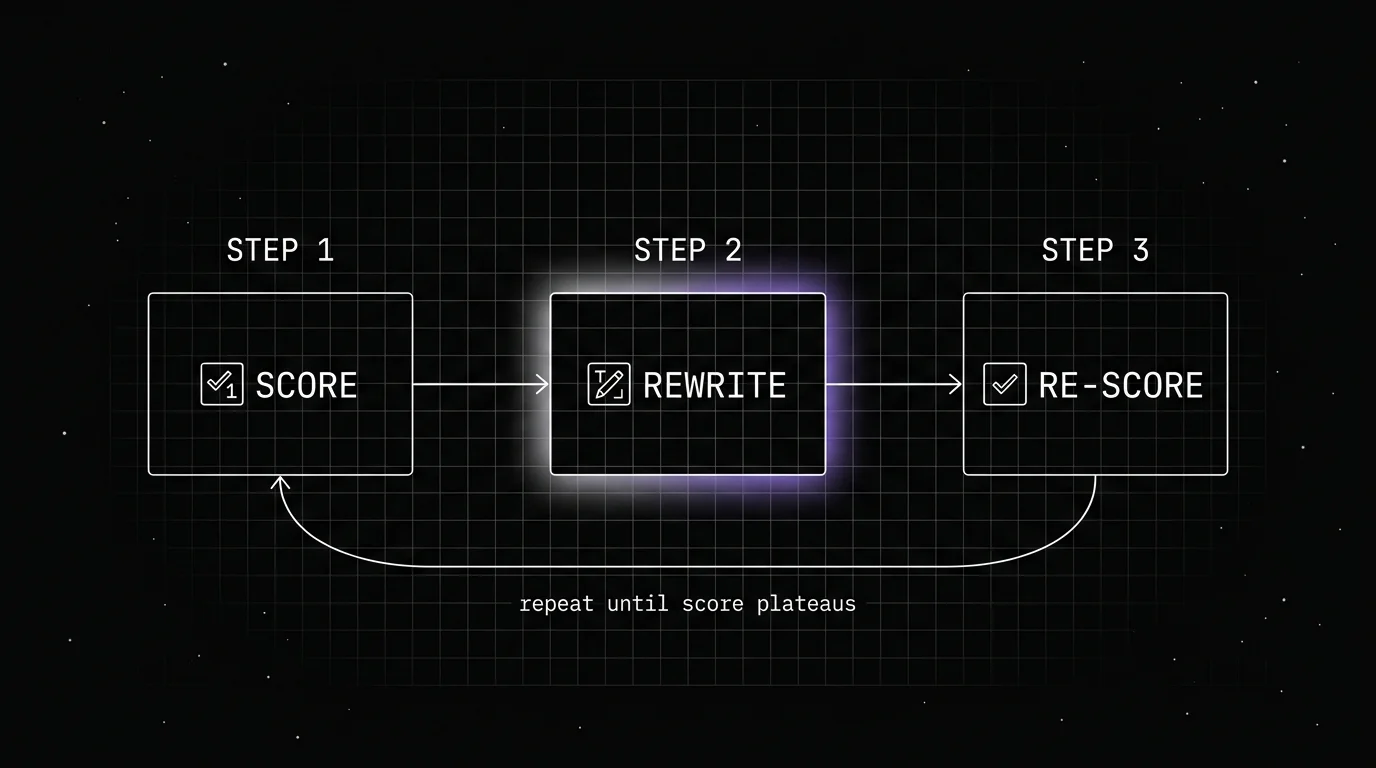
Every prompt optimizer, regardless of algorithm, runs the same three-step cycle. Understanding this loop first makes the algorithm differences in the next section much easier to follow.
Step one, score the current prompt. The optimizer runs the seed prompt against every example in the test set and records how well the model did on each one, using whatever metric or judge you configured.
Step two, generate a rewrite. Based on the scores, the optimizer produces one or more new prompt candidates. Different algorithms generate candidates differently, and that is where the algorithm families in the next section actually diverge.
Step three, re-score and compare. The new candidates run against the same test set. If a candidate beats the current best score, it replaces the current prompt. If nothing beats it, the round produces no change and the loop either stops or tries again with a different rewrite strategy.
| Loop step | What happens | What decides the outcome |
|---|---|---|
| Score | Prompt runs against every test example | The metric or LLM-judge rubric |
| Rewrite | New candidate prompts get generated | The optimizer’s search algorithm |
| Re-score | Candidates run against the same test set | Whether any candidate beats the current best |
| Convergence check | Loop stops or continues | Score plateau, iteration cap, or budget limit |
This cycle repeats for a fixed number of rounds or until the score stops improving. Nothing about the loop cares which algorithm generates the rewrites. That choice is what the next section covers.
Four Families of Prompt Optimization Algorithms
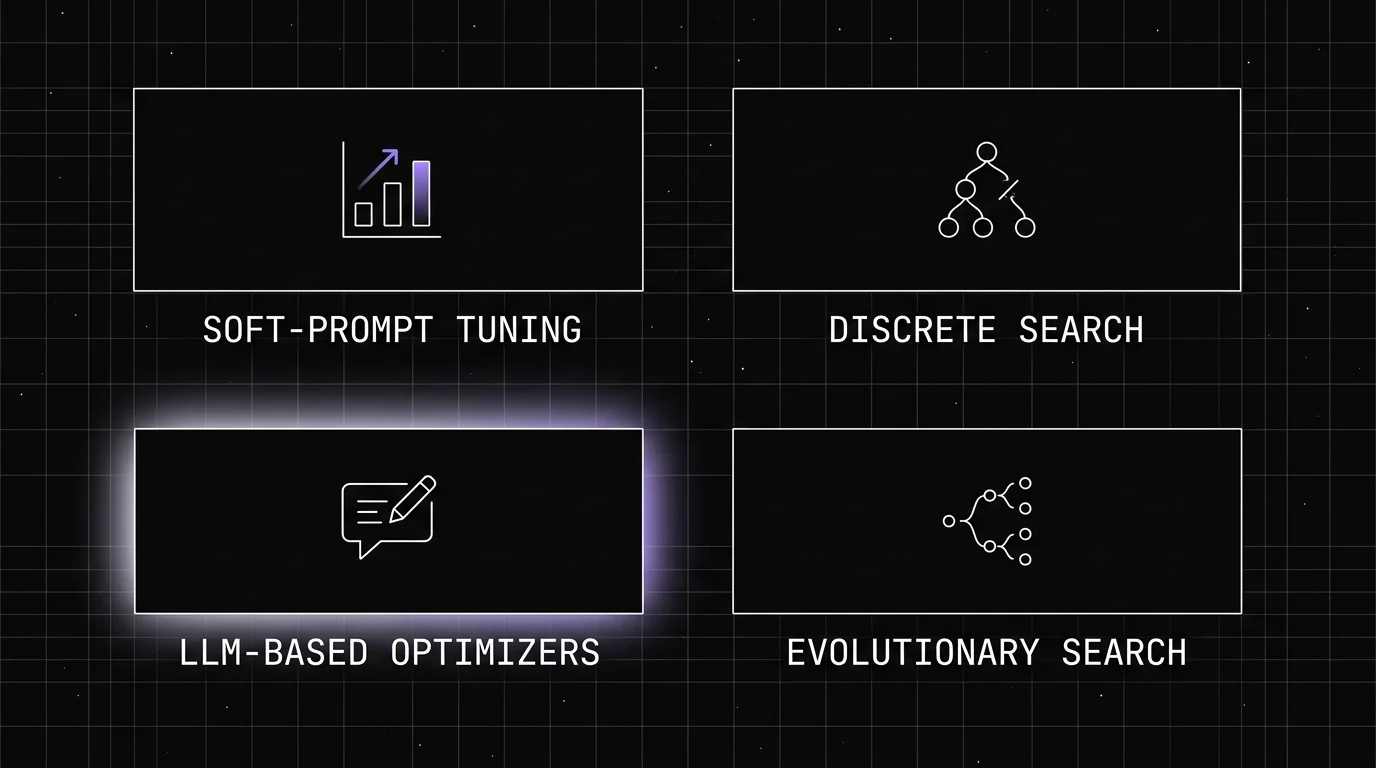
Every production prompt optimizer falls into one of four families, based on how it turns a low score into a new candidate prompt. Cameron Wolfe’s research writing groups them this way, and it maps cleanly onto what teams actually deploy in 2026.
Soft-Prompt Tuning
Soft-prompt tuning does not touch the words of the prompt at all. It adds a set of trainable numeric vectors in front of the model’s input and adjusts those vectors with gradient descent, the same math used to train the model itself. The result is not a readable sentence, it is a block of numbers tuned to steer the model’s internal state.
This only works when you have direct access to model weights and gradients, which rules it out for most hosted API models. Teams running open-weight models on their own infrastructure are the main users of this family.
Discrete Search: Gradient and Reinforcement Signals
Discrete search methods like AutoPrompt and RLPrompt keep the prompt as readable text but search token by token, guided by a signal that behaves like a gradient even though the underlying words are not continuous. RLPrompt treats prompt generation as a reinforcement-learning problem, rewarding token choices that raise the score.
These methods are compute-heavy and slower to converge than the other three families. They show up more often in research benchmarks than in production pipelines, because the search space at the token level is enormous.
LLM-Based Optimizers
This is the family most teams actually run. An LLM acts as the optimizer itself: it reads the current prompt, the scores, and a sample of failures, then writes a new prompt in plain language. APE, APO, and OPRO are the named methods here, and they differ mainly in what feedback they show the rewriting model.
OPRO shows the rewriting model a running history of past prompts and their scores, so the model can spot the trend and write something better than the trajectory suggests. APO samples specific failing examples and asks the rewriting model to diagnose why the prompt failed before it rewrites. Because the rewriter is just another LLM call, this family is cheap to run and easy to reason about.
Evolutionary Search
Evolutionary optimizers like EvoPrompt and Promptbreeder keep a population of candidate prompts instead of a single best one. Each round, the optimizer mutates and recombines prompts from the population, scores the new batch, and keeps the strongest performers for the next generation, borrowing directly from genetic algorithms.
The advantage shows up on tasks with more than one objective, where a prompt that is best on accuracy and a prompt that is best on brevity can both survive instead of collapsing into one blended score too early. The tradeoff is cost: evaluating a whole population every round uses far more test-set runs than a single-candidate rewrite loop.
What Makes an LLM a Good Optimizer?
The LLM-based family works because rewriting a prompt from failure examples is a task language models are already good at, reading text, spotting a pattern, and producing new text that addresses it. A meta-prompt hands the rewriting model three things: the current prompt, a handful of examples it got wrong, and the scores those examples received.
The rewriting model is not guessing blindly. It sees concrete failures and can reason about what phrase or instruction produced them, in the same way a person debugging a prompt reads through wrong answers before changing anything. The difference is that the optimizer does this at a scale no person can match, checking every example in the test set instead of the five a human happens to glance at.
This also explains the family’s biggest weakness. A rewriting model can latch onto surface patterns in the failing examples rather than the real cause, producing a prompt that fixes those specific cases while quietly breaking others. That risk is why the test set and the scoring rubric matter as much as the algorithm choice.
Comparing the Four Algorithm Families
| Family | How it rewrites | Needs model weights? | Typical cost per round |
|---|---|---|---|
| Soft-prompt tuning | Adjusts numeric vectors via gradient descent | Yes | Low, once weights are accessible |
| Discrete search | Token-level search with reward or gradient-like signal | No | High, large search space |
| LLM-based optimizers | Rewriting model reads scores and failures, writes new text | No | Low, a handful of LLM calls |
| Evolutionary search | Mutates and recombines a population of prompts | No | Medium to high, scales with population size |
For most teams working against a hosted API model, LLM-based optimizers and evolutionary search are the two realistic options. Soft-prompt tuning needs weight access most API users do not have, and discrete search rarely earns its compute cost outside research settings.
What You Need Before You Can Optimize a Prompt
None of the four families work without three pieces of infrastructure in place first, and skipping any one of them is the most common reason a team’s optimization run produces garbage.
A representative test set. The optimizer only ever sees what is in your dataset. If your test examples do not reflect the traffic your prompt actually handles in production, the optimizer will happily improve a score that has nothing to do with real performance.
Traces of what actually happened. You cannot build a good test set from memory. Recorded traces of real requests and responses show you which inputs the current prompt struggles with, which is exactly what an optimizer needs to target.
A scoring method you trust. Every algorithm family depends entirely on the score being an honest signal. A rule-based metric works when outputs have a clear right answer. An LLM-as-judge rubric works for open-ended tasks, but only if the rubric itself was checked against human judgment first.
Without these three, running any of the four algorithm families is search without a destination. The optimizer will still produce a “winning” prompt, but winning against a bad test set or an untrustworthy score is not the same as winning in production.
On test set size, more examples beat fewer, but coverage matters more than raw count. Thirty examples that span every input category your prompt actually sees will catch more real failures than three hundred examples clustered around one easy case. Start from your traces, group them by the kind of input they represent, and pull a balanced sample rather than a random one.
How Do You Know When a Prompt Optimizer Has Converged?
Convergence means the loop has stopped finding meaningfully better candidates, and there are three practical signals to watch for instead of guessing. The first is a score plateau: several consecutive rounds produce no improvement past a small threshold, which usually means the current prompt is near a local best for that test set.
The second signal is a hard budget limit, an iteration cap or a maximum number of test-set evaluations you set ahead of time so a run cannot spend unlimited compute chasing marginal gains. The third is a validation check: the winning prompt gets tested against a held-out set of examples it never saw during optimization, and if the validation score tracks the training score, the result is real rather than an artifact of overfitting to the test set.
Treat any one signal alone as insufficient. A plateau on a small or narrow test set can look like convergence while the prompt has actually just run out of new ways to game a weak scorer.
Common Failure Modes When Running a Prompt Optimizer
Three failure patterns show up repeatedly once teams move a prompt optimizer from a demo into a real workflow, and all three trace back to the scoring step rather than the algorithm.
Overfitting to the test set. A prompt that scores perfectly on forty examples can still fail on the forty-first, especially if the optimizer ran many rounds against a small, static set. The fix is splitting your data into a training slice the optimizer sees and a validation slice it never touches, then trusting only the validation number.
Judge gaming. When the scorer is an LLM-as-judge, a rewriting model can learn to satisfy the judge’s surface preferences, longer answers, more hedging language, extra caveats, without actually solving the task better. Watch for a rising score paired with outputs that read worse to a human reviewer; that gap is the tell.
Prompt drift after a model swap. A prompt optimized against one model version can lose its edge when the underlying model updates, because the phrasing that worked was tuned to that model’s specific quirks. Re-running the optimization loop after a model change, rather than assuming the old winning prompt still holds, catches this before it reaches production.
None of these are algorithm bugs. They are all symptoms of the same root cause covered earlier: the loop is only as good as the test set and the scoring method feeding it.
Future AGI
Future AGI’s agent-opt library, open source under Apache 2.0, runs six named optimizer algorithms against your prompts: Random Search, Bayesian Search, ProTeGi, Meta-Prompt, PromptWizard, and GEPA. Each one implements a different rewrite strategy from the families above, from a simple paraphrase baseline through GEPA’s genetic Pareto search.
The loop follows the same score, rewrite, re-score structure covered in this post. Per Future AGI’s optimization docs, the platform “scores rewrites against the evals you pick to define what good means, and keeps the winner,” running generate, evaluate, retain, iterate until the score plateaus or the budget runs out.
The scoring step is where Future AGI’s evaluation layer does the work this post spent a section arguing you need. Instead of a single fixed metric, you define custom evals, whether that’s an LLM-as-judge rubric, a code-based check, or an agent-level evaluator, and the same evals score traces from production, rows in a dataset, and candidates from an optimization run. That consistency matters because a prompt optimizer is only as trustworthy as the score it chases, and custom evals let you define what “good” means for your specific task rather than settling for a generic metric that does not fit it.
For a deeper dive into the exact algorithms (textual gradients, genetic evolution, meta-prompting) rather than the loop mechanics covered here, see Automatic Prompt Optimization in 2026.
Conclusion
A prompt optimizer is not a mysterious black box, it runs the same score, rewrite, re-score loop every time, and the four algorithm families only differ in how the rewrite step generates its next candidate. LLM-based optimizers and evolutionary search cover almost every production use case against a hosted model, while soft-prompt tuning and discrete search stay mostly in research settings.
The loop itself is the easy part. The hard part, and the part worth spending real time on, is building a test set that reflects real traffic and a scoring method you actually trust. Get those two right first, and any of the four algorithm families will give you a prompt that measurably beats the one you started with.
Frequently Asked Questions
What is a prompt optimizer?
How does a prompt optimizer know a rewrite is better?
Do I need labeled data to run a prompt optimizer?
What is the difference between prompt optimization and fine-tuning?
Can a prompt optimizer make a prompt worse?
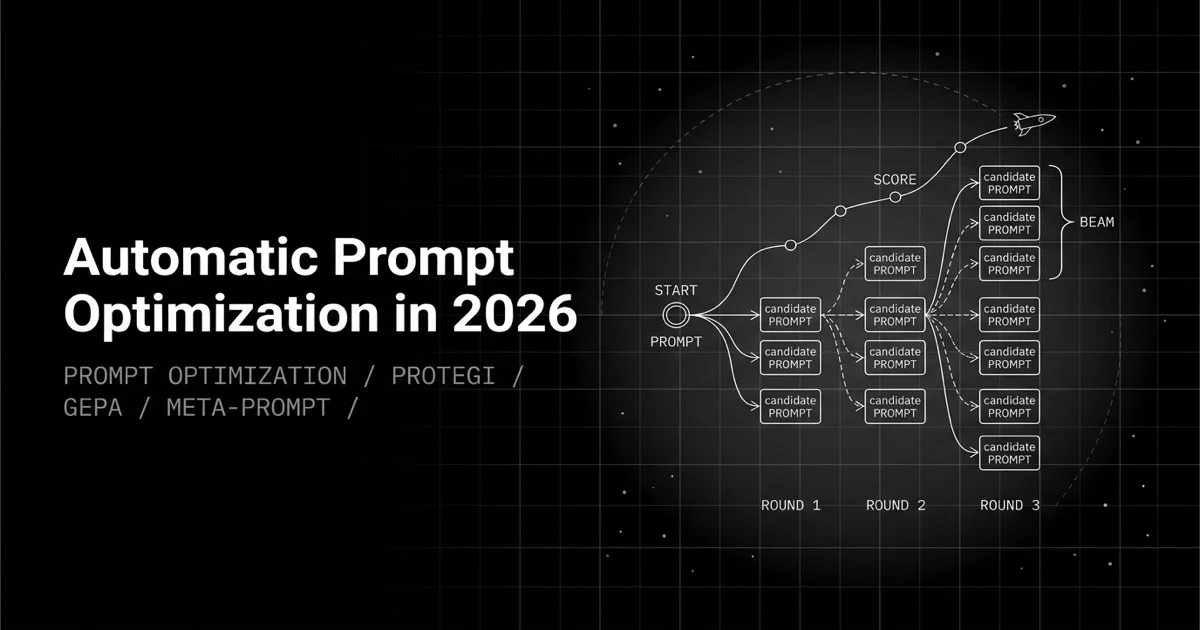
Automatic prompt optimization explained: textual gradients (ProTeGi), score trajectories (OPRO), genetic evolution (GEPA), meta-prompting, and how to pick one.
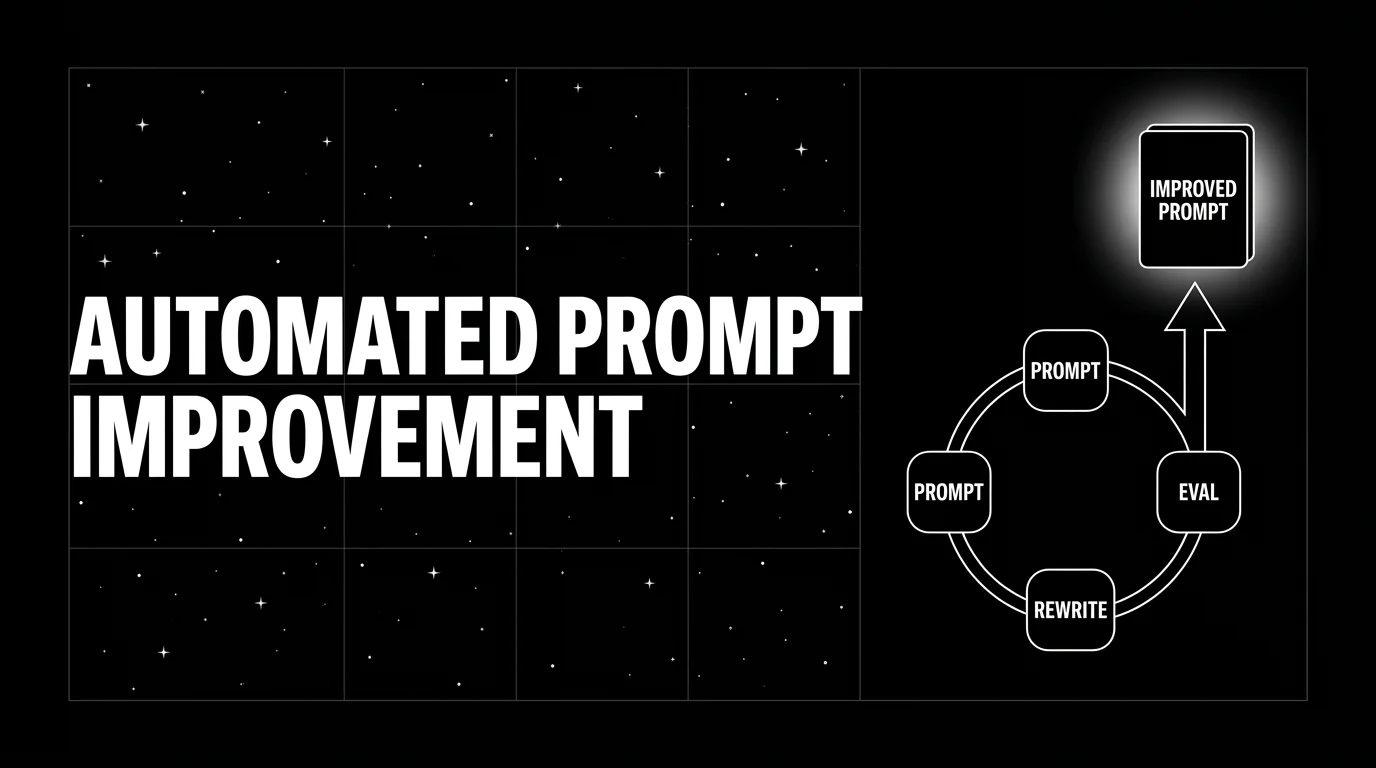
Automated prompt improvement in 2026 with six named optimizers (ProTeGi, GEPA, PromptWizard, MetaPrompt, BayesianSearch, RandomSearch) wired into CI.

Top 10 prompt optimization tools in 2026 ranked: FutureAGI, DSPy, TextGrad, PromptHub, PromptLayer, LangSmith, Helicone, Opik, DeepEval, Prompt Flow.
