Automatic Prompt Optimization in 2026: How Textual Gradients, Genetic Search, and Meta-Prompts Actually Work
Automatic prompt optimization explained: textual gradients (ProTeGi), score trajectories (OPRO), genetic evolution (GEPA), meta-prompting, and how to pick one.
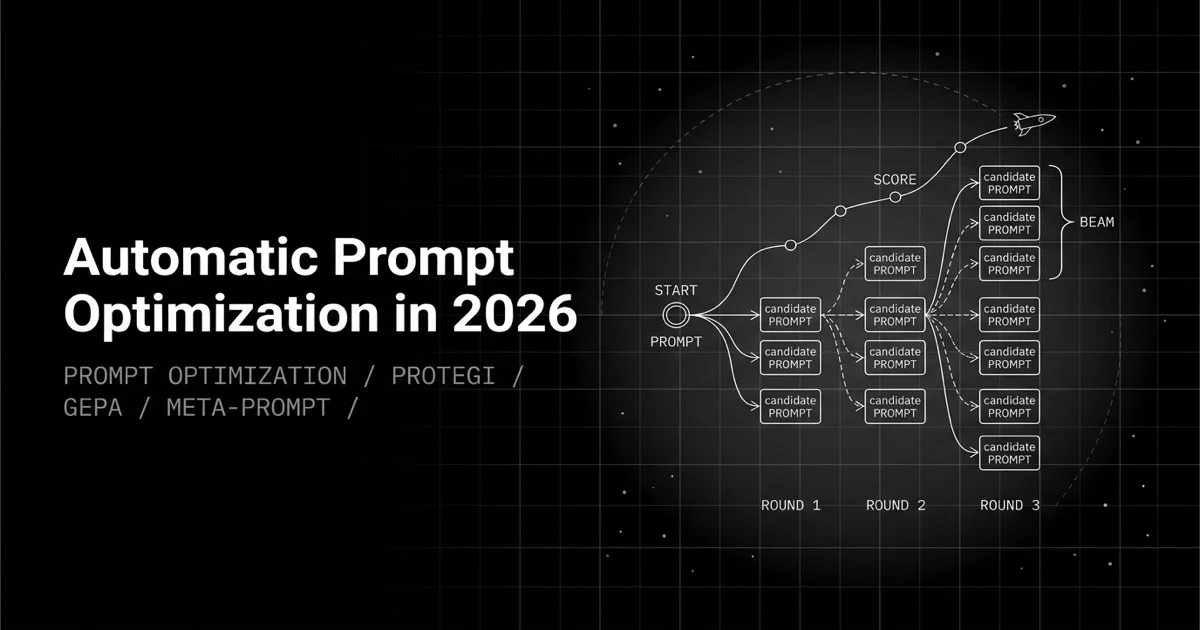
Table of Contents
Originally published May 29, 2026.
You change one line of the system prompt, run it against the same five examples you always check, eyeball the outputs, and ship. A week later a different five examples regress, and you cannot remember whether the line you added in March is what broke them. There is no gradient, no record, no signal. Just you, a text box, and a hunch.
That loop is where most prompt work still lives in 2026. It is also exactly the loop that automatic prompt optimization replaces. This post is the algorithm-level guide: what a textual gradient actually is, how genetic and meta-prompt optimizers differ, when each one wins, and a matrix for picking one. We will keep it at the level of how the methods work, with the papers linked, so you can reason about them rather than treat them as a black box.
What Is Automatic Prompt Optimization?
Automatic prompt optimization (APO) is a search algorithm, scored by an evaluator, that rewrites a prompt without a human editing the words. The optimizer proposes candidate prompts, runs them against a dataset, scores each candidate with a metric or an LLM judge, and keeps the variants that score higher. Over several rounds the prompt converges toward higher measured performance. The defining move is the scoring function: you define what good means once, as an eval, and the algorithm does the editing.
That last clause is the whole idea. Prompt engineering optimizes against your intuition; automatic prompt optimization optimizes against a number you wrote down. The four families below differ only in how they search the space of prompts and how they turn eval results into the next candidate.
Why Does Manual Prompt Tuning Stop Scaling?
Manual tuning is the right tool for the first draft and for framing the task. It breaks down on three axes, and all three are about measurement, not about writing skill. We argued the scaling case in prompt optimization at scale; here is the short version.
- You cannot eyeball at scale. A human reviews five outputs and forms an opinion. At five hundred cases across a dozen edge categories, eyeballing is sampling bias with extra steps. The cases you remember to check are the cases you already fixed.
- You have no memory of the search. Every prompt edit is a point in a space you are exploring blind. Without a logged score per candidate, you re-introduce changes you already disproved and chase regressions you cannot attribute.
- You optimize one dimension at a time. Tighten the prompt for faithfulness and it gets verbose. Trim for conciseness and it drops a safety caveat. A human juggling four objectives in their head picks the one they looked at last.
Automatic optimization fixes all three by making the score the unit of work. Candidates are scored, logged, and ranked, so the search has a memory and a direction. The rest of this post is the strategies that give it direction.
How Do Textual Gradients and Score Trajectories Work? (ProTeGi and OPRO)
A gradient, in normal training, is the direction that reduces loss. You cannot backpropagate through a prompt made of words, so textual-gradient methods do the next best thing: they ask a language model to describe, in English, why the prompt failed, and treat that description as the direction of improvement. OPRO takes a related but distinct route, optimizing from the score curve rather than from per-example critiques. Both are covered here because teams reach for them in the same situation.
ProTeGi (Pryzant et al., 2023) is the cleanest version. The loop has four moves:
- Find errors. Run the current prompt over a sample, keep the examples that score below a threshold.
- Compute the gradient. Send those failing examples to a teacher model and ask for a short list of distinct critiques: why did this prompt produce these failures? Each critique is a textual gradient.
- Apply the gradient. For each critique, ask the model to rewrite the prompt so the critique no longer applies. This is the “step” in the gradient-descent analogy.
- Beam search. Score all candidates, keep the top few, and repeat. The beam stops the search from collapsing onto one local fix.
OPRO (Google DeepMind, 2023) reaches the same goal from a different angle. Instead of critiquing individual failures, it shows the optimizer a trajectory of past prompts paired with their scores and asks it to write a prompt that beats the curve. The score history is the signal. OPRO is simpler to run and famously rediscovered “take a deep breath and work on this step by step” as a high-scoring instruction. ProTeGi is more surgical because it points the model at specific failing rows.
Use textual gradients when you have a single prompt, a clear eval, and failure modes that an LLM can articulate. They are the most interpretable family: you can read the critiques and see what the optimizer thinks is wrong.
How Does Genetic and Evolutionary Optimization Work? (GEPA)
Textual gradients follow one improving direction. Evolutionary methods keep a whole population and let variation plus selection do the searching, which matters when the landscape is bumpy and a single direction gets stuck.
GEPA (Genetic-Pareto) is the 2025 method worth knowing. It works in three repeating phases:
- Population. Hold several candidate prompts at once, not one.
- Reflective mutation. Run candidates, capture execution traces and eval feedback, and use reflection on those traces to propose mutated prompts. The mutation is informed by what actually happened, not random edits.
- Pareto selection. Select survivors on a Pareto front across multiple objectives rather than one averaged score. A prompt that is best on faithfulness and a different prompt that is best on conciseness both survive.
That Pareto step is the reason to reach for GEPA. The moment you have more than one thing you care about, averaging them into a single number throws away information early, and the optimizer converges on a bland compromise. Keeping the front means you end the run with a set of prompts that are each best at something, and you choose the trade-off after seeing the options. The GEPA paper also reports strong sample efficiency, reaching good prompts in far fewer rollouts than reinforcement-style tuning.
Use evolutionary optimization for multi-objective problems, multi-module pipelines, and cases where textual gradients plateau.
How Does Meta-Prompting Work?
Meta-prompting is the most direct family: a strong teacher model is handed the current prompt, the examples it got wrong, and the prompts it already tried and that scored worse, then asked to diagnose and rewrite.
The structure that makes it work is the memory of failed attempts. Without it, the teacher proposes the same plausible rewrite every round. With it, the prompt becomes: here is the current prompt, here are previous attempts that scored worse, here are the low-scoring examples, now state a hypothesis and produce a complete new prompt.
The hypothesis step is the trick. It forces the model to commit to a theory (“adding a chain-of-thought instruction will fix the multi-step cases”) before it writes, which makes the rewrite less of a shot in the dark.
Meta-prompting shines when failures are conceptual rather than surface-level: the prompt is missing an instruction, conflating two tasks, or under-specifying the output format. It is a reasoning step, not a search over many candidates, so it is cheaper per round but explores less breadth than a beam or a population.
Which Prompt Optimization Technique Should You Use?
Here is how the four production families compare on the axes that decide a run.
| Technique | Improvement signal | Search strategy | Best for | Cost profile |
|---|---|---|---|---|
| Textual gradients (ProTeGi) | LLM critique of failing examples | Beam search over rewrites | Single prompt, articulable failures | Medium, interpretable |
| Score-trajectory (OPRO) | History of prompts and scores | Optimizer reads the curve | Quick single-prompt lift | Low, simple |
| Genetic (GEPA) | Reflection on traces and feedback | Population, Pareto front | Multi-objective, pipelines | Higher, multi-metric |
| Meta-prompting | Diagnosis plus attempt memory | Single reflective rewrite per round | Conceptual prompt gaps | Low per round |
Few-shot exemplar selection (picking and ordering the in-context examples) is a complementary pass, not a fifth family: you stabilize the instruction with one of the methods above, then run a second search to pick the examples that sit best around it. For a tool-by-tool view rather than a method-by-method one, see our roundup of prompt optimization tools.
Which Optimizer Fits Your Problem? The Prompt Optimizer Selection Matrix
When teams ask which optimizer to start with, the answer is decided by three questions, not by which algorithm is newest. We call this the Prompt Optimizer Selection Matrix.
- One prompt or a pipeline? A single classifier or extractor prompt points to ProTeGi or OPRO. A multi-step agent or RAG pipeline with several prompts points to GEPA, which evolves the system rather than one string.
- One metric or many? A single accuracy number is happy with textual gradients. Two or more objectives that trade off (faithfulness versus length, helpfulness versus safety) want GEPA’s Pareto front so you do not average away the trade-off.
- Surface failure or conceptual gap? If you can read the failing outputs and name the missing instruction, meta-prompting fixes it in a round or two. If the failures are diffuse and you cannot articulate them, let textual gradients mine the critiques for you.
The matrix in one line: single prompt and single metric, start with ProTeGi; conceptual gap you can name, meta-prompt; pipeline or multi-metric, GEPA. Run the cheap one first, and escalate only when it plateaus.
How Do You Run Automatic Prompt Optimization in Production?
Reading about optimizers is not running them. The production gap is plumbing: you need an optimizer, a generation model, an evaluator that returns a score, a dataset, and a place to store the history of what was tried. Future AGI’s agent-opt SDK ships that wiring with ProTeGi, GEPA, and meta-prompt optimizers behind one interface, scored by the same 50+ evaluators Future AGI uses for evals, and backed by LiteLLM so any of 100+ models can be the generator or the teacher.
from fi.opt.optimizers import ProTeGi
from fi.opt.generators import LiteLLMGenerator
from fi.opt.base.evaluator import Evaluator
from fi.opt.datamappers.basic_mapper import BasicDataMapper

# the teacher model that writes the critiques and the rewrites
teacher = LiteLLMGenerator(model="gpt-4o", prompt_template="{prompt}")

# your scoring metric, plus a mapper from outputs to the eval's input keys
evaluator = Evaluator(metric=your_metric)              # a Future AGI metric object
data_mapper = BasicDataMapper(key_map={"output": "output", "expected": "expected"})

optimizer = ProTeGi(
    teacher_generator=teacher,
    num_gradients=4,        # critiques per failing batch
    errors_per_gradient=4,
    beam_size=4,            # candidates kept each round
)

result = optimizer.optimize(
    evaluator=evaluator,
    data_mapper=data_mapper,
    dataset=test_cases,                            # list of {input, expected} dicts
    initial_prompts=["You are a helpful assistant."],
)

print(result.best_generator.prompt_template)   # the winning prompt
print(result.final_score)                       # measured, not guessed
print(result.total_evaluations)                 # what the run cost
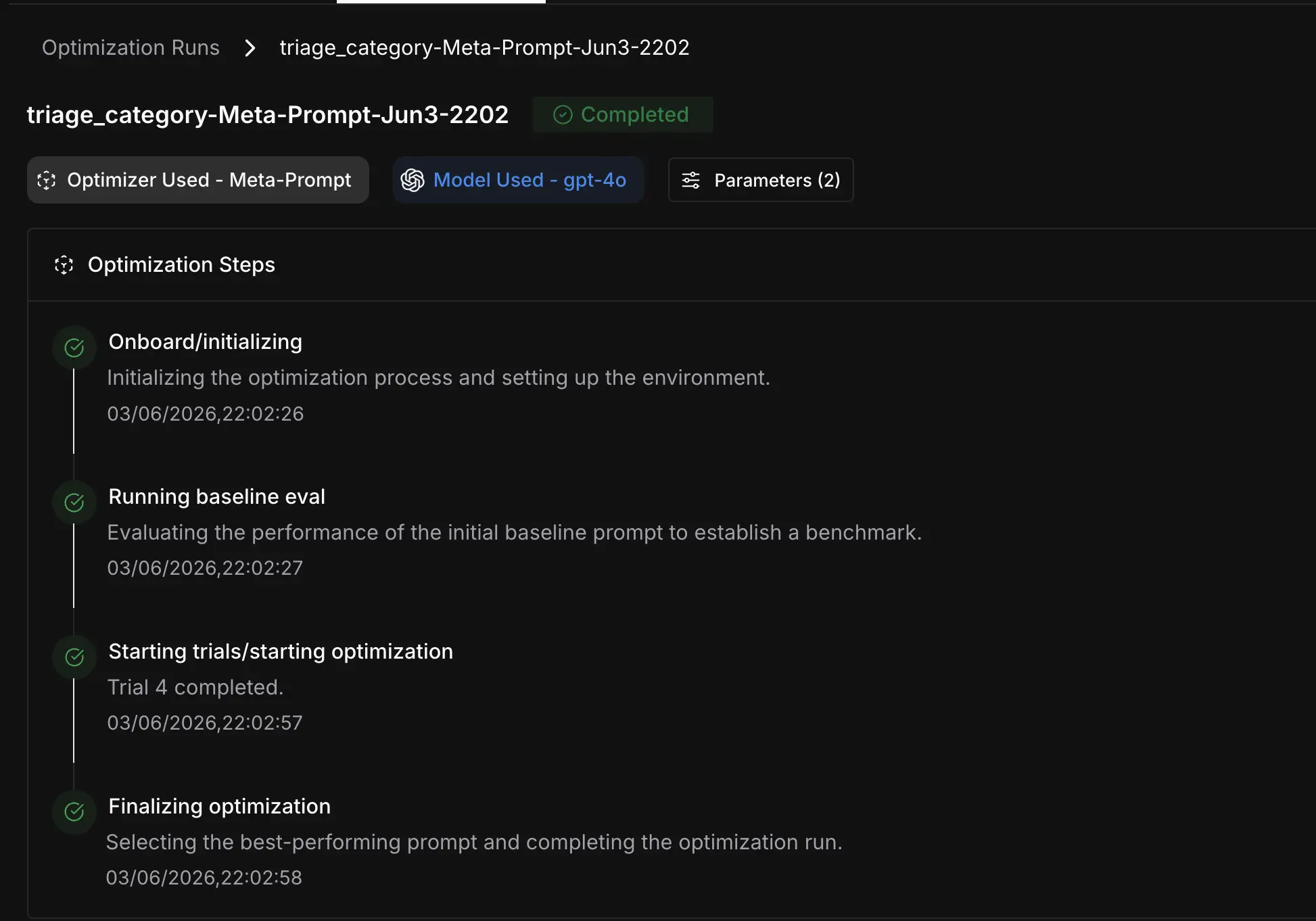
Two things make this production-grade rather than a notebook demo. First, OptimizationResult carries the full history of every candidate and its score, so the search has the memory manual tuning lacks. Second, EarlyStoppingConfig halts the run when the score plateaus and reports stop_reason, so you are not paying for rounds that no longer move the metric.
The pattern that ships: wire the optimizer to the same eval you already run in CI, trigger it on prompt changes or on a schedule, and gate the new prompt on a measured lift over the incumbent. Because the optimizer and the evaluator share one stack, the score that picks the winner is the score you monitor in production, not a separate offline proxy. If that scorer is an LLM judge, calibrate it first with our LLM-judge prompt engineering guide, since the optimizer will faithfully maximize whatever the judge rewards.
Where It Falls Short
- It optimizes wording, not framing. If the task is decomposed wrong or the prompt is missing the context the model needs, no optimizer will rescue it. Fix the framing first, then optimize.
- It is only as good as the scorer. A biased or vague evaluator produces a prompt that games the evaluator. Calibrate the eval before you trust the optimization.
- It is not free. You are spending teacher-model and generation calls. Budget it like a CI job, use early stopping, and keep the eval subset small enough to iterate.
Is Automatic Prompt Optimization Worth Adopting?
The shift in 2026 is not a new prompt trick. It is treating the prompt as something you search rather than something you write, with an eval as the objective. If you are still writing prompts by hand, our prompt engineering primer is the place to start before you automate it.
Textual gradients turn failures into a direction, evolution keeps a population and a Pareto front, and meta-prompting reasons about what is missing. The hard part was never the algorithm. It was the loop around it: a trustworthy evaluator, a dataset, a memory of every candidate, and a gate on measured lift.
Ready to optimize a prompt against a real eval instead of a hunch? Start with Future AGI’s optimization docs and point a ProTeGi or GEPA run at the eval you already have.
Frequently Asked Questions
What is automatic prompt optimization?
What is the difference between OPRO and ProTeGi?
What is GEPA prompt optimization?
Is automatic prompt optimization better than manual prompt engineering?
Do I need a labeled dataset to optimize a prompt?
How much does automatic prompt optimization cost to run?
Manual prompt tuning fails past 50 variants. Compare Future AGI, Promptfoo, LangSmith, and Datadog for 2026 automated prompt optimization at scale.

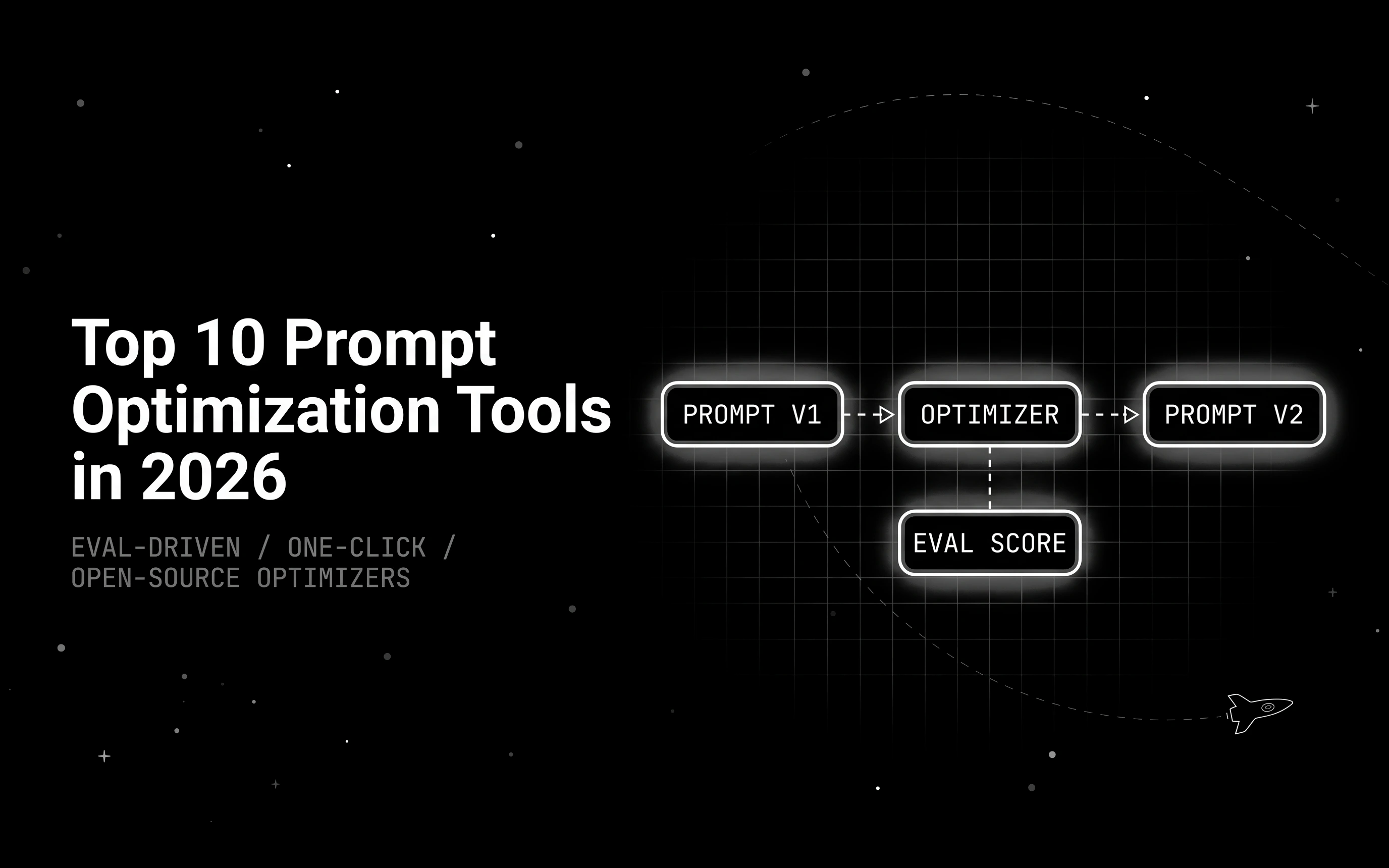
Compare the best prompt optimization tools for 2026, from Future AGI and DSPy to Opik and DeepEval, by algorithm, eval loop, tracing, license and team fit.

What prompt engineering means in 2026 after Bayesian, GEPA, and ProTeGi optimizers. Anatomy, techniques, tools, and where hand-tuning still earns its keep.