Table of Contents
-
Introduction
In 2025, autonomous AI agents can communicate with one another through A2A and connect to various data sources and tools using MCP.
To the developers out there: how are you planning to build the self-managed agent networks?
Using autonomous AI agents, complex, multi-agent ecosystems are replacing separate processes.
These days, they manage operations in real time, trading context and status to address more important issues than any one agent could manage. Teams of agents are being sent by companies across multiple fields, including operations and marketing, to automate whole processes free from ongoing human control.
This transition requires protocols that standardize agent access to data sources (MCP) and inter-agent communication (A2A) across platforms.
Model Context Protocol provides the final solution for interfacing with databases, APIs, and applications without need for unique coding.
Agent2Agent enables communication, context sharing, and collaboration among agents across many platforms.
Organizations require both seamless tool integration (MCP) and inter-agent cooperation (A2A) to enhance agentic solutions. Large-scale deployments depend on both to prevent inefficiencies and platform and team fragmentation.
But what’s the difference between MCP and A2A protocols, when to use them. Let’s find out.
-
MCP - Developed by Anthropic
Model Context Protocol (MCP) is a client-server protocol designed by Anthropic to present structured data and tools to LLMs using standardized JSON-RPC and REST-like interfaces. It gives agents a consistent way to find and call methods, which cuts down on the need for special interaction code. MCP uses JSON-RPC 2.0 messages via HTTP (or other transports) to transmit method calls, arguments, and results between LLM-powered clients and external servers.
2.1 Core Components
- MCP Server: Hosts endpoints that provide access to data sources, APIs, or toolchains; manages authentication and rate-limiting to ensure secure and regulated access to functionalities.
- MCP Client: An application or agent driven by a large language model interacts with the server’s JSON schema to negotiate supported methods and calls tool endpoints to enhance model responses.
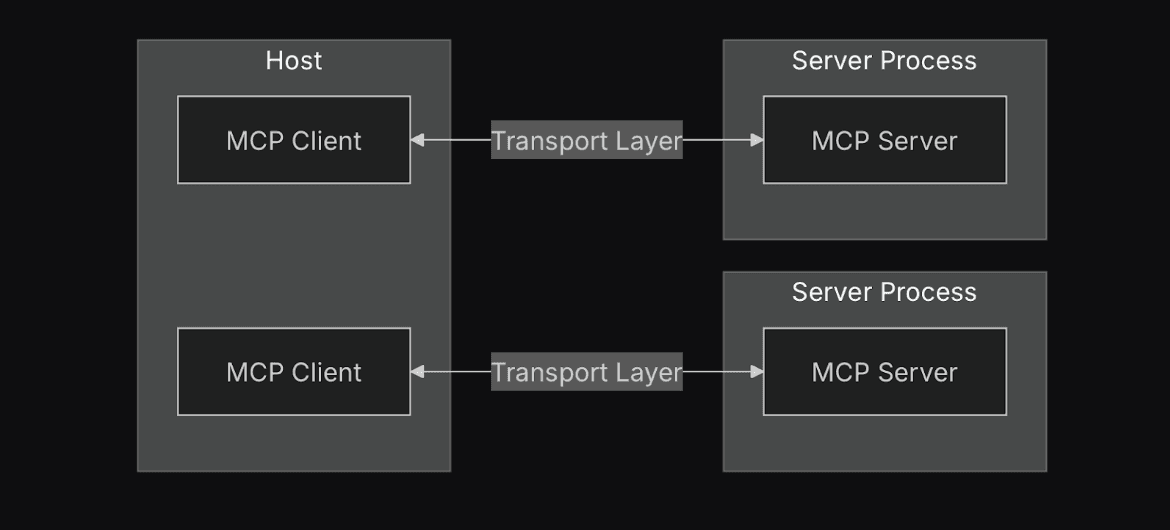
Figure 1: MCP Core Components: Source
2.2 Communication Flow
- Schema Discovery: Before starting any calls, the client searches the JSON schema of the server-e.g., schema.ts-to find accessible methods, arguments, and return types.
- Request Construction: Using JSON-RPC, the client generates a prompt including contextual metadata after specifying the intended method and parameters, so requesting either completion or generation.
- Execution and Response: The server executes approved actions (e.g., SQL queries, file reads) which the client then passes to the LLM for additional processing either structured or unstructured.
2.3 Key Features and Extensions
- Model-Agnostic: Working at the protocol level instead of with model-specific SDKs, Model-Agnostic works with any LLM API including OpenAI, Anthropic Claude, Google Gemini, and more.
- Secure Two-Way Links: Without giving consumers access to API keys, Secure Two-Way Links lets servers control rights and rate limitations. Rather, they control every method call with capable tokens.
- SDK Support: Official SDKs for Python, TypeScript, C#, Java, and other languages include high-level abstractions for schema loading, request signing, and transport configuration.
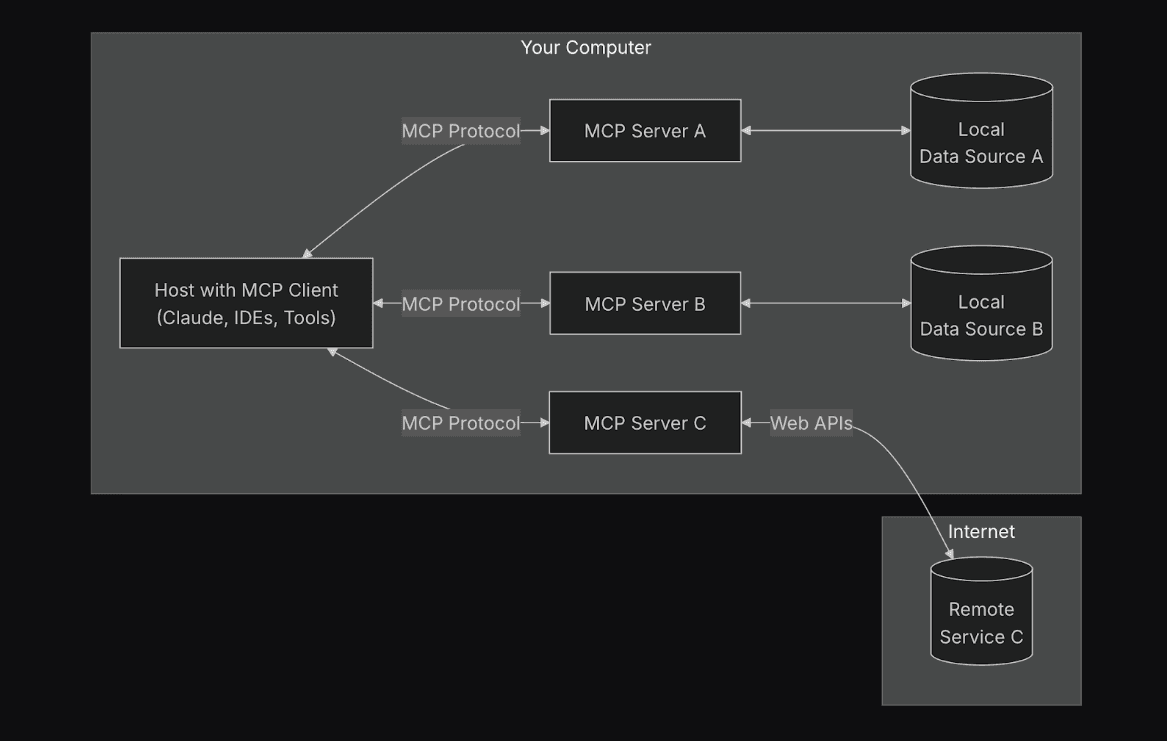
Figure 2: MCP architecture: Source
-
A2A - Developed by Google
Agent2Agent (A2A) is a peer-to-peer protocol developed by Google which enabling discovery, secure communication, and task management across diverse AI agents. It allows any agent to be a client or server, enabling cross-platform communication.
3.1 Core Primitives
- Agent Card: A publicly accessible JSON file (e.g., /.well-known/agent.json) that specifies an agent’s name, skills, endpoints, and authentication prerequisites, enabling peers to understand the activities it can do.
- Tasks & Messages: A2A defines tasks/send for single tasks, tasks/sendSubscribe for enduring workflows with progress events, along with generic message and artifact structures which enable data interchange and process status coordination.
3.2 Communication Patterns
- Discovery: Agents get peer Agent Cards by an HTTP GET request at
https://<agent-domain>/.well-known/agent.json, according to the RFC 8615 standards for “well-known” URIs. - Task Negotiation: To get task updates, a client agent sends a task/send JSON-RPC call to a peer and follows status updates over SSE (tasks/sent).
- Artifact Exchange: When an agent’s work is completed or at a stop, it generates artifacts-organized outputs like JSON payloads or file URIs. Then peers acquire these relics to carry on the process or exhibit the findings.
3.3 Core Design Principles
- Framework: Independent: A2A is based on HTTP(S), JSON-RPC 2.0, and SSE thus it can be used with any technology stack without being locked into one provider.
- Capability Discovery: Agents use information in the Agent Card to highlight their available skills and negotiating techniques, so facilitating dynamic matching between job requirements and qualified colleagues.
- Security & Auth: The protocol supports OAuth2, API keys, and mutual TLS (mTLS) for reciprocal authentication in addition to scoped tokens that limit each agent’s capabilities method-specifically.
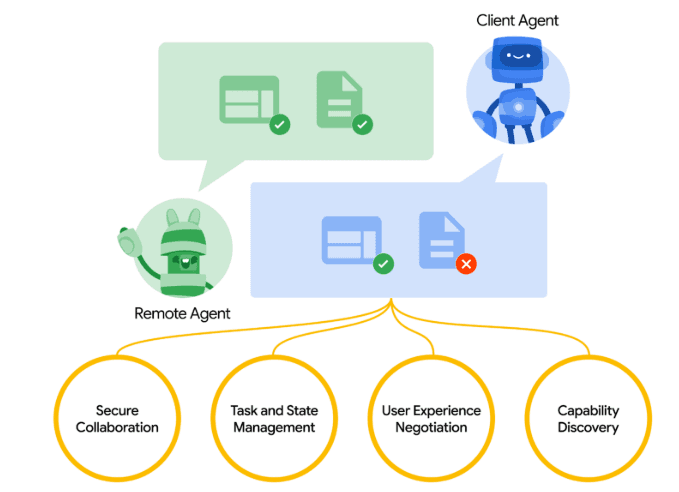
Figure 3: A2A Protocol: Source
-
Side-by-Side Comparison Matrix
| Dimension | MCP | A2A |
| Primary Focus | Tools and data access for LLMs | Agent-to-agent communication & coordination |
| Protocol Style | Client-Server (JSON-RPC / REST-like) | Peer-to-peer (HTTP/SSE + JSON-RPC) |
| Discovery Mechanism | Static server schemas (via JSON schema) | Agent Cards via /.well-known/agent.json |
| Security Model | Server-controlled permissions (capability tokens) | Mutual agent auth (OAuth2, API keys, mTLS) |
| Use Cases | Data retrieval, function calls, toolchains | Workflow orchestration, multi-agent workflows |
| Adoption Status | Supported by Anthropic, OpenAI, Google DeepMind, Microsoft | Backed by Google Cloud, Atlassian, LangChain, ServiceNow, Microsoft |
| Performance | Latency bound by server response times | Overhead from task/state streaming and eventing |
Table 1: MCP Vs A2A
-
MCP vs A2A: When to Use What
Use MCP When
- Requires Tight Control and Audit Trails: MCP is ideal in environments where traceability, control, and tracking are extremely critical. Every action an AI agent does is logged, allowing simple choice tracking and evaluation. For industries like banking or healthcare where responsibility is non-negotiable, MCP is therefore very appropriate.
- Needs Dynamic Tool Selection or Compliance Checks: MCP excels in scenarios requiring real-time tool selection or the enforcement of compliance protocols. A legal technology platform enables an agent to select the appropriate compliance checker or contract template based on local regulations. MCP lets agents dynamically call the right tool for the task, ensuring legal and business compliance.
- Needs Single-Agent Decision-Making with Strong Memory: MCP’s context management shines if a job calls for one agent to oversee a multi-step process while remembering context-like a customer support case spanning several interactions. It records past details (preferences, past problems, resolutions) so the agent maintains continuity and never loses important information.
Use A2A When
- Involves Multiple Agents from Different Vendors or Platforms: A2A excels when you need specialized agents from different vendors to interact naturally. A2A lets them share data and coordinate across platforms; in enterprise IT, one agent might handle helpdesk tickets, another tracks incidents, and a third monitors network health.
- Requires Coordination Between Specialized Agents: A2A uses structured communications and task orchestration to let agents know their roles and time when working on distinct parts of a task, such as inventory tracking, shipping logistics, and demand forecasting in supply chain management. These agents exchange communications and artifacts to ensure that their operations are uninterrupted.
- Involves Long or Multi-Step Tasks: A2A supports long-running tasks with real-time updates via Server-Sent Events and artifact exchange for handoffs for processes spanning hours or days-like a product development pipeline where market research, prototyping, and testing are handled by different agents. This ongoing communication ensures that every agent picks up exactly where the last left off, so preserving progress visibility all through the lifetimes.
Popular MCP Servers
These pre-built MCP servers can help you test and launch quickly if you need to:
- DataWorks: Provides dataset exploration and cloud resource management via MCP by letting AI access the DataWorks Open API.
- Kubernetes with OpenShift: MCP Server interfaces with OpenShift clusters and provides CRUD capabilities for Kubernetes resources.
- Langflow- DOC-QA-SERVER: Leveraging fundamental MCP capabilities, uses a Langflow backend to enable document-centric question answering.
- Lightdash MCP Server: Lets agents access analytical insights straight from MCP by querying BI dashboards.
- Linear MCP Server: Integration of LLMs with project management techniques by a linear MCP server helps to enable automated problem monitoring and changes.
- mcp-local-rag: Beneficial for privacy-centric processes, mcp-local-rag performs a local RAG-style search without using external APIs.
A2A Protocols
Google shows A2A in action if you want reference implementations or start fast:
- Google A2A Protocol: Supported by over 50 partners, Google A2A Protocol is a formal open-standard reference implementation managed by Google Cloud.
Conclusion
Together, MCP and A2A create the backbone of next-generation agentic artificial intelligence, allowing both contextual power and cooperative scale. MCP offers organized tool invocation and context management that enables auditability and dynamic tool access, so empowering single-agent processes. A2A provides scalable multi-agent systems across vendors and platforms by means of peer-to-peer discovery and secure messaging.
Strategic adoption of every protocol - or a combined approach - will make all the difference between adaptable, enterprise-grade agentic ecosystems in 2025 and beyond and static AI assistants. By means of both protocols, companies can chain contextual richness with collaborative breadth, so enabling end-to-end automation across finance, healthcare, supply chains, and IT operations.
FAQs
Q1: What is the Model Context Protocol (MCP)?
MCP is an open client-server protocol that enables LLM-powered apps to identify and use external tools or data sources over a standardized JSON-RPC interface over HTTP. It offers built-in authentication controls, session management, and organized context exchanges so agents may log and audit each action.
Q2: What is the Agent2Agent (A2A) protocol?
A2A is a peer-to-peer protocol that allows AI agents to locate one another using “Agent Cards” and thereafter exchange tasks, messages, and artifacts using HTTP and Server-Sent Events. It supports long-running processes, real-time coordination, and safe mutual authentication between heterogeneous agents.
Q3: When should I use MCP vs A2A?
MCP is common in finance, healthcare, and legal technology, used for single-agent procedures that need stringent control, dynamic tool selection, and detailed audit trails. When you need several specialized agents from different platforms to coordinate long- or multi-stage tasks in peer-to-peer fashion, choose A2A.
Q4: How do MCP and A2A ensure security and compliance?
MCP servers ensure every call is logged and traceable by enforcing permissions and rate limits using scoped tokens, so API keys never reach consumers. A2A exchanges secure messages between agents using enterprise-grade solutions including OAuth2, API keys, or mutual TLS for mutual authentication.
Related Articles
View all
Agentic UX: Building AI-Native Interfaces
Master Agentic UX with AG-UI protocol. Learn to design AI-native interfaces for seamless agent interactions. Build real-time, collaborative AI experiences.

The Ultimate Voice AI Evaluation Framework: Lead or Bleed
Optimize Voice AI testing with an AI-powered Voice Agent Simulator. Remove human testers, uncover edge cases early, and shrink testing cycles for production-ready voice agents.

MarTech 2.0: The GenAI Revolution
Discover GenAI in MarTech 2.0: predictive marketing, data intelligence layers, and secure Generative AI frameworks for scalable, trustworthy marketing tech.