Webinars

Agentic UX in 2026: How to Build AI-Native Interfaces Using the AG-UI Protocol

Master Agentic UX with AG-UI protocol. Learn to design AI-native interfaces for seamless agent interactions. Build real-time, collaborative AI experiences.

·
5 min read
agents webinars
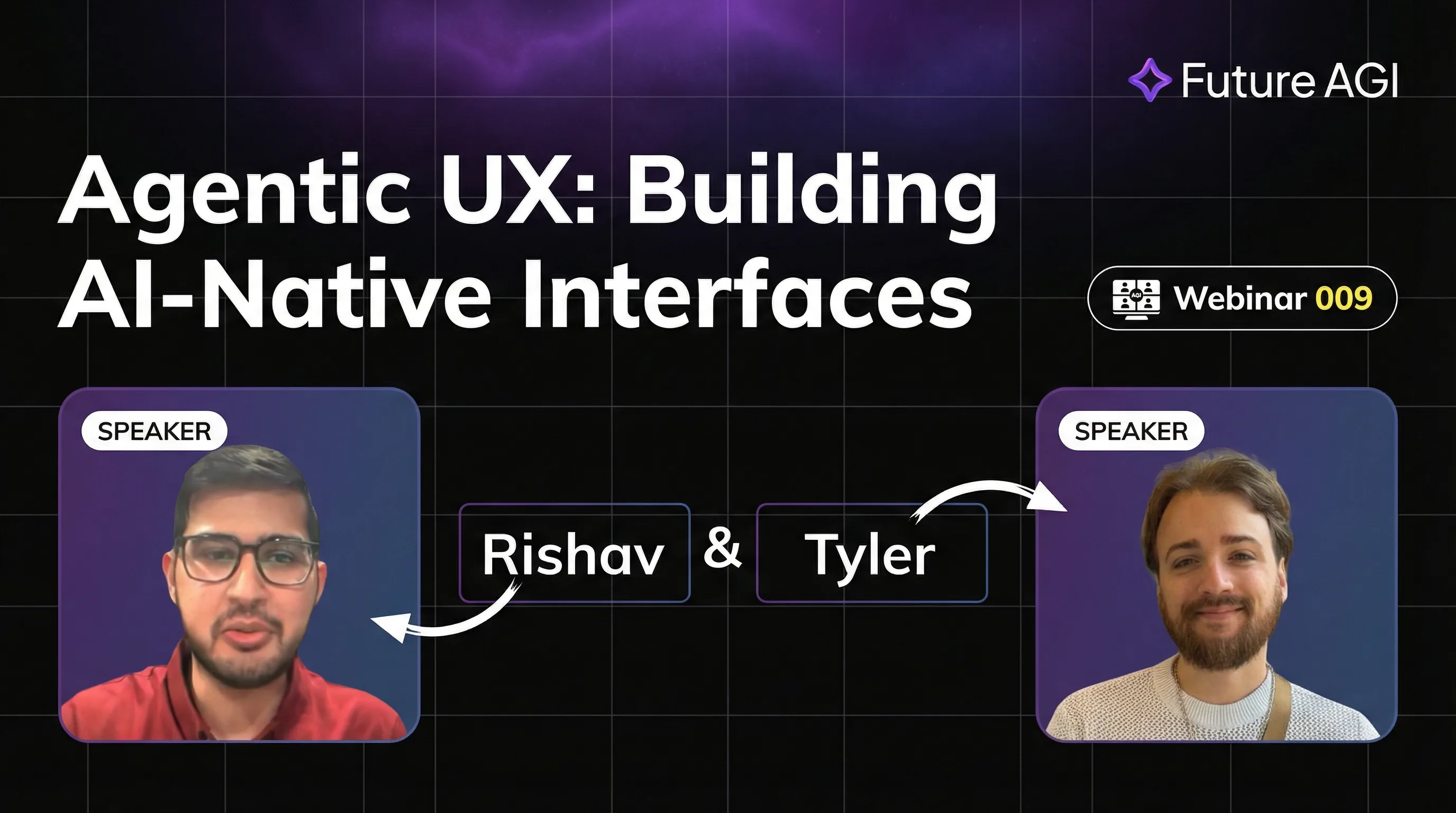
Agentic UX: Building AI-Native Interfaces
Table of Contents

Watch the Webinar

AI agents are reshaping how users interact with software, but traditional UI patterns can’t keep up.

Why Traditional UI Patterns Fail for AI Agents: Designing AI-Native Interfaces

Traditional UI assumes discrete actions, synchronous responses, and static state — none of which match how AI agents actually behave. An agent might take dozens of sequential steps, pause to request human input, stream partial results, or fork into parallel sub-tasks. Each of these behaviors demands UI primitives that simply don’t exist in component libraries built for CRUD applications. “Agentic UX” reframes the interface around continuous, real-time collaboration between humans and AI, creating experiences that feel natural rather than forced. This talk explores that shift through the lens of AG-UI, an open protocol that standardizes how agents communicate with front-end interfaces. Rather than retrofitting AI into existing UI patterns, Agentic UX means designing AI-native interfaces from the ground up — starting with the event model, not the component library.

Built for Product Designers, AI Engineers, and Frontend Developers Shipping Agent-Powered Apps

This webinar is designed for practitioners actively shipping agent-powered applications in 2026. Product designers will gain a new mental model for AI-first interaction design, including patterns for progressive disclosure of agent reasoning and graceful degradation during tool failures. AI engineers will learn how AG-UI’s event-driven architecture maps cleanly onto LangGraph, CrewAI, and Mastra, enabling consistent front-end integration regardless of which orchestration framework powers the backend. Frontend developers will see concrete implementation examples — handling RunStarted, TextMessageStream, and ToolCallStart events from a single normalized stream. Technical founders will understand how a vendor-neutral protocol de-risks agent infrastructure choices and accelerates time-to-production. No prior knowledge of AG-UI is required; a working understanding of React or a similar UI framework is sufficient to follow along.

AG-UI Event Model, Streaming Interactions & Multi-Agent Workflow Patterns Explained

The webinar walks through the full AG-UI event lifecycle and how it maps to real interface states. By the end, attendees will have both the mental model and the implementation patterns to ship production-quality agentic interfaces.

  • Understand how Agentic UX differs from conventional design paradigms and why the gap is widening in 2026
  • Master the AG-UI event model: run lifecycle events (RunStarted, RunFinished, RunError), message streaming (TextMessageStart, TextMessageContent, TextMessageEnd), and tool call events (ToolCallStart, ToolCallArgs, ToolCallEnd)
  • Learn patterns for building intuitive, AI-native interfaces — progress indicators for long-running agents, inline tool call visibility, and shared state displays
  • Discover vendor-neutral messaging that enables interoperability across LangGraph, CrewAI, Mastra, and custom orchestration frameworks
  • See real-world examples of AG-UI powering multi-agent, human-in-the-loop workflows with generative UI components
  • Leave with practical integration guidelines, a clear mental model for AI-first experiences, and reference implementation code

What Is Agentic UX and Why It Replaces Static Interface Design in 2026

Traditional interfaces assume static workflows and predetermined actions — a user clicks a button, a response arrives, the cycle repeats. Agentic UX breaks that model entirely: AI agents are long-running, stateful, and capable of initiating action without direct user input. The AG-UI protocol addresses this by defining a standard event stream that covers the full lifecycle of agent execution — run lifecycle events signal when work starts and ends, message streaming events deliver partial text as it generates, tool call events expose what the agent is doing in real time, and state delta events keep shared UI state synchronized without polling. By normalizing these events across frameworks, AG-UI lets you build a single reusable interface layer that works whether the agent backend is LangGraph, CrewAI, or a custom orchestrator. The result is an interface that streams, adapts, and responds in real-time — rather than freezing while waiting for a complete response.

Visit Future AGI

Frequently Asked Questions About Agentic UX and the AG-UI Protocol

What is the AG-UI protocol and how does it differ from other agent communication standards?

AG-UI is an open, vendor-neutral protocol that standardizes the event stream between an AI agent backend and a front-end interface. Unlike MCP (Model Context Protocol), which governs how agents access tools and data sources, AG-UI focuses specifically on the UI layer — defining events for message streaming, tool call visibility, run lifecycle, and shared state synchronization. This separation means you can use AG-UI alongside MCP or any other orchestration standard without conflict. Because the event schema is framework-agnostic, a single AG-UI-compliant front-end works with LangGraph, CrewAI, Mastra, or a custom Python orchestrator without modification.

How does Agentic UX improve user trust in AI-powered applications?

Trust in agentic systems breaks down when users can’t tell what the agent is doing or why. Agentic UX addresses this directly by surfacing tool calls, intermediate reasoning steps, and state changes in the interface as they happen — rather than showing a spinner and delivering a final answer. When users can see that an agent called a search API, retrieved three documents, and then synthesized a response, they understand the basis for the output and can catch errors early. AG-UI’s ToolCallStart and ToolCallEnd events make this transparency straightforward to implement without custom back-end instrumentation.

Which frameworks are compatible with AG-UI in 2026?

AG-UI is designed to be framework-agnostic. Official SDKs and integration guides cover LangGraph, CrewAI, and Mastra on the backend, with React as the primary front-end reference implementation. Because the protocol is built on a normalized event stream (typically over SSE or WebSockets), any agent framework that can emit structured events can be made AG-UI-compatible with a thin adapter layer. The webinar covers the adapter pattern in detail so teams using custom orchestration can still benefit from AG-UI-compliant front-end components.

Is this webinar suitable for teams just starting with AI agents?

Yes. The webinar assumes a working knowledge of front-end development (React or equivalent) but no prior experience with AG-UI or agentic systems. The session starts from first principles — explaining why traditional UI fails for agents — before moving into protocol specifics and implementation patterns. Teams in the early stages of building agent-powered features will get the most value from the mental model sections, while teams already shipping agents will benefit most from the implementation patterns and the framework interoperability walkthrough.

Related Articles
View all
MarTech 2.0: The GenAI Revolution
Guide

Watch the MarTech 2.0 GenAI webinar with Future AGI. Covers predictive data layers, hyper-personalization, synthetic data, adaptive AI agents, evaluation.

Rishav Hada
Rishav Hada ·
1 min
Stay updated on AI observability

Get weekly insights on building reliable AI systems. No spam.