LLM Leaderboard Rankings vs Real Use: 5 Measured Gaps
A high LLM leaderboard rank often fails to predict your results. Five measured reasons rankings and real-world quality come apart, with the studies behind each.
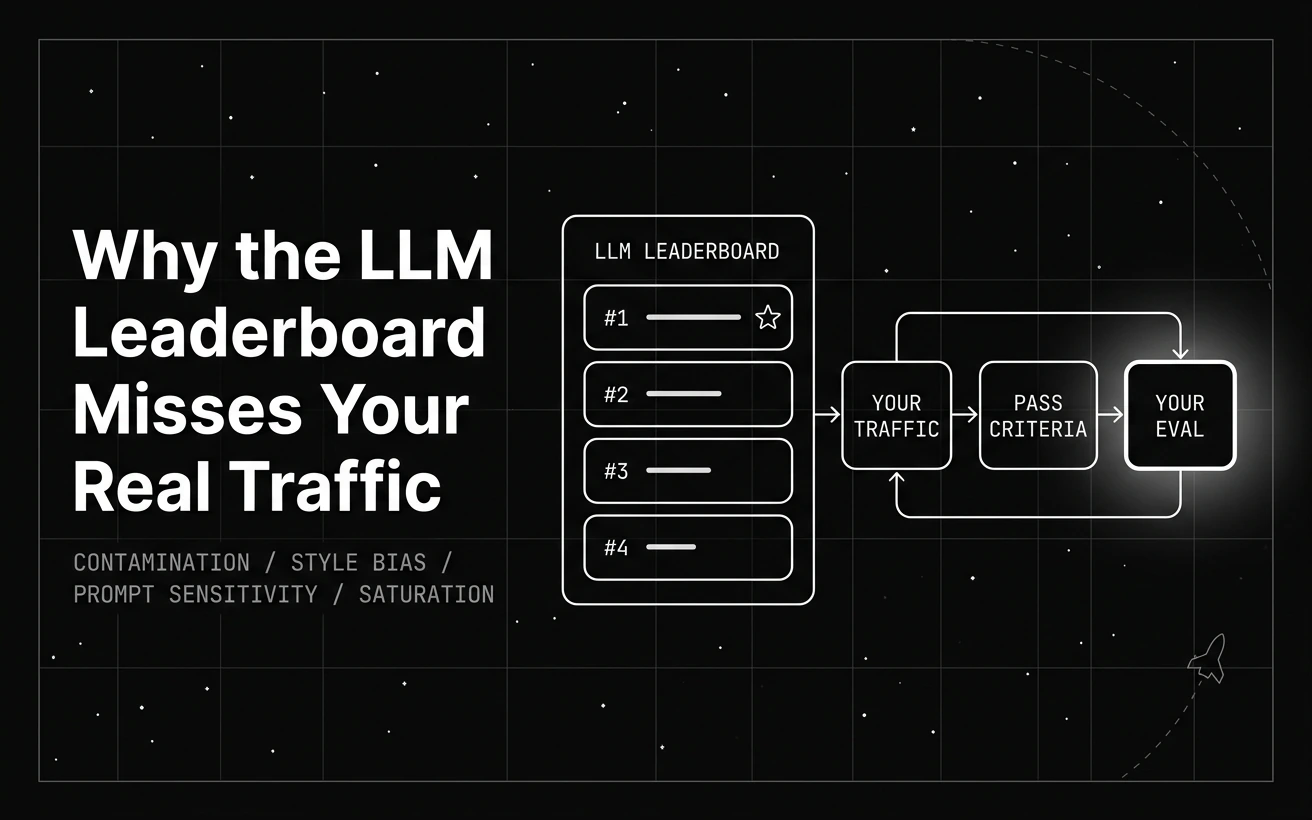
Table of Contents
You shipped the model sitting at the top of the LLM leaderboard, wired it into your pipeline, and waited for the quality jump. It never arrived. On some tasks the numbers slid backwards. The public board was certain this model was the best available, and your own outputs kept disagreeing with it.
That gap between a high LLM leaderboard rank and flat real-world results is common, and it has causes you can name. A leaderboard measures one thing on one dataset, and that dataset is almost never the mix of prompts your users send.
The angle here is deliberately narrow: five mechanisms that somebody has actually measured, each with the study and the number attached, so you can size the effect rather than nod at it. Two of the five, contamination and saturation, we cover from the reading-a-score angle in LLM benchmarks explained, which is the methodology checklist. What each individual board is and how it is scored lives in the LLM leaderboard explainer. Building domain reproductions of a public benchmark is benchmarks vs production evals. This page is the measurement page, and it leans hardest on the two mechanisms none of those cover: style bias on preference boards, and prompt-format sensitivity.
TL;DR
- An LLM leaderboard scores models on a fixed benchmark or aggregated preference votes, and neither matches the distribution of prompts in your product.
- Contamination inflates static scores: asked to refill a masked MMLU answer option, GPT-4 recovered the exact option 57% of the time and ChatGPT 52% (Deng et al., NAACL 2024).
- Preference boards reward length and formatting: LMArena measured a 0.249 length coefficient, and style control alone moved Grok-2-mini from 6th to 18th.
- Prompt format alone swung LLaMA-2-13B by up to 76 accuracy points on meaning-identical prompts (Sclar et al., ICLR 2024).
- Llama-4 Maverick ranked 2nd as an experimental chat build and 32nd once the released weights were tested on the same board.
- Build a golden set from real traffic and score candidates on task pass rate, not public rank.
What an LLM leaderboard measures, and what it hides
Public boards come in two families, and they answer different questions. Static benchmark boards run every model against a fixed test set, MMLU-style, and report accuracy. Human-preference boards, of which LMArena is the best known, show two anonymous answers to real users, collect the pairwise votes, and convert them into an Elo-style rank. One measures recall on a frozen exam. The other measures which answer a reader prefers in a blind taste test.
Both report a single aggregate across thousands of items, and an average hides its own distribution. A model can top the LLM leaderboard by winning the categories that dominate the test set while losing the narrow slice you actually depend on, such as strict JSON extraction or refusal behavior on adversarial prompts. Your production traffic is not a broad sample of that test set. It is a distribution of one: your prompts, your formats, your edge cases.
So the rank can be perfectly accurate and still fail to predict your results. The board answers a question about a general population, and you are asking about a single specific user, yourself. The measurable reasons that general-to-specific translation breaks come next, starting with the data the board is scored on.
Why LLM leaderboard rankings drift from real use
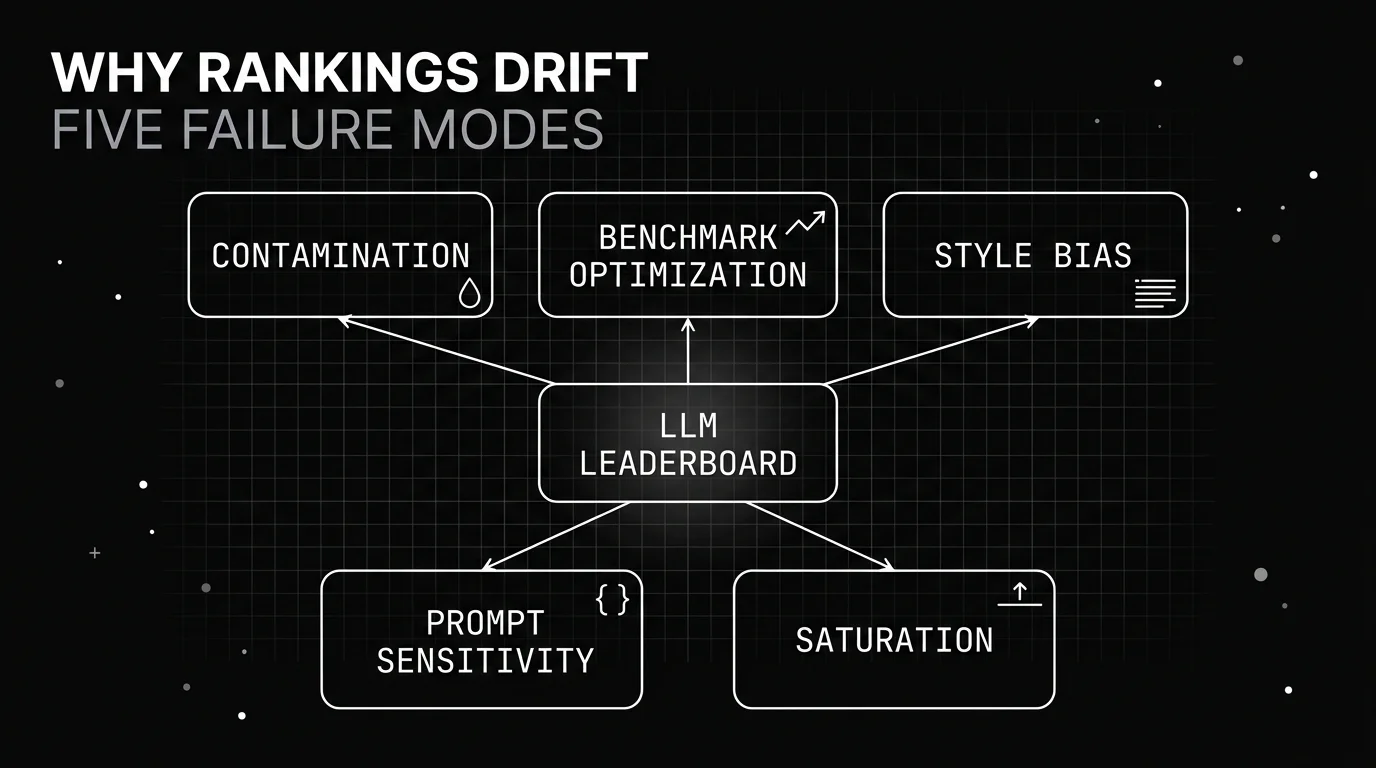
None of what follows means an LLM leaderboard is worthless. It means the rank is a noisy proxy, and the noise has named, studied sources. Five of them do most of the damage. The first two attack static benchmark boards: the test data leaks into training, and labs tune directly to the public set. The next two hit preference boards: voters reward presentation, and models swing with small prompt changes the board never varies. The last one, saturation, blurs the top of nearly every board at once.
Each has a measurement behind it, so you can size the effect instead of guessing at it. Read them as five independent reasons the public number and your number pull apart, and as a checklist for what to test on your own data before you trust any single rank.
Benchmark contamination
Contamination is the simplest failure to state and the hardest to rule out. If test items sit in a model’s training data, its score reflects memorization, not the reasoning you need.
The measurement here is direct. In Investigating Data Contamination in Modern Benchmarks for Large Language Models (NAACL 2024), Chunyuan Deng, Yilun Zhao, Xiangru Tang, Mark Gerstein and Arman Cohan masked one of the incorrect answer options in benchmark questions and asked models to fill it back in, a probe they call Testset Slot Guessing. Their reported result: “ChatGPT and GPT-4 demonstrated an exact match rate of 52% and 57%, respectively, in guessing the missing options in benchmark test data.” A model cannot reason its way to one specific wrong distractor it has never seen. That hit rate reads as memorization.
Note what the number is and is not. It is evidence that specific benchmark items sit in training data. It is not a percentage of the score that is fake, and it does not tell you the same is true of whichever board you are reading today. The general rule it supports is narrow and useful: the older and more widely copied a public benchmark is, the less its score tells you about anything new, which is exactly what your prompts are.
Detecting contamination from the outside, and choosing benchmarks built to resist it, is its own subject, and we work through the published methods and the contamination-resistant sets in LLM benchmarks explained. Here it is one of five reasons the rank moves without your quality moving.
Goodhart’s law and benchmark optimization
The second failure is structural, and it is Goodhart’s law with a scoreboard attached. Marilyn Strathern’s 1997 paper “Improving ratings”: audit in the British University system gives the phrasing everyone quotes: when a measure becomes a target, it ceases to be a good measure. A public benchmark is a target, the incentive to climb it is enormous, and labs respond the way incentives predict.
Training data gets curated to resemble the benchmark, prompts get tuned against the public questions, and checkpoints get selected for the score they post on that set. Each of those is legitimate engineering; together they mean the gains are real on the board and thin off it. This is why a jump in rank between two model versions often does not show up in your evals at all. The board improved. The capability you rely on may not have moved.
The strongest documented version of this, private multi-variant testing and publishing only the winner, we cover with the Leaderboard Illusion evidence in LLM benchmarks explained. For your purposes the tell is simpler: a model posts big benchmark gains and feels unchanged on your traffic. Separating that from a real regression is what systematic error analysis is for.
Style bias in preference leaderboards
Preference boards carry their own systematic tilt: readers reward answers that look good. Longer responses, confident tone, headers, and bullet lists win votes even when a shorter answer is more correct. This one is not a suspicion, because the board’s own team measured it and published the coefficients. In Does style matter? Disentangling style and substance in Chatbot Arena (29 August 2024), the LMArena team fitted style features into their rating model and found token length dominant at a coefficient of 0.249, an order of magnitude above markdown list (0.031), header (0.024), and bold (0.019). Length is not a tiebreaker on a preference board. It is most of the style effect.
Then they re-ranked with style controlled, and the top of the board reshuffled. GPT-4o-mini fell from 6th to 11th. Grok-2-mini fell from 6th to 18th. Claude 3.5 Sonnet rose from 6th to 4th. In their words: “GPT-4o-mini and Grok-2-mini drop below most frontier models, and Claude 3.5 Sonnet, Opus, and Llama-3.1-405B rise substantially.” Twelve places is not measurement noise. It is the board telling you how much of the original ordering was scoring presentation.
The useful reading is not that preference boards are broken. It is that they measure presentation and substance fused together, and give you no way to separate them at a glance. If your users read the answer, the fused number is close to what you want. If a parser reads it, the fused number is actively misleading, and the style-controlled leaderboard is the better column to look at.
Now map that onto real work. Plenty of production tasks punish verbosity: a strict JSON field, a single-line tool call, a terse extraction that a downstream parser has to read. A model that wins the LLM leaderboard by being expansive can be the wrong pick for a job that needs it brief and exact. The board’s taste and your parser’s needs point in opposite directions.
Prompt sensitivity
The fourth failure is that a leaderboard fixes one prompt format, and models are strikingly sensitive to format. In Quantifying Language Models’ Sensitivity to Spurious Features in Prompt Design (ICLR 2024), Melanie Sclar, Yejin Choi, Yulia Tsvetkov and Alane Suhr varied only meaning-preserving formatting, a different separator, extra whitespace, reordered fields, with the task untouched. They report “performance differences of up to 76 accuracy points when evaluated using LLaMA-2-13B” in few-shot settings. The same paper adds the part that matters for leaderboards: format performance correlates only weakly between models, so the format a board picked can favour one model over another for reasons unrelated to capability.
A board picks one format and reports the score it produces. Your application uses a different format, so the number you inherit was measured on a prompt you will never send. Two models a few rungs apart on the LLM leaderboard can flip order entirely under your prompt template. There is an upside hiding in this: because format matters this much, testing candidates on your exact prompts does more for you than almost any other single check, and it costs close to nothing to run.
Saturation and ceiling effects
The last one is quieter. Modern models have pushed the top of many benchmarks near their ceiling, and once several models cluster there the gaps between them shrink into the noise. The board still prints a strict ordering, first, second, third, while the differences separating the leaders can be smaller than the measurement error around each one. A saturated leaderboard is a tie dressed up as a ranking.
The practical rule is short: near the ceiling, read the leaders as a band of similar models rather than a sequence, and never let a one-rung difference justify a migration. How large the noise band actually is, and how ranking error compounds with the number of attempts a lab can submit, is quantified in LLM benchmarks explained. Here the point is only that saturation is the fifth way a rank stops carrying information, and the one that makes the other four harder to see.
| Leaderboard type | What it rewards | Blind spot |
|---|---|---|
| Static benchmark (MMLU-style) | Recall on a fixed test set | Contamination and saturation |
| Human preference (LMArena) | Persuasive presentation | Style bias and verbosity |
| Task-specific private board | Your own pass criteria | Build and maintenance cost |
The Llama-4 Maverick case: an LLM leaderboard rank the shipped model could not hold
One 2025 episode pulled every thread above tight in a single model. When Meta launched Llama 4 in April 2025, the build it submitted to LMArena, Llama-4-Maverick-03-26-Experimental, ranked second on the board, behind only Gemini 2.5 Pro. The catch surfaced within days: that build was labelled experimental and “optimized for conversationality,” and it was not the model developers could download. LMArena’s response, reported on 8 April 2025, was that “Meta’s interpretation of our policy did not match what we expect from model providers,” and the maintainers changed their submission policy.
They then scored the released weights, Llama-4-Maverick-17B-128E-Instruct, on the same board. It landed 32nd, below older models including GPT-4o, Claude 3.5 Sonnet and Gemini 1.5 Pro, as TechCrunch reported on 11 April 2025.
Second to thirty-second is the whole argument in one line, and notice that it is style bias and benchmark optimisation firing together: a build tuned to be liked in a blind vote, on a board that rewards exactly that. The version you could deploy was a different artifact. Had you picked your model off the first rank, you would have shipped something the LLM leaderboard never tested.
How to benchmark an LLM on your own tasks instead
The fix is a small private board, scored on your data, that you can stand up in an afternoon. The goal is to replace “which model does the internet prefer” with “which model passes my tasks.” The disciplined, full-length version of this procedure, dataset size, metric selection per input type, aggregation by intent and latency band, is already written up as how to evaluate an LLM on your own data, and the metric depth is in our definitive guide to AI agent evaluation. What follows is the smallest thing that beats a public rank.
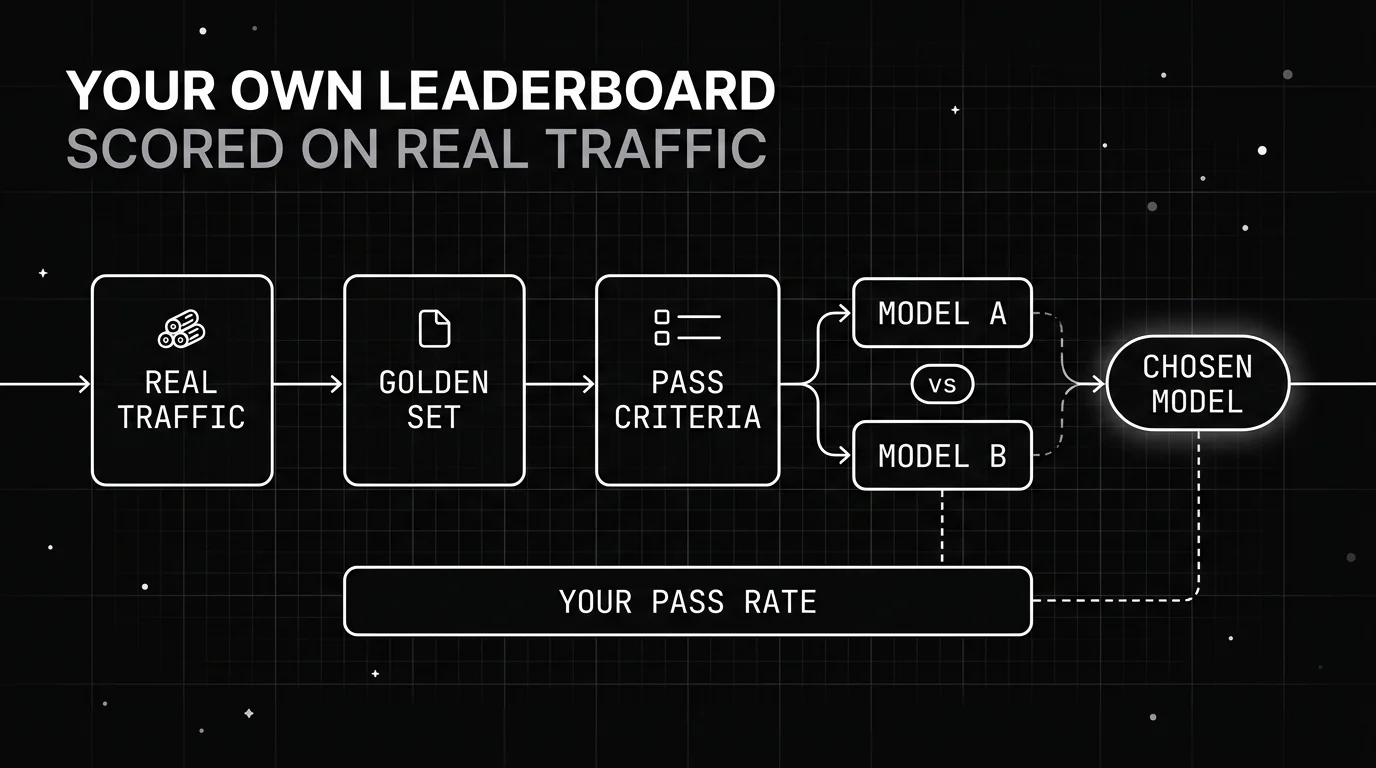
Start with a golden set. Pull 50 to 200 real requests from your logs, chosen to cover the tasks and edge cases you care about, and attach the correct or approved output wherever you can. This is your test set, and unlike a public benchmark it is drawn from the exact distribution you serve, so neither contamination nor style bias sits between the score and your reality.
Next, define pass criteria per task instead of one vague quality score. For a JSON extraction, does the output parse and carry every required field? For a support reply, does it stay grounded in the retrieved context and avoid inventing facts? Written criteria turn “seems fine” into something you can run head to head across candidate models.
Then run every candidate against the set and score by criteria coverage, not by which answer reads more nicely. The smallest possible version of that scorer fits in a few lines:
def pairwise_winrate(cases):
    """A tiny private leaderboard: which model covers your required content more often."""
    a = b = t = 0
    for out_a, out_b, required in cases:
        cov_a = sum(k.lower() in out_a.lower() for k in required)
        cov_b = sum(k.lower() in out_b.lower() for k in required)
        if cov_a > cov_b: a += 1
        elif cov_b > cov_a: b += 1
        else: t += 1
    n = len(cases)
    return f"A {a/n:.0%} B {b/n:.0%} Ties {t/n:.0%}"

if __name__ == "__main__":
    cases = [
        ("status: ok, id: 42", "done", ["id", "status"]),   # model A covers both
        ("id 7 processed", "processed", ["id"]),             # model A covers id
        ("hello there", "hi there", ["greeting"]),           # neither: tie
    ]
    print(pairwise_winrate(cases))   # -> A 67% B 0% Ties 33%
That scorer counts how often each model covers the content a task requires and reports a head-to-head win rate. Swap the placeholder keywords for your real criteria and the same shape grows into a private leaderboard. Our agent eval harness walkthrough shows how to wire this into CI, so every model swap is graded before it reaches users.
| Dimension | Public LLM leaderboard | Your own eval |
|---|---|---|
| Data | Generic test set | Your real traffic |
| Metric | Aggregate score or Elo | Task pass rate |
| Prompt | Fixed | Yours |
| Failure it catches | Broad capability | Your specific failure mode |
How Do You Run a Private Leaderboard Without Babysitting It?
Standing up that private board by hand works, and at some point you want it to run on every model swap without babysitting. The piece of Future AGI that maps directly onto this is Dataset Experiments: you load the golden set as a dataset, then run every prompt-and-model combination against the same rows, scored by the same evals. That is a private leaderboard with the two properties a public one cannot have, your prompts and your criteria, held constant across candidates so the comparison is actually a comparison.
The criteria themselves are custom evals, where you define the grading rule and the pass threshold, alongside built-ins like hallucination detection for the invented-fact failure that neither a preference vote nor a static benchmark checks for. If the candidate is a model swap on live traffic rather than an offline bake-off, Shadow Experiments mirror real production requests to the candidate without affecting users, which answers the prompt-sensitivity problem above with your actual prompts rather than a board’s.
That covers more than model choice. The same criteria become your production scoreboard: once a model is live, the checks that picked it keep grading real outputs, so a silent quality drop after a provider update shows up as a failing eval rather than a user complaint. Public boards test none of this, because none of it is their job. If you want to run the scoring locally instead, the Apache-2.0 Agent Learning Kit (pip install ai-evaluation) ships 72 local metrics with no network call.
Reading LLM leaderboards as a starting point, not a verdict
Public boards earn their keep as the first filter, not the final call. A leaderboard is a fast way to rule out the models that are clearly behind and to see which handful are in contention this month. That is a real service. The mistake is treating the top rank as a verdict about your application, when it is a summary of performance on data that is not yours.
So run the two-step. Let the public LLM leaderboard narrow the field, then let a small eval on your own traffic pick the winner. Go back to the model from the top of this article, the one that led the board and did nothing for your quality: a fifty-example golden set would have told you that before you shipped it, not after. The board points you at the right neighborhood. Your own evals find the house.
Frequently Asked Questions
Why don't LLM leaderboard rankings match real use?
What is benchmark contamination?
Is LMArena a reliable LLM leaderboard?
How should I choose a model instead of an LLM leaderboard?
Why did Llama-4 Maverick rank so differently on LMArena?
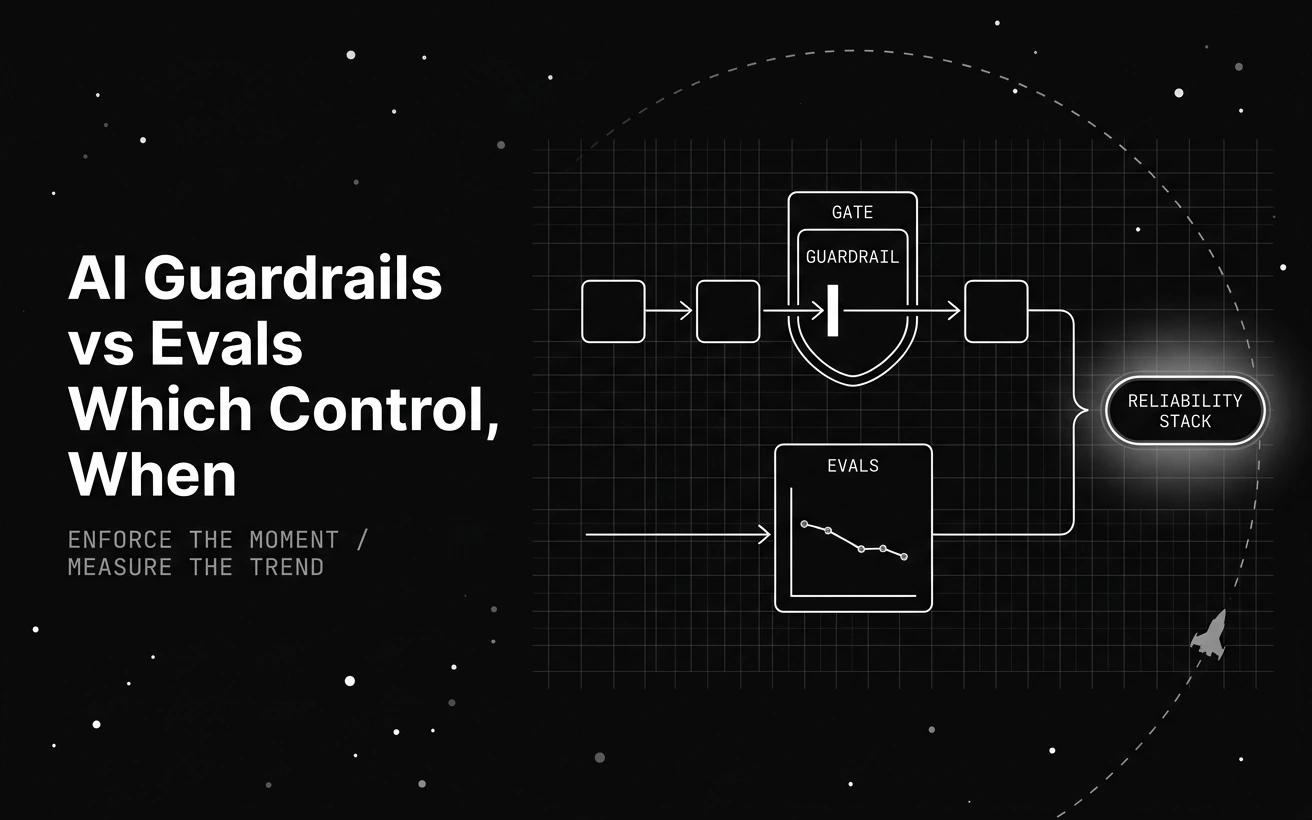
AI guardrails stop a bad request live; evals measure quality over time. See the blind spot each one leaves, and let blast radius pick the right control.


Inside Future AGI open source in Q2 2026: the platform shipped under Apache 2.0, Error Feed and the Agent Command Center went live, traces hit billions.


Gemini 3.5 Flash dropped today at Google I/O 2026. The 8 benchmark numbers that matter, $1.50/$9 pricing breakdown, and what to instrument before you swap.
