Training Large Language Models (LLMs) with Books
Learn LLM Training Using Book based data for improved accuracy, context, and adaptability. Explore use cases and FutureAGI’s innovative AI training methods

Table of Contents
-
Introduction
Large language model training resembles educating an ambitious college student: if you supply random chatter, the student stays shallow; however, when the syllabus consists of well-edited books, deeper insight soon appears. Because of that shift, Future AGI and other research groups now favour book-centric pipelines. By anchoring their models in full-length, polished works-rather than in uneven web snippets-they secure higher accuracy, broader context, and noticeably fewer robotic replies.
-
Why Large Language Model Training Matters
2.1 How the Process Works
During training, an LLM uncovers recurring patterns, preserves ideas that stretch across many pages, and produces sentences that sound natural. Although those goals look simple, the model must juggle statistical learning, contextual memory, and fluent generation all at once.
2.2 Four Key Steps
- Data preparation cleans errors, aligns formats, and strips noise.
- Tokenisation divides text into units small enough for the network to digest.
- Training loops iterate until reliable patterns emerge.
- Evaluation watches loss, perplexity, and accuracy to signal when to stop.
When these parts mesh, the model gains genuine nuance.
-
Books: A Hidden Treasure for LLMs
3.1 Why Books Help So Much
- First, they carry a wide vocabulary, from slang to specialised jargon.
- Second, they offer sustained context; chapters build arguments more rigorously than tweets ever could.
- Finally, their clear structure guides the model through complex links.
3.2 Extra Benefits
Books are already edited, so grammatical flaws are scarce. Moreover, domain texts-medical, legal, or technical-add depth that scattered blogs rarely match.
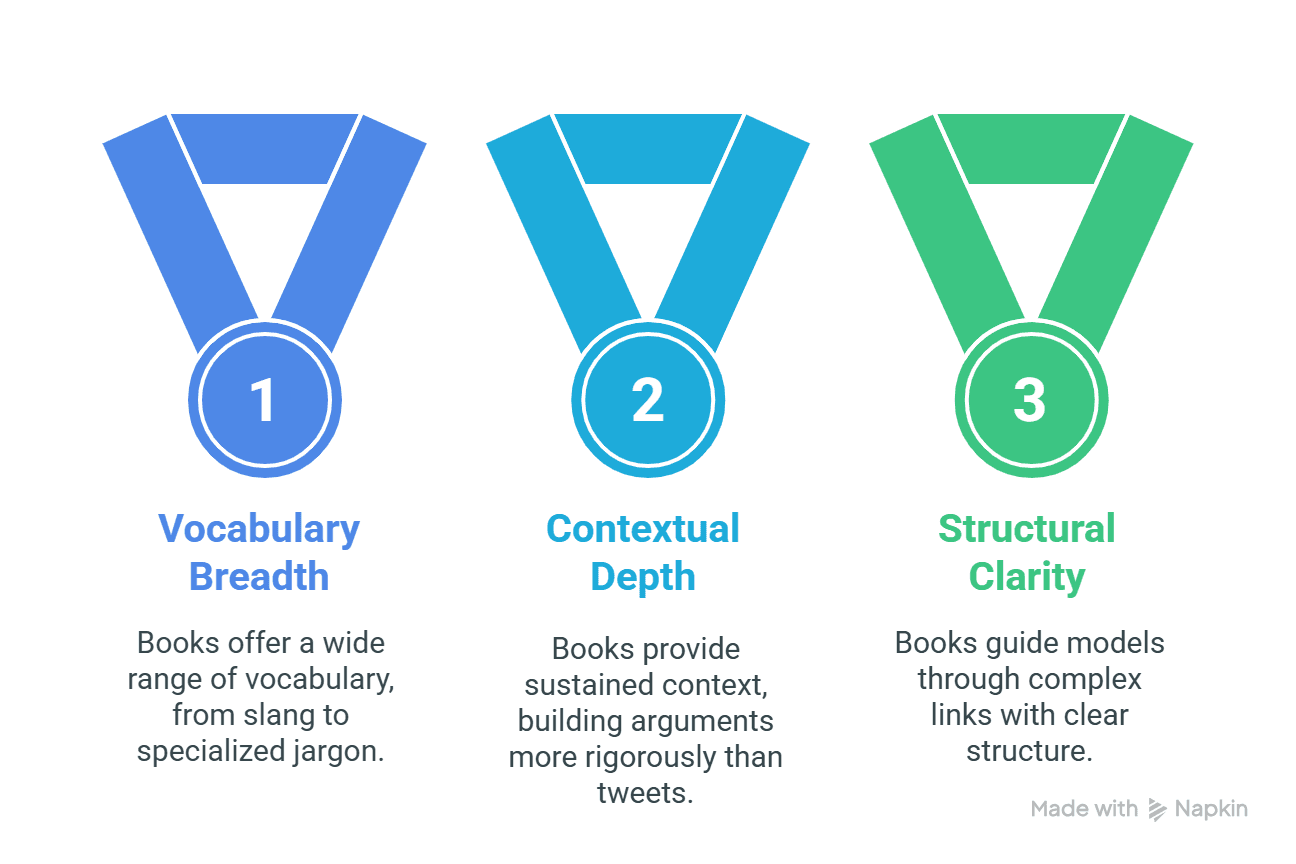
Image 1: Benefits of using books as learning resources for LLMs
-
A Five-Step Roadmap for Book-Based Training
Brief enough to skim, yet detailed enough to use.
Step 1 - Gather and Organise
Select books that match the task. Pull text-Project Gutenberg often helps-remove odd symbols, then store everything in tidy .json or .csv files.
Step 2 - Pre-process and Tokenise
Run spaCy or Hugging Face tokenisers. Next, delete duplicates, slice long passages into 512-token blocks, and confirm that language remains consistent.
Step 3 - Choose a Model Architecture
Pick a pre-trained giant or build from scratch. Meanwhile, balance compute cost against ambition: GPT-2 suits lightweight work, whereas GPT-3-scale models power enterprise apps.
Step 4 - Train in Steps
Set learning rates, batch sizes, and an optimiser such as AdamW. At first, debug on a small subset; later, scale up. Throughout, track loss in TensorBoard and save checkpoints often.
Step 5 - Fine-Tune for Precision
Lower the learning rate, freeze core layers, feed niche books, and validate on a reserved set. Finally, ship a latency-friendly model ready for production.
-
Hurdles and Practical Fixes
- Admittedly, novels lack chat-room tone, so add dialogue-rich texts if you need casual language.
- Likewise, respect copyright; rely on public-domain material or secure licences.
- Because GPUs cost real money, plan budgets early.
- Above all, fight bias by mixing authors from many backgrounds.
-
Fine-Tuning: From Generalist to Specialist
Fine-tuning is a gentle adjustment, not a rebuild. By lowering the learning rate and injecting focused material, the model learns medical terms, legal citations, or poetic metre-while retaining broader skills.
-
Four Stand-Out Use Cases
-
For researchers, compress dense papers into concise notes.
-
For educators, craft quizzes that match each learner’s pace.
-
For creatives, spark plots, poems, or script outlines.
-
For professionals, draft legal memos or clinical notes with textbook clarity.
Book-centric large language model training gives every case a solid base.
-
Best Practices for Smooth Projects
- Curate a current, diverse library; otherwise, outdated ideas seep in.
- Vary phrasing through paraphrasing or back-translation.
- Stop overfitting with validation sets, early stopping, and dropout.
- Record sources, licences, and filters so audits finish quickly.
Conclusion
Books and modern AI form a strong pair. Consequently, Future AGI demonstrates that large language model training with books yields systems that grasp nuance, honour context, and speak with authority. Whether you need a research aide, a classroom helper, or a co-author, a well-chosen shelf of books remains the smartest fuel you can buy.
Train your LLM models using Future AGI’s LLM Dev Hub platform or book a demo with us for an in-depth walkthrough of the platform.
FAQs
Q1: How many books are enough to improve a large language model?
About 5–8 million tokens, roughly 50–80 average-length books can lift domain accuracy measurably.
Q2: Do I still need copyright clearance for an internal-only LLM prototype?
Yes. Training counts as reproduction; secure licenses or use public-domain texts.
Q3: Will book-only data hurt an LLM’s chatty tone?
No. Blend in 10–20 % dialogue snippets or run a quick conversational fine-tune.
Q4: What compute budget fits a 7 B-parameter fine-tune on books?
Around 150–200 GPU-hours on A100s; ≈ $1–2 K at standard cloud rates.
Related Articles
View all
Step-by-Step Guide on Building Generative AI Chatbot 2025
Explore a detailed, step-by-step guide on building generative AI chatbots for AI teams in the USA. Learn about RAG, chatbot evaluation, and continuous monitoring.


Top 5 LLM Evaluation Tools of 2025
Explore the top LLM evaluation platforms of 2025-Future AGI, Galileo AI, Patronus, Arize, and MLflow-for building trustworthy, high-performance AI solutions.

Understanding Langchain Callback: How to Use It Effectively
Langchain Callback: Enhance AI workflows with real-time event tracking, logging, and performance monitoring for efficient, reliable AI development. | Future AGI
