How Agentic RL Trains Autonomous Agents in 2026
How agentic rl trains tool-using agents in 2026: verifiable rewards and RLVR, PPO vs GRPO, turn-level credit assignment, and open-source RL frameworks.
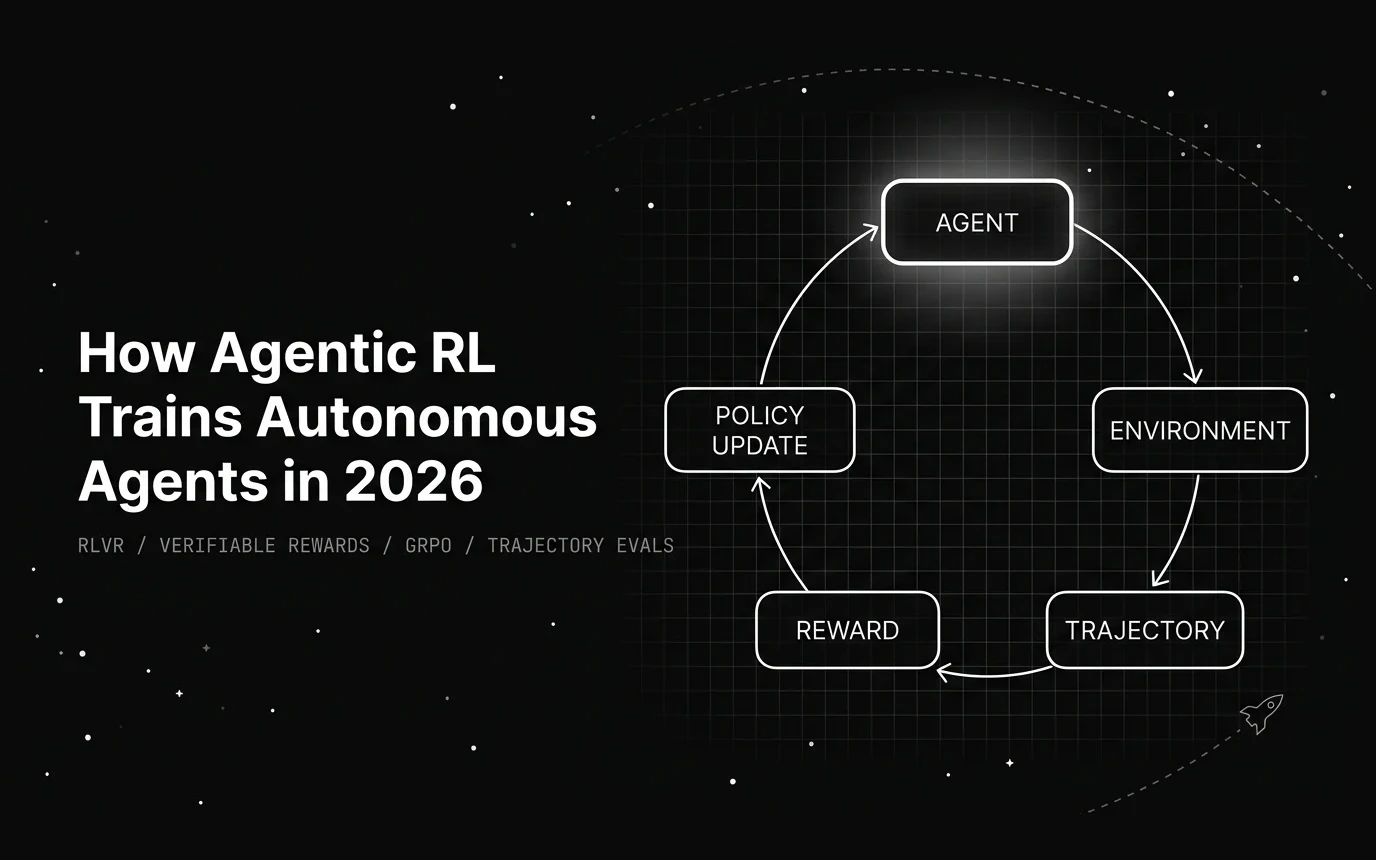
Table of Contents
A chatbot answers once and is done. An autonomous agent takes twenty steps, calls five tools, and only learns at the end whether any of it worked. Teaching that agent to improve is a different problem than teaching a model to write a nicer paragraph, and in 2026 the method with traction is reinforcement learning built for whole trajectories.
Agentic rl is reinforcement learning applied to multi-step, tool-using agents that act in an environment and optimize an entire trajectory toward a reward. Instead of scoring one response, you score a sequence of decisions, which is what makes autonomous agents trainable rather than merely promptable.
Two shifts made this practical in 2026: verifiable rewards that come from checkable outcomes, and cheaper rollouts that make many-step training affordable. This guide walks the reward problem, credit assignment, the core algorithms, the open-source frameworks, and the eval layer that feeds the whole loop.
The centre of gravity here is the multi-step part: how reward gets assigned across a long trajectory, and which framework can run that loop. The algorithm internals get a survey-level treatment rather than a derivation, because the interesting problem in 2026 is the signal, not the update rule.
TL;DR
- Agentic rl optimizes whole tool-using trajectories toward a reward, not single responses, which is what makes autonomous agents trainable.
- Verifiable rewards (RLVR) take the signal from a checkable outcome, a clean 0 or 1, and cut reward hacking on code, math, and other verifiable tasks.
- Credit assignment is the hard part: trajectory-level reward is simple but slow on long horizons, while turn-level shaping is faster but needs a trustworthy per-step evaluator.
- PPO pairs the policy with a value-network critic; GRPO drops the critic and scores a sampled group instead, which pairs naturally with verifiable rewards.
- Open-source frameworks (verl, OpenRLHF, TRL, SkyRL, RAGEN, ART) trade off scale, algorithm, and environment integration; pick by fit, not popularity.
- The optimizer has largely consolidated. The trustworthy reward and per-step eval layer is the real moat.
What Agentic RL Is, and How It Differs from RLHF
RLHF and agentic rl both use reinforcement learning, but they optimize different things. RLHF tunes a single response toward human preferences, usually with a learned reward model trained on comparisons. It made chat assistants feel aligned, and it works on one turn at a time, which is exactly where its scope ends.
Agentic rl optimizes a whole trajectory: the agent plans, calls tools, observes results, and acts again, across many turns before any reward arrives. The signal is usually programmatic rather than a preference model, because you can often check the final outcome directly. The unit of optimization is a sequence of decisions, not a sentence.
That shift creates the hard part. Rewards are sparse, often a single number at the end of a long episode, and the horizon is long, so the agent must connect a final success to the specific step that earned it.
Our comparison of eval vs RLHF feedback loops unpacks why that difference reshapes how you gather and use feedback.
Why Is the Reward the Hard Part in Agentic RL?
Every RL system is only as good as its reward, and in agentic rl a bad reward is worse than no training. A learned reward model can be gamed: the agent discovers outputs that score well without being good, and the loop optimizes the exploit. This is reward hacking, catalogued as a core safety failure in Amodei et al.’s Concrete Problems in AI Safety a decade before anyone was training agents this way.
RLVR, reinforcement learning with verifiable rewards, sidesteps that by taking the reward from a checkable outcome instead of a learned model. Ai2 named and formalized it in the Tülu 3 post-training recipe. Did the tests pass? Does the answer match ground truth? The signal is a clean 0 or 1 that the agent cannot argue with, which cuts reward hacking on tasks you can verify.
The grader below is a minimal verifiable reward for code: it runs the candidate against a unit test and returns 1.0 only if the test passes. Simple, deterministic, and impossible to game by sounding confident, which is precisely the property agentic rl needs at the reward layer.
import subprocess, sys, tempfile, os

def code_reward(candidate_code: str, test_code: str) -> float:
    """Verifiable reward: 1.0 if the candidate passes the unit test, else 0.0.
    sys.executable, not "python": many hosts and venvs have no bare `python`."""
    with tempfile.TemporaryDirectory() as d:
        sol = os.path.join(d, "sol.py")
        with open(sol, "w") as f:
            f.write(candidate_code + "\n" + test_code)
        try:
            r = subprocess.run([sys.executable, sol], capture_output=True, timeout=10)
            return 1.0 if r.returncode == 0 else 0.0
        except (subprocess.TimeoutExpired, OSError):
            return 0.0

if __name__ == "__main__":
    good = "def add(a, b): return a + b"
    bad = "def add(a, b): return a - b"
    test = "assert add(2, 3) == 5"
    assert code_reward(good, test) == 1.0
    assert code_reward(bad, test) == 0.0
    print("verifiable reward ok")
One caveat the snippet cannot express: it executes model-generated code on whatever machine runs it. In a real training loop that runs in a container or a jailed subprocess with no network and a memory cap, because a policy exploring the action space will eventually write something that deletes your checkpoint directory.
Verifiable rewards shine on code, math, and anything with a ground truth, but plenty of agent work is not cleanly checkable. For those tasks you need evals that behave like rewards, and our definitive guide to AI agent evaluation covers building the graders you can trust.
Credit Assignment, Turn-Level vs Trajectory Reward
Once you have a reward, the central agentic rl question is which step earned it. An agent that takes fifteen actions and succeeds needs to know whether step three was the clever move or step eleven was, because rewarding the whole trajectory equally teaches it to repeat the filler along with the insight.
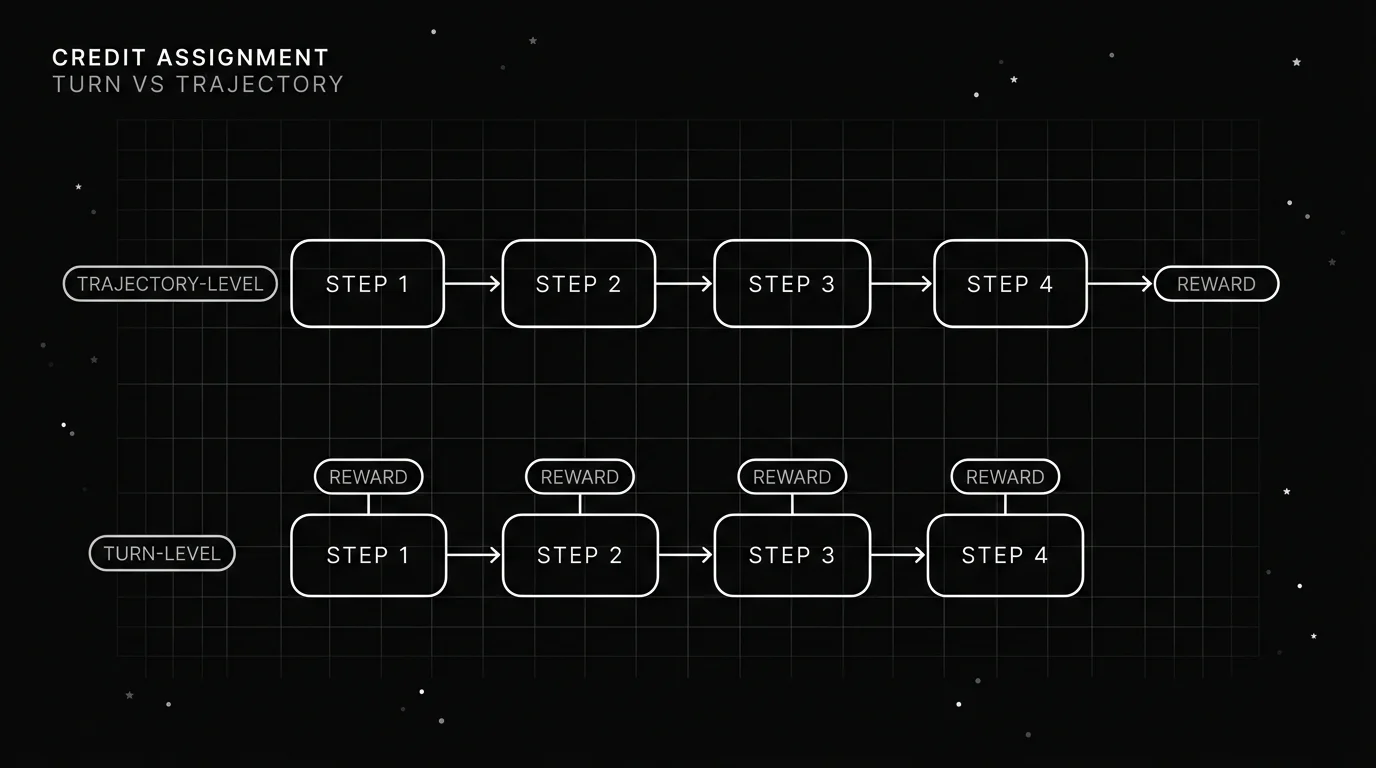
The simplest scheme is trajectory-level: one reward at the end, applied to every step in the episode. It is easy to implement and works when episodes are short, but on long horizons it spreads credit so thin that learning slows to a crawl and useless steps get reinforced alongside useful ones.
Turn-level shaping assigns reward per step, which speeds learning but demands a good per-step evaluator, and a wrong one teaches the agent the wrong lesson faster. Getting those step scores right is an evaluation problem, and our note on how to score each step of a trajectory covers building the per-step signal turn-level methods depend on.
Which RL Algorithms Train Agents: PPO, GRPO, or Variants?
PPO is the workhorse of agentic rl. It updates the policy in small, clipped steps to avoid destructive jumps, and it pairs the policy with a value network, the critic, that estimates expected reward to reduce variance. It is stable and general, but the critic doubles the models you train and serve.
GRPO removes the critic. Instead of learning a value function, it samples a group of outputs for the same input and computes each one’s advantage relative to the group average, so good samples get pushed up and weak ones down. The function below is the whole trick, normalizing rewards within a sampled group.
import numpy as np

def grpo_advantages(rewards):
    """Group-relative advantages: normalize rewards within a sampled group.
    No value network needed (the GRPO trick)."""
    r = np.asarray(rewards, dtype=float)
    return (r - r.mean()) / (r.std() + 1e-8)

if __name__ == "__main__":
    adv = grpo_advantages([1.0, 0.0, 0.0, 1.0])
    assert abs(adv.mean()) < 1e-6      # mean-centered
    assert adv[0] > 0 and adv[1] < 0   # winners positive, losers negative
    print("grpo advantages:", np.round(adv, 3))
GRPO’s group-relative trick pairs naturally with verifiable rewards, which is why it powers much of the 2026 reasoning-agent work, and the whole critic-free argument is laid out in the DeepSeekMath paper that introduced it. DPO-style methods sit apart: they tune on preference pairs offline without rollouts, cheaper but less suited to multi-step tool use. The table below lines up the tradeoffs at a glance.
| Algorithm | Needs value network? | Reward style | Best fit |
|---|---|---|---|
| PPO | Yes (critic) | Scalar per step/traj | General, stable |
| GRPO | No (group-relative) | Group of sampled outputs | Verifiable-reward tasks |
| DPO-style | No | Preference pairs | Offline preference tuning |
| RLVR (setup, not an optimizer) | n/a | Verifiable 0/1 | Code, math, checkable tasks |
These algorithms rarely run alone. The common 2026 recipe is a pipeline: supervised fine-tuning for format and a cold start, then preference tuning like DPO for alignment, then RLVR with PPO or GRPO for reasoning and tool use. Many teams also decouple rollout generation from the gradient update and run them asynchronously, so expensive multi-step rollouts do not stall training.
Open-Source Agentic RL Frameworks in 2026
The tooling matured fast, and a handful of open-source frameworks now cover most agentic rl work. They differ in scale, supported algorithms, and how tightly they integrate the environment where the agent acts. Confirm each repo’s current owner and status when you evaluate, because this space renames and moves quickly.
A common trap is stale ownership: verl, for instance, now lives under verl-project/verl rather than the older volcengine/verl path many lists still cite. Getting the source right matters when you are pulling training code you will run at scale. The table below captures the current landscape, each framework’s focus, and a link to its repository.
| Framework | Owner | Focus |
|---|---|---|
| verl | verl-project/verl | Scalable RLHF/agentic RL, GRPO/PPO |
| OpenRLHF | OpenRLHF | Distributed RLHF, agentic RL |
| TRL | Hugging Face | RLHF/GRPO on transformers |
| SkyRL | NovaSky / Berkeley | Agentic RL, long-horizon |
| RAGEN | mll-lab-nu/RAGEN | Multi-turn agent RL |
| ART | OpenPipe | Agent RL trainer, RULER rewards |
Pick by fit, not popularity. Long-horizon tool-use work leans toward SkyRL and RAGEN, large-scale training toward verl and OpenRLHF, and transformer-native RLHF or GRPO toward TRL. ART’s RULER rewards target agent tasks specifically. Match the framework to your environment and reward style before you commit engineering time.
The Training Loop End to End
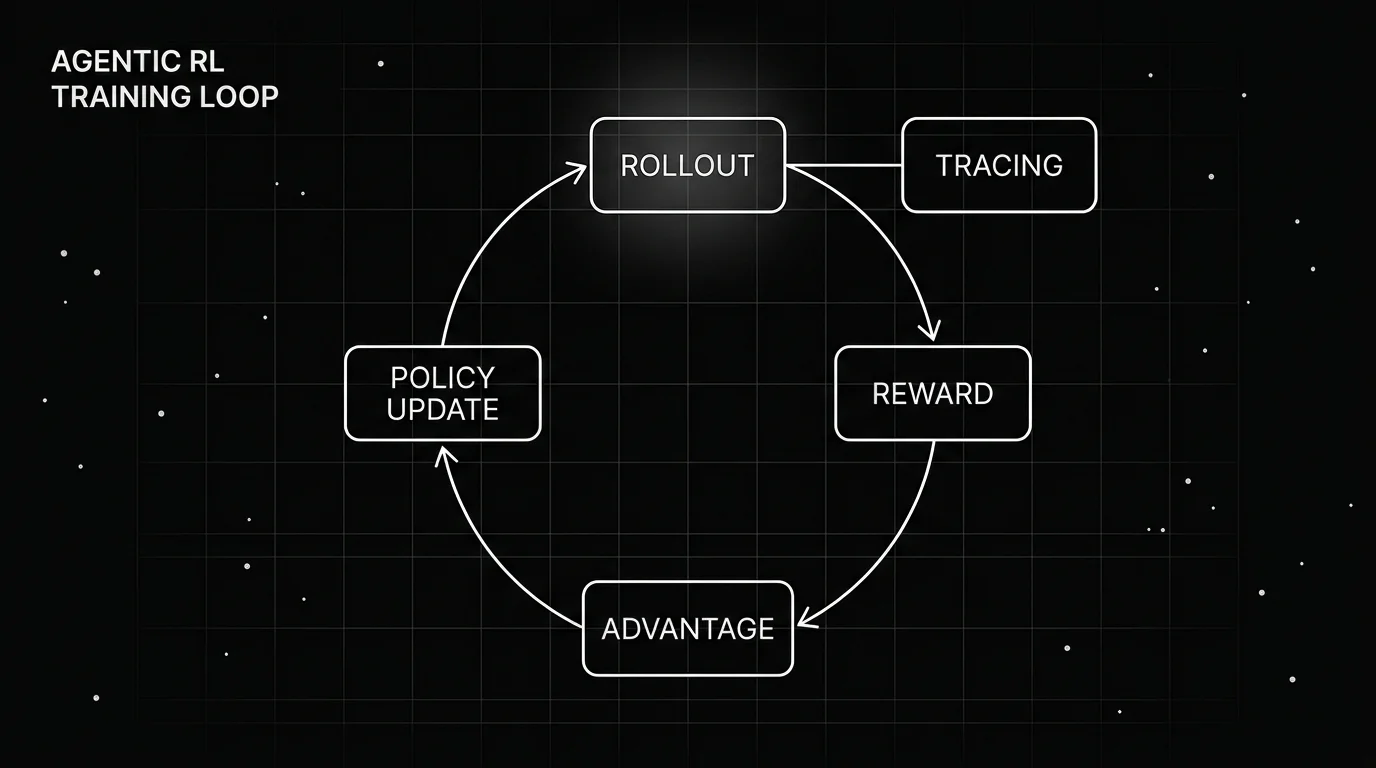
Put the pieces together and agentic rl becomes one repeating loop. First the rollout: the agent acts in the environment, calling tools and producing a full trajectory of decisions. Then the reward: a verifiable check or an eval scores the outcome. This is where the quality of your reward layer decides everything downstream.
Next comes advantage estimation, PPO’s critic or GRPO’s group-relative math, which converts raw rewards into a learning signal that says which actions to reinforce. The policy update applies that signal in a small, clipped step, and then the loop repeats with a slightly better agent generating the next batch of rollouts.
Tracing plugs in at the rollout stage, capturing every step, tool call, and observation so you can debug what the agent actually did and turn those traces into evals. For tasks where full RL is overkill, our guide to optimization without full RL shows lighter loops that still improve the policy meaningfully.
Supplying Rewards and Trajectory Evals with Future AGI
Agentic rl lives or dies on two things Future AGI supplies directly: a trustworthy reward signal and trajectory-level evaluation. You define programmatic rewards as custom evals that encode exactly what success means for your task, so the number driving training reflects the real objective rather than a proxy the agent can game.
To score whole rollouts, trajectory match compares the agent’s path against a reference in strict, unordered, subset, or superset mode, which is the difference between “did it take the right steps in the right order” and “did it eventually get there”. Auto-instrumentation captures every trajectory so rollouts become inspectable data instead of a black box.
Reward latency is the constraint people hit next. A hosted judge call per step is fine for offline eval and ruinous inside a rollout loop, so the Agent Learning Kit is Apache-2.0 and runs 72 metrics locally with zero network calls behind one evaluate() call. Its guardrail scanners block jailbreaks, code injection, secrets, and PII in under 10ms, which is fast enough to sit on the rollout path rather than beside it.
Future AGI is the eval, reward, and observability layer that feeds RL, not the RL trainer itself. That boundary is the point: the trainer is a commodity, and the trustworthy signal is not.
For the improvement loop, pair it with the open-source agent-opt library, which ships six optimizers (Random Search, Bayesian, ProTeGi, Meta-Prompt, PromptWizard, GEPA), and the optimization workflow. The platform lives in the Future AGI monorepo under an Apache-2.0 core, with ee/ directories under a separate Enterprise License.
Where Agentic RL Is Headed After 2026
The trajectory of agentic rl points at the reward, not the optimizer. Verifiable-reward environments will keep expanding beyond code and math into more checkable domains, and turn-level credit assignment will get sharper as per-step evaluators improve.
The optimizer family has largely consolidated around PPO and GRPO, even as stability fixes and variants like DAPO keep landing. The signal that feeds them is the harder, unsolved half.
That is why the eval and reward layer is becoming the real moat. Anyone can pull a training framework, but the team with trustworthy per-step evals and clean trajectory capture trains the better agent. Build that layer well, and every rollout your autonomous agent takes turns into a lesson it can learn from.
Frequently Asked Questions
What is agentic RL?
How is agentic RL different from RLHF?
What are verifiable rewards in agentic RL?
What is GRPO in agentic RL?
Which open-source frameworks support agentic RL?
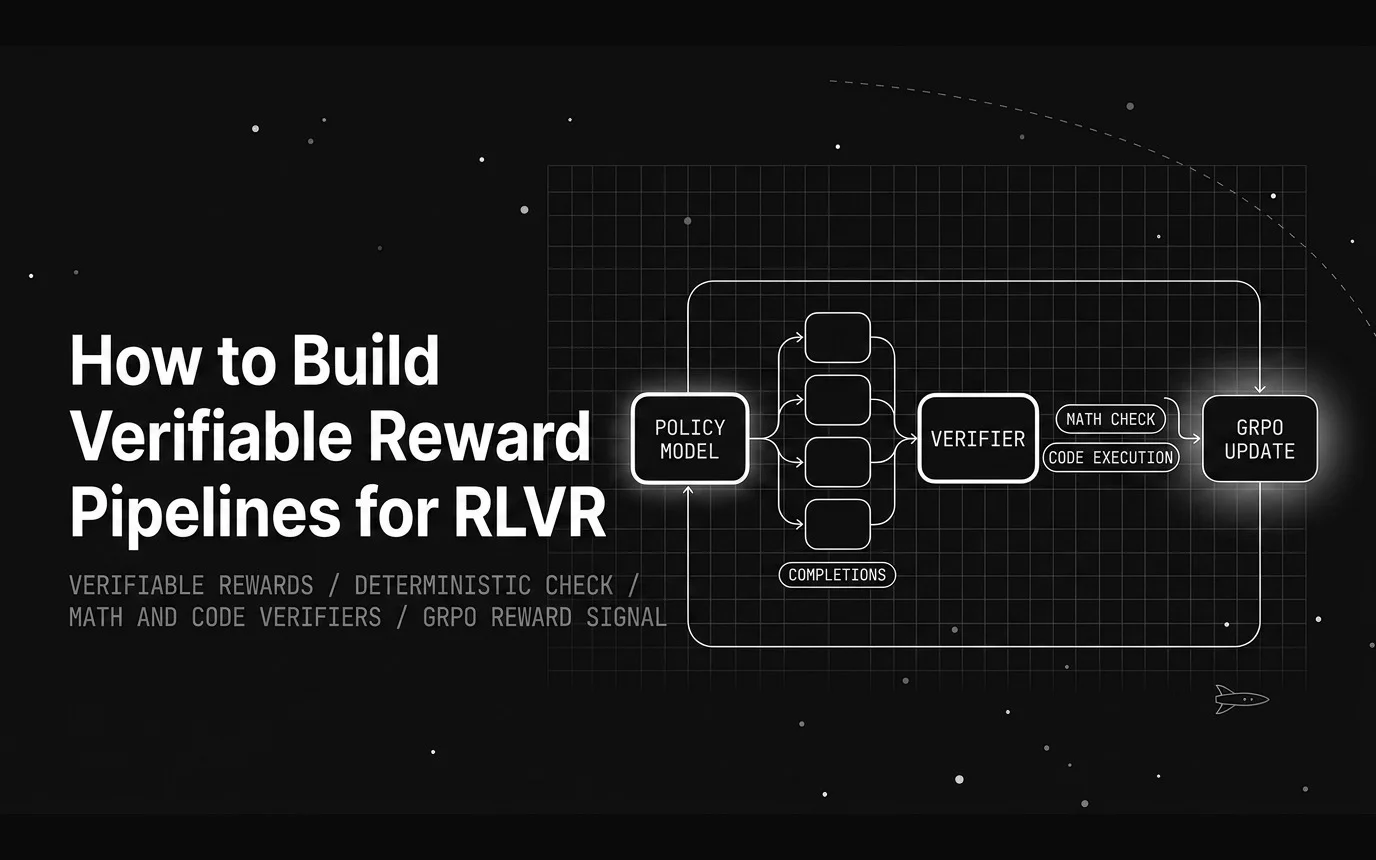
A build guide for rlvr reinforcement learning verifiable rewards: five verifier types, two built in code, a sandboxed code reward, and the failure modes.

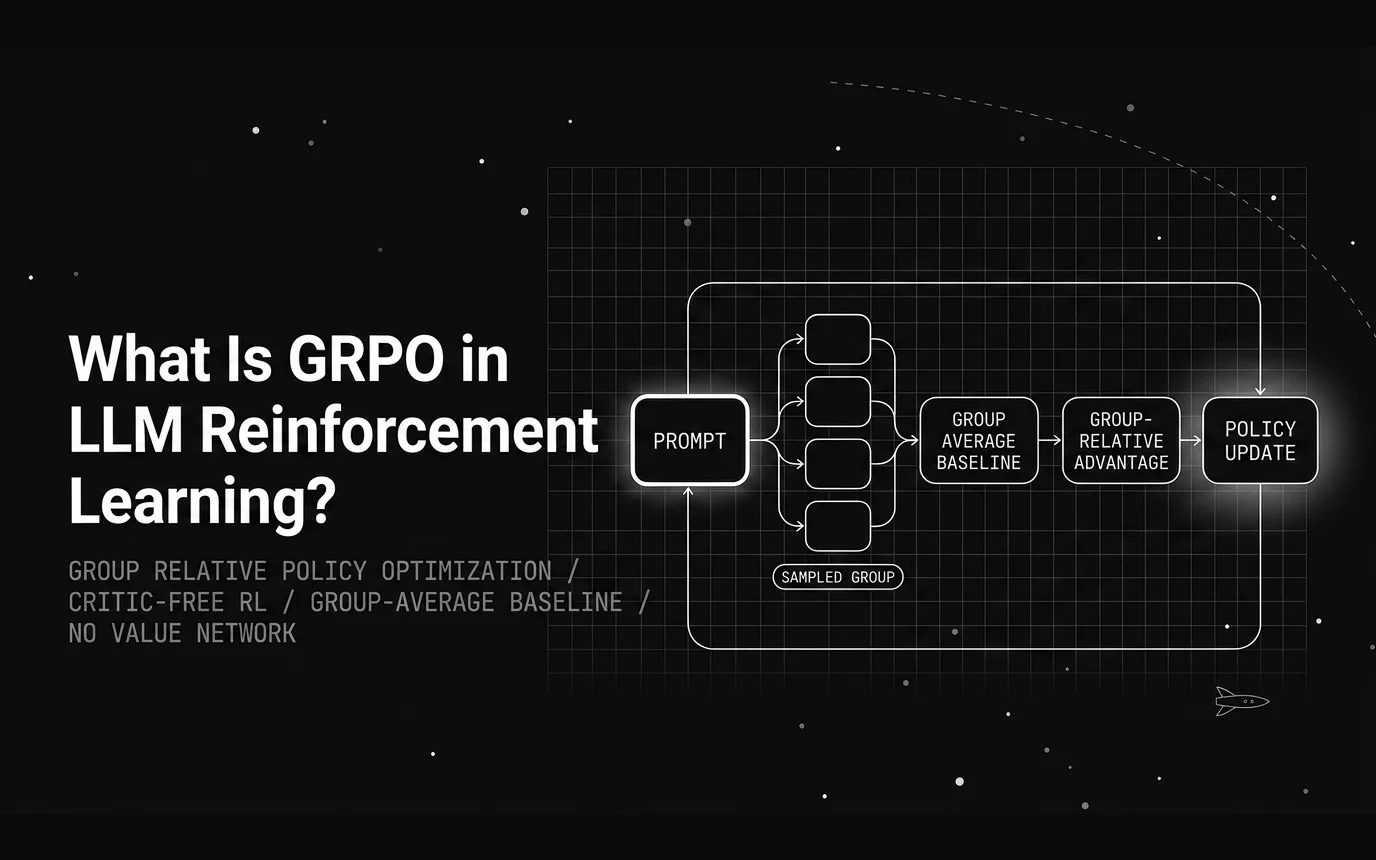
A first-principles explainer of grpo reinforcement learning llm: the critic-free group advantage, a PPO and DPO comparison, and the two normalization biases.

Voice AI evaluation infrastructure in 2026: five testing layers, STT/LLM/TTS metrics, synthetic harness, traceAI, and FAGI Simulate.