Future AGI vs Galileo AI Comparison
Compare Future AGI vs Galileo AI in 2025. Discover the best LLM evaluation tool for speed, accuracy & real-time tracing
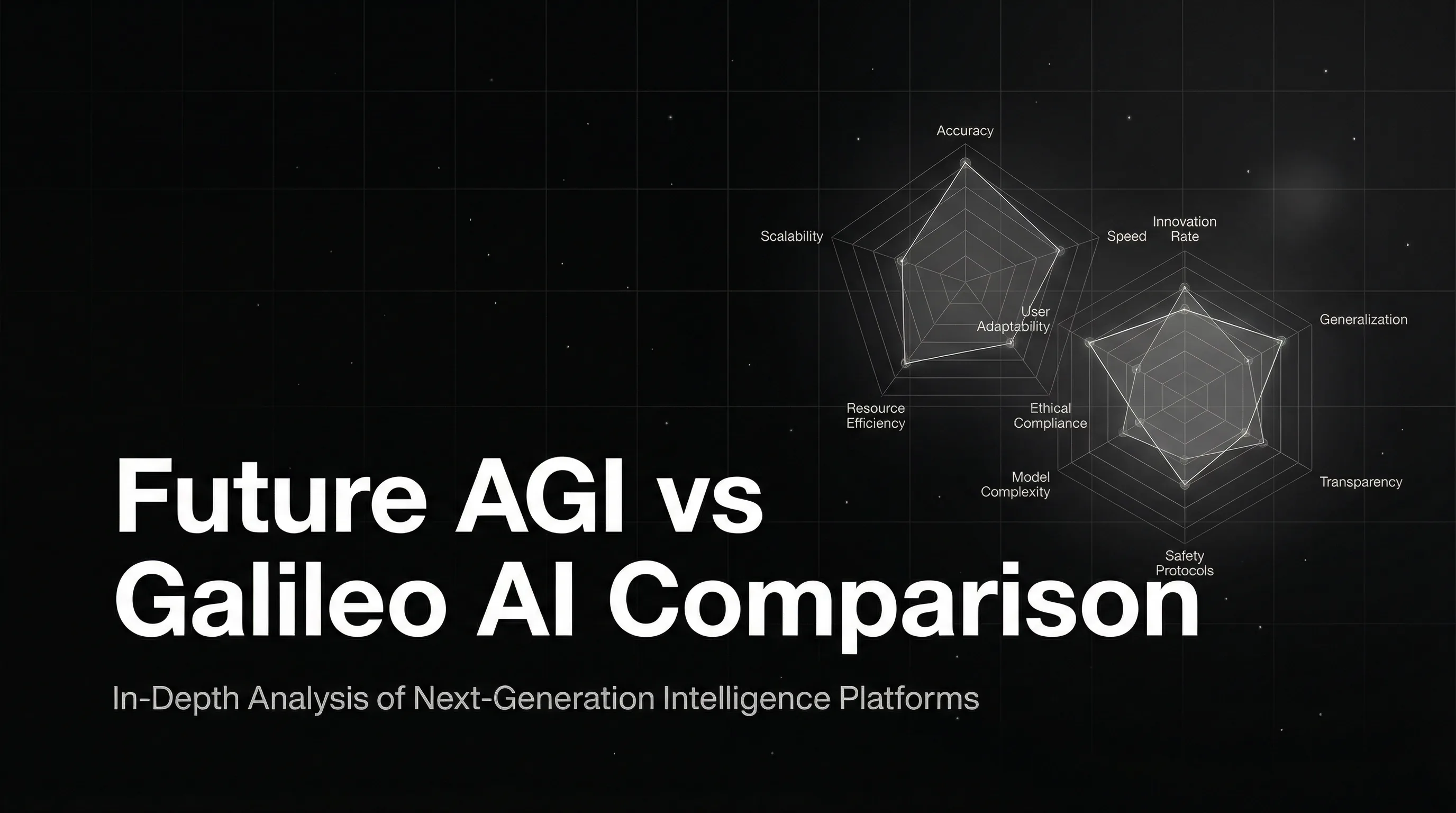
Table of Contents
-
Introduction
Modern LLM evaluation demands robust model monitoring tools and precise AI observability systems. More than 85% of AI projects fail due to low LLM accuracy, poor prompt optimisation, or a lack of real-time tracking. As large language models and AI agents scale, choosing the right AI evaluation platform becomes critical. This blog looks at Future AGI vs Galileo AI, two leading platforms for evaluating large language models, and examines their advantages in creating synthetic data, evaluating retrieval-augmented generation, incorporating human feedback, and tracking prompt performance in machine learning processes for business.
To explore how LLM models work, click here!
-
Why LLM Evaluation Matters in 2025
As large language models come to play a central role in business operations in the guise of co-pilots, chatbots, or systems used to assess risks, the capacity to constantly evaluate and monitor their outputs becomes imperative. Traditional metrics such as BLEU and ROUGE fail in a generative AI context. We should create new tools that are capable of evaluating large language models which can:
- Detect hallucinations and factual errors
- Mark toxic, biased, or unsafe outputs
- Establish Relevance and Fluency
- Support model iteration and prompt
- Maintain traceability to ensure compliance
-
Overview
Future AGI
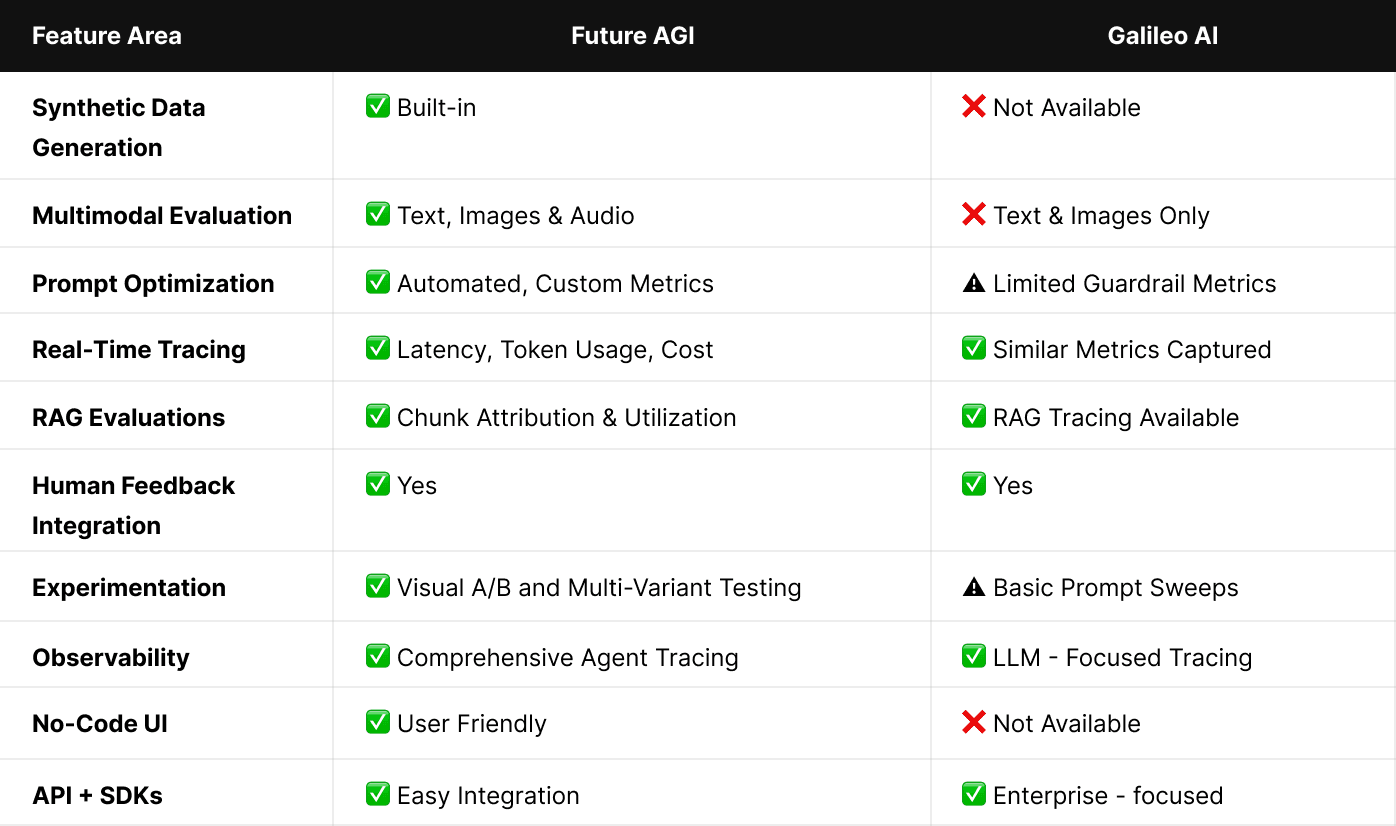
Future AGI is a comprehensive platform designed to evaluate and optimise AI, aiming for a high model accuracy across various modalities. It tests the outputs from models and synthesises data, performs experiments, and provides continuous improvement through feedback loop. The platform is a complete solution to test and monitor LLMs.
Galileo AI
Galileo AI is an observability platform designed to monitor generative AI applications and offer enterprise users tools to monitor and evaluate LLM performance (e.g., detect hallucinations and measure the quality of prompts) in real-time. It’s designed with a strong emphasis on diagnostics, tracing, and RAG analysis.
-
Use Cases
Future AGI
- Enterprise-grade GenAI systems
- High-stakes AI agents aiming for high accuracy
- Multi-modal evaluation (text, image, audio)
- Automated agent optimization and error feedback loops
Galileo AI
- Teams focused on prompt engineering and LLM debugging
- Use cases involving RAG pipelines
- Real-time LLM tracing and hallucination tracking
-
Ease of Use and Integration
Future AGI is built to make onboarding quick and painless. It features a no-code experimentation hub, seamlessly integrates with OpenTelemetry, and effortlessly functions with popular LLM providers such as OpenAI, Anthropic, Hugging Face, and more. Additionally, it facilitates collaboration by providing a single, shared dashboard that unifies everyone.
Galileo AI offers real-time tracing, a clean and intuitive interface, and easy SDK integration. But it’s more tailored for enterprise setups and assumes users already know their way around LLM metrics and technical workflows.
-
Performance and Scalability
Future AGI supports high-throughput evaluation with distributed processing, enabling massive test runs and real-time monitoring at enterprise scale. It is built for both cloud and edge deployments, handling multimodal and agent-based models.
Galileo AI is designed for enterprise-scale LLM deployments. It supports real-time metrics and performance monitoring, and it has a strong infrastructure for analysing large logs and prompt outputs. It is more focused on observability than on automated evaluation.
-
Customer Adoption & Reviews
Future AGI is a new breakthrough platform with official, early traction that is growing strong. Case studies report accuracy improvements of 10× faster iteration cycles. It’s state-of-the-art multimodal evaluation is garnering recognition. It has served customers with use cases like summarization accuracy, chatbots hallucination, etc You can read the case studies here.
Galileo AI is gaining traction with enterprise users. It has few public reviews, while some people praise it for its RAG analysis and hallucination detection capabilities.
-
Conclusion
When choosing between Future AGI and Galileo AI in 2025, your decision may be influenced by your priorities:
- Future AGI is cost effective and caters to all sizes of teams, from young start-ups to enterprises. If you need an all-in-one evaluation platform with capabilities ranging from synthetic data generation and multimodal evaluations to prompt optimisations and automated feedback loops, choose Future AGI.
- If your focus is just enterprise level LLM observability, tracing, and monitoring, then Galileo AI may be a fit.
In summary, both the tools are great, but if your goal is maximum model accuracy, speed of iteration, and easy collaboration, Future AGI provides a more comprehensive and sophisticated solution.
For users looking for an overall LLM evaluation tool, try Future AGI now!
FAQs
Q1: What are the primary differences between Future AGI and Galileo AI?
Future AGI offers comprehensive evaluation and optimization, supporting multimodal data and automated processes. Galileo AI focuses specifically on real-time tracing and diagnostics for LLMs.
Q2: Does Future AGI support multimodal evaluation?
Yes, Future AGI evaluates text, images, and audio data.
Q3: Which tool is more suitable for non-technical users?
Future AGI is more suitable for non-technical users due to its intuitive, no-code interface.
Q4: Do both platforms provide real-time tracing?
Yes, both Future AGI and Galileo AI effectively support real-time tracing of LLMs.
Related Articles
View all
OpenAI AgentKit + Future AGI: Your End-to-End Solution for Reliable AI Agents
Discover how OpenAI AgentKit and Future AGI create reliable production AI agents. Guide covers evaluation, monitoring, workflows, and optimization.

Future AGI vs Comet (2025): Real-World Comparison for AI Teams, Developers, and Product Managers
Discover a detailed, real-world comparison of Future AGI and Comet for AI developers and teams. Explore features, pricing, user reviews, pros & cons, and which platform delivers the best results for generative AI projects in 2025.

Future AGI vs. LangSmith: Honest, Hands-On Comparison for AI Developers in 2025
Curious which LLMOps platform truly delivers for AI teams? Dive into this real-world comparison of Future AGI and LangSmith - covering features, pricing, user experience, integrations, and more. Discover which tool outsmarts AI hallucinations and why Future AGI stands out for model accuracy, multi-modal support, and peace of mind. No hype, just facts for AI developers and product managers.