Choosing the Right Prompt Optimization Tool for Production Teams: 8 Questions to Ask
Eight questions for choosing a prompt optimization tool for production teams: automated search over your own eval scores, named algorithms, open source, convergence, and CI/CD fit.
Table of Contents
You have eleven versions of the same prompt in a doc, three of them named “final,” and no idea which one actually scores best on last week’s failures. So you tweak it again by hand, eyeball ten outputs, decide it “seems better,” and ship. That is not optimization. That is guessing with extra steps, and it stops scaling the moment you have more than a couple of prompts and a real eval set.
A prompt optimization tool exists to do that search for you: rewrite the prompt, score it against your data, and keep the version that measurably wins. The catch is that most tools sold near this problem only manage prompts (version, log, and replay them), they do not optimize them. Here are the 8 questions that separate a real optimizer from a prompt manager with a playground, and how to answer each.
TL;DR: choose a prompt optimization tool that automatically searches for a better prompt, scores candidates against your own eval, uses a real search algorithm (gradient, genetic, or DSPy-style, not a single rewrite), shows a measurable score gain and the trajectory, is open source so you can inspect and self-host it, and runs in code and CI/CD on any model. Versioning and a playground are not optimization.
For the wider landscape first, see our roundup of prompt optimization tools and why manual tuning fails at scale.
Why choosing a prompt optimization tool is harder than it looks
The category is crowded with tools that look similar and do different jobs. Prompt management platforms give you versioning, a playground, A/B testing, and collaboration. They are useful, but they track the prompts a human writes; they do not write better ones. Prompt optimization is a separate capability: an algorithm that proposes prompt candidates, scores them against your data, and converges on the best one. A buyer comparing feature grids will see “prompt testing” on both and miss that only one of them changes the prompt for you.
The failure mode is the eleven-versions doc. Manual tuning works for the first few prompts, then collapses: you cannot hand-search the space, you cannot score candidates consistently, and you cannot reproduce why one version won. The 8 questions below are weighted toward that gap, the automated search and the eval score it climbs, because that is the part a “prompt tool” most often does not actually do.
The 8 questions to ask before you choose
The Prompt Optimization Audit. Score each question pass or fail. Aim for six or more.
| # | Question | Pass if the tool… |
|---|---|---|
| 1 | Optimizes, not just stores | Rewrites the prompt for you, not only versions it |
| 2 | Your own eval as objective | Optimizes against your eval score, not a generic metric |
| 3 | Real search algorithm | Uses gradient, genetic, or DSPy-style search, not a one-shot rewrite |
| 4 | Trustworthy result | Shows score gain, convergence, and the trajectory |
| 5 | Open source | Ships an inspectable codebase you can read, self-host, and fork |
| 6 | Code-first, any model | Runs programmatically on your data, across the models you serve |
| 7 | Runs in CI/CD | Re-optimizes in a pipeline as code, not a one-off GUI session |
| 8 | Management workflow | Pairs cleanly with prompt versioning your team needs |
1. Does it optimize the prompt, or only store and version it?
Why it matters: versioning tells you which prompt you shipped. It does not give you a better prompt. If the tool never changes the prompt, you are still doing the hard part by hand.
What to look for: an optimization run that takes a starting prompt and returns a measurably improved one, not just a diff view of versions you wrote.
What to avoid: the product is a registry and playground, and “optimization” means you edit and compare manually.
How FutureAGI fits: agent-opt runs an optimization loop that takes your initial prompt, generates candidates, scores them, and returns an improved prompt with its score. Prompt management tools stop at versioning because that is what they were built for; agent-opt is built to produce the next version, not just store the last one.
2. Does it optimize against your own eval scores, not a generic metric?
Why it matters: a prompt that improves on a vendor’s generic “quality” score can still fail your task. The only objective worth optimizing is the one you actually grade on.
What to look for: you supply the evaluator (a metric or an LLM judge), and the optimizer uses that score as its objective function.
What to avoid: a fixed, opaque “improve my prompt” button with no way to plug in your own scoring.
How FutureAGI fits: agent-opt optimizes against an evaluator you pass in, a callable that scores each candidate on your dataset and returns a number. The platform uses your eval score as the objective function, so the prompt it converges on is the one that wins on your metric, not a generic one. That ties directly to whatever you already grade with, including an LLM judge you engineered.
3. Does it use a real search algorithm, or a single rewrite?
Why it matters: asking a model once to “make this prompt better” is a guess, not a search. Real improvement comes from proposing many candidates and selecting on score across your data.
What to look for: named, comparable optimization algorithms that explore a space of candidates, not a one-shot suggestion. The main families are gradient-based search (computing a “prompt gradient,” a critique of why a prompt failed, and editing toward it), genetic or evolutionary search (mutating and selecting over a population of prompts), DSPy-style optimizers (such as MIPRO and BootstrapFewShot, which search instructions and few-shot examples together), and meta-prompt rewriting (a model that reflects on and improves the prompt). Knowing which family a tool uses is what lets you compare two optimizers on the same axis.
What to avoid: the entire “optimizer” is a single LLM call that rewrites the prompt once.
How FutureAGI fits: agent-opt ships multiple algorithms, including ProTeGi (which computes prompt “gradients,” critiques of why a prompt failed, and edits toward them), GEPA (a genetic, population-based search), and MetaPrompt (self-reflective rewriting). Those cover three of the families above, so you can weigh them on the same axes you would use to judge a DSPy-style optimizer. You pick the strategy and it searches a space of candidates, rather than betting on one rewrite.
4. Can you trust the result: a measurable gain, convergence, and a trajectory?
Why it matters: “the new prompt seems better” is the problem you came to solve, not a result. You need a number, on data the optimizer did not train on, and a record of how it got there.
What to look for: a final score on a held-out set, the per-iteration history, and how many evaluations it ran, so you can see it converged and did not just overfit.
What to avoid: a new prompt with no score, no trajectory, and no way to tell whether it actually improved.
How FutureAGI fits: an optimization run returns an OptimizationResult with the best prompt, a final_score, the per-iteration history, the total_evaluations it ran, and whether it early_stopped once the score plateaued. You see the score gain and the trajectory, not just a new string.
5. Is it open source, so you can inspect and self-host it?
Why it matters: a prompt optimizer rewrites the instructions at the center of your product, so a closed “improve my prompt” API asks you to trust a black box with your most important text. Open source lets you read the search strategy, run it in your own environment, and fork it when your needs outgrow the defaults.
What to look for: a permissively licensed optimizer you can read and run yourself, with the search algorithms in the open rather than hidden behind an API.
What to avoid: a closed service that optimizes prompts you cannot inspect, with no way to self-host or audit how a candidate was chosen.
How FutureAGI fits: agent-opt is an open framework you can read and run yourself (github.com/future-agi/agent-opt), so the search strategies are inspectable rather than hidden behind an API, and the same code runs in your own environment against your own data. DSPy and similar open optimizers clear this bar too; a closed “improve my prompt” button does not.
6. Is it code-first, running on any model and your own data?
Why it matters: a prompt that optimizes in a playground but cannot be called programmatically is a one-time demo, and an optimizer locked to one provider strands you when you switch models. The optimizer has to run as code, on whatever you serve, against your dataset.
What to look for: a code-first SDK, support for whatever model you serve, and optimization that runs on your own dataset rather than a fixed benchmark.
What to avoid: a GUI-only flow locked to one provider with no programmatic path.
How FutureAGI fits: agent-opt is a Python SDK that runs against your dataset, with a LiteLLM backend so the optimizer works across 100+ models (OpenAI, Anthropic, and others). You point it at your own data and the model you actually serve, rather than optimizing against a benchmark that is not your task.
7. Can you run it in CI/CD, not just once in a session?
Why it matters: production teams re-optimize when the base model changes, a prompt regresses, or the data shifts, and that has to be a pipeline step, not a manual session someone remembers to run. An optimizer you can only drive by hand drifts out of date the moment a model upgrades.
What to look for: an optimizer you can invoke as code in CI/CD, so re-optimization runs on a trigger and the result is reproducible.
What to avoid: a one-off GUI session with no scriptable entry point, so every re-optimization is manual.
How FutureAGI fits: because agent-opt is a code-first SDK, you can wire it into CI/CD and re-optimize on a trigger, for example when the base model shifts, and get a reproducible run rather than a hand-driven one. That is the repeatable workflow manual tuning cannot keep up with.
8. Does it also cover the prompt-management workflow your team needs?
Why it matters: optimization produces a better prompt, but your team still needs to version it, review it, and let non-engineers edit safely. An optimizer with no management story leaves a real gap.
What to look for: clean handoff into a prompt registry and versioning workflow, whether built in or via a tool your team already uses.
What to avoid: treating an optimization engine as if it replaces the whole prompt lifecycle, or a management tool that pretends a versioning UI is optimization.
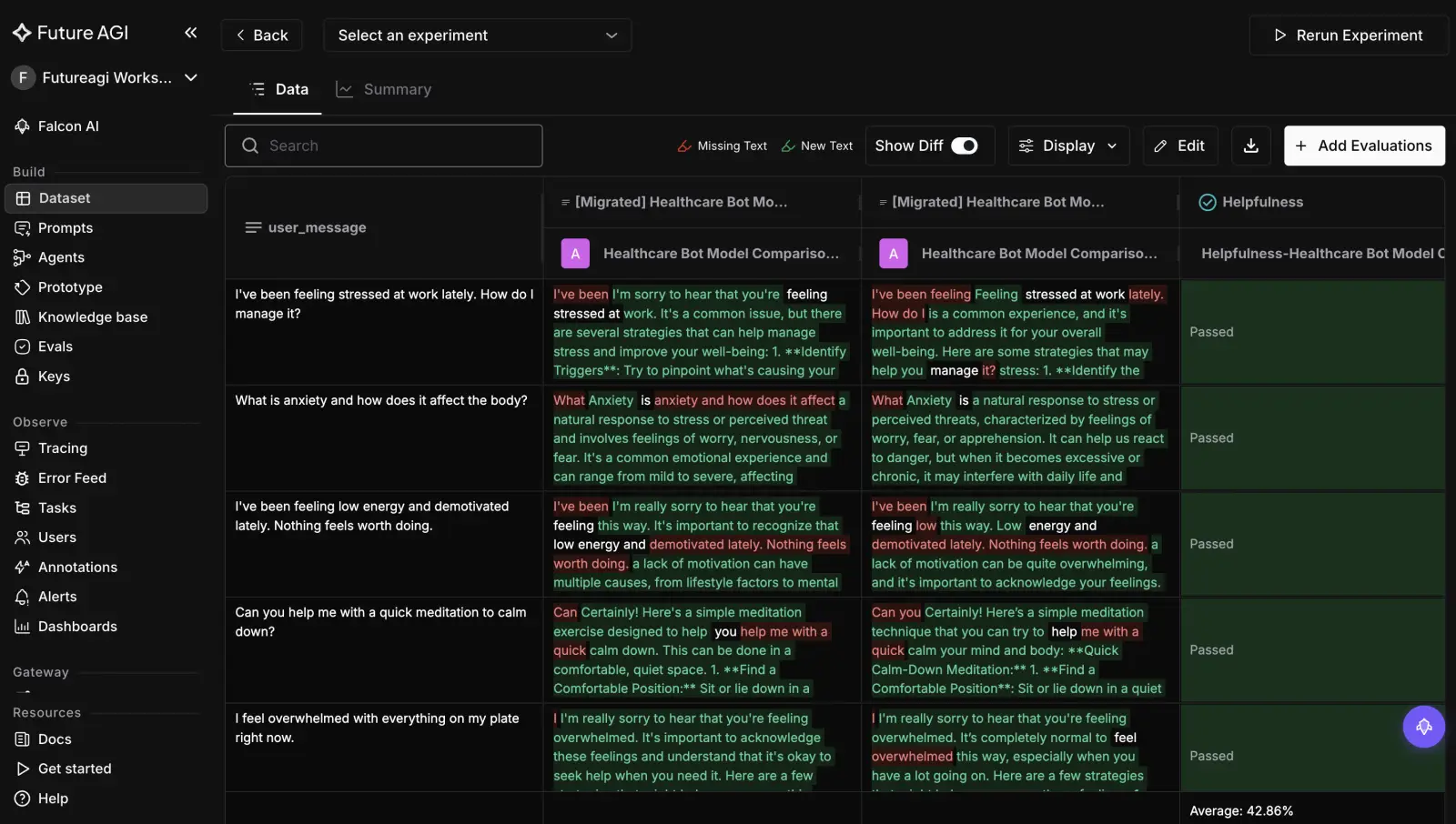
Where FutureAGI is honest about this one: this is the factor where agent-opt is not the whole answer. It is an optimization engine you wire into code and CI; it is not a polished, no-code prompt management workbench for a non-technical team. If your primary need is a shared registry, visual versioning, and a collaboration UI for product managers, a dedicated prompt management tool is the better center of gravity, and agent-opt is the optimizer you point at the prompts it holds. What it does give you is a side-by-side experiment view to compare two prompt versions on your eval before you promote one:
A quick decision framework
Weight the questions by what you are actually buying.
| Choose | When | What decides it |
|---|---|---|
| A real optimizer | You have more than a few prompts and a real eval set, and manual tuning has stopped scaling | Questions 1, 2, 3 |
| For trustworthy results | You need to prove a prompt got better, not just claim it | Question 4 |
| An open, self-hostable optimizer | You need to inspect the search or keep it in your own environment | Question 5 |
| For production fit | You re-optimize across model upgrades and want it in CI/CD | Questions 6 and 7 |
| A prompt management platform instead | Your main need is versioning, collaboration, and a no-code playground | Question 8: a different category of tool |
Where FutureAGI fits
The eight questions above get you an optimizer that rewrites a prompt and proves the gain against your eval. Here is what FutureAGI does past the optimization run itself, in the lifecycle around it.
You can build the dataset the optimizer needs instead of hand-writing it. A good run depends on examples that match real inputs, and writing those by hand is the bottleneck. You can define scenarios from a CSV or file to cover specific intents and edge cases before launch, then later assemble a set from production traces you already scored. The optimizer points at that dataset, so the work moves from inventing cases to curating them.
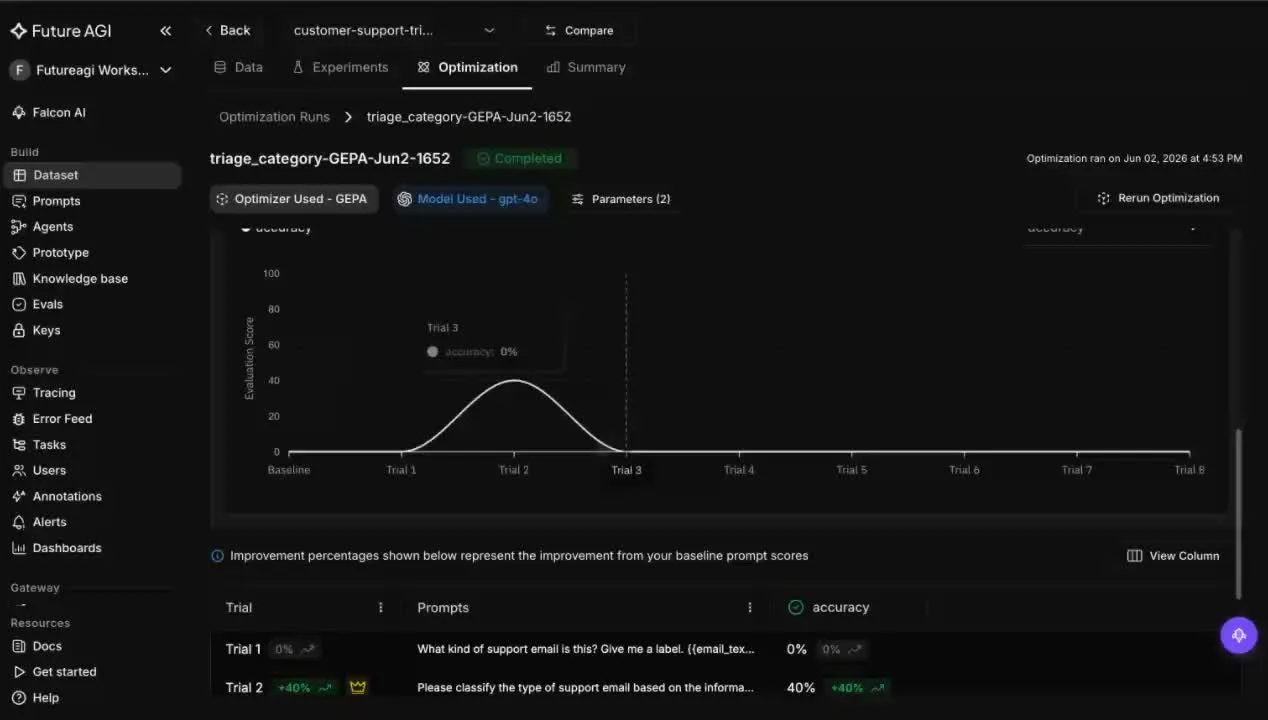
You can watch the run unfold and audit how it got there. The optimization run is observable in the product, not just a final string the SDK hands back. You see the evaluation-score curve across trials and a per-trial table where each rewritten candidate is scored against the baseline, with the improvement it earned. That lets you confirm the optimizer climbed steadily and pick a trial deliberately, rather than trust one number.
You can version the winning prompt and compare versions before you promote one. An optimized prompt still has to be reviewed and shipped, so the winner saves into a prompt registry with its history. You can then run an Experiment that puts two versions side by side on your eval, read the per-row differences and the score delta, and promote the version that actually wins. That closes the loop from a search result to a prompt you are confident shipping.
Where FutureAGI is not the pick: if what you need is the prompt-management layer, a shared registry, visual versioning, and a no-code editor for non-engineers, a dedicated prompt management platform is the right center of gravity. agent-opt is the optimization engine that improves the prompts it holds; it does not replace the lifecycle around them.
To run an optimizer against your own dataset and eval, see the FutureAGI evaluation platform and the optimization docs.
What to read next
- Treating prompts as versioned code? Read prompt versioning and lifecycle management.
- Comparing the management layer specifically? See the top prompt management platforms for how the category lines up.
- Want the algorithm details? Study FutureAGI Prompt Optimize and its optimization algorithms.
- Want agents that tune themselves? Study eval-driven strategies for self-optimizing agents.
Frequently Asked Questions About Prompt Optimization Tools
What is a prompt optimization tool?
A tool that automatically rewrites and tests your prompt to raise a measurable score. It runs the prompt against a dataset, scores the outputs with an evaluator, and uses a search algorithm to generate better versions until the score stops improving. That is different from a prompt management tool, which stores and versions prompts but leaves the actual rewriting to you.
How is prompt optimization different from prompt management?
Prompt management is versioning, a playground, and collaboration: it tracks the prompts you write. Prompt optimization is the engine that writes better prompts for you, by searching against an eval score. Most teams need both, but they are different jobs, and a tool strong at one is usually weak at the other.
Does prompt optimization need an evaluation set?
Yes. Optimization is only as good as the score it climbs. You need a dataset that represents real inputs and an evaluator (a metric or an LLM judge) that scores an output the way you actually care about. The optimizer then uses that score as its objective function, so a weak eval produces a prompt that games a weak metric.
Can you trust an automatically optimized prompt?
Trust the result when the tool shows its work: the score on a held-out set, the per-iteration trajectory, and the number of evaluations it ran. A prompt chosen by search across a dataset is more robust than one lucky manual edit. Always confirm the final score on data the optimizer did not train on.
Is prompt optimization worth it over manual tuning?
Past a handful of prompts and a few evals, manual tuning stops scaling: you cannot hand-search the space, and you cannot reproduce why one version won. Automated optimization searches more candidates than a human can, scores each one consistently, and records the trajectory, which is what makes it repeatable in production.
Eight factors for choosing a hallucination detection tool for production AI, from catching errors with no reference answer to blocking bad responses live instead of flagging them once they've already reached users.

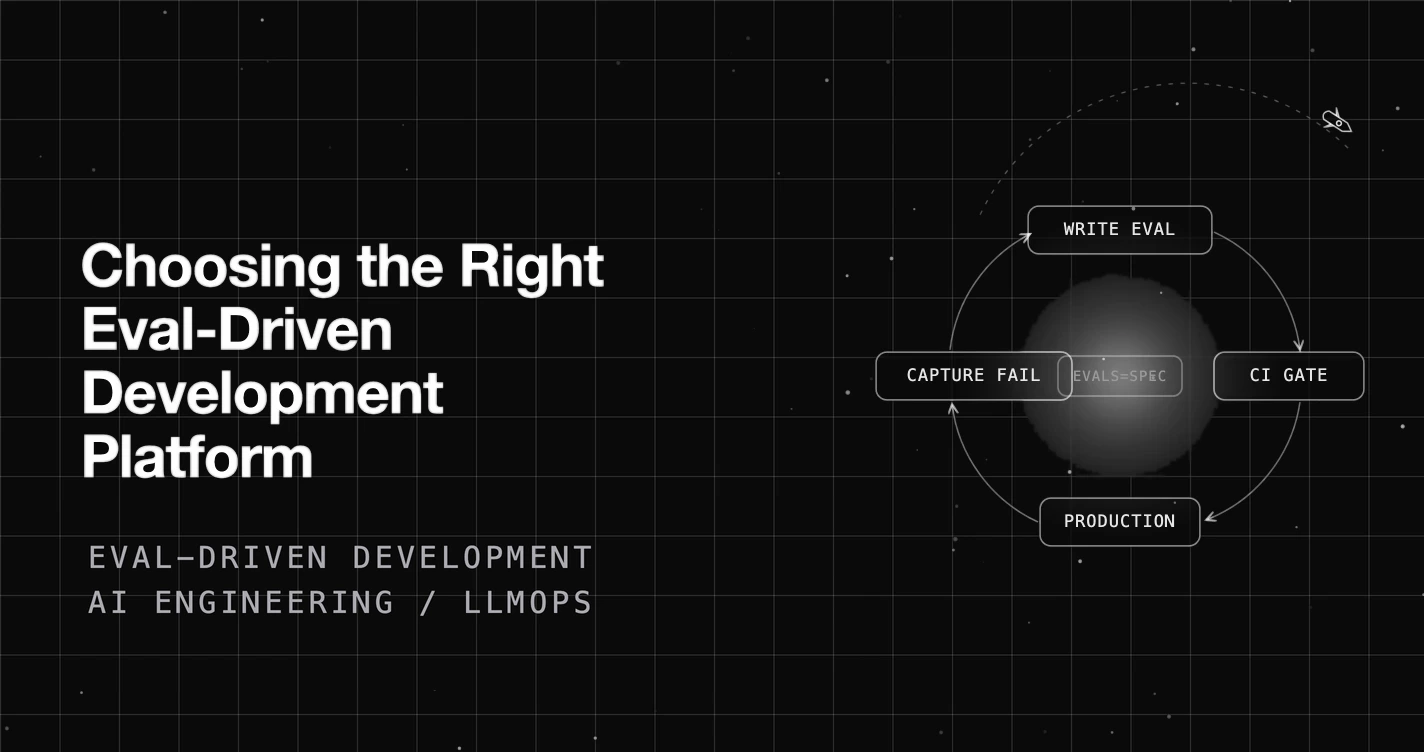
Eight factors for choosing an eval-driven development platform for AI teams: evals as spec, CI gating, dev-prod parity, regression loops, and optimization.

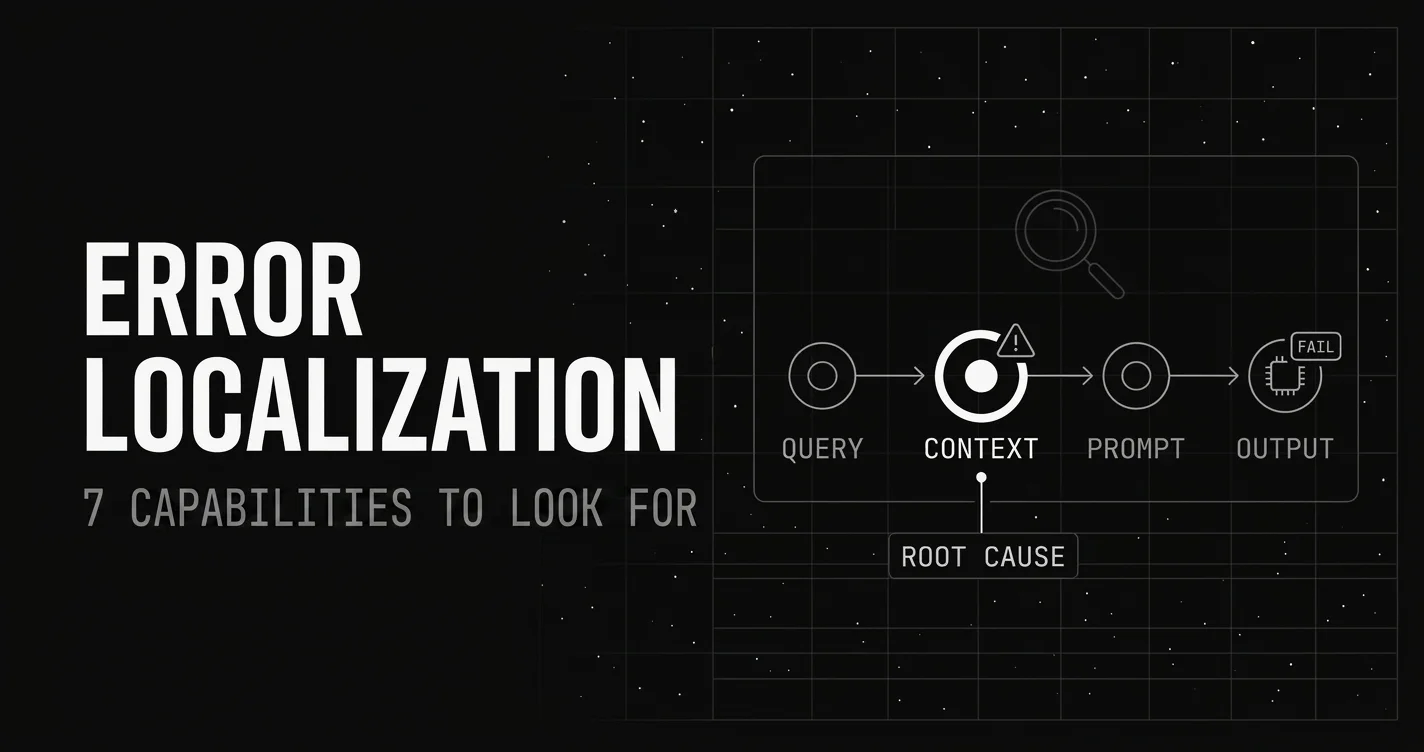
Seven capabilities to look for in error localization when choosing an LLM eval platform: field-level attribution, span-tied failures, reasoning, and production fit.