Choosing the Right Prompt Injection Defense Tool for AI Agents: 8 Factors to Compare
Eight factors for choosing a prompt injection defense tool for AI agents: catching indirect injection, blocking at runtime, constraining tools, securing MCP.
Table of Contents
The fastest way to choose the wrong prompt injection defense tool is to test it on a malicious user message and assume your agent is covered. A team adds an injection filter to the user prompt, watches it block an obvious jailbreak, and ships the agent. Then the real attack arrives where they were not looking: a document in the agent’s knowledge base contains hidden instructions, the agent reads it as part of a tool result, and follows them, calling a tool it should never have touched and sending data where it should not go. The filter on the front door held while the attacker walked in through a tool.
That is the problem a prompt injection defense tool for AI agents has to solve, and it is why testing the user prompt is the wrong way to shop. An agent has tools, so a successful injection is not a bad sentence, it is an action, and the injection can arrive indirectly through any document or tool result the agent reads. So choosing a prompt injection defense tool is not about whether it catches an obvious jailbreak in the input. It is about whether it screens the untrusted content the agent reads, blocks before the agent acts, and constrains what the agent can do when something slips through. Here are the 8 factors that separate a real prompt injection defense tool for agents from an input filter, and how to answer each.
TL;DR: choose a prompt injection defense tool that catches indirect injection in tool and retrieval content, blocks at the gateway before the agent acts, constrains the agent to least-privilege tools, protects the system prompt, secures the MCP layer, and is testable. No tool fully solves injection, so layer the defenses.
For the attack landscape, see prompt injection attack types and defenses and the broader LLM security guide.
Why choosing a prompt injection defense tool is harder than it looks
The trap is that injection defense looks solved when you only consider the user’s message. Block the obvious “ignore your instructions” and move on. But an agent does not only read the user. It reads tool results, retrieved documents, and web pages, and an instruction hidden in any of those is indirect injection, the attack a user-prompt filter never sees. The hardest part is not catching the crude direct attack; it is that the payload can ride in on any data source the agent touches.
The second trap is treating detection as the whole defense. Detection is necessary, but no detector catches every attack, and the moment one slips through, what matters is what the agent is allowed to do. An agent with unconstrained tool access turns a single missed injection into a destructive action, while an agent scoped to least-privilege tools survives the same miss. So the buying decision for a prompt injection defense tool is whether it screens the content the agent reads, constrains the agent’s tools, and assumes some attacks get through. The 8 factors below are weighted toward exactly that.
The 8 factors to ask before you choose
The Agent Injection Defense Test. Score each factor pass or fail. Aim for six or more. The rule it encodes: an agent’s blast radius is its tools, so injection defense must screen the untrusted content the agent reads and constrain what it can do, not just filter the user prompt.
| # | Factor | Pass if the tool… |
|---|---|---|
| 1 | Indirect injection | Screens tool, RAG, and web content, not just the user prompt |
| 2 | Runtime block | Blocks at the gateway before the agent acts |
| 3 | Tool least-privilege | Constrains which tools the agent can call |
| 4 | System prompt | Protects the system prompt from extraction and override |
| 5 | MCP security | Validates MCP and tool calls before execution |
| 6 | Red-teamable | Lets you test the agent against injection continuously |
| 7 | Audit trail | Records blocked injections for review and triage |
| 8 | Honest scope | Treats injection as defense-in-depth, not solved |
1. Does it catch indirect injection from tools, RAG, and web content the agent reads?
Why it matters: the dominant agent attack does not come from the user. It rides in on a document, a web page, or a tool result the agent reads as data but the model treats as instructions. A tool that only screens the user prompt is blind to it.
What to look for: screening of the untrusted content the agent ingests, including tool outputs and retrieved documents, so an instruction hidden in a knowledge-base file is caught the same way a malicious user message is.
What to avoid: an input-only filter that checks the user’s message and nothing the agent later reads, which leaves every tool and data source open.
How FutureAGI fits: FutureAGI’s Protect layer runs a Prompt Injection scanner at the gateway and screens tool calls and arguments through MCP Security and Input Validation, so an injection arriving through a tool result is caught, not only the user’s message. Because the scan sits in the request path, the poisoned content is flagged before the agent acts on it. An input-only tool misses this because the payload never appeared in the prompt, only in the data the agent later read.
2. Does it block inline at the gateway, before the agent acts?
Why it matters: detection after the agent has already called the tool is a postmortem. For an agent, the dangerous moment is the action, so the defense has to intervene before the model is called or a tool runs, not after the damage.
What to look for: a tool that runs inline in the request path, at the gateway, and can block a flagged request before it reaches the model or triggers a tool, in real time.
What to avoid: a scanner that analyzes logs after the fact, which tells you the agent was hijacked only once it already acted.
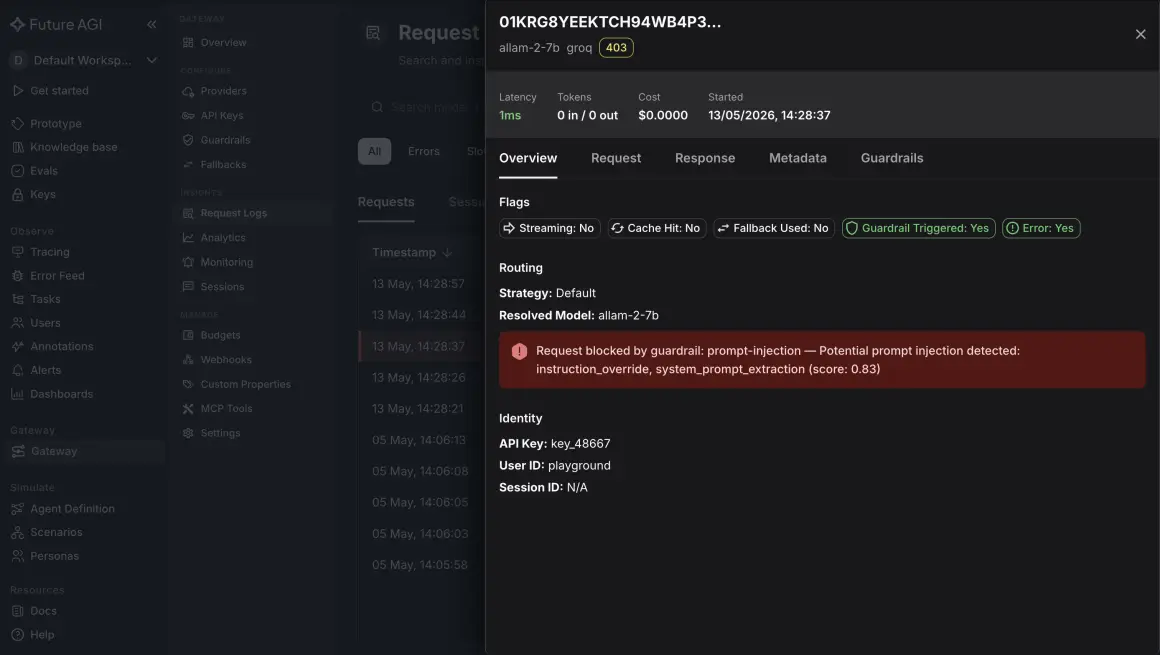
How FutureAGI fits: FutureAGI runs its injection scanner inline at the gateway, so a flagged request is blocked before the model is called or a tool executes. The screenshot in the section below shows a request blocked at the gateway for prompt injection, with the attack patterns flagged and the call refused, before the agent could act on it. A log-scanning tool misses this because the action already happened. For the runtime model, see agent runtime guardrails.
3. Does it constrain which tools the agent can call?
Why it matters: detection will sometimes fail, and when it does, the only thing standing between a missed injection and a destructive action is what the agent is allowed to do. An agent that can call any tool turns one slip into a breach.
What to look for: least-privilege tool controls, an allow or deny list scoping the agent to the tools it actually needs, so even a successful injection cannot trigger an action outside that scope.
What to avoid: an agent with unconstrained tool access and a defense that relies entirely on catching every attack, which has no margin for a miss.
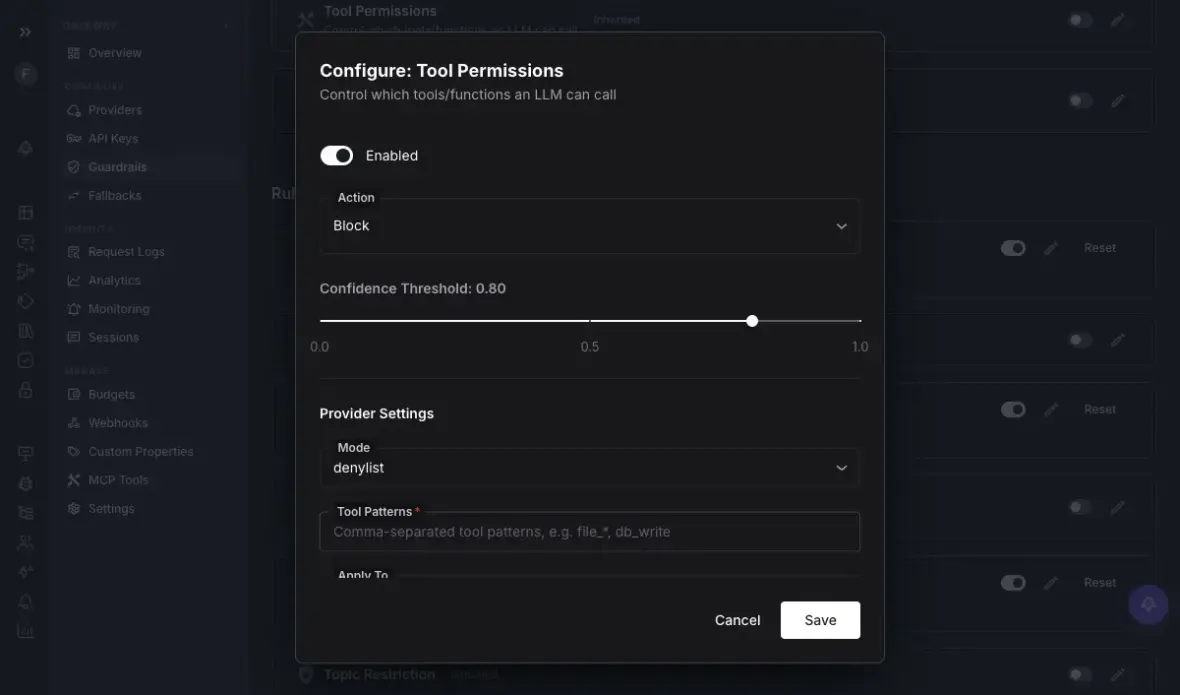
How FutureAGI fits: FutureAGI’s Tool Permissions scanner constrains the agent to an allow or deny list with a block action, so a tool outside the agent’s scope cannot be called even under a successful injection. The screenshot below shows the tool-permission control, with a block action, a denylist, and tool patterns, so a coerced agent still cannot reach a tool you did not grant. An unconstrained agent fails this because the injection inherits all of the agent’s power. The control caps the blast radius regardless of whether detection held.
4. Does it protect the system prompt from extraction and override?
Why it matters: the system prompt is the agent’s policy, and a common injection goal is to read it or rewrite it. Leak it and an attacker learns how to manipulate the agent; override it and they have changed the rules entirely.
What to look for: a guard that watches for system-prompt extraction and override attempts and stops the response, so the agent’s instructions are neither exposed nor replaced.
What to avoid: a tool with no system-prompt protection, which lets an attacker pull or overwrite the instructions that govern the agent.
How FutureAGI fits: FutureAGI’s System Prompt Protection scanner watches for extraction and override attempts and stops the response, so the agent’s instructions are not leaked or rewritten by a crafted prompt. The earlier blocked-request example flagged exactly this pattern, system-prompt extraction, alongside the injection. A tool without this guard misses it because the extraction looks like an ordinary request until the prompt is already out. Protecting the policy is part of protecting the agent.
5. Does it secure the MCP and tool layer?
Why it matters: the Model Context Protocol and tool integrations are an increasingly targeted agent attack surface. A poisoned MCP server, a malicious tool schema, or a crafted tool argument can drive an agent without ever touching the user prompt.
What to look for: validation of MCP and tool calls before execution, checking tool schemas and arguments against policy, so an unauthorized or malformed call is rejected rather than run.
What to avoid: an injection filter with no awareness of MCP or tool calls, which leaves the layer attackers increasingly target wide open.
How FutureAGI fits: FutureAGI’s MCP Security scanner validates tool calls against policy before they execute, and Input Validation rejects malformed or suspicious tool arguments, so a poisoned MCP server or a crafted call is caught at the tool boundary. That extends defense from the prompt to the tools the agent actually invokes. A prompt-only filter misses this because the attack lives in the tool layer, not the message. For evaluating that layer, see evaluating tool-calling agents.
6. Can you red-team the agent against injection, continuously?
Why it matters: a defense you cannot test is a defense you cannot trust, and injection attacks evolve, so a catch rate you measured once and never again quietly drifts down. You need to attack your own agent, repeatedly.
What to look for: adversarial simulation that replays known injection attacks against the full agent trajectory, runnable on every change, so you can measure the catch rate over time and gate a release on a regression.
What to avoid: a tool with no testing harness, which leaves you guessing whether the defense still works against this month’s attacks.
How FutureAGI fits: FutureAGI’s Simulate, its agent-testing module, drives the agent through adversarial personas and multi-turn scenarios you define, so you can build injection test cases and run them against the agent before you ship and on every change. That turns red-teaming into a repeatable test instead of a one-time audit. A defense with no harness misses this because nobody is attacking it but the attackers. For the simulation approach, see the simulation docs.
7. Does it record blocked injections for audit and triage?
Why it matters: when security asks what attacks your agent faced and what the defense did, a silent blocker leaves you nothing. You need a record of what was flagged and stopped, both to prove the control and to spot a campaign.
What to look for: a recorded trail of blocked attempts, with the flagged patterns and context, queryable so a security team can investigate and see recurring attacks rather than isolated events.
What to avoid: a tool that blocks invisibly with no log, which leaves you unable to review what happened or notice a pattern.
How FutureAGI fits: FutureAGI records each scan verdict as a trace attribute and a queryable log entry, so a blocked injection is an investigable record with the flagged patterns, not a silent drop, and recurring attacks surface for triage. That is what a security review needs instead of an assurance. A silent blocker misses this because it kept no evidence. The record turns defense into something you can audit and improve.
8. Can any tool fully solve prompt injection?
Why it matters: here the honest answer is the one that keeps you safe. A vendor that claims to have solved prompt injection invites you to drop the other controls, which is exactly where the next attack gets through.
What to look for: a tool that is clear injection is an open problem, that detection is one layer among several, and that expects to sit inside a defense-in-depth posture with least-privilege tools, monitoring, and red-teaming.
What to avoid: a vendor promising complete protection from prompt injection, which is the claim least likely to survive contact with a determined attacker.
Where FutureAGI is honest about this one: FutureAGI does not claim to have solved prompt injection, because no one has. Its scanners catch known patterns, but the durable protection is the combination: detection, least-privilege tool permissions so a miss cannot do much, system-prompt protection, an audit trail, and continuous red-teaming. Each layer lowers the risk; together they make a successful attack much harder and much less damaging. High-stakes agents still need human review and least-privilege design on top. If you want a single switch that makes an agent un-attackable, no tool is that, and the ones that say so are the ones to avoid.
A quick decision framework
The factors are the test; here is how the answers map to a pick.
| Choose | When | What decides it |
|---|---|---|
| An indirect-injection-aware tool | Your agent reads documents, web, or tool results | Factors 1 and 5; a user-prompt filter misses the document that carried the payload |
| A tool-permission-first defense | Your agent can take destructive actions | Factor 3; if a missed injection can call any tool, detection is your only line |
| A runtime gateway defense | A bad action is an incident, not a typo | Factor 2; a log scanner acts after the agent already moved |
| Defense-in-depth, not one tool | You run agents anywhere that matters | Factor 8; no single control solves injection, so layer them |
Where FutureAGI fits
The 8 factors get you a layered defense: indirect injection screened, blocked at runtime, tools constrained, system prompt protected, MCP secured, and tested. Past the individual controls, three things matter to teams defending agents that the checklist does not cover: running injection defense with the other guardrails, keeping the policy stable across providers, and being able to investigate what was blocked.
Injection defense is one of the guardrails, in one policy layer. An attack rarely comes alone: the same request that carries an injection might carry a PII leak or a secret. FutureAGI runs Prompt Injection alongside PII detection, content moderation, secret detection, and more, so one guardrail layer covers injection and the rest at the same hop, instead of a stack of single-purpose tools.
The agent’s defense travels with the agent. A defense that only works for one model weakens the moment you switch providers. FutureAGI applies the same injection scanners and tool-permission policy whether the agent runs on OpenAI, Anthropic, or a self-hosted model, and the gateway is self-hostable in your VPC, so an agent’s protection is a property of the agent and its policy, not of whichever provider it happens to call this week.
See a campaign, not just a single block. A blocked attack in isolation is a data point; a security team needs the pattern. Because every block lands on the same traces as the agent’s behavior, FutureAGI lets you investigate an attack in the context of the run it targeted and spot recurring attempts across requests, rather than only counting them. The screenshot below shows a request blocked for prompt injection, with the patterns flagged and the call refused, the kind of record an incident review actually needs.
Where FutureAGI is not the pick: no tool solves prompt injection, and FutureAGI does not claim to. It lowers risk through layered controls, but a high-stakes agent still needs least-privilege design and human review on top. FutureAGI earns its place when an agent has tools, reads untrusted content, and the defense has to cover the whole path. See the Protect documentation or the Agent Command Center for the gateway and scanners.
What to read next
- Prompt Injection Attack Types and Defenses (2026): the attacks behind the factors, direct and indirect, with how each is defended.
- Evaluating Tool-Calling Agents (2026): how to test the tool layer that Factors 3 and 5 are about.
- Best AI Gateways for Prompt Injection Defense (2026): if you would rather see specific gateways ranked than work the factors yourself.
- Ultimate Guide to LLM Guardrails (2026): where injection defense sits among the other runtime guardrails an agent needs.
Frequently Asked Questions About Prompt Injection Defense Tools
What is a prompt injection defense tool for AI agents?
A prompt injection defense tool detects and blocks attempts to hijack an AI agent through malicious instructions hidden in its inputs. For an agent, those instructions do not only come from the user: they arrive in tool results, retrieved documents, and web pages the agent reads, which is indirect injection. Because an agent has tools, a successful injection can make it call a destructive action, exfiltrate data, or leak its system prompt. A real defense tool screens the untrusted content the agent reads, blocks at runtime before the agent acts, constrains which tools it can call, and is testable against attacks.
Why is prompt injection worse for agents than for chatbots?
Because an agent has tools, and tools are blast radius. A chatbot under injection can say something wrong; an agent under injection can take an action: call an API, delete a record, send data to an attacker, or chain into other tools. The attack surface is also larger, since the injection can arrive indirectly through any document or tool result the agent reads, not just the user message. So defending an agent is not only about filtering input, it is about constraining what the agent is allowed to do when an injection slips through.
What is indirect prompt injection?
Indirect prompt injection is an attack delivered not by the user but through content the model later reads: a poisoned web page, a malicious document in a RAG corpus, or a crafted tool result. The agent retrieves the content as data, but the model treats the embedded instructions as commands. It is the dominant agent attack surface because every new tool, connector, and data source the agent can read is another way in. A defense that only checks the user prompt misses it entirely, so screening tool and retrieval content is essential.
Can a tool completely stop prompt injection?
No, and any vendor claiming to have solved prompt injection should be treated with suspicion. It is an open problem, and no single detector catches every attack, especially as attackers find new encodings and phrasings. The realistic goal is defense-in-depth: detect known injection patterns, constrain the agent to least-privilege tools so a slip cannot do much, protect the system prompt, monitor and record what was blocked, and red-team continuously. Layered controls lower the risk; they do not make an agent un-attackable.
How do you test an agent against prompt injection?
You red-team it. Maintain a corpus of known injection attacks across categories, direct and indirect, encoded and role-play and tool-call, and run them through your defenses on every change, tracking the catch rate over time and gating releases on a regression. Adversarial simulation that replays attacks against the full agent trajectory, not just single prompts, catches the failure modes a static test set misses. The point is to measure your defense continuously, because the attacks keep evolving and a number you do not track will quietly drift down.
Inside Future AGI open source in Q2 2026: the platform shipped under Apache 2.0, Error Feed and the Agent Command Center went live, traces hit billions.

Eight factors for choosing an AI guardrails platform for legal AI: real-time blocking, confidentiality, fabricated-citation detection, tool permissioning, and self-hosting.

Seven questions for choosing an AI guardrails platform for healthcare AI: real-time PHI blocking, output-side scanning, hallucination checks, and self-hosting.