Best 5 MCP Gateways in 2026: Post-RCE Production Picks
Five MCP gateways for production AI agents in 2026, scored on the Future AGI Production Gateway Scorecard after the April Anthropic STDIO RCE.
Table of Contents
Originally published May 12, 2026. Updated May 16, 2026.
A growth-stage SaaS team rolled an autonomous coding agent that called a community MCP server for repository search, and woke up to find an attacker had pushed a malicious server name through the STDIO transport and exfiltrated their AWS keys and Kubernetes config to an attacker-controlled endpoint inside the first hour. This guide compares the five MCP gateways production teams should consider in 2026, ranked by what security teams ship after the April 15, 2026 OX Security disclosure of the Anthropic MCP STDIO RCE class, not what vendors put in a one-pager.
TL;DR: The 5 Best MCP Gateways for 2026
Future AGI Agent Command Center is the strongest single pick for an MCP gateway in 2026 because it ships native MCP and A2A protocol support, a dedicated MCP Security guardrail scanner, OAuth 2.1 enforcement, and OpenTelemetry-native audit telemetry in one Apache 2.0 Go binary you can self-host. License clarity and acquisition independence are now part of the MCP gateway decision: Helicone is in maintenance mode after the March 3, 2026 Mintlify acquisition, LiteLLM carries the March 24, 2026 PyPI supply-chain risk plus CVE-2026-30623 in April, and Portkey is being merged into Palo Alto Networks (close expected in PANW fiscal Q4 2026).
| # | Platform | Best for |
|---|---|---|
| 1 | Future AGI Agent Command Center | Native MCP plus A2A plus MCP Security scanner plus OAuth 2.1 plus OTel-native audit in one Apache 2.0 Go binary |
| 2 | Lunar.dev MCPX | Open-source MCP gateway with a governance-first policy engine |
| 3 | IBM ContextForge | Multi-protocol federation across MCP, REST-to-MCP, and gRPC |
| 4 | Composio | Teams that want the broadest managed MCP server catalog out of the box |
| 5 | Maxim Bifrost | Go shops where MCP and LLM routing throughput is the binding constraint |
The 5 MCP Gateways at a Glance
The pattern is the same across agentic coding workflows, customer-support copilots, internal research agents, and regulated enterprise rollouts. MCP gateways with tool allowlists, OAuth 2.1, audit logging, and guardrails on the MCP path are what keeps production agents inside the blast radius after the April 2026 STDIO RCE class.
Read the eight-row superlative table first, then the five-platform shortlist with the one-line reason each made the cut.
| Superlative | Tool |
|---|---|
| Best overall for production MCP | Future AGI Agent Command Center: native MCP plus A2A plus MCP Security scanner plus 18+ guardrails in one Apache 2.0 Go binary |
| Best open-source MCP gateway | Lunar.dev MCPX: pure-play OSS MCP gateway with policy engine and audit trail |
| Best for OpenTelemetry-native MCP audit | Future AGI Agent Command Center: Prometheus on /-/metrics plus OTLP traces with span-level tool-call capture |
| Best for sub-100 ms MCP guardrails | Future AGI Agent Command Center: 18+ built-in scanners including a dedicated MCP Security scanner |
| Best for multi-protocol federation | IBM ContextForge: MCP, REST-to-MCP, and gRPC under one federation layer |
| Best for managed MCP server catalog | Composio: large hosted server inventory with dev SDK ergonomics |
| Best for self-hosted or air-gapped | Future AGI Agent Command Center: Apache 2.0 single Go binary |
| Best for raw throughput | Maxim Bifrost: vendor-published 11 microsecond P50 at 5,000 RPS on t3.xlarge |
| # | Platform | Best for | License or pricing model |
|---|---|---|---|
| 1 | Future AGI Agent Command Center | Teams that want native MCP plus A2A plus OAuth 2.1 plus OTel-native audit in one self-hostable binary | Apache 2.0; cloud at gateway.futureagi.com/v1 or self-host |
| 2 | Lunar.dev MCPX | Open-source MCP gateway with declarative policy and audit out of the box | OSS plus cloud |
| 3 | IBM ContextForge | Multi-protocol federation across MCP, REST-to-MCP, and gRPC | Apache 2.0 |
| 4 | Composio | Broadest hosted MCP server catalog plus developer SDK | Source available plus cloud |
| 5 | Maxim Bifrost | Go shops that need MCP plus LLM routing throughput in one Go binary | Apache 2.0 |
Helicone, LiteLLM, and Portkey are intentionally not in the ranked list. Helicone shifted under Mintlify in March 2026, LiteLLM carries the March 2026 PyPI supply-chain incident plus the April CVE-2026-30623 STDIO command injection, and Portkey is being merged into Palo Alto Networks.
Teams already on any of these should treat the next 12 months as a planned migration window. The trust-cohort sidebar below covers the dates and sources.
How Did We Score These MCP Gateways?
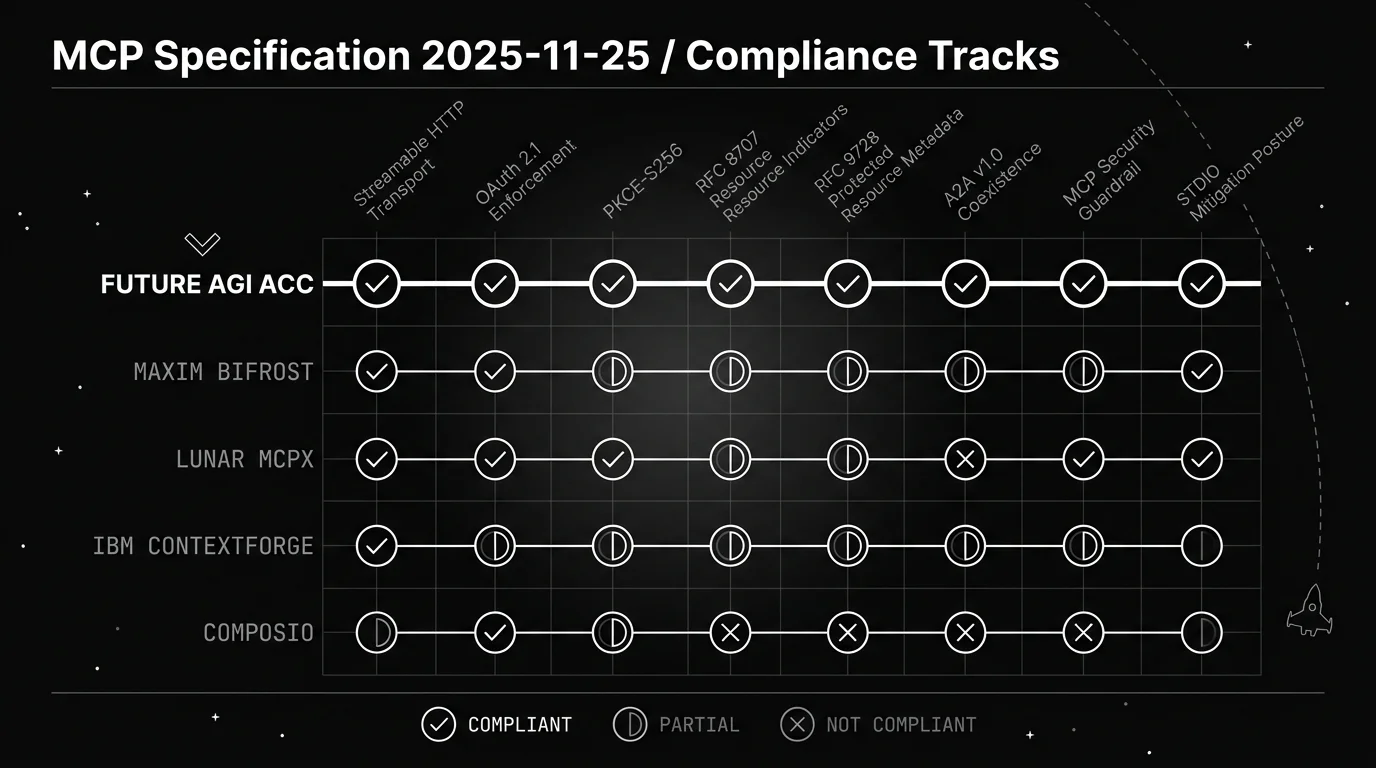
We used the Future AGI Production Gateway Scorecard, a seven-dimension rubric for production MCP and LLM gateway workloads. Most listicles compare MCP gateways on feature checklists and call it a day.
Production MCP gateway choice needs a sharper rubric, because a feature checklist falls short when the gateway that lists every protocol ships no audit trail and the gateway that supports fewer protocols emits the audit log your CISO already trusts.
| # | Dimension | What we measure |
|---|---|---|
| 1 | Provider and protocol breadth | MCP transport surface (STDIO, Streamable HTTP, WebSocket); A2A protocol support; LLM provider count when the gateway also routes LLM calls |
| 2 | Latency overhead | Added P99 latency at production load; benchmark provenance (vendor-published versus independent CSV) |
| 3 | Guardrail depth on the MCP path | Built-in scanner count including a dedicated MCP Security scanner; sub-100 ms enforcement; tool poisoning detection |
| 4 | Observability and audit | OpenTelemetry-native traces with MCP semantic conventions; Prometheus metrics; per-request tool, agent, and argument capture |
| 5 | Deployment flexibility | License; self-host (Docker, Kubernetes); air-gapped; cloud managed; FedRAMP and SOC 2 path |
| 6 | AuthN, AuthZ, and policy | OAuth 2.1; per-agent tool allowlists; policy engine; scope rewriting; secrets management on the gateway boundary |
| 7 | Total cost of ownership | Self-host versus per-token markup; SDK migration effort; integration overhead for existing MCP servers |
Guardrail depth on the MCP path and AuthN/AuthZ policy are the two dimensions that decide whether the gateway actually contains the blast radius in production. The 16-row capability matrix in the next section is the input to this rubric.
We don’t publish a single composite score because the right priority depends on the buyer profile. The decision matrix below the per-tool reviews maps buyer profiles (regulated enterprise, open-source pure-play, integration breadth, agent throughput) to picks.
The 16-Dimension MCP Capability Matrix the SERP Is Missing
Across the five gateways below, Future AGI Agent Command Center leads on combined MCP plus A2A protocol surface, guardrail depth on the MCP path, OpenTelemetry-native audit, and deployment flexibility. MCPX wins on policy engine clarity for OSS pure-play deployments. ContextForge wins on multi-protocol federation. Composio wins on the managed server catalog. Bifrost wins on raw throughput.
The 16-row matrix below is the single thing every MCP gateway listicle on the SERP is missing: Maxim’s article caps at five or six columns, Lunar.dev’s at four, none ship pricing transparency, license clarity, or 2026 trust event status next to the feature list, and none ship FAQPage JSON LD or honest Limitations subheads inside each vendor section.
| Capability | Future AGI ACC | Lunar.dev MCPX | IBM ContextForge | Composio | Maxim Bifrost |
|---|---|---|---|---|---|
| Routing strategies (count) | 6 named (15 routing and reliability combined) | MCP first (LLM via pair) | Multi-protocol federation | Catalog routing | 6 plus |
| Pricing model | Apache 2.0 plus cloud | OSS plus cloud | Apache 2.0 | Source available plus cloud | Apache 2.0 |
| Language and runtime | Single Go binary | Go and TypeScript | Python | Node and Python SDKs | Single Go binary |
| Supported providers (LLM) | 100 plus | LLM via paired gateway | LLM agnostic | 250 plus | 1,000 plus models |
| MCP transport | STDIO, Streamable HTTP, WebSocket | STDIO, Streamable HTTP | STDIO, Streamable HTTP, gRPC | STDIO, Streamable HTTP | STDIO, Streamable HTTP |
| A2A protocol | Yes | No (MCP focus) | Federation only | No | Partial |
| OAuth 2.1 enforcement | Yes (gateway boundary) | Yes (policy engine) | Yes (plugin) | Yes (managed) | Yes |
| Tool allowlist plus scope rewriting | Yes | Yes (declarative policy) | Yes | Partial | Yes |
| Built-in guardrails on MCP path | 18+ scanners including MCP Security | Policy plus secrets | Plugin-based | Limited | Partial |
| Exact and semantic caching | Yes (in-memory, Redis, Qdrant, Pinecone) | Partial | Plugin-based | No | Yes |
| OpenTelemetry-native audit | Prometheus /-/metrics plus OTLP traces | OTel partial | OTel via plugin | Managed dashboard | OTel partial |
| Deployment options | Docker, Kubernetes, air-gapped, cloud | Docker, Kubernetes | Docker, Kubernetes, on-prem | Cloud plus self-host | Docker, Kubernetes |
| Setup time | Minutes (drop-in) | Minutes to hours | Hours | Minutes | Minutes |
| Open source | Yes (Apache 2.0) | Yes (OSS core) | Yes (Apache 2.0) | Source available | Yes (Apache 2.0) |
| Acquisition or trust risk (May 2026) | None | None | None | None (independent) | None |
| Vendor-published benchmark | About 29,000 req/s, P99 21 ms with guardrails on, t3.xlarge (vendor; independent reproduction pending) | None published | None published | None published | 11 microsecond P50 at 5,000 RPS, t3.xlarge (vendor; mock 60 ms upstream) |
The shape of the matrix is the shape your buying decision will be: nobody wins every column, and the four columns that matter most for production MCP (guardrails on the MCP path, OAuth 2.1 enforcement, OpenTelemetry-native audit, license and acquisition risk) are where the field separates.
The Post-RCE MCP Threat Model in 2026
On April 15, 2026, OX Security disclosed a design flaw in Anthropic’s MCP STDIO transport. Any process command passed to the STDIO interface executes on the host whether or not it spawns a valid MCP server.
The flaw is baked into the official Python, TypeScript, Java, and Rust SDKs. It affects roughly 7,000 publicly accessible MCP servers and 150 million plus downstream downloads across the ecosystem (sources: the Hacker News writeup of the Anthropic MCP STDIO design flaw and the OX Security advisory on MCP RCE vulnerabilities).
Anthropic confirmed the behavior is by design. Sanitization is the implementor’s responsibility, and the Model Context Protocol specification 2025-11-25 acknowledges the security model relies on developer enforcement rather than protocol-level controls. That puts the gateway on the critical path.
Production MCP gateways in 2026 ship four control planes you used to glue together yourself:
- Tool catalog and discovery. Every tool listing the gateway returns to the agent is filtered by an allowlist scoped to that agent’s role. Unknown servers don’t appear in the agent’s tool list.
- OAuth 2.1 authorization and policy. The gateway enforces OAuth 2.1 at the boundary, validates audience and scope, and rewrites tokens before passing requests downstream. Scope rewriting prevents an agent from inheriting more privilege than it actually needs.
- Audit and OpenTelemetry. Every tool invocation captures agent identity, tool name, arguments, and response in an OpenTelemetry span tied back to the originating LLM call via
span_id. Audit logs flow into the same observability stack your platform team already operates. - Guardrails on the MCP path. A dedicated MCP Security scanner validates protocol traffic, blocks tool poisoning, and short-circuits prompt injection attempts that target tool arguments. This is the layer the April STDIO flaw was missing in default deployments.
A gateway that ships layers 1 and 2 but skips 3 and 4 is good for an internal demo and bad for production. The five reviews below are scored against all four.
Future AGI Agent Command Center: Best Overall for Production MCP
Future AGI Agent Command Center tops the 2026 MCP gateway list because it bundles every layer of the post-RCE MCP control stack at the same network hop in one Apache 2.0 Go binary you can self-host.
It loses on out-of-the-box managed dashboard polish (Composio wins that axis) and on raw single-dimension gateway overhead (Bifrost’s vendor-published 11 microsecond P50 is the lowest specific number on this list).
For teams whose buying constraint is OAuth 2.1 plus tool allowlists plus a dedicated MCP Security scanner plus OpenTelemetry-native audit in one self-hostable binary, the combined surface still puts it first.
The bundled surface is native MCP and A2A protocol support, a dedicated MCP Security guardrail scanner, OAuth 2.1 enforcement, exact plus semantic caching, and OpenTelemetry-native audit on /-/metrics. The full surface is documented in the Agent Command Center docs and the source ships at the Future AGI GitHub repo.
Best for. Engineering teams already running OpenTelemetry that want native MCP plus A2A protocol support, a dedicated MCP Security scanner, OAuth 2.1 enforcement at the gateway boundary, and per-agent tool allowlists feeding their existing observability stack, without wiring three open-source projects together.
Key strengths.
- Native MCP and A2A protocol support at the gateway layer; the same binary that routes LLM provider traffic also fronts MCP servers, so agent and tool calls share the same audit context.
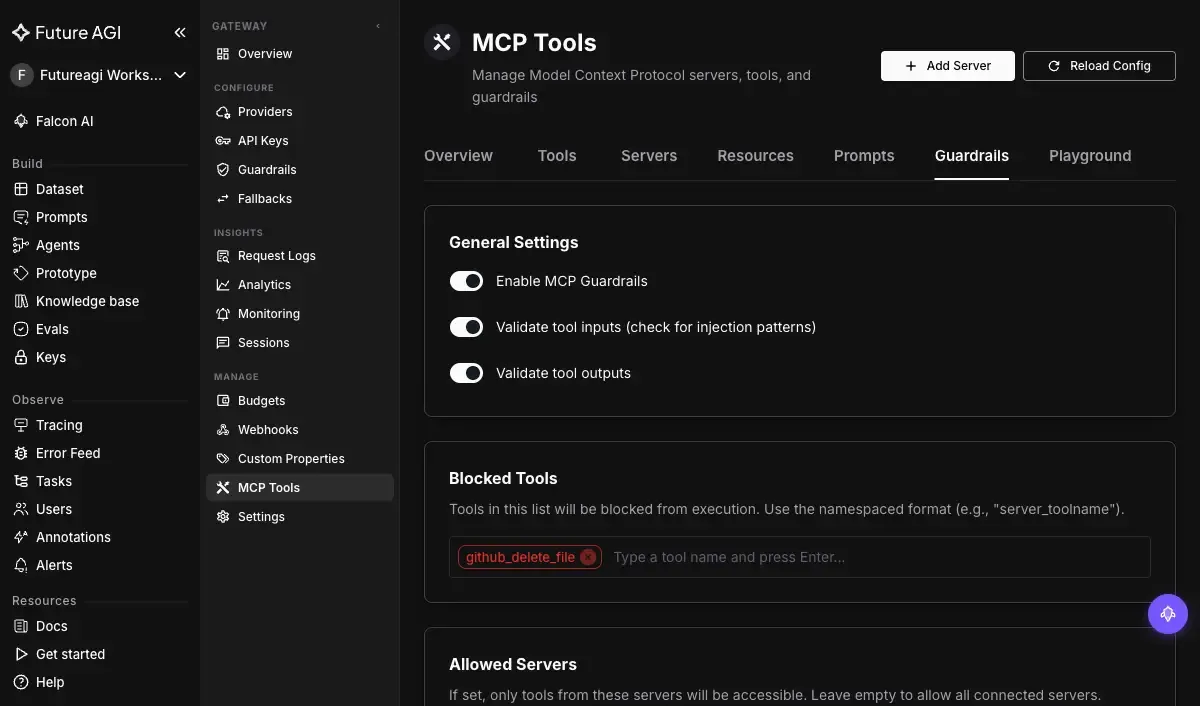
- The Future AGI Protect model family as the inline guardrail layer on the MCP path, ~67 ms p50 text and ~109 ms p50 image (arXiv 2510.13351). Protect is FAGI’s own fine-tuned model family built on Google’s Gemma 3n with specialized adapters across four safety dimensions (content moderation, bias detection, security/prompt-injection, data privacy/PII), natively multi-modal across text, image, and audio, a model family, not a plugin chain of third-party detectors. A dedicated MCP Security scanner sits alongside the four adapters and validates MCP protocol traffic, blocks tool poisoning, and short-circuits prompt injection attempts that target tool arguments. The same four dimensions are reusable as offline eval metrics so the prod policy and the eval rubric stay in sync.
- OAuth 2.1 enforcement at the gateway boundary with scope rewriting; per-agent tool allowlists; tag-based custom properties for tenant-level enforcement.
- OpenAI-compatible drop-in for the LLM side: change
base_urltohttps://gateway.futureagi.com/v1and keep existing OpenAI SDK code unchanged. - 100+ LLM providers (OpenAI, Anthropic, Google Gemini, AWS Bedrock, Azure OpenAI, Cohere, Groq, Together, Fireworks, Mistral, DeepInfra, Perplexity, Cerebras, xAI, OpenRouter, plus self-hosted via Ollama, vLLM, LM Studio).
- OpenTelemetry-native audit: per-tool-invocation span attributes capture agent identity, tool name, arguments, and response, with
span_idlinking back to the originating LLM call; Prometheus metrics on/-/metricsplus OTLP trace export feed Grafana and the Future AGI Evaluation pipeline.traceAIinstruments 35+ frameworks OpenInference-natively, and Error Feed (FAGI’s “Sentry for AI agents”) sits alongside as the zero-config error monitor: auto-clusters related per-agent tool-poisoning attempts and MCP failures (50 traces → 1 issue), auto-writes the root cause from the span evidence plus a quick fix plus a long-term recommendation per issue, and tracks rising/steady/falling trend per issue so emerging tool-injection patterns surface like exceptions rather than buried in trace search. - Apache 2.0; single Go binary; Docker, AWS, GCP, Azure, air-gapped or on-prem.
Limitations.
- Full execution tracing for agents is currently an “In Progress” roadmap item on the public roadmap in the Future AGI GitHub repo and is rolling out alongside the existing gateway-side OpenTelemetry trace export.
from openai import OpenAI

client = OpenAI(
    api_key="$FAGI_API_KEY",
    base_url="https://gateway.futureagi.com/v1",
)

# Existing OpenAI SDK code unchanged from here. MCP tool calls
# go through the same gateway hop, with OAuth 2.1 at the boundary,
# tool allowlists, and the MCP Security scanner inline.
response = client.chat.completions.create(
    model="anthropic/claude-3-5-sonnet",
    messages=[{"role": "user", "content": "Search repo for stale TODOs."}],
)
Where most MCP gateways stop at OAuth and audit, Agent Command Center attaches MCP protocol guardrails, per-agent tool allowlists, scope rewriting, and OpenTelemetry-native audit at the same network hop, so a malicious STDIO server name hits the guardrail wall before it hits the agent’s host.
Use case fit. Strong for engineering teams on OpenTelemetry, multi-tenant agentic SaaS, regulated enterprises needing OAuth 2.1 plus audit plus least privilege in one place, and platform teams that want eval plus tracing plus MCP plus LLM gateway in one Apache 2.0 stack. Less optimal for teams that want a fully managed MCP server catalog before any infrastructure code.
Pricing and deployment. Apache 2.0 single Go binary; cloud-hosted endpoint at https://gateway.futureagi.com/v1 or self-host (Docker, Docker Compose, AWS, GCP, Azure, air-gapped). SOC 2 Type II, HIPAA, GDPR, and CCPA all certified; BAA available via FAGI sales.
Verdict. The strongest single pick if your 2026 MCP gateway story is “we want OAuth 2.1 plus a dedicated MCP Security scanner plus per-agent tool allowlists in our existing OpenTelemetry stack, without operating three open-source projects under one team.” Tier-1 enterprises that want a managed MCP catalog before writing infrastructure code should still evaluate Composio alongside.
Lunar.dev MCPX: Best for Open-Source MCP Governance
Lunar.dev MCPX is the strongest open-source pure-play MCP gateway in 2026. It’s built around a governance-first policy engine and audit trail, and is the pick when the brief is “we want an open-source MCP gateway that ships policy as code on day one without writing a custom plugin.”
Best for. Engineering teams that want an open-source MCP gateway with a declarative policy engine, audit trail, and secrets management out of the box, paired with whatever LLM gateway already runs in production.
Key strengths.
- Pure-play MCP gateway; no LLM provider routing responsibility, so the surface area stays small and the policy story stays sharp.
- Declarative policy engine; tool allowlists, scope rewriting, and OAuth 2.1 are configured in code rather than per server.
- Audit trail is first class; every tool invocation captures agent identity, tool name, and arguments by default.
- Active maintainer community and published comparison content; Lunar.dev’s own April 2026 writeup on open-source MCP gateways is one of the few competitor blogs with a useful evaluation framework.
Limitations.
- No LLM provider routing; you pair MCPX with a separate LLM gateway (Future AGI Agent Command Center, Maxim Bifrost, or your own) to handle the model side.
- Guardrail depth is policy plus secrets, not the 18+ scanner library Future AGI ships; teams that need built-in tool poisoning detection across many shapes write more glue.
- Vendor benchmark not published as of May 2026; latency overhead is workload-dependent and should be measured against your own MCP server fleet.
Use case fit. Strong for engineering teams that already operate an LLM gateway, want a focused open-source MCP layer, and prefer policy as code over a guardrail library. Less optimal for teams that want one binary handling both LLM and MCP responsibilities.
Pricing and deployment. OSS core; cloud and enterprise tiers via Lunar.dev.
Verdict. The cleanest open-source pure-play MCP gateway in 2026. Pair with Future AGI Agent Command Center, Bifrost, or your own LLM gateway and you cover both sides of the agentic surface without overlap.
IBM ContextForge: Best for Multi-Protocol MCP Federation
IBM ContextForge is the strongest pick when the buying constraint is multi-protocol federation. It’s Apache 2.0, ships 40+ plugins, and federates MCP, REST-to-MCP, and gRPC under one gateway. It fits when “our agents talk to MCP servers, REST APIs we expose as MCP, and a couple of internal gRPC services” describes your environment.
Best for. Enterprise platform teams whose agentic surface spans MCP, REST APIs that need to be exposed as MCP, and internal gRPC services, who want one federation layer instead of three.
Key strengths.
- Multi-protocol federation across MCP, REST-to-MCP translation, and gRPC; the broadest protocol surface on this list.
- Apache 2.0; 40+ plugins covering authentication, observability, transformation, and policy.
- Backed by IBM’s enterprise governance heritage and a long maintainer history for adjacent open-source projects.
- OpenTelemetry support via plugin; multi-region deployment patterns documented.
Limitations.
- Configuration complexity is higher than single-binary alternatives; the federation surface is the strength and the cost.
- Enterprise governance polish is improving but is less mature than IBM’s older API governance products.
- Built-in guardrail scanner library is plugin-based rather than out of the box, so the MCP Security scanner equivalent is something you assemble.
Use case fit. Strong for enterprises with mixed protocol surfaces, regulated environments that want IBM as the vendor of record, and teams that prefer plugin ecosystems over single-binary feature consolidation. Less optimal for teams whose surface is MCP-only and who want minimum operational footprint.
Pricing and deployment. Apache 2.0; Docker, Kubernetes, on-prem; commercial support via IBM.
Verdict. The federation-strongest pick on this list. Worth the higher operational footprint if your agentic surface genuinely spans MCP plus REST-to-MCP plus gRPC; less compelling for MCP-only deployments.
Composio: Best for the Broadest Managed MCP Server Catalog
Composio is the strongest pick when the brief is “we need 200+ MCP servers wired up by Friday and the team doesn’t want to operate any of them.” It’s a managed MCP server catalog plus developer SDK that handles the glue between agents and hundreds of third-party tools (GitHub, Slack, Notion, Linear, Jira, and beyond).
Best for. Engineering teams that want the broadest hosted MCP server catalog out of the box, with developer SDK ergonomics, and are willing to run a managed catalog alongside whatever self-hosted MCP servers they keep in house.
Key strengths.
- Largest managed MCP server catalog on this list; covers most SaaS integrations engineering teams reach for.
- Developer SDK in Python and TypeScript; OAuth flow handled per integration.
- Managed dashboard with usage analytics, agent identity, and integration health.
- Active product velocity; tight feedback loop with the agentic developer community.
Limitations.
- Source available, not fully Apache 2.0; verify whether the open core covers your air-gapped requirements before signing.
- Built-in guardrail depth on the MCP path is limited; pair with a guardrail layer or an MCP gateway that ships an MCP Security scanner.
- Vendor benchmark not published; latency varies by integration and is dominated by the downstream SaaS API.
Use case fit. Strong for teams shipping consumer or internal agents that talk to many third-party SaaS tools, founders who want time to value over operational control, and teams that want a managed catalog plus a self-hosted gateway in series. Less optimal for regulated environments that require Apache 2.0 across the board.
Pricing and deployment. Source available core; managed cloud catalog; enterprise tiers.
Verdict. The catalog-breadth pick. Pair with Future AGI Agent Command Center or Lunar.dev MCPX for the guardrail and OAuth 2.1 layer the managed catalog can’t fully replace.
Maxim Bifrost: Best for Raw MCP Throughput on Go
Maxim Bifrost is the Go-native gateway from Maxim, Apache 2.0, with vendor-published throughput in the 11 microsecond P50 range at 5,000 requests per second on t3.xlarge (Maxim’s own harness with a mock 60 ms upstream). It also ships a separate brand around MCP token reduction (“Code Mode”) for Claude Code workflows.
It’s the MCP gateway most often cited when throughput is the binding constraint, and it ships LLM routing plus MCP features in one binary.
Best for. Teams whose binding constraint is gateway throughput at high agent concurrency, plus teams running Claude Code at scale that want to reduce MCP tool-call token cost on the hot path.
Key strengths.
- Vendor-published benchmark showing roughly 11 microsecond mean P50 at 5,000 RPS on
t3.xlarge(Maxim’s own harness with a mock 60 ms upstream). - Apache 2.0, single Go binary, drop-in deployment for both LLM provider routing and MCP gateway features.
- Code Mode for MCP token reduction in Claude Code workflows; vendor-claimed up to 92.8 percent input-token reduction across 508 tools on 16 MCP servers.
- Active product velocity and aggressive content cadence keep the brand visible across the gateway category.
Limitations.
- Maxim self-ranks Bifrost number one across its own gateway listicles with no published limitations, a trust signal worth weighing.
- Observability and audit dashboards on the MCP path are thinner than Future AGI’s; teams that need MCP semantic conventions in OpenTelemetry today end up writing custom exporters.
- Throughput claims are vendor-published on a mock 60 ms harness; independent reproduction is still light. Treat as a baseline rather than a settled benchmark.
Use case fit. Strong for Go shops, high-throughput agent inference paths, and teams running Claude Code at scale. Less optimal where the buying constraint is centered on per-agent tool allowlists with scope rewriting and OpenTelemetry-native MCP audit.
Pricing and deployment. Apache 2.0; Docker, Kubernetes; commercial cloud tier via Maxim.
Verdict. Strong throughput numbers and real engineering credibility, but the “go faster” pitch isn’t the same as the “contain the blast radius” pitch. Choose Bifrost when throughput is the primary axis; choose elsewhere when MCP-path guardrails and per-agent audit are.
The 2026 MCP and Gateway Migration and Trust Cohort
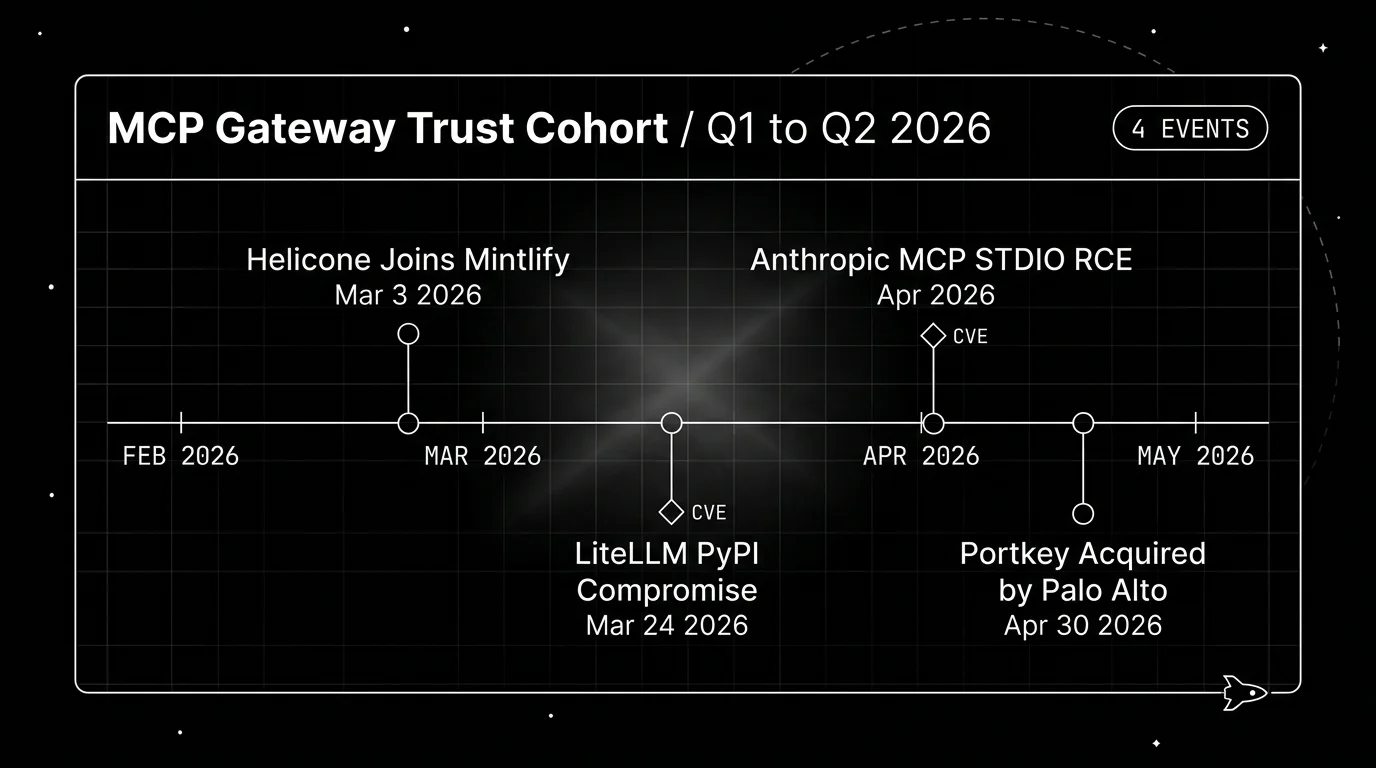
Every MCP gateway listicle on the SERP is treating these as if they didn’t happen. They did, and they reshape the procurement question for the next 12 months.
- Helicone joining Mintlify (March 3, 2026). Helicone acquired by Mintlify; public roadmap shifts toward documentation platform first. Existing Helicone users should treat this as a planned migration window, not a continued procurement.
- LiteLLM PyPI supply-chain compromise (March 24, 2026). Versions
1.82.7and1.82.8were compromised on PyPI; the malicious package exfiltrated SSH keys, cloud credentials, and Kubernetes configs to an attacker-controlled endpoint (source: the Datadog Security Labs writeup of the LiteLLM PyPI compromise and the LiteLLM official advisory). The LiteLLM MCP server is downstream of the same package tree; pin commits to 1.82.6 or upgrade past 1.83.7. - Anthropic MCP STDIO RCE class (April 15, 2026). OX Security disclosed a design flaw in the official Python, TypeScript, Java, and Rust MCP SDKs; the STDIO transport executes arbitrary host commands. Anthropic confirmed the behavior is by design. CVE inventory grew to include LiteLLM authenticated RCE (CVE-2026-30623, fixed in 1.83.7-stable), plus assignments across Agent Zero, Upsonic, Flowise, Windsurf, DocsGPT, Jaaz, Langchain-Chatchat, Bisheng, MCP Inspector, and LibreChat. Gateways routing MCP traffic are now expected to enforce least-privilege tool access, OAuth 2.1, and Streamable HTTP transport over STDIO.
- Portkey acquired by Palo Alto Networks (April 30, 2026). Acquisition announced; the AI gateway roadmap is merging into Palo Alto’s Prisma AIRS network security platform. Close is expected in PANW fiscal Q4 2026 subject to customary closing conditions. Verify roadmap continuity before signing a multi-year contract. Primary source: the Palo Alto Networks press release.
The practical takeaway: for the next 12 months, license clarity, acquisition independence, and STDIO transport defaults are part of the MCP gateway decision. A cheap MCP gateway you have to migrate off in six months isn’t cheap.
MCP Gateway Picks by Buyer Profile in 2026
The buyer profile drives the pick more than the feature matrix does.
OpenTelemetry-first engineering teams pick Future AGI Agent Command Center; open-source pure-play teams pick Lunar.dev MCPX; multi-protocol federation buyers pick IBM ContextForge; integration-catalog buyers pick Composio; and Go shops where throughput is the binding constraint pick Maxim Bifrost.
| If you are a… | Pick | Why |
|---|---|---|
| Engineering team already on OpenTelemetry, OpenAI SDK heavy | Future AGI Agent Command Center | Native MCP plus A2A plus MCP Security scanner plus OTel-native audit in one Apache 2.0 Go binary |
| Regulated enterprise that needs OAuth 2.1 plus audit plus least privilege in one place | Future AGI Agent Command Center | Per-agent tool allowlists, scope rewriting, OAuth 2.1 at gateway boundary, audit via OTLP traces |
| Multi-tenant agentic SaaS that needs tag-based enforcement and per-tenant audit | Future AGI Agent Command Center | Tag-based custom properties plus span-level audit per tool invocation |
| Air-gapped or on-prem regulated environment | Future AGI Agent Command Center or IBM ContextForge | Apache 2.0; Docker, Kubernetes, air-gapped; ContextForge for multi-protocol federation |
| Open-source pure-play MCP team that already runs an LLM gateway | Lunar.dev MCPX | Declarative policy engine plus audit trail; pure-play OSS surface |
| Enterprise with mixed MCP plus REST plus gRPC surface | IBM ContextForge | Multi-protocol federation; 40+ plugins; Apache 2.0 |
| Team that needs broadest hosted MCP server catalog by Friday | Composio | Managed catalog plus developer SDK; pair with a guardrail layer |
| Go shop where MCP plus LLM throughput is the binding constraint | Maxim Bifrost | 11 microsecond P50 at 5,000 RPS; Apache 2.0 single Go binary |
| Team running Claude Code at scale | Maxim Bifrost | Code Mode MCP token reduction in the same gateway as LLM routing |
Which MCP Gateway Is Right for You in 2026?
MCP gateways in 2026 aren’t a single feature. They’re a stack: tool catalog and discovery, OAuth 2.1 authorization with scope rewriting, OpenTelemetry-native audit, and guardrails on the MCP path, running at the same network hop, attached to a license that isn’t about to be re-platformed inside an acquirer.
Of the five gateways above, Future AGI Agent Command Center is the strongest pick for the production case where the buying constraint is native MCP plus A2A plus a dedicated MCP Security scanner plus OAuth 2.1 plus OpenTelemetry-native audit in one Apache 2.0 Go binary you can self-host.
Lunar.dev MCPX is the right call when you already run an LLM gateway and want a focused open-source MCP gateway with declarative policy as code. IBM ContextForge is the right call when the agentic surface spans MCP, REST APIs, and gRPC and one federation layer is worth the extra operational footprint.
Composio is the right call when integration catalog breadth and time to value matter more than open-source license clarity. Maxim Bifrost is the right call when Go shop throughput plus Claude Code at scale outweigh per-agent tool allowlists with OTel-native audit.
For deeper reads on the patterns referenced above:
- The Agent Command Center docs for the full gateway feature surface.
- The Future AGI observability docs for the audit-log path the MCP gateway plugs into.
- The Future AGI Protect docs for the MCP Security scanner and the 18+ built-in guardrail library.
- The Future AGI Evaluation docs for the eval-to-gateway link via
span_idthat gates the next call after a low-quality tool response. - The Future AGI GitHub repo for the Apache 2.0 source.
External authority for the threat model and trust events cited above:
- The Hacker News writeup of the Anthropic MCP STDIO design flaw.
- The OX Security advisory on MCP RCE vulnerabilities.
- The Model Context Protocol specification 2025-11-25.
- The LiteLLM advisory for CVE-2026-30623 and the LiteLLM security update March 2026.
Try Agent Command Center free. Native MCP and A2A, MCP Security scanner, OAuth 2.1, and OpenTelemetry audit in one Apache 2.0 Go binary.
Related reading
- Best 5 AI Gateways for MCP Tool-Level Observability with Codex CLI in 2026
- Best 5 MCP Gateways for Claude Code in 2026, the MCP gateway picks for Claude Code teams
- Best 5 AI Gateways for LLM Cost Optimization in 2026, the five-layer cost stack and the 2026 trust cohort
- Best MCP Gateway for Claude Code to Cut Token Costs by 50 Percent in 2026, the deep-dive on cutting Claude Code MCP token costs
Frequently Asked Questions
What Is the Best MCP Gateway in 2026?
What Is an MCP Gateway and Why Do You Need One?
How Is an MCP Gateway Different From an AI Gateway?
Did the April 2026 Anthropic MCP STDIO RCE Make MCP Gateways Mandatory?
Which MCP Gateways Are Open Source and Production-Ready in 2026?
How Do MCP Gateways Enforce OAuth 2.1 and Least-Privilege Tool Access?
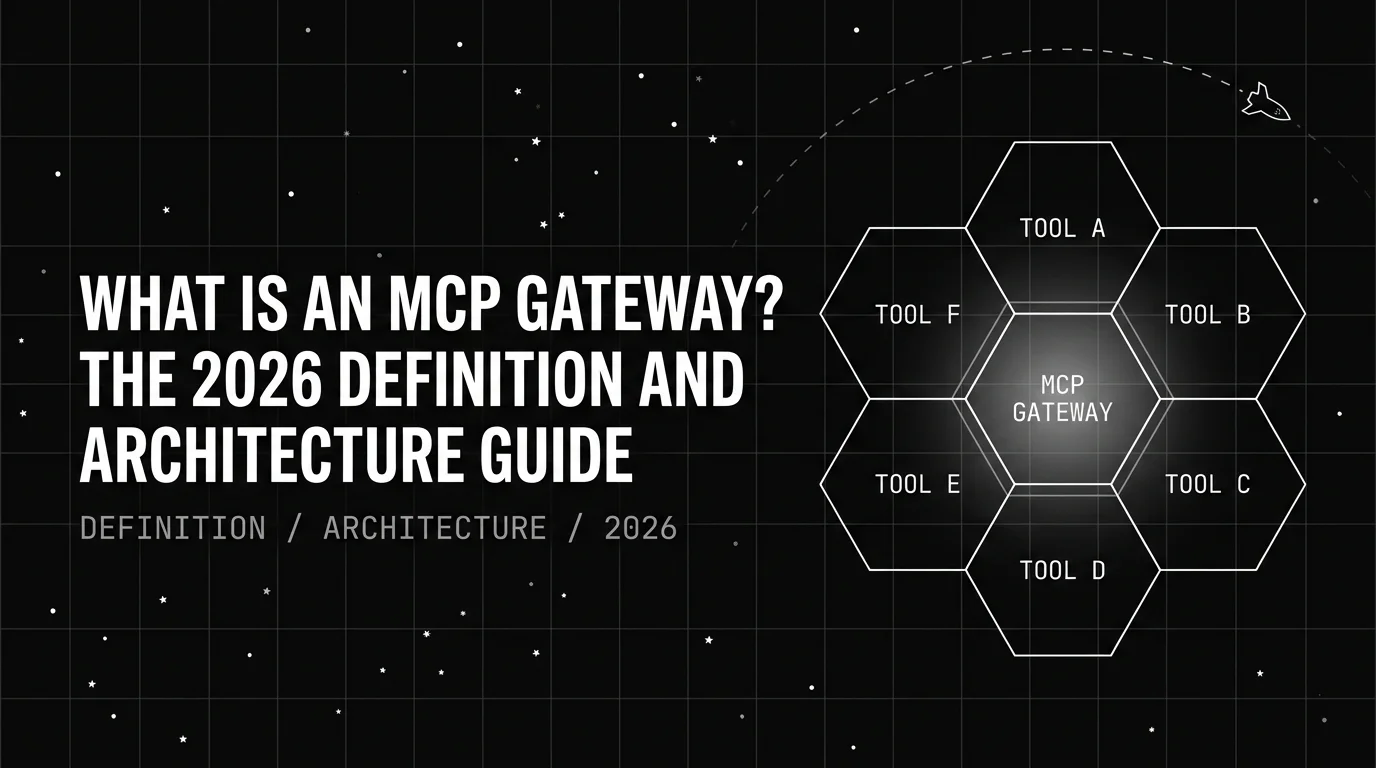
Canonical 2026 MCP gateway definition: MCP 2025-11-25, OAuth 2.1, OpenTelemetry GenAI, post-April STDIO RCE threat model, 5 named approaches, 12 steps.

Cloudflare MCP, Bifrost (Maxim), Composio, Smithery, MCP Inspector CLI, and Agent Command Center compared on registration, observability, auth, and OTel.

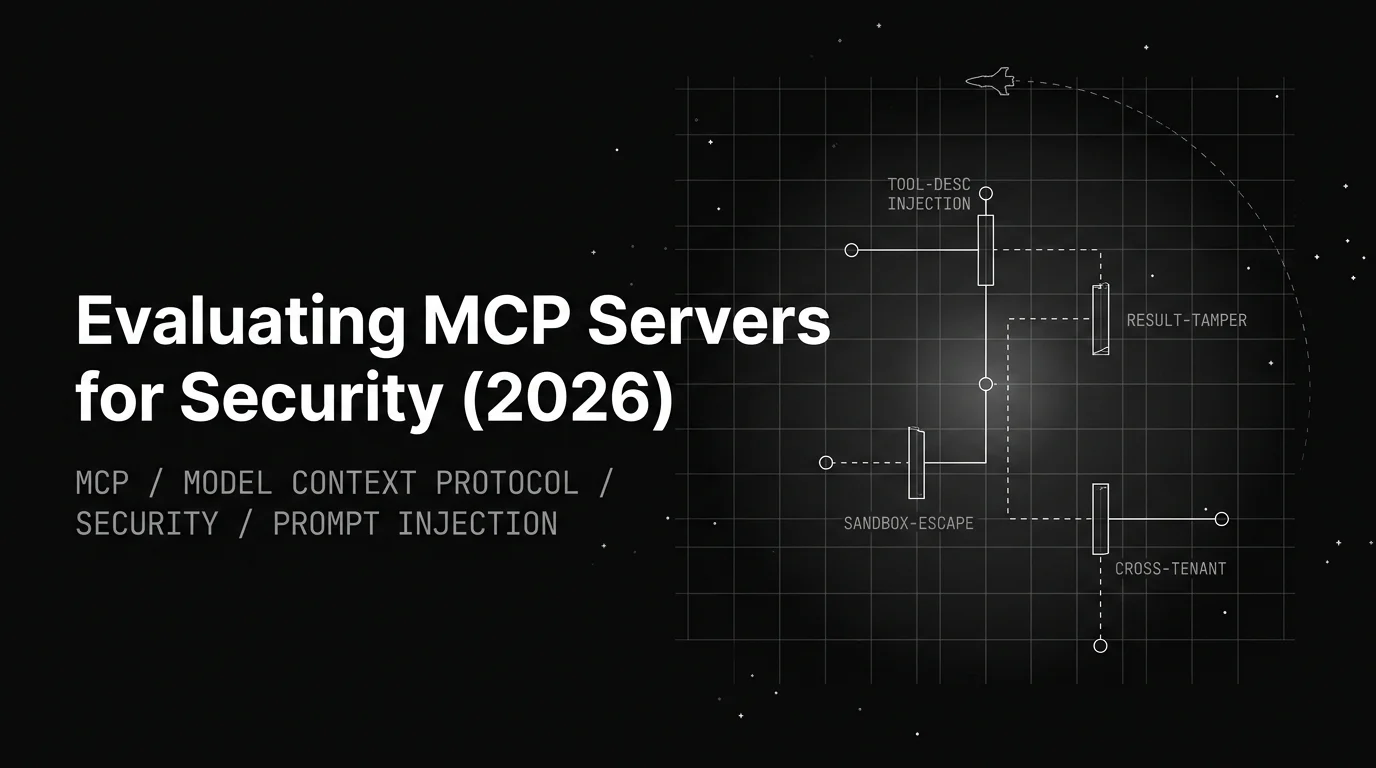
Evaluate MCP servers for security in 2026: tool-description injection, tool-result tampering, sandbox escape, cross-tenant isolation. Four eval checks.