The Best Agent Harnesses for AI Builders in 2026
A field guide to the best agent harnesses in 2026: Claude Code, Codex CLI, OpenHands, SWE-agent, Aider, Cline and more, and how to pick one for your stack.
Table of Contents
The word “harness” now stretches from a terminal coding tool to a full autonomy platform. This is a builder’s field guide to the named harnesses worth knowing in 2026, and what each one is genuinely good at.
You have decided not to hand-build the agent loop. Good call. The next question is harder: which agent harness do you actually adopt? Open a few “best of” lists and you get a wall of names, star counts that shifted last week, and very little on what separates one tool from the next.
This is a field guide to the harnesses worth knowing in 2026. Each one wraps a language model with the same core parts, the loop, the tools, the memory, and the permissions, so a model can read a repo, run a command, and finish a multi-step task. What differs is the shape of that scaffolding and the job it fits. If you want the ground-level definition first, the primer on what an agent harness is sets the stage.
The list stays vendor-neutral and names a real selection bar. No single tool wins every row. The goal is to match the harness to the work in front of you, and to flag the parts of this space that change fast enough to burn you.
The Short List: What Earns a Spot Here
Four things earn a spot: a public repository, active maintenance, real adoption, and a genuinely distinct approach. By that bar, the shortlist is Claude Code, OpenAI Codex CLI, OpenHands, SWE-agent, Aider, Cline, OpenCode, and Goose, plus two framework-style kits for teams building their own: LangChain Deep Agents and the OpenAI Agents SDK.
Star counts are deliberately kept out of the tables below. They move every week, they reward hype over fit, and a high number tells you nothing about whether a tool matches your stack. License and language are stable, so those stay. Everything else here is about approach and best fit.
The bar matters because it filters the noise. A repository that has not shipped a commit in months, or a viral tile with no history behind it, does not make the cut no matter how many stars it shows. What follows is the set that clears all four tests today.
| Harness | License | Language | Distinct approach | Best for |
|---|---|---|---|---|
| Claude Code | Proprietary | N/A | Terminal-native, deep MCP, subagents | Frontier-model terminal coding |
| Codex CLI | Apache 2.0 | Rust | Sandbox-first, high npm adoption | Local sandboxed coding |
| OpenHands | MIT | Python | Event-stream architecture | Autonomous multi-step dev |
| SWE-agent | MIT | Python | Agent-computer interface (ACI) | Research and SWE-bench work |
| Aider | Apache 2.0 | Python | Repo map, Architect/Editor split | Pair programming in a repo |
| Cline | Apache 2.0 | TypeScript | Editor-embedded, @cline/sdk | VS Code and IDE workflows |
| OpenCode | MIT | TypeScript | Plan and Build modes, provider-agnostic | Terminal, any provider |
| Goose | Apache 2.0 | Rust | 70+ MCP extensions | MCP-heavy tool ecosystems |
| Deep Agents | MIT | Python | Harness scaffolding as a library | Building your own harness |
| Agents SDK | MIT | Python | Agents, handoffs, guardrails | Custom multi-agent systems |
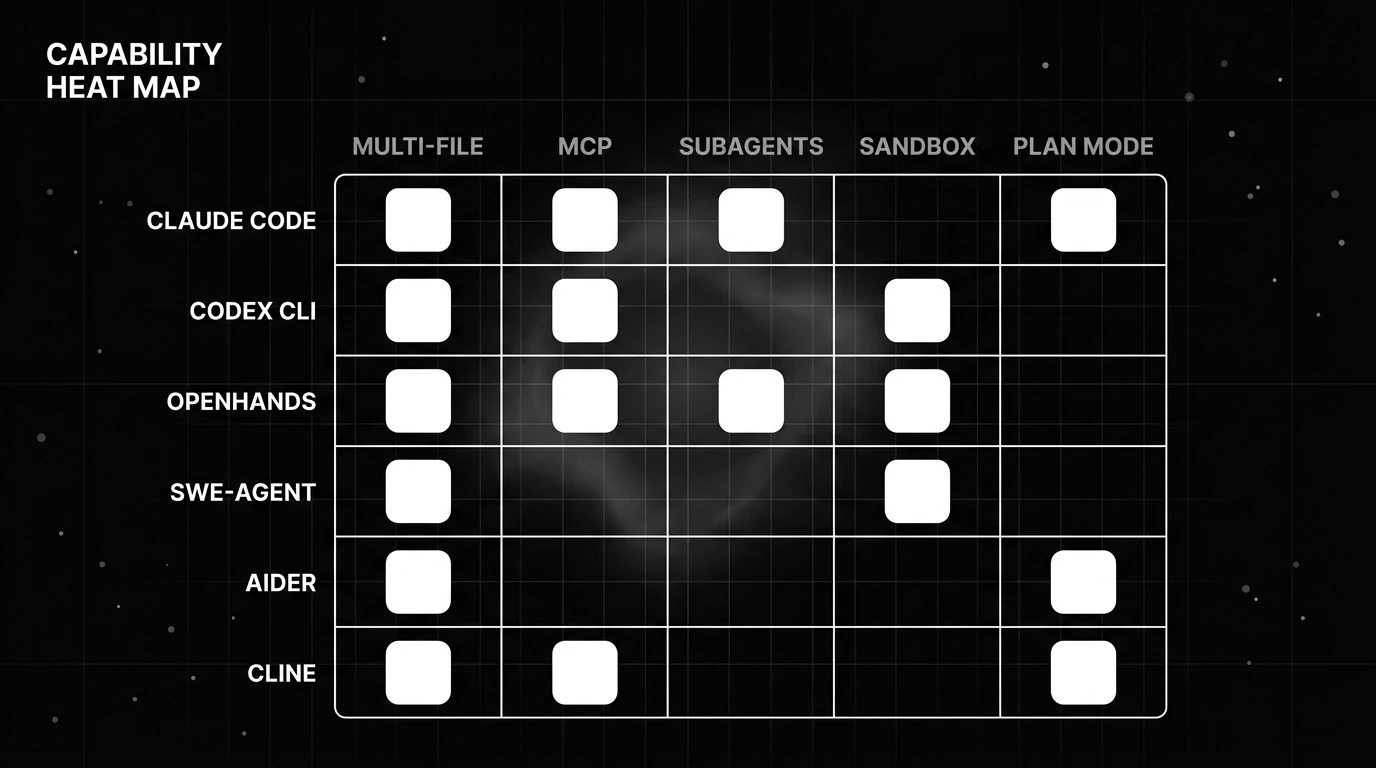
The heat map above reads at a glance: filled cells mean the capability ships in the box, empty cells mean you add it yourself. It is a quick way to see why two tools that look similar on paper fit very different jobs.
General-Purpose Coding Harnesses
These are the terminal-native, model-vendor harnesses most builders reach for first. Claude Code wraps Anthropic’s frontier models with deep Model Context Protocol support and subagents. OpenAI’s Codex CLI is an Apache 2.0, Rust-based, sandbox-first tool with tens of millions of monthly installs. Google’s Gemini CLI sits in this tier too, though its name is now in motion.
Claude Code runs in your terminal, holds the full agent loop, and leans hard on MCP for tools plus subagents for parallel work. It is proprietary and freely usable, and its docs now live at code.claude.com. Reach for it when you want a frontier model driving a terminal coding session with minimal setup.
OpenAI’s Codex CLI is open source under Apache 2.0, written in Rust, and built sandbox-first, so generated code runs inside an isolated environment by default. Its npm package sees tens of millions of installs a month as of mid-July 2026, which makes it one of the most widely deployed harnesses on this list.
What unites this tier is that the model vendor also ships the runtime, so the loop, the tool set, and the permission model are tuned together. Where they differ is trust posture. Codex leans on the sandbox to contain what generated code can touch, while Claude Code leans on interactive permission prompts and MCP servers for reach. Neither approach is strictly safer; they trade convenience against control in different places.
A Naming Caveat: Gemini CLI Is Becoming Antigravity CLI
Google’s Gemini CLI belongs in this tier, but its name is changing. At Google I/O in May 2026 the company introduced Antigravity CLI as the agent-first successor, and Gemini CLI stopped serving Pro and Ultra requests on June 18, 2026. The original repository is still live and Apache 2.0, so confirm the current name and support status before you standardize a team on it.
Open-Source Powerhouses
These community harnesses carry the deepest capability and the largest followings. OpenHands runs an event-stream architecture for autonomous work. SWE-agent introduced the agent-computer interface behind much SWE-bench research. Aider brings a repo map and an Architect/Editor split. Cline embeds in your editor. OpenCode and Goose cover the provider-agnostic terminal and MCP-heavy ends.
OpenHands, formerly OpenDevin, is MIT-licensed and built in Python around an event stream: every action the agent takes and every observation it gets back flows through one central log, which makes long autonomous runs easier to follow and replay. It is the common pick when you want fully open, self-hostable autonomy. SWE-agent, from Princeton and Stanford, is also MIT and Python, and it introduced the agent-computer interface: the idea that agents need purpose-built commands to browse and edit code. Its NeurIPS 2024 paper made it a research staple for SWE-bench work.
Aider is Apache 2.0 and focuses on pair programming inside an existing repository. Two ideas define it: a repo map that gives the model a compact view of your whole codebase, and an Architect/Editor split that lets one model plan a change while another writes the diff. It fits when you want to stay in the loop and drive edits interactively.
Cline is Apache 2.0 and TypeScript, and it lives inside your editor, most visibly as a VS Code extension. It now ships an @cline/sdk package too, so the same engine can run in a script or a custom tool. Reach for it when you want agent help without leaving the IDE.
OpenCode is MIT, TypeScript, and provider-agnostic: you point it at any model provider’s API key. It offers two modes you toggle with a keypress, Plan mode to propose an approach and Build mode to make the changes. Goose, created by Block, is Apache 2.0 and Rust, and its calling card is breadth: it connects to more than 70 tool extensions over MCP, which suits workflows that lean on many external systems.
Picking among these six comes down to where you want the agent to live. SWE-agent and OpenHands assume a headless, autonomous run you launch and monitor. Aider and Cline assume you are sitting right there, reviewing each change as it lands. OpenCode and Goose sit in between, terminal-first but happy to reach across many tools. Match that posture to how closely you want to supervise the work.
Framework-Style Harness Kits
For teams building a custom harness instead of adopting one, two libraries ship the loop scaffolding you would otherwise write yourself. LangChain Deep Agents (MIT) adds planning, subagents, and a virtual file system on top of a graph runtime. The OpenAI Agents SDK (MIT) gives you three primitives: agents, handoffs, and guardrails. Both sit closer to the framework end of the spectrum.
These are not ready-to-run coding agents the way Claude Code or Aider are. They are the parts kit: you assemble the agent, wire the tools, and decide the control flow. That places them on the framework side of a real boundary, which the harness versus framework comparison covers in depth. Choose them when no off-the-shelf harness matches your domain and you need to own the loop.
The trade is ownership for effort. A kit lets you shape the loop, the memory policy, and the tool boundary to your exact domain, but you carry the maintenance that a packaged harness would have absorbed. That pays off for a novel or non-coding agent, and it rarely pays off when a terminal coding harness already does the job.
How to Choose: Match the Harness to the Job
The honest answer is that the decision maps to concrete needs, not a leaderboard. Ask four questions. Terminal, editor, or SDK-embedded? Single agent or multi-agent? How much MCP tool breadth do you need? Which license posture and language fit your stack? Answer those and the field usually narrows to two or three real candidates.
License posture is a real axis, not a footnote. If you run in a regulated or air-gapped environment, an MIT or Apache 2.0 harness you can self-host and audit clears procurement in a way a proprietary CLI may not. If you just want the strongest terminal experience available today, that constraint may not apply to you at all. Decide which world you are in before you shortlist.
It also helps to picture the tools on one axis, from a minimal single-loop agent to a full multi-agent orchestrator. Aider and the vendor CLIs sit toward the lean end. OpenHands and the framework kits sit toward the orchestration end, where planning, subagents, and durable state carry more weight. The design that drives that spread is its own topic, covered in the harness architecture breakdown.
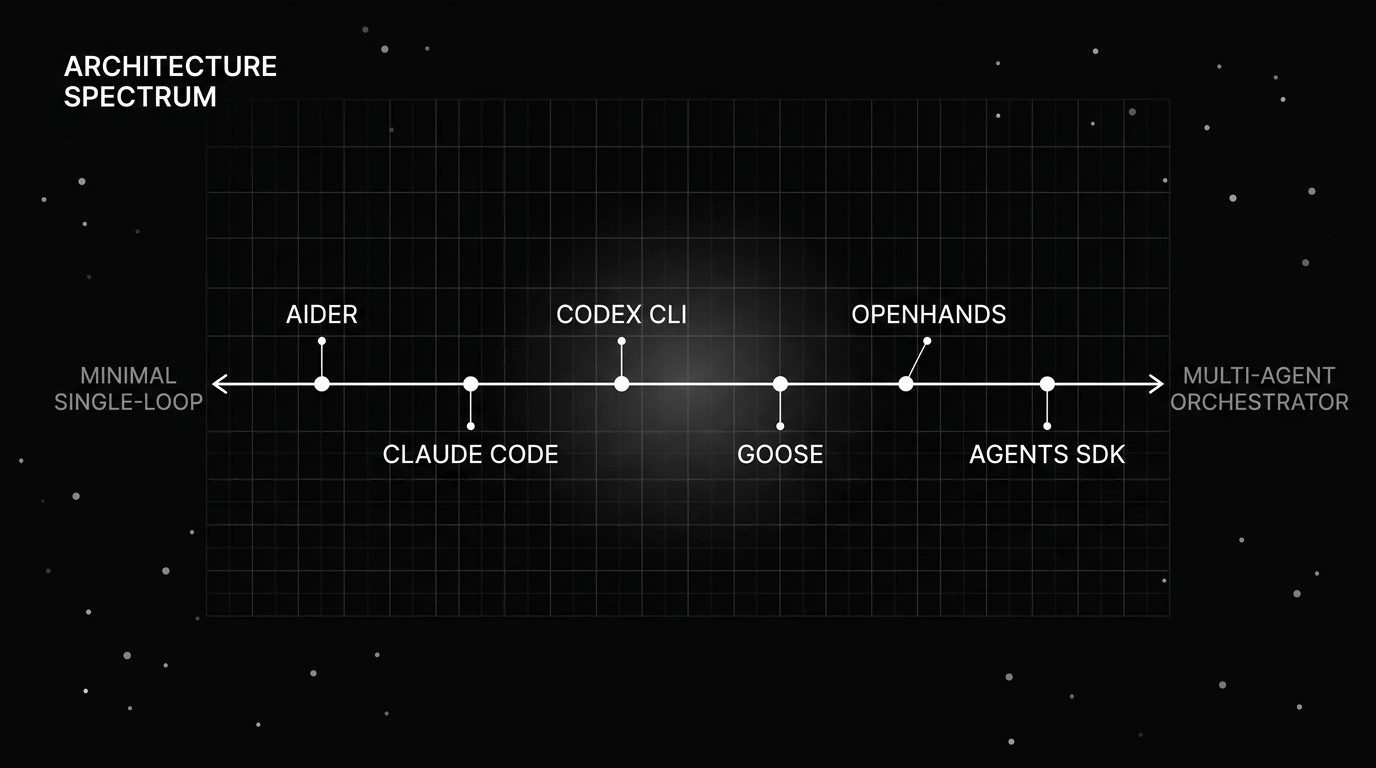
With that axis in mind, the decision guide below turns each common need into a concrete pick.
| If you need | Reach for | Why |
|---|---|---|
| Terminal coding on a frontier model | Claude Code or Codex CLI | Full loop and permissions out of the box |
| Fully open, self-hostable autonomy | OpenHands | MIT, event-stream, active community |
| Repo-aware pair programming | Aider | Repo map plus Architect/Editor split |
| IDE-embedded assistance | Cline | Editor integration and an SDK |
| Heavy MCP tool integration | Goose | More than 70 MCP extensions |
| To build your own harness | Deep Agents or Agents SDK | Loop scaffolding as a library |
The Fast-Moving Edges: Read Before You Adopt
This space churns weekly. Star counts swing, projects get renamed, and repositories change owners. OpenHands moved orgs, OpenCode shares its name with an older archived project, and several tools now live under renamed handles. Treat any ranking as a snapshot, and check a repo’s provenance and activity before you commit.
You will also see viral harness repos circulate with eye-catching star counts that do not survive a second look. Before adopting one, confirm the repository’s history, its license, and whether commits are recent. A big number on a leaderboard is not provenance, and an impressive tile can sit on top of an abandoned project. A quick check is the commit history and the release notes: a healthy harness shows steady commits, tagged releases, and open issues that get answered, while a stalled one shows a burst of stars around launch and little since.
One specific caution: OpenAI Swarm still shows up on lists, but its own README labels it experimental and educational, and OpenAI now points production users to the Agents SDK. Treat Swarm as a teaching tool, not a harness to ship on. The same care applies to any project whose only credential is a screenshot of its star graph.
So skip the hunt for a single best agent harness. The durable move is to write down what your work actually requires, terminal or IDE, one agent or many, how much tool breadth, and pick the harness that clears that bar today. When the rankings shift next month, your checklist still holds. And when you want to see how these tools are actually scored, the coding agent harness benchmarks guide shows how the same model can move tens of points across different scaffolds.
Frequently Asked Questions
What is the best agent harness in 2026?
What is the difference between an agent harness and an agent framework?
Are agent harnesses free and open source?
What is the best open-source coding agent harness?
Do I need a coding-specific harness or a general one?
How do I know which harness performs best?
An agent harness fails in production in four places: tool permissions, state, the control loop, and verification. Here is how to test yours before you ship.

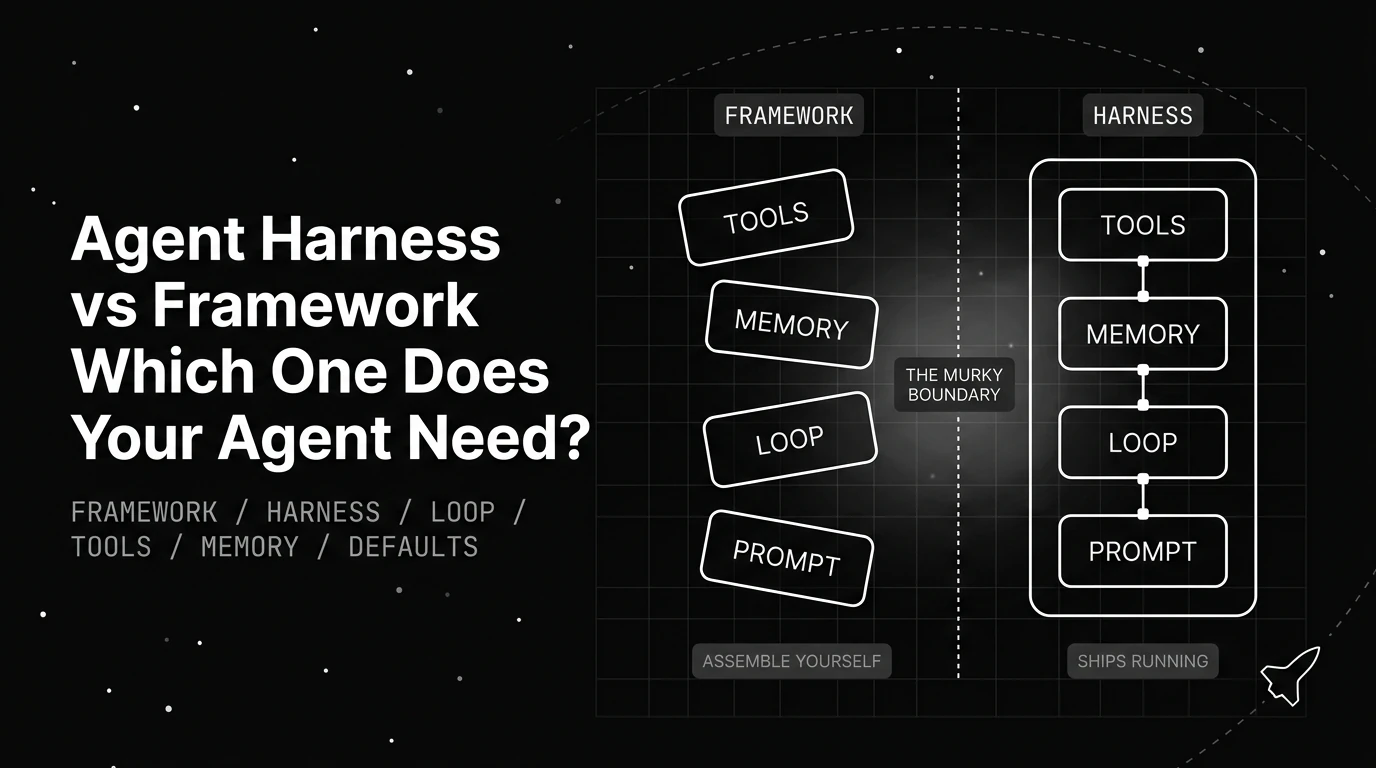
Agent harness vs framework: a framework supplies reusable abstractions, while a harness runs and controls the agent loop. Learn when you need each.

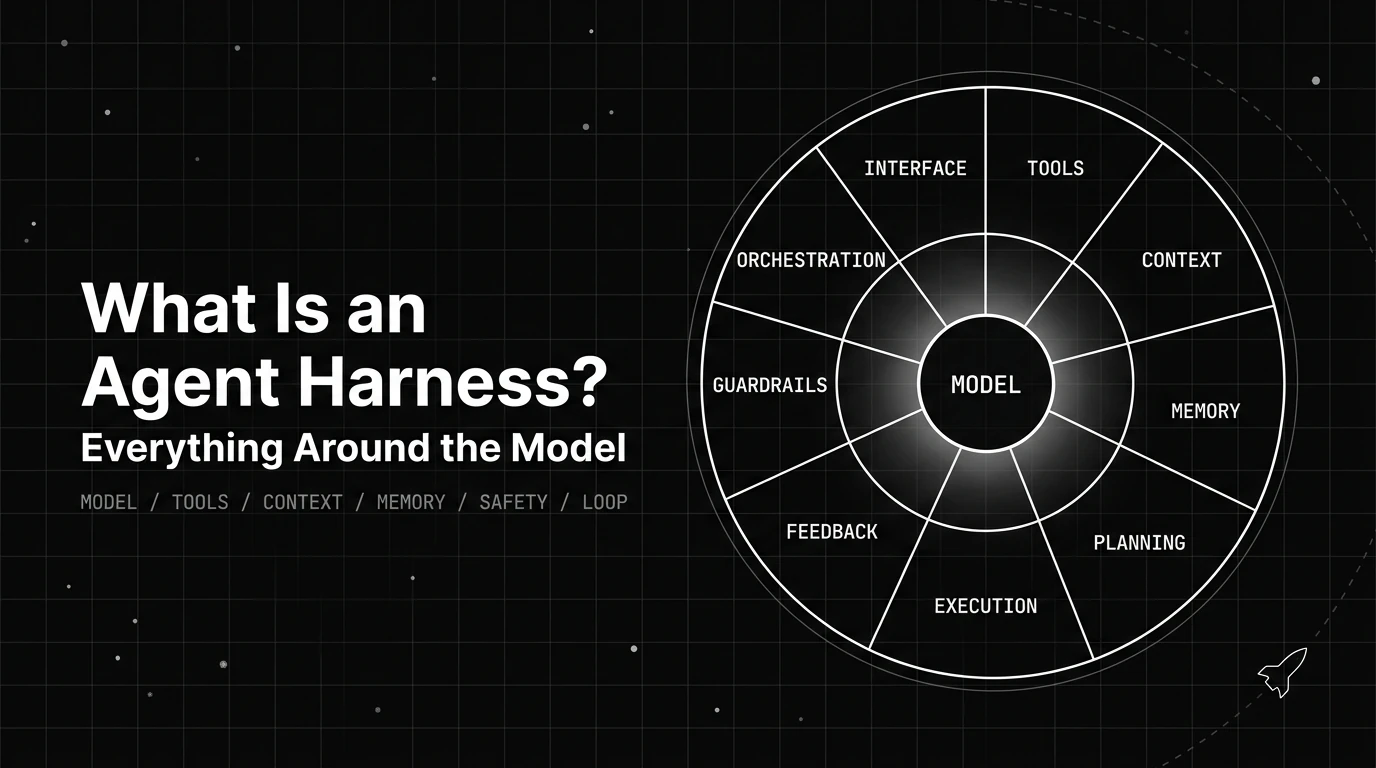
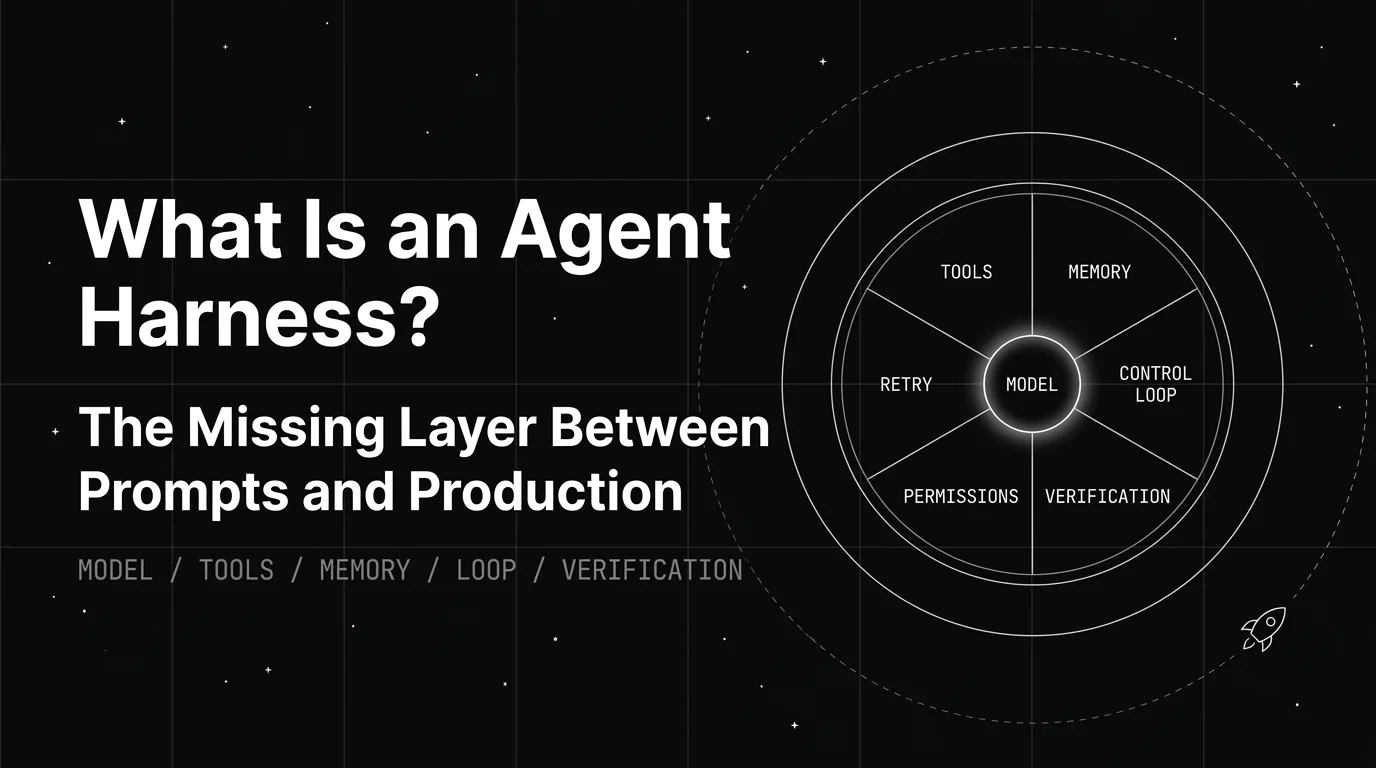
An agent harness is the runtime layer around an LLM that manages tools, context, state, execution, and safety. Learn how it shapes reliability.