API vs MCP in 2026: REST/gRPC vs Model Context Protocol Compared
API vs MCP in 2026: REST, gRPC, and GraphQL versus Model Context Protocol. Discovery, context streaming, security, versioning, and when to combine both.
Table of Contents
TL;DR: API vs MCP in 2026
| Dimension | Traditional API (REST, gRPC, GraphQL) | MCP (Model Context Protocol) |
|---|---|---|
| Year launched | 2000 (REST), 2015 (gRPC), 2015 (GraphQL) | November 2024 (Anthropic) |
| Primary consumer | Other services, web apps, mobile apps | LLM agents and AI hosts |
| Discovery | Static OpenAPI, GraphQL schema | Runtime tools/list, resources/list |
| Transport | HTTP/1.1, HTTP/2, WebSocket | stdio (local), Streamable HTTP with SSE (remote) |
| Wire format | JSON, Protocol Buffers, GraphQL | JSON-RPC 2.0 |
| Auth | OAuth 2.0, API keys, mTLS | OAuth 2.0 (2025-03-26 spec), bearer tokens, host-mediated |
| Streaming | gRPC bidirectional, SSE, WebSocket | Notifications, progress messages, partial results |
| Versioning | URL path (/v1) or headers | Protocol date tags (2024-11-05, 2025-03-26, 2025-06-18, 2025-11-25) |
| Best for | Service-to-service, web/mobile, latency-tight | Agent tool use, multi-host AI integration |
If you read one row: MCP does not replace REST or gRPC. MCP is the layer that lets LLM agents discover and use tools; REST and gRPC are the layer underneath that the MCP server usually wraps.
What is an API in 2026
An API is a request-response interface that lets one piece of software call another over a network. The three dominant flavors in 2026:
- REST. HTTP+JSON, resource-oriented, the default for web and mobile backends. Strengths: ubiquitous tooling, easy to cache, easy to test. Limits: no built-in tool discovery, no streaming by default (SSE bolts it on).
- gRPC. HTTP/2 with Protocol Buffers, supports unary, server streaming, client streaming, and bidirectional streaming. Strengths: efficient wire format, strong typing, streaming. Limits: less browser-friendly, requires .proto files.
- GraphQL. Single endpoint, client-specified field selection. Strengths: avoids over-fetch and under-fetch, strong typing. Limits: harder to cache, easier to over-query.
Across all three flavors, the consumer is usually another service or a web/mobile app. Adapting an API for an LLM agent traditionally means writing a custom function-calling wrapper per endpoint, which is what MCP was designed to eliminate.
What is MCP in 2026
The Model Context Protocol is an open standard introduced by Anthropic in November 2024. It defines a JSON-RPC 2.0 transport for AI clients (hosts) to communicate with servers that expose tools, resources, and prompts. The MCP architecture has three roles:
- Host. The application running the LLM (Claude Desktop, Cursor, Goose, Cline, Windsurf, custom).
- Client. A library inside the host that maintains an MCP connection to a server.
- Server. A process that advertises tools, resources, and prompts; the host’s LLM can invoke them.
The core MCP messages:
initialize: handshake, exchange protocol version and capabilities.tools/list: server returns its tool catalog with schemas.tools/call: client invokes a named tool with arguments.resources/listandresources/read: server exposes URI-addressable data.prompts/listandprompts/get: server exposes reusable prompt templates.notifications: server pushes progress, log, or change events.
Everything is JSON-RPC 2.0 over stdio (local) or Streamable HTTP with SSE (remote). The spec revisions are date-tagged: 2024-11-05, 2025-03-26 (OAuth 2.0, structured tool results, image content), 2025-06-18, 2025-11-25.
Core differences: API vs MCP
Discovery
- API: Static. Clients read OpenAPI, gRPC
.proto, or GraphQL schema at build time; adding a new endpoint usually means a client SDK regen. - MCP: Dynamic. Clients call
tools/listat runtime and receive the current tool catalog with schemas. A server can add a tool without any client change.
Context and state
- API: Stateless by default. Each request carries its own context (cookies, tokens, query params). Streaming requires explicit setup (SSE, WebSocket, gRPC streaming).
- MCP: Stateful by design. A connection persists, the server can push notifications, and the host accumulates conversation context that the LLM uses to choose tools.
Authentication
- API: Per-endpoint OAuth, API keys, mTLS. Configured outside the protocol.
- MCP: The 2025-03-26 specification revision added an OAuth 2.0 authorization framework; the protocol supports per-tool token scopes. In practice most 2026 MCP servers run with a single bearer token per server and lean on the host for end-user auth.
Streaming
- API: gRPC streaming, SSE on top of REST, WebSocket. Three different mechanisms.
- MCP: Notifications and progress messages over the single MCP transport. Same connection for request, response, and streamed updates.
Versioning
- API: URL versioning (/v1, /v2) or header versioning. Clients pin a version.
- MCP: Protocol versioning by date tag plus capability negotiation in
initialize. Tool schema changes are exposed through rediscovery (tools/list); teams should manage tool compatibility explicitly when shipping schema changes.
Failure handling
- API: Each call returns a status code; clients implement retries, backoff, error mapping.
- MCP: Errors return as JSON-RPC errors over the same channel; the LLM host typically surfaces them back to the model for retry or escalation.
Function invocation: API vs MCP from an LLM’s perspective
Via traditional API
When an LLM calls a REST or gRPC endpoint, the agent framework usually does the following:
- The framework loads tool schemas into the prompt (OpenAPI snippets or hand-written tool definitions).
- The LLM emits a function call as structured JSON (name + arguments).
- The framework parses the JSON, validates against the schema, and calls the endpoint.
- The framework returns the response to the LLM as a tool message.
Failure modes: the LLM hallucinates argument names, the schema in the prompt drifts from the actual API, every new endpoint needs a new tool definition and prompt update.
Via MCP
- The host opens an MCP connection and calls
tools/list; the server returns the live tool catalog. - The LLM sees the schema and decides to call a tool.
- The host sends
tools/call; the server executes and returns a structured result. - The host returns the result to the LLM.
Failure modes are similar but the schema lives on the server, not in the prompt template; adding or updating a tool is a server-side change, no prompt rewrite needed.
MCP gateways: the 2026 production layer
Raw MCP servers ship without enterprise features. Production teams in 2026 put an MCP gateway in front to handle:
- Auth. Per-tool scopes, RBAC, per-tenant tokens.
- Rate limiting. Per-tool, per-tenant, per-host quotas.
- Observability. Tool-call traces, latency histograms, error rates.
- Evaluation. Faithfulness, Helpfulness, Hallucination scores on tool inputs and outputs.
- Guardrails. PII filters, prompt-injection screens, output sanitization.
- Audit logs. Every tool call recorded for compliance.
Examples of MCP gateway approaches in 2026:
| Gateway approach | Strength | When to pick |
|---|---|---|
| Future AGI Agent Command Center | MCP gateway plus REST gateway, eval, observability, simulation, guardrails on one stack | Production agent stack that needs span-attached evaluation and gating on the same plane as the gateway |
| Open-source MCP proxy | Lightweight proxy, simple auth and rate-limit | Self-hosted, minimal feature set |
| Docs-platform MCP gateway | Developer documentation and host pairing | Docs-platform integration use |
| Self-built | Maximum control | When you must own the protocol layer for compliance |
The Agent Command Center supports both REST and MCP gateway routes in one runtime, so the same span carries the gateway hop, the eval scores, the guardrail decisions, and the audit log. The OSS pieces of the surrounding stack are Apache 2.0 traceAI and Apache 2.0 ai-evaluation.
Real-world patterns: where each protocol wins
Pattern 1: REST under MCP for tool exposure
Most production MCP servers wrap an existing REST API and expose it as MCP tools.
Example: a Stripe-backed billing service exposes /v1/charges over REST. An MCP server registers create_charge, refund_charge, and list_charges as tools; each tool internally calls the existing REST endpoint. Result: the web app still uses REST; the AI agent uses MCP; both share the same backing service.
Pattern 2: gRPC for backend, MCP for the agent
A microservice mesh uses gRPC for internal service-to-service traffic. The agent stack uses MCP to call the same services. An MCP server sits at the edge, translates tools/call to gRPC, and returns structured results.
Pattern 3: GraphQL for clients, MCP for agents
A consumer-facing API uses GraphQL for the web client. An MCP server exposes the same data through tool calls (get_user, get_order) instead of letting the agent issue arbitrary GraphQL queries (which is risky for cost and complexity).
Pattern 4: MCP-only for new tools
Greenfield tools that exist solely for LLM use can ship as MCP-only. Examples: code-search tools, internal knowledge-base lookup, custom data analysis. No REST equivalent needed.
When to pick API vs MCP
Pick by consumer:
- Service-to-service traffic, web app, mobile app: REST or gRPC.
- LLM agent calling tools or fetching resources: MCP.
- Both consumers want the same data: REST or gRPC underneath, MCP wrapper for the agent.
Pick by latency budget:
- Sub-50ms p99: gRPC over HTTP/2 with Protocol Buffers.
- 100-500ms acceptable: REST or MCP both work.
Pick by maturity:
- Mission-critical, decade of tooling: REST or gRPC.
- Agent-first product, MCP-compatible host: MCP.
Security considerations for MCP in 2026
MCP added structured security work in the 2025-03-26 and 2025-11-25 revisions, but production deployments still introduce several risks:
- Prompt injection through tool results. An MCP tool can return text that an LLM will read; that text can carry instructions. Always sanitize tool outputs or run a prompt-injection guardrail at the gateway.
- Over-broad bearer tokens. Many MCP servers run with a single bearer token per server; if compromised, it grants every tool. Use per-tool scopes where the server supports them.
- Local stdio servers run with the host’s process privileges. Audit which servers your host loads; a malicious local server can read files the host can read.
- Tool discovery leaks.
tools/listreturns schemas; in regulated environments, tool descriptions are themselves sensitive. Gatetools/listper tenant.
A 2026-grade MCP deployment runs the server behind a gateway with auth, scope checks, prompt-injection screens, output sanitization, and audit logs on every tool call.
How Future AGI fits in for MCP and API integration
Future AGI competes directly in the MCP gateway, agent observability, and LLM evaluation niches. The Agent Command Center is a BYOK gateway that routes both REST/LLM provider traffic and MCP tool calls through one plane, attaches span-level evaluations (Faithfulness, Helpfulness, Hallucination) to every call, runs runtime guardrails on tool inputs and outputs, and writes a unified audit log. Pair with traceAI for OpenTelemetry-compatible instrumentation of MCP clients and servers.
For evaluation of MCP-connected agents, the fi.evals library scores tool inputs and outputs offline and in CI, and there is a full walkthrough on how to evaluate MCP-connected AI agents in production. Auth uses FI_API_KEY and FI_SECRET_KEY. Latency targets: turing_flash ~1-2s, turing_small ~2-3s, turing_large ~3-5s, per the cloud-evals docs.
A minimal trace-and-evaluate flow around an MCP tool call:
from fi.evals import evaluate
from fi_instrumentation import register, FITracer

# register a tracer; spans cover both MCP and any underlying REST hop
tracer_provider = register(project_name="agent-mcp-eval")
tracer = FITracer(tracer_provider)

with tracer.start_as_current_span("mcp_tool_call") as span:
    span.set_attribute("tool.name", "search_docs")
    # the host calls the MCP server here and gets a structured result
    tool_output = "Refund processed for invoice 4012."

# score the tool output for helpfulness against the user query
score = evaluate(
    "helpfulness",
    input="Please refund invoice 4012.",
    output=tool_output,
)
Summary: APIs are the layer, MCP is the agent contract
The API-vs-MCP framing implies a winner. There is no winner because they are not the same layer. APIs (REST, gRPC, GraphQL) are the integration layer between services. MCP is the contract between an LLM agent and the tools it uses. In 2026 production stacks, MCP servers usually wrap REST or gRPC endpoints underneath. The unlock is not picking one; the unlock is wiring both into the same observability, evaluation, and guardrail stack so every call (whether REST, gRPC, or MCP) carries the same scores and the same audit trail.
For a deeper look at MCP gateways, see Best MCP Gateways in 2026 and What is an MCP Server in 2026.
Frequently asked questions
What is the difference between API and MCP in 2026?
When should I use MCP instead of a traditional API in 2026?
Is MCP a replacement for REST and gRPC APIs?
How does MCP handle authentication compared to APIs?
What is an MCP gateway and why do teams need one in 2026?
Does MCP support streaming like gRPC does?
How does MCP versioning work compared to API URL versioning?
Should I run REST and MCP side-by-side?
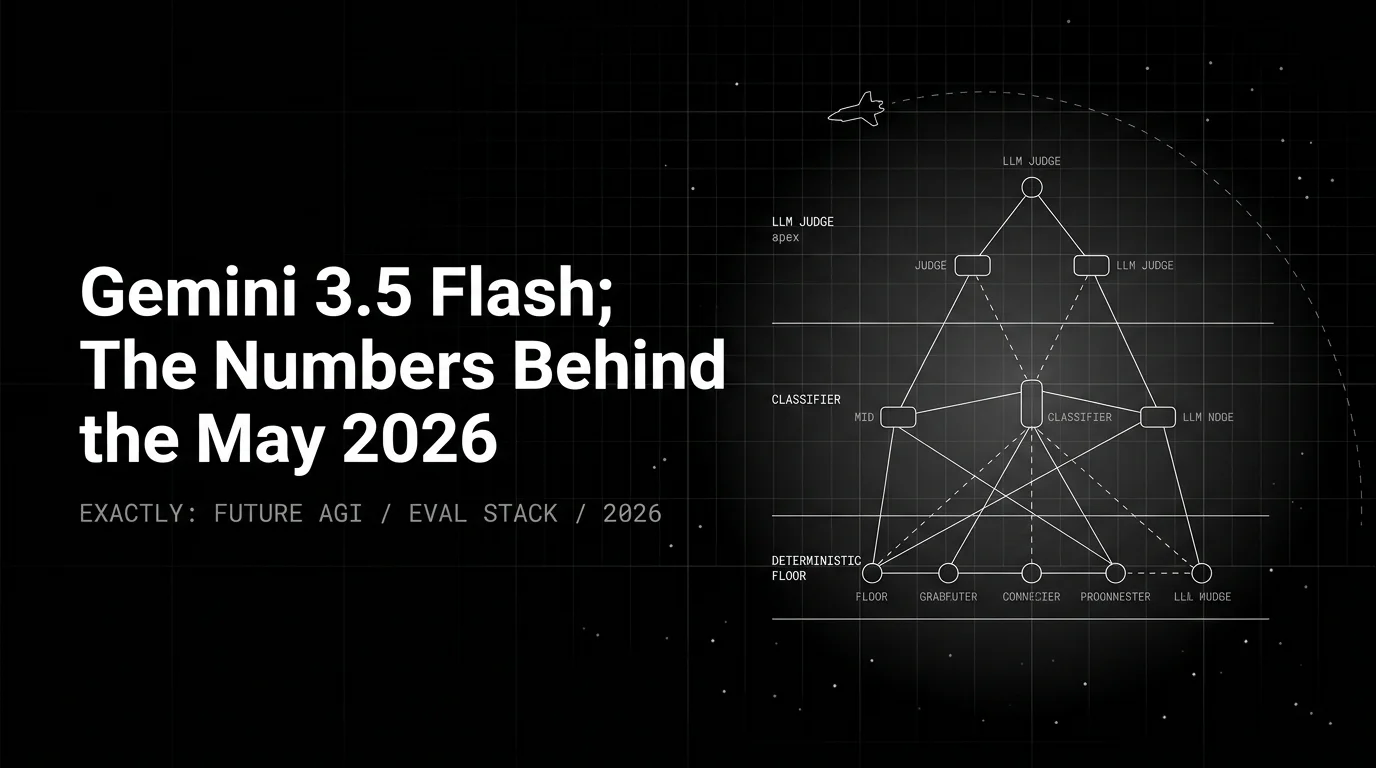
Gemini 3.5 Flash dropped today at Google I/O 2026. The 8 benchmark numbers that matter, $1.50/$9 pricing breakdown, and what to instrument before you swap.

MCP became the de facto AI tool-use standard in 2025-2026: Anthropic, OpenAI, and Google all adopted it. Architecture, SDKs, security, gateway options.

Instrument AI agents with TraceAI in 2026: OpenTelemetry-native Apache 2.0 spans, 20+ framework instrumentors, FITracer decorators, and 5-minute setup.